
U.S. Strike on Iran’s Top General: Trading the Stocks-Down, Oil-Up Shock
The U.S. strike on Iran’s top general in January 2020 created one of the clearest examples of a stocks-down, oil-up shock trade in modern markets. Within hours, global equities sold off while crude oil surged—an immediate repricing of geopolitical risk. For traders, this event offers a repeatable framework for navigating future crises.
Today, with tools like SimianX AI, traders can analyze these events in real time—combining macro signals, sentiment, and technical indicators to capture fast-moving geopolitical trades with higher precision.
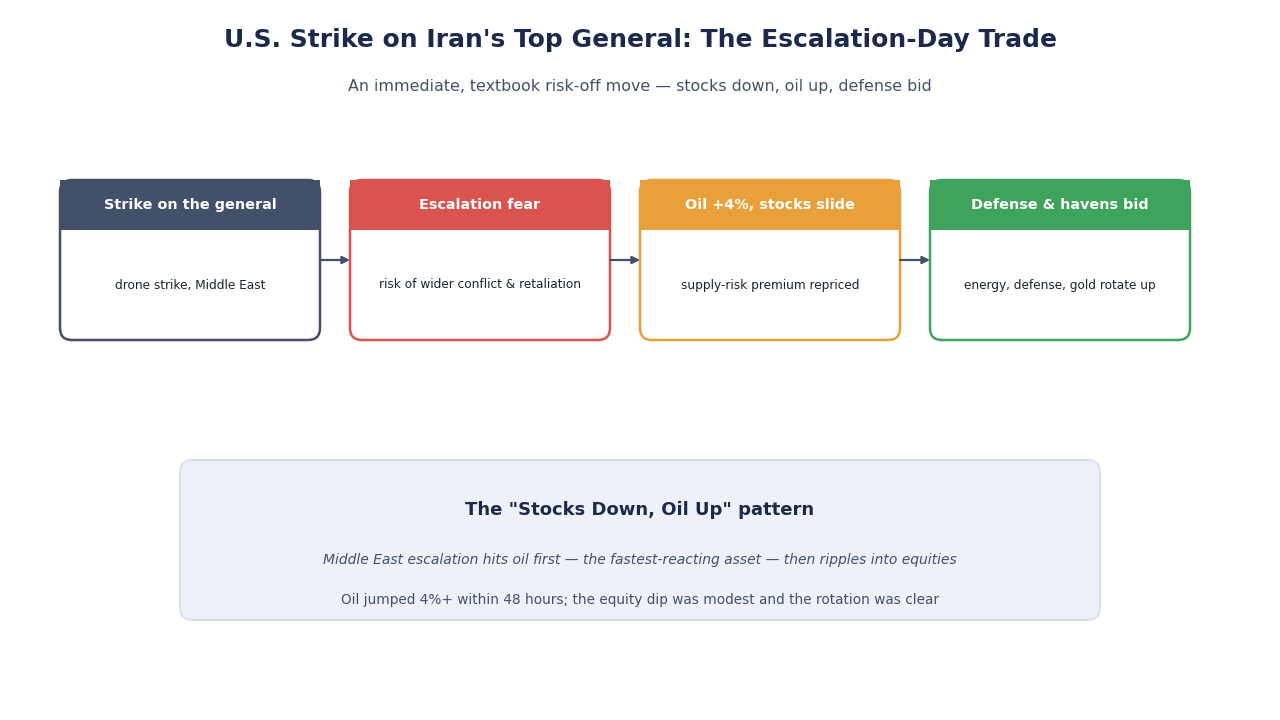
The Immediate Market Reaction: Stocks Fall, Oil Surges
When the U.S. conducted a drone strike that killed General Qassem Soleimani, markets reacted instantly:
- U.S. stocks dropped from record highs
- Oil prices surged over 4% within hours
- Investors rotated into safe-haven assets like gold and bonds
This reaction is not random—it reflects a deeply ingrained market structure.
“Geopolitical shocks tend to trigger immediate risk-off behavior, pushing equities lower while energy prices spike due to supply fears.”
Why Oil Rises First
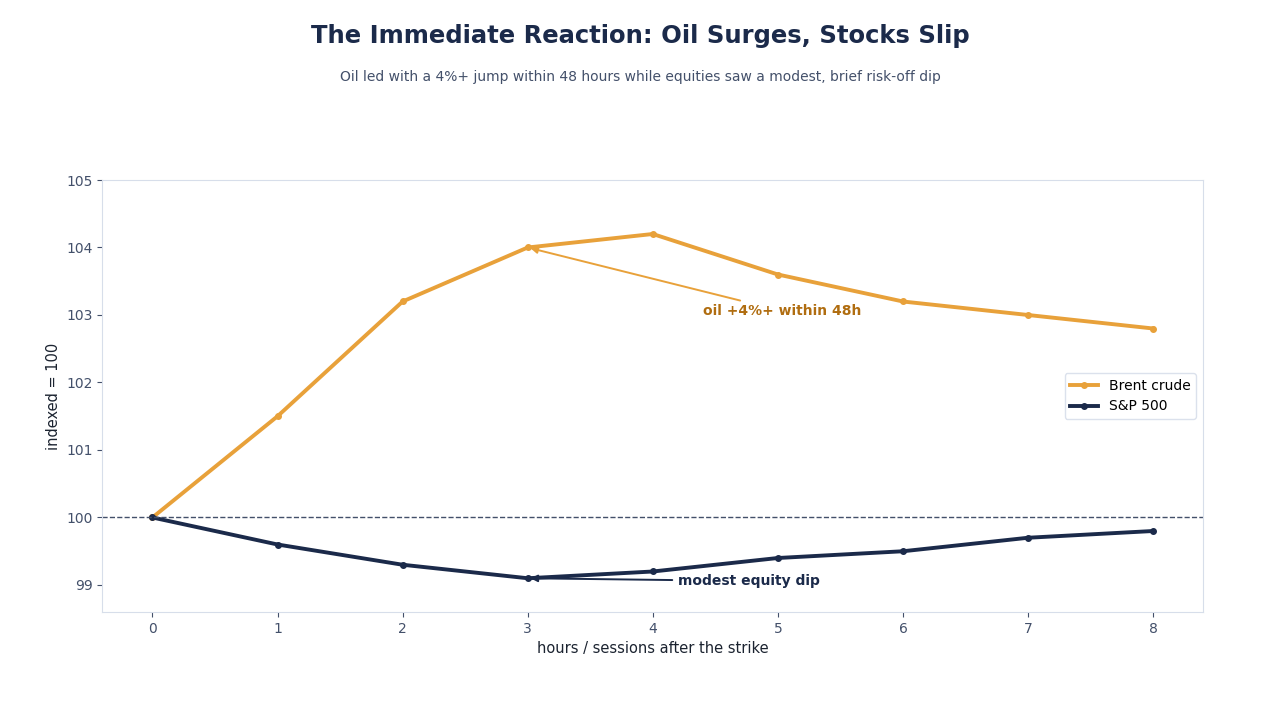
Oil markets are the fastest-reacting asset class during geopolitical crises, especially in the Middle East:
- Fear of supply disruptions (Strait of Hormuz risk)
- Potential attacks on oil infrastructure
- Strategic inventory uncertainty
Historically:
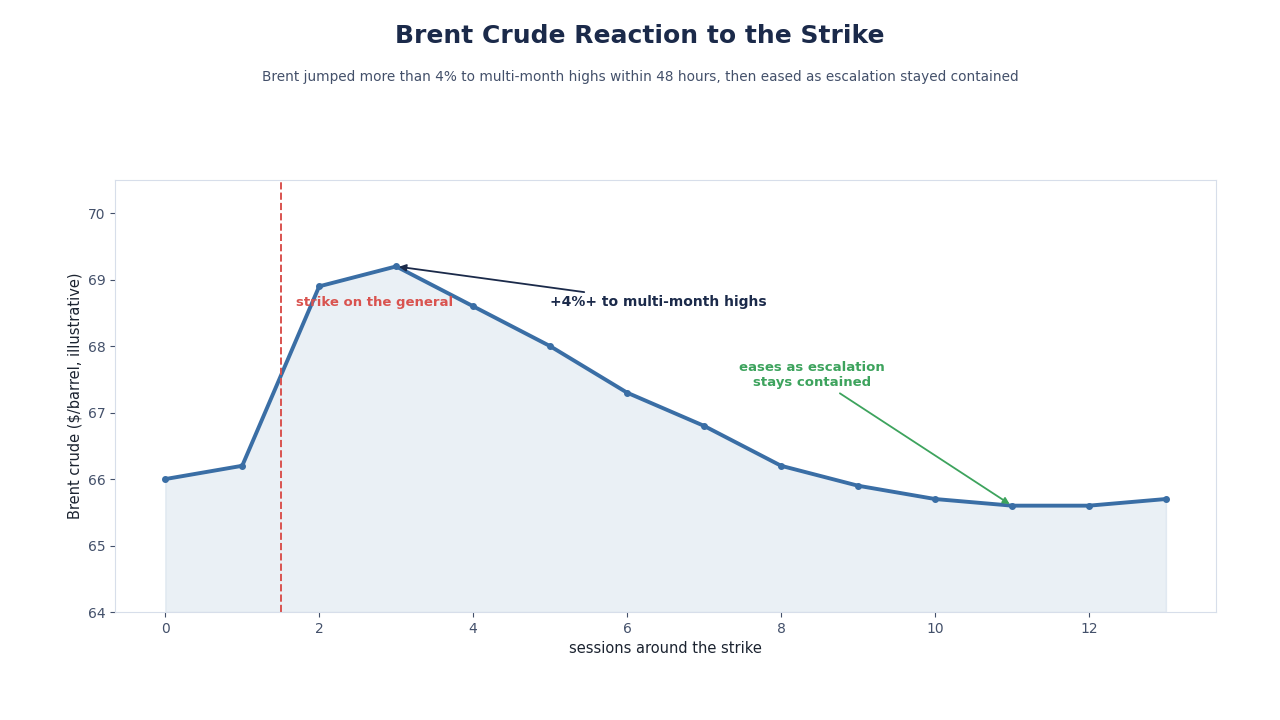
- Oil jumped 4%+ within 48 hours after the Soleimani strike
- Brent crude reached multi-month highs
Why Stocks Drop
Equities respond differently:
- Increased uncertainty → lower risk appetite
- Higher oil → inflation pressure + margin compression
- Global trade disruption fears
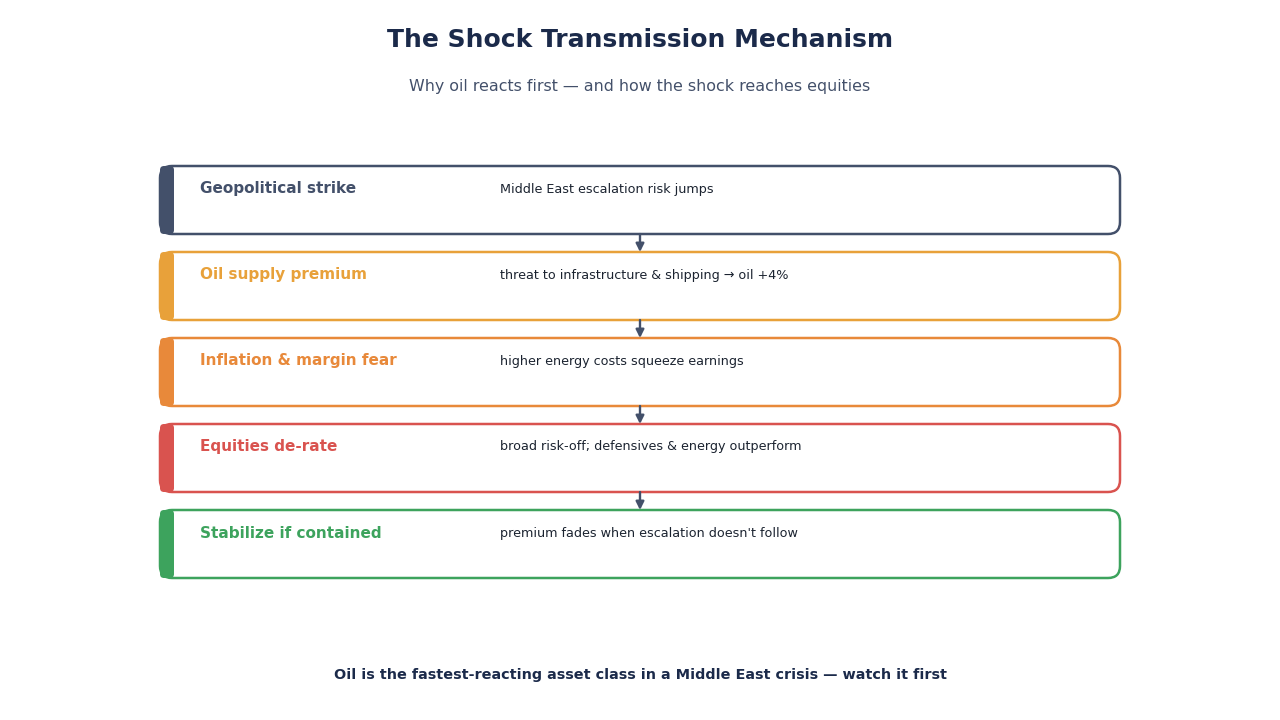
The Shock Transmission Mechanism
Understanding how the shock propagates is critical for trading.
| Phase | Market Reaction | Explanation |
|---|---|---|
| Immediate (0–24h) | Oil ↑, Stocks ↓ | Risk repricing |
| Short-term (1–3 days) | Volatility spikes | News + retaliation risk |
| Medium-term (3–10 days) | Stabilization | Clarity emerges |
| Long-term | Recovery | Macro dominates |
Interestingly, markets often recover quickly:
- Stocks typically stabilize within 72 hours if no escalation occurs
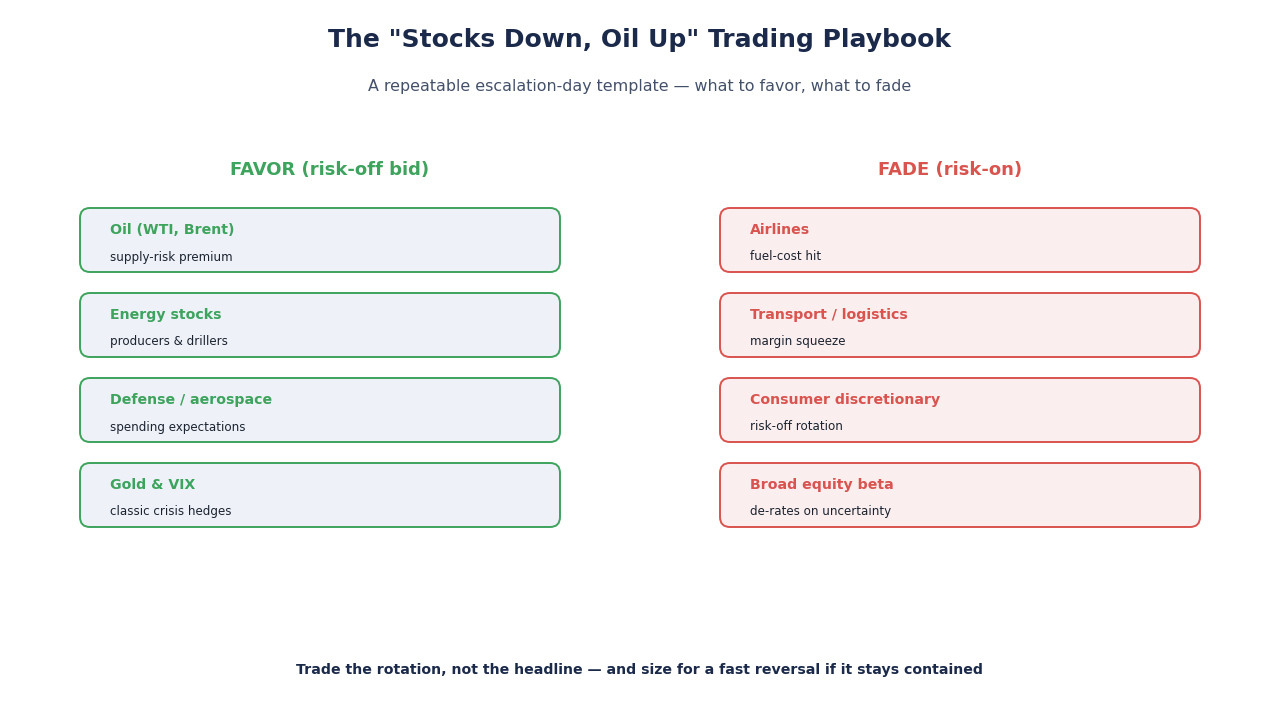
Trading the “Stocks Down, Oil Up” Playbook
This pattern is not a one-off—it’s a repeatable trading framework.
Core Strategy
Trade Setup:
- Short equities (index futures, ETFs)
- Long oil (WTI, Brent, energy stocks)
Execution Timing:
- Enter within minutes to hours of the event
- Exit before narrative shifts (usually 2–5 days)
Key Indicators to Watch
- Oil futures (
CL,Brent) - S&P 500 futures (
ES) - VIX (volatility index)
- Treasury yields (risk-off signal)
High-conviction signals:
- Oil breakout + equity futures gap down
- Headlines confirming escalation
Risk Management Rules
- Avoid over-leverage (headline risk is extreme)
- Use tight stop-losses
- Monitor political developments continuously
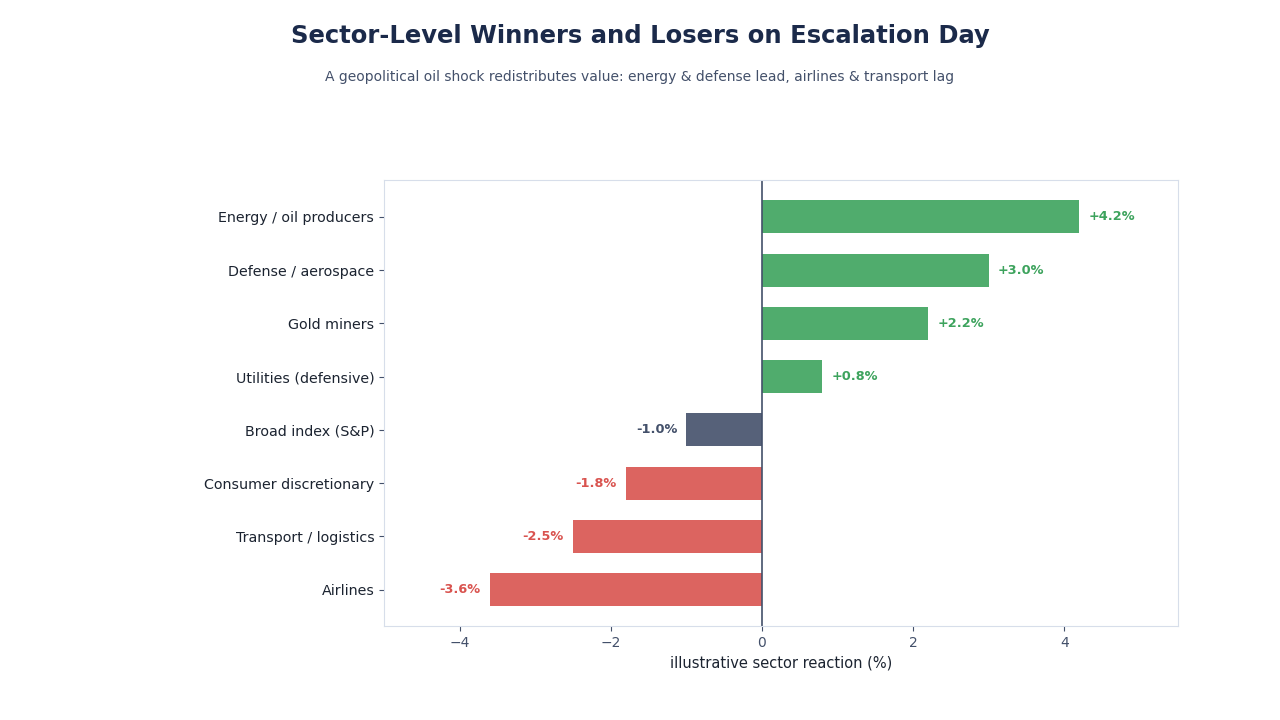
Sector-Level Winners and Losers
Different sectors react differently to geopolitical shocks:
Winners
- Energy stocks (oil producers, drillers)
- Defense contractors
- Commodities (gold, oil)
Losers
- Airlines (fuel cost sensitivity)
- Consumer discretionary
- Global trade-dependent sectors
| Sector | Impact | Reason |
|---|---|---|
| Energy | Positive | Higher oil prices |
| Tech | Neutral/Mild Negative | Risk sentiment |
| Airlines | Negative | Fuel cost spike |
| Defense | Positive | Increased spending |
How AI Changes Geopolitical Trading
Traditional traders rely on news feeds. But modern markets move too fast.
This is where SimianX AI becomes critical.
What SimianX AI Does Differently
- Integrates real-time news + sentiment + technicals
- Uses multi-agent decision models
- Generates actionable trade signals
Instead of guessing, traders can:
- Identify early signals of escalation
- Track multi-timeframe reactions (1m → 1d)
- Measure risk vs reward dynamically
“In geopolitical trading, speed and signal clarity matter more than prediction accuracy.”
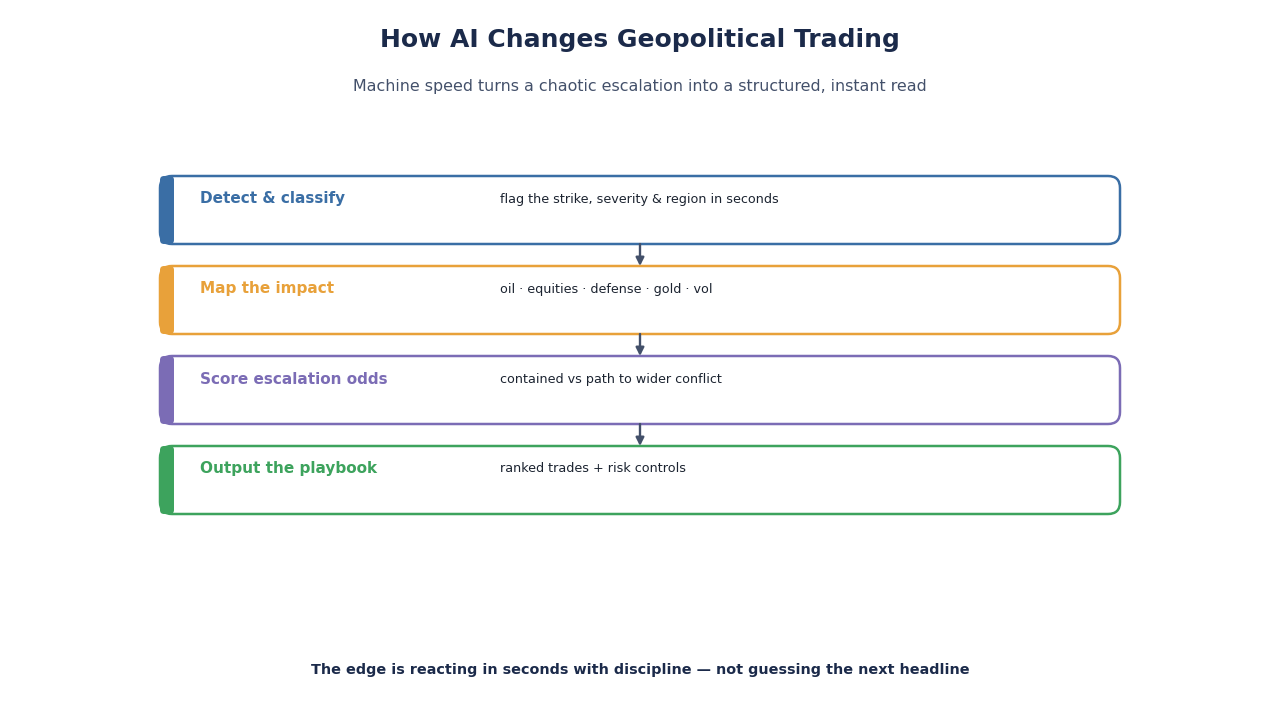
Example Workflow with SimianX
- Detect breaking geopolitical event
- Analyze sentiment + macro triggers
- Confirm with technical indicators (EMA, RSI, MACD)
- Execute structured trade
- Monitor AI-updated risk signals
Case Study: Why the Pattern Repeats
The Soleimani strike is not unique. Similar patterns occurred in:
- Saudi Aramco attack (2019) → oil +15% spike
- Iran missile retaliation (2020) → stocks drop, oil surge
- Recent Iran tensions (2026) → oil spikes on supply risk
Markets are predictable under stress because they follow:
- Liquidity flows
- Risk-off behavior
- Supply-demand shocks
How to Trade Geopolitical Risk in 2026 and Beyond
Modern markets require a more advanced approach.
Updated Framework
- Combine macro + AI + execution speed
- Focus on short-duration trades
- Use multi-asset confirmation
Step-by-Step Approach
- Identify event severity (local vs global impact)
- Track oil reaction first
- Confirm equity weakness
- Execute correlated trade
- Exit before narrative reversal
How to Use SimianX for Geopolitical Shock Trading
SimianX is designed exactly for these scenarios.
Practical Use Cases
- Real-time oil breakout detection
- AI-generated risk scoring
- Multi-agent analysis:
- Indicator agent (technical signals)
- Intelligence agent (news sentiment)
- Decision agent (final trade output)
Why It Matters
Without structured tools:
- Traders react late
- Miss optimal entries
- Overstay trades
With SimianX:
- Decisions become systematic, not emotional
- Signals are repeatable and measurable
FAQ About U.S. Strike Iran Market Impact
What happens to stocks after a U.S. strike on Iran?
Stocks typically decline immediately due to increased geopolitical risk and uncertainty. However, they often recover within days if escalation is limited.
Why does oil go up during geopolitical conflict?
Oil prices rise due to fears of supply disruption, especially in regions like the Middle East that control key global energy routes.
How to trade stocks-down oil-up scenarios?
Traders usually short equities and go long oil or energy stocks, focusing on short-term moves within 1–5 days.
Is this pattern reliable?
Yes, but only in the short term. The pattern fades quickly as markets reassess actual economic impact.
Can AI improve geopolitical trading outcomes?
Absolutely. AI tools like SimianX help process real-time data, reducing reaction time and improving decision quality.
Conclusion
The U.S. strike on Iran’s top general demonstrated a classic and repeatable market dynamic: stocks fall, oil rises. Understanding this pattern gives traders a powerful edge—but execution speed and discipline are critical.
In today’s markets, manual analysis is no longer enough. Tools like SimianX AI enable traders to detect, analyze, and act on geopolitical shocks in real time, turning uncertainty into opportunity.
If you want to trade the next geopolitical event with precision, leverage AI-driven decision systems—and start with SimianX AI.
Deep Dive: Liquidity, Positioning, and the Second-Order Effects
While the immediate stocks-down, oil-up shock trade is well understood, the deeper edge lies in analyzing second-order effects—how liquidity, positioning, and cross-asset flows evolve after the initial shock.
Liquidity Vacuum and Forced Repricing
In the first 24 hours after the U.S. strike on Iran’s top general, markets didn’t just react—they repositioned aggressively:
- Market makers widened spreads
- Liquidity thinned in index futures
- Options markets repriced volatility sharply
This creates what traders call a “liquidity vacuum”, where:
- Small orders move markets disproportionately
- Stop-loss cascades amplify volatility
- Algorithms dominate short-term price discovery
“In geopolitical shocks, price moves are often driven less by fundamentals and more by liquidity imbalances.”
Positioning Matters More Than News
The magnitude of the move depends heavily on pre-event positioning:
- If markets are overbought, downside accelerates
- If oil is already bid, upside may be limited
- If volatility is low, spikes are more violent
Key insight:
- The same event can produce different outcomes depending on positioning.
| Pre-Condition | Expected Reaction |
|---|---|
| Low volatility | Sharp spike |
| High leverage | Forced liquidation |
| Risk-on sentiment | Strong reversal potential |
Options Market Dynamics: The Hidden Layer
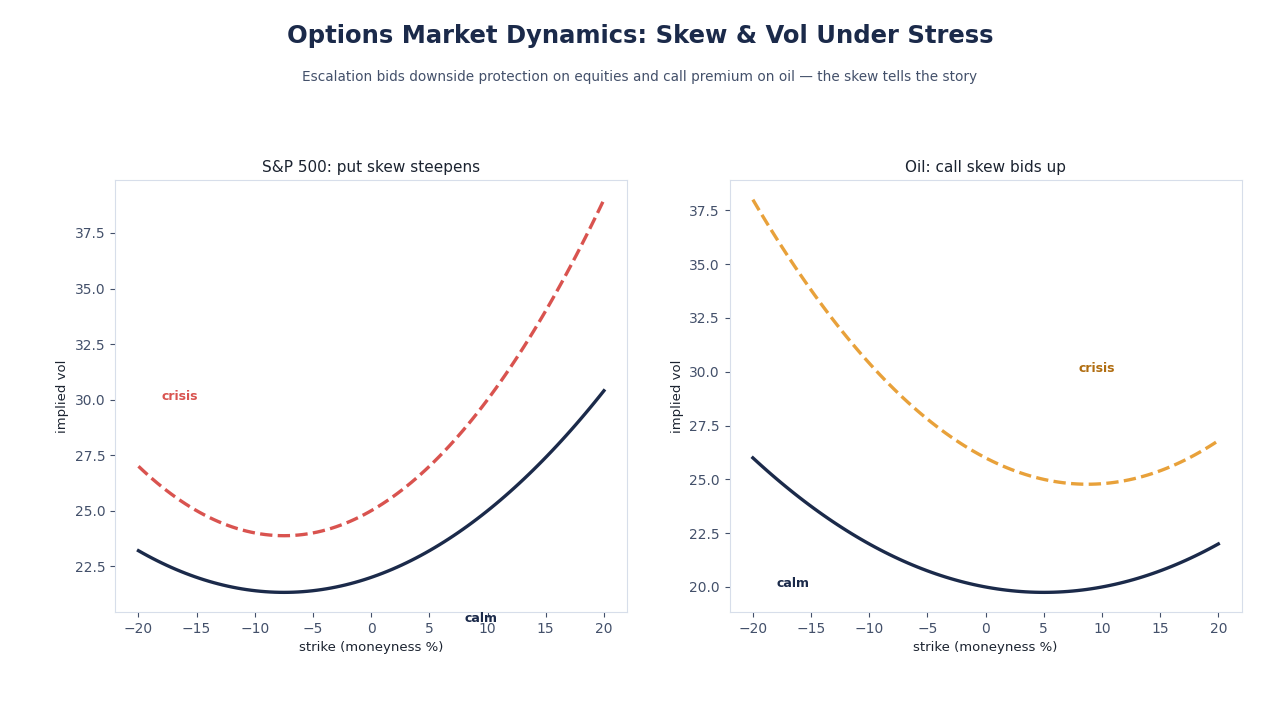
Options markets provide a powerful lens into geopolitical trading.
Volatility Explosion
Following the strike:
- VIX surged rapidly
- Put options became significantly more expensive
- Implied volatility expanded across maturities
This creates opportunities:
- Short-term volatility trades
- Gamma scalping strategies
- Event-driven options positioning
Skew and Tail Risk Pricing
During crises:
- Downside protection (puts) becomes extremely expensive
- Call skew in oil increases (expectation of spikes)
Advanced traders monitor:
- Put/Call ratios
- Skew steepness
- Implied vs realized volatility divergence
Practical Strategy
- Buy oil call options early in the event
- Hedge with equity puts
- Exit as volatility peaks
Cross-Asset Correlations Under Stress
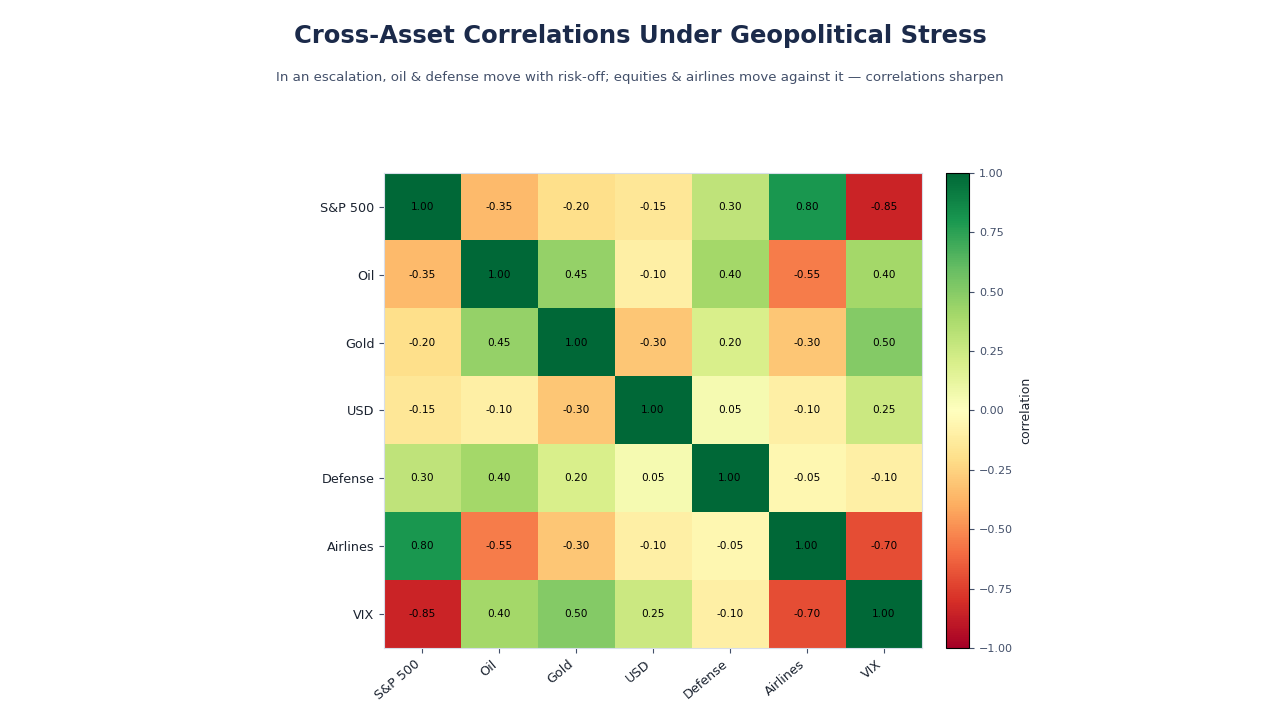
One of the most important dynamics is how correlations change.
Normal vs Crisis Correlations
| Asset Pair | Normal | Crisis |
|---|---|---|
| Stocks vs Oil | Mixed | Strong negative |
| Stocks vs Gold | Weak | Strong negative |
| Oil vs Gold | Weak | Strong positive |
Why This Matters
- Diversification breaks down
- Correlations converge toward risk-off patterns
- Portfolio hedging becomes less effective
“In crisis regimes, everything trades off one factor: risk.”
Algorithmic Trading and Reaction Speed
Modern markets are dominated by algorithms.
The Role of High-Frequency Trading
- News-based algorithms react within milliseconds
- Order flow imbalances are detected instantly
- Price discovery is accelerated
This creates challenges:
- Human traders are always late
- Entry timing becomes critical
- Noise increases significantly
How SimianX AI Changes This
With SimianX AI, traders can:
- Detect signals across multiple timeframes instantly
- Aggregate news + technicals + sentiment
- Execute structured decision-making
Instead of reacting late, traders can:
- Align with the first wave of institutional flow
- Avoid false signals
- Optimize entry timing
Behavioral Finance: Fear, Overreaction, and Recovery
Markets are not purely rational.
The Fear Cycle
- Shock → Panic selling
- Media amplification
- Retail overreaction
- Institutional stabilization
Overreaction Patterns
- Initial moves often overshoot fair value
- Reversal trades become highly profitable
- Mean reversion is common
Example:
- Stocks drop sharply on day 1
- Stabilize within 2–3 days
- Recover within 1–2 weeks
Trading Insight
- First move = momentum trade
- Second move = mean reversion trade
Energy Market Microstructure
Oil markets behave differently from equities.
Futures Curve Dynamics
During geopolitical shocks:
- Front-month contracts spike
- Backwardation increases
- Inventory expectations shift
Key Drivers
- Physical supply risk
- Shipping routes
- Strategic reserves
Trade Implications
- Short-term trades focus on front-month futures
- Longer-term trades depend on macro outlook
Scenario Analysis: What If Escalation Happens?
Not all shocks are equal.
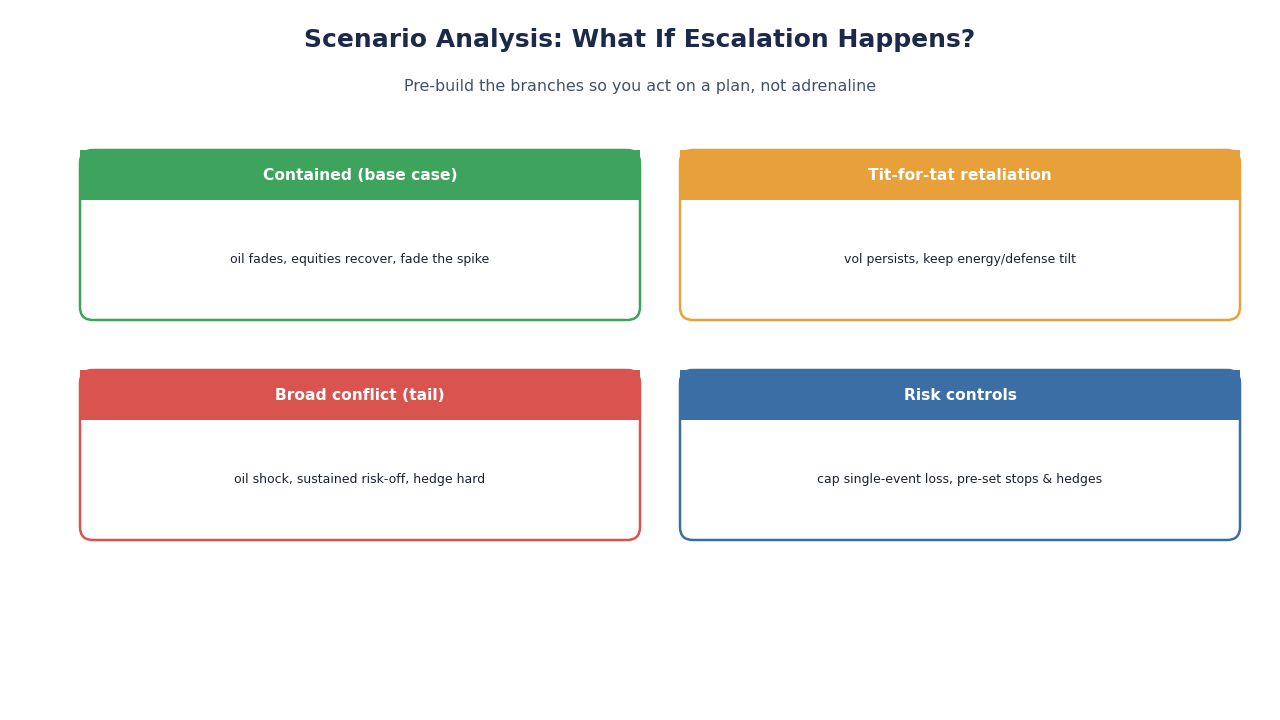
Scenario 1: Limited Conflict
- Oil spikes temporarily
- Stocks recover quickly
- Volatility fades
Scenario 2: Regional Escalation
- Sustained oil rally
- Prolonged equity weakness
- Increased defense spending
Scenario 3: Global Conflict
- Severe equity drawdowns
- Commodities surge broadly
- Structural market shifts
| Scenario | Oil | Stocks | Volatility |
|---|---|---|---|
| Limited | ↑ short-term | ↓ then recover | Spike then fade |
| Regional | ↑ sustained | ↓ prolonged | Elevated |
| Global | ↑↑ | ↓↓↓ | Extreme |
Building a Repeatable Trading Framework
To consistently trade geopolitical events, you need a structured system.
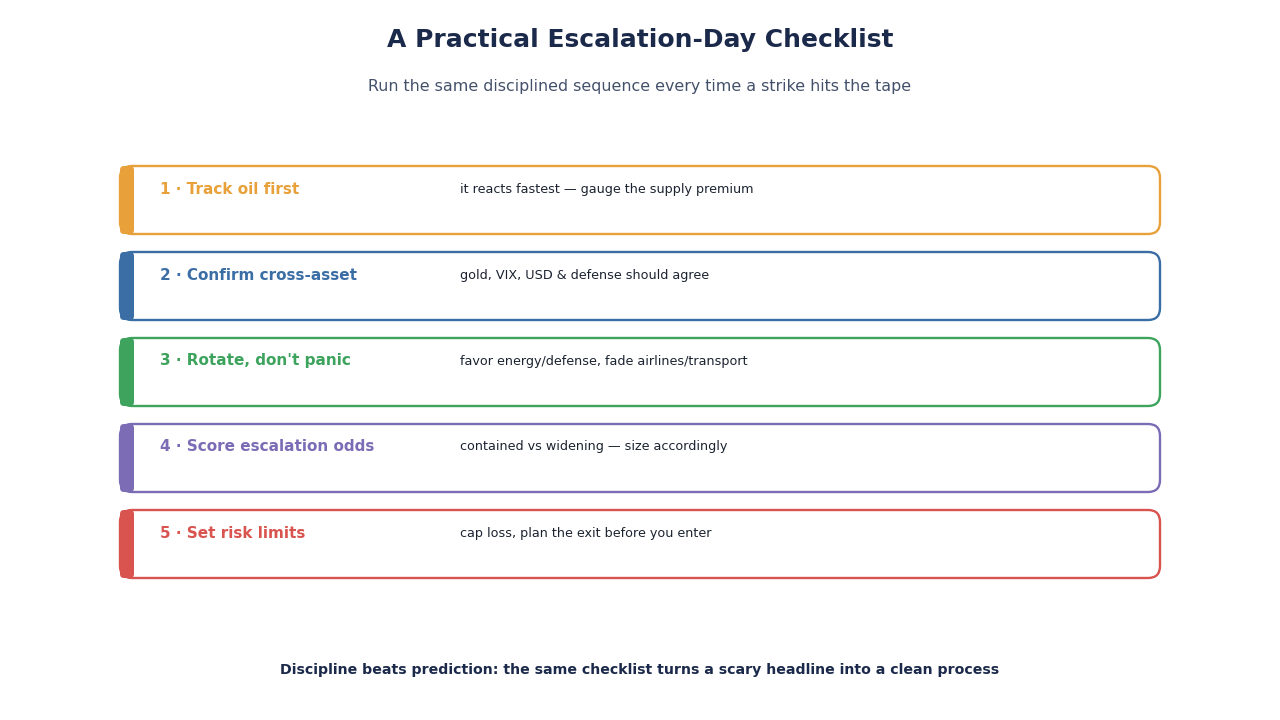
The 5-Step Framework
- Event Detection
- Severity Assessment
- Cross-Asset Confirmation
- Execution
- Exit Strategy
Key Principles
- Speed over perfection
- Structure over emotion
- Discipline over prediction
Integrating SimianX AI Into the Workflow
Multi-Agent Advantage
SimianX uses multiple AI agents:
- Indicator agent → technical signals
- Intelligence agent → news & sentiment
- Fundamentals agent → macro context
- Decision agent → final trade output
Customization
Traders can:
- Choose different models per agent
- Adjust refresh frequency
- Optimize for different timeframes
Real-Time Decision Support
- 1-minute signals → ultra-short trades
- 15-minute signals → intraday positioning
- Daily signals → macro trend alignment
Advanced Strategy: Multi-Timeframe Alignment
Why It Matters
Most traders lose because they:
- Trade against higher timeframe trends
- Ignore macro context
Alignment Strategy
- Use 1m for entry
- Use 15m for confirmation
- Use 1d for direction
Example:
- Daily trend bullish oil
- 15m breakout confirmed
- 1m entry optimized
Risk Management Under Extreme Volatility
Core Rules
- Reduce position size
- Increase stop discipline
- Avoid overnight exposure
Tail Risk Protection
- Use options for hedging
- Diversify across assets
- Avoid concentration
Psychological Discipline
- Stick to predefined rules
- Avoid emotional decisions
- Focus on process
Lessons From Historical Geopolitical Events
The Soleimani strike fits a broader pattern.
Key Takeaways Across Events
- Initial reaction is predictable
- Long-term impact is often limited
- Markets adapt quickly
Common Mistakes
- Chasing late entries
- Ignoring reversal signals
- Overestimating long-term impact
Future Outlook: AI-Driven Geopolitical Trading
Markets are evolving.
What’s Changing
- Faster information flow
- Increased algorithmic dominance
- Higher volatility clustering
The Role of AI
AI systems like SimianX:
- Process massive data in real time
- Identify patterns faster than humans
- Provide structured decision frameworks
“The future of trading is not prediction—it’s intelligent reaction.”
Practical Checklist for Traders
Before the Event
- Monitor geopolitical hotspots
- Track oil market positioning
- Analyze volatility levels
During the Event
- Confirm oil spike
- Confirm equity drop
- Execute quickly
After the Event
- Monitor stabilization signals
- Identify reversal opportunities
- Exit systematically
Final Strategic Insight
The stocks-down, oil-up shock trade is one of the most reliable patterns in global markets—but only for those who understand:
- Timing
- Structure
- Execution
With SimianX AI, traders gain a critical edge:
- Faster signal detection
- Multi-dimensional analysis
- Disciplined execution
Extended FAQ: Advanced Geopolitical Trading
How long do geopolitical trades usually last?
Most high-impact trades last between 1 to 5 days, depending on escalation risk and market clarity.
What is the best asset to trade during geopolitical shocks?
Oil is typically the fastest and most responsive asset, followed by gold and volatility instruments.
Can stocks recover quickly after shocks?
Yes, if escalation is limited, stocks often recover within days due to underlying economic stability.
How do institutions trade these events?
They rely on cross-asset strategies, options hedging, and algorithmic execution.
Is manual trading still viable?
Yes, but only with structured systems. AI tools like SimianX significantly improve consistency and timing.
Final Conclusion
The U.S. strike on Iran’s top general revealed a powerful and repeatable market dynamic: geopolitical shocks create immediate, tradable dislocations.
However, success in these trades requires:
- Speed
- Discipline
- Multi-asset awareness
In today’s markets, leveraging AI is no longer optional—it’s essential.
Explore how SimianX AI can help you transform geopolitical uncertainty into structured, high-probability trading opportunities.
Related Reading
- Iran-US War Impact on Stocks: AI Risk Signals Live
- 2019 Saudi Aramco Drone Strike: Oil +20%, Stocks -5%
- Syria Airstrike 2017: S&P 500 -1.2%, Same-Week Recovery
- 1991 Gulf War Countdown: Oil Doubles, Pre-Storm Stock Setup
- Russia-Ukraine War Stock Impact: Sectors, VIX, Risk Plan
- 7 AI Risk Radars for Equities: Breadth, Revisions, Skew