
Syria Airstrike 2017 Market Dip and Recovery Analysis
The Syria airstrike 2017 market dip provides a powerful case study in how financial markets react to sudden geopolitical shocks—and more importantly, how quickly they recover. On April 7, 2017, the United States launched missile strikes on a Syrian airbase, triggering immediate uncertainty across global markets. Yet, within days, markets stabilized and resumed their upward trajectory.
In today’s AI-driven trading landscape, platforms like SimianX AI help traders interpret such events in real time—turning panic into opportunity through data-driven insights and multi-agent analysis.
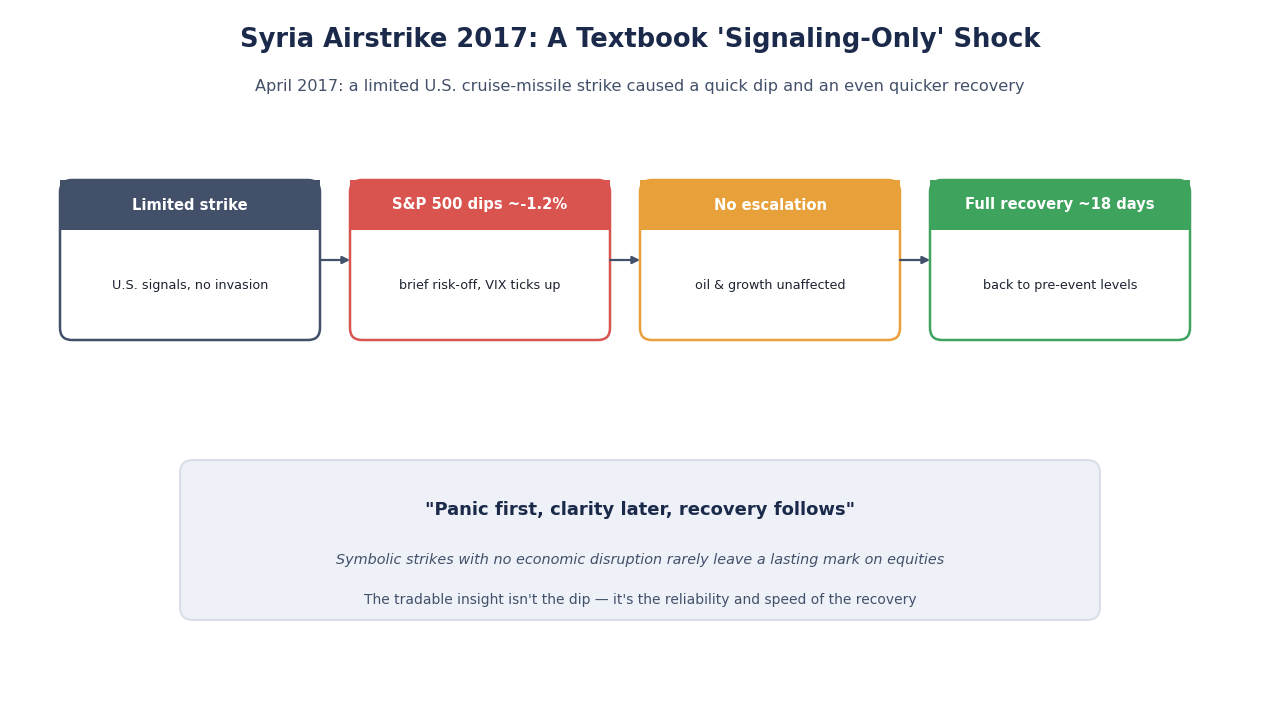
Understanding the 2017 Syria Airstrike Event
The airstrike, ordered under the administration of President Donald Trump, targeted the Shayrat Airbase in response to a chemical weapons attack. Financial markets reacted almost instantly:
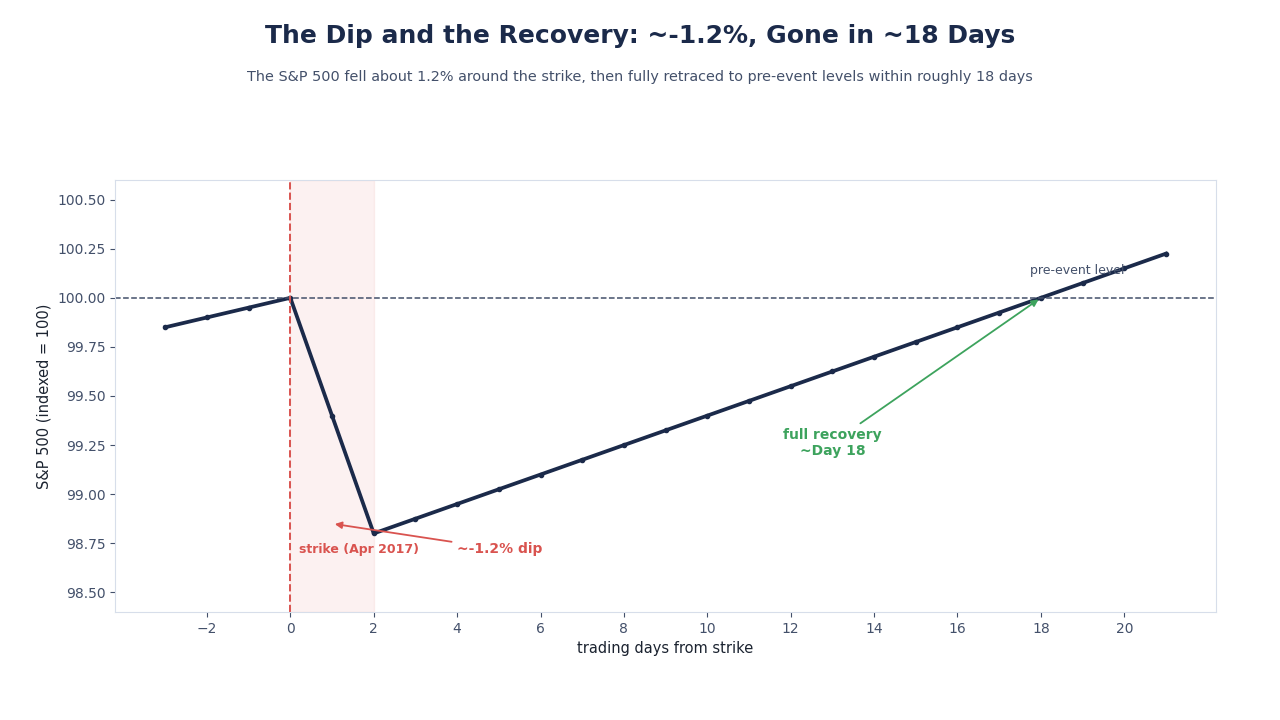
- S&P 500 dipped approximately -1.2%
- Volatility (VIX) spiked briefly
- Safe-haven assets like gold and U.S. Treasuries rallied
However, the key takeaway was not the dip—but the speed of recovery.
Markets often react faster to uncertainty than to resolution.
Key characteristics of the event:
- Sudden geopolitical escalation
- Limited scope military action
- No prolonged conflict escalation
- Rapid information clarity
Immediate Market Reactions
| Asset Class | Reaction |
|---|---|
| Equities | Short-term dip |
| Gold | Sharp rise |
| Oil | Mild increase |
| Bonds | Yield drop (flight to safety) |
- Traders moved capital into safe havens
- Algorithmic trading amplified volatility
- News sentiment drove short-term panic
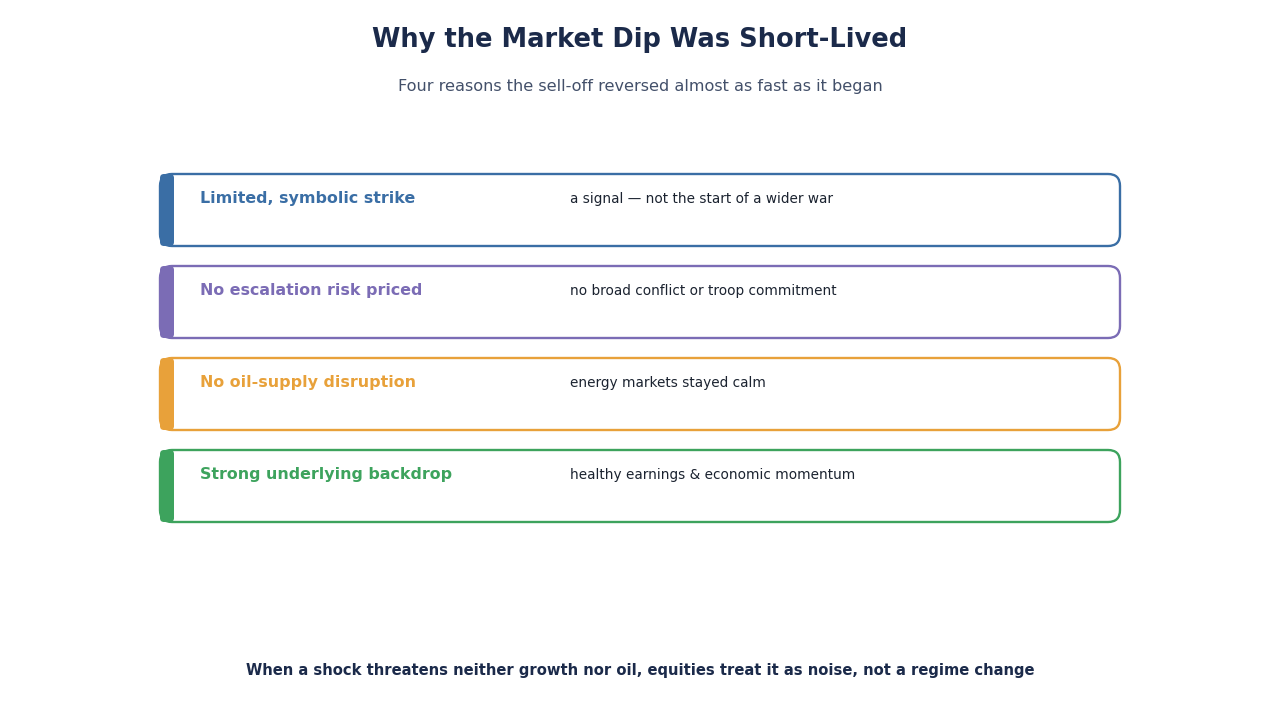
Why the Market Dip Was Short-Lived
One of the most important insights from the Syria airstrike 2017 market dip is that markets price in uncertainty quickly—but also resolve it quickly.
Key Reasons for Fast Recovery
- Contained conflict: No escalation into a broader war
- Clear signaling: The strike was a one-off response
- Strong macro backdrop: Global growth remained stable
- Liquidity conditions: Central bank policies supported risk assets
The faster uncertainty resolves, the faster markets rebound.
Recovery timeline:
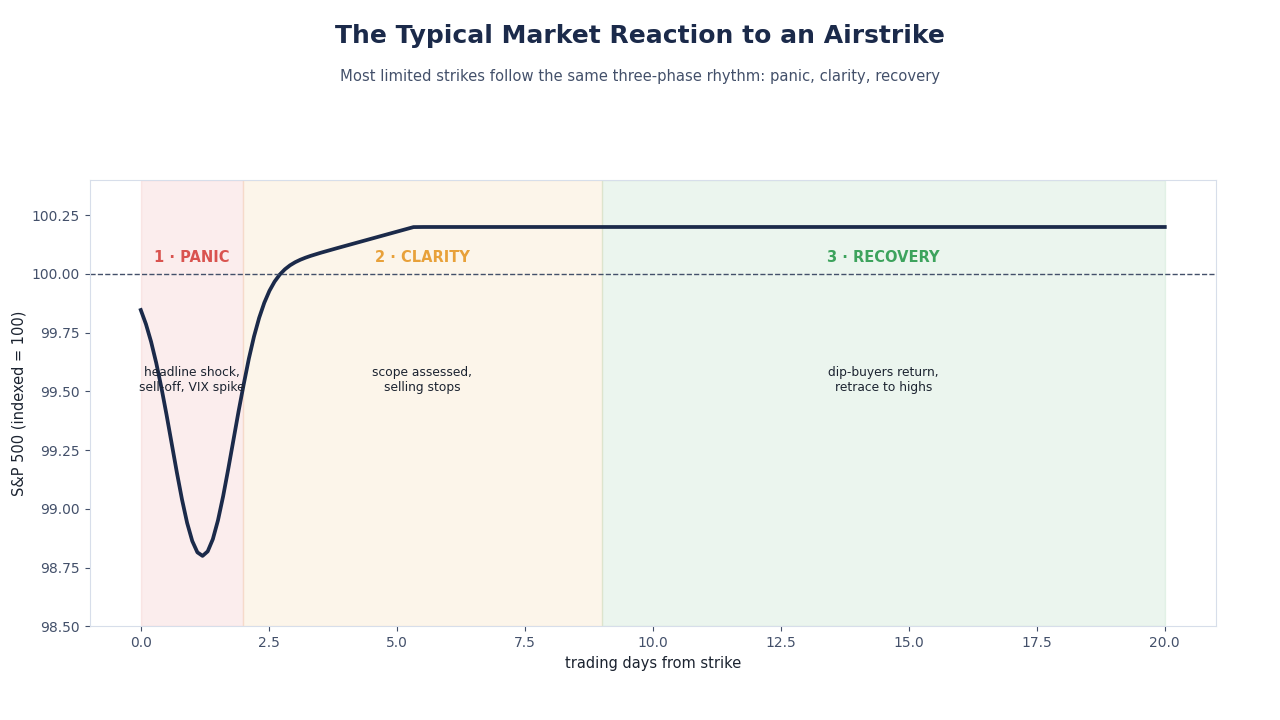
- Day 1–3: Panic selling and volatility spike
- Day 4–7: Stabilization phase
- Day 7–18: Full recovery to pre-event levels
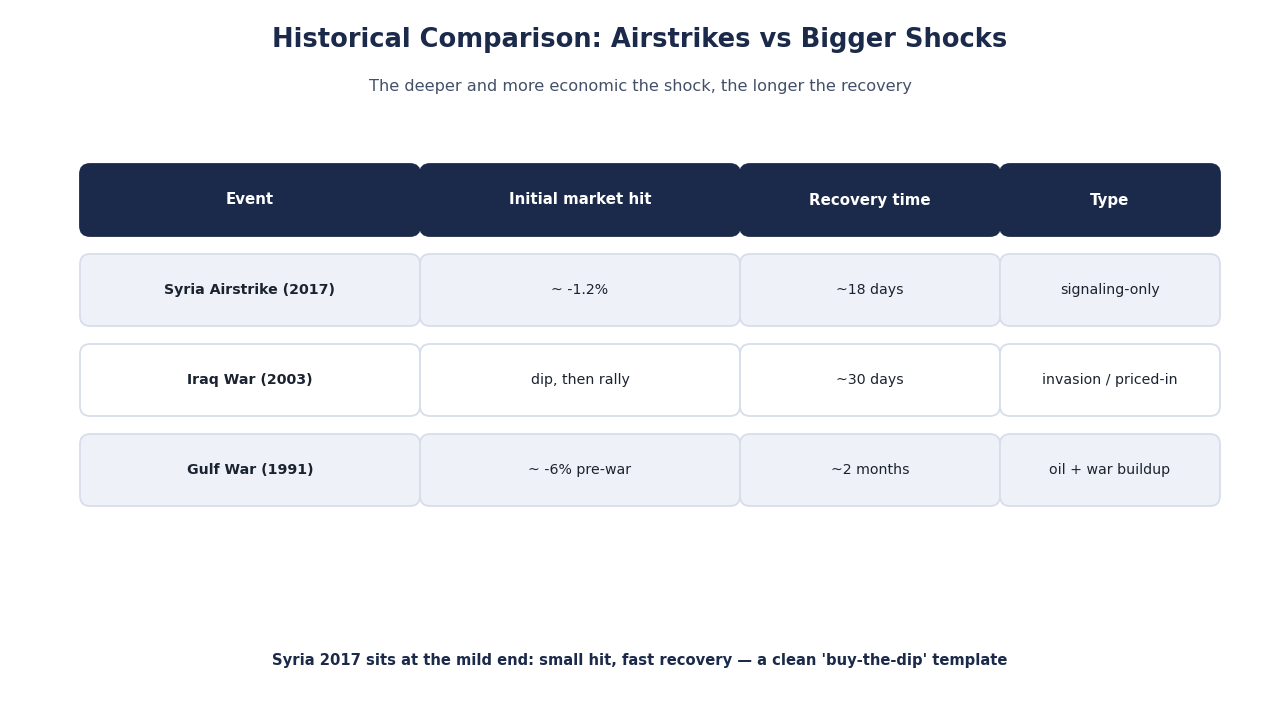
Historical Comparison
| Event | Max Drawdown | Recovery Time |
|---|---|---|
| Syria Airstrike (2017) | -1.2% | ~18 days |
| Iraq War (2003) | Initial dip then rally | ~30 days |
| Gulf War (1991) | -6% pre-war | ~2 months |
How Traders Can Interpret Geopolitical Shocks
The Syria case highlights a recurring pattern:
“Panic first, clarity later, recovery follows.”
Modern traders must differentiate between:
- Systemic risk events (long-term impact)
- Transient shocks (short-term volatility)
Key Trading Framework
- Assess scope of conflict
- Analyze market sentiment vs fundamentals
- Monitor volatility indicators (VIX, spreads)
- Identify overreaction zones
Indicators to watch:
- RSI oversold signals
- Volume spikes
- Safe-haven inflows
- News sentiment polarity
Not all geopolitical events justify long-term bearish positioning.
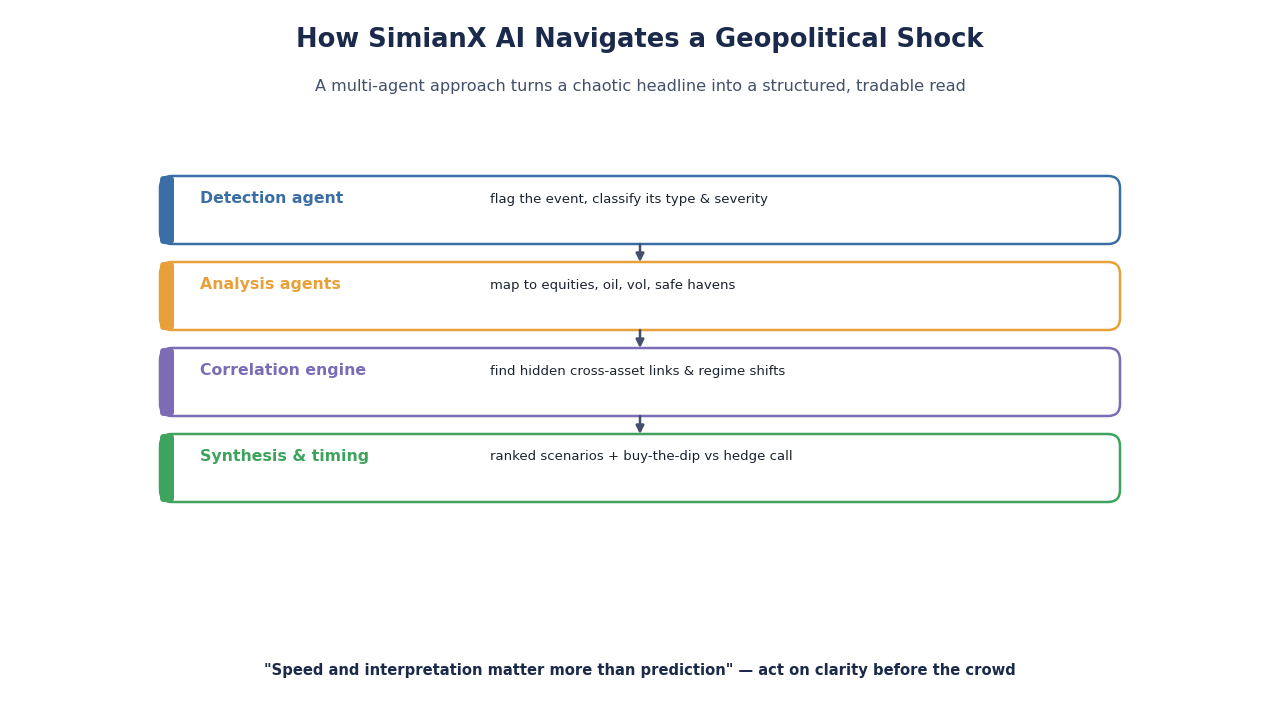
How SimianX AI Helps Navigate Market Shocks
In fast-moving geopolitical scenarios, manual analysis is often too slow. This is where SimianX AI becomes critical.
Multi-Agent Intelligence Approach
SimianX AI integrates multiple AI agents:
- Market Intelligence Agent → Real-time news + sentiment analysis
- Indicator Agent → Technical signals across timeframes
- Decision Agent → Trade recommendations
- Fundamental Agent → Macro context evaluation
Practical Example: Syria Airstrike Simulation
Using SimianX AI, traders could have:
- Detected early volatility spikes
- Identified oversold entry points
- Avoided panic selling
- Positioned for recovery within days
| Feature | Benefit |
|---|---|
| Multi-timeframe analysis | Detect short-term vs long-term trends |
| AI sentiment parsing | Understand news impact instantly |
| Risk modeling | Adjust exposure dynamically |
| Backtesting engine | Validate geopolitical strategies |
What Is the Typical Market Reaction to Airstrikes?
How does the Syria airstrike 2017 market dip compare to other events?
Airstrikes typically produce short-term volatility spikes, but rarely trigger prolonged bear markets unless:
- They escalate into full-scale wars
- They disrupt global supply chains
- They create systemic financial risk
Typical Pattern
- Shock phase → Immediate sell-off
- Assessment phase → Market digests information
- Recovery phase → Prices normalize
Key insight:
Markets are forward-looking—they react to uncertainty, not just events.
Actionable Trading Strategies for Geopolitical Events
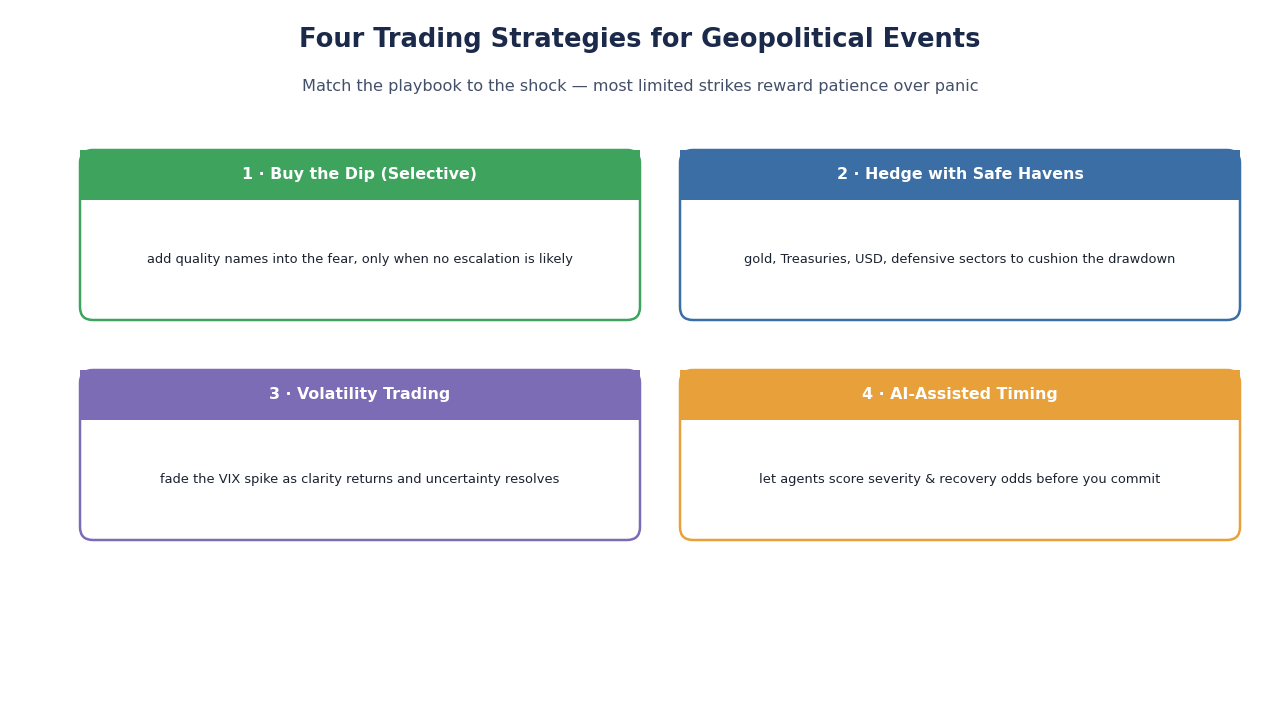
Strategy 1: Buy the Dip (Selective)
- Enter when RSI < 30
- Confirm with volume exhaustion
- Use tight stop-loss
Strategy 2: Hedge with Safe Havens
- Gold
- USD
- Treasury bonds
Strategy 3: Volatility Trading
- Use options strategies (straddles/strangles)
- Capture volatility expansion
Strategy 4: AI-Assisted Timing
Using SimianX AI, traders can:
- Track real-time signal alignment
- Combine technical + sentiment + macro
- Execute faster than discretionary traders
The Role of AI in Future Geopolitical Trading
The Syria airstrike was a relatively simple event compared to today’s complex geopolitical environment.
Future challenges include:
- Multi-region conflicts
- AI-generated misinformation
- Faster market reactions
This makes AI platforms like SimianX essential.
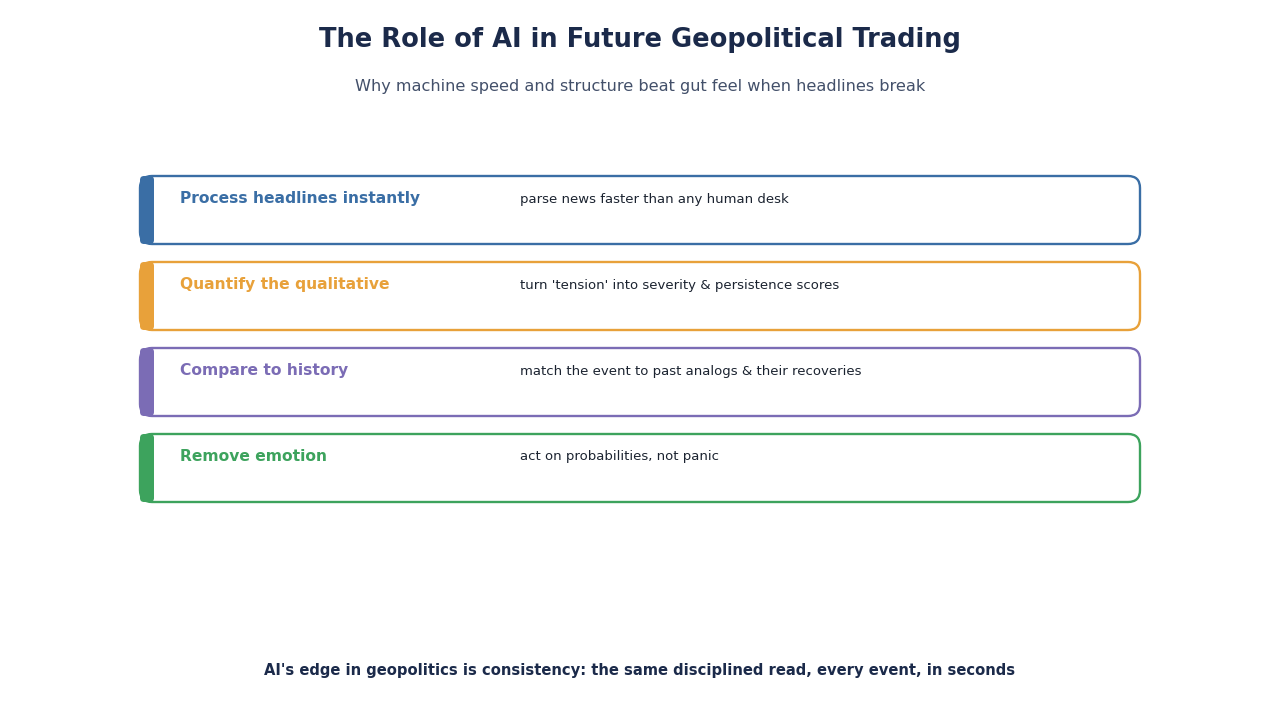
Why AI Matters
- Processes massive data instantly
- Removes emotional bias
- Identifies hidden correlations
- Adapts to changing volatility regimes
In modern markets, speed and interpretation matter more than information access.
FAQ About Syria Airstrike 2017 Market Dip
What happened to the stock market after the 2017 Syria airstrike?
The stock market experienced a short-term dip of about -1.2%, followed by a rapid recovery within approximately 18 days. The event caused temporary volatility but no long-term trend reversal.
How do geopolitical events affect stock markets?
Geopolitical events typically trigger uncertainty, leading to short-term sell-offs and increased volatility. However, markets often recover quickly if the event does not escalate into a broader crisis.
Is it good to trade during geopolitical crises?
Yes, but only with proper risk management. These events create volatility and opportunities, but require disciplined strategies and tools like AI-driven analysis.
How can AI help during market shocks?
AI platforms like SimianX AI analyze real-time data, sentiment, and technical indicators simultaneously, helping traders make faster and more informed decisions during volatile conditions.
Conclusion
The Syria airstrike 2017 market dip demonstrates a critical truth about financial markets: fear-driven sell-offs are often temporary, and recovery can be swift when uncertainty fades. Traders who understand this pattern can turn volatility into opportunity.
By leveraging tools like SimianX AI, investors can move beyond reactive trading and adopt a proactive, data-driven strategy—combining real-time intelligence, multi-agent analysis, and predictive modeling.
In a world where geopolitical shocks are inevitable, the advantage belongs to those who can interpret faster, act smarter, and adapt continuously. SimianX AI is designed to give you exactly that edge.
Content strategy aligned with SEO framework and structure guidelines
Related Reading
- 2019 Saudi Aramco Drone Strike: Oil +20%, Stocks -5%
- 1991 Gulf War Countdown: Oil Doubles, Pre-Storm Stock Setup
- Buy the Invasion Pattern: Iraq 2003 S&P 500 +15% Rally
- Iran-US War Impact on Stocks: AI Risk Signals Live
- Russia-Ukraine War Stock Impact: Sectors, VIX, Risk Plan
- 7 AI Risk Radars for Equities: Breadth, Revisions, Skew