
Tet Offensive 1968 Market Impact: -6.0% Drawdown, 25-Day Bottom, 46-Day Recovery
The Tet Offensive 1968 Market Impact remains one of the most instructive historical case studies for traders navigating geopolitical shocks. During this pivotal moment in the Vietnam War, U.S. equity markets experienced a sharp -6.0% drawdown, reached a bottom after 25 trading days, and fully recovered within 46 days.
For modern traders and investors, understanding this pattern is critical. Platforms like SimianX AI now make it possible to analyze such historical shocks in real time, helping traders respond with structured, data-driven strategies instead of emotional reactions.
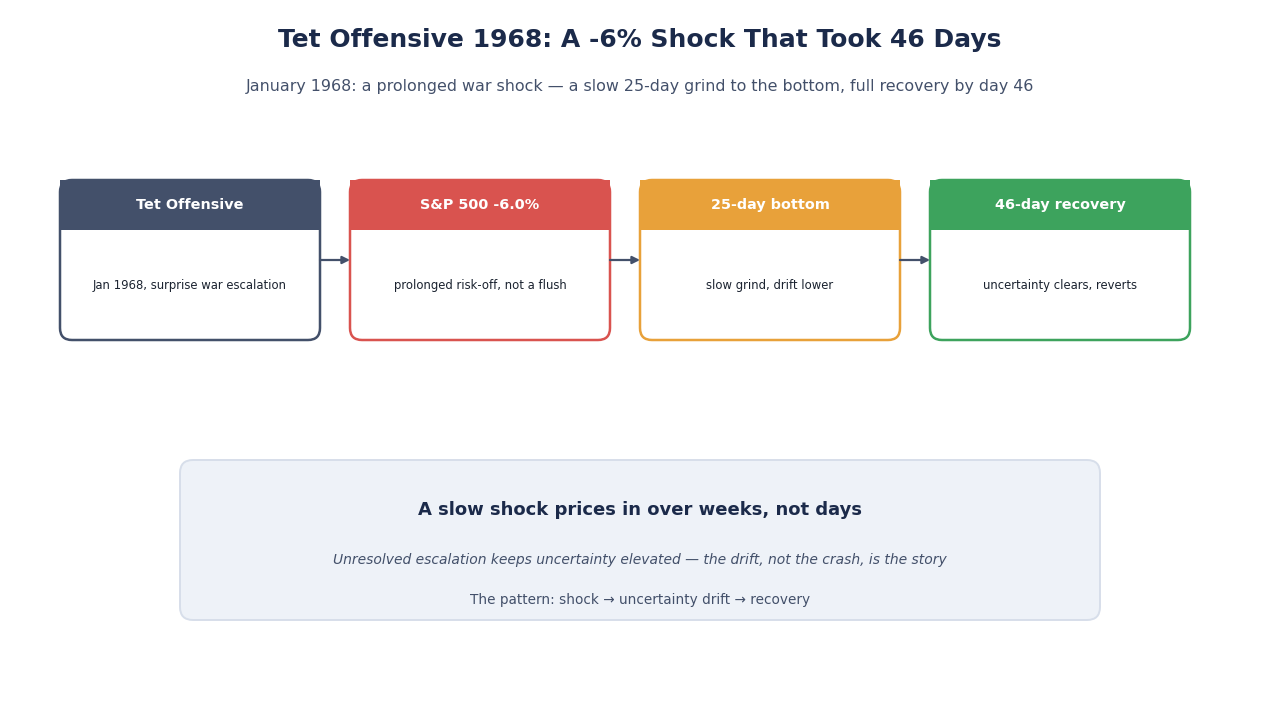
Understanding the Tet Offensive Shock and Market Reaction
The Tet Offensive, launched in January 1968, was a coordinated series of attacks by North Vietnamese and Viet Cong forces. While militarily it did not result in a decisive victory, its psychological and political impact was enormous—especially for U.S. markets.
Key Market Metrics
| Metric | Value |
|---|---|
| Peak Drawdown | -6.0% |
| Time to Bottom | 25 Days |
| Recovery Duration | 46 Days |
| Market Behavior | Shock → Drift → Recovery |
The Tet Offensive demonstrates that markets often overreact initially to geopolitical shocks, then stabilize as uncertainty declines.
Key takeaway: Markets are not pricing the event itself—but the uncertainty surrounding it.
- Initial panic driven by news shock
- Extended drawdown due to uncertainty persistence
- Recovery triggered by narrative stabilization
- Shock hits → liquidity dries up
- Information evolves → volatility persists
- Narrative stabilizes → buyers return
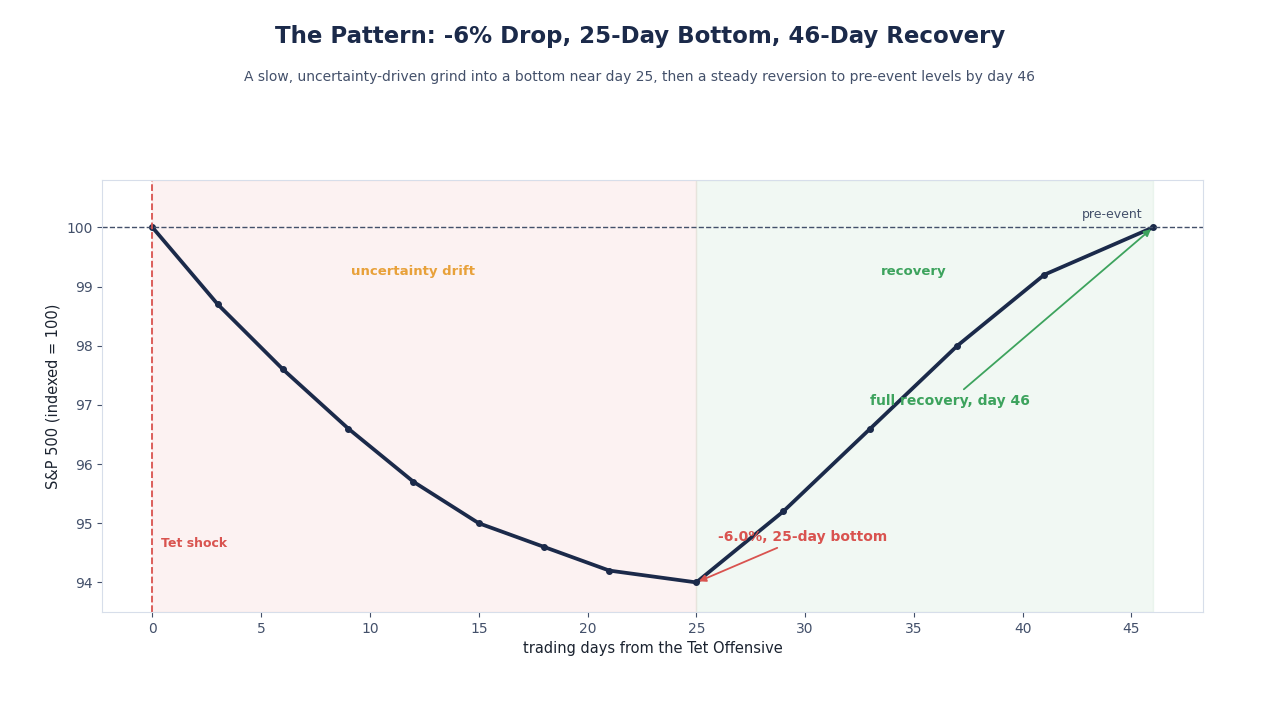
The Three-Phase War Shock Model
One of the most powerful insights from the Tet Offensive is that geopolitical shocks tend to follow a repeatable structure.
Phase 1: Shock (Day 0–5)
Markets react violently to unexpected events.
- Rapid sell-off
- Spike in volatility (VIX-like behavior)
- Liquidity imbalance
Phase 2: Uncertainty Drift (Day 5–25)
This is where Tet Offensive becomes unique.
- Continued downside pressure
- Conflicting news narratives
- Institutional repositioning
Phase 3: Recovery (Day 25–46)
Once uncertainty declines:
- Buyers step in
- Technical support holds
- Momentum shifts upward
| Phase | Market Behavior | Trading Approach |
|---|---|---|
| Shock | Panic selling | Avoid catching falling knife |
| Drift | Weak consolidation | Watch for divergence signals |
| Recovery | Trend reversal | Enter on confirmation |
How Traders Can Use Tet Offensive 1968 Market Impact Today
Modern traders can replicate this framework across crypto, equities, and macro assets.
Practical Trading Framework
Using tools like SimianX AI, traders can map:
- Technical indicators (EMA, RSI, MACD)
- Sentiment and news flow
- Key support/resistance zones
The edge is not predicting events—but reacting systematically.
Step-by-Step Approach
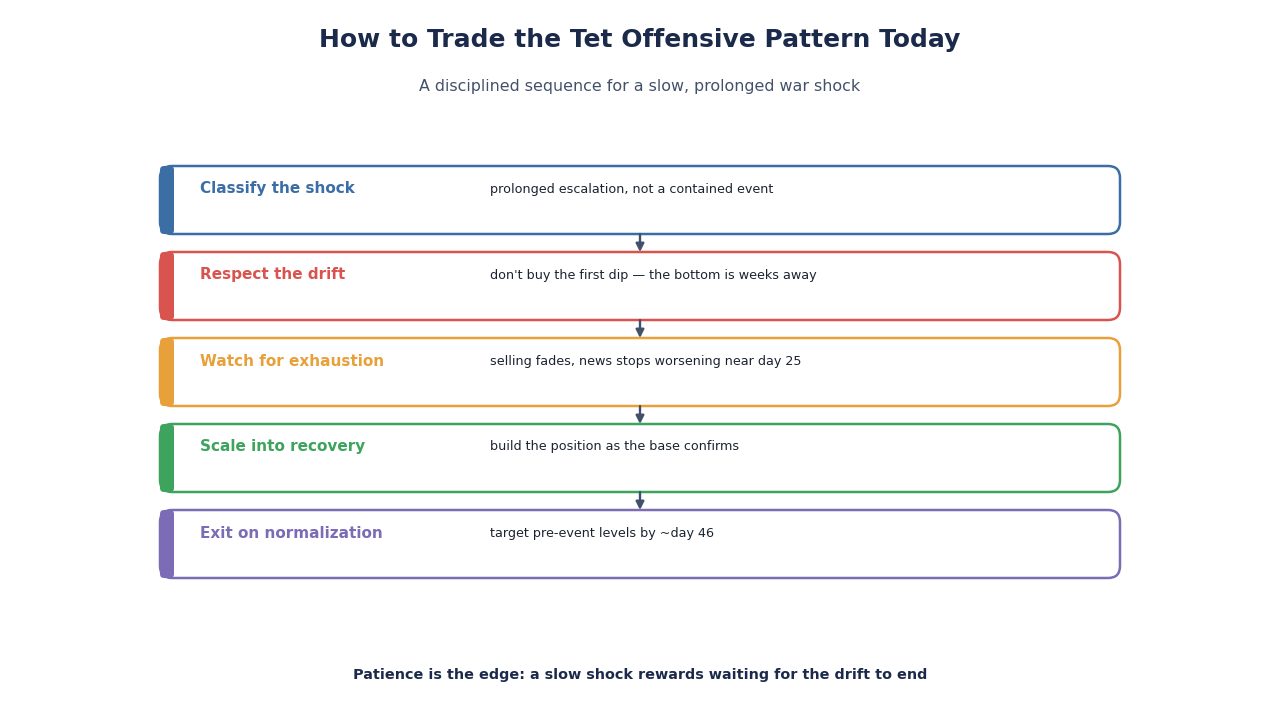
- Identify the shock event
- Measure initial drawdown
- Track duration to bottom
- Monitor sentiment stabilization
- Enter during early recovery phase
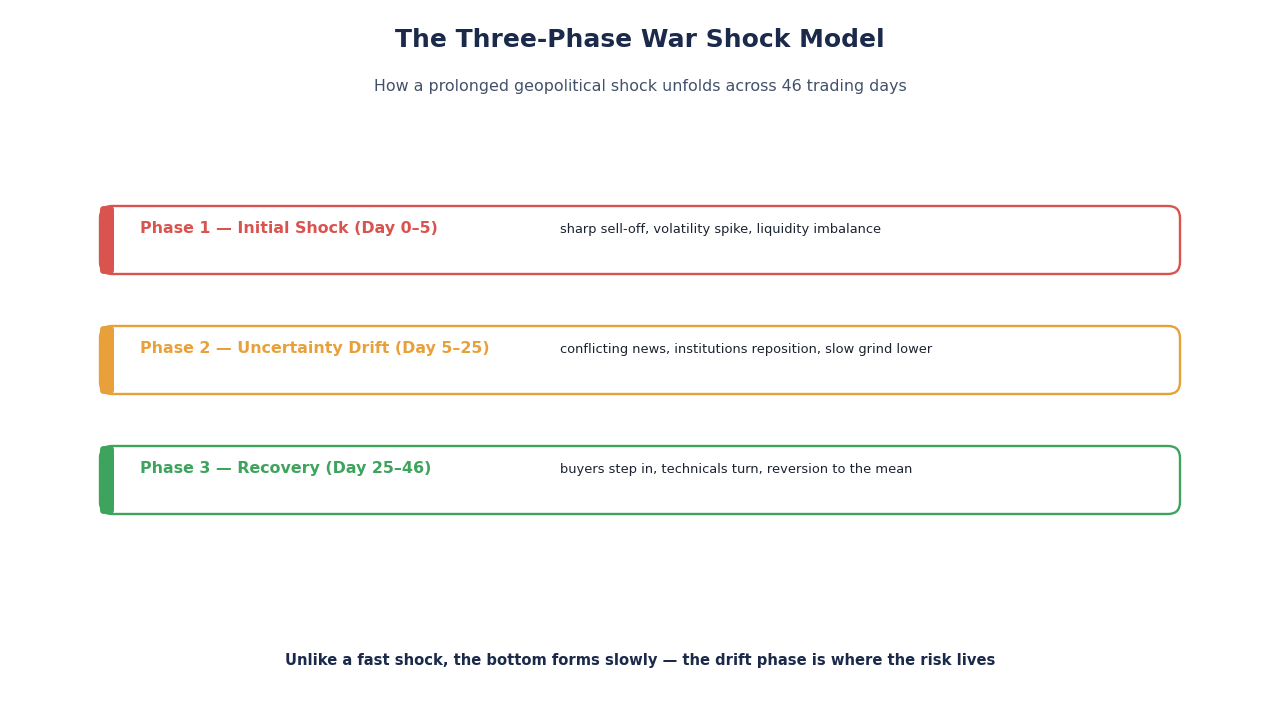
Why the 25-Day Bottom Matters
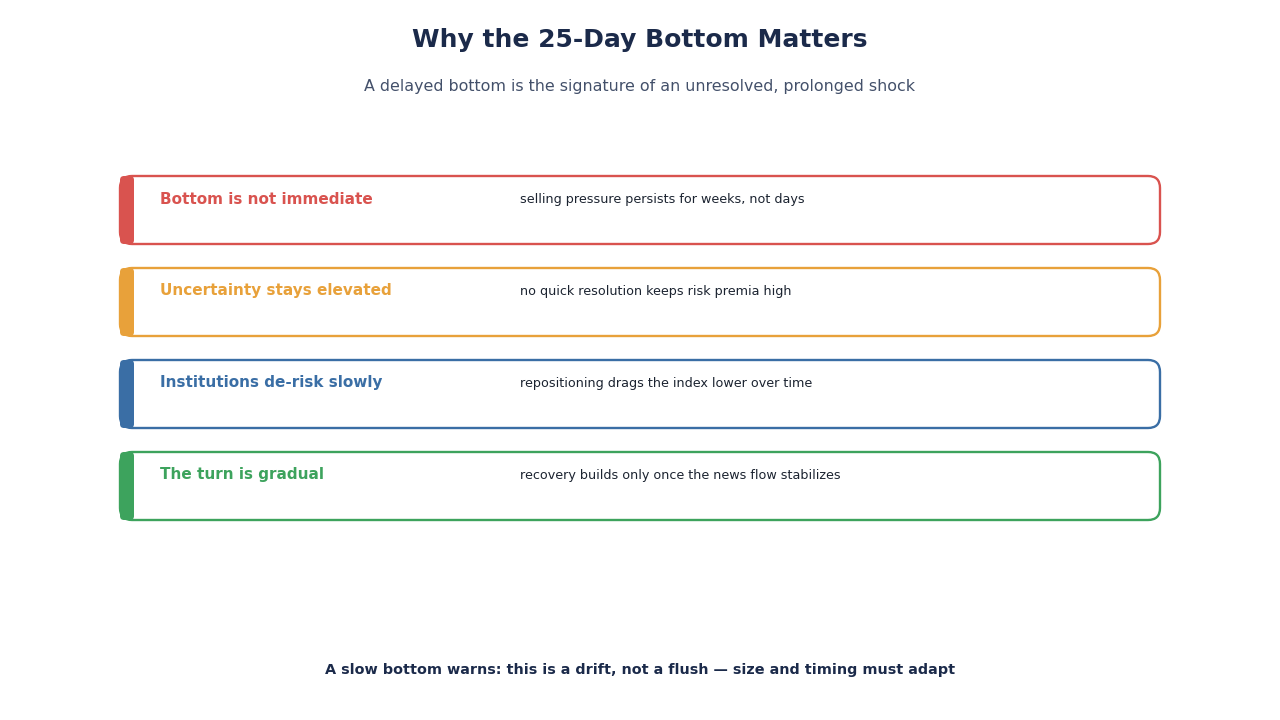
The Tet Offensive did not bottom immediately—this is critical.
Many traders assume:
- “Big drop = quick bounce”
But Tet shows:
- Extended bottoms are common in geopolitical shocks
Key Insight
The longer uncertainty persists, the longer markets take to bottom.
This has major implications:
- Avoid early dip-buying
- Wait for confirmation signals
- Use multi-timeframe analysis
How SimianX AI Helps Trade War-Induced Volatility
Unlike traditional tools, SimianX AI uses a multi-agent system to interpret complex market environments.
Key Capabilities
- Indicator Agent: Tracks EMA, RSI, MACD signals
- Sentiment Agent: Monitors news and market reactions
- Fundamental Agent: Identifies macro-level support/resistance
- Decision Agent: Synthesizes all inputs into a clear bias
| Feature | Benefit |
|---|---|
| Multi-agent system | Reduces noise and bias |
| Real-time signals | Faster reaction to events |
| Confidence scoring | Improves decision clarity |
Instead of guessing, traders follow a structured decision process.
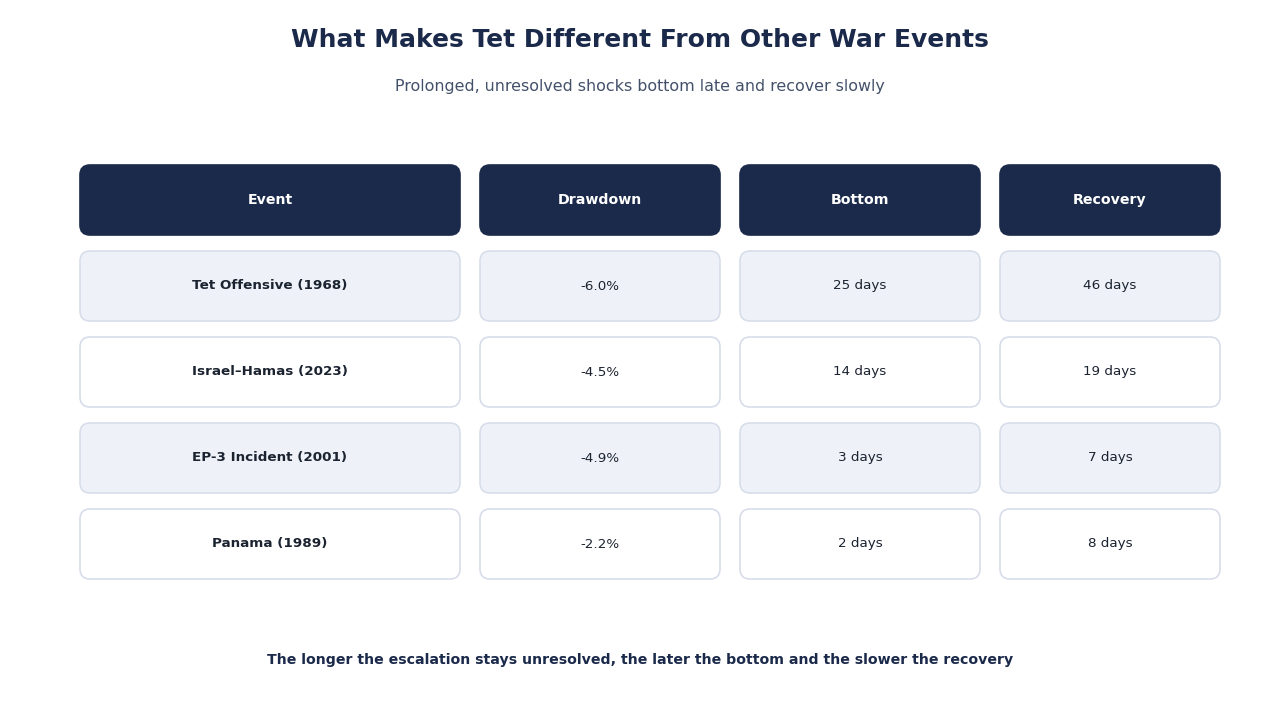
What Makes Tet Offensive Different From Other War Events?
Compared to other historical shocks:
- Pearl Harbor: deeper drawdown, longer recovery
- London Bombings 2005: near-zero drawdown
- Israel–Hamas 2023: faster recovery
Tet Offensive sits in the middle zone:
- Moderate drawdown
- Medium-term uncertainty
- Structured recovery
This makes it a perfect template for modern markets, especially crypto.
How does Tet Offensive 1968 market impact compare to modern war shocks?
The Tet Offensive shows a slower bottom formation compared to modern events, where information spreads faster. However, the core structure—shock, drift, recovery—remains consistent. Today’s markets compress timelines, but the behavioral pattern is unchanged. Tools like SimianX AI help identify these compressed cycles more effectively.
Applying Tet Offensive Insights to Crypto Markets
Crypto behaves similarly—but faster.
- 25 days → often becomes 5–10 days
- 46 days recovery → may compress into 2–3 weeks
Example Mapping
| Tet 1968 | Crypto Equivalent |
|---|---|
| 25-day bottom | 7-day bottom |
| 46-day recovery | 14-day recovery |
Key insight: Same pattern, different speed.
FAQ About Tet Offensive 1968 Market Impact
What caused the Tet Offensive market crash?
The crash was driven by unexpected escalation in the Vietnam War, which shocked investor confidence. Markets reacted not just to the event but to uncertainty about its implications.
How long did the market take to recover after Tet Offensive?
The market reached its bottom in about 25 days and fully recovered within 46 days, highlighting a structured recovery cycle.
Can Tet Offensive patterns be used in modern trading?
Yes, the shock–drift–recovery framework is still highly relevant. Modern tools like AI-based platforms help identify these phases more precisely.
What is the best way to trade war-induced market volatility?
The best approach is to avoid early entries, monitor sentiment shifts, and enter during confirmed recovery phases using technical and macro signals.
Conclusion
The Tet Offensive 1968 Market Impact offers a timeless lesson: markets react to uncertainty, not just events. A -6.0% drawdown, 25-day bottom, and 46-day recovery reveal a repeatable structure that traders can still use today.
By applying this framework—and leveraging tools like SimianX AI—you can transform chaotic geopolitical shocks into structured trading opportunities.
If you want to navigate the next market shock with clarity, discipline, and data-driven precision, start exploring SimianX AI today.
Deep Dive: Liquidity, Sentiment, and Institutional Positioning During Tet Offensive
To fully understand the Tet Offensive 1968 Market Impact, we must go beyond price action and examine the underlying drivers: liquidity, sentiment, and institutional behavior.
Liquidity Contraction Dynamics
During the initial shock phase, liquidity does not disappear randomly—it withdraws systematically.
- Market makers widen spreads
- Institutional desks reduce risk exposure
- Retail panic accelerates selling
Liquidity is not lost—it is withheld until uncertainty resolves.
This explains why:
- Prices fall faster than fundamentals justify
- Recovery begins before “good news” appears
Institutional Behavior Patterns
Institutional investors rarely panic—but they reprice risk aggressively.
| Stage | Institutional Action | Market Effect |
|---|---|---|
| Shock | De-risk portfolios | Sharp drop |
| Drift | Rebalance + hedge | Sideways/down pressure |
| Recovery | Gradual re-entry | Sustained rally |
This behavior creates predictable inefficiencies that traders can exploit.
Volatility Structure: The Hidden Edge in War Events
Volatility is not just a byproduct—it is the core signal.
Volatility Expansion Phase
- Sudden spike in implied volatility
- Correlation across assets increases
- Cross-asset contagion (stocks, bonds, commodities)
Volatility Compression Phase
- Volatility peaks before price bottoms
- Implied volatility begins to decline
- Smart money accumulates positions
The best trades often occur when volatility is falling—but still elevated.
Practical Insight
Instead of chasing price:
- Track volatility peaks
- Look for divergence between price and volatility
- Enter when volatility declines but price stabilizes
Cross-Asset Reactions During Tet Offensive
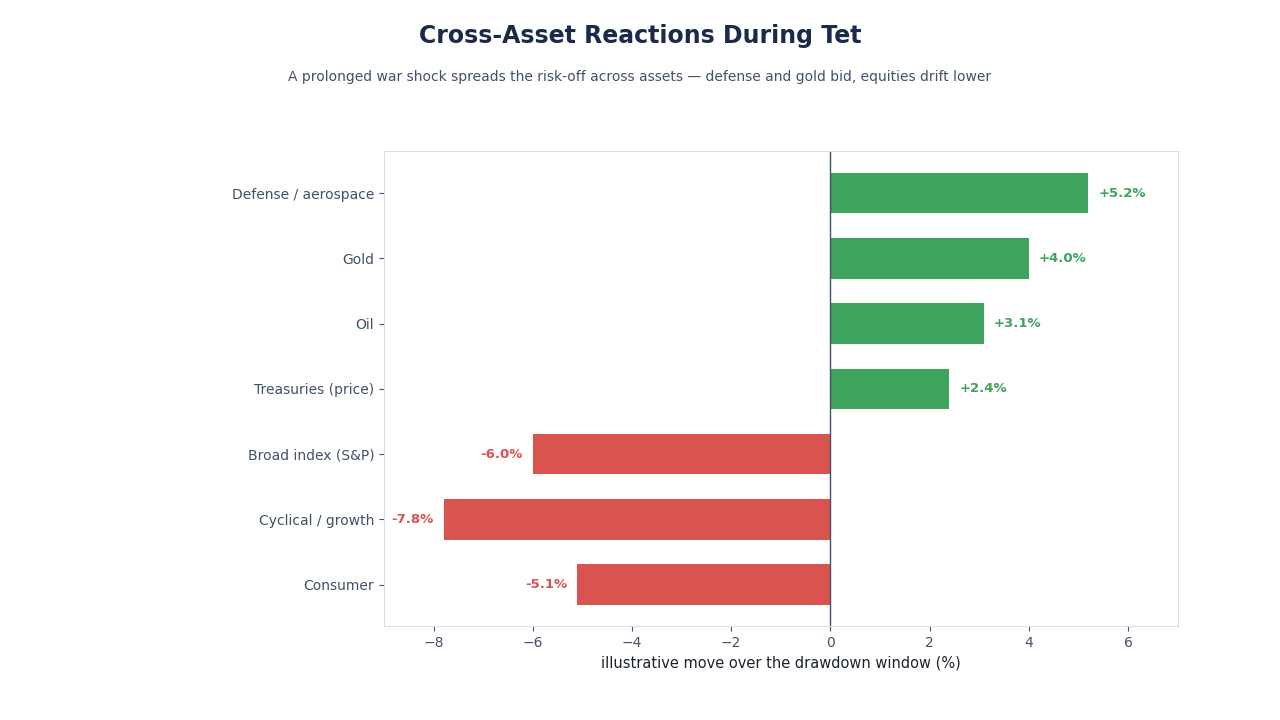
The Tet Offensive did not affect equities alone—it triggered multi-asset reactions.
Typical War Shock Correlations
| Asset Class | Reaction Pattern |
|---|---|
| Equities | Sell-off |
| Gold | Safe-haven inflow |
| Oil | Supply risk premium |
| Bonds | Mixed (flight vs inflation) |
Key Insight
Markets operate as a system, not isolated instruments.
This is where SimianX AI becomes critical:
- Tracks cross-asset signals
- Identifies hidden correlations
- Generates unified decision outputs
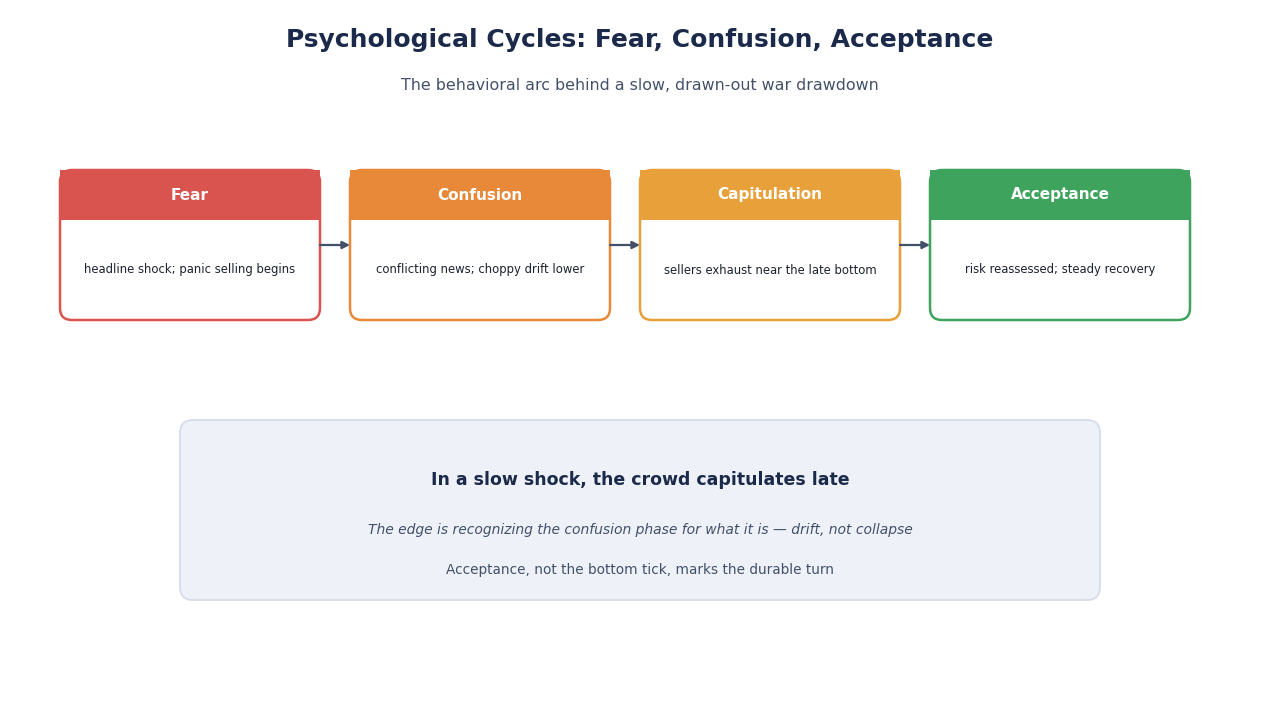
Psychological Cycles: Fear, Confusion, Acceptance
Market cycles during war events are fundamentally psychological.
Phase 1: Fear
- Immediate reaction
- Headlines dominate decisions
- Emotional selling
Phase 2: Confusion
- Conflicting narratives
- Analysts disagree
- Price action becomes choppy
Phase 3: Acceptance
- New reality priced in
- Risk premium stabilizes
- Market resumes trend
Markets bottom when participants stop asking “what if?”
Signal Stacking: Combining Indicators for Higher Accuracy
Single indicators fail during chaotic events.
Multi-Signal Framework
To trade effectively, combine:
- Trend signals (EMA crossovers)
- Momentum signals (RSI divergence)
- Volatility signals (range contraction)
- Sentiment signals (news tone shift)
Example Setup
- Price stabilizes near support
- RSI shows bullish divergence
- Volatility declines
- News flow shifts from panic to neutral
This creates a high-probability entry zone.
| Signal Type | Indicator Example | Interpretation |
|---|---|---|
| Trend | EMA 20/50 | Direction shift |
| Momentum | RSI | Exhaustion signal |
| Volatility | ATR | Compression |
| Sentiment | News flow | Narrative stabilization |
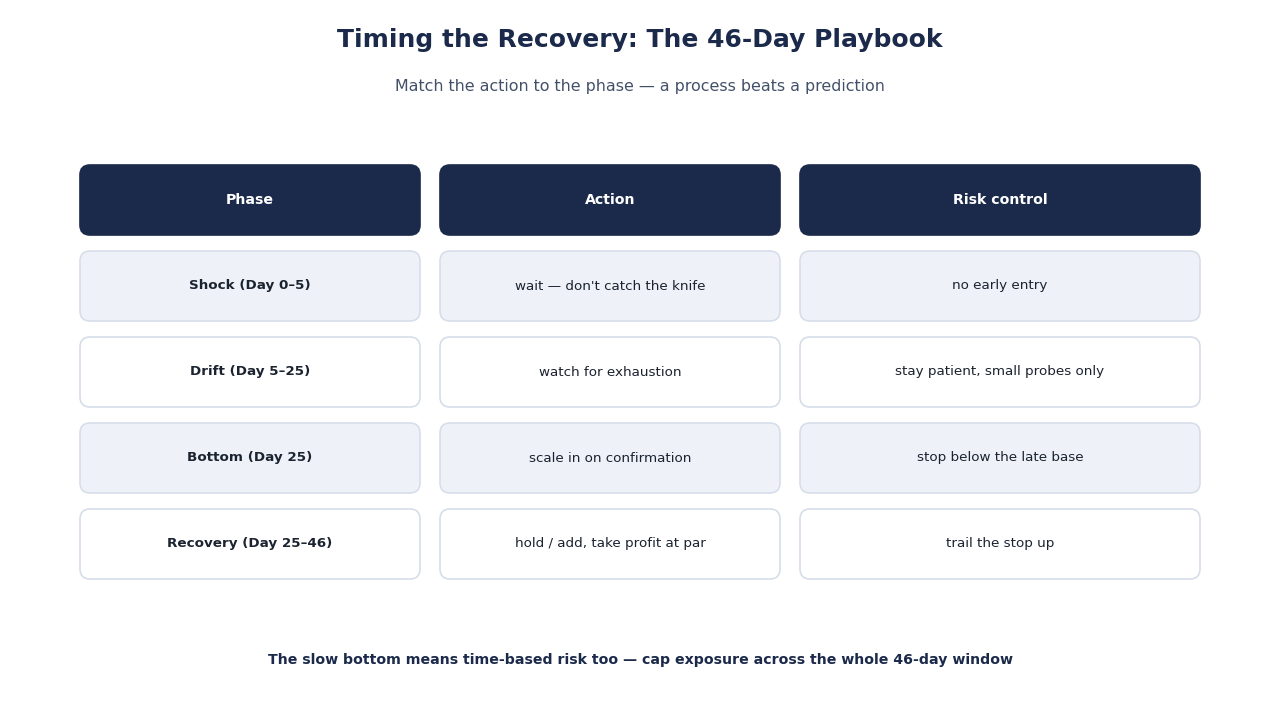
Timing the Recovery: The 46-Day Playbook
The recovery phase is where the real opportunity lies.
Early Recovery Signals
- Higher lows forming
- Decreasing volatility
- Increasing volume on up days
Mid Recovery Signals
- Break of resistance
- Momentum acceleration
- Institutional accumulation
Late Recovery Signals
- Overbought conditions
- Retail participation surge
- Narrative optimism
The best risk-reward exists in the early recovery phase.
Modern Application: From Vietnam War to AI Trading Era
The biggest difference today is not market behavior—it is information speed.
Then vs Now
| Factor | 1968 Market | Modern Market |
|---|---|---|
| Information Flow | Slow | Instant |
| Reaction Speed | Gradual | Rapid |
| Recovery Time | Longer | Compressed |
Despite this:
Human behavior has not changed.
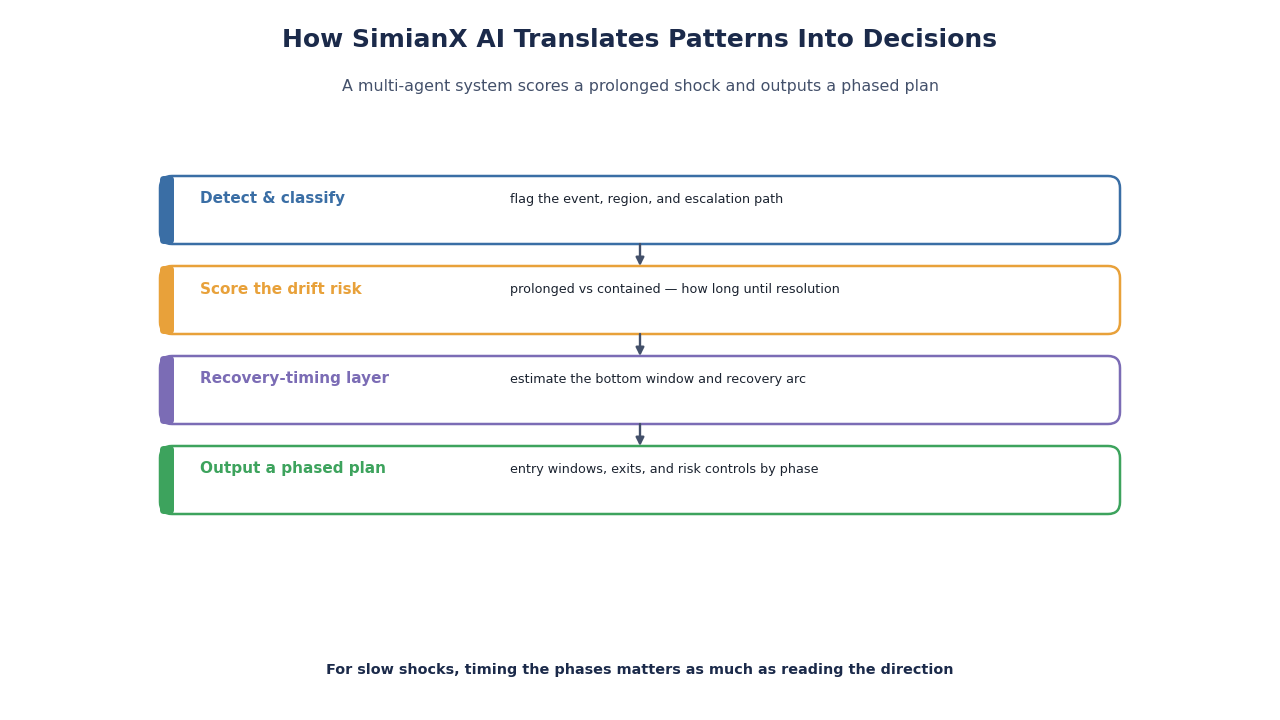
How SimianX AI Translates Historical Patterns Into Real-Time Decisions
SimianX AI bridges the gap between historical insight and real-time execution.
Real-Time Signal Flow
- EMA / RSI / MACD alignment
- News sentiment aggregation
- Support/resistance mapping
- Risk scoring + confidence level
Example Workflow
- Shock detected
- System tracks volatility spike
- Agents monitor sentiment shift
- Decision agent outputs bias
You are not predicting—you are responding faster and smarter.
Advanced Strategy: Trading the “Second Opportunity”
Many traders miss the first move—but Tet Offensive shows there is often a second entry opportunity.
Secondary Entry Setup
- Initial recovery pullback
- Lower volatility environment
- Stronger confirmation signals
Why It Works
- Weak hands exit
- Strong hands accumulate
- Trend becomes clearer
Risk Management Framework for War Events
Risk management becomes more important than strategy.
Core Principles
- Reduce position size
- Avoid leverage spikes
- Use wider stop-loss ranges
Practical Rules
- Never enter during peak panic
- Wait for confirmation
- Scale in gradually
| Risk Factor | Mitigation Strategy |
|---|---|
| Volatility spike | Smaller position size |
| News risk | Avoid overexposure |
| False signals | Multi-indicator confirmation |
Lessons for 2026 and Beyond
The Tet Offensive provides a blueprint for:
- Geopolitical conflicts
- Financial crises
- Black swan events
Key Lessons
- Markets overreact first
- Bottoms take time
- Recovery is structured
The edge belongs to those who wait, observe, and act with discipline.
Extended FAQ: Advanced Trading Questions
How reliable is the Tet Offensive pattern for modern markets?
While timelines may compress, the structure remains consistent. Shock, uncertainty, and recovery phases still define market behavior across assets.
What indicators work best during geopolitical shocks?
A combination of trend, momentum, volatility, and sentiment indicators provides the highest reliability.
Can AI outperform human traders in war-driven markets?
AI systems like SimianX AI can process multiple signals simultaneously, reducing emotional bias and improving consistency.
Is it better to trade or stay out during war events?
For inexperienced traders, staying out is often safer. For experienced traders, structured strategies can offer high-probability opportunities.
Final Thoughts: Turning Chaos Into Strategy
The Tet Offensive 1968 Market Impact is not just history—it is a repeatable framework for navigating uncertainty.
By understanding:
- Market structure
- Behavioral psychology
- Signal alignment
You gain a significant edge.
With platforms like SimianX AI, you can:
- Analyze shocks in real time
- Combine multiple data sources
- Execute with clarity and confidence
In a world where uncertainty is constant, the goal is not to avoid volatility—but to master it.
Related Reading
- Israel-Hamas 2023: S&P -4.5% Drawdown, 14-Day Bottom
- Buy the Invasion Pattern: Iraq 2003 S&P 500 +15% Rally
- U.S. Strike on Iran General: Stocks Down, Oil +4% Shock
- Gulf of Tonkin 1964: Small Event, Decade-Long Market Impact
- Pearl Harbor 1941: Dow -19.8% Crash, 307-Day Recovery
- Buy the Invasion 2026: 9 of 12 Wars Saw S&P 500 Rally