Pearl Harbor 1941 Market Crash: Drawdown, Bottom, Recovery
Market Analysis

Pearl Harbor 1941 Market Crash: Drawdown, Bottom, Recovery

Analyze the Pearl Harbor 1941 Market Crash: -19.8% drawdown, 143-day bottom, and 307-day recovery with insights for modern investors.

2026-03-18
45 min read
Listen to article

Pearl Harbor 1941 Market Crash: -19.8% Drawdown, 143-Day Bottom, 307-Day Recovery


The Pearl Harbor 1941 Market Crash: -19.8% drawdown, 143-day bottom, 307-day recovery stands as one of the most important case studies in financial history. When Japan launched its surprise attack on December 7, 1941, global markets were thrown into uncertainty—but what followed reveals powerful insights about resilience, recovery, and investor psychology.


For modern traders and analysts using tools like SimianX AI, understanding these historical patterns is critical. By studying how markets reacted to one of the most shocking geopolitical events in history, we can better model risk, anticipate recovery cycles, and optimize trading strategies in today’s volatile environment.


SimianX AI during WWII, Japan launched a surprise attack on Pearl Harbor
during WWII, Japan launched a surprise attack on Pearl Harbor

The Immediate Market Reaction to Pearl Harbor


The attack on Pearl Harbor triggered an immediate shock response across U.S. financial markets. When markets reopened on December 8, 1941, the Dow Jones Industrial Average fell sharply as panic selling dominated.


Markets often react not to the event itself—but to uncertainty and lack of clarity.

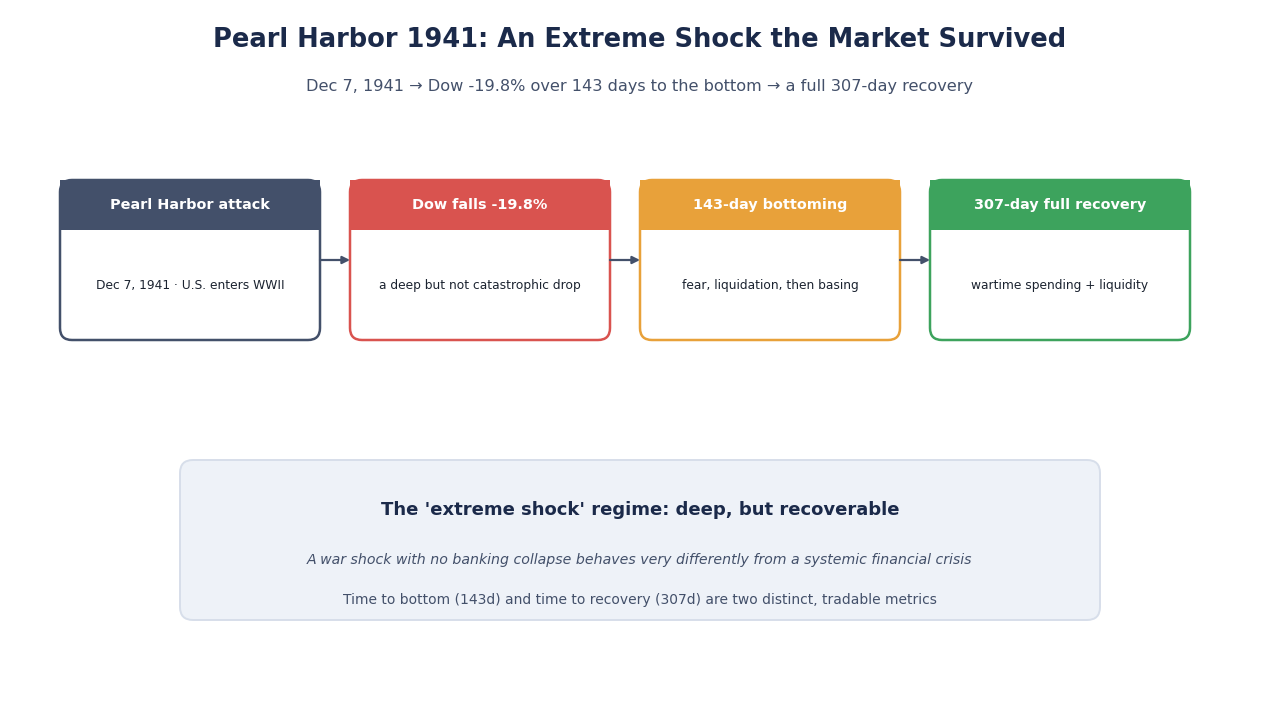
Key metrics from the Pearl Harbor crash:


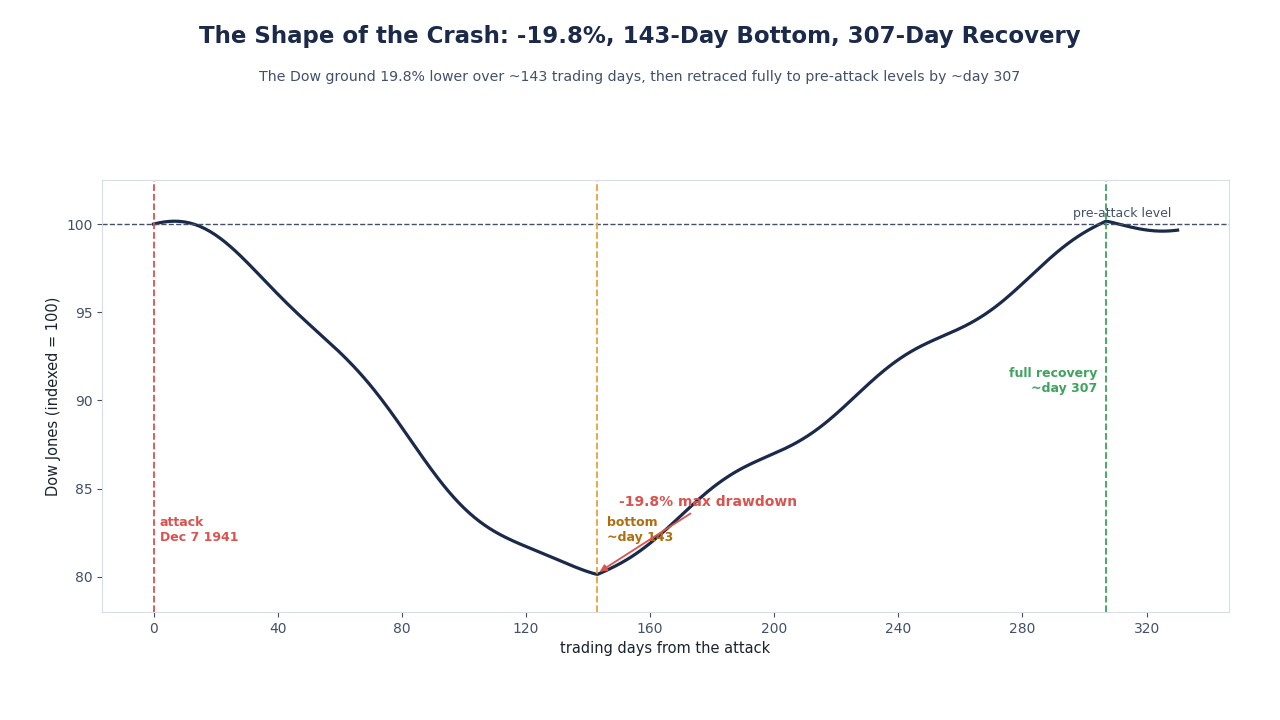
  • Maximum drawdown: -19.8%
  • Time to bottom: ~143 days
  • Full recovery: ~307 days

  • This initial drop reflects a classic fear-driven liquidity event, where investors rapidly de-risk portfolios.


    Why the Market Didn’t Collapse Further


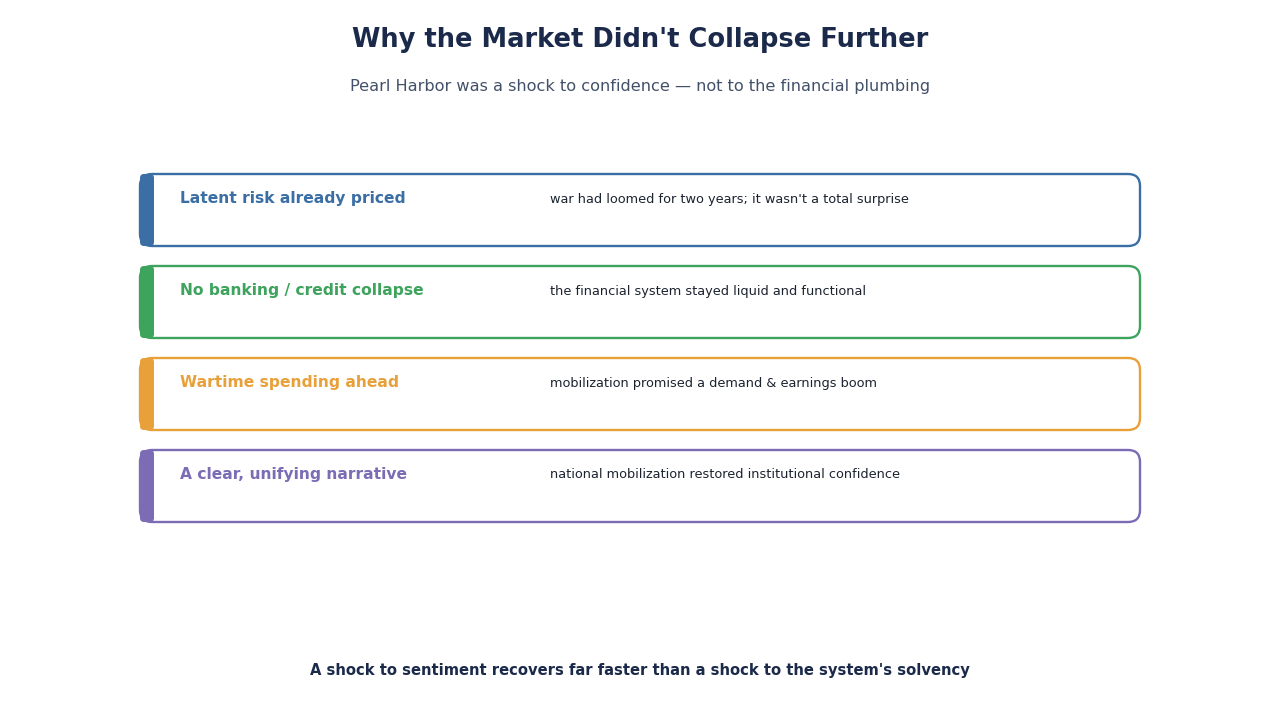
    Despite the severity of the attack, the market did not spiral into a prolonged depression. Several factors helped stabilize investor sentiment:


  • Rapid government mobilization and wartime spending
  • Industrial expansion boosting economic output
  • Clear national direction reducing uncertainty
  • Strong institutional participation supporting liquidity

  • 1. Government spending surged, creating demand.

    2. War production accelerated industrial growth.

    3. Investor confidence stabilized as clarity emerged.


    FactorImpact on Market
    War MobilizationBoosted industrial stocks
    Fiscal ExpansionIncreased liquidity
    National UnityReduced panic sentiment
    Military ResponseRestored confidence

    SimianX AI Wartime industrial production and stock market recovery
    Wartime industrial production and stock market recovery

    Understanding the -19.8% Drawdown


    The -19.8% drawdown is particularly important because it represents a moderate but not catastrophic decline.


    Unlike the Great Depression:


  • There was no systemic banking collapse
  • Liquidity remained intact
  • Economic policy responded quickly

  • This aligns with what modern analysts classify as a "shock-driven correction" rather than structural collapse.


    Key takeaway:


    Not all crashes are equal—event-driven declines often recover faster than systemic crises.

    With platforms like SimianX AI, traders can classify events into categories (geopolitical shock vs systemic risk) and adjust strategies accordingly.


    The 143-Day Bottom Formation


    The market took approximately 143 days (~5 months) to reach its bottom. This period was characterized by:


  • Continued uncertainty about war outcomes
  • Volatility spikes
  • Gradual absorption of macroeconomic realities

  • What Happens During the Bottoming Phase?


    During this phase, markets transition from panic to stabilization:


  • Selling pressure decreases
  • Institutional accumulation begins
  • Narratives shift from fear to adaptation

  • How SimianX AI Models This Phase


    Using multi-agent systems, SimianX AI can:


  • Detect volatility regime shifts
  • Identify accumulation zones
  • Analyze macro sentiment transitions

  • This allows traders to move from reactive to proactive positioning.


    SimianX AI Market bottom formation and accumulation zones
    Market bottom formation and accumulation zones

    The 307-Day Recovery: A Case of Rapid Resilience


    Perhaps the most striking aspect of the Pearl Harbor crash is the relatively fast recovery—just 307 days.


    Compared to other crises:


  • Faster than 2008 financial crisis recovery
  • Comparable to post-COVID rebound patterns
  • Significantly shorter than the Great Depression

  • Why Did Recovery Happen So Quickly?


    Several structural forces drove recovery:


  • Massive government spending (war economy)
  • Industrial expansion (manufacturing boom)
  • Employment surge
  • Increased corporate earnings

  • Recovery drivers:


  • Fiscal policy
  • Industrial output
  • Strategic clarity
  • Investor adaptation

  • Recovery DriverEffect on Market
    War EconomyIncreased GDP and earnings
    Industrial DemandBoosted equities
    Employment GrowthStrengthened consumption
    Policy StabilityReduced uncertainty

    What Can Modern Investors Learn?


    The Pearl Harbor crash offers timeless lessons for navigating geopolitical shocks:


    1. Markets Price Uncertainty, Not Just Events


    The biggest drop happens when uncertainty peaks, not necessarily when the event occurs.


    2. Recovery Begins Before News Improves


    Markets often bottom before clarity returns.


    3. Liquidity Is the Key Variable


    As long as liquidity remains strong, recoveries tend to be faster.


    4. Macro Regime Matters More Than Headlines


    War did not destroy markets—it reshaped economic dynamics.


    How to Apply This Using SimianX AI


    Modern traders don’t need to rely solely on historical analysis—they can use SimianX AI to operationalize these insights.


    With SimianX, users can:


  • Track real-time geopolitical signals
  • Analyze multi-timeframe market reactions
  • Simulate historical analog scenarios
  • Use AI agents to generate risk-adjusted strategies

  • Example Workflow


    1. Identify geopolitical shock (e.g., conflict escalation)

    2. Compare with historical analogs (like Pearl Harbor)

    3. Analyze drawdown probabilities

    4. Execute strategy with dynamic risk controls


    The goal is not prediction—but probabilistic positioning.

    SimianX AI Japanese attack on PearlHarbor on Dec. 7, 1941
    Japanese attack on PearlHarbor on Dec. 7, 1941

    How does the Pearl Harbor 1941 market crash compare to modern crashes?


    The Pearl Harbor crash is best compared to event-driven corrections such as:


  • 9/11 attacks (2001)
  • Crimea crisis (2014)
  • COVID shock (2020 initial phase)

  • Key similarities:


  • Sharp initial drop
  • Rapid sentiment shift
  • Relatively fast recovery

  • Key differences:


  • Slower information flow in 1941
  • Less algorithmic trading
  • Stronger industrial policy impact

  • FAQ About Pearl Harbor 1941 Market Crash


    What was the stock market drop after Pearl Harbor?

    The U.S. stock market experienced a maximum drawdown of approximately -19.8% following the attack. This decline unfolded over several months rather than a single-day crash.


    How long did it take for the market to recover after Pearl Harbor?

    The market took about 307 days to fully recover to pre-crash levels, reflecting a relatively fast rebound compared to major financial crises.


    Why didn’t the market crash more severely during World War II?

    Unlike systemic crises, WWII triggered economic expansion through government spending, which supported corporate earnings and stabilized markets.


    What can investors learn from the Pearl Harbor crash today?

    Investors can learn that geopolitical shocks often create temporary volatility, but markets tend to recover if liquidity and economic activity remain strong.


    How can AI help analyze events like Pearl Harbor?

    AI platforms like SimianX AI can analyze historical patterns, real-time data, and macro signals to help investors make informed, data-driven decisions.


    Conclusion


    The Pearl Harbor 1941 Market Crash: -19.8% drawdown, 143-day bottom, 307-day recovery is a powerful example of how markets respond to extreme geopolitical shocks. Despite initial panic, the market demonstrated resilience driven by liquidity, policy support, and economic transformation.


    For modern investors, the lesson is clear: understand the nature of the shock, not just the headline.


    By leveraging advanced tools like SimianX AI, traders can move beyond reactive decision-making and build strategies grounded in historical insight, real-time data, and AI-driven analysis.


    Explore SimianX AI today to turn historical patterns into actionable trading intelligence.

    A Deeper Historical Framework for Interpreting the Pearl Harbor 1941 Market Crash


    To understand the full meaning of the Pearl Harbor 1941 market crash, it is not enough to look only at the headline figures of -19.8% drawdown, 143 days to bottom, and 307 days to recovery. Those numbers are important because they offer clean, memorable benchmarks. But the deeper value comes from understanding why the market behaved that way, how investor expectations changed across each phase of the decline, and what mechanisms turned wartime fear into a relatively fast equity recovery.


    In modern financial research, historical events are often simplified into easy narratives:


  • “War causes stocks to fall.”
  • “Markets hate uncertainty.”
  • “Once the worst is known, markets rebound.”
  • “Government spending supports recovery.”

  • All of these statements contain some truth, but none is sufficient on its own. The Pearl Harbor episode is valuable precisely because it shows how market structure, macro policy, industrial transformation, and collective psychology can interact in complex ways. For anyone studying geopolitical risk today—especially traders, macro analysts, and quantitative researchers using platforms like SimianX AI—Pearl Harbor is not just a history lesson. It is a live template for interpreting future shocks.


    SimianX AI Historical stock market framework and war-cycle analysis
    Historical stock market framework and war-cycle analysis

    The Market Before Pearl Harbor: Why Context Matters


    One of the most common mistakes in historical market analysis is treating a geopolitical event as if it occurred in a vacuum. In reality, markets are never blank slates. They enter each crisis with pre-existing valuations, sentiment, liquidity conditions, monetary settings, and macro expectations.


    Before Pearl Harbor, the United States was not stepping into history from a position of total calm. The global backdrop was already unstable:


  • Europe had been at war since 1939
  • Nazi expansion had altered strategic expectations
  • Britain was under pressure
  • The U.S. had already shifted toward support for Allied powers
  • Investors knew global conflict was not hypothetical

  • That means the December 7, 1941 attack was a dramatic escalation, but not a completely unimaginable event. In market terms, this distinction matters. Some geopolitical events are truly exogenous shocks; others are latent risks that become suddenly concrete.


    Latent Risk vs Sudden Shock


    The Pearl Harbor event contained both elements:


    Risk TypeDescriptionMarket Implication
    Latent geopolitical riskGlobal war tensions were already visibleSome risk likely priced in
    Sudden tactical shockSurprise attack on U.S. territoryImmediate repricing of uncertainty
    Strategic regime shiftDirect U.S. entry into WWIINew long-term economic assumptions
    Policy accelerationGovernment mobilization intensifiedRecovery potential increased

    This combination is one reason the market fell sharply, but not endlessly. A fully unpriced catastrophe can produce deeper systemic damage. A partially anticipated risk, once made real, may trigger panic but also accelerate adaptation.


    Why This Still Matters for Today’s Traders


    Modern markets constantly price latent geopolitical risks:


  • Taiwan Strait tensions
  • Middle East energy disruptions
  • cyberwar escalation
  • sanctions regimes
  • shipping lane blockages
  • great-power military posturing

  • Platforms like SimianX AI are especially useful in these conditions because traders need more than headlines. They need to determine:


    1. Was the event already partially priced?

    2. Is the event a short-term shock or a regime change?

    3. Does it threaten liquidity or merely sentiment?

    4. Does the event destroy demand, or redirect demand?


    These are exactly the kinds of distinctions that determine whether a drawdown becomes a brief panic, a medium-duration correction, or a multi-year structural bear market.


    Investor Psychology After Pearl Harbor


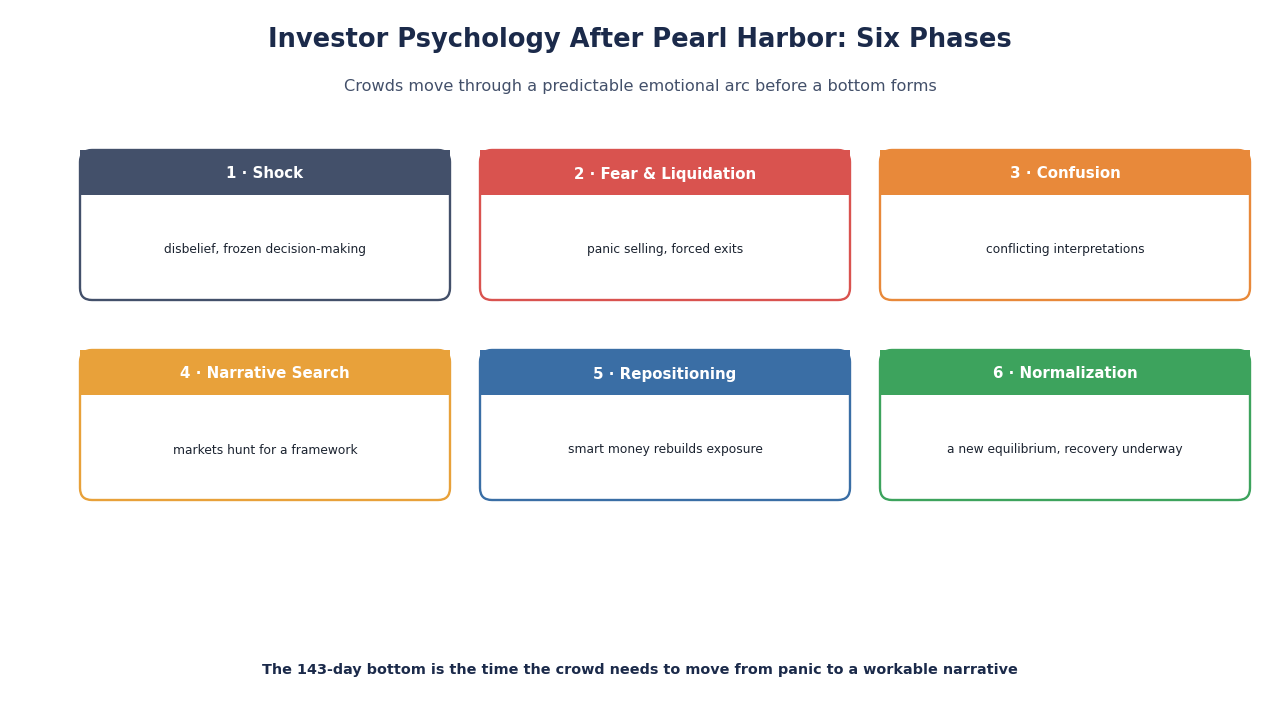
    Every crash has a psychological arc. The Pearl Harbor drawdown is not only a macroeconomic story—it is also a behavioral story. Investors do not respond to events in a purely rational sequence. Instead, they move through overlapping emotional states:


    1. Shock

    2. Fear

    3. Confusion

    4. Narrative search

    5. Selective repositioning

    6. Gradual normalization


    Phase 1: Shock


    Immediately after Pearl Harbor, investors faced profound uncertainty:


  • Was this the start of a much larger military disaster?
  • Would the U.S. mainland be vulnerable?
  • Would trade routes collapse?
  • Would business operations be interrupted nationwide?
  • Would the war destroy capital markets?

  • When the information set is incomplete, participants do not price precise outcomes—they price the range of possible bad outcomes. This is why initial reactions are often exaggerated.


    In the earliest stage of crisis, markets price the width of uncertainty more aggressively than the most likely outcome.

    Phase 2: Fear and Liquidation


    After the first shock comes liquidation. Fear compresses decision-making into a few dominant impulses:


  • reduce exposure
  • increase cash
  • sell cyclicals
  • cut leverage
  • avoid illiquid names

  • Even if investors intellectually believe that the market may recover, many still sell because risk constraints and portfolio mandates force action.


    Phase 3: Confusion and Interpretation


    As the first panic subsides, the market begins asking new questions:


  • Will wartime spending support industrial firms?
  • Which sectors benefit from mobilization?
  • Are current valuations too pessimistic?
  • Does the war imply inflationary pressure or growth acceleration?
  • How much downside is already reflected?

  • This phase is crucial because it marks the shift from emotional selling to analytical repositioning.


    Phase 4: Narrative Search


    Investors always seek a coherent story. After Pearl Harbor, several competing narratives likely emerged:


  • catastrophic national vulnerability
  • industrial mobilization opportunity
  • long war, high uncertainty
  • state-driven growth and production boom

  • The winning narrative matters. Markets do not recover simply because selling stops. They recover because a new dominant interpretation becomes investable.


    Phase 5: Repositioning


    Once investors start seeing wartime mobilization as economically stimulative rather than purely destructive, capital rotates:


  • from indiscriminate selling to selective buying
  • from panic into sector discrimination
  • from cash hoarding into medium-term positioning

  • Phase 6: Normalization


    Eventually, volatility compresses and the market no longer trades every update as existential. At that point, the recovery becomes self-reinforcing.


    SimianX AI Investor psychology cycle from panic to adaptation
    Investor psychology cycle from panic to adaptation

    The Difference Between a War Shock and a Financial Crisis


    One of the most important analytical distinctions in market history is the difference between:


  • event-driven geopolitical shock
  • systemic financial crisis

  • This is where Pearl Harbor becomes especially instructive.


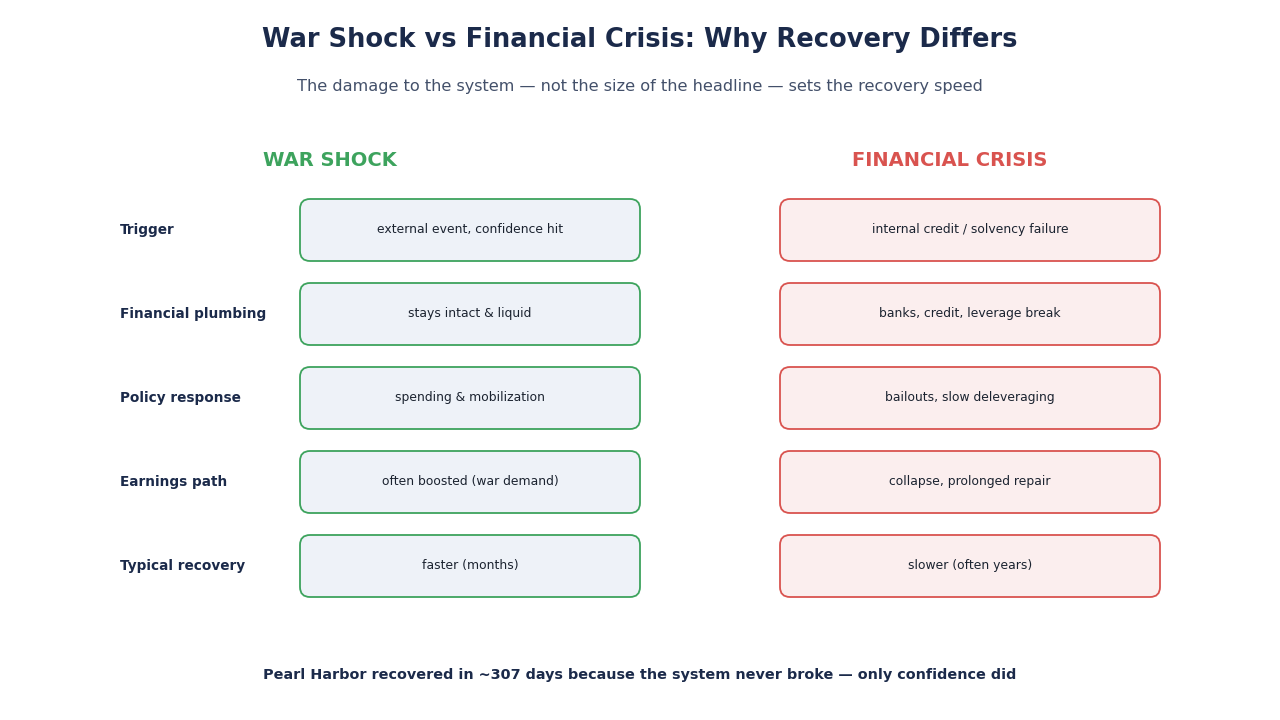
    A financial crisis typically originates from fragility inside the economic or financial system itself. Examples include banking collapses, excessive leverage, credit contagion, asset-liability mismatch, and sudden dysfunction in money markets.


    A war shock, by contrast, often originates outside financial plumbing. Its first-order damage is uncertainty, fear, and possible disruption—not necessarily immediate breakdown of credit transmission.


    Comparing the Two


    DimensionWar ShockFinancial Crisis
    OriginExternal geopolitical eventInternal financial fragility
    Initial driverUncertainty and fearCredit deterioration and insolvency
    Liquidity riskVariableOften severe
    Policy responseFiscal, strategic, industrialMonetary, fiscal, rescue operations
    Recovery pathCan be fast if production risesOften slow if deleveraging is required
    Sector winnersDefense, industrials, commoditiesOften fewer immediate winners
    Investor challengeRegime interpretationSurvival and balance-sheet analysis

    Pearl Harbor did not represent a banking collapse. It did not destroy the core architecture of U.S. finance. That is one reason the drawdown stopped short of depression-style destruction.


    Why Recovery Can Be Faster After Geopolitical Shocks


    War shocks can be followed by recovery when:


  • the economy retains productive capacity
  • state spending rises sharply
  • labor demand increases
  • strategic clarity improves
  • financial intermediation remains functional

  • This is a powerful insight for current market participants. Not every sharp decline should be treated like 2008. Some are closer to Pearl Harbor in structure: fear-heavy, headline-driven, but ultimately reversible once the economic transmission becomes clearer.


    Wartime Spending as an Equity Support Mechanism


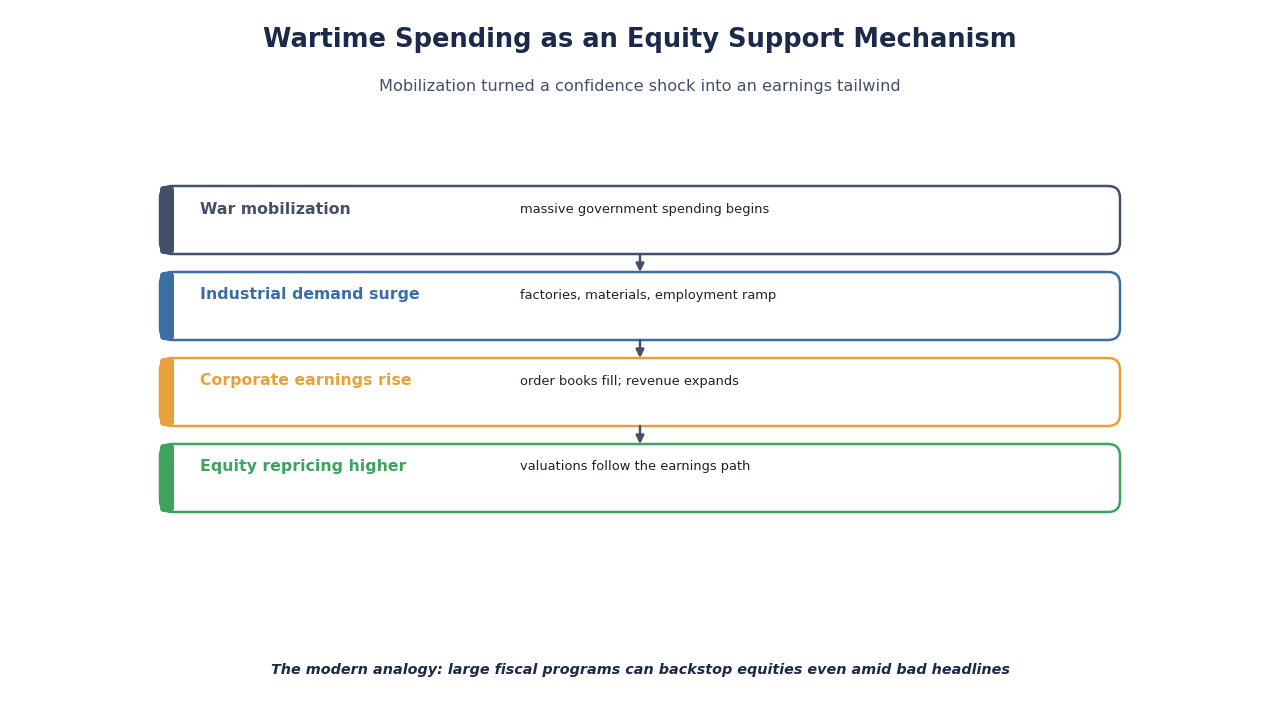
    One of the central reasons for the relatively rapid recovery after the Pearl Harbor drawdown was the scale of wartime mobilization. In modern macro language, the U.S. economy underwent a massive fiscal-industrial acceleration.


    How War Spending Changes the Economic Equation


    War spending can support markets through several channels:


  • direct procurement for industrial firms
  • increased employment
  • higher capacity utilization
  • infrastructure expansion
  • secondary demand effects across supply chains
  • improved visibility for certain corporate revenues

  • This does not mean war is “good” in moral or humanitarian terms. It means that from a market and output perspective, large-scale government spending can transform expectations.


    The Economic Repricing After Pearl Harbor


    At first, the attack increased uncertainty. But as mobilization took hold, investors could begin pricing a different reality:


  • factories would run at higher intensity
  • industrial profits could improve
  • labor markets could tighten
  • aggregate output could rise
  • the government would not allow economic drift

  • In other words, part of the market’s recovery came from recognizing that the event had shifted the economy into a state-directed expansionary regime.


    A Modern Analogy


    In contemporary markets, similar logic can appear after major crisis responses:


  • large infrastructure bills
  • defense spending expansion
  • energy security initiatives
  • semiconductor reshoring
  • supply-chain redundancy programs

  • With SimianX AI, traders can monitor when a shock evolves from a pure uncertainty event into a policy-supported reallocation event. That transition often marks the difference between extended bear phases and investable rebounds.


    The 143-Day Bottom: Why Bottoms Take Time


    A market bottom rarely forms in a straight line. The 143-day path to the Pearl Harbor low matters because it reminds us that even when the eventual recovery is relatively fast, the process can still be psychologically exhausting.


    Why Bottom Formation Is Slow


    Bottoms take time because markets must absorb multiple layers of uncertainty:


    1. Event uncertainty — What happened?

    2. Policy uncertainty — How will authorities respond?

    3. Economic uncertainty — What happens to earnings, output, and employment?

    4. Narrative uncertainty — Is this temporary or structural?

    5. Valuation uncertainty — How much bad news is already priced in?


    This digestion process creates a sequence of rallies, retests, and false starts.


    Features of a Typical Bottoming Process


    During a medium-duration bottoming phase, you often see:


  • sharp relief rallies that fade
  • lower volatility on successive selloffs
  • sector rotation beneath the surface
  • divergence between indexes and leading stocks
  • increased sensitivity to policy announcements
  • declining panic intensity

  • The Pearl Harbor case fits a broader pattern found in many event-driven corrections: the first wave is emotional, the middle phase is analytical, and the later phase is selective accumulation.


    What Traders Often Get Wrong


    Many investors expect bottoms to feel obvious. In practice, bottoms are confusing. At the time, there is usually no clean signal saying “the low is in.” Instead, evidence accumulates gradually:


  • downside momentum weakens
  • bad news stops causing new lows
  • beneficiaries of the new regime start outperforming
  • market breadth improves quietly
  • macro expectations become less chaotic

  • That is why modern analytical systems matter. SimianX AI can help traders identify:


  • volatility compression
  • leadership rotation
  • sector dispersion
  • analog patterns from prior geopolitical shocks
  • relative strength emerging before broad index confirmation

  • SimianX AI Bottoming process with failed rallies and accumulation signals
    Bottoming process with failed rallies and accumulation signals

    Sector-Level Interpretation of the Pearl Harbor Crash


    Indexes are useful, but they can hide internal rotation. The broader drawdown after Pearl Harbor likely contained different sector outcomes beneath the surface.


    Likely Relative Winners and Losers


    Although exact sector structures differ from today’s market composition, the logic of wartime reallocation likely favored some groups over others.


    Sector TypeLikely Post-Shock Dynamic
    Defense-linked manufacturingStronger medium-term outlook
    Heavy industryBenefited from mobilization
    TransportationMixed, depending on strategic role
    Consumer discretionaryPressured by uncertainty and reprioritization
    FinancialsSensitive to confidence and funding conditions
    Commodities / materialsSupported by war demand
    Export-dependent firmsImpact varied by logistics and policy

    The broader lesson is that headline index declines often conceal investable crosscurrents.


    Why Sector Rotation Matters in Geopolitical Crises


    When war risk rises, capital does not merely exit markets—it often reallocates:


  • away from fragile demand stories
  • toward policy-aligned industries
  • toward strategic resources
  • toward firms with pricing power or state-linked demand

  • This is a crucial principle for present-day traders. Whether the event is a military conflict, sanctions escalation, shipping disruption, or energy shock, the real question is:


    Which sectors face destruction of demand, and which sectors gain visibility of demand?

    That distinction often determines alpha.


    Comparing Pearl Harbor to Other Historical War-Linked Market Episodes


    To deepen the analysis, it helps to compare Pearl Harbor with other conflict-related episodes. While no two events are identical, historical analogs can reveal recurring patterns.


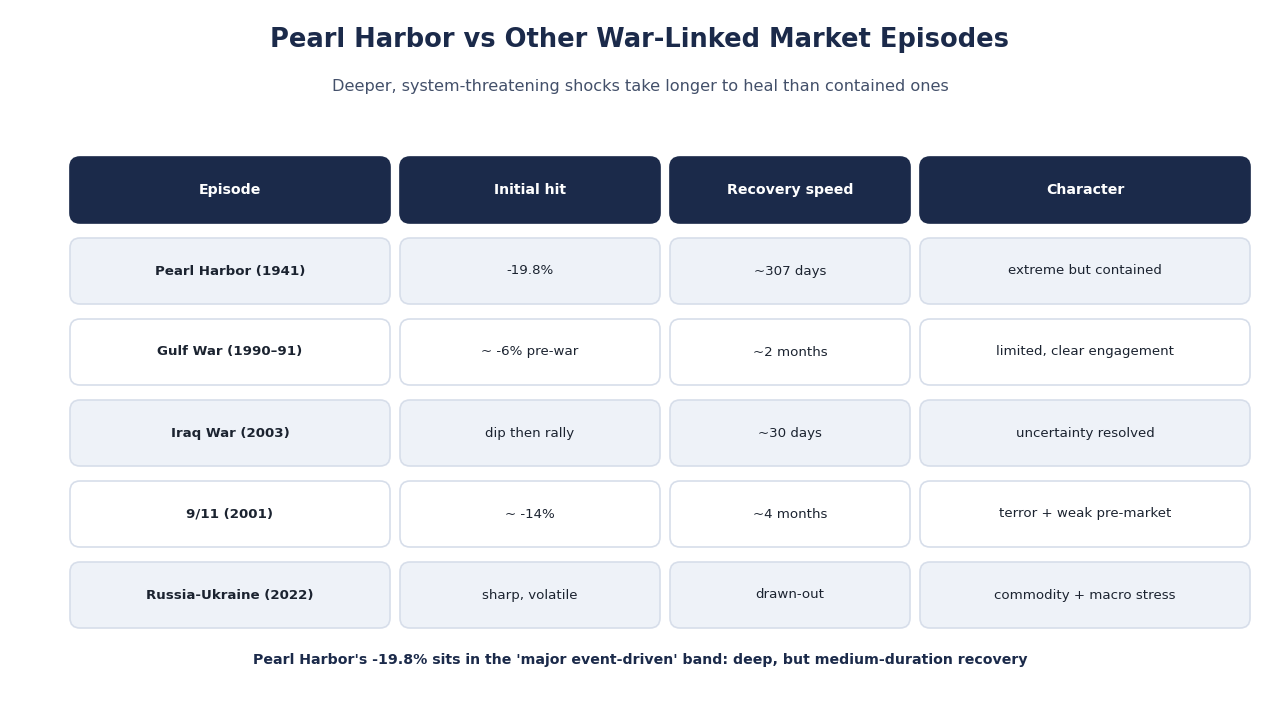
    1. Gulf War (1990–1991)


    The pre-war phase was marked by uncertainty, oil price volatility, and fear about Middle East instability. Once military action began and the strategic path became clearer, markets recovered.


    Similarity to Pearl Harbor: uncertainty mattered more than the mere existence of conflict.

    Difference: the Gulf War involved a more limited and geographically contained engagement for the U.S. economy.


    2. Iraq War (2003)


    The market narrative around the Iraq War often centers on the idea that once invasion uncertainty was resolved, equities rebounded. Again, the market appeared to prefer clarity, even if the underlying event remained serious.


    Similarity: “sell uncertainty, buy clarity” logic.

    Difference: the macro backdrop and monetary conditions were very different.


    3. 9/11 (2001)


    The 9/11 attacks produced profound psychological shock, temporary market closure, and broad fear. But the medium-term market behavior was also shaped by pre-existing tech-bubble damage, which makes it a mixed analog.


    Similarity: national trauma and sudden external shock.

    Difference: the market was already weakened by a structural tech unwind.


    4. Russia-Ukraine War (2022)


    Markets reacted sharply to sanctions, commodity disruption, and inflation implications. Yet the transmission pathway centered heavily on energy, inflation, and monetary policy—not simply on fear.


    Similarity: geopolitical uncertainty triggers cross-asset repricing.

    Difference: inflation and central bank tightening played much larger roles.


    Key Comparative Insight


    EventPrimary Shock TypeRecovery DriverStructural Damage Level
    Pearl Harbor 1941War shock + regime changeFiscal-industrial mobilizationModerate, non-systemic
    Gulf War 1991Oil/geopolitical uncertaintyStrategic clarityLimited systemic damage
    Iraq War 2003Pre-war uncertaintyResolution of uncertaintyLimited systemic damage
    9/11Terror shock + weak pre-existing marketPolicy supportMixed due to tech unwind
    Russia-Ukraine 2022Commodity/geopolitical shockAdaptation and pricing resetPersistent inflation spillovers

    For SimianX AI users, this comparative approach matters because the platform’s value is not just signal generation—it is signal classification. Traders need to know whether they are facing an analog closer to Pearl Harbor, 9/11, or a credit crisis.


    What the Pearl Harbor Crash Teaches About Drawdowns


    The -19.8% drawdown is large enough to create fear, but small enough to suggest that the market never fully embraced a civilization-level collapse scenario.


    This middle-range drawdown is analytically rich because it sits between two extremes:


  • too small to be dismissed as noise
  • too shallow to be a total systemic unraveling

  • Drawdown Interpretation Framework


    When studying any geopolitical market drop, investors can ask:


    1. How deep is the drawdown?

    2. How fast did it happen?

    3. Did volatility spike and then compress?

    4. Did policy respond aggressively?

    5. Did the event damage financial plumbing?

    6. Were there clear sectoral beneficiaries?

    7. Was the recovery earnings-led, liquidity-led, or narrative-led?


    These questions transform a raw number into a usable framework.


    Categories of Drawdowns


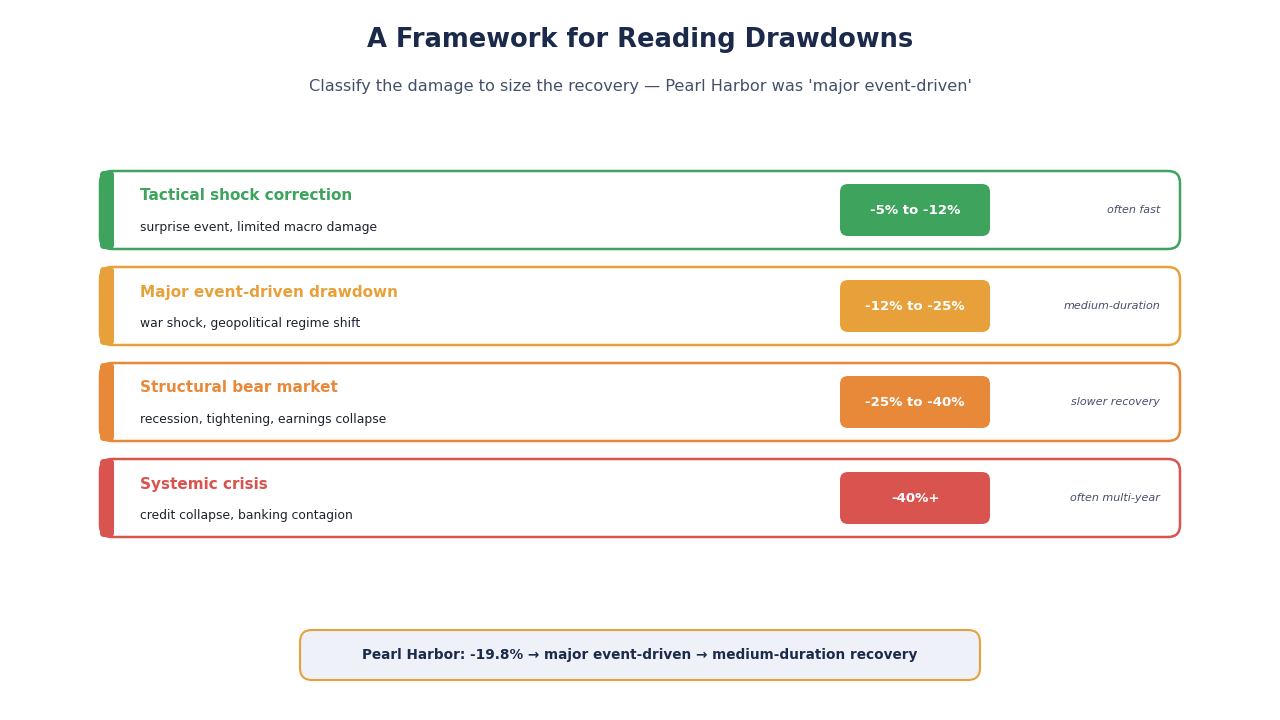
    Drawdown TypeTypical RangeCommon CauseRecovery Profile
    Tactical shock correction-5% to -12%Surprise event, limited macro damageOften fast
    Major event-driven drawdown-12% to -25%War shock, geopolitical regime shiftMedium-duration recovery
    Structural bear market-25% to -40%Recession, prolonged tightening, earnings collapseSlower recovery
    Systemic crisis-40%+Credit collapse, banking contagionOften multi-year

    Pearl Harbor fits most closely into major event-driven drawdown territory.


    Time to Bottom vs Time to Recovery: Why Both Metrics Matter


    Too many analyses focus only on maximum drawdown. But the Pearl Harbor episode becomes more insightful when broken into two separate clocks:


  • time to bottom: 143 days
  • time to recovery: 307 days

  • These clocks measure different market behaviors.


    What Time to Bottom Measures


    Time to bottom reflects:


  • uncertainty digestion speed
  • persistence of fear
  • repeated reassessment of outcomes
  • macro and policy ambiguity

  • What Time to Recovery Measures


    Time to recovery reflects:


  • confidence restoration
  • earnings repricing
  • policy effectiveness
  • capital re-engagement
  • durability of the new narrative

  • A market may bottom quickly but recover slowly. Or it may take time to bottom and then rebound rapidly. Understanding both dimensions provides much more actionable insight.


    Why This Is Useful for Risk Management


    Modern portfolio managers can use this framework to estimate:


  • how long a panic phase might last
  • when to scale in rather than all-in
  • whether to expect violent bear-market rallies
  • how to structure hedges over different time horizons

  • For example:


  • short-horizon traders care about the volatility and retest dynamics during the 143-day descent
  • position traders care about capturing the recovery before consensus is comfortable
  • risk managers care about how long elevated stress remains probable

  • SimianX AI can support all three by combining:


  • market structure signals
  • macro event tracking
  • historical analog detection
  • multi-timeframe technical analysis

  • SimianX AI Multi-timeframe drawdown and recovery timeline comparison
    Multi-timeframe drawdown and recovery timeline comparison

    The Role of Information Flow in 1941 vs Today


    One crucial difference between Pearl Harbor and modern crises is speed of information.


    In 1941:


  • information traveled slower
  • media distribution was less instantaneous
  • institutional analysis had a slower cycle
  • retail participants had fewer real-time tools

  • Today, every crisis unfolds inside a dense network of:


  • social media
  • algorithmic trading
  • newswire alerts
  • options market hedging flows
  • geopolitical OSINT analysis
  • high-frequency repositioning

  • How Faster Information Changes Crises


    Faster information can do two opposite things:


  • accelerate panic, because bad news spreads instantly
  • accelerate stabilization, because uncertainty resolves more quickly

  • That means some modern analogs can experience sharper but shorter reactions than historical events.


    Why Historical Analogies Must Be Adjusted


    A direct comparison between Pearl Harbor and modern markets requires adjusting for:


  • faster liquidity migration
  • ETF and derivative flows
  • real-time macro commentary
  • central bank communication speed
  • broader cross-asset coupling

  • This is one reason AI-driven systems are increasingly valuable. Human intuition alone can struggle to integrate thousands of moving signals during a fast geopolitical shock. SimianX AI can help translate raw event flow into structured market interpretation.


    Pearl Harbor and the Concept of “Priced-In Catastrophe”


    One of the most fascinating questions in historical finance is: How much catastrophe does the market price before the world actually sees the full outcome?


    In the case of Pearl Harbor, the answer appears to be: a lot, but not everything.


    The market likely priced:


  • uncertainty about military outcomes
  • fear of prolonged conflict
  • disruption to expectations
  • loss of confidence

  • But it did not fully price a permanent destruction of U.S. productive capacity. Once that distinction became clearer, the market’s recovery could begin.


    The Three Layers of Catastrophe Pricing


    LayerDescriptionMarket Behavior
    Tactical catastropheImmediate event damageSharp initial selloff
    Strategic catastropheFear of prolonged negative consequencesMedium-duration weakness
    Systemic catastropheFear of total economic breakdownDeep, persistent bear market

    Pearl Harbor triggered the first two layers more strongly than the third. That is a key reason the decline was severe, but not existential.


    Application to Today


    When analyzing modern crises, investors should ask:


  • Is the market pricing tactical damage only?
  • Is it overpricing strategic spillover?
  • Is it mistakenly treating the event as systemic?

  • This framework can be especially powerful in periods of media saturation, when narratives expand faster than fundamentals.


    Lessons for Portfolio Construction


    Historical episodes like Pearl Harbor are not useful only for storytelling. They can directly shape portfolio design.


    Portfolio Lessons From the Pearl Harbor Drawdown


    1. Separate shock risk from solvency risk

    Not every selloff implies a broken system.


    2. Maintain liquidity for redeployment

    Fast recoveries reward those who preserve buying power.


    3. Use phased entry rather than single-point hero trades

    Bottoms are processes, not announcements.


    4. Focus on regime beneficiaries

    Look for sectors aligned with policy and strategic demand.


    5. Expect narrative lag

    The market can start recovering before headlines feel reassuring.


    Example Allocation Logic During Event-Driven Drawdowns


    Portfolio GoalPossible Historical Lesson
    Capital preservationReduce fragile leverage
    Opportunity captureHold tactical dry powder
    Relative outperformanceIdentify regime winners
    Volatility controlUse staggered entries
    Strategic learningCompare with historical analogs

    This does not provide financial advice. It provides a decision framework—the kind of framework that sophisticated users can implement with quantitative overlays, scenario analysis, and AI-driven signal monitoring.


    What SimianX AI Can Add to Historical Event Analysis


    Historical analysis becomes much more powerful when it is connected to live decision support. This is where SimianX AI becomes especially relevant.


    A human researcher can study Pearl Harbor and draw useful lessons. But in real time, markets move too quickly for manual analogy alone. The advantage of a platform like SimianX AI is that it can help bridge:


  • historical precedent
  • live market structure
  • macro event analysis
  • risk-managed execution logic

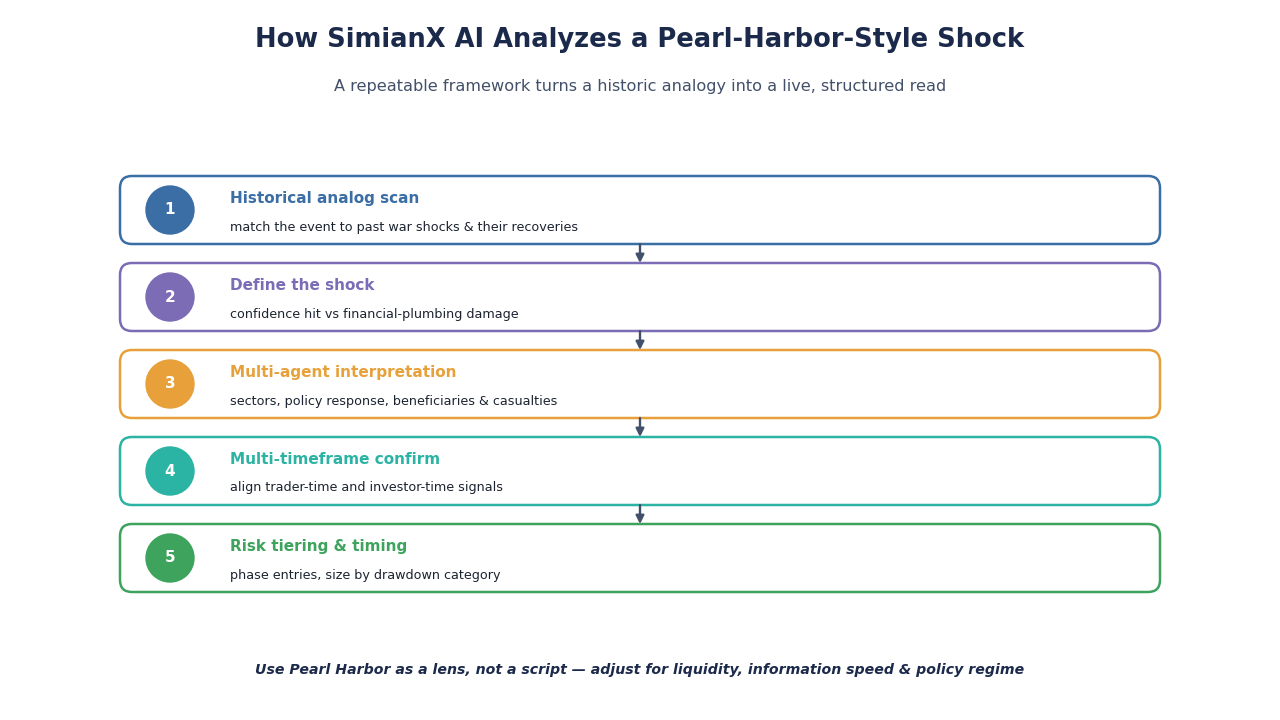
  • Practical Applications of SimianX AI in a Pearl Harbor-Style Framework


    1. Historical Analog Scanning

    SimianX AI can help traders compare current geopolitical shocks with historical episodes based on:


  • drawdown depth
  • volatility behavior
  • recovery speed
  • sector leadership
  • macro regime characteristics

  • 2. Multi-Agent Interpretation

    Because different market shocks have different transmission channels, a multi-agent system is especially useful:


  • a Market Intelligence Agent can track live event flow
  • an Indicator Agent can monitor trend deterioration and reversal signals
  • a Fundamental Agent can assess sector-level implications
  • a Decision Agent can synthesize risk-adjusted actions

  • 3. Multi-Timeframe Confirmation

    Pearl Harbor-style insights are only useful if they can be translated across time horizons:


  • 1m and 5m for event reaction
  • 1h and 4h for trend transition
  • 1d for recovery structure
  • macro overlays for narrative stability

  • 4. Risk Tiering

    Not every geopolitical shock deserves the same response. SimianX AI can help classify scenarios into:


  • low spillover tactical event
  • medium spillover event-driven correction
  • high spillover regime shock
  • systemic destabilization risk

  • This kind of classification is where historical case studies become operational rather than decorative.


    SimianX AI AI-based geopolitical market analysis dashboard
    AI-based geopolitical market analysis dashboard

    A Step-by-Step Framework for Analyzing Future War Shocks


    The Pearl Harbor case can be generalized into a practical framework for future events.


    How should investors analyze a Pearl Harbor-style market shock today?


    When a modern geopolitical shock occurs, investors can use the following process.


    Step 1: Define the Nature of the Shock

    Ask whether the event is:


  • surprise attack
  • escalation of an ongoing conflict
  • symbolic shock
  • supply chain disruption
  • energy market threat
  • cyber/financial infrastructure threat

  • Step 2: Measure Financial Plumbing Risk

    Determine whether the event threatens:


  • banking stability
  • funding markets
  • payment systems
  • sovereign credit
  • collateral chains

  • If yes, the event may resemble a systemic crisis more than a Pearl Harbor-type shock.


    Step 3: Estimate Policy Response Direction

    Will governments likely respond with:


  • fiscal stimulus
  • defense spending
  • sanctions
  • industrial reshoring
  • energy intervention
  • central bank backstops

  • Step 4: Identify Potential Beneficiaries and Casualties

    Map the likely winners and losers.


    Step 5: Track Time-Based Signals

    Use the two key clocks:


    1. time to bottom

    2. time to recovery


    Step 6: Watch for Narrative Consolidation

    The market begins to heal when the dominant narrative becomes actionable.


    Step 7: Phase Entries and Risk Controls

    Avoid binary decision-making. Use staggered positioning and dynamic risk rules.


    This framework helps turn history into process. That is the real analytical value of the Pearl Harbor episode.


    Pearl Harbor as a Study in National Mobilization and Market Confidence


    Another reason the Pearl Harbor market episode is so important is that it illustrates the relationship between national mobilization and market confidence.


    Confidence in markets is not merely confidence in prices. It is confidence in:


  • institutions
  • policy capacity
  • productive potential
  • social coordination
  • long-term continuity

  • After Pearl Harbor, the U.S. did not present as a collapsing nation. It presented as a nation moving rapidly into organized mobilization. That matters enormously for market confidence.


    Confidence Is Institutional, Not Just Emotional


    Investors gain confidence when they believe:


  • the state can respond
  • industry can adapt
  • capital markets will remain functional
  • demand will not vanish permanently
  • strategic direction is coherent

  • This is why some geopolitical shocks become contained drawdowns, while others turn into deep crises. The question is not just “what happened?” It is also “what does the event reveal about institutional capacity?”


    Relevance for Contemporary Markets


    In modern shocks, traders should evaluate:


  • fiscal space
  • industrial readiness
  • energy resilience
  • alliance structure
  • sanctions durability
  • technological self-sufficiency
  • central bank coordination

  • These factors influence whether a shock becomes a confidence rupture or a confidence reset.


    Why the Recovery Timeline Matters for Long-Term Investors


    The 307-day recovery after Pearl Harbor offers another crucial lesson: markets can recover on a timescale that feels long in daily trading, but short in strategic capital allocation.


    The Difference Between Trader Time and Investor Time


    PerspectiveA 307-Day Recovery Feels Like
    Day traderExtremely long
    Swing traderMajor regime shift
    Portfolio managerManageable but painful
    Long-term investorHistorically fast

    This is important because investor mistakes often come from time-horizon mismatch. Someone with long-term capital may sell because short-term volatility feels unbearable. But if the event is historically more similar to Pearl Harbor than to a depression-level collapse, premature liquidation can destroy long-term returns.


    The Strategic Takeaway


    Recovery timelines should shape position sizing and emotional discipline. Investors who understand that a war shock may produce a medium-depth but sub-one-year recovery profile may react very differently than those who assume every crisis becomes a decade-long loss.


    The Limits of Historical Analogy


    Even though Pearl Harbor is a powerful case study, it is essential to acknowledge the limits of analogy.


    Historical Analogies Can Mislead When:


  • the monetary regime is different
  • debt burdens are much higher
  • inflation dynamics are structurally changed
  • financialization is deeper
  • derivative leverage amplifies contagion
  • geopolitical blocs are configured differently
  • public policy credibility is weaker

  • That is why historical work must be interpretive, not mechanical.


    Use Pearl Harbor as a Lens, Not a Script


    The right approach is not:


    “This event is exactly like Pearl Harbor, so the market will recover in 307 days.”

    The better approach is:


    “Pearl Harbor shows how a severe geopolitical shock can produce a medium-depth drawdown and relatively fast recovery when productive capacity, policy response, and strategic clarity remain strong.”

    That distinction preserves analytical humility while still extracting practical value.


    FAQ About the Pearl Harbor 1941 Market Crash


    How did the stock market react after Pearl Harbor in 1941?

    The market reacted with a sharp decline as investors repriced wartime uncertainty, fear, and unknown strategic consequences. The broader drawdown eventually reached about -19.8%, showing a significant but non-systemic correction profile.


    Why did the market bottom 143 days after Pearl Harbor instead of immediately?

    Markets usually need time to absorb uncertainty, test policy assumptions, and reprice earnings expectations. The 143-day path to bottom reflects the gradual shift from panic to adaptation rather than a one-day full repricing.


    Why was the recovery after Pearl Harbor relatively fast?

    The recovery was supported by wartime industrial mobilization, strong government spending, rising production, and restored confidence in national capacity. Because the crisis did not destroy financial plumbing, the recovery could proceed faster than in systemic credit events.


    What is the main lesson of the Pearl Harbor market crash for modern investors?

    The core lesson is that geopolitical shocks are not automatically systemic financial collapses. Investors must distinguish between temporary uncertainty, long-term economic damage, and policy-driven opportunity.


    How can traders use AI to study events like the Pearl Harbor crash?

    AI tools can compare current events to historical analogs, track volatility and sentiment shifts, identify sector beneficiaries, and support multi-timeframe decision-making. Platforms like SimianX AI make this process more structured and actionable.


    Turning Historical Insight Into Modern Market Intelligence


    The greatest value of the Pearl Harbor 1941 market crash is not simply that it happened, nor even that it produced memorable statistics. Its enduring value lies in the framework it offers.


    It teaches that markets respond to crises in layers:


  • first with emotion
  • then with interpretation
  • then with discrimination
  • then with recovery

  • It shows that drawdown depth alone is not enough. Investors must also study:


  • time to bottom
  • time to recovery
  • sector rotation
  • policy response
  • liquidity conditions
  • institutional resilience

  • And perhaps most importantly, it demonstrates that extreme headlines do not always translate into permanent market destruction.


    For researchers, traders, and investors, this is where modern tools become decisive. SimianX AI can help transform historical understanding into real-time analysis by combining macro awareness, technical structure, analog pattern recognition, and AI-assisted decision support. Instead of reacting only to fear, users can build a disciplined framework for interpreting shocks, managing drawdowns, and identifying when panic is giving way to opportunity.


    Conclusion


    The Pearl Harbor 1941 Market Crash: -19.8% Drawdown, 143-Day Bottom, 307-Day Recovery remains one of the clearest examples of how markets process a major geopolitical shock without collapsing into systemic ruin. The decline was serious, the uncertainty was real, and the fear was justified—but the recovery proved that productive capacity, policy support, and institutional confidence can turn even a historic trauma into a tradable transition rather than a permanent financial breakdown.


    For modern market participants, the lesson is not that every war shock will resolve neatly. The lesson is that classification matters. Some crises destroy liquidity. Some destroy confidence. Some redirect capital. Some create new industrial winners. The ability to tell the difference is where edge is created.


    That is why historical analysis still matters—and why tools like SimianX AI are increasingly valuable. By combining past analogs with live data, multi-agent reasoning, and risk-aware workflows, SimianX AI can help traders and investors turn events like Pearl Harbor from retrospective history into practical market intelligence.


    If you want to move beyond headlines and study geopolitical drawdowns with deeper structure, explore SimianX AI and use history not just to remember the past, but to interpret the next shock more intelligently.

    Ready to Transform Your Trading?

    Join thousands of investors using AI-powered analysis to make smarter investment decisions