
 By Muke
Dow Jones Risk Pulse: AI Signals from Market Breadth, VIX Regimes & Credit Spreads
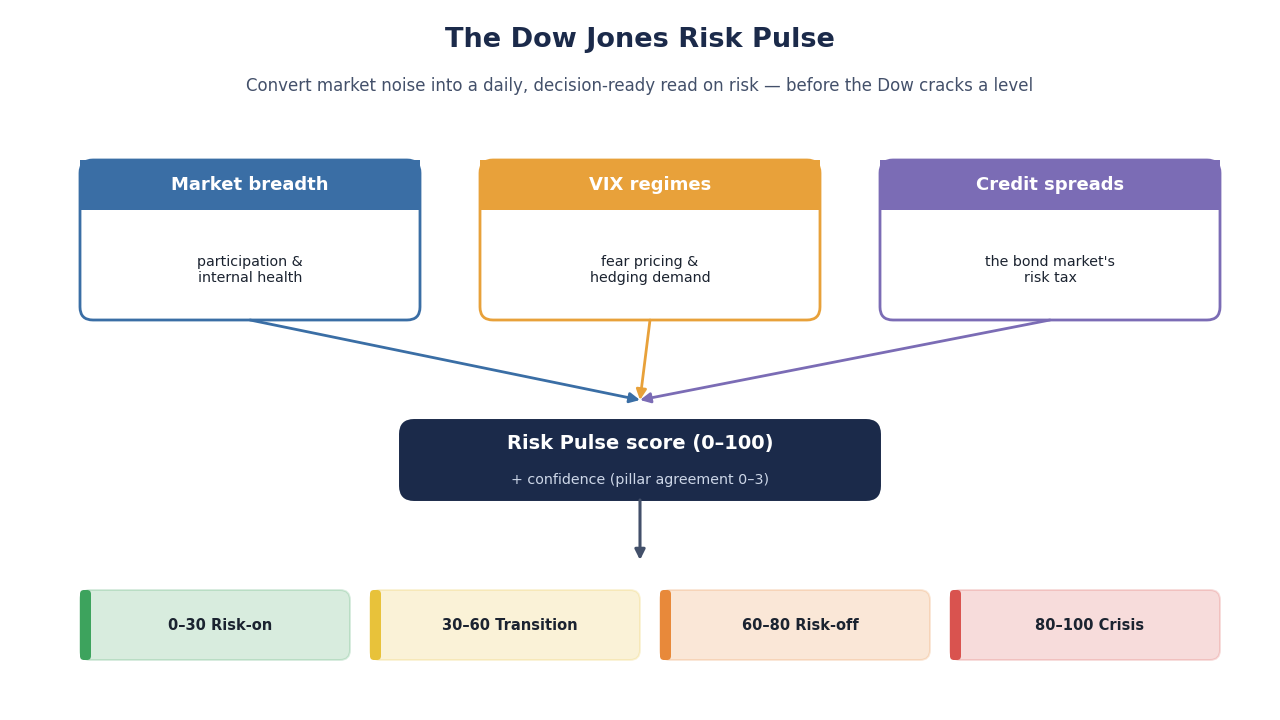
A Dow Jones Risk Pulse is a structured way to convert “market noise” into a daily, decision-ready read on risk conditions—using three inputs that consistently matter when drawdowns begin: market breadth, VIX volatility regimes, and credit spreads. Instead of reacting after the Dow cracks a key level, a Risk Pulse helps you recognize when the probability of stress is rising (or fading) so you can size exposure, hedge intelligently, and avoid overconfidence in fragile rallies.
If you want to operationalize this kind of workflow with explainable summaries and repeatable dashboards, platforms like SimianX AI can help you compress multi-market signals into a single, interpretable “risk posture” you can use every day—without juggling ten tabs and a spreadsheet.
Why the Dow Jones needs a “Risk Pulse” (and why price alone isn’t enough)
The Dow Jones Industrial Average (DJIA) is often treated as a headline index: “the Dow was up/down X points.” But from a risk-management perspective, the Dow can be deceptively calm right before turbulence:
- It’s concentrated (30 components), so a handful of names can mask internal weakness.
- Big “defensive” components can soften index-level volatility while the broader market deteriorates.
- Volatility and credit markets often “sniff out” stress before equities show it cleanly.
A Risk Pulse solves a practical problem:
You don’t need perfect prediction. You need early, explainable evidence that risk conditions are changing—so you can adjust before drawdowns force you to.
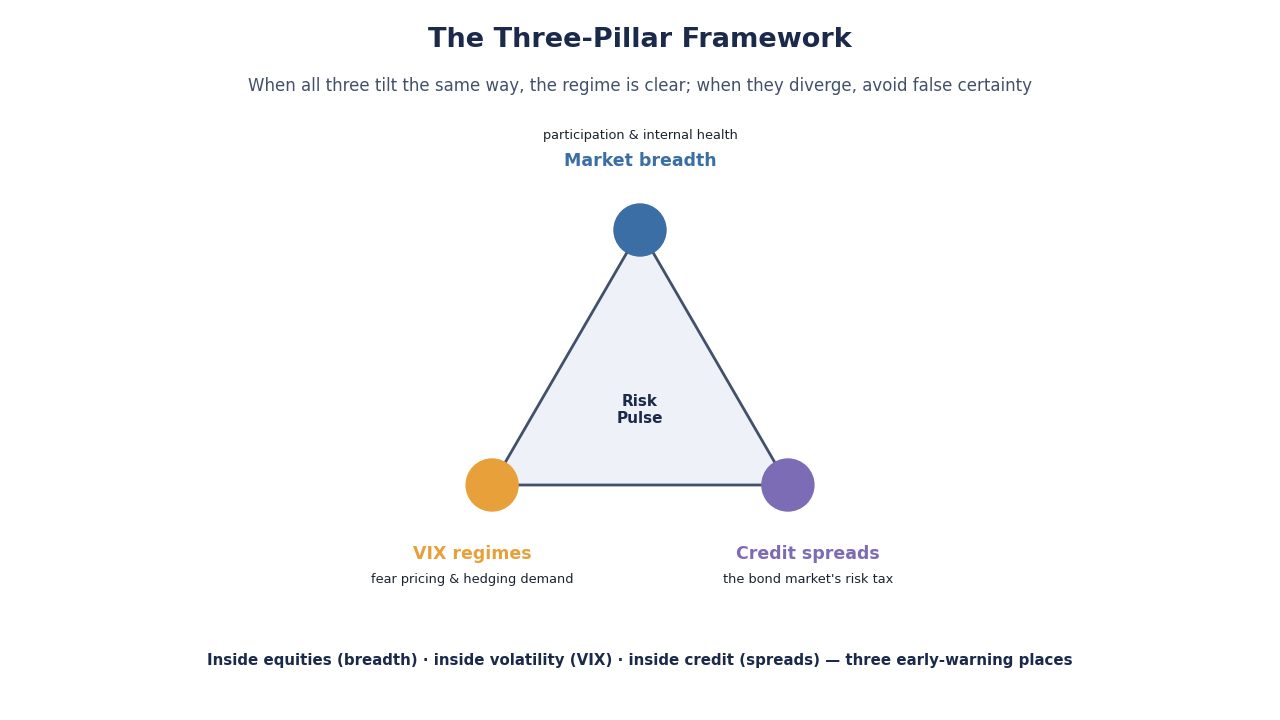
In practice, the best early evidence usually appears in three places:
- Inside equities (breadth): participation and internal health
- Inside volatility (VIX regimes): pricing of fear, hedging demand, and uncertainty
- Inside credit (spreads): the bond market’s “risk tax” and funding stress
When these three tilt in the same direction, the regime becomes clearer. When they diverge, the Risk Pulse helps you avoid false certainty.
The three pillars of a Dow Jones Risk Pulse (what each actually measures)
Pillar 1 — Market breadth: participation and internal “immune system”
Market breadth answers a simple question:
Is strength broad and healthy, or narrow and fragile?
Even if you trade the Dow (or DIA), breadth is often best measured across a wider universe (NYSE, large-cap universe, or an index breadth proxy) because risk regimes are systemic. You want to know whether many stocks are participating or whether the market is being carried by a shrinking set of leaders.
High-utility breadth metrics for a Dow Jones Risk Pulse:
- Advance/Decline (A/D) line: cumulative advancers minus decliners (participation trend)
- % of stocks above key moving averages (e.g., 50D / 200D): trend participation
- New highs vs. new lows: momentum participation and exhaustion
- Equal-weight vs cap-weight ratios: leadership concentration (broad vs narrow)
- Sector breadth: how many sectors are improving vs stalling
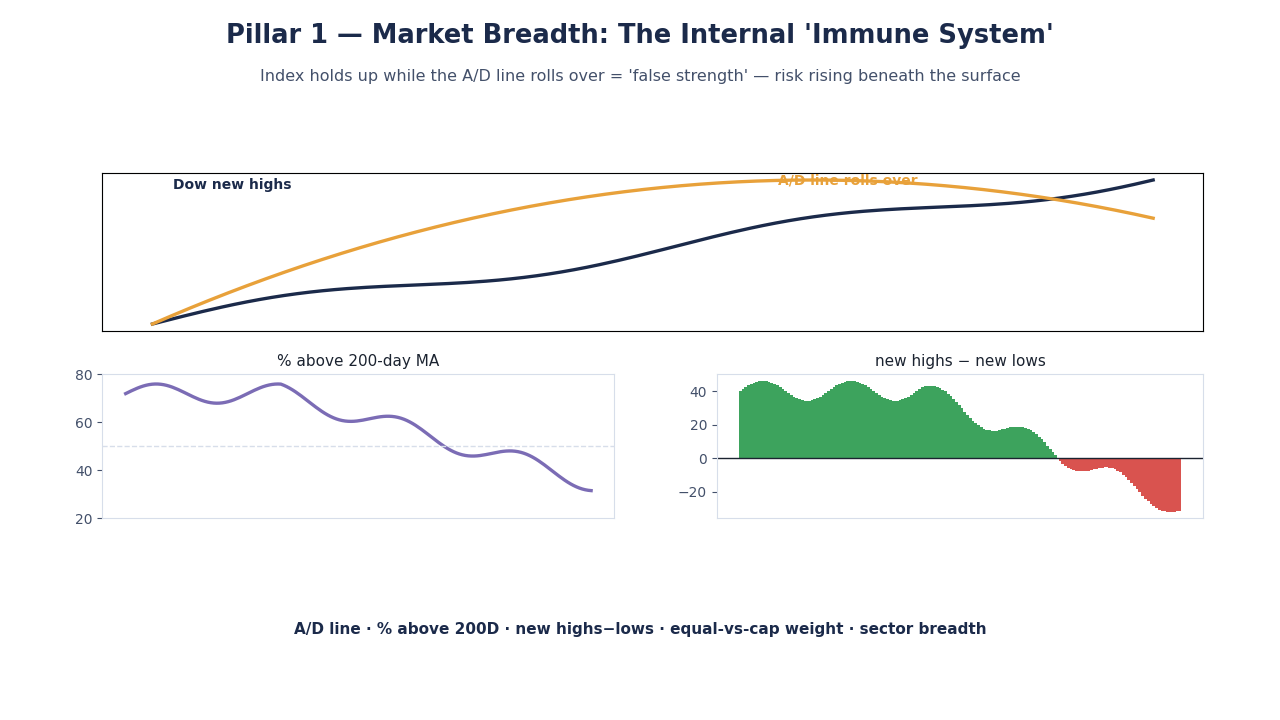
Breadth deterioration often looks like:
- Index holds up, but A/D line rolls over
- Fewer stocks remain above the 200D
- New lows expand even while headlines stay “fine”
- Leadership narrows to defensives or a small mega-cap cluster
Breadth is your early warning against “false strength.”
When price looks stable but participation weakens, risk is often rising beneath the surface.
Pillar 2 — VIX regimes: volatility as a market “weather system”
The VIX is often described as “the fear index,” but for a Risk Pulse it’s more useful to treat VIX as a regime variable: it reflects how the market is pricing uncertainty, hedging demand, and left-tail risk.
A simple VIX level threshold is not enough. What matters is:
- Regime (low / normal / elevated / stress)
- Direction and speed (rising fast vs drifting)
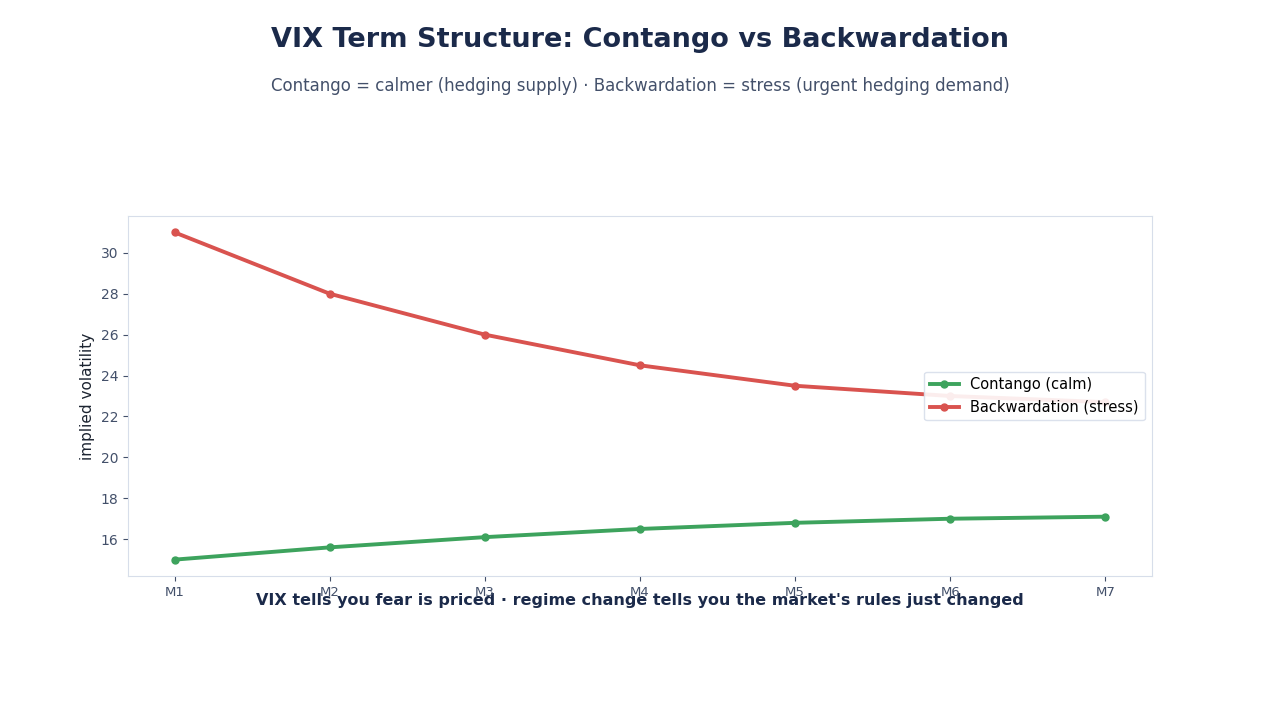
- Term structure (contango vs backwardation)
- Confirmation from related volatility signals (short-dated vol, vol-of-vol)
Why regimes matter:
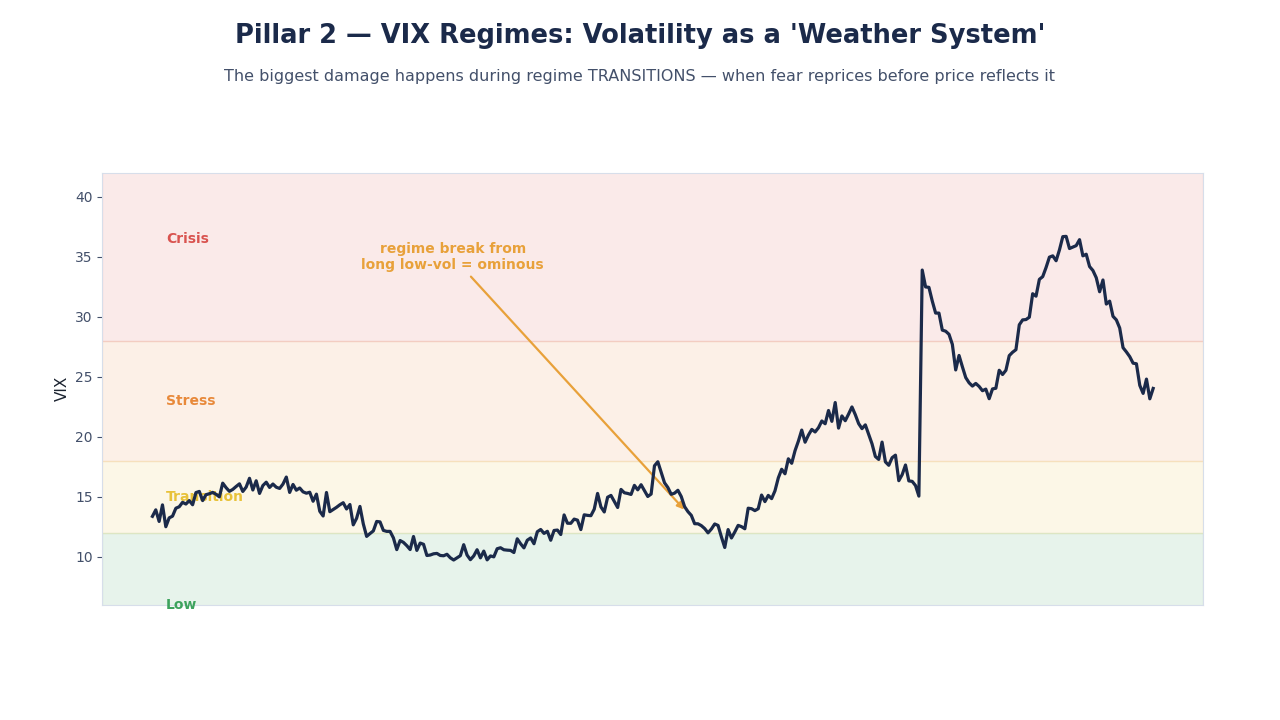
A VIX of 18 can be calm in one environment and ominous in another if it’s breaking upward from a long low-vol regime. Conversely, a VIX of 28 might be improving if it’s falling rapidly after a shock and credit spreads are stable.
A practical regime lens:
- Low-vol regime: risk-on, complacency (but watch for regime breaks)
- Transition regime: uncertainty rising, hedging demand increasing
- Stress regime: volatility bid + correlation rising + fragility
- Crisis regime: disorderly repricing; risk controls dominate return seeking
Key insight: The biggest damage often happens during regime transitions, when the market is repricing uncertainty but price hasn’t fully reflected it yet.
Pillar 3 — Credit spreads: the bond market’s “risk tax”
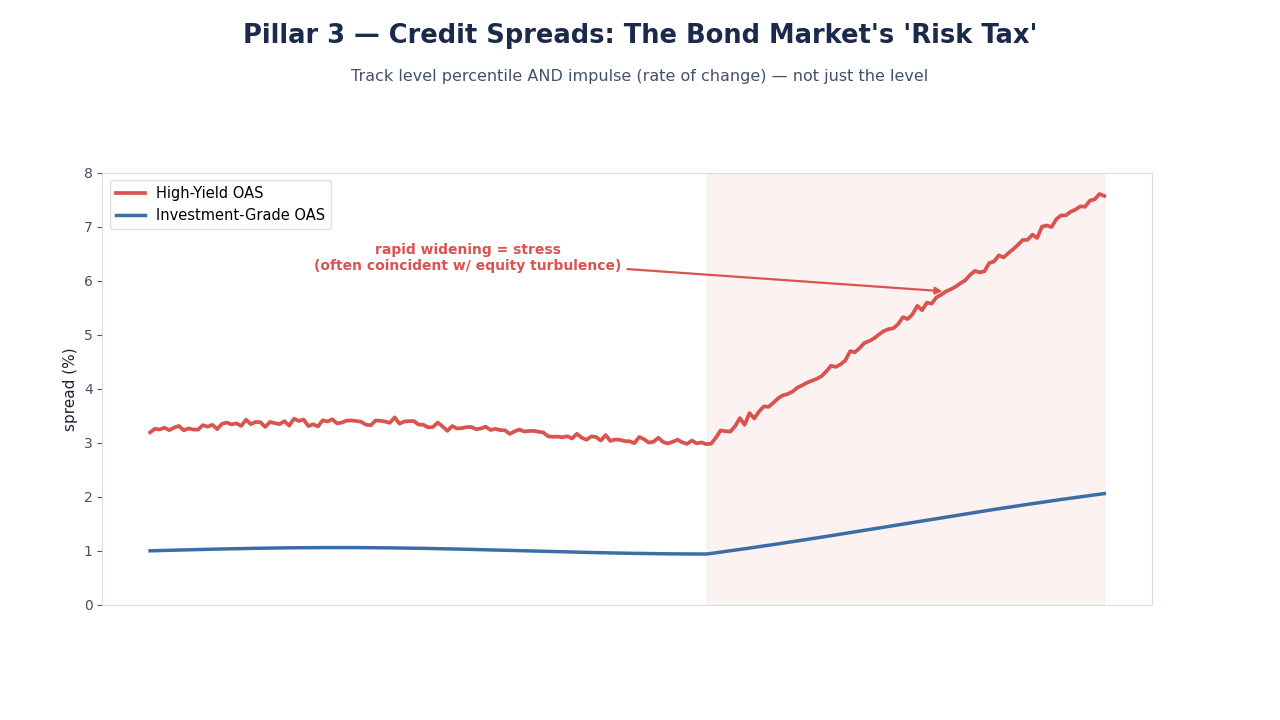
Credit spreads measure how much extra yield investors demand to hold corporate credit relative to safer benchmarks. Spreads embed default risk, liquidity risk, and risk appetite—often adjusting before equities fully react.
For a Risk Pulse, the most useful separation is:
- Investment Grade (IG) spreads: early caution, macro softening, tightening conditions
- High Yield (HY) spreads: sharper stress, higher drawdown probability, risk-off pressure
How to read spreads in a risk framework:
- Tightening spreads → risk-on tailwind (conditions easing)
- Widening spreads → risk-off pressure (conditions tightening)
- Rapid widening → stress signal, often coincident with equity turbulence
A common mistake is watching only the level. A better approach:
- track percentiles (where are we vs history?)
- track impulse (how quickly are spreads changing?)
- combine with breadth (is equity internals confirming?)
How do you build a Dow Jones Risk Pulse score step by step?
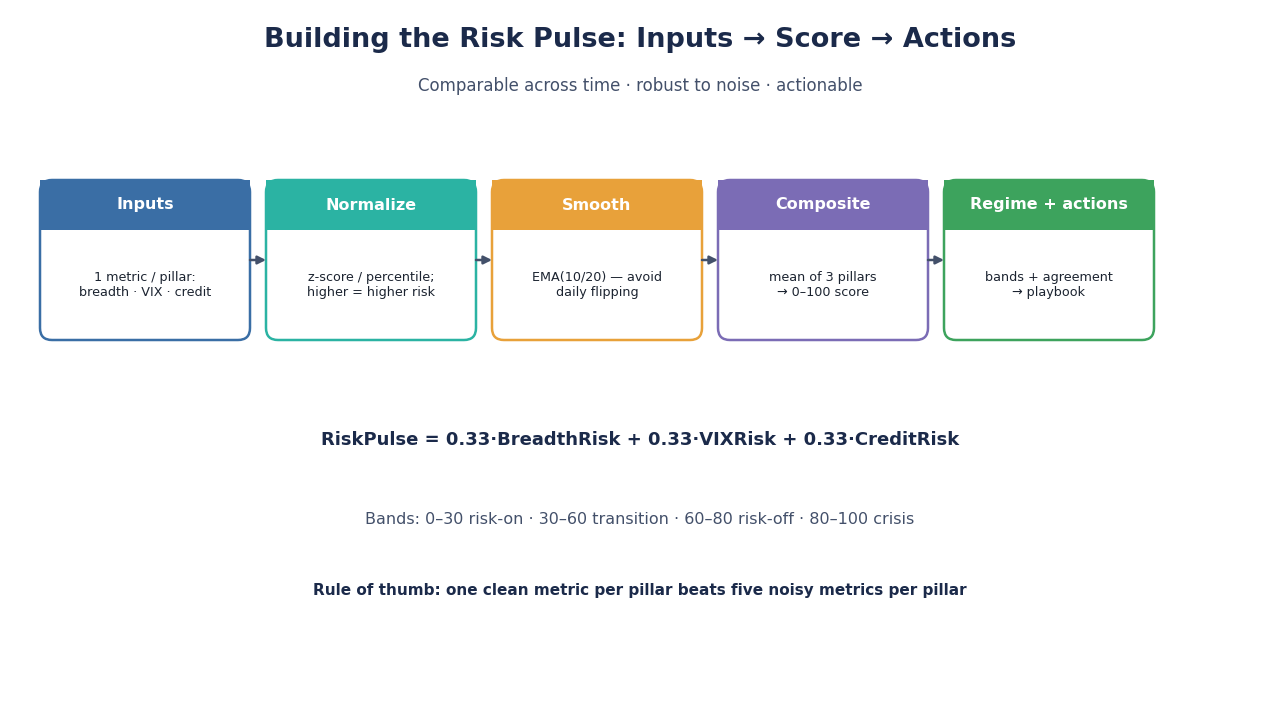
A Dow Jones Risk Pulse works best when it’s:
- Comparable across time (standardization like z-scores or percentiles)
- Robust to noise (smoothing + regime logic)
- Actionable (clear thresholds + playbooks)
Here’s a practical build process you can implement with basic market data.
Step 1: Choose a “minimum viable” input set (one per pillar)
A strong starting set:
Breadth (daily):
- A/D line (or daily net advancers)
- % above 200D (broad universe)
- New highs minus new lows (optional)
Volatility (daily):
- VIX level
- VIX change (1D, 5D)
- Term structure proxy (optional)
Credit (daily/weekly):
- HY spread (OAS or proxy)
- IG spread (optional)
- Spread change (impulse)
Rule of thumb: One clean metric per pillar beats five noisy metrics per pillar.
Step 2: Normalize each input (so they’re comparable)
You want all inputs in a comparable “risk units” format.
Common options:
- Z-score over a rolling window (e.g., 252 trading days)
- Percentile rank over a rolling window
- Min-max scaling (less robust during crises)
A practical approach:
- Use percentiles for interpretability (0–100)
- Use z-scores for modeling and composites
Direction matters. Standardize so that:
- higher score = higher risk
- lower score = lower risk
Examples:
- Breadth improving should reduce risk score → invert breadth metrics
- VIX rising should increase risk score
- Spreads widening should increase risk score
Step 3: Smooth the noise (but keep regime shifts)
Markets are noisy. Your Risk Pulse should avoid flipping every day.
Typical smoothing:
EMA(10)orEMA(20)on the normalized inputs- Or apply smoothing to the final composite
Step 4: Combine into a composite Risk Pulse
Start simple:
- Equal weights (1/3 each pillar), then improve later
- Or weight based on your objective (drawdown avoidance vs participation)
A simple composite:
RiskPulse = 0.33*BreadthRisk + 0.33*VIXRisk + 0.33*CreditRisk
Then convert to a clean 0–100 score:
- 0–30 = risk-on
- 30–60 = neutral/transition
- 60–80 = risk-off
- 80–100 = crisis
Step 5: Add regime logic (so the score becomes tradable)
This is where the Pulse becomes useful.
Example rules:
- If VIXRisk spikes but CreditRisk stays calm, treat as transient risk unless breadth breaks too
- If CreditRisk rises + BreadthRisk rises, treat as structural risk even if VIX is lagging
- If all three align, treat as high-confidence regime
Pillar 1 deep-dive: the best market breadth signals for Dow risk
Breadth can be measured many ways. For a Dow Jones Risk Pulse, focus on breadth signals that identify participation, trend health, and momentum exhaustion.
1) Advance/Decline (A/D) line: the participation trend
The A/D line is one of the cleanest “internal health” indicators:
- Rising A/D line = broad participation
- Falling A/D line = shrinking participation
Risk pattern:
- If the Dow rises but the A/D line makes lower highs, the rally is often fragile.
Practical use:
- Use a rolling slope (e.g., 20D slope) as the signal.
- Invert it into a risk score: weaker slope = higher risk.
2) % of stocks above 200D: structural trend health
This tells you how many stocks are in long-term uptrends.
Interpretation:
- 70–90% above 200D: strong regime (but watch for overheating)
- 40–60%: mixed
- <40%: weakening structure, higher drawdown risk
Why it matters:
Major drawdowns usually arrive after structural participation has already eroded.
3) New highs vs new lows: momentum participation and exhaustion
New highs expanding confirms trend strength. New lows expanding is often an early warning.
Key behavior to watch:
- New lows rising while the index is near highs
- Highs shrink while lows expand (classic late-cycle behavior)
4) Equal-weight vs cap-weight: leadership concentration
Even if you don’t trade equal-weight products, the ratio helps answer:
Is leadership broad, or is the market being “carried”?
If cap-weight outperforms equal-weight persistently, leadership is narrowing—often a risk build-up signal.
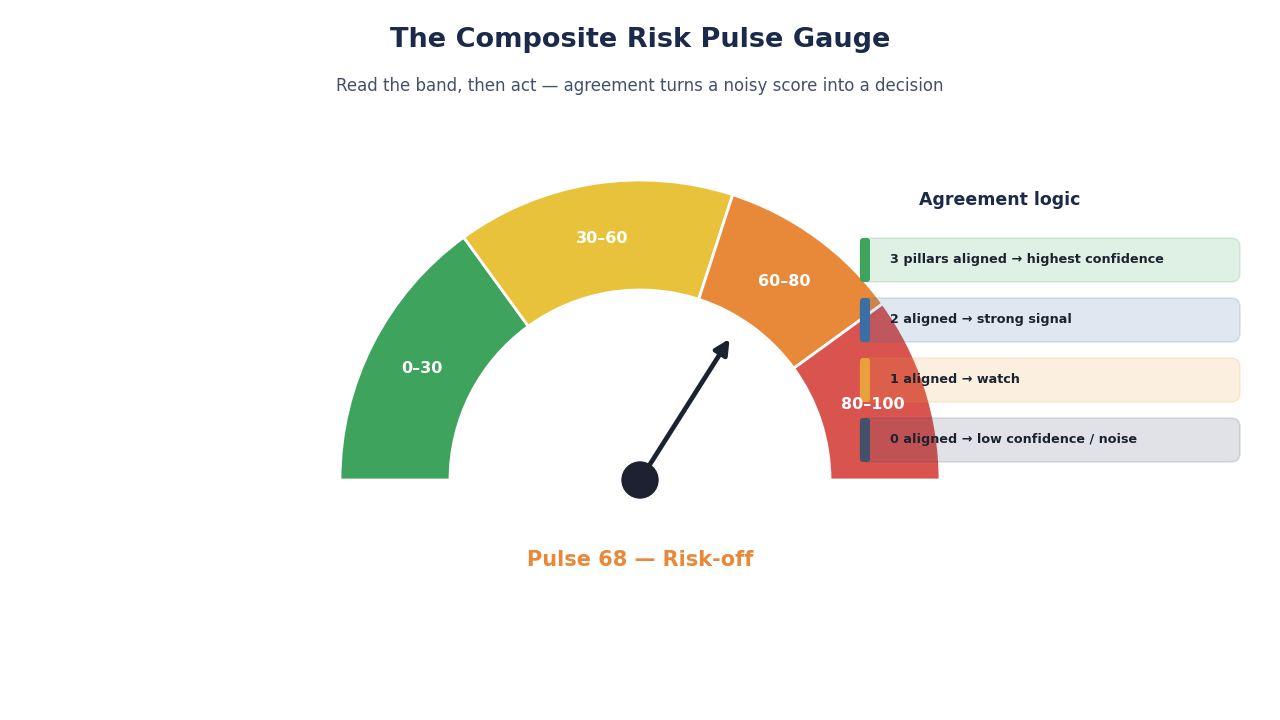
5) Sector breadth: where weakness starts
Sector breadth helps you diagnose what kind of risk is emerging:
- cyclicals weakening first → growth slowdown / tightening conditions
- defensives leading → risk-off rotation
- financials breadth breaking → credit/funding stress often not far behind
Breadth is diagnostic, not just predictive.
It tells you what is weakening, which helps you choose the right hedge.
Pillar 2 deep-dive: VIX regimes that matter for Dow positioning
A VIX regime framework helps you avoid two common mistakes:
1) treating every VIX uptick as a crash signal
2) ignoring volatility regime shifts until it’s too late
A practical VIX regime classification
One effective method is to use percentiles:
- Low regime: VIX < 30th percentile
- Normal regime: 30–60th percentile
- Elevated regime: 60–85th percentile
- Stress regime: >85th percentile
Then add momentum:
- VIX rising fast = risk rising
- VIX falling fast = risk improving
Term structure: contango vs backwardation (optional but powerful)
Even if you don’t model futures directly, a term structure proxy is valuable:
- Contango often aligns with calmer conditions (hedging supply)
- Backwardation often aligns with stress (urgent hedging demand)
Short-dated volatility: “panic detection”
If you have access to short-dated vol (like 9-day measures), it can help detect:
- sudden hedging demand
- event-driven fear
- “panic spikes” that may fade quickly unless confirmed by credit and breadth
Vol-of-vol: when the market is unstable
Volatility of volatility can rise before or during stress regimes. If vol-of-vol rises while credit spreads widen and breadth breaks, the risk regime is often more dangerous.
Useful shortcut:
VIX tells you fear is being priced.
Regime change tells you the market’s rules just changed.
Pillar 3 deep-dive: credit spreads as the “hidden stress” signal
Credit spreads are the slow, heavy signal that often confirms whether volatility is “real.”
Why IG and HY spreads behave differently
- IG spreads often widen first in macro slowdowns, risk repricing, or liquidity tightening
- HY spreads tend to widen more violently when default risk and growth fear rise
The most actionable spread features
1) Level percentile
- Where are spreads relative to the last 1–3 years?
2) Impulse (rate of change)
- Is the spread widening rapidly over 5–20 days?
3) Confirmation
- Are spreads widening while breadth weakens and VIX rises?
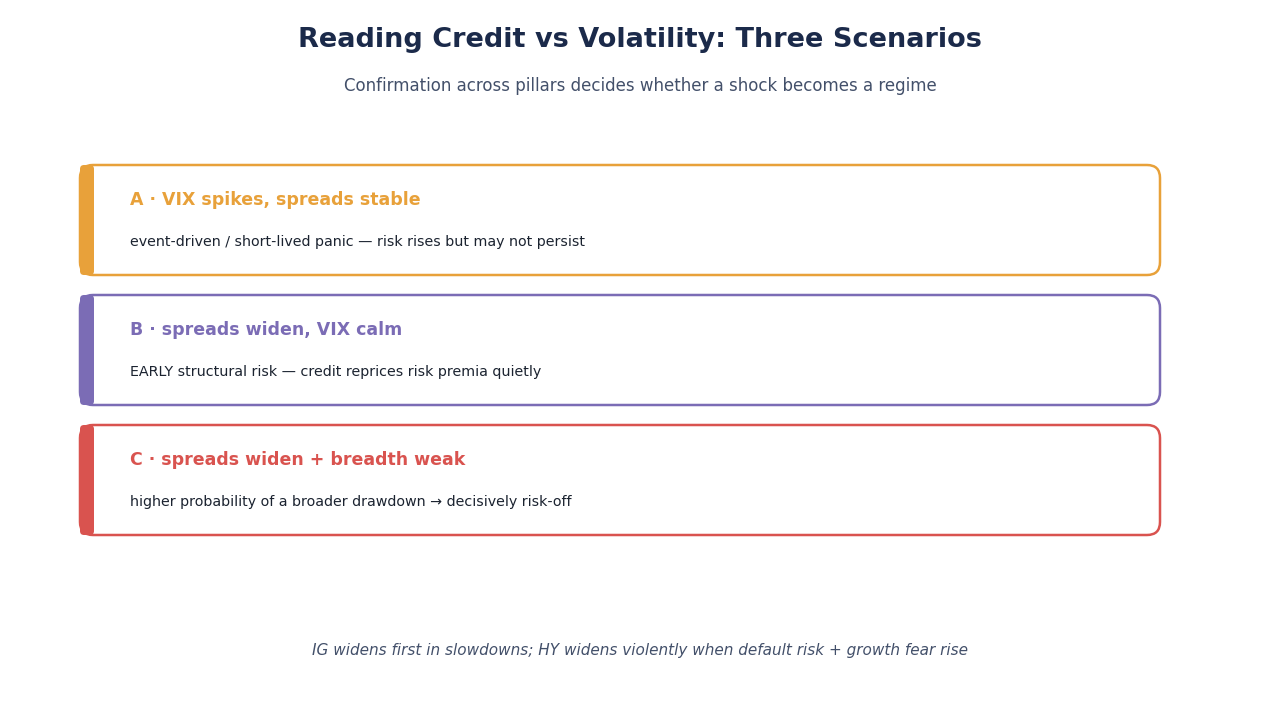
Interpreting common situations
Scenario A: VIX spikes, spreads stable
- Often event-driven volatility or short-lived panic
- Risk rises, but regime may not persist unless spreads start widening
Scenario B: spreads widen, VIX not yet exploding
- Often early structural risk
- The credit market is repricing risk premia quietly
Scenario C: spreads widen + breadth deteriorates
- Higher probability the equity drawdown becomes broader
- Risk Pulse should move decisively toward risk-off
Turning the three pillars into a tradable Dow Jones Risk Pulse
Now let’s combine the pillars into a signal you can actually use.
A simple, robust composite (baseline model)
Inputs (example):
- BreadthRisk = average of:
- inverted A/D slope percentile
- inverted % above 200D percentile
- VIXRisk = average of:
- VIX percentile
- VIX 5D change percentile
- CreditRisk = average of:
- HY spread percentile
- HY spread 10D change percentile
Composite:
RiskPulse = mean(BreadthRisk, VIXRisk, CreditRisk)
Then apply:
- smoothing (
EMA(10)orEMA(20)) - regime bands (0–30, 30–60, 60–80, 80–100)
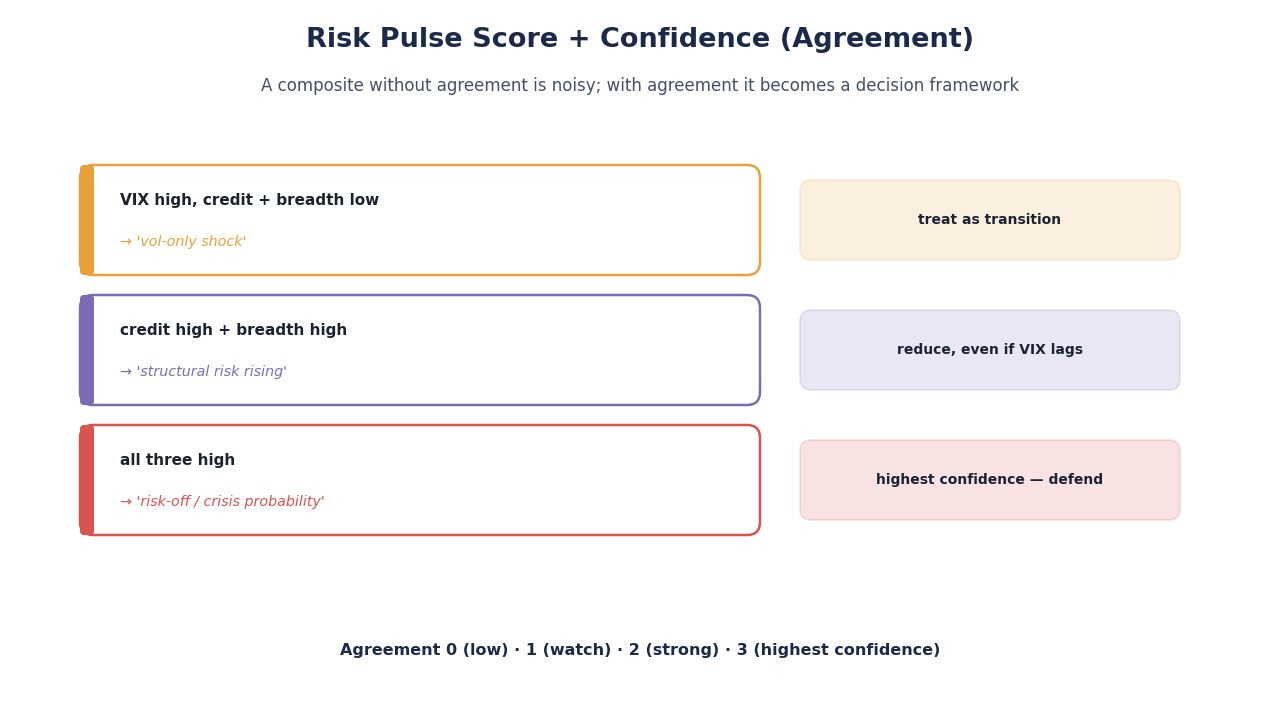
Improve it with “agreement logic” (confidence scoring)
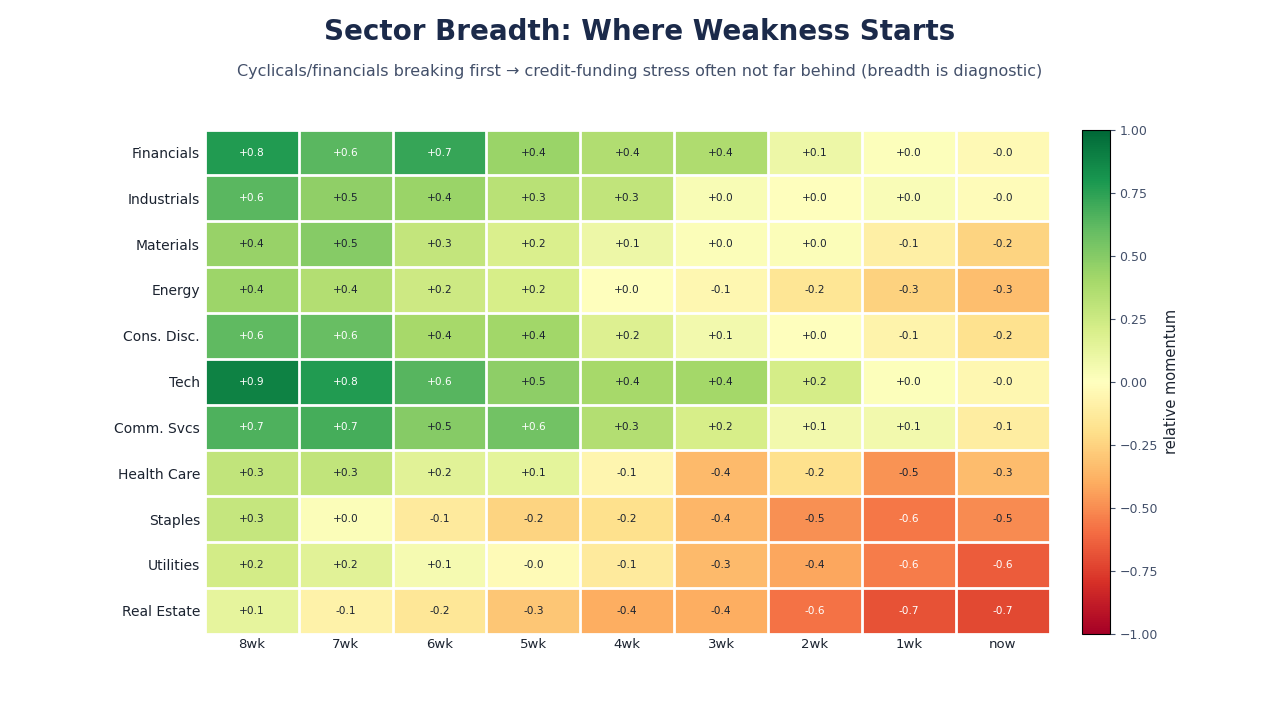
A clean enhancement is to compute agreement:
- 0 pillars aligned (low confidence)
- 1 pillar aligned (watch)
- 2 pillars aligned (strong)
- 3 pillars aligned (highest confidence)
Example:
- If VIXRisk is high but CreditRisk is low and BreadthRisk is low → “vol-only shock”
- If CreditRisk is high and BreadthRisk is high → “structural risk rising”
- If all three high → “risk-off / crisis probability elevated”
A composite without agreement can be noisy.
A composite with agreement becomes a decision framework.
A practical playbook: what to do in each Risk Pulse regime
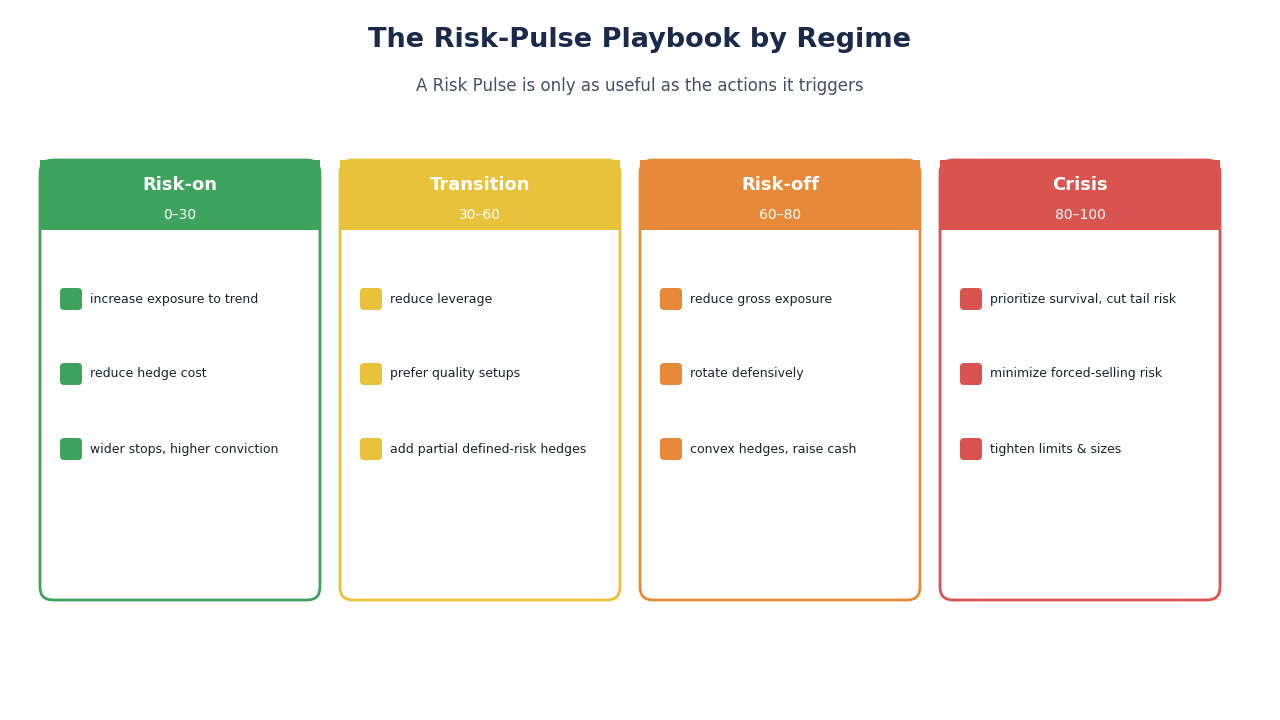
A Risk Pulse is only as useful as the actions it triggers.
Regime 1: Risk-on (Pulse 0–30)
Typical conditions:
- breadth improving
- VIX stable/low
- credit spreads tightening or stable
Practical stance:
- increase exposure to primary trend
- reduce hedge cost
- allow trades more time (wider stops, higher conviction)
Regime 2: Neutral / Transition (Pulse 30–60)
Typical conditions:
- signals diverge (e.g., VIX rising but credit stable)
- breadth softens, but not broken
- market becomes “headline-sensitive”
Practical stance:
- reduce leverage
- prefer quality setups over marginal trades
- add partial hedges (defined-risk hedges)
- tighten risk controls
Regime 3: Risk-off (Pulse 60–80)
Typical conditions:
- breadth breaking
- VIX elevated and rising
- spreads widening (especially HY)
Practical stance:
- reduce gross exposure
- rotate defensively
- raise cash buffer
- use hedges with meaningful convexity
Regime 4: Crisis (Pulse 80–100)
Typical conditions:
- widespread breadth deterioration
- VIX stress regime
- spreads widening rapidly (funding stress)
Practical stance:
- prioritize survival: cut tail risk
- minimize forced selling risk
- tighten risk limits and position sizes
- consider event-risk protections
A simple action table you can implement
| Risk Pulse Band | Regime Label | Typical Signal Mix | Positioning Bias | Hedging Bias |
|---|---|---|---|---|
| 0–30 | Risk-on | breadth strong, VIX calm, spreads stable/tight | add exposure, trend-follow | reduce hedge cost |
| 30–60 | Transition | divergence, rising uncertainty | neutral, selective | light hedges |
| 60–80 | Risk-off | breadth weak + VIX elevated + spreads widening | reduce exposure | meaningful convex hedges |
| 80–100 | Crisis | broad weakness + vol stress + credit stress | capital preservation | strong tail-risk posture |
Using AI to make the Risk Pulse explainable (not a black box)
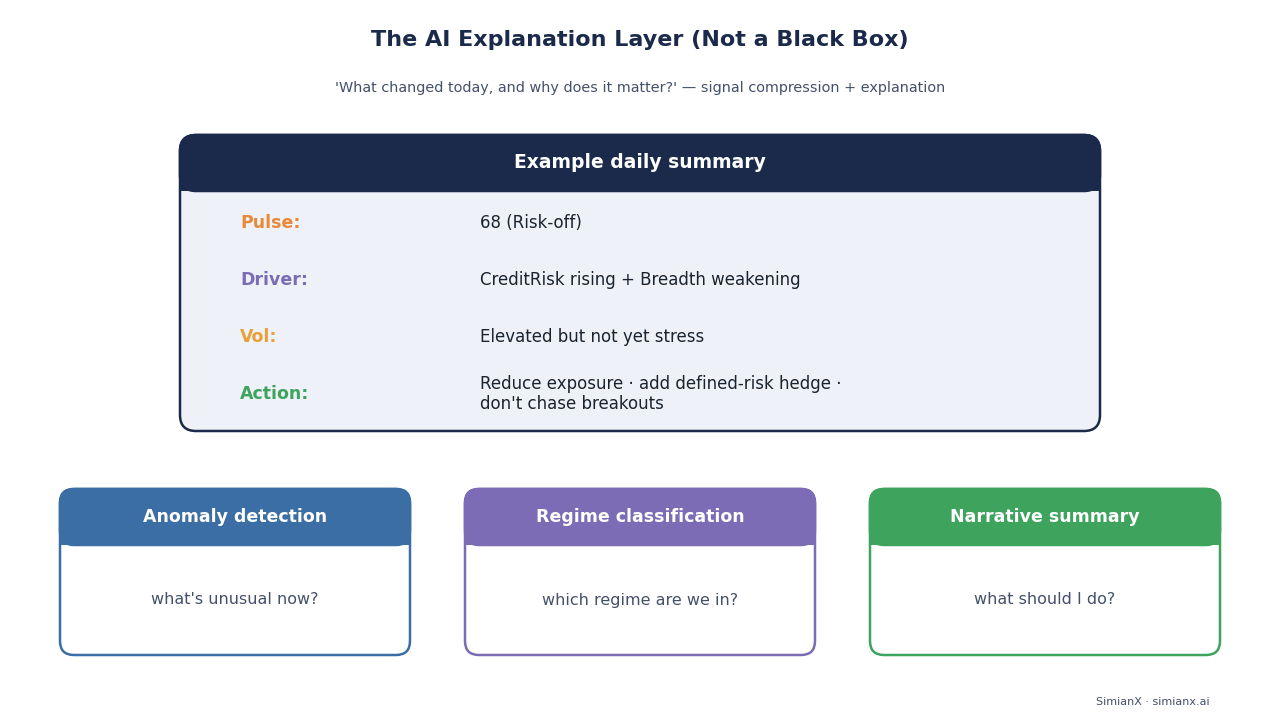
A Risk Pulse becomes significantly more valuable when it can answer:
“What changed today, and why does it matter?”
That’s where AI helps—not as magic prediction, but as signal compression + explanation.
AI layer 1: anomaly detection (what’s unusual right now?)
Use statistical detection:
- “Is today’s VIX move a 95th percentile shock?”
- “Are HY spreads widening faster than normal?”
- “Did breadth break a key threshold?”
AI layer 2: regime classification (what regime are we in?)
Options:
- logistic model (risk-on vs risk-off)
- hidden Markov model (regime transitions)
- tree-based classifier (nonlinear interactions)
The key is interpretability: you want to know which pillar is driving the classification.
AI layer 3: narrative summary (what should I do?)
This is where an LLM-style layer is useful:
- summarize the three pillars in plain language
- highlight the dominant driver (credit vs vol vs breadth)
- suggest a playbook action aligned with your rules
Example daily summary format:
- Pulse: 68 (Risk-off)
- Driver: CreditRisk rising + Breadth weakening
- Vol: Elevated but not yet stress
- Action: Reduce exposure, add defined-risk hedge, avoid chasing breakouts
This is also where SimianX AI fits naturally: you can structure the Risk Pulse inputs into panels, have the system generate daily explanations, and tie alerts to regime thresholds for a repeatable workflow. Include an internal resource link for readers here: SimianX AI.
How to build the Dow Jones Risk Pulse in a repeatable workflow
Below is a concrete, implementable workflow you can adapt.
A repeatable daily checklist (10 minutes)
- Breadth check: A/D slope, % above 200D, highs/lows
- Vol check: VIX level + 5D change; regime band
- Credit check: HY spread level + impulse; IG optional
- Pulse output: composite score + confidence (agreement)
- Action: apply regime playbook (size, hedge, hold period)
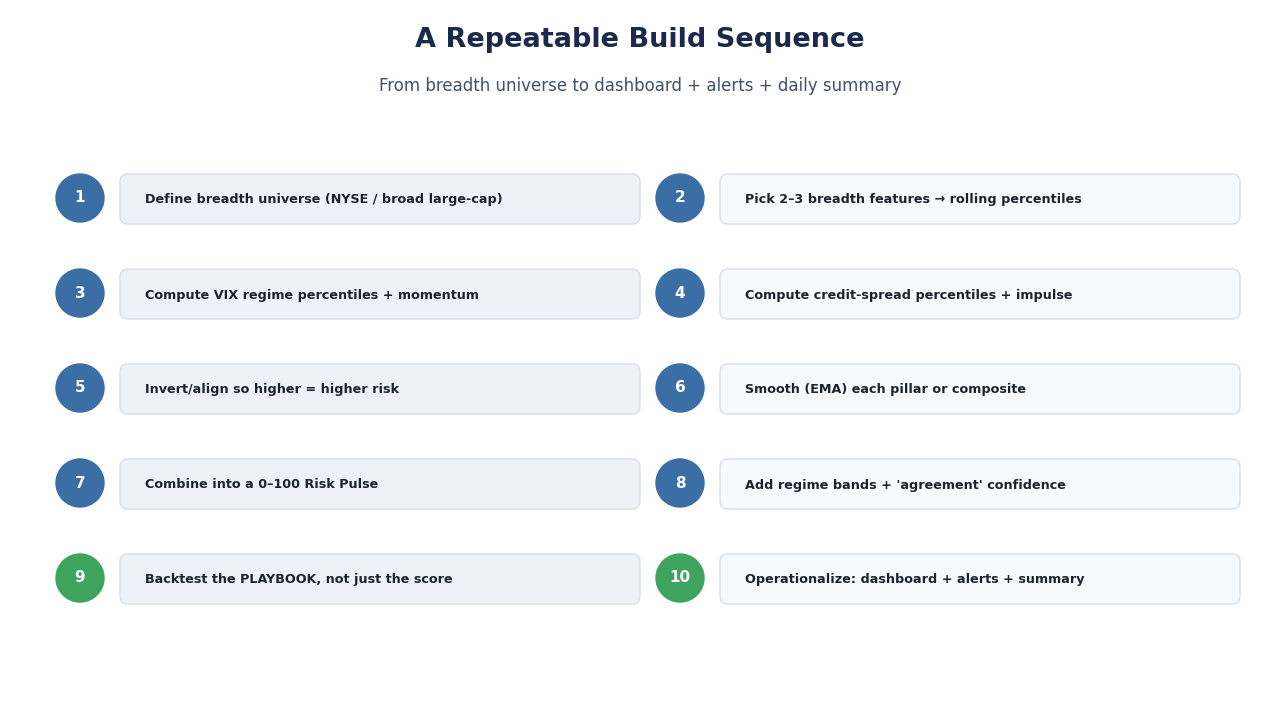
A simple build sequence (numbered steps)
- Define your breadth universe (NYSE or broad large-cap proxy).
- Pick 2–3 breadth features and compute rolling percentiles.
- Compute VIX regime percentiles and momentum features.
- Compute credit spread percentiles and impulse features.
- Invert/align directions so higher = higher risk.
- Smooth (EMA) each pillar or the composite.
- Combine pillars into a 0–100 Risk Pulse score.
- Create regime bands and “agreement” confidence.
- Backtest your playbook rules (not just the score).
- Operationalize: dashboard + alerts + daily summary.
Backtesting: how to evaluate whether your Risk Pulse actually helps
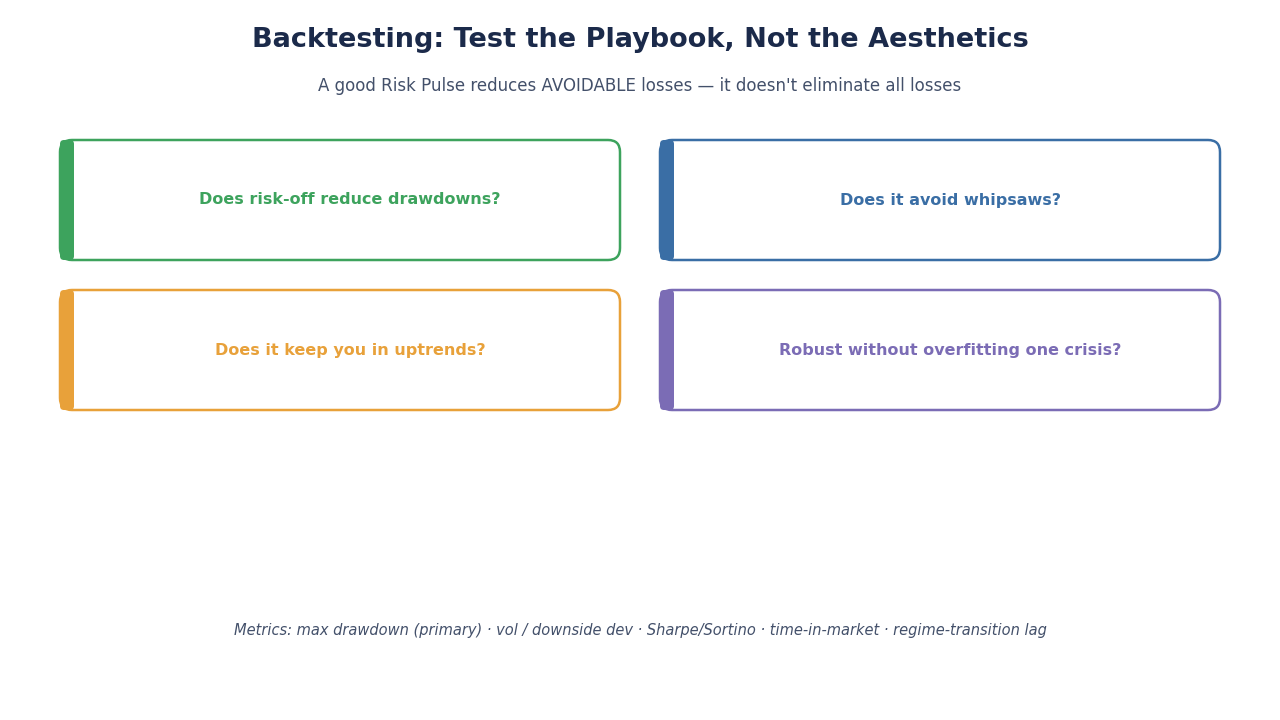
A Risk Pulse is not “right” because it looks smart. It’s right if it improves decisions.
What to test (and what not to test)
Test the playbook outcomes, not the signal aesthetics:
- Does risk-off reduce drawdowns?
- Does it avoid whipsaws?
- Does it keep you in uptrends?
Avoid:
- overfitting thresholds to one crisis
- excessive complexity with dozens of features
- evaluating only returns without drawdown control
Practical evaluation metrics
- Max drawdown (primary)
- Volatility and downside deviation
- Sharpe / Sortino (secondary)
- Hit rate (but don’t obsess)
- Time in market (important for opportunity cost)
- Regime transition lag (how quickly you react)
Common “failure modes” to watch
- VIX-only false positives (event spikes that fade)
- credit spreads lagging in sudden equity crashes (rare but possible)
- breadth distortions from index composition or microstructure noise
A good Risk Pulse does not eliminate losses.
It reduces avoidable losses and prevents catastrophic positioning errors.
Case studies: what the three pillars tend to look like before stress
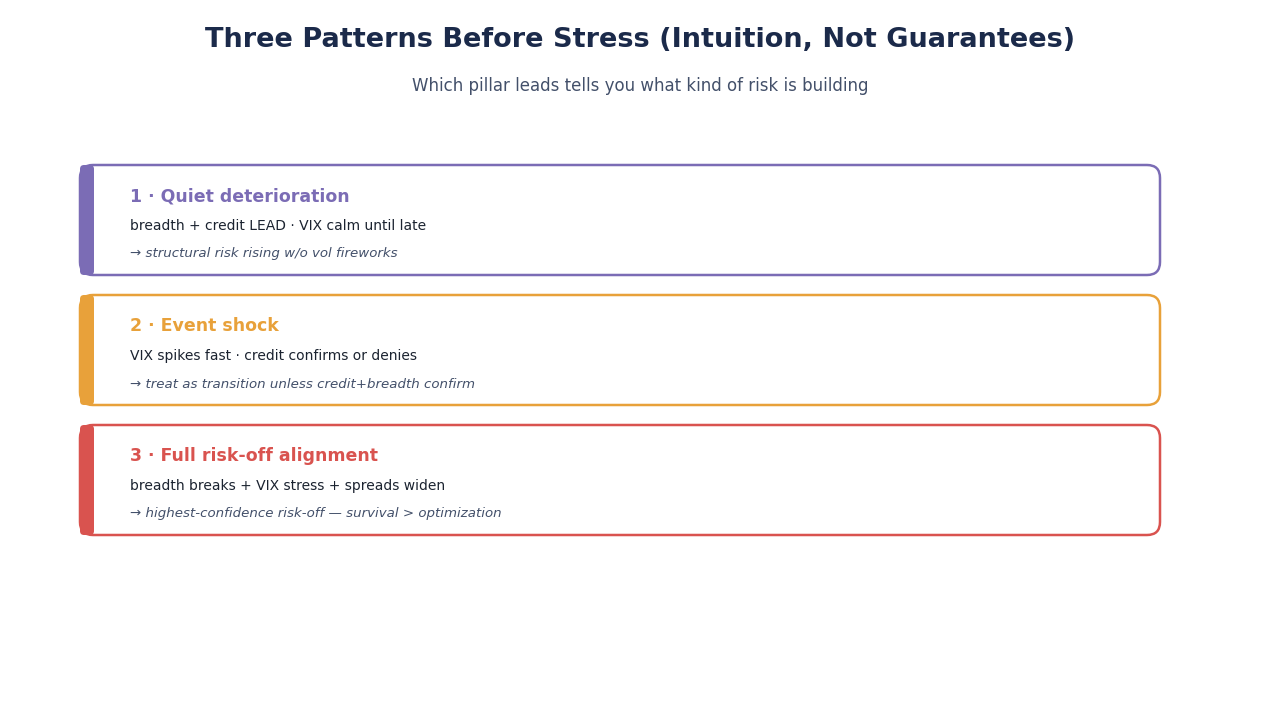
Use these as pattern intuition, not guarantees.
Pattern 1: “quiet deterioration” (breadth + credit lead)
- Breadth rolls over first (participation shrinks)
- Credit spreads widen gradually (risk tax rising)
- VIX stays relatively calm until late
- Dow may look “fine” until the repricing accelerates
Pulse interpretation: structural risk rising even without volatility fireworks.
Pattern 2: “event shock” (vol leads, credit confirms or denies)
- VIX spikes fast
- Breadth may dip briefly
- Credit spreads either:
- stay stable (shock fades), or
- begin widening (shock becomes regime)
Pulse interpretation: treat as transition unless credit + breadth confirm.
Pattern 3: “full risk-off alignment” (all three agree)
- Breadth breaks sharply
- VIX enters stress regime
- Credit spreads widen rapidly
Pulse interpretation: highest confidence risk-off; survival > optimization.
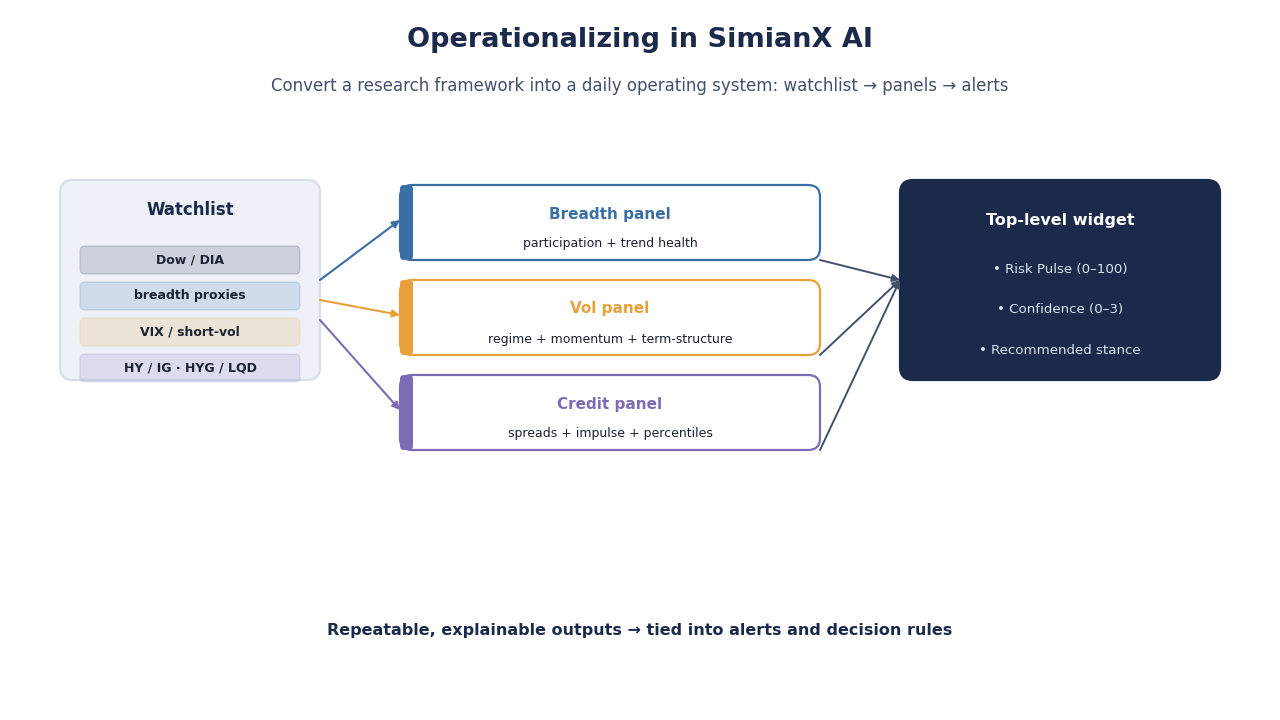
Practical implementation inside SimianX AI (example setup)
To make the Risk Pulse operational—not theoretical—you want:
- a watchlist (Dow + breadth + vol + credit proxies)
- a dashboard with three panels
- an alert system for regime changes
- an explanation layer that summarizes “drivers”
Example watchlist structure (conceptual)
Dow / ETF proxy
DJIorDIA
Breadth proxies
- A/D line proxy, % above 200D proxy, highs/lows proxy
Volatility
VIX(and optional short-dated vol proxy)
Credit
- HY spread proxy, IG spread proxy, credit ETF proxies (
HYG,LQD) if needed
Dashboard panels
1) Breadth panel: participation + trend health
2) Vol panel: regime + momentum + term structure proxy
3) Credit panel: spreads + impulse + percentiles
Then a top-level widget:
- Risk Pulse score (0–100)
- Confidence (agreement 0–3)
- Recommended stance (risk-on / transition / risk-off / crisis)
This is exactly where SimianX AI is useful: you can convert a multi-signal research framework into a daily operating system that produces repeatable, explainable outputs—then tie it into alerts and decision rules. Link readers here again for the internal CTA: SimianX AI.
Common mistakes (and how to make the Risk Pulse stronger)
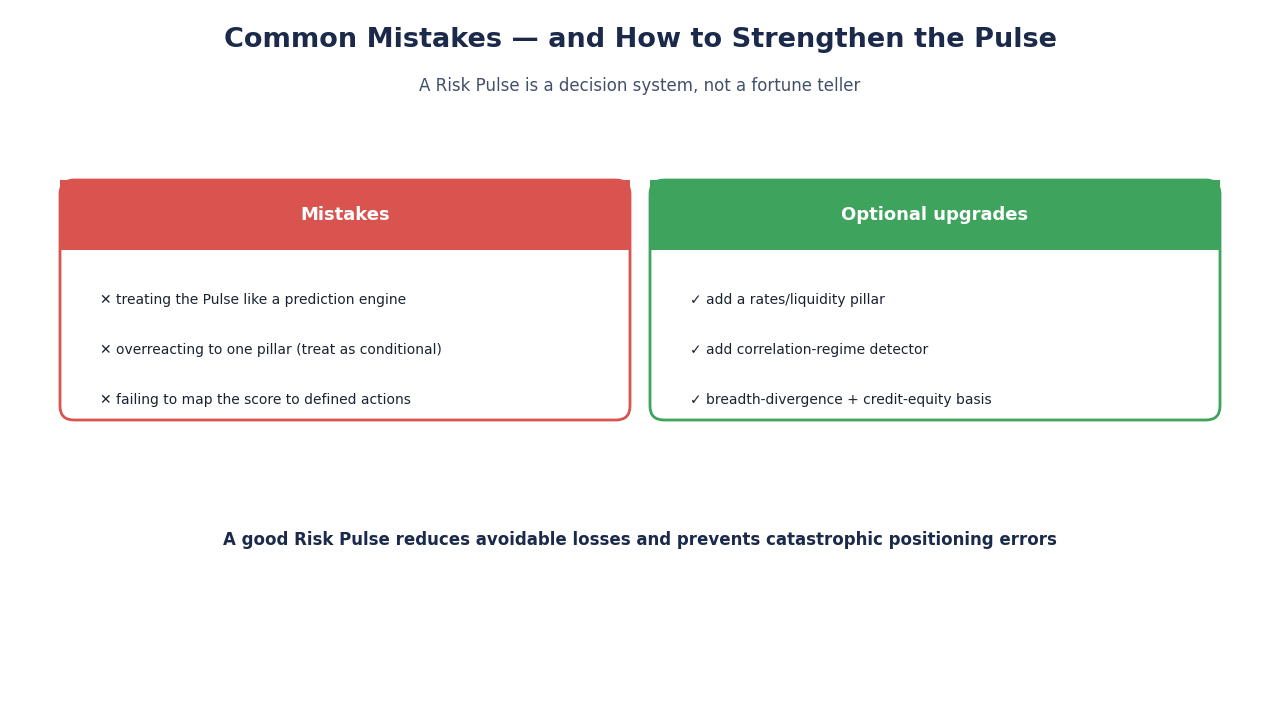
Mistake 1: treating the Pulse like a prediction engine
A Risk Pulse is a decision system, not a fortune teller.
Its job is to improve positioning under uncertainty.
Mistake 2: overreacting to one pillar
One pillar can scream while the others stay calm.
That doesn’t mean ignore it—it means treat it as conditional.
Mistake 3: failing to define actions
If you don’t map the score to decisions, you’ll still trade emotionally.
Ways to strengthen the framework (optional upgrades)
- Add a rates/liquidity pillar (yields, real yields) if you want macro sensitivity
- Add correlation regime (equity correlation spikes often coincide with stress)
- Add breadth divergence detectors (index up, internals down)
- Add credit-equity basis measures (when credit is more stressed than equities)
FAQ About Dow Jones Risk Pulse
What is a Dow Jones Risk Pulse indicator?
A Dow Jones Risk Pulse indicator is a composite risk score that combines market breadth, VIX volatility regimes, and credit spreads to estimate whether conditions are shifting toward risk-on or risk-off. It’s designed to be actionable and explainable, not a black-box forecast.
How to build a Dow Jones Risk Pulse using market breadth, VIX, and credit spreads?
Start with one metric per pillar (breadth, VIX, credit), normalize them into comparable percentiles or z-scores, align directions so higher = higher risk, smooth the noise, then average into a composite score. Add regime bands and a playbook so the score directly drives sizing and hedging decisions.
What is a VIX volatility regime and why does it matter for the Dow?
A VIX volatility regime describes whether volatility is in a low, normal, elevated, or stress state relative to history. Regimes matter because transitions often precede drawdowns, and the Dow can look stable even while volatility is repricing risk.
What do widening credit spreads mean for Dow Jones drawdown risk?
Widening credit spreads usually mean the market is demanding a higher risk premium to fund corporate borrowers—often a sign of tightening conditions and rising stress. If spreads widen while breadth weakens, the probability of a broader equity drawdown typically increases.
What are the best market breadth signals for a Dow risk dashboard?
No single indicator wins, but a strong combo is A/D line trend + % above 200D + new highs/new lows. Together they capture participation, structural trend health, and momentum exhaustion—three dimensions that often deteriorate before major risk-off regimes.
Conclusion
A Dow Jones Risk Pulse gives you a practical way to translate messy market behavior into a clear daily read on risk using three pillars that repeatedly matter: market breadth (participation health), VIX regimes (uncertainty and hedging demand), and credit spreads (the bond market’s risk tax). The goal isn’t perfect timing—it’s better posture: recognizing regime shifts earlier, reducing avoidable drawdowns, and staying systematic when headlines get loud.
If you want to operationalize this framework into a decision-ready dashboard with explainable summaries, regime alerts, and repeatable workflows, explore SimianX AI and build your own Dow Jones Risk Pulse as a daily risk-management system.
Related Reading
- US Stock Risk Dashboard: AI Signals from Breadth, Spreads
- S&P 500 Risk Radar: AI Signals from Breadth, Revisions
- Wall Street Drawdown Watch: 10% Warnings, 40% Tail Risk
- Nasdaq 100 Liquidity Pulse: Yields, Spreads, Revisions
- Why US Stocks & Crypto Plummeted This Week: The Causes
- S&P 500 to 7000: Momentum, Liquidity & Valuation Signals
- Russell 2000 Rotation in 2026: New Market Leaders Emerge
References
- S&P DJI — Dow Jones Industrial Average
- FRED — Yields & Credit Spreads
- CBOE — VIX Volatility Index
- Nasdaq — Stock Exchange & Market Data
- Investopedia — Advance/Decline Line
- Investopedia — Moving Average (200-Day)
- Investopedia — Option-Adjusted Spread (OAS)
- Investopedia — Credit Spread
- Investopedia — High-Yield Bond
- Investopedia — Contango & Backwardation