
 Par Muke
Dans la flambée d'Unitree : robots livrés, marges et ce que 460 % intègrent déjà
L'introduction en bourse de Unitree Robotics s'envole de 460 % ressemble à un titre provenant du pic d'un cycle technologique spéculatif. Pourtant, la société derrière cette hausse n'est pas simplement un concept d'intelligence artificielle sans produits ni revenus. Unitree fabrique des milliers de robots humanoïdes et quadrupèdes, développe des composants clés et des systèmes de contrôle, vend à l'international et a déclaré un bénéfice en 2025.
Deux mois plus tard, cette clôture du premier jour apparaît sous un tout autre jour : l'action s'échangeait à 426,98 RMB le 16 octobre 2026, environ la moitié de la clôture de 845 RMB, mais encore quelque 183 % au-dessus du prix d'introduction de 150,80 RMB.
La question difficile est de savoir si ces réalisations justifient la valorisation que les investisseurs ont attribuée à l'entreprise lors de son premier jour de négociation.
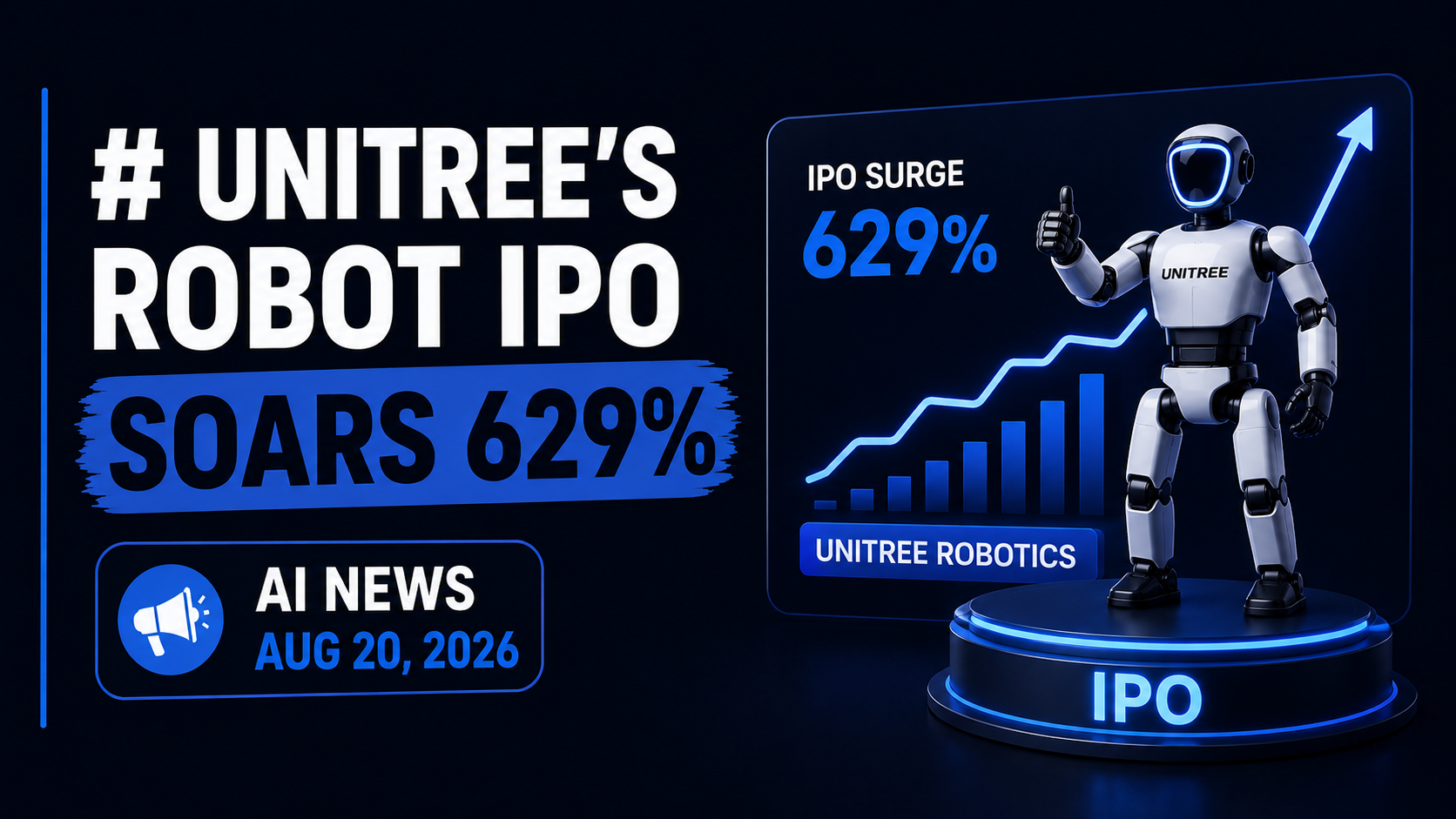
Unitree Robotics, cotée à Shanghai sous le code 688836, a été introduite sur le marché STAR de la Bourse de Shanghai le 19 août 2026. Ses actions ont été proposées à 150,80 RMB, ont ouvert à 1 100 RMB—en hausse d'environ 629 %—et ont clôturé à 845 RMB, soit une augmentation d'environ 460,3 % le premier jour. Le prix de clôture a valu à Unitree environ 341,8 milliards RMB, soit environ 50 milliards USD selon le taux de change. Au prix d'ouverture intrajournalier, la valorisation a brièvement approché 445 milliards RMB.
La montée de l'introduction en bourse reflète plus que la performance financière récente de Unitree. Les investisseurs anticipent un avenir dans lequel les robots humanoïdes deviennent une nouvelle plateforme informatique, les fabricants chinois dominent la chaîne d'approvisionnement matérielle, et Unitree évolue de la vente de corps de robots agiles à la fourniture de travailleurs intelligents à une échelle industrielle.
Cet avenir est possible—mais il est loin d'être prouvé.
Cette recherche examine la structure de l'offre, les états financiers de Unitree, l'économie des produits, les capacités en IA, le marché adressable, l'exposition réglementaire, la position concurrentielle et la valorisation. Les investisseurs peuvent utiliser SimianX AI pour surveiller les entreprises de robotique, de semi-conducteurs, d'automatisation et d'IA physique cotées aux États-Unis à mesure que de nouvelles preuves financières et techniques émergent.
Conclusion de recherche : Unitree représente une véritable percée dans la fabrication de robots. Cependant, sa valorisation boursière du premier jour suppose que le leadership matériel deviendra évolutif, l'intelligence autonome avant que la demande de recherche, la concurrence, la réglementation et le risque d'exécution ne rattrapent.
Introduction en bourse de Unitree Robotics : Les chiffres vérifiés
La première étape consiste à séparer le prix d'offre, le prix d'ouverture et le prix de clôture.
| Indicateur IPO | Chiffre rapporté |
|---|---|
| Ticker du marché STAR | 688836 |
| Date de l'IPO | 19 août 2026 |
| Prix d'offre | 150,80 RMB par action |
| Prix d'ouverture | 1 100 RMB |
| Gain intrajournalier à l'ouverture | 629,4 % |
| Prix de clôture du premier jour | 845 RMB |
| Gain de clôture du premier jour | 460,3 % |
| Actions émises | Environ 40,45 millions |
| Actions en circulation après l'IPO | Environ 404,5 millions |
| Capital levé | Environ 6,1 milliards RMB |
| Valorisation de l'IPO | Environ 61,0 milliards RMB |
| Valeur marchande de clôture du premier jour | Environ 341,8 milliards RMB |
| Valeur marchande d'ouverture | Environ 444,9 milliards RMB |
L'entreprise a levé environ 6,1 milliards RMB, soit environ 900 millions de dollars américains. C'était considérablement plus que les 4,2 milliards RMB initialement attribués à ses quatre principaux projets d'investissement.
L'Associated Press a confirmé le prix d'offre de 150,80 RMB, le prix d'ouverture de 1 100 RMB, la clôture à 845 RMB et environ 6,1 milliards RMB levés. La couverture de l'IPO de Unitree par la Bourse de Shanghai a rapporté qu'environ 40,45 millions de nouvelles actions représentaient 10 % du capital social élargi.
Le chiffre de 460 % est donc exact lorsqu'il est mesuré du prix de l'IPO à la clôture du premier jour. Les actions ont encore augmenté à l'ouverture avant de restituer une partie du gain.
Cette distinction est importante car « Unitree a augmenté de 629 % » et « Unitree a clôturé à 460 % de plus » décrivent différents points dans la même session de trading.
Pourquoi l'action de Unitree Robotics a-t-elle tant augmenté ?
Le gain du premier jour ne peut pas être expliqué uniquement par les fondamentaux commerciaux. La structure du marché a joué un rôle majeur.
Seul un petit pourcentage d'actions pouvait être échangé
Bien que l'introduction en bourse ait émis environ 10 % des actions post-listing, seulement environ 30,09 millions d'actions non restreintes, ou 7,44 % du capital social total, étaient disponibles pour le trading au stade initial de la cotation. Le rapport de pré-cotation de China Daily a documenté le flottement initial limité.
Lorsque la demande est intense et que l'offre négociable est rare, une quantité relativement petite d'achats peut faire varier le prix du marché de manière spectaculaire.
L'offre a été fortement sursouscrite
La demande des investisseurs a largement dépassé les actions disponibles. La Bourse de Shanghai a rapporté que les souscriptions hors ligne qualifiées ont atteint environ 71,46 milliards d'actions, soit plus de 2 700 fois l'allocation initiale hors ligne avant ajustement. Rapport d'introduction en bourse de la Bourse de Shanghai
Cela a créé un grand groupe d'investisseurs qui souhaitaient des actions d'introduction en bourse mais ont reçu peu ou pas d'allocation. Une partie de cette demande non satisfaite s'est déplacée vers le marché secondaire lorsque le trading a commencé.
Les règles du marché STAR ont permis une découverte de prix extrême
Contrairement à de nombreuses bourses conventionnelles, le marché STAR n'impose pas de limite de prix quotidienne pendant les cinq premiers jours de trading d'une introduction en bourse. Une limite quotidienne de 20 % commence ensuite.
Les règles de trading de la Bourse de Shanghai stipulent explicitement que les nouvelles actions du marché STAR n'ont aucune limite de prix pendant leurs cinq premiers jours de trading.
Cette structure permet au marché de trouver rapidement un prix, mais elle crée également des conditions pour une volatilité extrême lors de la première semaine.
Unitree a offert une exposition rare au marché public
La plupart des entreprises de robotique humanoïde les plus en vue restent privées ou sont intégrées dans de plus grandes corporations :
- Figure AI est détenue en privé.
- Agility Robotics est détenue en privé.
- Apptronik est détenue en privé.
- Boston Dynamics est contrôlée par Hyundai Motor Group.
- Le programme Optimus de Tesla est une petite partie d'une entreprise beaucoup plus grande.
- AgiBot est restée privée au moment du lancement de Unitree.
- UBTech se négocie à Hong Kong mais a un profil de produit et de perte plus large.
Unitree est donc devenue un proxy rare et liquide pour l'ensemble du récit de l'IA incarnée en Chine.
Le mouvement de 460 % ne signifiait pas que les usines de Unitree, sa propriété intellectuelle ou ses flux de trésorerie attendus devenaient six fois plus précieux en un jour. Cela signifiait que des actions négociables rares répondaient à une demande énorme pour un thème d'investissement rare.
Le bond de 460 %, deux mois plus tard
Un gain du premier jour n'est qu'un point de données. Les deux mois qui suivent disent ce qu'il valait vraiment.
Unitree a rendu près de la moitié de son cours de clôture du premier jour sans jamais revenir à son prix d'introduction. Au 16 octobre 2026, le titre comptait 36 séances pleines depuis ses débuts, et toutes se sont closes au-dessus de 150,80 RMB.
| Date | Séance | Clôture (RMB) | Vs prix d'introduction | Vs clôture du 1er jour | Capitalisation |
|---|---|---|---|---|---|
| 2026-08-19 | Débuts | 845,00 | +460,3 % | — | 341,8 Md RMB |
| 2026-08-20 | Deuxième | 687,00 | +355,6 % | −18,7 % | 277,9 Md RMB |
| 2026-08-24 | Quatrième | 603,08 | +299,9 % | −28,6 % | 243,9 Md RMB |
| 2026-09-11 | Semaine 4 | 477,12 | +216,4 % | −43,5 % | 193,0 Md RMB |
| 2026-09-18 | Semaine 5 | 514,98 | +241,5 % | −39,1 % | 208,3 Md RMB |
| 2026-09-30 | Fin de trimestre | 450,40 | +198,7 % | −46,7 % | 182,2 Md RMB |
| 2026-10-15 | Plus bas en clôture à ce jour | 405,10 | +168,6 % | −52,1 % | 163,8 Md RMB |
| 2026-10-16 | Dernier | 426,98 | +183,1 % | −49,5 % | 172,7 Md RMB |
Les prix sont les clôtures quotidiennes de 688836.SS ; les capitalisations reposent sur 404 464 340 actions en circulation.
Trois enseignements découlent de ce tableau.
La restitution a été rapide, et elle a surtout concerné la prime d'ouverture. Entre les 1 100 RMB touchés en séance le premier jour et le cours actuel, l'action recule d'environ 61,2 %. Depuis la clôture de 845 RMB, le repli atteint près de 49,5 %. Environ les trois quarts de la baisse depuis ce plus haut en séance se sont produits en quatre séances, la valeur de marché passant de 444,9 milliards de RMB à 243,9 milliards le 24 août.
Le prix de l'introduction n'a jamais été le problème. Même après la glissade, ceux qui ont obtenu des titres à 150,80 RMB gagnent environ 183 %. Le débat ne porte pas sur une erreur de prix à l'émission, mais sur le fait que le marché secondaire a payé trop cher le premier jour. Le même schéma apparaît dans d'autres introductions de 2026 — voir les débuts de Newcleo NWCL, où l'écart entre le prix affiché et la première cotation réelle a fait presque tout le travail.
Les multiples ont baissé avec le cours et restent extrêmes. À 426,98 RMB, la société est valorisée à peu près ainsi :
| Mesure de valorisation | Clôture du 1er jour | 2026-10-16 |
|---|---|---|
| Valeur de marché | 341,8 Md RMB | 172,7 Md RMB |
| Cours / chiffre d'affaires 2025 | 201× | 102× |
| Cours / résultat comptable 2025 | 1 228× | 621× |
| Cours / résultat ajusté 2025 | 579× | 292× |
Diviser par deux un multiple de 201 fois les ventes laisse un multiple de 102 fois les ventes. La correction a effacé la couche la plus extrême du prix du premier jour ; elle n'a pas transformé Unitree en fabricant de matériel valorisé de façon classique. Pour voir comment ce schéma s'est dénoué lors des engouements précédents, consultez toutes les bulles technologiques depuis 1929.
La performance financière de Unitree est réelle—et exceptionnellement forte
Contrairement à de nombreuses jeunes entreprises de robotique humanoïde, Unitree a des revenus significatifs et a déclaré des bénéfices.
Selon les divulgations de l'entreprise résumées par la Bourse de Shanghai, les revenus ont augmenté de :
| Année fiscale | Revenus | Croissance d'une année sur l'autre |
|---|---|---|
| 2023 | 159,1 millions RMB | — |
| 2024 | 392,8 millions RMB | 146,8 % |
| 2025 | Environ 1,70 milliard RMB | Environ 335 % |
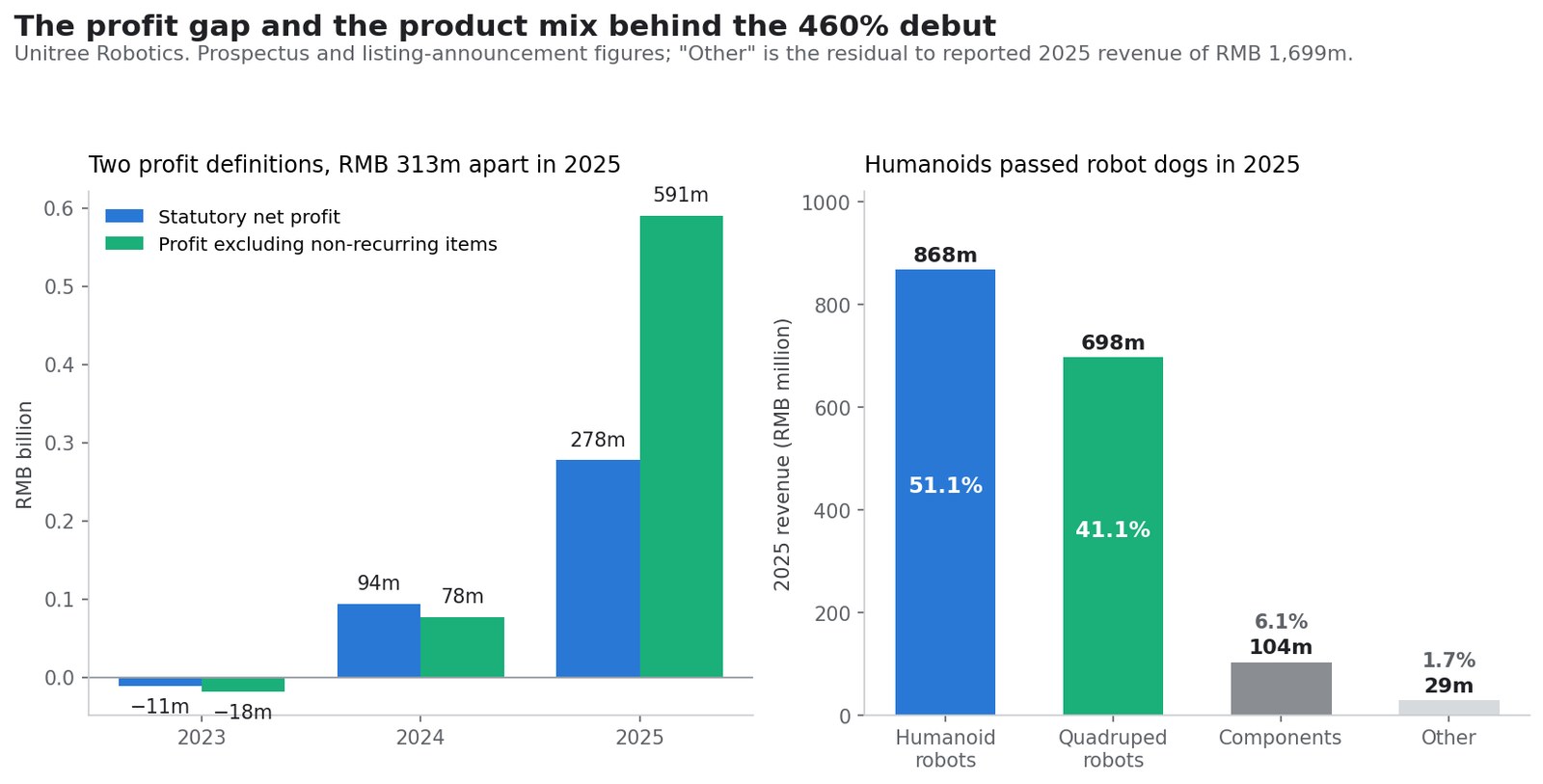
Unitree a déclaré un bénéfice net statutaire de 2025 d'environ 278,2 millions RMB. Le bénéfice attribuable à la société mère, après exclusion des éléments non récurrents, a été déclaré à environ 590,8 millions RMB.
Ces deux mesures de profit sont matériellement différentes. Les investisseurs ne devraient pas les mélanger sans examiner la réconciliation. L'écart exceptionnellement large reflète des ajustements comptables — y compris des dépenses considérées comme non récurrentes — plutôt que deux définitions interchangeables du profit économique.
La marge brute des activités principales de l'entreprise en 2025 était d'environ 60,1%, selon la couverture de l'offre par la Bourse de Shanghai.
C'est une marge impressionnante pour un fabricant de matériel. Cela suggère qu'Unitree a bénéficié de :
- Développement interne de composants clés
- Coûts de fabrication chinois plus bas
- Prix premium pour les systèmes de recherche
- Technologie de contrôle de mouvement propriétaire
- Configurations humanoïdes de grande valeur
- Forte demande par rapport à l'offre disponible
Répartition des revenus d'Unitree en 2025
L'entreprise n'était plus principalement un producteur de chiens robots en 2025.
| Catégorie de produit | Revenus 2025 | Part du revenu total |
|---|---|---|
| Robots humanoïdes | Environ 868 millions de RMB | 51,1% |
| Robots quadrupèdes | Environ 698 millions de RMB | 41,1% |
| Composants de robots | Environ 104 millions de RMB | 6,1% |
| Autres revenus | Solde restant | Moins de 2% |
Ces chiffres montrent pourquoi les investisseurs considèrent Unitree comme une véritable entreprise de robotique humanoïde plutôt qu'un fabricant quadrupède traditionnel utilisant une étiquette d'IA.
Mais la rentabilité de 2026 est déjà devenue moins prévisible
Unitree a rapporté des revenus du premier trimestre 2026 d'environ 423 millions de RMB, en hausse de 68,5 % par rapport à l'année précédente. Cependant :
- Le bénéfice net attribuable à la société mère a diminué d'environ 47,7 %.
- Le bénéfice hors éléments non récurrents a diminué d'environ 52,6 %.
- Le flux de trésorerie d'exploitation a chuté de manière significative.
- Les dépenses de recherche, de marketing et de promotion ont augmenté.
La participation de l'entreprise au Gala du Printemps 2026 a amélioré la visibilité mais a également augmenté les dépenses de vente. Une plus grande dépense en R&D est stratégiquement raisonnable, mais elle démontre que la marge ajustée exceptionnelle de 2025 ne doit pas être automatiquement projetée en avant.
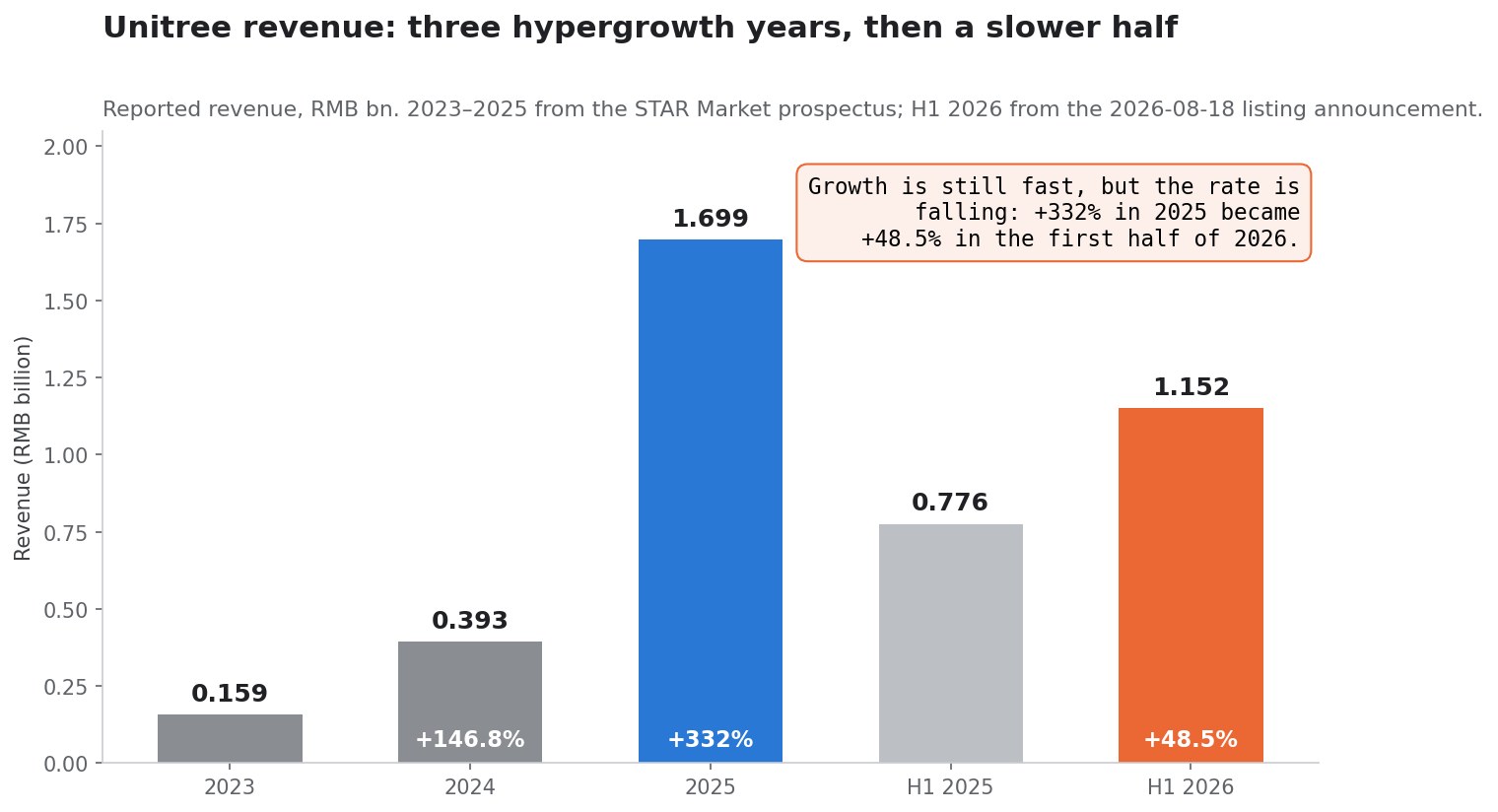
Unitree prévoit un chiffre d'affaires pour le premier semestre 2026 d'environ 1,052 milliard de RMB à 1,128 milliard de RMB, représentant une croissance de 35,6 % à 45,4 %. Elle s'attend à un bénéfice ajusté au niveau des actionnaires de 236 millions de RMB à 283 millions de RMB. Ces prévisions indiquent toujours une forte croissance, mais le taux a ralenti par rapport à l'expansion extraordinaire de 2025. Revue du prospectus par Xinhua
Prévisions contre réalisations : le bulletin du premier semestre 2026
L'information la plus utile autour de cette cotation n'est pas le cours du premier jour. C'est qu'Unitree a publié une prévision dans son prospectus, puis communiqué les chiffres semestriels réels le 18 août 2026, soit la veille du début des échanges. Tout investisseur ayant acheté à 1 100 ou 845 RMB le jour des débuts connaissait déjà le résultat du premier semestre.
| Indicateur | Prévision du prospectus | Publié le 18 août 2026 | Résultat |
|---|---|---|---|
| Chiffre d'affaires S1 2026 | 1 052–1 128 M RMB (+35,6 % à +45,4 %) | 1 152 M RMB (+48,5 %) | Au-dessus de la fourchette |
| Résultat S1 2026 hors éléments exceptionnels | 236–283 M RMB (−22,0 % à −6,4 %) | 244 M RMB (−19,3 %) | Dans la fourchette, moitié basse |
| Résultat net comptable S1 2026 | Non prévu | 274 M RMB, contre une perte de 32,0 M RMB | Retour au bénéfice |
| Flux de trésorerie d'exploitation S1 2026 | Non prévu | 232 M RMB (−32,5 %) | En baisse sur un an |
Ces comptes semestriels ne sont pas audités : ils ont été publiés dans l'avis d'admission lui-même, et non dans un rapport intermédiaire distinct.
Lues ensemble, ces quatre lignes dessinent une image cohérente, pas contradictoire.
Le chiffre d'affaires dépasse la prévision de l'entreprise : c'est la moitié haussière. Les deux lignes de résultat livrent l'autre moitié : le passage d'une perte de 32,0 millions à un bénéfice de 274 millions tient largement à un effet de base, le semestre comparable de 2025 ayant supporté une lourde charge de rémunération en actions. La mesure qui exclut ces éléments — celle qu'Unitree avait elle-même annoncée — recule de 19,3 % sur un an. Le flux de trésorerie d'exploitation perd environ un tiers alors que le bénéfice publié progresse.
La trajectoire trimestrielle dit la même chose. Le chiffre d'affaires du premier trimestre 2026, 423 millions de RMB, progresse de 68,5 % après 332,6 % un an plus tôt, et le résultat trimestriel hors exceptionnels chute de 52,6 %, à 40,25 millions. Le chiffre semestriel marque donc une amélioration par rapport au premier trimestre, pas un retournement de tendance : la croissance ralentit depuis une base exceptionnelle pendant que les dépenses montent.
Unitree l'a dit dans ses propres termes : une base de revenus bien plus large, un enthousiasme sectoriel refroidi et une concurrence plus vive placent désormais la croissance semestrielle sous son rythme annuel composé. L'article de The Standard sur les comptes semestriels et l'analyse de l'introduction par 36Kr reprennent les chiffres tels qu'ils ont été communiqués.
Le prochain rendez-vous est le rapport du troisième trimestre, attendu avant fin octobre 2026 selon les règles applicables aux actions A. La ligne à surveiller n'est pas la croissance du chiffre d'affaires : c'est de savoir si le résultat hors éléments exceptionnels cesse de baisser alors que les dépenses de R&D et commerciales continuent d'augmenter.
Unitree a-t-il une véritable percée en robotique ?
Oui—particulièrement dans le matériel robotique, le contrôle de mouvement, l'accessibilité et la fabrication.
La plus grande réussite de Unitree n'est pas que ses robots possèdent une intelligence de niveau humain. Ils ne le font pas. Sa réussite est qu'il a considérablement réduit le coût du matériel de robot à pattes capable tout en augmentant le volume de production.
Plateformes humanoïdes abordables
Le G1 humanoïde de Unitree commence à environ 85 000 RMB en Chine ou 13 500 USD via sa boutique internationale, selon la configuration, les taxes, l'expédition et la disponibilité. Le robot pèse environ 35 kilogrammes et offre entre 23 et 43 articulations motorisées.
La ligne R1 à coût réduit de l'entreprise a été annoncée à partir d'environ 4 900 USD, tandis que les machines de la série H plus grandes coûtent significativement plus cher.
Ces prix ne décrivent pas des remplacements entièrement autonomes pour les travailleurs humains. Les configurations de base peuvent avoir un accès au développement limité, du matériel de manipulation, de l'informatique, du temps d'exécution ou des logiciels d'application. Néanmoins, ils sont bien en dessous du coût historique des plateformes de recherche humanoïdes sophistiquées.
La page produit officielle de l'Unitree G1 indique un prix de base de 13 500 $ US et décrit l'apprentissage par imitation, l'apprentissage par renforcement, des options de mains agiles et une stratégie de développement de modèle du monde robotique.
Échelle d'expédition leader
Unitree a déclaré avoir expédié 5 511 robots humanoïdes en 2025 et enregistré des ventes de 5 215 unités. La différence reflète les unités expédiées mais pas encore acceptées ou reconnues comme ventes complètes à la fin de l'année.
Omdia a estimé qu'environ 15 000 robots humanoïdes ont été expédiés dans le monde entier en 2025, Unitree et AgiBot expédiant plus de 5 000 chacun. Si les définitions de mesure sont comparables, Unitree détenait une part très importante du jeune marché.
Unitree a également expédié plus de 30 000 robots quadrupèdes entre 2022 et septembre 2025, lui donnant une expérience de fabrication que de nombreuses startups humanoïdes n'ont pas.
Intégration verticale
Unitree développe des composants et systèmes importants en interne, y compris :
- Moteurs à couple élevé
- Contrôleurs de moteur
- Réducteurs et articulations
- Algorithmes de contrôle de mouvement
- Systèmes de perception
- Logiciel d'exploitation robotique
- Outils d'apprentissage par renforcement
- Corps humanoïdes et quadrupèdes
- Modèles et ensembles de données d'IA incarnée
Cette intégration peut réduire les coûts, raccourcir les cycles de développement et permettre aux équipes d'ingénierie d'optimiser le matériel et les logiciels ensemble.
Écosystème de développement ouvert
Unitree a publié des modèles, des outils et des données à travers son programme open-source. Sa famille UnifoLM comprend des recherches sur la vision-langage-action conçues pour la manipulation robotique à usage général. Le portail open-source de Unitree fournit également des ensembles de données de robots et des ressources de développement.
Une large base installée de robots relativement abordables peut faire de Unitree une plateforme attrayante pour les universités, les laboratoires d'IA, les développeurs et les startups. Cet avantage d'écosystème pourrait ressembler au rôle précoce que les kits informatiques peu coûteux ont joué dans la recherche en logiciels et en électronique.
La percée matérielle de Unitree est déjà visible. La question non résolue est de savoir s'il peut transformer des corps abordables en travailleurs autonomes et fiables.
Unitree est-il une entreprise d'IA ou une entreprise de matériel robotique ?
Aujourd'hui, Unitree est mieux décrite comme une entreprise de matériel robotique intégrée verticalement investissant agressivement dans l'IA incarnée.
Ses vidéos virales démontrent une locomotion exceptionnelle :
- Course
- Danse
- Boxe
- Séquences d'arts martiaux
- Saltos arrière
- Récupération après des perturbations
- Performances de groupe coordonnées
Ces capacités sont techniquement difficiles, mais elles ne sont pas les mêmes que l'intelligence générale.
Un robot humanoïde peut exécuter une séquence de mouvements hautement répétée tout en étant incapable de plier une chemise inconnue, de sélectionner l'outil correct, de récupérer d'une saisie échouée ou de compléter un quart de travail industriel de huit heures sans intervention.
Les investisseurs devraient distinguer quatre couches de capacité :
| Couche robotique | Position actuelle de Unitree | Défi restant |
|---|---|---|
| Corps mécanique | Fort | Durabilité et certification industrielle |
| Locomotion dynamique | Leader du secteur | Sécurité et répétabilité autour des personnes |
| Manipulation | En développement | Précision, retour tactile et achèvement des tâches |
| Autonomie générale | Précoce | Raisonnement, planification, adaptation et fiabilité |
Le plan de dépenses pour l'introduction en bourse de l'entreprise reconnaît effectivement cet écart.
D'environ 4,2 milliards de RMB affectés à quatre projets :
| Investissement prévu | Montant | Part des fonds de projet prévus |
|---|---|---|
| R&D de modèles de robots intelligents | 2,022 milliards de RMB | 48,1% |
| R&D de corps de robots | 1,110 milliard de RMB | 26,4% |
| Nouveaux produits de robots intelligents | 445 millions de RMB | 10,6% |
| Base de fabrication | 624 millions de RMB | 14,9% |
Près de la moitié des dépenses de projet prévues sont destinées au développement de modèles de robots—le « cerveau » plutôt que le corps. La répartition a été publiée dans la couverture de la Bourse de Shanghai.
C'est stratégiquement encourageant car la direction semble comprendre le goulot d'étranglement. C'est aussi un avertissement : la capacité centrale impliquée par la valorisation de l'action n'a pas encore été prouvée à grande échelle.
La vérification de réalité la plus importante : Qui achète des humanoïdes Unitree ?
Le volume d'expédition à lui seul peut exagérer la maturité commerciale.
Selon des données dérivées du prospectus, environ 73,6% des revenus humanoïdes de Unitree au cours des trois premiers trimestres de 2025 provenaient de la recherche scientifique et de l'éducation. Les clients commerciaux et consommateurs représentaient environ 17,4%, tandis que les applications industrielles comptaient pour environ 9%.
Cette distinction est critique.
Une université achetant une plateforme humanoïde pour la recherche est une preuve de la demande de produit. Cela n'est pas équivalent à un fabricant déployant des centaines de robots parce qu'ils produisent un retour sur investissement mesurable.
Les clients de recherche peuvent accepter :
- Maintenance fréquente
- Temps de fonctionnement limité
- Téléopération
- Démonstrations scriptées
- Logiciel expérimental
- Succès des tâches incohérent
- Supervision d'ingénierie
- Coûts de personnalisation élevés
Les clients industriels exigent généralement :
- Temps de fonctionnement prévisible
- Sécurité documentée
- Maintenance rapide
- Manipulation répétable
- Intégration avec les systèmes d'usine
- Fonctionnement multi-quarts
- Économies de main-d'œuvre mesurables
- Une période de retour sur investissement claire
La Fédération Internationale de Robotique avertit que l'adoption généralisée d'assistants humanoïdes universels pour les usines ou de robots domestiques est peu probable à court ou moyen terme. Le plan de la Chine pour 2026-2030 anticipe la commercialisation des humanoïdes vers la fin de la période de planification, tandis que la robotique industrielle améliorée par l'IA conventionnelle pourrait se développer plus tôt. Analyse de la stratégie robotique de la Chine par l'IFR
Cela ne signifie pas que les revenus de recherche sont de mauvaise qualité. Les institutions de recherche construisent des applications, génèrent des données, forment des ingénieurs et élargissent l'écosystème de Unitree. Mais cela signifie que le leadership en expéditions d'aujourd'hui ne prouve pas encore l'économie industrielle de demain.
Le véritable "moment ChatGPT" n'est pas encore arrivé
Le fondateur de Unitree, Wang Xingxing, a décrit un point de basculement futur comme un robot entrant dans un environnement inconnu et accomplissant environ 80 % des tâches assignées. Il a suggéré que l'industrie pourrait atteindre un tel stade dans deux à trois ans.
C'est une aspiration, pas une capacité actuelle démontrée.
La véritable percée ne sera pas une autre vidéo de salto arrière. Ce sera un robot capable de :
- Comprendre un lieu de travail jamais vu auparavant.
- Apprendre une tâche utile à partir de démonstrations limitées.
- Exécuter cette tâche de manière répétée sans ingénieur à proximité.
- Se rétablir en toute sécurité après des pannes inattendues.
- Fonctionner à un coût suffisamment bas pour surpasser l'automatisation conventionnelle ou le travail humain.
Jusqu'à ce que ces jalons soient visibles, les robots humanoïdes restent en partie un marché de plateforme de recherche.
Évaluation de Unitree Robotics après la hausse de 460 % lors de l'introduction en bourse
L'évaluation est l'endroit où l'argument de la bulle devient le plus fort.
Au prix de clôture de 845 RMB le premier jour, la capitalisation boursière de Unitree était d'environ 341,8 milliards de RMB.
En utilisant les résultats financiers de 2025 :
| Mesure d'évaluation | Multiple approximatif de clôture du premier jour |
|---|---|
| Prix sur ventes | 201× |
| Prix sur bénéfices statutaires | 1,228× |
| Prix sur bénéfices ajustés | 579× |
Ce sont des calculs approximatifs :
Capitalisation boursière = 845 RMB × 404,5 millions d'actions
≈ 341,8 milliards RMB
Prix sur ventes = 341,8B RMB ÷ 1,70B RMB
≈ 201×
P/E statutaire = 341,8B RMB ÷ 278,2M RMB
≈ 1,228×
P/E ajusté = 341,8B RMB ÷ 590,8M RMB
≈ 579×
Au prix d'introduction en bourse, la société était déjà évaluée à environ :
- 36 fois les ventes de 2025
- 219 fois les bénéfices statutaires
- 103 fois les bénéfices ajustés
L'introduction en bourse elle-même incluait donc des attentes de croissance substantielles. La hausse du premier jour a multiplié ces attentes.
Quelle croissance justifierait l'évaluation du premier jour ?
Supposons qu'un investisseur veuille finalement que Unitree se négocie à 30 fois les bénéfices—une prime mais un multiple de société technologique plus mature.
Pour justifier une évaluation de 341,8 milliards RMB à 30 fois les bénéfices, Unitree aurait besoin d'environ :
Bénéfice net annuel requis = 341,8B RMB ÷ 30
≈ 11,4 milliards RMB
C'est plus que :
- 40 fois le bénéfice statutaire de Unitree en 2025
- 19 fois son bénéfice ajusté en 2025
- 6 fois l'ensemble de ses revenus en 2025
Si Unitree atteint finalement une marge nette de 20 %, le chiffre d'affaires annuel devrait atteindre environ 57 milliards RMB pour générer 11,4 milliards de bénéfices.
C'est possible seulement si le marché des humanoïdes s'élargit considérablement et qu'Unitree conserve une part importante tout en évitant la marchandisation du matériel.
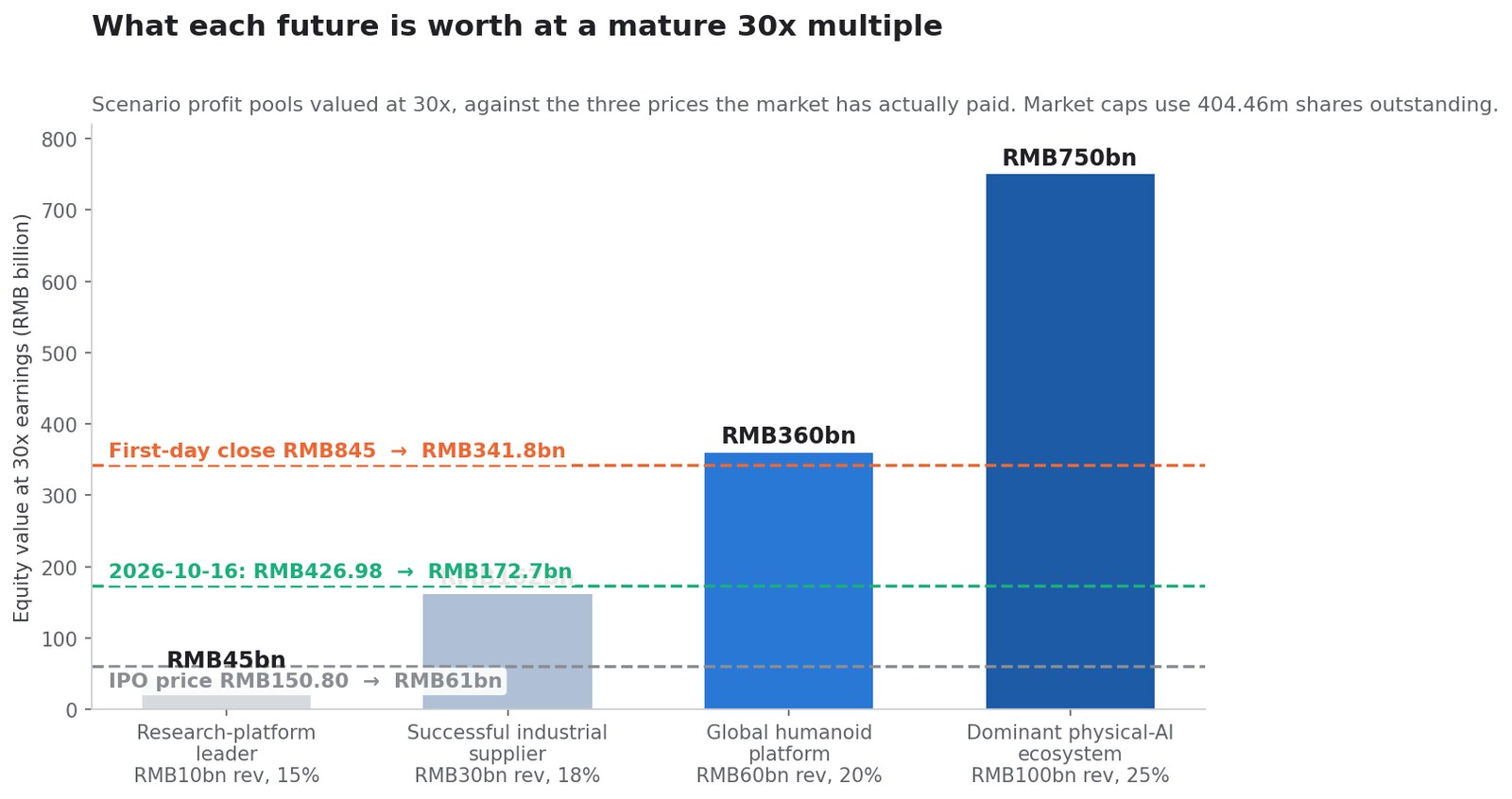
Une analyse de scénario
| Scénario | Revenus à long terme | Marge nette | Bénéfice implicite | Valeur à 30× bénéfices |
|---|---|---|---|---|
| Leader de la plateforme de recherche | 10B RMB | 15% | 1,5B RMB | 45B RMB |
| Fournisseur industriel réussi | 30B RMB | 18% | 5,4B RMB | 162B RMB |
| Plateforme humanoïde mondiale | 60B RMB | 20% | 12B RMB | 360B RMB |
| Écosystème d'IA physique dominant | 100B RMB | 25% | 25B RMB | 750B RMB |
La valorisation de clôture du premier jour intègre déjà quelque chose de proche du plateforme humanoïde mondiale.
Les investisseurs ne payaient pas pour l'activité de Unitree en 2025. Ils payaient pour une entreprise beaucoup plus grande qui n'existe pas encore.
Qui a acheté à 150,80 RMB, et quand ces titres pourront être vendus
Deux faits expliquent l'offre de titres mieux que n'importe quel modèle de valorisation : qui a été servi au prix d'introduction, et pour combien de temps chacun est bloqué. Les deux figurent dans l'avis d'admission déposé le 18 août 2026.
Le placement stratégique
Les investisseurs stratégiques ont obtenu 8 089 286 actions — 20,00 % de l'opération, soit 2,00 % du capital après émission — pour environ 1,22 milliard de RMB sur les 6,1 milliards levés.
| Investisseur stratégique | Actions | Souscription (M RMB) | Blocage |
|---|---|---|---|
| Plan d'actionnariat salarié Unitree n° 1 | 1 356 100 | 204,5 | 12 mois |
| Conseil national du fonds de sécurité sociale (portefeuilles 601, 502, 109) | 933 402 | 140,8 | 12 mois |
| Hangzhou DeepSeek Artificial Intelligence Basic Technology Research | 933 399 | 140,8 | 36 mois |
| CNPC Kunlun Capital | 903 290 | 136,2 | 12 mois |
| China Southern Power Grid Industry Finance Holding Group | 903 290 | 136,2 | 12 mois |
| Tianyi Capital Holdings | 903 290 | 136,2 | 12 mois |
| Shanghai Qishan Investment (Tencent) | 903 290 | 136,2 | La plus tardive de 12 mois après la cotation et 36 mois après le premier achat de Tencent |
| CITIC Securities Investment (investissement du sponsor) | 808 928 | 122,0 | 24 mois |
| Plan d'actionnariat salarié Unitree n° 2 | 444 297 | 67,0 | 36 mois |
| Total | 8 089 286 | 1 219,9 | — |
Cette liste est une déclaration d'intention de l'État chinois et du secteur des plateformes à la fois : le fonds de pension national, le bras d'investissement d'un pétrolier, l'opérateur du réseau électrique du sud, un véhicule d'investissement télécoms, Tencent et DeepSeek — qui a accepté un blocage de 36 mois, trois fois la durée retenue par la plupart des investisseurs stratégiques — ont payé le même prix que l'offre publique. C'est la même thèse d'IA physique que valorisent déjà des fournisseurs cotés ailleurs : le pari à 7 milliards de dollars d'ON Semiconductor sur Synaptics en est la version américaine.
Au registre après l'offre, le fondateur Wang Xingxing détient 21,4395 % du capital mais contrôle au plus 65,31 % des droits de vote grâce au dispositif de droits de vote multiples du marché STAR, sa plateforme d'intéressement Shanghai Yuyi détenant 9,8472 % de plus. Hanhai Information, le véhicule de Meituan, détient 6,8502 % ; Ningbo HSG, 5,5890 % ; Tencent Technology, 0,5388 % ; et Hangzhou Haoyue, filiale d'Alibaba, 0,4041 %.
La falaise du flottant
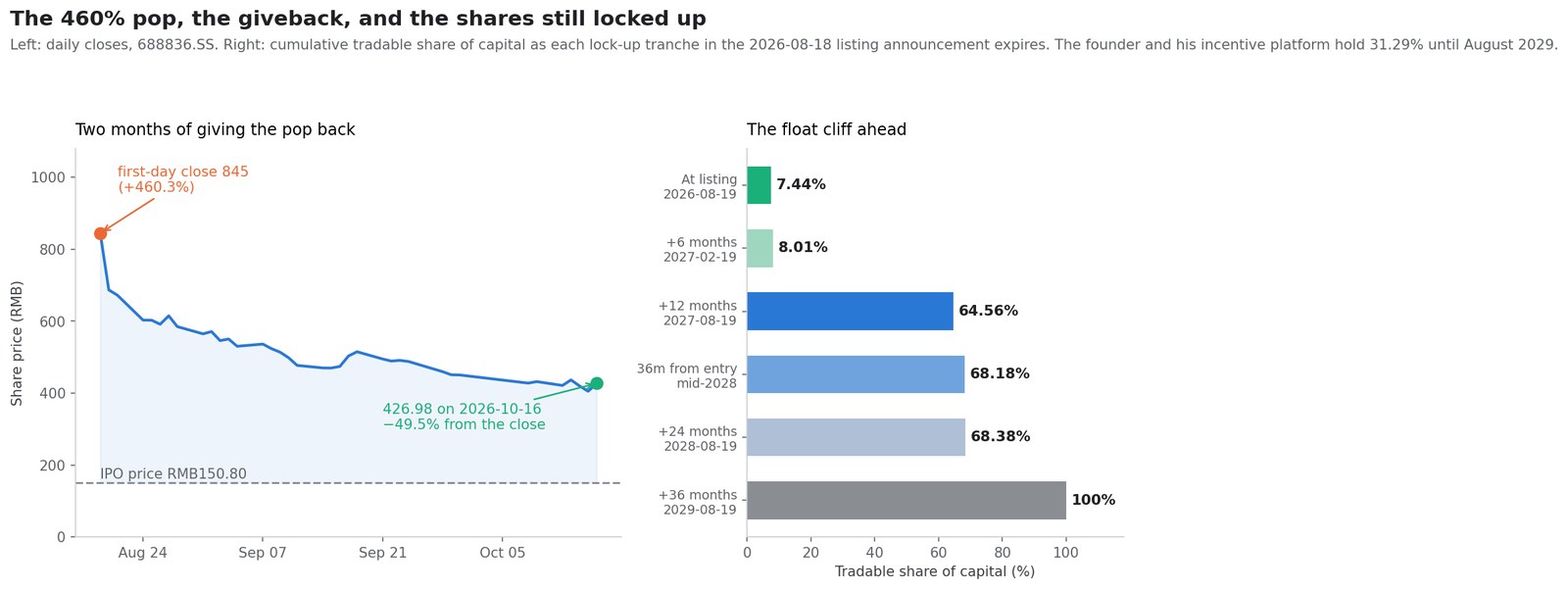
Seules 30 087 720 actions — 7,44 % des 404 464 340 en circulation — étaient négociables le premier jour. Les 374 376 620 autres se débloquent selon le calendrier fixé dans l'avis d'admission.
| Tranche | Blocage | Première date de libération | Part du capital | Cumul négociable |
|---|---|---|---|---|
| Flottant initial | Aucun | 2026-08-19 | 7,44 % | 7,44 % |
| 10 % de l'allocation institutionnelle (2 269 428 actions) | 6 mois | 2027-02-19 | +0,56 % | 8,00 % |
| Investisseurs stratégiques à 12 mois | 12 mois | 2027-08-19 | +1,24 % | 9,24 % |
| Actionnaires pré-IPO à 12 mois | 12 mois | 2027-08-19 | +55,32 % | 64,56 % |
| Actionnaires entrés en 2025, bloqués 36 mois à compter de leur propre entrée | 36 mois après l'entrée | Vers le milieu de 2028 | +3,62 % | 68,18 % |
| Investissement du sponsor (CITIC Securities Investment) | 24 mois | 2028-08-19 | +0,20 % | 68,38 % |
| Wang Xingxing, Shanghai Yuyi, DeepSeek et le plan salarié n° 2 | 36 mois | 2029-08-19 | +31,62 % | 100 % |
C'est la colonne cumulée qui compte. Environ 64,6 % du capital devient négociable à partir du 19 août 2027, près de 68,2 % une fois que les entrants de 2025 auront purgé leurs propres trois ans vers le milieu de 2028, et 68,4 % à partir d'août 2028 — contre les 7,44 % disponibles pendant la formation des prix qui a produit le titre à 460 %. Les derniers 31,6 %, détenus par le fondateur, sa plateforme d'intéressement, DeepSeek et le plan salarié, restent bloqués jusqu'en août 2029.
Pouvoir vendre n'est pas vendre, et un actionnaire de long terme peut simplement conserver. Mais la rareté qui a contribué à fixer le prix du premier jour porte une date d'expiration publiée, et la première échéance tombe en février 2027. Les valorisations privées affrontent la même épreuve dans l'autre sens : l'introduction reportée d'Oura montre ce qui arrive quand le marché public refuse de valider le dernier tour.
Pourquoi le scénario optimiste est plus qu'un engouement
Qualifier toute l'histoire de Unitree de bulle ignorerait plusieurs avantages puissants.
Écosystème de fabrication de robots en Chine
La Chine représentait environ 54 % des installations de robots industriels mondiaux en 2024, selon la Fédération Internationale de Robotique. Les usines chinoises ont opéré plus de deux millions de robots industriels, et les fournisseurs nationaux ont augmenté leur part locale de 30 % en 2020 à 57 % en 2024.
Cet écosystème fournit :
- Moteurs et actionneurs de haute volume
- Fournisseurs de batteries
- Usinage de précision
- Fabrication électronique
- Capteurs et caméras
- Fabricants sous contrat
- Clients automobiles
- Grand nombre d'ingénieurs en robotique
- Zones industrielles soutenues par le gouvernement
Unitree peut itérer dans un environnement déjà optimisé pour la fabrication de matériel avancé.
Le leadership en coûts peut élargir le marché
Un humanoïde à 13 500 $ n'a pas besoin de rivaliser avec une machine industrielle à 100 000 $ dans chaque tâche. Des prix plus bas permettent à davantage d'universités, de développeurs et d'entreprises d'expérimenter.
Un volume de déploiement élevé peut produire :
- Plus de développement d'applications
- Plus de données de terrain
- Découverte des échecs plus rapide
- Meilleure économie des composants
- Un écosystème de maintenance plus large
- Une plus grande familiarité des développeurs
Cela ressemble à une stratégie de plateforme : du matériel abordable sème le marché, tandis que le logiciel et l'intelligence s'améliorent par la suite.
Unitree génère déjà des revenus
Figure AI a annoncé une valorisation privée d'environ 39 milliards de dollars US en septembre 2025 après avoir levé plus de 1 milliard de dollars US. L'annonce de financement de Figure a souligné le développement de l'IA et l'expansion de la fabrication, mais l'entreprise ne publie pas d'états financiers de société cotée comparables au prospectus de Unitree.
La valorisation du premier jour de Unitree a dépassé la dernière valorisation privée divulguée de Figure, mais Unitree a également offert des données visibles sur les revenus, la marge brute, les expéditions et la rentabilité.
L'IPO finance les capacités manquantes
6,1 milliards de RMB de nouveau capital donnent à Unitree les ressources pour investir dans :
- Modèles vision-langage-action
- Modèles du monde
- Simulation
- Apprentissage par renforcement
- Collecte de données
- Manipulation habile
- Tests de fiabilité
- Capacité de fabrication
- Nouvelles catégories de produits
L'IPO ne prouve pas que l'entreprise résoudra l'intelligence incarnée, mais elle augmente considérablement les ressources disponibles.
Pourquoi le risque de bulle des robots humanoïdes est réel
Le scénario baissier le plus fort n'est pas que Unitree est frauduleux ou technologiquement faible. C'est qu'une vraie entreprise a été assignée à un avenir irréaliste parfait.
La valorisation laisse peu de place aux revers ordinaires
À plus de 200 fois les ventes passées, même une forte croissance peut décevoir.
L'action pourrait décliner substantiellement si :
- La croissance des revenus tombe en dessous des attentes.
- La marge brute se normalise.
- L'adoption industrielle prend plus de temps.
- La demande de recherche s'avère cyclique.
- Les concurrents réduisent les prix.
- Les nouveaux modèles nécessitent un soutien lourd.
- Les dépenses en R&D restent élevées.
- Les premiers actionnaires vendent après l'expiration des périodes de blocage.
Une entreprise peut croître rapidement tandis que son action chute si la valorisation initiale supposait une croissance encore plus rapide.
Faible flottement amplifie la découverte des prix
Seulement 7,44 % des actions étaient initialement non restreintes et négociables. Un faible flottement peut produire un prix de marché qui reflète un enthousiasme marginal plutôt qu'une évaluation équilibrée par tous les actionnaires.
La deuxième séance de négociation a illustré le risque : les actions de Unitree ont chuté d'environ 18,7 % à 687 RMB, même si l'entreprise n'avait pas perdu 18,7 % de sa capacité productive du jour au lendemain.
Le prix de la première semaine était influencé par le positionnement, la rareté et le sentiment autant que par de nouvelles informations.
Le matériel humanoïde pourrait être banalisé
La Chine compte de nombreuses entreprises de robotique humanoïde. AgiBot, UBTech, Fourier Intelligence, Leju, Galbot, EngineAI, XPeng Robotics et d'autres développeurs poursuivent des marchés qui se chevauchent.
Les concurrents internationaux incluent :
- Tesla Optimus
- Figure AI
- Apptronik Apollo
- Agility Robotics Digit
- Boston Dynamics Atlas
- 1X
- Sanctuary AI
- NEURA Robotics
Si les corps mécaniques, les moteurs et les systèmes de contrôle deviennent standardisés, les prix du matériel pourraient chuter rapidement. La valeur pourrait migrer vers :
- Modèles de base
- Données d'entraînement propriétaires
- Logiciels d'application
- Intégration de systèmes
- Gestion de flotte
- Certification de sécurité
- Distribution client
Unitree doit rester différencié au-delà de la locomotion à bas coût.
Le ROI industriel reste incertain
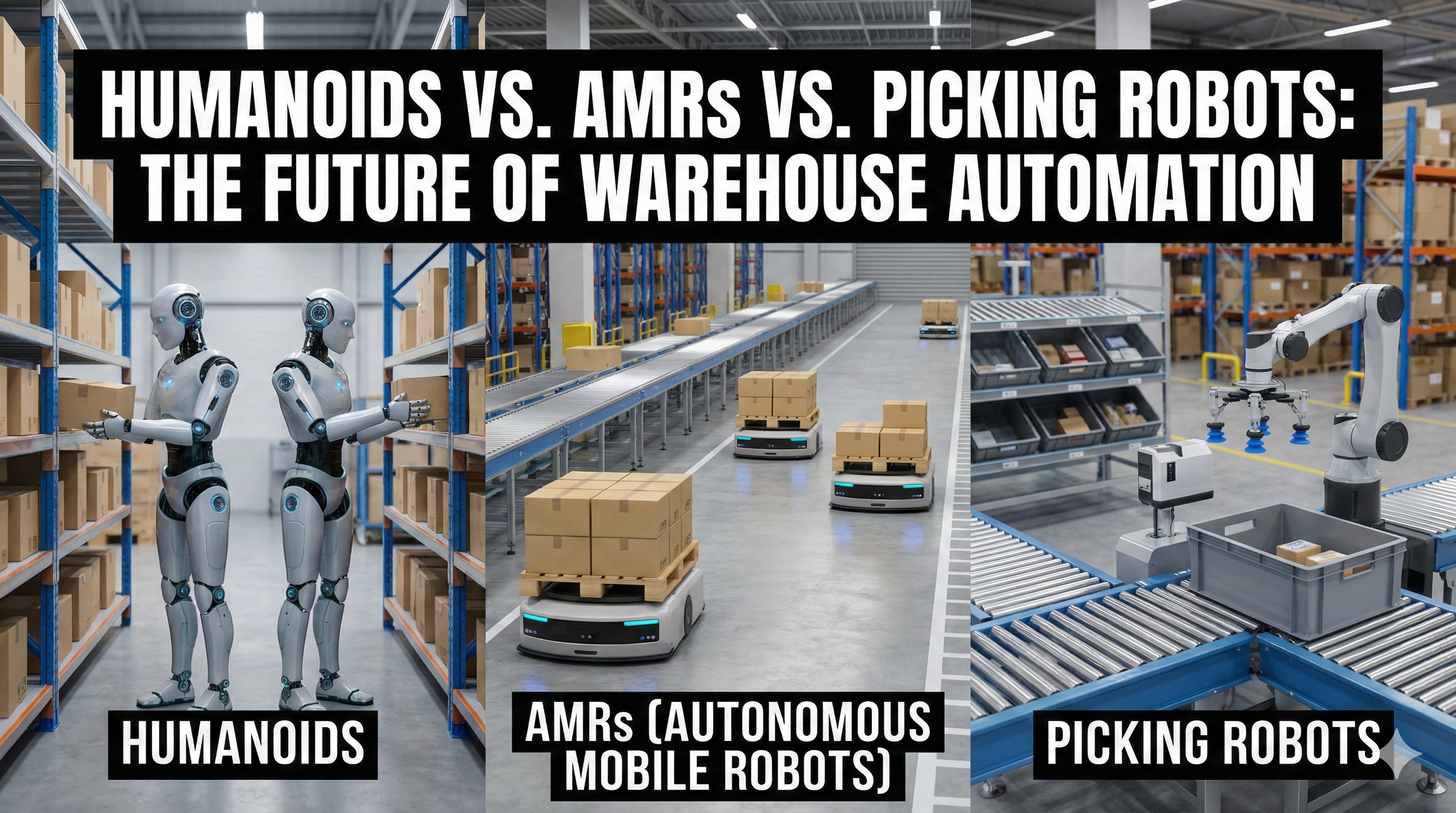
Les robots humanoïdes rivalisent non seulement avec les travailleurs humains mais aussi avec :
- Bras industriels fixes
- Robots mobiles autonomes
- Systèmes de convoyage
- Machines conçues pour un usage spécifique
- Automatisation d'entrepôt
- Refonte des processus
Une forme humanoïde est précieuse lorsque les environnements sont conçus pour les personnes et ne peuvent pas être facilement reconstruits. Dans des usines prévisibles, des machines spécialisées peuvent rester plus rapides, plus sûres et moins chères.
Risques réglementaires et géopolitiques
Le succès international de Unitree crée une exposition aux restrictions commerciales.
Plus de 40 % de ses revenus de 2025 provenaient des marchés étrangers. Les États-Unis ont contribué de manière significative — la divulgation de Unitree l'a estimée à environ les bas à moyens adolescents selon la période de reporting et la définition des revenus.
En juillet 2026, la Commission fédérale des communications des États-Unis a restreint l'autorisation de nouveaux modèles de robots humanoïdes et quadrupèdes produits à l'étranger, invoquant des préoccupations en matière de cybersécurité, de surveillance, de chaîne d'approvisionnement et de sécurité nationale. Les modèles approuvés existants étaient traités différemment, mais les nouveaux produits font face à des barrières plus importantes.
Le rapport de l'Associated Press sur les restrictions explique que les mesures visaient principalement la Chine et couvraient de nouveaux systèmes humanoïdes et quadrupèdes.
Les conséquences potentielles incluent :
- Pertes de ventes aux États-Unis
- Accès réduit aux institutions de recherche
- Coûts de conformité supplémentaires
- Pression sur les partenaires européens
- Restrictions sur les puces d'IA avancées
- Limites sur les composants sensibles
- Exigences accrues en matière de localisation des données
- Politiques de rétorsion chinoises
Unitree peut rediriger ses ventes vers la Chine, l'Europe, l'Asie du Sud-Est, le Moyen-Orient et d'autres régions. Perdre l'accès aux clients américains réduirait néanmoins la diversité des revenus et l'interaction avec les principaux laboratoires de robotique.
La cybersécurité est un risque produit essentiel
Un robot humanoïde connecté combine des caméras, des microphones, un réseau sans fil, un mouvement physique, des services cloud et une puissance de calcul substantielle. Un échec de sécurité peut donc créer à la fois des conséquences numériques et physiques.
Des chercheurs en sécurité ont révélé une vulnérabilité connue sous le nom de UniPwn affectant plusieurs plateformes Unitree, y compris les humanoïdes G1 et H1 et les quadrupèdes Go2 et B2.
La faiblesse signalée concernait l'interface de configuration Wi-Fi Bluetooth Low Energy et pouvait permettre un contrôle au niveau racine. Les chercheurs ont averti qu'un robot infecté pourrait rechercher et compromettre d'autres robots Unitree vulnérables à portée sans fil.
La Société IEEE de robotique et d'automatisation a résumé la vulnérabilité et son potentiel à se propager entre les machines. La base de données nationale des vulnérabilités des États-Unis enregistre également un problème d'injection de commandes affectant plusieurs produits Unitree. Enregistrement de vulnérabilité NVD
Unitree a depuis établi un centre de réponse à la sécurité et a invité les chercheurs à signaler les vulnérabilités.
Les investisseurs devraient considérer la sécurité comme une exigence opérationnelle continue plutôt que comme un correctif ponctuel. Les clients industriels exigeront :
- Démarrage sécurisé
- Firmware signé
- Communication chiffrée
- Segmentation du réseau
- Contrôles d'accès
- Journaux d'audit
- Correction rapide
- Politiques de gouvernance des données
- Comportement physique à sécurité intégrée
Une entreprise vendant des machines qui se déplacent autour des personnes ne peut pas traiter la cybersécurité comme une fonctionnalité logicielle optionnelle.
Une liste de contrôle pratique pour les investisseurs de Unitree Robotics
Les investisseurs évaluant l'introduction en bourse de Unitree Robotics après sa hausse de 460 % devraient suivre des preuves opérationnelles plutôt que des vidéos virales.
1. Séparer les expéditions de la productivité déployée
Demandez :
- Combien d'unités ont été expédiées ?
- Combien ont été acceptées comme ventes ?
- Combien restent actives ?
- Combien fonctionnent dans une production industrielle payante ?
- Combien sont utilisées principalement pour la recherche ou les démonstrations ?
2. Suivre le mélange de clients
La transition la plus importante est celle de la demande de recherche vers un déploiement économiquement justifié.
Surveillez si les applications industrielles passent d'environ 9 % des revenus humanoïdes vers 25 %, 40 % ou plus.
3. Mesurer la productivité des robots
Les indicateurs utiles incluent :
- Taux de réussite des tâches
- Interventions humaines par quart
- Temps moyen entre les pannes
- Heures de fonctionnement par jour
- Utilisation d'énergie
- Coût de maintenance
- Succès de la prise
- Temps de déploiement
- Délai de récupération
4. Réconcilier les définitions de profit
Ne vous fiez pas au chiffre de bénéfice le plus favorable. Comparez :
- Bénéfice net statutaire
- Bénéfice ajusté
- Rémunération en actions
- Subventions gouvernementales
- Changements de valeur juste
- Flux de trésorerie d'exploitation
- Dépenses en capital
- Fonds de roulement
5. Surveillez la marge brute
Une marge brute de base de 60 % est attrayante mais peut diminuer si :
- Les produits de consommation représentent une part plus importante.
- Les concurrents baissent les prix.
- Les clients industriels exigent des garanties de service.
- Les coûts de garantie augmentent.
- Les configurations à coût réduit augmentent.
- La production s'étend avant la demande.
6. Évaluez les progrès du modèle
L'évaluation dépend de plus en plus de la capacité d'UnifoLM et des modèles associés à offrir une autonomie pratique.
Recherchez des démonstrations réalisées :
- Dans des environnements inconnus
- Sans téléopération
- Sans coupes cachées
- Sur plusieurs robots
- Sur de longues périodes d'exploitation
- Avec des taux de succès mesurés de manière indépendante
7. Suivez la réglementation
Surveillez les règles d'autorisation aux États-Unis, les contrôles à l'exportation, les exigences de cybersécurité européennes, les restrictions de données et l'accès aux processeurs avancés.
SimianX AI est conçu pour combiner les prix du marché, les divulgations des entreprises, les nouvelles de dernière minute, l'analyse fondamentale et les indicateurs techniques. Bien que Unitree soit une action A plutôt qu'un titre coté aux États-Unis, les investisseurs peuvent utiliser SimianX AI pour surveiller les entreprises américaines connexes telles que TSLA, NVDA, les fournisseurs de semi-conducteurs, les entreprises d'automatisation et les actions industrielles exposées à la robotique.
Percée en IA ou bulle des robots humanoïdes ?
Les preuves soutiennent les deux côtés—mais à différents niveaux.
| Question | Évaluation de la recherche |
|---|---|
| Unitree a-t-il réalisé une percée matérielle ? | Oui |
| A-t-il réduit le prix des robots humanoïdes ? | Oui |
| A-t-il démontré une échelle de fabrication ? | Oui, par rapport au jeune marché |
| A-t-il des revenus réels ? | Oui |
| A-t-il signalé une rentabilité ? | Oui, bien que les chiffres ajustés et statutaires diffèrent matériellement |
| L'IA incarnée à usage général a-t-elle été résolue ? | Non |
| Les humanoïdes sont-ils largement productifs dans les usines ? | Pas encore |
| La plupart de la demande pour les humanoïdes est-elle industrielle ? | Non ; la recherche et l'éducation restent dominantes |
| L'évaluation du premier jour nécessite-t-elle une exécution exceptionnelle ? | Oui |
| La faible flottabilité a-t-elle amplifié le mouvement de l'action ? | Presque certainement |
La réponse la plus précise est :
Unitree est une véritable percée en robotique enveloppée dans une évaluation potentiellement à niveau bulle.
L'entreprise a résolu suffisamment de problèmes matériels pour mériter une importance stratégique. Le marché boursier l'a évaluée comme si les problèmes de logiciel, d'autonomie, d'adoption industrielle, d'accès réglementaire et de rentabilité à long terme seraient également résolus.
Ce sont des réalisations distinctes.
FAQ sur l'introduction en bourse de Unitree Robotics
Pourquoi l'introduction en bourse de Unitree Robotics a-t-elle grimpé de 460 % ?
La hausse a reflété une forte demande pour une exposition publique rare à la robotique humanoïde, une forte sursouscription à l'introduction en bourse, un petit flottant initial négociable, et des règles du marché STAR qui n'imposent aucune limite de prix pendant les cinq premiers jours de négociation. La croissance rapide des revenus de Unitree et son leadership en expéditions ont renforcé le récit, mais la structure du marché a amplifié le mouvement.
Unitree Robotics est-elle rentable ?
Unitree a signalé un bénéfice net statutaire de 278 millions de RMB pour 2025 et un bénéfice hors éléments non récurrents d'environ 591 millions de RMB. Étant donné que ces chiffres diffèrent considérablement, les investisseurs devraient étudier la réconciliation comptable et les flux de trésorerie plutôt que de se fier à un seul chiffre ajusté.
L'action de Unitree Robotics est-elle surévaluée ?
À sa valeur de clôture du premier jour, Unitree se négociait autour de 201 fois les ventes de 2025, plus de 1 200 fois le bénéfice statutaire et près de 580 fois le bénéfice ajusté. Cette valorisation ne peut être justifiée que si Unitree devient une plateforme d'IA physique dominante à l'échelle mondiale avec des dizaines de milliards de yuans de revenus futurs.
Les robots Unitree sont-ils réellement autonomes ?
Les robots Unitree démontrent une locomotion avancée et peuvent supporter l'apprentissage par imitation, l'apprentissage par renforcement et la manipulation expérimentale. Ils ne sont pas encore des travailleurs autonomes polyvalents capables de compléter de manière fiable la plupart des tâches dans des maisons ou des usines inconnues.
Les investisseurs internationaux peuvent-ils acheter des actions de Unitree Robotics ?
Unitree se négocie sur le marché STAR de Shanghai sous le code 688836. L'accès direct peut être restreint par l'éligibilité des investisseurs, le soutien des courtiers, la juridiction et les règles de négociation transfrontalière. Les investisseurs doivent confirmer l'accès, le risque de change, les impôts, le règlement et les exigences réglementaires auprès d'un courtier qualifié.
Qu'a fait l'action Unitree depuis l'introduction en Bourse ?
Au 16 octobre 2026, Unitree comptait 36 séances pleines depuis ses débuts et cotait autour de 426,98 RMB : environ 183 % au-dessus du prix d'introduction de 150,80 RMB, mais près de 49,5 % sous la clôture de 845 RMB du premier jour et environ 61,2 % sous le plus haut en séance de 1 100 RMB. La valeur de marché implicite est passée de 341,8 milliards à environ 172,7 milliards de RMB sur la période.
Quand les actions bloquées d'Unitree deviendront-elles négociables ?
Seuls 7,44 % du capital étaient négociables lors de la cotation. Dix pour cent de l'allocation institutionnelle se libèrent au bout de six mois, en février 2027, portant le flottant à 8,00 %. La grande marche est le 19 août 2027 : les tranches de douze mois — la plupart des actionnaires pré-IPO plus les investisseurs stratégiques à un an — portent la part négociable à environ 64,6 %. Les actionnaires entrés en 2025 sont bloqués 36 mois à compter de leur propre entrée, soit vers le milieu de 2028, ce qui ajoute environ 3,6 points ; l'investissement du sponsor se libère en août 2028 ; et les 31,6 % restants — le fondateur, sa plateforme d'intéressement, DeepSeek et le plan salarié n° 2 — restent bloqués jusqu'en août 2029.
Conclusion
L'histoire de l'IPO de Unitree Robotics qui s'envole de 460% n'est ni un simple triomphe ni une simple bulle.
Unitree a construit quelque chose de substantiel. Elle a réduit le coût des robots avancés à pattes, créé des produits reconnus mondialement, fabriqué des milliers d'humanoïdes, généré des revenus en forte croissance, développé des composants clés en interne et atteint une rentabilité rapportée alors que de nombreux concurrents restent financés par des fonds privés et en perte.
Ces réalisations font de Unitree l'une des entreprises les plus crédibles dans l'IA incarnée.
Le prix de l'action raconte une histoire plus agressive. Une valorisation de clôture du premier jour proche de 342 milliards de RMB représentait environ 201 fois les ventes passées. Elle supposait que l'avance matérielle de Unitree se traduirait par une autonomie polyvalente, de grands déploiements industriels, des marges durables, un accès au marché international et une économie de niveau plateforme.
Aujourd'hui, la plupart des revenus des robots humanoïdes proviennent encore de la recherche et de l'éducation. Les déploiements industriels restent limités, l'opération autonome généralisée n'a pas été démontrée, la concurrence s'élargit, la cybersécurité nécessite des investissements continus, et les restrictions américaines menacent un marché d'exportation important.
La question centrale d'investissement n'est donc pas de savoir si les robots humanoïdes vont s'améliorer. Ils vont presque certainement le faire. La question est de savoir combien de ce futur Unitree capturera—et combien les investisseurs ont déjà payé pour.
Un investisseur discipliné devrait suivre le mélange de clients, les heures de fonctionnement industriel, les taux de réussite des tâches, les marges, le flux de trésorerie d'exploitation, la performance en matière de sécurité, les progrès des modèles d'IA, et l'offre d'actions après la période de blocage. Ces indicateurs révéleront bien plus que des démonstrations de robots dansants, boxant ou faisant des saltos arrière.
Pour un suivi en temps réel des entreprises publiques fournissant et concurrençant dans l'écosystème de l'IA physique, explorez SimianX AI. Son approche multi-agents peut aider les investisseurs à comparer les dépôts financiers, les signaux techniques, les catalyseurs d'actualités et les facteurs de risque sans réduire une thèse complexe sur la robotique à un seul titre viral.
À la mi-octobre 2026, le marché avait corrigé ce chiffre : environ 173 milliards de RMB, soit près de 102 fois les ventes — un prix que seule une plateforme dominante d'IA physique pourrait justifier avec le temps.
Lecture Liée
- newcleo en Bourse : NWCL à 8,145 $ contre 10 $ au SPAC
- Oura reporte son IPO : ce que cache le S-1 derrière 13,5 Md$
- Toutes les bulles tech depuis 1929 face au cycle IA de 2026
- Introduction en Bourse de Tesla : date, prix et rendement
- Capex IA 2026 : 96 % des flux de trésorerie des géants tech
Références
- Bourse de Shanghai — prix de l'introduction d'Unitree, emploi des fonds et comptes 2025
- Bourse de Shanghai — demande institutionnelle lors du placement
- Marché STAR — règles de négociation, dont les cinq premières séances sans limite de cours
- China Daily — rapport d'avant-cotation sur le flottant initial
- Xinhua — lecture du prospectus d'Unitree et de la prévision semestrielle
- The Standard — comptes du premier semestre 2026 publiés la veille des débuts
- 36Kr — structure de l'opération, placement stratégique et calendrier de blocage
- Associated Press — cours du premier jour et montant levé
- Associated Press — restrictions américaines sur les nouveaux robots humanoïdes et quadrupèdes étrangers
- Yahoo Finance — historique quotidien des cours de 688836.SS
- Fédération internationale de robotique — synthèse de World Robotics 2025
- Fédération internationale de robotique — analyse de la stratégie robotique chinoise
- IEEE Robotics and Automation Society — la vulnérabilité UniPwn
- National Vulnerability Database — CVE-2025-35027
- Avis d'admission d'Unitree, 18 août 2026 — placement stratégique, calendrier de blocage et comptes semestriels 2026 non audités
Cet article est à des fins de recherche et d'éducation uniquement. Ce n'est pas un conseil en investissement, juridique ou fiscal. Les chiffres financiers et les prix du marché doivent être vérifiés par rapport aux derniers dépôts d'échange avant de prendre des décisions.