
 By Muke
Two Inflation Gauges, One Decision: Inside the September FOMC Call
For most of this year the market's only question about the September 2026 Fed rate cut was when it would arrive. That question has been almost completely replaced by a more uncomfortable one: could the Federal Reserve raise rates instead?
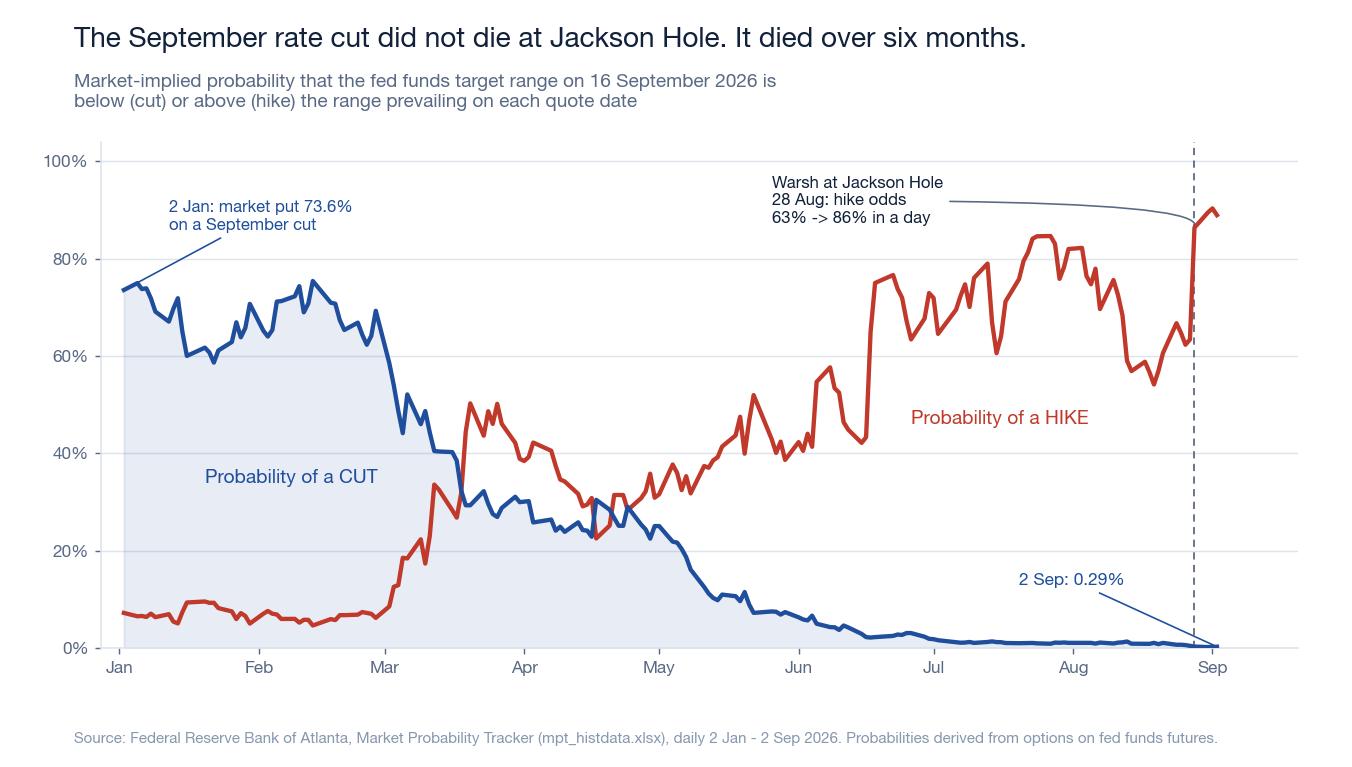
The scale of the reversal is easy to understate. On 2 January the options market attached a 73.6% probability to the target range being lower after the September meeting. On 2 September that probability was 0.29% — and the probability of a higher range had gone from 7.2% to 88.9%. Fed Chair Kevin Warsh’s Jackson Hole speech on 28 August moved hike pricing 23 percentage points in a single session; Governor Christopher Waller’s remarks on 3 September pulled part of it back. But neither man was arguing about a cut. Waller’s own framing was hold or hike.
The uncertainty is arriving just as the United States enters the most politically sensitive part of the 2026 calendar. The congressional midterm election is scheduled for November 3, 2026, with all 435 House seats and roughly one-third of Senate seats at stake. The Federal Reserve is legally independent, and this research will argue that the September decision is a data decision rather than a political one — but the election still shapes the fiscal and trade backdrop the Fed has to forecast against, and it lands between the October and December meetings.
This research examines whether September rate-cut hopes are truly dead, what the latest labor and inflation data imply, how the midterms could influence markets, and which scenarios investors should monitor. Every figure below is taken from a primary source — Federal Reserve statements and speeches, the Bureau of Labor Statistics, the Bureau of Economic Analysis, the Treasury and the regional Reserve Banks — and each is linked so you can check it yourself. SimianX AI can help investors track these fast-changing developments across economic data, Fed communications, Treasury yields, equities and market sentiment.
The September FOMC Decision Is Not a Rate-Cut Story Anymore
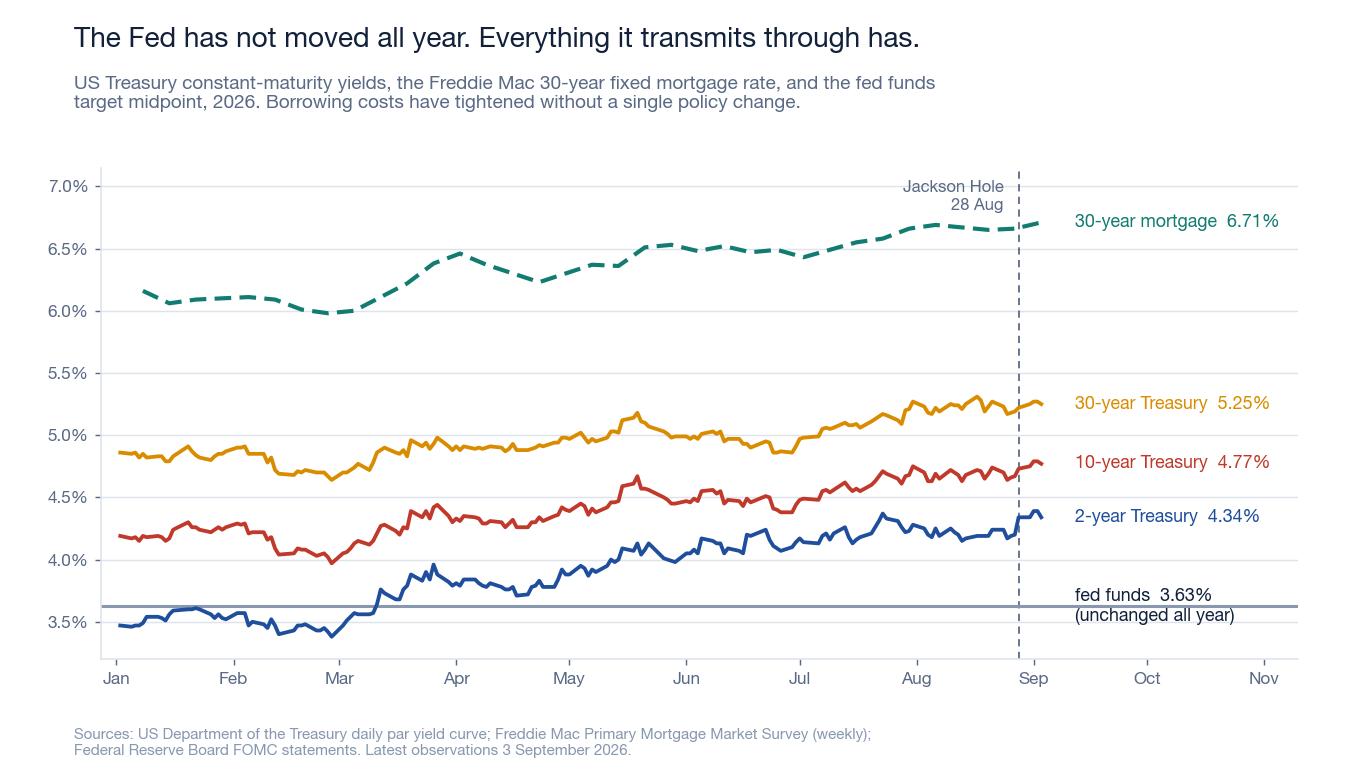
Start with the number the debate is actually about. The federal funds target range is 3.50% to 3.75%, and it has been 3.50% to 3.75% at every single meeting of 2026 — January, March, April, June and July. The effective rate printed 3.63% on 2 September. The Federal Reserve’s official 2026 calendar places the next FOMC meeting on September 15–16, followed by October 27–28 and December 8–9. September carries a new Summary of Economic Projections; October does not. Federal Reserve 2026 FOMC calendar · Effective federal funds rate, New York Fed
The market narrative changed in four stages:
- Easing expectations (January to early March): investors focused on cooling labor demand and the possibility that inflation would return toward the Fed’s 2% target. Market-implied cut odds for September peaked above 75%.
- The energy shock (March to May): headline CPI rose 0.9% in March and 0.6% in April as global energy prices spiked; the two-year Treasury yield crossed above the funds rate in March and never came back. Cut odds fell below 10% by mid-May.
- Hawkish repricing (June to August): the June projections lifted the committee’s own year-end rate path, and Warsh’s Jackson Hole message set a standard for inflation that the data had not met.
- Conditional pause (3 September): Waller indicated that continued disinflation would lead him to favor keeping rates unchanged — explicitly framing the alternative as a hike, not a cut.
That sequence matters because it shows how quickly rate pricing shifts after one credible policy signal. It is worth being precise about what “market odds” means, because two widely quoted gauges currently disagree. The Federal Reserve Bank of Atlanta’s Market Probability Tracker builds a full distribution from options on federal-funds futures and put the probability of a higher range on 16 September at 88.9% on 2 September. CME FedWatch, which is derived from futures prices, was reported at roughly 65% on the same day, easing to about 50-50 after Waller spoke. Neither is a promise from a policymaker; both are prices, and the gap between them is a reminder that the distribution matters more than any single headline number. Atlanta Fed Market Probability Tracker
As of early September, the realistic September outcomes and what the options market pays for them are:
| Outcome | Target range | Market-implied probability, 2 Sep |
|---|---|---|
| Hold | 3.50%–3.75% | 10.8% |
| Hike, 25bp | 3.75%–4.00% | 82.1% |
| Hike, 50bp | 4.00%–4.25% | 7.0% |
| Cut | below 3.50% | 0.29% |
The last line is the honest answer to the question in the headline, and it is worth sitting with. The market is not pricing a close call between a cut and a hold. It is pricing a 1-in-345 chance that the Fed cuts at all, against an 89% chance that it tightens. A September cut now requires a genuine shock — a collapse in the August employment report, a sharply negative inflation surprise, or a financial-stability event between now and the 16th.
Why Rate-Cut Hopes Faded So Quickly
The Federal Reserve is balancing two mandates: maximum employment and stable prices. The current debate is difficult because neither mandate is producing a clear signal.
Inflation remains above target
The Bureau of Labor Statistics reported July CPI at +0.1% for the month and +3.4% over twelve months, with core CPI — the index excluding food and energy — at +0.2% for the month and +2.5% over twelve months. Shelter alone accounted for roughly two-thirds of the monthly increase, while the energy index fell 1.5% after a spring spike that still leaves it 14.7% higher than a year ago. BLS Consumer Price Index, July 2026
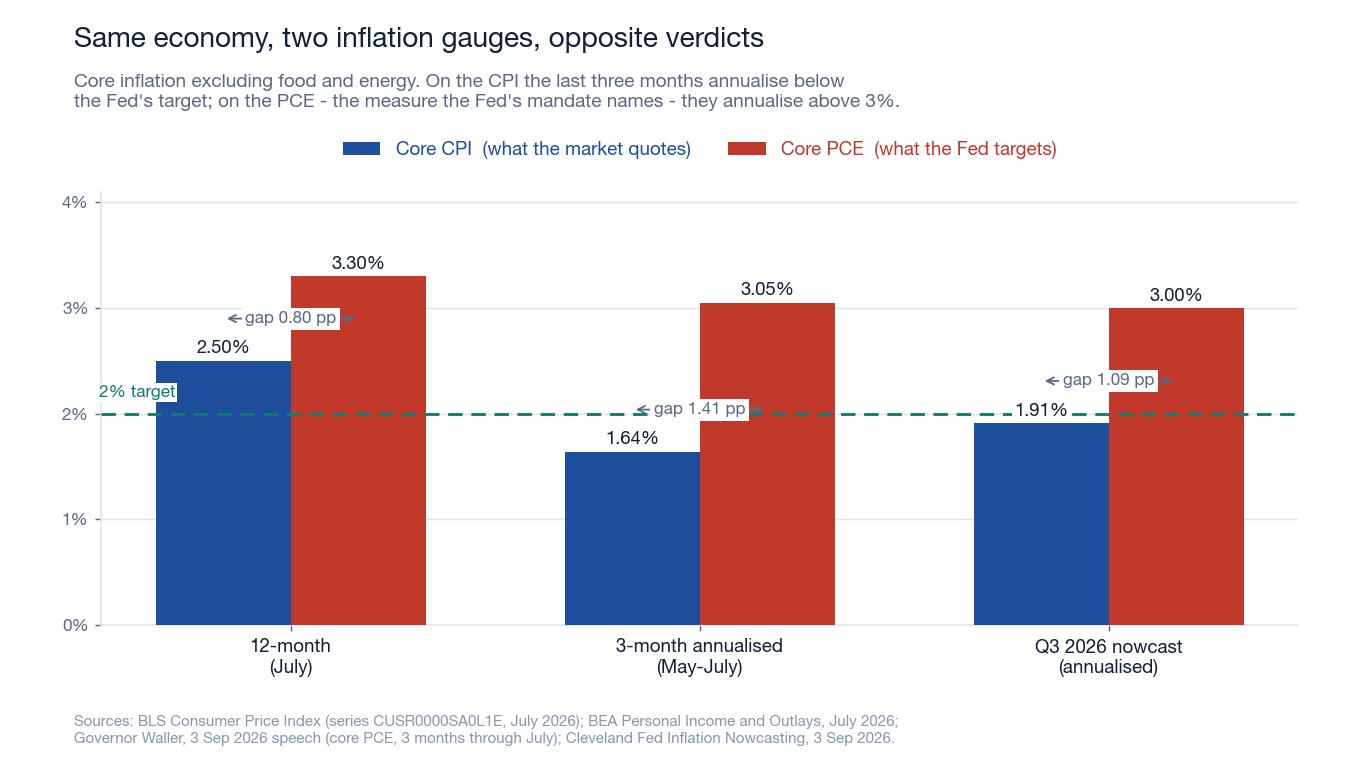
On that measure the Fed looks close to done. Core CPI is 2.5% over a year and, on the three most recent months annualized, 1.64% — below target. So why is anyone discussing a hike? Because the Fed does not target the CPI.
Energy prices, tariffs, housing costs and services inflation remain important risks. Even if goods inflation moderates, shelter and labor-intensive services can keep core inflation elevated. A central bank considering a rate cut must be confident that inflation expectations are anchored; otherwise, easing could revive demand before price pressures are fully contained.
The labor market is slowing, but it is not the reason to cut
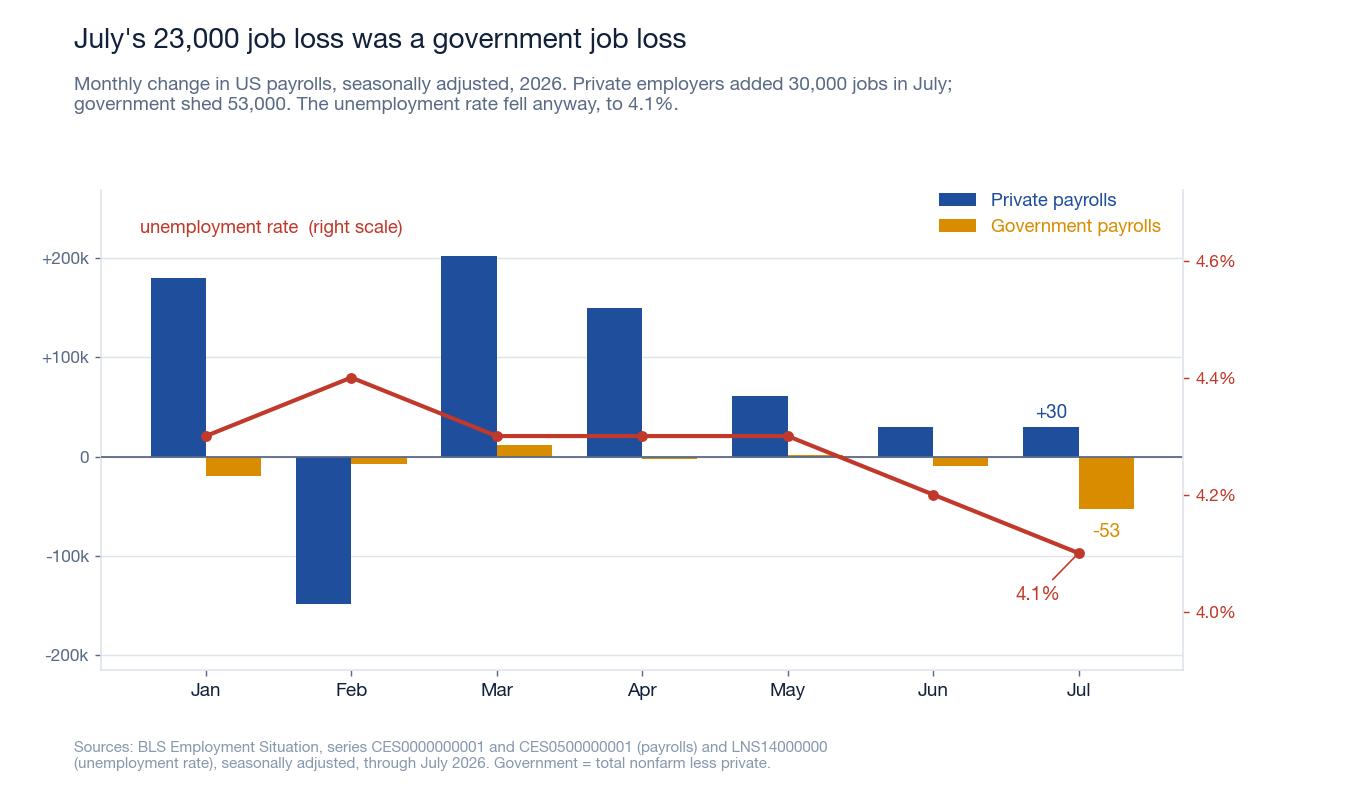
The headline that circulated in August was that the United States lost jobs in July: total nonfarm payrolls fell by 23,000. Read one level down and the picture inverts. Private payrolls rose 30,000 in July. Government payrolls fell 53,000. The entire reported decline, and more, came from the public sector.
The unemployment rate did not rise either. It fell, from 4.2% in June to 4.1% in July — the lowest reading of 2026, and below the bottom of the range every one of the eighteen June projections had penciled in for the fourth quarter. Averaged across the first seven months of the year, payroll growth ran at about 61,000 a month, which Governor Waller has described as at or slightly above what it now takes to keep pace with a labor force growing slowly on much lower net immigration.
That is the difference between a labor market that is deteriorating and one that is simply growing more slowly because there are fewer new workers to hire. The August employment report is due September 4 — the day after this piece was written, and eleven days before the FOMC meets. BLS Employment Situation release schedule
The Fed must distinguish between:
- A controlled slowdown in hiring.
- A sudden rise in layoffs.
- A temporary distortion in the payroll data.
- A persistent decline in labor-force demand.
If hiring slows while unemployment remains relatively stable, policymakers can wait. If unemployment rises rapidly and job losses broaden across sectors, the pressure to cut rates increases.
The Two Inflation Gauges That Disagree
Almost every argument about the September decision reduces to a measurement question that rarely gets stated out loud: which inflation number are you looking at?
The United States publishes two. The Consumer Price Index, from the Bureau of Labor Statistics, is a fixed-basket survey of what urban households pay. The personal consumption expenditures price index, from the Bureau of Economic Analysis, covers a broader set of spending, reweights as people substitute between goods, and includes items nobody is actually billed for. The Federal Reserve’s 2 percent objective is defined on the PCE index, not the CPI — Warsh restated that explicitly at Jackson Hole: “The Fed’s price-stability objective of 2 percent, as measured by the personal consumption expenditures (PCE) price index, is a firm, fixed target.”
Most of the time the two move together and the distinction is a footnote. Right now they are telling opposite stories.
| Core measure, July 2026 | 12-month | 3-month annualized |
|---|---|---|
| Core CPI | 2.50% | 1.64% |
| Core PCE | 3.30% | 3.05% |
| Gap | 0.80 pp | 1.41 pp |
Read the right-hand column. On the CPI, the three most recent months annualize at 1.64% — below the Fed’s target. On the PCE, the same three months annualize at 3.05%. The Cleveland Fed’s nowcast for the third quarter as a whole puts core CPI at 1.91% and core PCE at 3.00%, so this is not a one-month artifact.
Two things drive the wedge, and both are worth understanding before you decide whose side you are on.
Weights. The CPI is a household out-of-pocket basket, so shelter is roughly a third of it. The PCE includes spending made on households’ behalf — most importantly employer- and government-funded medical care — which gives healthcare a much larger weight. When shelter cools and medical services do not, the CPI falls faster than the PCE. That is close to what 2026 has looked like: shelter rose just 0.1% in July.
Imputation. Part of the PCE is not an observed price at all. Waller singled this out on 3 September: nonmarket services prices — figures the statistical agencies estimate rather than collect — accounted for roughly half of July’s increase in core PCE. His own conclusion was that “ignoring this one factor, my take is that underlying inflation is doing better than the core numbers suggest.”
That is a governor of the Federal Reserve saying, in public, that the measure his committee targets is currently overstating the problem by a meaningful margin. And it is the reason the September vote is genuinely uncertain rather than merely close: Warsh and Waller are not disagreeing about the economy. They are disagreeing about a statistic.
For an investor the practical takeaway is narrow and useful. When the August CPI lands on 11 September, do not read the headline and stop. A soft core CPI print is the outcome the market will trade first and the outcome that matters least to the mandate. The number that decides the argument — August core PCE — is not published until the end of the month, after the meeting.
What Fed Officials Are Saying
Fed communication has become unusually important, and for a specific reason that is worth stating plainly: the current Chair has deliberately taken forward guidance away. Kevin Warsh took office on 22 May 2026 for a four-year term, and September will be only his third FOMC meeting. He was a Fed governor once before, from 2006 to 2011. Board of Governors, Kevin Warsh
Kevin Warsh: inflation credibility first
Warsh spoke at the Kansas City Fed’s annual symposium in Jackson Hole on 28 August, marking, as he put it, his hundredth day as Chairman. The speech is worth reading rather than paraphrasing, because what it actually says is more interesting than the headline it generated. Kevin Warsh, “In Our Time,” 28 August 2026
He never used the word hike. What he did was set a standard and then show the data failing it:
“We must be confident that underlying inflation is moving to our objective, clearly and at sufficient speed. Otherwise, we have work to do.”
The evidence he assembled for “otherwise” is the most useful thing in the speech. Warsh disaggregates all 199 components of the PCE price index and counts how many are rising faster than 3%:
| Period | Share of the PCE basket rising above 3% |
|---|---|
| Two decades before the pandemic | 32% |
| Post-pandemic peak | 77% |
| Last 12 months | 54% |
| Last 6 months | 49% |
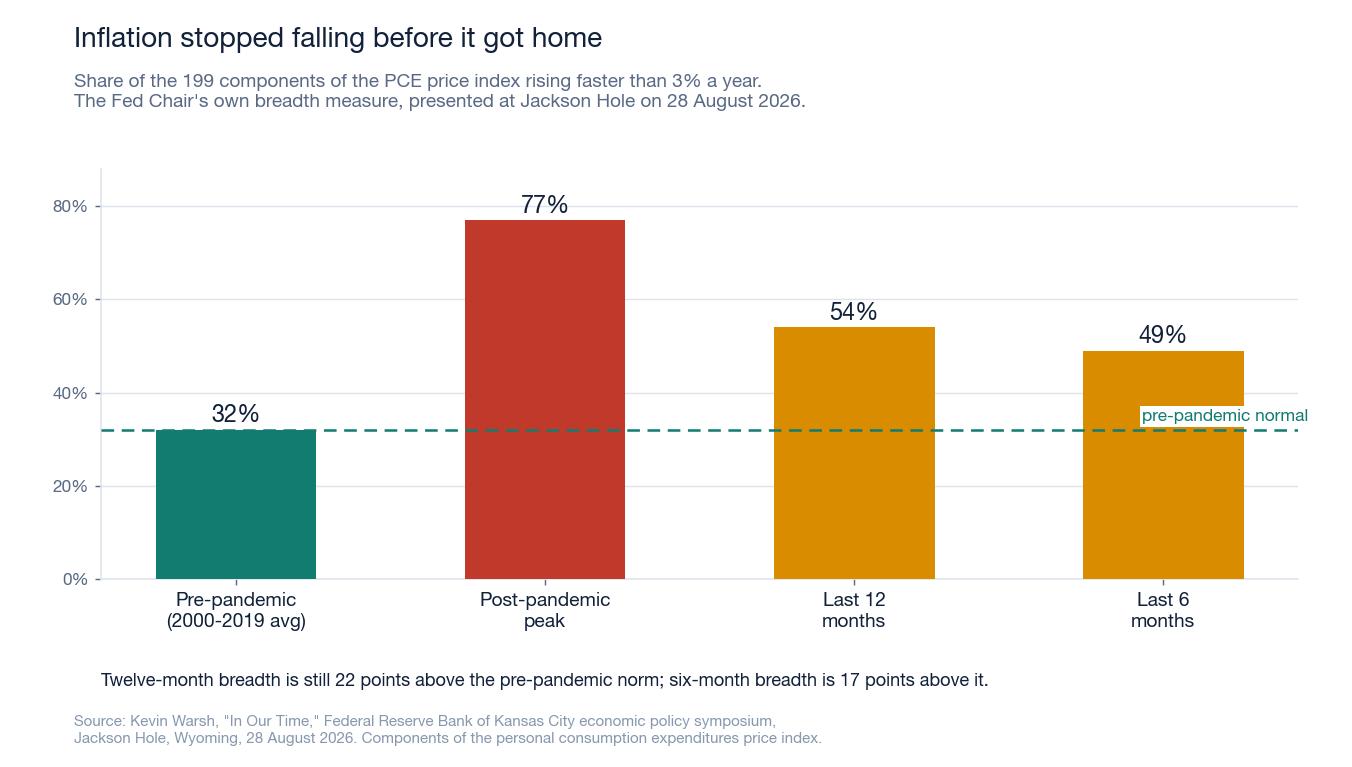
Inflation has come a long way down from the peak and has then stopped, with breadth still running at roughly 1.6 times the pre-pandemic norm. He paired that with a blunt assessment of financial conditions — corporate credit spreads near the low end of their historical range, bank lending standards on the easier end, S&P 500 profits up more than 20% over the year, capital spending on equipment and intangibles growing about 9% — and concluded: “I would be hard pressed to describe broad financial conditions as restrictive.”
And then the sentence that markets took as the signal, which is really an admission: “The responsibility for 65 months of sustained, elevated inflation sits squarely with the central bank. And that is where it belongs.”
His closing line was not guidance at all. “I stand here today committed to a discipline, not to a decision.” Markets, deprived of anything firmer, priced the discipline as a decision anyway — hike odds went from 63.4% to 86.4% between the Thursday and the Friday close.
Christopher Waller: conditional patience
Six days later, in a Reuters NEXT newsmaker interview in Washington on 3 September, Governor Christopher Waller did the opposite of what his Chair had recommended: he described his reaction function in detail, and defended the practice of doing so. Christopher J. Waller, 3 September 2026
His case for patience rests on a number almost nobody quotes. Core PCE inflation over the three months through July annualizes at 3.05%, down from 4.76% in February. That is still not 2%, but the direction and the speed are real. He also flagged that nonmarket services prices — imputed figures rather than observed transactions — accounted for roughly half of July’s core increase, which in his reading means underlying inflation is doing better than the core number suggests.
Read his conclusion carefully, because it is routinely misreported as dovish:
“If there is continued progress toward our 2 percent goal, then I am willing to support holding the policy rate at its current level. But if inflation comes in hot, I would consider a rate hike… it may not take much acceleration in inflation to nudge me into supporting tighter policy.”
That is not hold-or-cut. It is hold-or-hike, from the member of the Board widely read as the dove. Nobody on the committee is publicly arguing for a September cut. The Associated Press reported the same framing the day he spoke. AP: Waller says inflation report next week is pivotal
The June projections were already divided
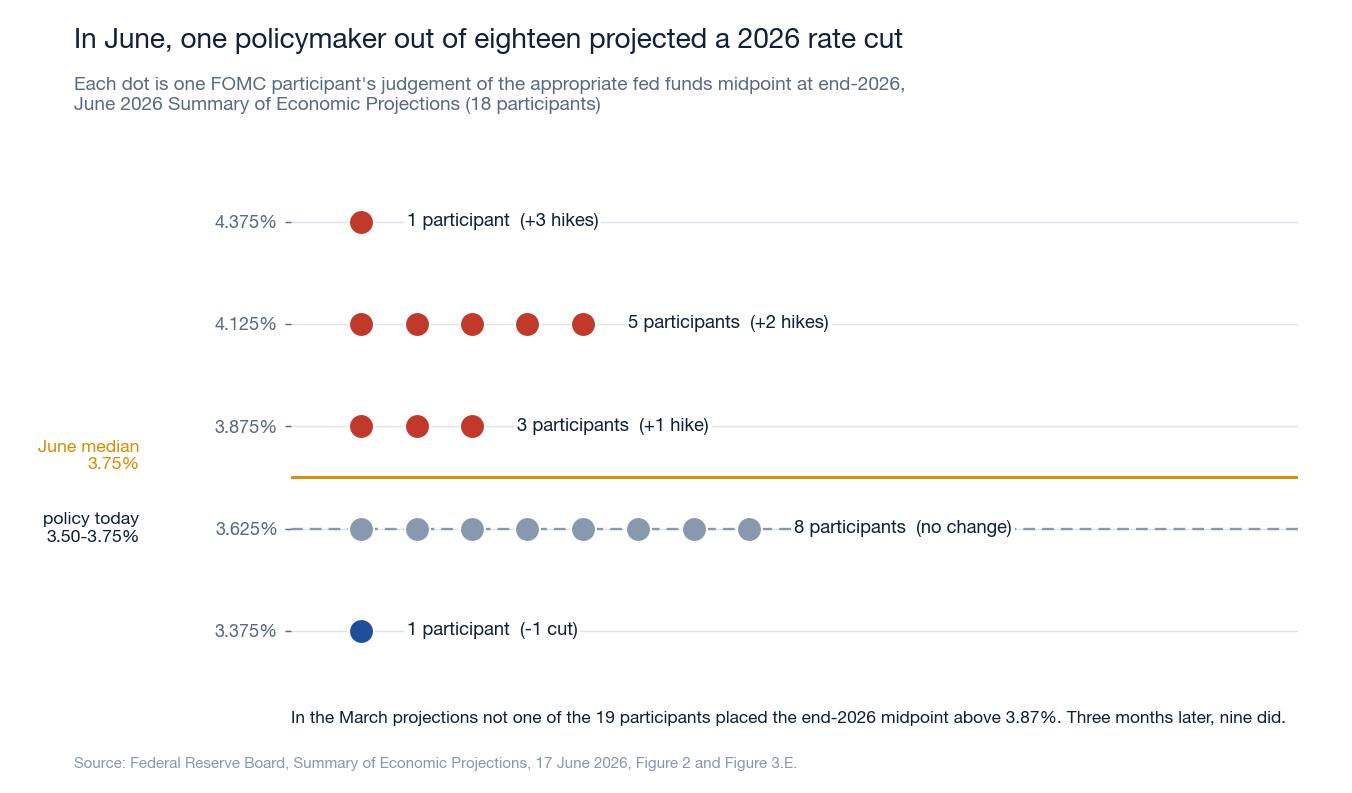
You do not have to rely on reporting for this; the projections are published. Eighteen participants submitted forecasts in June, and the distribution of their end-2026 policy rates was:
| End-2026 midpoint | Participants | Implied move from 3.625% |
|---|---|---|
| 4.375% | 1 | three hikes |
| 4.125% | 5 | two hikes |
| 3.875% | 3 | one hike |
| 3.625% | 8 | no change |
| 3.375% | 1 | one cut |
Nine of eighteen projected a higher rate by December; six of those nine projected two hikes or more. One projected a cut. The median landed at 3.75%, which is to say the middle of this committee was already leaning toward tightening in June. Summary of Economic Projections, 17 June 2026 (PDF)
The speed of the shift is the part worth remembering. In the March projections not one of the nineteen participants had the end-2026 midpoint above 3.87%, and not one had 2026 core PCE above 3.0%. Three months later nine were above 3.87% on rates and seventeen of eighteen were above 3.0% on core PCE — the median 2026 core PCE forecast jumped from 2.7% to 3.3% in a single quarter. That is not a committee fine-tuning; that is a committee whose inflation forecast broke.
Five Holds, Seven Dissents and a Rewritten Statement
The public commentary treats this as a debate that started at Jackson Hole. The voting record says otherwise, and it is the single best-documented part of this story because the Fed publishes every statement and every dissent.
The target range has been 3.50% to 3.75% at every meeting of 2026. Five holds in a row. What changed underneath is the composition of the disagreement.
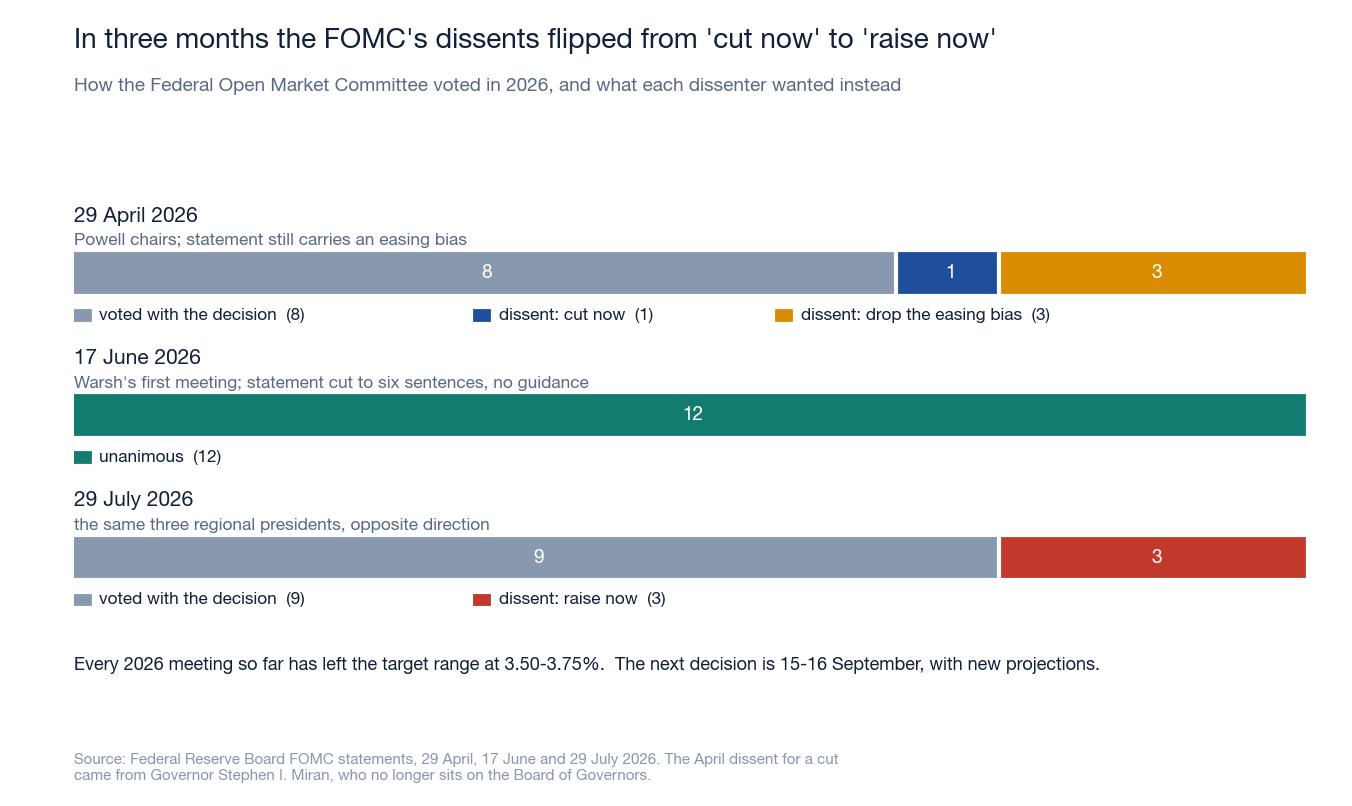
29 April, 8-4. The most divided meeting of the year, and divided in both directions. Governor Stephen Miran dissented because he wanted to cut immediately. Beth Hammack of Cleveland, Neel Kashkari of Minneapolis and Lorie Logan of Dallas dissented because they supported the hold but did not want an easing bias in the statement at all. FOMC statement, 29 April 2026
17 June, 12-0. Warsh’s first meeting produced a unanimous vote and a statement that had been rewritten from the ground up. Where April’s ran to five paragraphs of conditional guidance, June’s ran to six sentences, dropped the easing bias, dropped the promise to “carefully assess incoming data, the evolving outlook, and the balance of risks,” and closed with a line the Federal Reserve had not used before: “The Committee will deliver price stability.” FOMC statement, 17 June 2026
29 July, 9-3. The same three regional presidents dissented again — this time because they “preferred to raise the target range for the federal funds rate by 1/4 percentage point at this meeting.” In three months the dissent bloc had gone from arguing against signaling a cut to voting for a hike, and the one participant who wanted to ease is no longer on the Board. FOMC statement, 29 July 2026
That is the context the September meeting inherits. A hike would not be a policy reversal engineered by one speech; it would be the committee’s own two-quarter drift arriving at its conclusion.
Why this Fed moves markets more, not less
There is a second-order effect here that explains the violence of the price action, and it is deliberate.
Warsh spent roughly a third of his Jackson Hole address arguing that forward guidance, adopted during the financial crisis, “has overstayed its welcome.” He declined to publish a reaction function — “providing forecasts to illustrate the Fed’s reaction function works better in theory than in practice, better in the lab than in the field” — and warned about a “hall-of-mirrors problem” in which the Fed reads market prices while markets read the Fed. He wants a “quieter Fed.”
The intention is defensible. The mechanical consequence is not quiet at all. Guidance is a shock absorber: when a central bank has told you the conditions under which it will act, individual data points and individual speeches carry less information. Remove it, and every appearance becomes the statement. That is why one address in Wyoming was worth 23 percentage points of hike probability, and why a single newsmaker interview six days later gave several of them back.
Worth noting too: Jerome Powell remains a sitting governor, with a term running to January 2028, and votes at every one of these meetings. The immediate past Chair is still in the room. Board of Governors
The Two Data Releases That Matter Most
The September decision will be shaped by two key reports arriving just before the meeting.
1. The August employment report
The employment report provides information on payroll growth, unemployment, wage gains, labor-force participation and average weekly hours.
A weak report could revive rate-cut expectations if it shows:
- Large payroll losses.
- A sharp unemployment increase.
- Falling hours worked.
- Broad-based weakness beyond government or weather-sensitive sectors.
- Moderating wage growth.
A strong report would increase the risk of a hike if it shows:
- Payroll growth above expectations.
- A lower unemployment rate.
- Faster wage gains.
- Stronger revisions to prior months.
- Resilient private-sector hiring.
The most market-moving result may be a mixed report. For example, weak payroll growth combined with sticky wages would leave the Fed facing an uncomfortable trade-off rather than a clear decision.
2. The August CPI report
August CPI is scheduled for September 11 at 8:30 a.m. Eastern, five days before the FOMC convenes. That is the release Waller has said will decide his vote. BLS Consumer Price Index release schedule
We are not entirely in the dark about what it will say. The Federal Reserve Bank of Cleveland publishes a daily nowcast of both price indexes, built from daily oil prices, weekly gasoline data and the historical behavior of each component. As of 3 September it projects:
| August 2026 nowcast | Month over month | Year over year |
|---|---|---|
| CPI | +0.36% | 3.38% |
| Core CPI | +0.20% | 2.38% |
| PCE | +0.35% | 3.80% |
| Core PCE | +0.27% | 3.40% |
Read the two bold rows together, because they are the whole problem in two lines. The nowcast has core CPI falling from 2.5% to 2.38% — continued disinflation, exactly the outcome Waller said would let him hold. It has core PCE rising from 3.3% to 3.40%, and headline PCE rising from 3.7% to 3.80%. The August data may let Waller hold and give Warsh grounds to move, from the same month. Cleveland Fed Inflation Nowcasting
A genuinely hot CPI print would end the discussion and make a hike near-certain. A soft one changes less than it looks, because the measure the mandate names is not the one that would have softened.
Investors should focus on the monthly core reading, shelter, services excluding housing and categories exposed to tariffs — and, this cycle, on the wedge between the two indexes. One soft monthly print is not enough to establish a durable trend, but several soft readings could materially change the Fed’s outlook.
How the 2026 Midterms Complicate the Policy Debate
The 2026 midterm election will take place on November 3. The Federal Election Commission’s own calendar of congressional primary dates carries that general-election date on every page. FEC 2026 congressional primary dates (PDF)
Before listing the channels, it is worth being honest about the timing, because it cuts against the framing this story is usually given. The September meeting is seven weeks before the election and will be decided by two data releases that arrive first. The October 27–28 meeting is six days before it. The December 8–9 meeting is the first one that can respond to a result. If the midterms move Fed policy in 2026, they move it in December, not September.
What the election does shape, immediately, is the environment the Fed must forecast against. The Fed is not supposed to set interest rates based on election outcomes; it is required to forecast fiscal and trade policy, and campaigns change both.
Fiscal policy uncertainty
Election campaigns may increase pressure for tax cuts, spending programs, subsidies or trade measures. If fiscal policy adds demand to an already supply-constrained economy, inflation could remain higher for longer.
Tariff and trade policy
Tariffs can raise import costs directly and may also encourage domestic producers to increase prices. If election-related trade proposals become more aggressive, the Fed could face a difficult distinction between a temporary price-level adjustment and a persistent inflation impulse.
Political criticism of the Fed
A central bank raising rates before an election will attract criticism from the administration and members of Congress; one cutting them will face accusations of responding to political pressure. The conventional defense is a transparent, data-based reaction function — and this is precisely where the current Fed has chosen a different path. Warsh has argued in public that publishing a reaction function “works better in theory than in practice,” which leaves the Committee’s credibility resting on results rather than on explanation. His own formulation, borrowed from Chuck Yeager: “At the moment of truth, there are either reasons or results.” It is a defensible stance, but it removes the paper trail that usually protects a central bank from the charge of acting politically.
Market volatility
As polling, fiscal proposals and policy announcements shift, Treasury yields and equity-sector leadership can move rapidly. Small-cap stocks, housing shares, banks and long-duration technology stocks are especially sensitive to changes in rate expectations.
The midterms matter, then, not because they hand anyone control over the Fed — they do not — but because they shape the macroeconomic environment in which the Fed's credibility, independence and inflation expectations are tested.
Scenario Analysis for the September Meeting
Scenario 1: A 25-basis-point hike — 82% priced
This is what the options market expects. Three regional presidents already voted for it in July, the June median already pointed at it, and the Chair has said broad financial conditions are not restrictive.
Market implications:
- Front-end Treasury yields would likely rise, though much of the move is already in the two-year at 4.34%.
- The reaction would hinge on the statement and the dot plot, not the move itself: one-and-done versus the start of a sequence.
- Housing and consumer-discretionary shares would face the sharpest pressure, with the 30-year mortgage already at a 13-month high.
- Banks could benefit from a steeper front end, though credit concerns offset part of it.
- The dollar would likely find support.
Scenario 2: Hold with a hawkish statement — 11% priced
The Fed leaves rates unchanged but emphasizes that inflation remains above target and that further tightening remains possible. This becomes the base case if the August CPI print on 11 September is soft.
Market implications:
- Treasury yields may remain elevated.
- The yield curve could flatten if investors expect restrictive policy for longer.
- Growth stocks may face valuation pressure.
- The U.S. dollar could strengthen.
- Rate-sensitive sectors may underperform.
This outcome would not revive the original September-cut thesis, but it could preserve the possibility of cuts later if inflation improves.
Note that a hold is now the contrarian outcome. If it happens, front-end yields fall and rate-sensitive equities rally — the mirror image of the usual assumption that no change means no news.
Scenario 3: A surprise cut — 0.29% priced
A cut would be difficult to justify without a major downside shock. The Fed would need evidence that the labor market is deteriorating quickly or that financial conditions are becoming unstable — and it would be moving against a core PCE running above 3% and its own June projections.
Market implications:
- Bond yields could fall sharply.
- Long-duration technology stocks might rally.
- The dollar could weaken.
- Gold and inflation-sensitive assets could rise.
- Investors might interpret the cut as a response to recession risk rather than a routine adjustment.
A cut would not automatically be bullish. If markets view it as confirmation that the economy is in serious trouble, equities could fall despite lower interest rates.
Is a September Rate Cut Already Dead?
The most accurate answer is: a September cut is not mathematically dead, but at 0.29% it is closer to dead than most headlines admit — and it did not die last week.
The decay was continuous. Market-implied cut probability for this meeting ran 32% in mid-March, 23% in mid-April, 9.8% in mid-May, 4.3% in mid-June, 1.4% in mid-July, 0.9% in mid-August and 0.29% on 2 September. There was no single event. There was an energy shock in the spring, a committee that revised its own inflation forecast up by six tenths in one quarter, and a new Chair who removed the guidance that had been holding expectations in place.
Yet rate markets can reverse quickly when employment or inflation data surprise, and two such releases arrive before the meeting.
The September cut would require a combination such as:
- Payroll growth far below expectations or outright job losses.
- A noticeable increase in unemployment.
- Moderating wages and hours worked.
- A soft August CPI report.
- No evidence of accelerating tariff-related inflation.
- Financial conditions that remain orderly enough for the Fed to ease.
If only one of those conditions occurs, the likely response is a hold. If several occur simultaneously, a cut could return to the discussion.
It is worth naming the disagreement here rather than hiding it. On the market’s pricing, the more probable path is a hike on 16 September. On the CPI — the number most readers will see on 11 September — the case for one looks thin. Both can be true at once, because they are arguments about different indexes, and the index the mandate names is the one running above 3%.
What Investors Should Watch After September 16
The FOMC decision is only one event. Investors should monitor the entire policy path.
The Summary of Economic Projections
The dot plot can show whether policymakers expect hikes, cuts or prolonged stability. The distribution matters more than the median if the committee is deeply divided.
Treasury-market pricing
Watch the two-year Treasury yield for changes in expected policy and the 10-year for growth, inflation and fiscal-risk premiums. A rising 10-year despite weak data signals term-premium or fiscal concerns rather than stronger growth.
The curve has already done a great deal of the Fed’s work. The two-year yield crossed above the funds rate in March and closed at 4.34% on 3 September, roughly 70 basis points above the 3.63% effective rate — a full hike and then some, already paid for. The 10-year is at 4.77% and the 30-year at 5.25%. US Treasury daily par yield curve
The revision nobody has scheduled around
On 30 September — two weeks after the FOMC decides, and four weeks before it decides again — the Bureau of Economic Analysis begins its 2026 annual update of the National Economic Accounts. Waller flagged, in the same 3 September remarks, that a pending change to how the Commerce Department estimates fees paid to stock-market traders and related professionals “could lower 12-month PCE inflation by a few tenths of a percentage point.”
A few tenths is not a rounding detail here. Core PCE at 3.3% and core PCE at 3.0% are different arguments about the same economy. If the FOMC raises rates on 16 September and the target measure is then revised down at the end of the month, the October meeting will be relitigating a decision made on numbers that no longer exist. This is a genuine, dated, scheduled risk and almost nobody is writing it down. BEA annual update information
Financial conditions
Credit spreads, mortgage rates, equity volatility and the dollar can either reinforce or offset the Fed’s policy stance. If market conditions tighten independently, the Fed may not need to raise rates as much.
Consumer and business surveys
Small-business hiring plans, consumer inflation expectations and purchasing-manager surveys can reveal turning points before official data confirm them.
Election-related fiscal announcements
Tax, tariff and spending proposals could affect inflation expectations even before legislation is passed. Markets often price policy risk before implementation.
The calendar between here and the election
| Date | Event |
|---|---|
| September 4 | August employment report (BLS) |
| September 11 | August CPI (BLS) |
| September 15–16 | FOMC decision and Summary of Economic Projections |
| September 30 | BEA annual update of the National Economic Accounts begins |
| October 2 | September employment report |
| October 14 | September CPI |
| October 27–28 | FOMC decision (no projections) |
| November 3 | Congressional midterm election |
| December 8–9 | FOMC decision and projections |
Note the order. September’s CPI does not print until October 14, which is after the October meeting would need it and before the election. The Fed will go into its last pre-election meeting with one fewer inflation reading than it would like.
SimianX AI is designed to help investors organize this information. Its platform combines fundamental analysis, technical indicators, news sentiment and market data through multiple specialized agents. That type of workflow can be useful during event-heavy periods such as the September FOMC meeting and the 2026 midterms. However, SimianX AI is a research and educational tool, not a registered investment adviser, and its outputs should be independently verified. Visit SimianX AI
Practical Portfolio Framework for a High-Volatility Fed Market
Investors do not need to predict the exact September decision to manage risk effectively.
Step 1: Separate duration exposure from business quality
A high-quality company with strong cash flow can still decline when discount rates rise. Review both the company’s fundamentals and its sensitivity to bond yields.
Step 2: Avoid binary positioning
Options, leverage and concentrated trades can create large losses if the Fed surprises markets. Consider staged exposure and position limits around the employment and CPI releases.
Step 3: Track real yields
Real yields often matter more for growth-stock valuations than the nominal policy rate. Rising real yields can pressure long-duration assets even if inflation expectations are stable.
Step 4: Build scenario ranges
Instead of assuming a single outcome, model:
- Hold with hawkish guidance.
- 25-basis-point hike.
- Dovish hold after soft data.
- Surprise cut caused by labor-market deterioration.
Step 5: Reassess after the data, not before
The August employment report and CPI report may change the odds dramatically. Investors should update assumptions after the numbers arrive instead of anchoring to current futures pricing.
FAQ About the September 2026 Fed Rate Decision
Is a September 2026 Fed rate cut still possible?
Technically yes, but the options market priced it at 0.29% on 2 September, against roughly 89% for a hike. A cut would require a genuine shock: a collapse in the August employment report, a sharply negative inflation surprise, or a financial-stability event before the 16th.
What is the date of the September 2026 FOMC meeting?
The Federal Reserve’s official calendar lists the meeting for September 15–16, 2026, with the decision published at 2:00 p.m. Eastern on the 16th. It includes a Summary of Economic Projections; the following meeting, on October 27–28, does not. Federal Reserve meeting calendar
How do the 2026 midterms affect Fed policy?
Less than the framing suggests, at least for September. The election is on November 3; the September meeting is seven weeks before it and will be decided by the 4 September jobs report and the 11 September CPI. The October meeting is six days before the vote, and December is the first meeting that can respond to a result. Where the midterms genuinely matter is the fiscal and trade backdrop the Fed must forecast against — tax, spending and tariff proposals move inflation expectations before any legislation passes.
What data will decide whether the Fed hikes or holds?
The August employment report (September 4) and the August CPI report (September 11). Governor Waller has said explicitly that the inflation release will decide his vote.
Why do the CPI and PCE tell different stories right now?
Different weights and different construction. The CPI is a household out-of-pocket basket in which shelter is about a third; the PCE includes employer- and government-funded healthcare, so medical services weigh far more heavily, and part of it is imputed rather than observed. In July, core CPI ran 2.5% over twelve months and 1.64% over the last three annualized; core PCE ran 3.3% and 3.05%. The Fed’s 2% target is defined on the PCE index.
What is the current federal funds target range?
3.50% to 3.75%, unchanged at every 2026 meeting — January, March, April, June and July. The effective rate printed 3.63% on 2 September.
What happens to stocks if the Fed hikes in September?
A hike could pressure growth stocks, housing shares and other rate-sensitive sectors, while supporting the dollar and short-term Treasury yields. The longer-term market reaction would depend on whether investors view the hike as a one-time adjustment or the beginning of a broader tightening cycle.
Conclusion
The phrase “September rate-cut hopes are dead” is too absolute, but the direction of travel has clearly changed. Investors are no longer debating when the Fed will cut; they are debating whether the central bank might raise rates to protect inflation credibility.
The September 15–16 meeting will be shaped by the August jobs report, the August CPI release, internal Fed disagreement and the political sensitivity of the 2026 midterm environment. A soft labor report and soft inflation print could restore expectations for a pause followed by future easing. Sticky inflation or resilient hiring could keep a hike on the table.
The market’s base case is a 25-basis-point hike, priced at about 82%, with a hawkish hold as the main alternative at roughly 11%. A cut is priced at 0.29%. That distribution can still move — the same probability swung more than twenty points on a single Friday in August and gave several points back on a single Thursday in September — but it is a very long way from the “when does the Fed cut” debate this year opened with.
The deeper point is about how the answer will be reached. This Fed has told you it will not tell you in advance. Warsh spent a third of his Jackson Hole speech explaining why forward guidance “has overstayed its welcome,” and the June statement duly arrived stripped to six sentences. That is a defensible position. It also means every speech now carries the information that used to sit in the statement — which is exactly why one address in Wyoming was worth twenty-three points of probability.
For ongoing monitoring, SimianX AI can help bring together Fed statements, macroeconomic releases, Treasury yields, technical signals and political-risk headlines. Use it to structure research, challenge assumptions and compare scenarios—but consult a qualified financial professional before making investment decisions.
Related Reading
- July CPI Report 2026: Inflation Falls, Fed Hike in Doubt
- Jackson Hole 2026: Will Innovation Rewrite Fed Policy?
- June 2026 FOMC Decision: Dot Plot, AI Stocks & Bitcoin
- 2026 Fed Rate Cut Expectations: Live Market Pricing Map
- Trump Treasury Bond Buybacks: Midterm Ploy or Market Fix?
- 2026 Midterm Election Stocks: 12 Tickers, 3 Scenarios
- Every Fed Rate-Hike Cycle Since 1983: S&P 500 & Chip Stocks
- The Presidential Cycle: S&P 500 Returns by Year, 1928-2025
References
- Federal Reserve — 2026 FOMC meeting calendar
- Kevin Warsh — “In Our Time,” Jackson Hole, 28 August 2026
- Christopher J. Waller — economic outlook and policy communication, 3 September 2026
- Federal Reserve — Summary of Economic Projections, 17 June 2026 (PDF)
- FOMC — statement, 29 April 2026
- FOMC — statement, 17 June 2026
- FOMC — statement, 29 July 2026
- Federal Reserve — Board of Governors
- Federal Reserve Bank of Atlanta — Market Probability Tracker
- Federal Reserve Bank of Cleveland — Inflation Nowcasting
- Federal Reserve Bank of New York — effective federal funds rate
- Bureau of Labor Statistics — Consumer Price Index, July 2026
- Bureau of Labor Statistics — CPI release schedule
- Bureau of Labor Statistics — Employment Situation release schedule
- Bureau of Economic Analysis — PCE price index and annual update
- US Department of the Treasury — daily Treasury par yield curve
- Freddie Mac — Primary Mortgage Market Survey
- Federal Election Commission — 2026 congressional primary dates (PDF)
- Associated Press — Waller says inflation report is pivotal
- SimianX AI — multi-agent market research