
 By Muke
Using AI for DeFi Fund Expenditure Analysis: Expenditure Rate and Sustainability
Using AI for DeFi fund expenditure analysis has become a critical capability as decentralized finance protocols mature and capital efficiency replaces growth-at-all-costs. For investors, DAO governors, and protocol operators, understanding how quickly funds are spent—and whether that spending is sustainable—can mean the difference between long-term survival and silent treasury depletion.
At SimianX AI, expenditure analysis is treated not as a static accounting task, but as a dynamic, predictive system built on on-chain data, behavioral signals, and machine learning models. This article explores how AI transforms DeFi fund expenditure analysis, focusing on expenditure rate, runway, and sustainability under stress.
Why DeFi Fund Expenditure Analysis Matters More Than Ever
In traditional finance, expenditure analysis relies on quarterly reports, budgets, and audits. In DeFi, capital moves continuously, transparently, and globally—yet interpretation remains difficult.
Key challenges include:
- Treasury funds spread across multiple wallets and chains
- Automated spending via smart contracts
- Emissions-based incentives masking real cash burn
- Sudden governance-driven changes in spending behavior
Transparency does not equal clarity. On-chain data is open, but without AI, it is rarely actionable.
DeFi fund expenditure analysis aims to answer three core questions:
- How fast is the protocol spending its funds?
- What is the purpose and efficiency of that spending?
- Can the current expenditure rate be sustained under adverse conditions?
AI enables these questions to be answered in near real time.
Defining Expenditure Rate in DeFi Contexts
The expenditure rate (often called burn rate) in DeFi measures how quickly treasury assets are leaving protocol-controlled addresses.
Unlike startups, DeFi expenditure is more complex:
- Spending may occur in multiple tokens
- Outflows can be operational, incentive-based, or strategic
- Some expenses are reversible; others are not
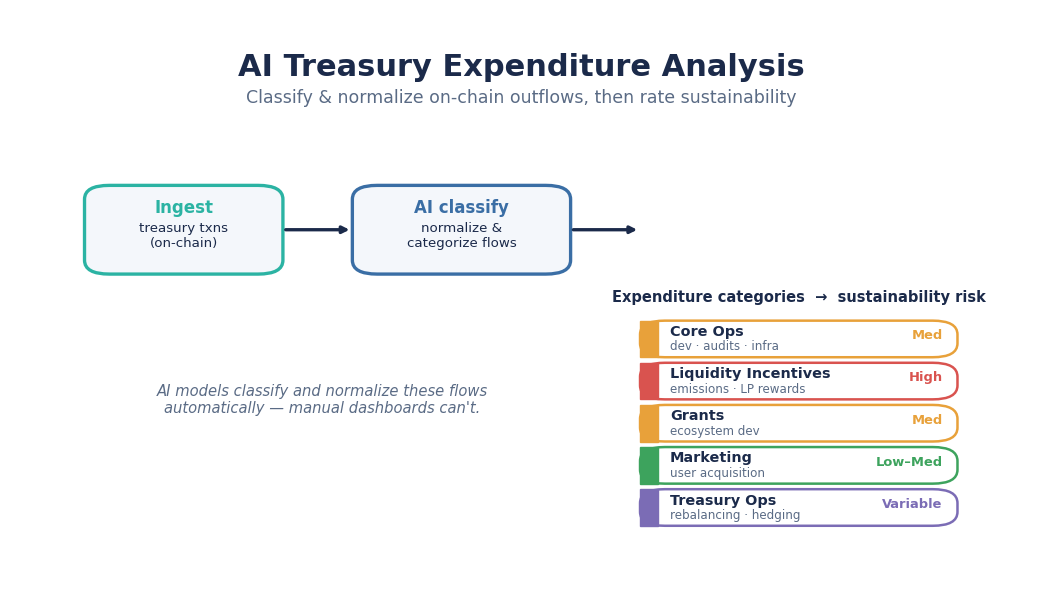
Core Expenditure Categories
| Category | Description | Sustainability Risk |
|---|---|---|
| Core Ops | Dev salaries, audits, infrastructure | Medium |
| Liquidity Incentives | Token emissions, LP rewards | High |
| Grants | Ecosystem development | Medium |
| Marketing | User acquisition campaigns | Low–Medium |
| Treasury Ops | Rebalancing, swaps, hedging | Variable |
AI models classify and normalize these flows automatically, something manual dashboards struggle to do.
How AI Identifies True DeFi Expenditure Rate
A key advantage of AI-driven DeFi fund expenditure analysis is signal extraction from noisy on-chain activity.
AI Techniques Commonly Used
- Address clustering to identify treasury-controlled wallets
- Transaction classification models to label spending intent
- Time-series decomposition to separate trend vs. noise
- Token-normalized accounting to compare stablecoins, ETH, and native tokens
SimianX AI applies these techniques to calculate a real expenditure rate that reflects economic reality, not cosmetic token movements.
A protocol with growing TVL can still be burning capital unsustainably.
Expenditure Rate vs. Treasury Runway
Once expenditure rate is measured, AI models estimate treasury runway—how long the protocol can operate before funds are depleted.
Basic Runway Formula (Enhanced by AI)
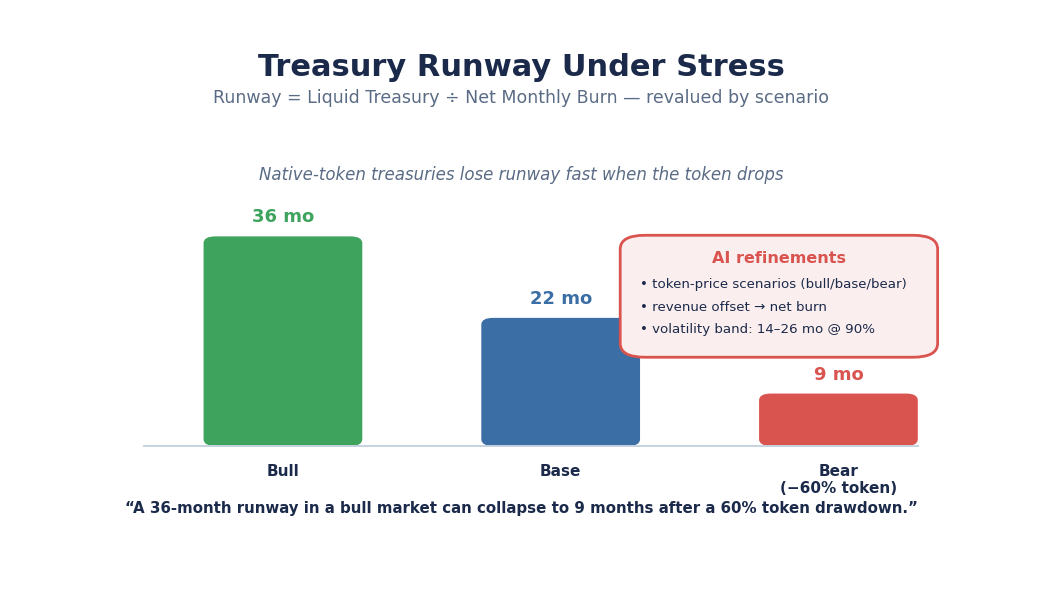
The simplest runway estimate divides liquid treasury value by the net monthly expenditure rate:
Runway (months) = Liquid Treasury Value ÷ Net Monthly Burn
AI refines this static formula in three ways:
- Token-price scenarios — native-token treasuries are revalued under bull, base, and bear price paths, because a treasury that is 70% denominated in its own token can lose half its runway in a single drawdown.
- Revenue offset — protocol fees and real yield are subtracted from gross burn to produce net burn, so a fee-generating protocol shows a longer runway than its raw spending implies.
- Volatility-adjusted bands — instead of one number, the model outputs a runway distribution (e.g. 14–26 months at 90% confidence).
A 36-month runway in a bull market can collapse to 9 months after a 60% token drawdown. Static dashboards miss this; scenario-aware AI does not.
Sustainability Scoring Under Stress
Runway answers how long; sustainability scoring answers how robust. SimianX AI combines expenditure rate, revenue coverage, and treasury composition into a single 0–100 score, stress-tested against adverse conditions.
| Signal | Healthy | At Risk |
|---|---|---|
| Stablecoin share of treasury | > 40% | < 15% |
| Revenue / expenditure coverage | > 0.7 | < 0.3 |
| Emissions as % of total burn | < 30% | > 60% |
| Runway (bear scenario) | > 18 mo | < 6 mo |
The score degrades automatically as emissions rise, stablecoin reserves fall, or fee revenue weakens — surfacing trouble months before it appears in headline TVL. The same early-warning logic powers AI early-warning for DeFi liquidity risks, where treasury depletion and liquidity stress often share a root cause.
Three Treasury Failure Patterns
Across hundreds of protocol treasuries, unsustainable spending tends to fail in three recognizable ways. Naming the patterns makes them easier to catch before they reach the headline numbers.
- The Native-Token Mirage — A treasury reports a large notional value, but most of it is denominated in the protocol's own token. The runway looks comfortable until a drawdown revalues the position and the real, stablecoin-equivalent runway collapses. AI catches this by stress-testing treasury composition rather than headline value.
- The Mercenary-Liquidity Spiral — Liquidity is rented through high token emissions. When emissions slow, providers exit, TVL falls, the token weakens, and the treasury must emit even more to defend the same liquidity — a reflexive loop that accelerates burn. Emissions as a share of total burn is the leading indicator.
- The Silent Grant Drain — Steady, low-visibility outflows — grants, contributor stipends, recurring service contracts — rarely trigger governance scrutiny one by one, yet compound into a structural deficit. Address clustering and transaction classification expose the aggregate that no single proposal reveals.
Each pattern shares one root cause: spending that outpaces durable, fee-based revenue. Sustainability scoring is built to surface all three early, while there is still runway left to act.
From Opaqueness to Decisions
On-chain transparency is not the same as understanding. AI-driven expenditure analysis turns raw treasury flows into the three answers that matter: how fast funds leave, how efficiently they are spent, and whether the current rate survives a downturn. For DAO governors weighing a new incentive program, or investors sizing protocol risk, that is the difference between a defensible decision and a guess.
Related Reading
- AI Agents Analyze DeFi Risks: TVL, Real Yield Rates
- AI for DeFi Data Analysis: Practical On-Chain Workflow
- AI Early-Warning for DeFi Liquidity and Depeg Risks 2026