Trading the Israel–Hamas 2023 Shock, Day by Day
Geopolitical shocks have long been among the most psychologically disruptive catalysts for financial markets. The Israel–Hamas War 2023 market impact became one of the most closely watched geopolitical risk events in recent years, triggering immediate reactions across equities, commodities, volatility markets, and safe-haven assets.
When Hamas launched its surprise attack on Israel on October 7, 2023, markets rapidly began repricing risk. Investors faced urgent questions:
- Would the conflict remain localized?
- Could Iran become directly involved?
- Would oil supply be disrupted?
- Was this the beginning of a broader Middle East war?
For traders and portfolio managers, these moments are precisely where structured decision-making matters more than emotion. Platforms like SimianX AI help investors process geopolitical shocks through real-time multi-agent market analysis, combining technical signals, macro intelligence, sentiment flows, and cross-asset risk interpretation.
This report examines exactly what happened.
We break down:
- The S&P 500’s drawdown path
- Recovery timing
- Cross-asset reaction patterns
- Sector winners and losers
- Historical comparisons
- Actionable investor frameworks
Timeline: What Happened?
October 7, 2023 — Initial Shock
Hamas launched a coordinated surprise attack on Israel.
Immediate geopolitical concerns emerged:
- Israeli military retaliation
- Regional escalation risk
- Iranian involvement
- Oil supply disruption
- Broader Middle East instability
Although the event occurred over a weekend, futures markets quickly reflected concern.
Initial Market Interpretation
The first reaction followed the classic geopolitical playbook:
Risk-off positioning
Capital moved toward:
- Gold
- U.S. Treasuries
- Energy stocks
- Defense names
- Volatility hedges
Risk assets faced pressure.
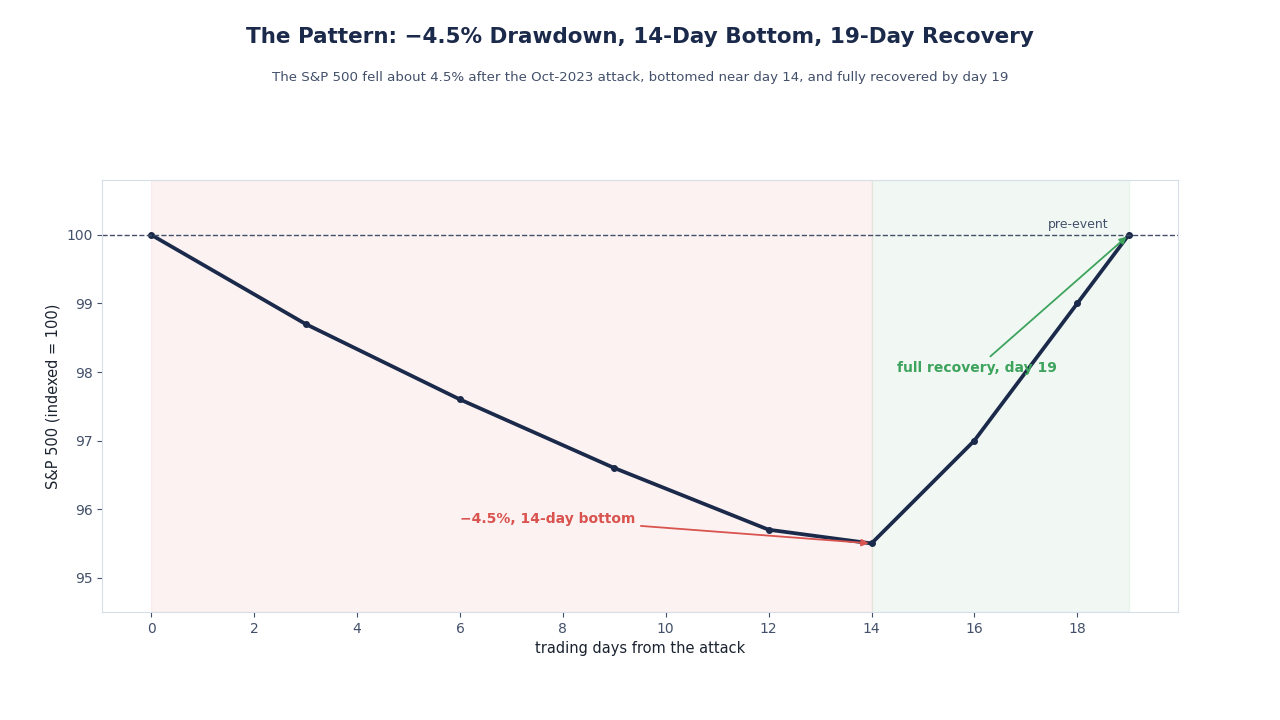
S&P 500 Price Reaction
Drawdown Metrics
| Metric | Result |
|---|---|
| Event date | Oct 7, 2023 |
| Initial equity selloff | Immediate |
| Peak drawdown | −4.5% |
| Bottom timing | 14 trading days |
| Recovery timing | 19 trading days |
This is notable.
Why?
Because despite alarming headlines, the actual equity market damage was relatively contained.
Why Was the Drawdown Limited?
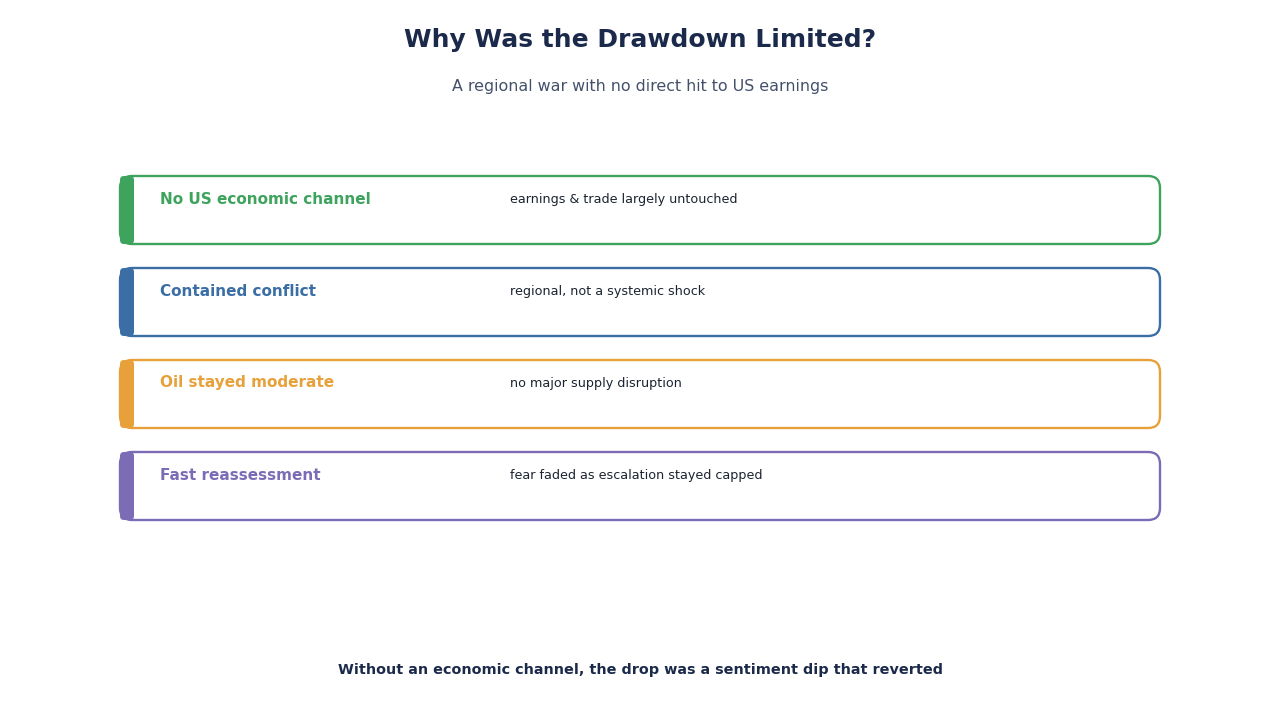
Three structural reasons explain this.
1. Conflict Localization Expectations
Markets price uncertainty—not headlines.
The key question:
Would the war stay regional?
Initial investor consensus:
- Israel retaliation likely
- Hamas conflict severe
- But full regional war uncertain
Since markets did not immediately price a multi-front Middle East war, panic remained constrained.
2. No Immediate Oil Supply Shock
The biggest systemic concern was energy.
If oil infrastructure or shipping routes were disrupted:
- inflation expectations rise
- Fed policy tightens
- margins compress
- recession risk increases
But the feared supply shock did not immediately materialize.
That capped downside pressure.
3. Existing Macro Context Already Weak
The market was already under stress before October 7.
Contributing factors:
- rising Treasury yields
- Fed higher-for-longer fears
- tech multiple compression
- tightening financial conditions
This matters.
Because some selling had already occurred.
The geopolitical event accelerated weakness—but didn’t create an entirely new risk regime.
Sector Winners and Losers
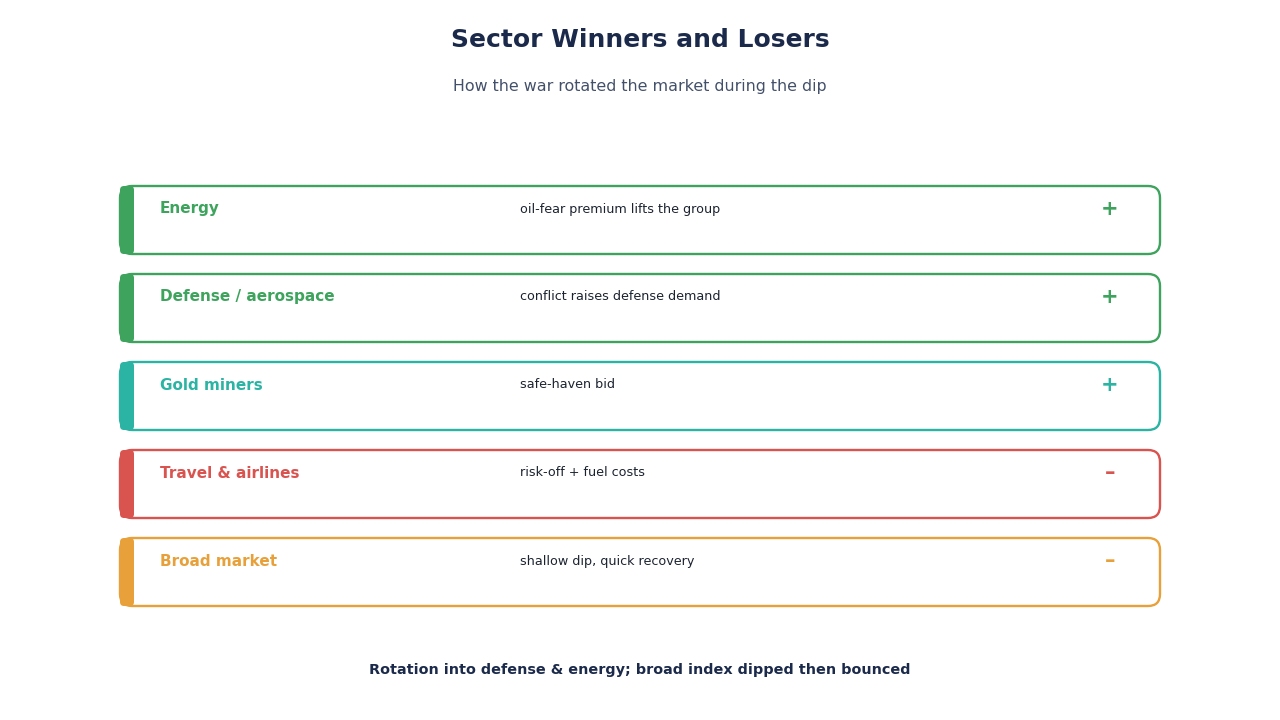
Geopolitical shocks rarely hit all sectors equally.
Winners
Energy
Oil risk premium rose.
Beneficiaries:
- Exxon Mobil
- Chevron
- oil services names
Why?
Higher expected crude prices improve earnings assumptions.
Defense
Classic geopolitical beneficiaries.
Examples:
- Lockheed Martin
- Northrop Grumman
- RTX
Investor logic:
Higher military spending expectations.
Gold Miners
Safe haven rotation.
Names:
- Newmont
- Barrick Gold
Losers
Airlines
Fuel risk.
Margin compression concerns.
Examples:
- Delta
- United
- American Airlines
Consumer Discretionary
Risk-off pressure reduces appetite for cyclical exposure.
Examples:
- retail
- travel
- leisure
High-Multiple Tech
Rising yields + uncertainty = valuation pressure.
Oil Market Reaction
Oil is often the most critical transmission mechanism in war shocks.
Immediate Risk Premium
Crude initially rose because traders priced:
- supply disruption
- Iranian escalation
- Hormuz shipping risks
But crucially:
No sustained physical disruption occurred.
That changed everything.
Why Oil Didn't Explode
Key constraints:
- No direct Iran war
- No Strait of Hormuz shutdown
- No major infrastructure loss
- OPEC dynamics manageable
Without supply destruction, speculative premium faded.
Gold and Safe Haven Flows
Gold behaved exactly as expected.
Drivers:
- uncertainty
- capital preservation
- inflation hedge demand
Pattern:
Initial spike → stabilization → consolidation
This fits normal geopolitical response behavior.
Volatility Market Response
VIX Behavior
The VIX rose—but not into panic territory.
That distinction matters.
Historical panic usually means:
- VIX 35+
- forced deleveraging
- liquidity stress
This event produced caution—not systemic stress.
Treasury Market Response
Safe haven buying supported Treasuries.
But a competing force existed:
higher inflation fears if oil surged.
That produced mixed behavior.
Unlike recession-driven shocks, this wasn't a clean bond rally environment.
Historical Comparison
How unusual was this event?
Let's compare.
| Event | S&P 500 Drawdown | Bottom Time | Recovery |
|---|---|---|---|
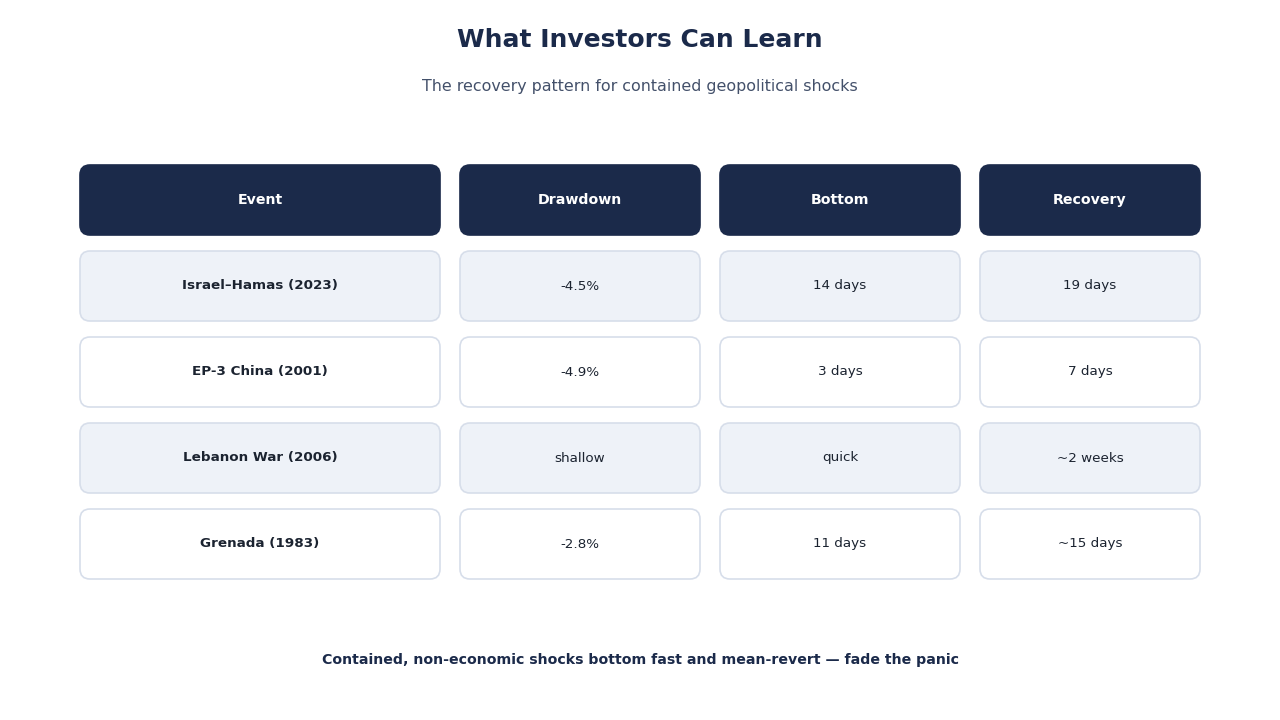
| Israel–Hamas 2023 | −4.5% | 14 days | 19 days |
| 9/11 | deeper | longer | longer |
| Gulf War | moderate | event dependent | variable |
| Russia–Ukraine 2022 | larger commodity shock | slower | slower |
| Pearl Harbor | severe | prolonged | extended |
Key observation:
Localized conflicts often create shorter equity shocks unless energy contagion develops.
What Investors Can Learn from Israel–Hamas War 2023 Market Impact
Lesson 1: Headlines Are Not the Trade
Emotion reacts to headlines.
Markets react to second-order effects.
Ask:
- Is oil disrupted?
- Is credit stress emerging?
- Is global trade impacted?
- Is policy changing?
Lesson 2: Energy Is the Critical Transmission Channel
Middle East conflicts become macro events mainly through energy.
Without oil shock:
damage is often contained.
With oil shock:
everything changes.
Lesson 3: Speed Matters
Modern markets reprice faster.
AI-driven monitoring matters.
Platforms like SimianX AI help traders track:
- real-time sentiment shifts
- macro regime transitions
- technical confirmation
- cross-asset divergence
instead of relying on fragmented dashboards.
How to Analyze Geopolitical Risk Systematically
Step-by-Step Framework
- Identify immediate shock
- Map transmission channels
- Measure cross-asset confirmation
- Track policy responses
- Monitor escalation probabilities
- Separate emotional volatility from systemic stress
Practical Checklist
| Signal | Why It Matters |
|---|---|
| Oil | inflation transmission |
| Gold | fear gauge |
| VIX | volatility stress |
| Treasury yields | safe haven vs inflation |
| Defense stocks | conflict expectations |
| Credit spreads | systemic stress |
Could AI Have Helped During This Event?
Yes.
Traditional workflows fail because information becomes fragmented.
Problems:
- headlines overload
- contradictory commentary
- delayed synthesis
- emotional bias
SimianX AI addresses this through multi-agent decision architecture:
- indicator intelligence
- sentiment intelligence
- macro intelligence
- decision fusion
That allows faster interpretation under stress.
FAQ About Israel–Hamas War 2023 Market Impact
How did the Israel–Hamas War affect the S&P 500?
The S&P 500 experienced an approximate −4.5% drawdown, bottoming within about 14 trading days before recovering within 19 days, making the impact meaningful but not structurally catastrophic.
What sectors performed best during the conflict?
Energy, defense, and precious metals generally outperformed because investors sought inflation hedges, military beneficiaries, and safe havens.
Why didn’t stocks crash harder?
Because the conflict remained relatively localized, oil supply disruptions did not materialize, and systemic financial contagion failed to emerge.
How do wars usually affect stock markets?
It depends on:
- geography
- energy exposure
- inflation transmission
- credit stress
- policy response
Localized conflicts often cause temporary volatility; systemic wars create deeper repricing.
What is the best way to monitor geopolitical market risk?
A structured framework combining:
- macro indicators
- technical signals
- sentiment analysis
- volatility monitoring
- real-time cross-asset interpretation
AI-assisted platforms improve response speed.
Conclusion
The Israel–Hamas War 2023 market impact offers a critical reminder that geopolitical shocks are not all equal.
The initial fear was understandable:
- war headlines
- Middle East instability
- oil risk
- escalation uncertainty
Yet actual market behavior showed resilience.
The S&P 500’s −4.5% drawdown, 14-day bottom, and 19-day recovery illustrate how markets differentiate between emotional shock and systemic threat.
For investors, the lesson is clear:
Track transmission channels—not headlines.
The most dangerous variable was never the headline itself.
It was oil.
For traders and investors seeking structured real-time geopolitical intelligence, SimianX AI provides a faster framework for interpreting uncertainty, filtering noise, and making higher-conviction decisions when markets move fast.
Related Reading
- Israel-Hamas 2023: S&P -4.5% Drawdown, 14-Day Bottom
- Buy the Invasion Pattern: Iraq 2003 S&P 500 +15% Rally
- Iran War Impact: Stocks Risk-Off, Oil $100-$120, VIX Spike
- EP-3 Incident 2001: S&P -4.9%, 7-Day Recovery Pattern
- Grenada Invasion 1983: S&P -2.8%, 11-Day Bottom Recovery
- Syria Airstrike 2017: S&P 500 -1.2%, Same-Week Recovery