
Magkano ang Tunay na Halaga ng 26% Paglago ng CrowdStrike sa 35 Beses ng Benta
CrowdStrike Stock 2026 ay nag-aalok sa mga mamumuhunan ng isang bihirang kumbinasyon: mahusay na momentum sa operasyon, isang kredibleng posisyon sa AI-driven cybersecurity, at isang valuation na nag-iiwan ng kaunting puwang para sa ordinaryong pagpapatupad. Ang kita at taunang paulit-ulit na kita ng CrowdStrike ay lumalaki ng higit sa 20%, ang libreng cash flow ay lumalawak, at ang Falcon ay nakakakuha ng atensyon lampas sa endpoint security. Gayunpaman, ang CRWD ay nakipagkalakalan sa $207.39 matapos ang kanyang apat-para-isang paghahati noong Agosto 6, 2026, na nagpapahiwatig ng isang market capitalization na humigit-kumulang $211 bilyon at isang premium na valuation kahit sa mga elite na pamantayan ng software.
Ang pananaliksik na ito ay naghihiwalay sa kaso ng negosyo mula sa kaso ng presyo ng stock. Sinusuri nito kung ano ang maaaring idagdag ng AI sa paglago ng CrowdStrike, kung ano ang kasalukuyang inaasahan ng valuation, at kung aling mga sukatan ang dapat bantayan ng mga mamumuhunan. Ang SimianX AI ay maaaring magdagdag sa balangkas na ito sa pamamagitan ng pagdadala ng real-time na presyo, SEC filing, pangunahing, teknikal, at pagsusuri ng balita sa isang multi-agent na workflow ng pananaliksik. Dapat itong gamitin bilang isang analitikal na tool, hindi bilang kapalit ng personal na pagsisiyasat o propesyonal na payo sa pananalapi.
Ang data sa artikulong ito ay kasalukuyan hanggang Agosto 6, 2026, maliban kung iba ang nakasaad. Ang fiscal year ng CrowdStrike ay nagtatapos sa Enero 31, kaya ang fiscal 2027 ay tumutukoy sa taong nagtatapos sa Enero 31, 2027.
Tumakbo na ang bahagi
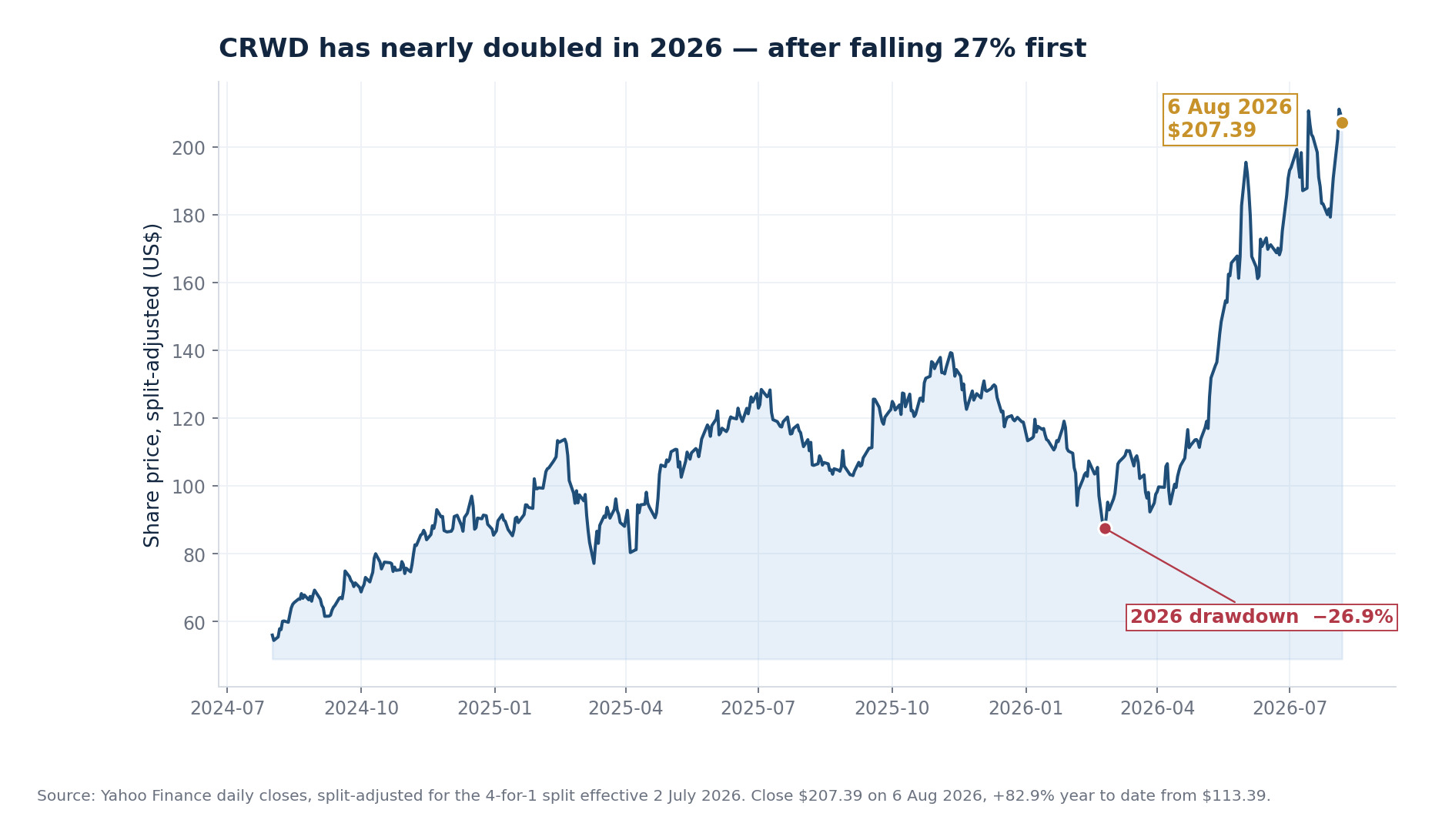
Bago ang anumang usapin sa multiple, mahalagang itakda kung nasaan talaga ang bahagi. Nagsara ang CRWD sa **$207.39** noong 6 Agosto 2026, o tumaas ng 82.9% sa taong ito mula sa $113.39 noong 2 Enero. At dumating ang tubong iyon matapos ang paglagpak na 26.9% na umabot sa pinakamababa noong 24 Pebrero. Sa isinaayos na paghahati, ang saklaw ng pagsasara sa 52 linggo ay $87.56 hanggang $211.22, kaya 2% na lang ang layo nito sa sariling rurok.
Mahalaga ito sa isang simpleng dahilan: ang taong may 83% na tubo ay hindi nagpapababa ng pamantayan para sa susunod na ulat — itinataas nito. Ito ang parehong asimetriyang pinagtrabahuhan namin sa pag-usbong ng Nvidia at, sa kabilang dulo ng merkado, sa JPMorgan sa 3.2 beses ng tangible book: maaaring maging katamtamang puhunan pa rin ang mahusay na negosyo kung ipinagpalagay na ng multiple sa pagpasok ang magandang kalalabasan.
Ang Thesis ng CrowdStrike Stock 2026 sa Isang Talahanayan
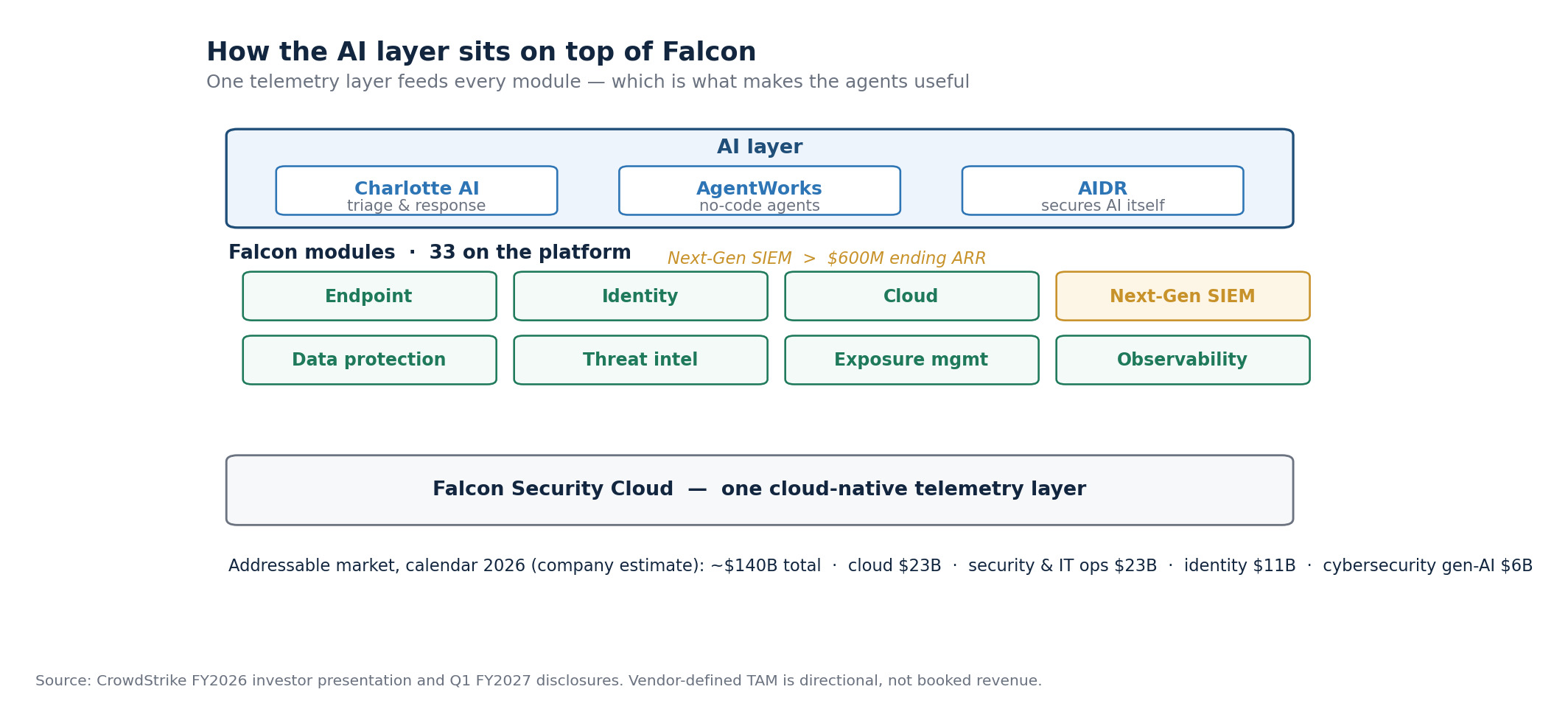
CrowdStrike ay hindi lamang nagbebenta ng antivirus software. Ang kanyang Falcon platform ay sumasaklaw sa endpoint, pagkakakilanlan, ulap, pamamahala ng impormasyon at kaganapan sa seguridad, pinamamahalaang pagtuklas at pagtugon, proteksyon ng data, intelihensiyang banta, observability, at seguridad ng generative AI. Ang lawak na ito ay lumilikha ng isang makapangyarihang argumento para sa konsolidasyon: isang cloud-native na layer ng data ay maaaring suportahan ang higit pang mga module, bawasan ang kumplikadong integrasyon, at gawing mas madali ang pag-aampon ng bawat karagdagang produkto.
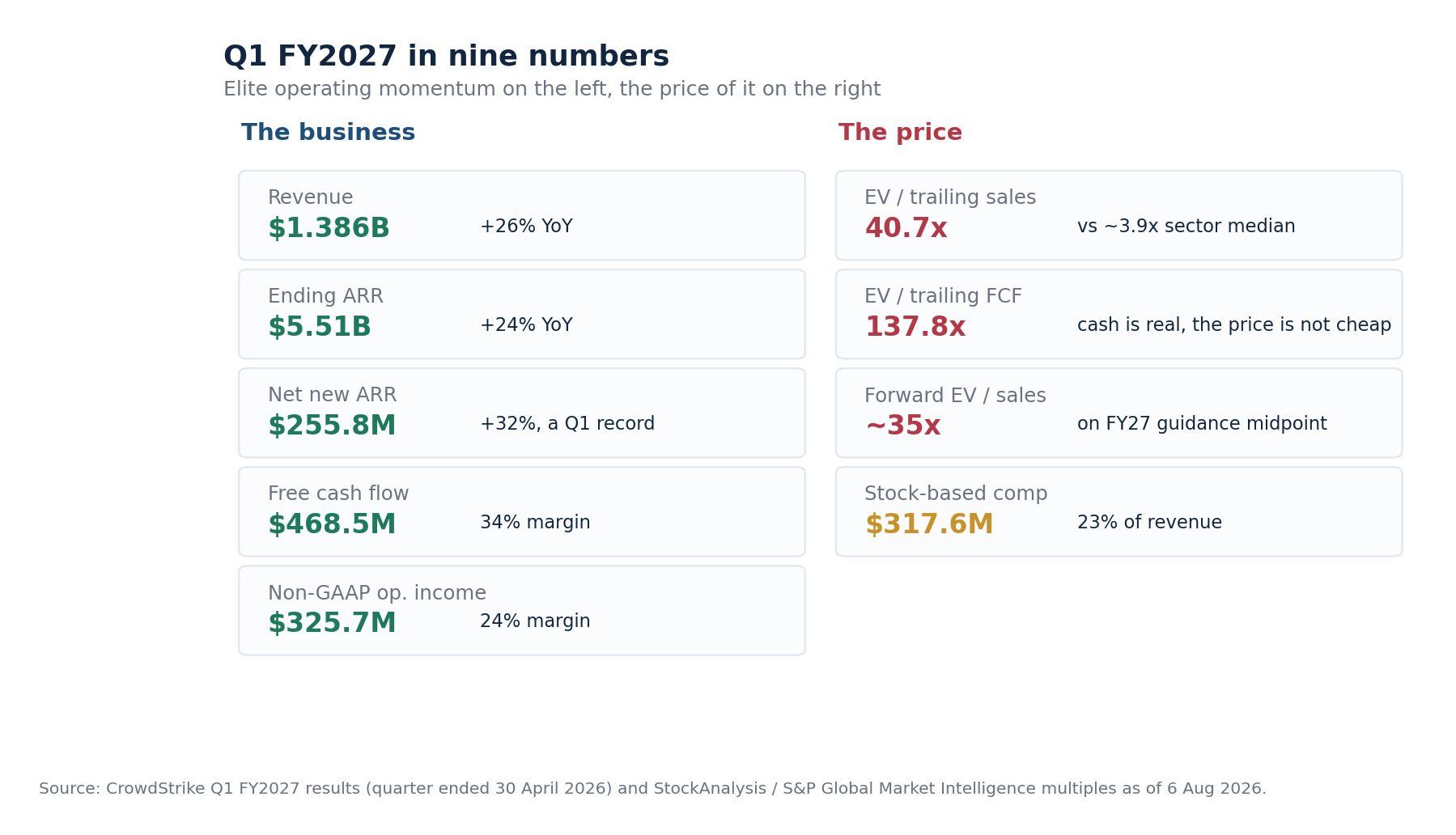
Ang tanong ay kung ang mga bentahe na iyon ay makakapagbigay ng sapat na paglago at cash flow upang suportahan ang isang pagtataya na humigit-kumulang 40.7 beses na trailing enterprise value sa benta at 137.8 beses na trailing enterprise value sa free cash flow. Ang mga numerong ito ay batay sa isang enterprise value na humigit-kumulang $207.5 bilyon, trailing revenue na $5.09 bilyon, at trailing free cash flow na $1.51 bilyon na iniulat ng StockAnalysis gamit ang data ng S&P Global Market Intelligence.
| Investment factor | Bull interpretation | Bear interpretation |
|---|---|---|
| Q1 FY2027 revenue | $1.386 bilyon, tumaas ng 26% | Ang malakas na paglago ay nakapaloob na sa multiple |
| Ending ARR | $5.51 bilyon, tumaas ng 24% | Ang paglago ay dapat manatili sa itaas ng 20% sa loob ng mga taon, hindi mga kwarter |
| Net new ARR | Record Q1 ng $256 milyon, tumaas ng 32% | Ang quarterly ARR ay maaaring maging pana-panahon at mahalaga ang timing ng kontrata |
| Free cash flow | $468 milyon, 34% margin sa Q1 | Ang cash flow ay may kasamang malaking stock-compensation add-back |
| AI security | Ang AIDR at Charlotte AI ay lumilikha ng mga bagong workload | Ang absolutong AI product ARR ay hindi isiniwalat |
| Falcon Flex | Higit sa $1.9 bilyon ng ARR mula sa mga Flex account | Ang flexible consumption ay maaaring makasagabal sa visibility ng kita |
| Valuation | Scarcity value para sa isang lider ng kategorya | Ang multiple compression ay maaaring mag-overwhelm sa paglago ng kita |
Pangunahing konklusyon: Ang paglago ng AI security ng CrowdStrike ay maaaring magpaliwanag ng premium, ngunit ang presyo ngayon ay tila nangangailangan ng patuloy na pagpapatupad na malapit sa isang bullish na senaryo. Ang isang mahusay na kumpanya ay hindi awtomatikong isang mahusay na stock sa bawat pagtataya.
Ipinapakita ng Pinakabagong Resulta sa Pananalapi ng CrowdStrike ang Tunay na Pagsulong
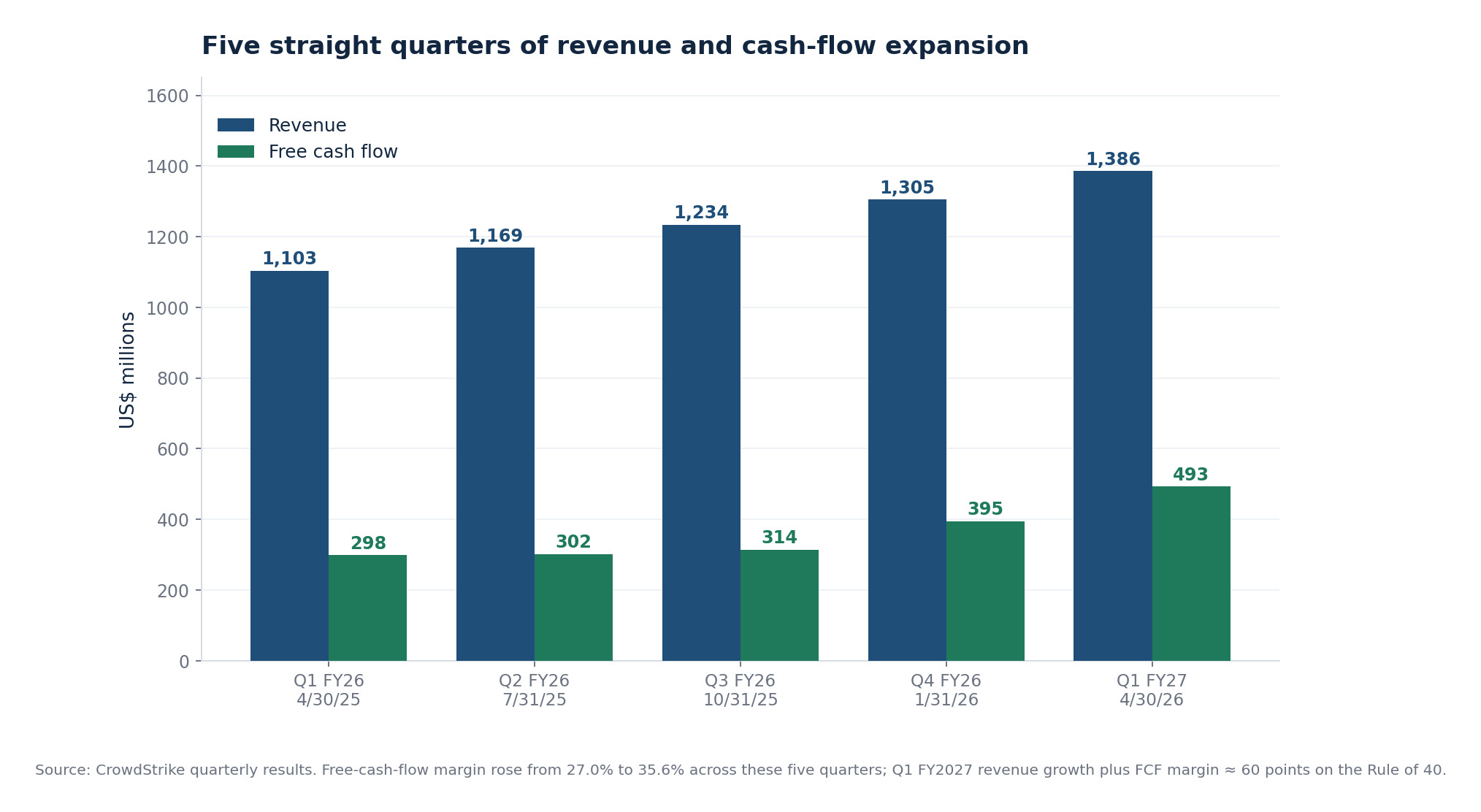
Ang pinakamalakas na bahagi ng kaso ng pamumuhunan sa CrowdStrike ay ang kamakailang momentum ay nasusukat. Sa quarter na nagtatapos noong Abril 30, 2026, iniulat ng CrowdStrike ang kabuuang kita na $1.386 bilyon, tumaas ng 26% taon-taon, at kita mula sa subscription na $1.321 bilyon, tumaas din ng 26%. Umabot ang pagtatapos ng ARR sa $5.51 bilyon, habang ang rekord na net new ARR sa unang quarter ay tumaas ng 32% sa $255.8 milyon.
Pumuti ang kakayahang kumita sa parehong oras:
- Ang GAAP subscription gross margin ay 78%.
- Ang Non-GAAP subscription gross margin ay 81%.
- Ang GAAP operating loss ay bumaba sa $30.6 milyon mula sa $118.7 milyon.
- Ang Non-GAAP operating income ay tumaas sa $325.7 milyon, isang 24% margin.
- Ang free cash flow ay umabot sa $468.5 milyon, isang 34% margin.
- Ang cash at cash equivalents ay umabot sa kabuuang $4.55 bilyon sa pagtatapos ng quarter.
Itinaas din ng pamunuan ang gabay para sa fiscal 2027. Ang midpoint ngayon ay humihiling ng humigit-kumulang $5.937 bilyon ng kita, $6.544 bilyon ng pagtatapos ng ARR, at $1.466 bilyon ng non-GAAP operating income. Sa midpoint ng ARR, magdadagdag ang CrowdStrike ng humigit-kumulang $1.29 bilyon sa panahon ng fiscal year, na naaayon sa binagong inaasahan ng pamunuan para sa humigit-kumulang 27.7% na paglago sa net new ARR.
This combination matters. Ang pagbilis ng kita nang walang pagbuo ng cash ay maaaring maging marupok, habang ang pagpapalawak ng margin nang walang matibay na paglago ay maaaring magpahiwatig ng kapanahunan. Ang CrowdStrike ay kasalukuyang may pareho. Ang paglago ng kita nito sa Q1 kasama ang margin ng free-cash-flow ay humigit-kumulang 60 puntos, na komportableng higit sa karaniwang “Batas ng 40” na threshold ng software.
Ang Paglago ng AI Security ng CrowdStrike ba ay isang Matibay na Revenue Engine?
Pinapalakas ng AI ang pagkakataon ng CrowdStrike sa dalawang natatanging paraan. Una, ginagamit ng mga umaatake ang AI upang i-automate ang reconnaissance, social engineering, credential theft, at evasion. Pangalawa, ang mga negosyo ay nag-de-deploy ng mga aplikasyon ng AI at mga autonomous agent na nagdadala ng mga bagong pagkakakilanlan, pribilehiyo, daloy ng data, at mga panganib sa runtime. Samakatuwid, ang paggastos sa seguridad ay maaaring tumaas dahil ang mga pag-atake ay nagiging mas epektibo at dahil ang protektadong ibabaw ay lumalaki.
Ang konteksto ng demand ay kapani-paniwala. Ang Global Cybersecurity Outlook 2026 ng World Economic Forum ay natagpuan na 94% ng mga sumasagot ay inaasahang ang AI ang magiging pinakamahalagang tagapag-udyok ng pagbabago sa cybersecurity sa 2026, habang 87% ang tumukoy sa mga kahinaan na may kaugnayan sa AI bilang pinakamabilis na lumalagong panganib sa cyber noong 2025. Ang 2025 Cost of a Data Breach Report ng IBM ay natagpuan na 97% ng mga na-breach na organisasyon na nakakaranas ng insidente ng seguridad na may kaugnayan sa AI ay kulang sa wastong kontrol sa pag-access ng AI.
Ang CrowdStrike ay tumutugon sa merkadong iyon sa pamamagitan ng ilang mga layer:
- Charlotte AI ay tumutulong sa mga security team na imbestigahan ang mga detections, i-automate ang triage, at i-orchestrate ang tugon.
- Charlotte AI AgentWorks ay nagpapahintulot sa mga customer at kasosyo na bumuo ng mga custom security agent nang walang code.
- AI Detection and Response (
AIDR) ay natutuklasan at pinoprotektahan ang mga sistema ng AI, ahente, modelo, at daloy ng data.
- Falcon Next-Gen SIEM ay nagdadala ng seguridad na telemetry sa platform, na nagbibigay ng mas maraming konteksto sa mga ahente ng AI.
- Pagpapatupad ng pagkakakilanlan at endpoint ay maaaring patuloy na kontrolin kung ano ang pinapayagan ng mga pagkakakilanlan ng tao at makina na gawin.
Ang CrowdStrike ay nagtipon din ng isang makabuluhang ecosystem. Ang AgentWorks launch ay kinabibilangan ng AWS, Anthropic, NVIDIA, OpenAI, Salesforce, Accenture, Deloitte, at iba pang mga kasosyo. Hiwalay, pinalawak ng kumpanya ang proteksyon ng AI sa endpoint, SaaS, browser, at cloud na mga kapaligiran at ipinakilala ang patuloy na mga kontrol sa pagkakakilanlan para sa mga ahente ng AI.
Ano ang Ipinapakita ng Katibayan na Ang AI ay Nag-aambag sa Paglago ng CrowdStrike?
Mayroong mga nakaka-engganyong nangungunang tagapagpahiwatig, ngunit dapat paghiwalayin ng mga mamumuhunan ang katibayan mula sa salaysay. Ang presentasyon ng CrowdStrike para sa Q1 FY2027 ay nagsabi na ang AIDR na nagtatapos na ARR ay lumago ng higit sa 250% mula quarter sa quarter at ang Charlotte AI na nagtatapos na ARR ay bumilis ng sunud-sunod. Sinabi rin nito na ang seguridad sa cloud, susunod na henerasyong pagkakakilanlan, at susunod na henerasyong SIEM ay sama-samang naghatid ng rekord na net bagong ARR sa unang quarter.
Gayunpaman, hindi inihayag ng CrowdStrike ang absolute ARR para sa AIDR o Charlotte AI. Ang triple-digit na rate ng paglago mula sa isang maliit na base ay maaaring mukhang mas mahalaga sa ekonomiya kaysa sa tunay na kalagayan nito. Ang pinaka-maaasahang konklusyon ay ang AI ay tumutulong na sa pag-aampon ng produkto, paglikha ng pipeline, at pagkakaiba-iba ng platform, ngunit ang pampublikong data ay hindi pa napatunayan na ang mga produkto ng AI lamang ay nag-aambag ng makabuluhang porsyento ng ARR ng kumpanya.
Dapat hanapin ng mga mamumuhunan ang tatlong anyo ng kumpirmasyon:
- Tiyak na AIDR o Charlotte AI na kita at disclosure ng ARR
- Mas mataas na net retention o mas mabilis na pagpapalawak sa mga customer ng produkto ng AI
- Patuloy na paglago sa net bagong ARR nang hindi isinasakripisyo ang gross margin
Maaaring Mas Mahalaga ang Falcon Flex Kaysa sa AI Label
Pinapayagan ng Falcon Flex ang mga customer na mag-commit sa platform ng CrowdStrike at maglaan ng paggamit sa iba't ibang module. Sa ekonomiya, binabawasan nito ang hadlang sa pagbili ng isa pang produktong Falcon. Sa estratehiya, ginagawang launchpad ng endpoint security para sa pagkakakilanlan, cloud, SIEM, proteksyon ng data, at AI security.
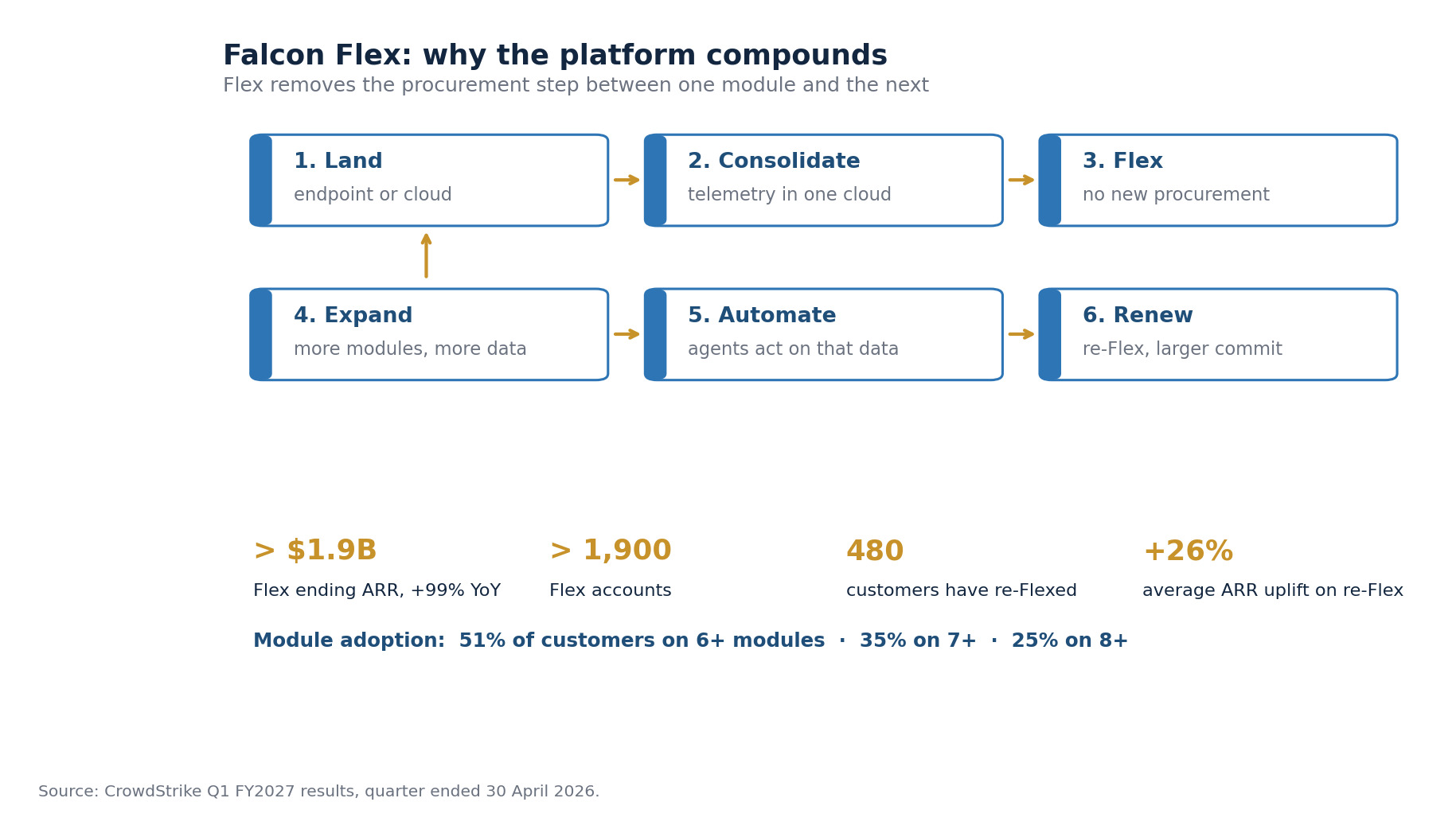
Malaki ang mga numero. Ang pagtatapos na ARR mula sa mga Flex account ay lumampas sa $1.9 bilyon sa Q1 FY2027, tumaas ng higit sa 99% taon-taon. Ang CrowdStrike ay may higit sa 1,900 Flex account, at 480 na customer ang nag-renew o “re-Flexed,” na may average na pagtatapos na ARR uplift na 26%. Umabot ang adoption ng module sa 51% para sa anim o higit pang module, 35% para sa pito o higit pa, at 25% para sa walo o higit pa.
Sinusuportahan ng mga metric na ito ang isang klasikong platform flywheel:
- Nagtatayo ang CrowdStrike ng isang endpoint o cloud security customer.
- Pinagsasama ng Falcon ang telemetry sa Security Cloud.
- Binabawasan ng Flex ang hadlang sa procurement para sa karagdagang mga module.
- Ang mas maraming module ay lumilikha ng mas mayamang data at mas mataas na switching costs.
- Ginagamit ng mga AI agent ang data na iyon upang i-automate ang mas maraming security workflows.
- Ang mas magandang resulta ay naghihikayat ng isa pang pagpapalawak o renewal.
Ito ang dahilan kung bakit maaaring lumikha ng halaga ang AI kahit bago pa man maging malaking standalone revenue line ang Charlotte AI. Kung ang AI ay nagpapataas ng utility ng buong platform ng Falcon, ang kontribusyon nito sa ekonomiya ay maaaring lumitaw sa mas malalaking Flex commitments, mas maraming module bawat customer, mas magandang retention, at mas mabilis na adoption ng SIEM.
Para sa praktikal na pagmamanman, maaaring gamitin ng mga mamumuhunan ang SimianX AI upang ihambing ang bawat paglabas ng kita sa nakaraang gabay ng pamamahala, suriin ang mga SEC filings, subaybayan ang mga teknikal na kondisyon, at hamunin ang isang nag-iisang bullish o bearish na naratibo gamit ang maraming analitikal na ahente. Ang tamang daloy ng trabaho ay upang beripikahin ang bawat pahayag laban sa filing, pagkatapos ay magpasya kung ang pagbabago ay nakakaapekto sa tibay ng kita, mga margin, o ang valuation multiple.
Maaaring Bang Ijustify ng AI ang Valuation ng CRWD Stock sa 2026?
Sa pagsasara noong Agosto 6, ang presyo ng bahagi ng CrowdStrike na $207.39 at humigit-kumulang $211.2 bilyon na market capitalization ay isinasalin sa isang valuation na nag-aassume ng higit pa sa isang magandang fiscal 2027. Gamit ang midpoint ng gabay ng pamamahala para sa kita sa fiscal 2027, ang enterprise value ay humigit-kumulang 35 beses na hinaharap na benta. Ang stock ay nakipagkalakalan din sa paligid ng 159 beses na hinaharap na kita batay sa mga consensus estimates ng third-party.
Ang valuation na iyon ay lumilikha ng asymmetric expectations. Kung ang CrowdStrike ay lumampas sa mga pagtataya ng kita ng 3%, ang pagtaas sa pundamental na halaga ay maaaring maging katamtaman kumpara sa 35-beses na multiple. Kung ang paglago ay bumagal nang hindi inaasahan o nagpasya ang merkado na ang angkop na multiple ay 20 beses na benta, ang epekto sa presyo ng bahagi ay maaaring maging malubha kahit na ang kita ay patuloy na lumalaki.
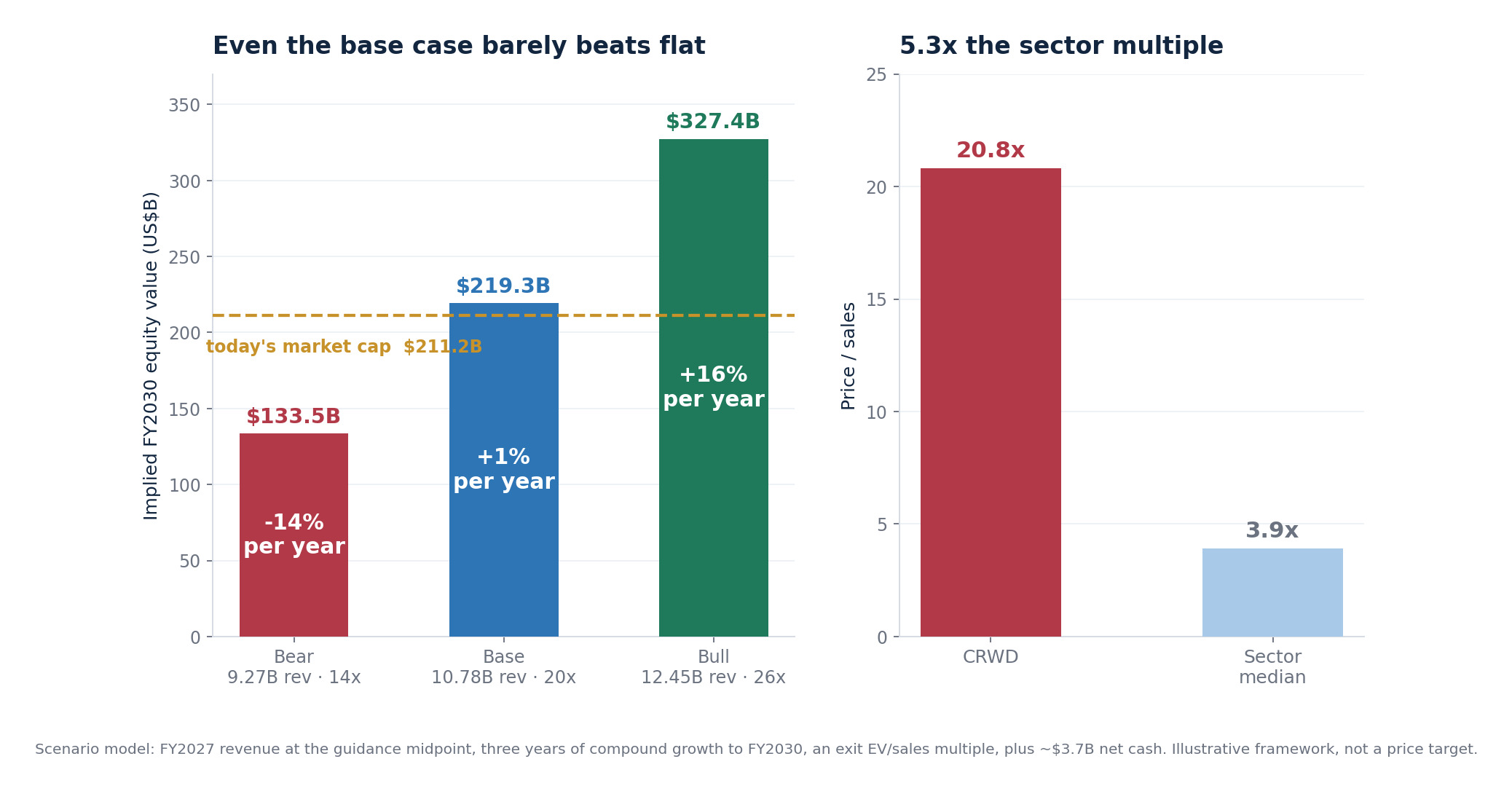
Ang sumusunod na pagsusuri ng senaryo ay nakapagpapakita, hindi isang target na presyo. Nagsisimula ito sa kita sa fiscal 2027 sa midpoint ng gabay, nag-aaplay ng tatlong taon ng compound growth hanggang fiscal 2030, nagtalaga ng exit EV/sales multiple, at nagdaragdag ng kasalukuyang net cash na humigit-kumulang $3.7 bilyon. Ito ay nag-aassume ng walang materyal na pagbabago sa net cash, bilang ng bahagi, o mga acquisition, kaya ito ay sinadyang pinadali.
| Senaryo | FY2028-FY2030 kita CAGR | Tinatayang FY2030 kita | Exit EV/benta | Implied equity value | Approx. 3-taong annualized return vs. $211.2B market cap |
|---|---|---|---|---|---|
| Bear | 16% | $9.27B | 14x | $133.5B | -14% |
| Base | 22% | $10.78B | 20x | $219.3B | +1% |
| Bull | 28% | $12.45B | 26x | $327.4B | +16% |
Ang base case ay ang babala sa pagtatasa: kahit na tatlong taon pa ng 22% na paglago at isang napakayamang 20-beses na multiple ng benta ay nagbubunga lamang ng mababang solong-digit na annualized return sa simpleng modelong ito.
Ang bull case ay posible, ngunit nangangailangan. Kailangan ng CrowdStrike na mapanatili ang paglago malapit sa kasalukuyang antas habang ang base ng kita ay dumodoble, mapanatili ang nangungunang ekonomiya sa kategorya, at patuloy na makakuha ng 26-beses na multiple ng benta sa fiscal 2030. Para sa konteksto, ang sariling kita ng CrowdStrike sa fiscal 2026 ay $4.81 bilyon. Ang isang $12.45 bilyong kinalabasan ay nangangahulugang pagdaragdag ng higit sa $7.6 bilyon ng taunang kita sa loob ng apat na fiscal na taon.
Ano ang Maaaring Gumawa ng CrowdStrike Stock na Karapat-dapat sa Premium?
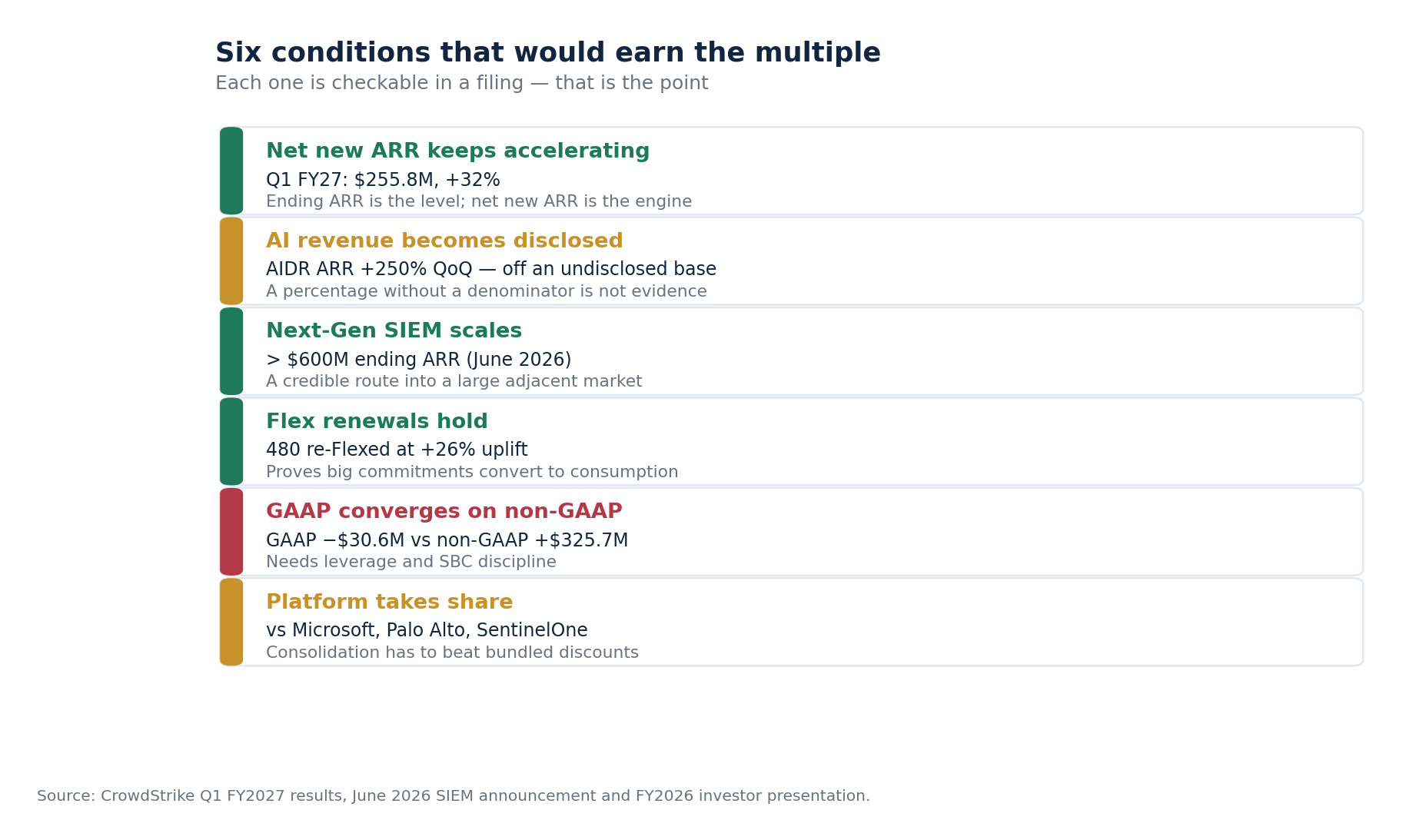
Ang kasalukuyang pagtatasa ay nagiging mas maipagtanggol kung ang ilang mga kondisyon ay nagpapalakas sa isa't isa:
- Patuloy na bumibilis ang net new ARR. Mahalaga ang pagtatapos ng paglago ng ARR, ngunit ipinapakita ng net new ARR kung ang incremental growth engine ay lumalakas.
- Ang AI security ay nagiging nasusukat. Ang absolute AIDR at Charlotte AI ARR ay gagawing ma-audit ang AI thesis.
- Ang Next-Gen SIEM ay mabilis na lumalaki. Sinabi ng CrowdStrike noong Hunyo 2026 na ang Falcon Next-Gen SIEM ay lumampas sa $600 milyon sa pagtatapos ng ARR, na lumilikha ng isang kapani-paniwala na landas patungo sa isang malaking karatig na merkado.
- Nanatiling matatag ang mga pag-renew ng Flex. Ang pagtaas ng Re-Flex at pagpapalawak ng module ay magpapakita na ang malalaking pangako ay nagiging matibay na pagkonsumo.
- Ang mga margin ng GAAP ay nagkakasundo patungo sa mga margin ng non-GAAP. Nangangailangan ito ng operating leverage at disiplinadong stock-based compensation.
- Ang platform ay kumukuha ng bahagi mula sa mga point products. Ang konsolidasyon ay dapat magbigay ng mga mapagkumpitensyang panalo laban sa Microsoft, Palo Alto Networks, SentinelOne, at mga legacy na vendor ng SIEM.
Ang sukat at arkitektura ng CrowdStrike ay nag-aalok ng tunay na mga bentahe. Ang pagsusuri ng mamumuhunan ng kumpanya para sa fiscal 2026 ay nagsasabing ang Falcon ay sumasaklaw sa 33 cloud modules at tumutukoy sa pinagsamang pagkakataon sa merkado para sa calendar-2026 na humigit-kumulang $140 bilyon, kabilang ang $23 bilyon sa cloud security, $23 bilyon sa seguridad at IT operations, $11 bilyon sa proteksyon ng pagkakakilanlan, at $6 bilyon sa cybersecurity generative AI. Dapat tratuhin ng mga mamumuhunan ang vendor-defined TAM bilang direksyonal sa halip na garantisadong kita, ngunit ang lawak nito ay ginagawang posible ang mahabang landas ng paglago.
Ang Mga Panganib na Maaaring Masira ang Teorya ng Stock ng CrowdStrike
1. Pagsisikip ng Pagtatasa
Ang pagtatasa ang pinakamalinaw na panganib dahil hindi ito nangangailangan ng pagkabigo ng negosyo. Maaaring lumago ang kita ng CRWD ng 20% at bumagsak pa rin kung ang forward sales multiple nito ay bumaba mula sa humigit-kumulang 35 patungo sa mas karaniwang mataas na paglago ng software na saklaw. Ang mas mataas na mga rate ng interes, pag-iwas sa panganib, o isang pag-ikot ng sektor ay maaaring magdulot nito nang nakapag-iisa sa pagpapatupad ng kumpanya. Ang makasaysayang batayang bilang nito ay nasa bawat siklo ng pagtaas ng rate ng Fed mula 1983 at, sa bersiyong pang-sektor, sa bawat pagbagsak ng SOX mula 1995.
2. Stock-Based Compensation at Dilusyon
Q1 FY2027 na batay sa stock na kabayaran at mga kaugnay na buwis sa payroll ay umabot sa $317.6 milyon, katumbas ng humigit-kumulang 23% ng kita. Ang pagkakaiba sa pagitan ng GAAP operating loss na $30.6 milyon at non-GAAP operating income na $325.7 milyon ay samakatuwid ay may mahalagang kahalagahan sa ekonomiya. Ang libreng cash flow ay tunay na paglikha ng cash, ngunit ang stock compensation ay naglilipat ng bahagi ng gastos sa mga shareholder sa pamamagitan ng dilution. Ang bilang ng mga bahagi ng CrowdStrike ay tumaas ng humigit-kumulang 2.3% taon-taon, ayon sa datos ng S&P Global Market Intelligence.
3. Kompetisyon at Pagsasama
Maaaring pagsamahin ng Microsoft ang Defender, Entra, Purview, Intune, at Security Copilot sa isang mas malawak na relasyon sa enterprise. Ang Palo Alto Networks ay nagtutulak ng sarili nitong platformization strategy at tinatayang ang kita para sa fiscal 2026 ay humigit-kumulang $11.42 bilyon. Ang SentinelOne at mga espesyal na vendor ay maaaring makipagkumpitensya sa automation, presyo, o nakatuon na kakayahan. Dapat patunayan ng CrowdStrike na ang pagiging epektibo at simpleng operasyon nito ay sapat na mahalaga upang malampasan ang mga bundled discounts.
4. Komoditisasyon ng AI
Ang mga tampok ng AI ay maaaring maging inaasahan sa halip na hiwalay na maaaring pagkakitaan. Ang mga pagpapabuti sa foundation-model ay maaaring makinabang sa bawat vendor ng seguridad, at maaaring tumanggi ang mga customer na magbayad ng premium na presyo para sa mga assistant na pinagsasama-sama ng mga kakumpitensya. Ang matibay na bentahe ng CrowdStrike ay dapat manggaling sa proprietary security telemetry, workflow integration, threat expertise, at enforcement, hindi lamang sa pag-access sa malalaking modelo ng wika.
5. Operational at Legal Overhang
Ang pag-update ng nilalaman noong Hulyo 19, 2024 ay nagdulot ng malawakang pagkasira ng sistema ng Windows at nagpakita ng systemic risk ng endpoint software. Ang April 2026 Form 10-Q ng CrowdStrike ay nagsabing patuloy na humaharap ang kumpanya sa mga paghahabol, proseso, at mga imbestigasyon ng gobyerno na may kaugnayan sa insidente, at na ang posibleng saklaw ng pagkawala ay hindi matatayang. Kasama rin sa Q1 ang $18.1 milyon ng net incident-related costs sa pangkalahatan at administratibong gastos.
Ang parehong pagsasampa ay nagsasaad na ang CrowdStrike ay nakikipagtulungan sa mga kahilingan para sa impormasyon tungkol sa pagkilala ng kita at pag-uulat ng ARR para sa ilang mga transaksyon, pati na rin ang insidente noong Hulyo 19. Ang mga pagtatanong na ito ay hindi patunay ng maling gawain, ngunit dapat subaybayan ng mga mamumuhunan ang mga bagong pagsisiwalat sa halip na ipagpalagay na ang isyu ay nalutas na.
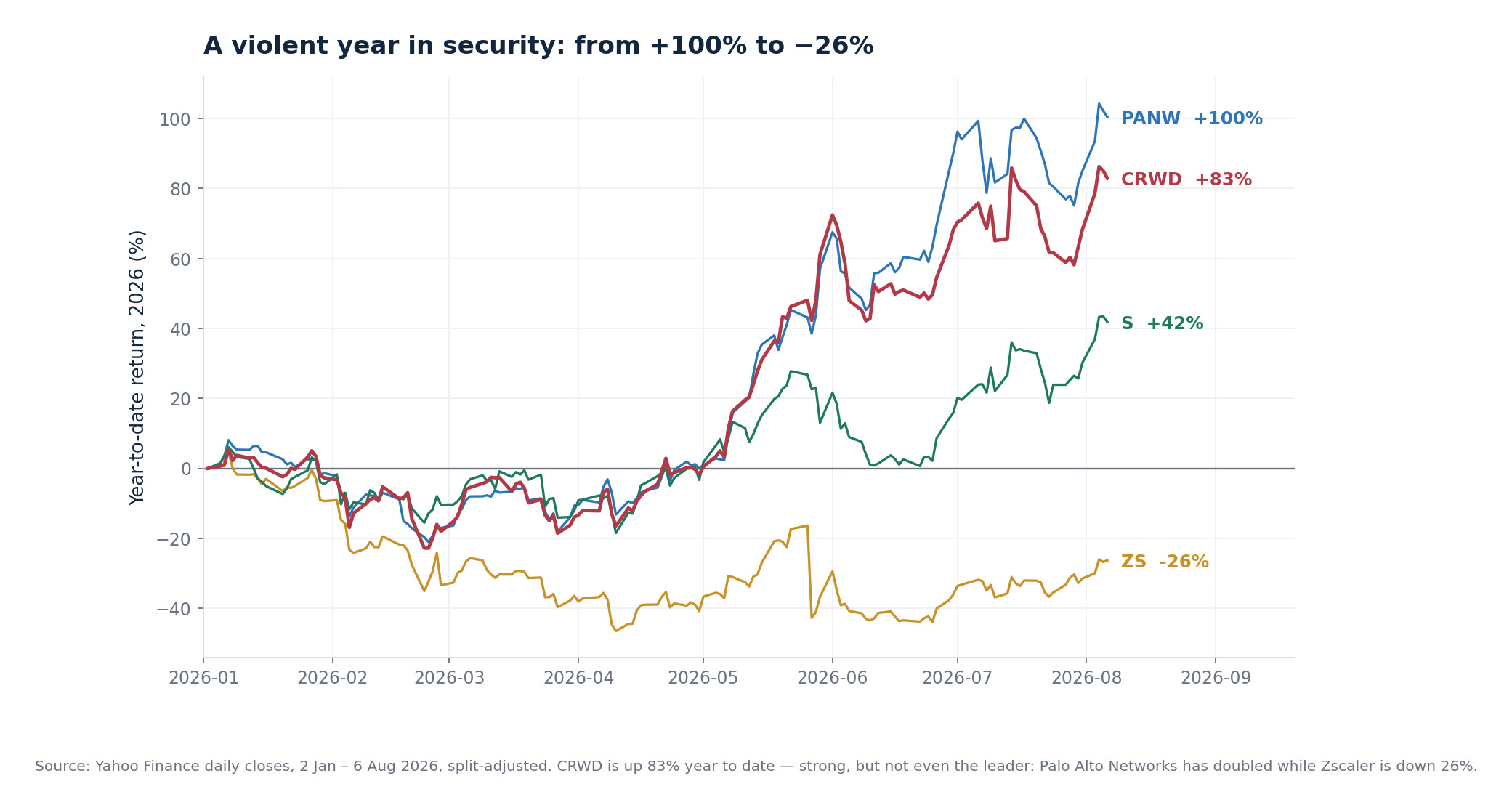
Hindi man lang ang CrowdStrike ang pinakamalakas na bahagi sa sarili nitong sektor ngayong taon. Nagdoble ang Palo Alto Networks sa 2026, tumaas ang CrowdStrike ng 83%, ang SentinelOne ng 42% at bumagsak ang Zscaler ng 26% — 126 puntos ng agwat sa loob ng isang industriya. Kasingbilis ng pag-angat ng multiple dulot ng sigla sa buong sektor ang pagbawi nito, at iyon mismo ang mekanismong nakatala sa bawat bula ng teknolohiya mula 1929 at, sa antas ng indeks, sa konsentrasyon ng Magnificent 7 sa 2026.
Isang Praktikal na Checklist sa Pananaliksik ng Stock ng CRWD
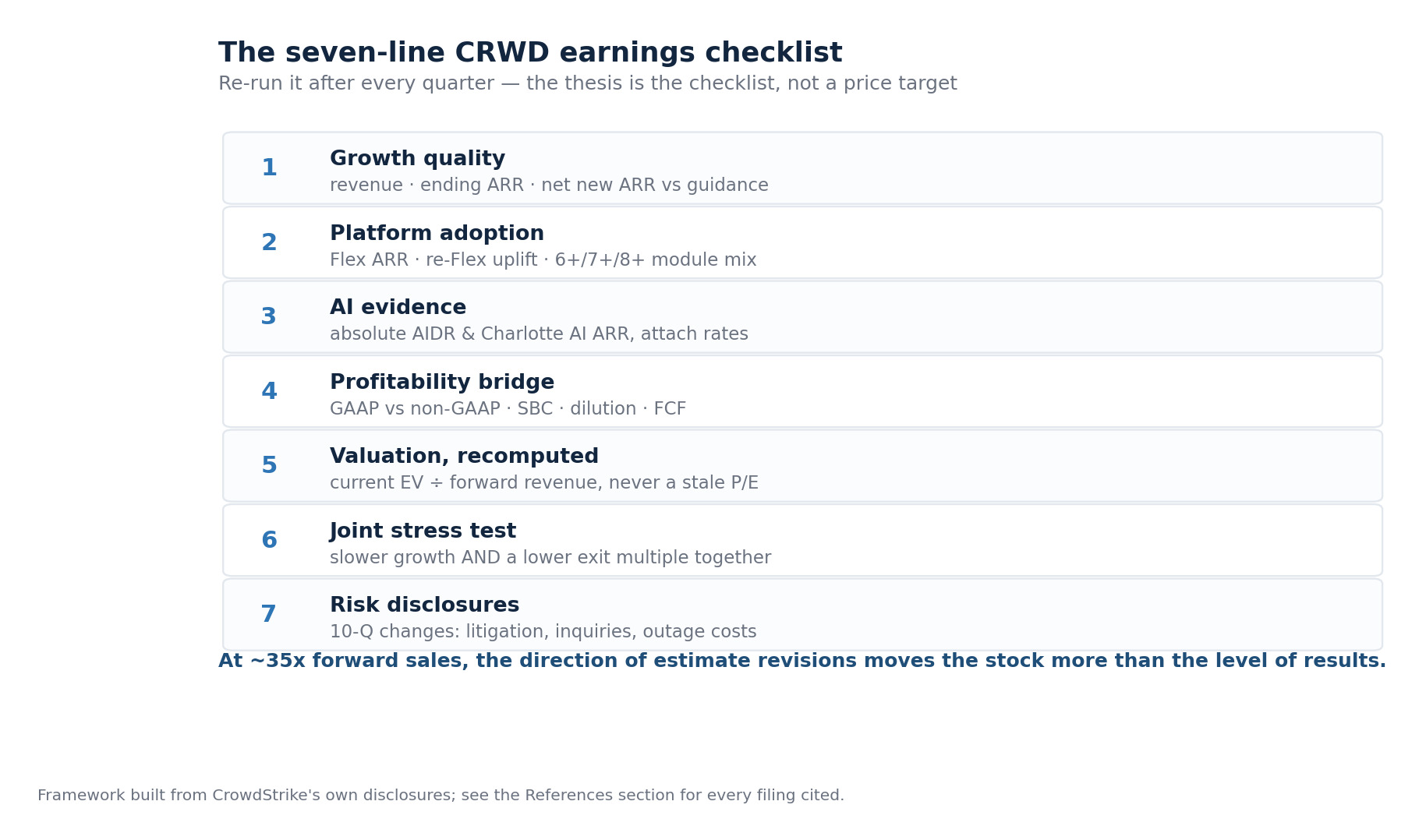
Bago bumili, humawak, o magbawas ng stock ng CrowdStrike, i-update ang tesis pagkatapos ng bawat ulat ng kita gamit ang parehong balangkas:
- Suriin ang kalidad ng paglago: Ihambing ang kita, nagtatapos na ARR, at netong bagong ARR sa gabay at sa nakaraang taon.
- Sukatin ang pag-aampon ng platform: Itala ang Flex ARR, Re-Flex uplift, at anim-, pito-, at walong-module na pag-aampon.
- Humiling ng ebidensya ng AI: Maghanap ng kabuuang kita mula sa produkto ng AI, bilang ng mga customer, attach rates, o datos ng pagpapanatili.
- I-reconcile ang kakayahang kumita: Ihambing ang GAAP operating margin, non-GAAP operating margin, stock compensation, dilution, at free cash flow.
- I-recalculate ang valuation: Gamitin ang pinakabagong enterprise value at forward revenue estimate sa halip na umasa sa isang lipas na P/E ratio.
- Stress-test ang mga inaasahan: I-modelo ang mas mabagal na paglago at mas mababang exit multiple nang sabay; ang mga premium na stock ay madalas na nakakaranas ng parehong sabay-sabay.
- Suriin ang mga panganib na pagsisiwalat: Hanapin ang pinakabagong
10-Qo10-Kpara sa mga pagbabago sa litigation, mga imbestigasyon, mga paghahabol ng customer, at mga gastos sa outage.
Ang susunod na quarterly na resulta ay lalong mahalaga dahil kailangan ng mga mamumuhunan ng kumpirmasyon na ang rekord na Q1 pipeline ay nag-convert sa Q2 ARR at na ang itinataas na gabay ng pamunuan para sa fiscal 2027 ay nananatiling konserbatibo. Ang isang solong quarter ay hindi dapat magtakda ng pangmatagalang tesis, ngunit sa valuation na ito, ang direksyon ng mga pagbabago sa pagtataya ay maaaring magdala ng matinding paggalaw sa stock. Dapat alam ang distribusyon ng mga reaksiyong iyon bago pa lumabas ang ulat: ipinapakita ng aming talahanayan ng bawat reaksiyon ng NVDA matapos ang ulat mula 2016 kung gaano kadalas nagtatapos sa pulang kandila ang magandang bilang sa isang bahaging mataas ang inaasahan.
FAQ Tungkol sa CrowdStrike Stock 2026
Sobrang mahal ba ang CrowdStrike stock sa 2026?
Sa mga karaniwang benta at cash-flow multiples, napakamahal ng CRWD. Kung ito ay sobrang mahal ay nakasalalay sa kung makakapagpanatili ang CrowdStrike ng higit sa 20% na paglago, mapalawak ang GAAP profitability, at makalikha ng makabuluhang kita mula sa AI security sa loob ng ilang taon; ang kasalukuyang presyo ay nag-aalok ng limitadong proteksyon kung humina ang mga palagay na iyon.
Maaaring ipaliwanag ng paglago ng AI security ang valuation ng CRWD?
Maaaring ipaliwanag ng AI security ang isang premium dahil pinalalaki nito ang parehong threat surface at ang halaga ng data platform ng CrowdStrike. Gayunpaman, ang humigit-kumulang 35-times forward-sales valuation ay malamang na nangangailangan ng AI upang magdulot ng matibay na ARR acceleration, hindi lamang mga anunsyo ng produkto o mataas na paglago mula sa isang hindi isiniwalat na base.
Ano ang pinakamahusay na sukatan para sa pagsusuri ng CrowdStrike stock?
Walang isang sukatan na sapat. Dapat pagsamahin ng mga mamumuhunan ang net new ARR growth, free-cash-flow margin, stock-based compensation, module adoption, at forward EV/sales; sama-sama silang nagpapakita ng bilis ng paglago, cash economics, dilution, lalim ng platform, at mga inaasahan.
Ano ang forecast ng CrowdStrike stock para sa 2026?
Ang mga short-term price forecasts ay hindi mapagkakatiwalaan, partikular para sa isang high-multiple stock. Isang mas mahusay na diskarte ay ang scenario analysis: maaaring lumampas ang CRWD kung ang paglago at monetization ng AI ay lumampas sa mga inaasahan, ngunit kahit na ang solidong pagpapatupad ay maaaring magdulot ng mahinang kita kung ang valuation multiple nito ay nag-normalize.
Ginawa bang mas mura ng stock split ng CrowdStrike sa 2026 ang mga bahagi?
Hindi. Ang apat-sa-isang paghahati ay nagsimulang makipagkalakalan sa isang paghahati-na-aangkop na batayan noong Hulyo 2, 2026 at nagbawas ng presyo bawat bahagi habang pinalalaki ang bilang ng mga bahagi nang proporsyonal. Binago nito ang accessibility at optics, hindi ang enterprise value o intrinsic value ng CrowdStrike.
Konklusyon
Ang debate sa CrowdStrike Stock 2026 ay may simpleng sagot na may mahalagang kwalipikasyon. Ang paglago ng AI security ay maaaring suportahan ang negosyo ng CrowdStrike sa mga darating na taon: ang mga umaatake ay kumikilos nang mas mabilis, ang mga negosyo ay kailangang tiyakin ang mga autonomous agents, at ang telemetry, pagkakakilanlan, endpoint, cloud, at SIEM capabilities ng Falcon ay bumubuo ng isang kredibleng agentic-security platform. Ang mga kamakailang resulta ay nagpapatunay sa operating momentum, na may 26% na paglago ng kita, rekord na Q1 net new ARR, lumalawak na pag-aampon ng module, at 34% na free-cash-flow margin.
Ngunit ang valuation ay nagdidiskwento na sa pambihirang tagumpay. Sa humigit-kumulang 35 beses na kita sa fiscal 2027, ang mga mamumuhunan ay nagbabayad ngayon para sa mga taon ng matatag na compounding at patuloy na premium multiples. Ang pinaka-kaakit-akit na entry point ay dapat pagsamahin ang napatunayan na monetization ng AI sa alinman sa mas mabilis na mga pagtataya o mas hindi hinihinging presyo. Hanggang sa panahong iyon, ang CRWD ay pinakamahusay na tingnan bilang isang mataas na kalidad na kumpanya na may mataas na inaasahang stock.
Kaugnay na Babasahin
- Pinapalobo ba ni Jensen Huang ang AI Bubble? Suri sa Nvidia
- Stock ng JPMorgan 2026: 23% ROTCE Laban sa 3,2x Libro
- Bawat Tech Bubble Mula 1929: Paghambing sa AI Cycle ng 2026
- NVDA matapos ang ulat: bawat reaksyon mula 2016 sa talaan
- Magnificent 7 sa 2026: Bigat at Concentration Risk
- Mga bear market ng semiconductor: bawat SOX crash 1995–2026
- Bawat Siklo ng Pagtaas ng Interes ng Fed Mula 1983: S&P 500
- Gaano Katagal Bago Nakabawi ang Bawat Bear Market: 1929-2022
Mga Sanggunian
- CrowdStrike — resulta ng unang kuwarto ng piskal na taong 2027
- SEC — Form 10-Q ng CrowdStrike, kuwartong natapos noong 30 Abril 2026
- CrowdStrike — presentasyon sa mamumuhunan para sa piskal na taong 2026
- CrowdStrike — paglulunsad ng Charlotte AI AgentWorks
- CrowdStrike — ugnayan sa mamumuhunan
- StockAnalysis — istatistika ng CRWD
- Yahoo Finance — kasaysayan ng presyo ng CRWD
- World Economic Forum — Global Cybersecurity Outlook 2026
- IBM — ulat sa gastos ng paglabag sa datos
- Nasdaq — listahan ng CRWD
Kung nais mong subaybayan ang mga rebisyong iyon nang hindi kailangang basahin mismo ang bawat dokumento, ginawa ang aming mga kasangkapan para diyan:
- SimianX AI — plataporma ng pananaliksik na maraming ahente
- Crypto leaderboard — kung paano niraranggo ng 30 modelong AI ang mga pangunahing barya, tuloy-tuloy ang update
- Live Command Room — apat na yugtong daloy ng ahente sa kahit anong ticker
- Autopilot — awtomatikong muling pagsusuri kapag nagbago ang datos
- Pulso ng Merkado — pagtukoy ng pangyayari sa real time sa stocks at crypto
Gamitin ang SimianX AI upang subaybayan ang live market data ng CrowdStrike, mga SEC filings, mga pagbabago sa kita, mga teknikal na signal, at mga nakikipagkumpitensyang bull at bear cases sa isang proseso ng pananaliksik. Pagkatapos ay i-validate ang mga output laban sa mga pangunahing mapagkukunan at i-align ang anumang desisyon sa iyong time horizon at risk tolerance. Nagbibigay ang SimianX ng pang-edukasyon na pagsusuri sa merkado, hindi personal na payo sa pamumuhunan.