 By Muke
How to Read This Week's Token Unlocks: MON, SOON and XPL, Nov 23–29, 2026
Monad's MON dominates the crypto token unlock calendar for November 23–29, 2026. About 16.61 billion MON, held by the team, investors and the Category Labs treasury, is scheduled to unlock on November 24, the first anniversary of Monad's mainnet. That is 1.4 times MON's circulating supply and was worth about $205 million at our price snapshot. SOON (November 23) and Plasma's XPL (November 25) follow with much smaller events.
A large unlock is not the same as a large sell order. An unlock changes what holders are allowed to do with their tokens. It does not tell you how many they will sell, whether they have already hedged, or whether buyers are there to absorb them. This page gives the calendar for the week, checks every figure against the projects' own token documents and two independent trackers, and sets out a four-question method for reading any unlock: size against which supply, who receives the tokens, cliff or linear release, and what history shows.
Snapshot: prices, market caps and supply figures are from CoinGecko and Tokenomist at 01:50 UTC on November 23, 2026 (5:50 pm PT on November 22). "This week" means November 23–29, 2026 in UTC. Dollar values are tokens times the snapshot price, not sale proceeds. If you are reading after an event's scheduled time, the event has probably happened; we will add what actually unlocked and how prices moved after the week ends.
Crypto Token Unlocks This Week: The Calendar
| Token (project) | Date and time | US Eastern | UTC+8 | Tokens | Recipients | Type |
|---|---|---|---|---|---|---|
| SOON (SOON Network) | Nov 23, 2026, ~08:00 UTC | Nov 23, ~03:00 | Nov 23, ~16:00 | ~20.24M (disputed) | Seven pools incl. SOON Squad, ecosystem, team | Linear monthly tranches |
| MON (Monad) | Nov 24, 2026, 14:00 UTC | Nov 24, 09:00 | Nov 24, 22:00 | ~16.61B | Team, investors, Category Labs treasury | One-year cliff |
| XPL (Plasma) | Nov 25, 2026, 12:00 UTC | Nov 25, 07:00 | Nov 25, 20:00 | ~227.78M | Ecosystem and growth, team, investors | Linear monthly tranche |
Sources: Tokenomist and CoinGecko event schedules, checked against the Monad token-sale disclosure and Plasma's XPL tokenomics. The SOON time is the tracker countdown, not a project announcement.
Tracker times mark when tokens become eligible to move. Claiming, distribution and exchange deposits can happen hours, days or months later, or not at all.
| Token | Tokens unlocking | Value at snapshot | Share of circulating supply | Share of released supply (Tokenomist) | Price change, 30 days to Nov 22 |
|---|---|---|---|---|---|
| MON | 16.61B | $205.0M | 140.4% | 32.36% | −41.6% |
| SOON | 20.24M | $5.29M | 5.96% | 3.38% | −13.2% |
| XPL | 227.78M | $10.11M | 4.78% | 4.78% | −41.0% |
| Bitcoin, for comparison | — | — | — | — | −24.6% |
Sources: CoinGecko prices and circulating supply at the snapshot; Tokenomist released-supply ratios; Kraken daily closes (UTC) for the 30-day change, cross-checked with Coinbase and CoinGecko. Ratios and values are our calculations.
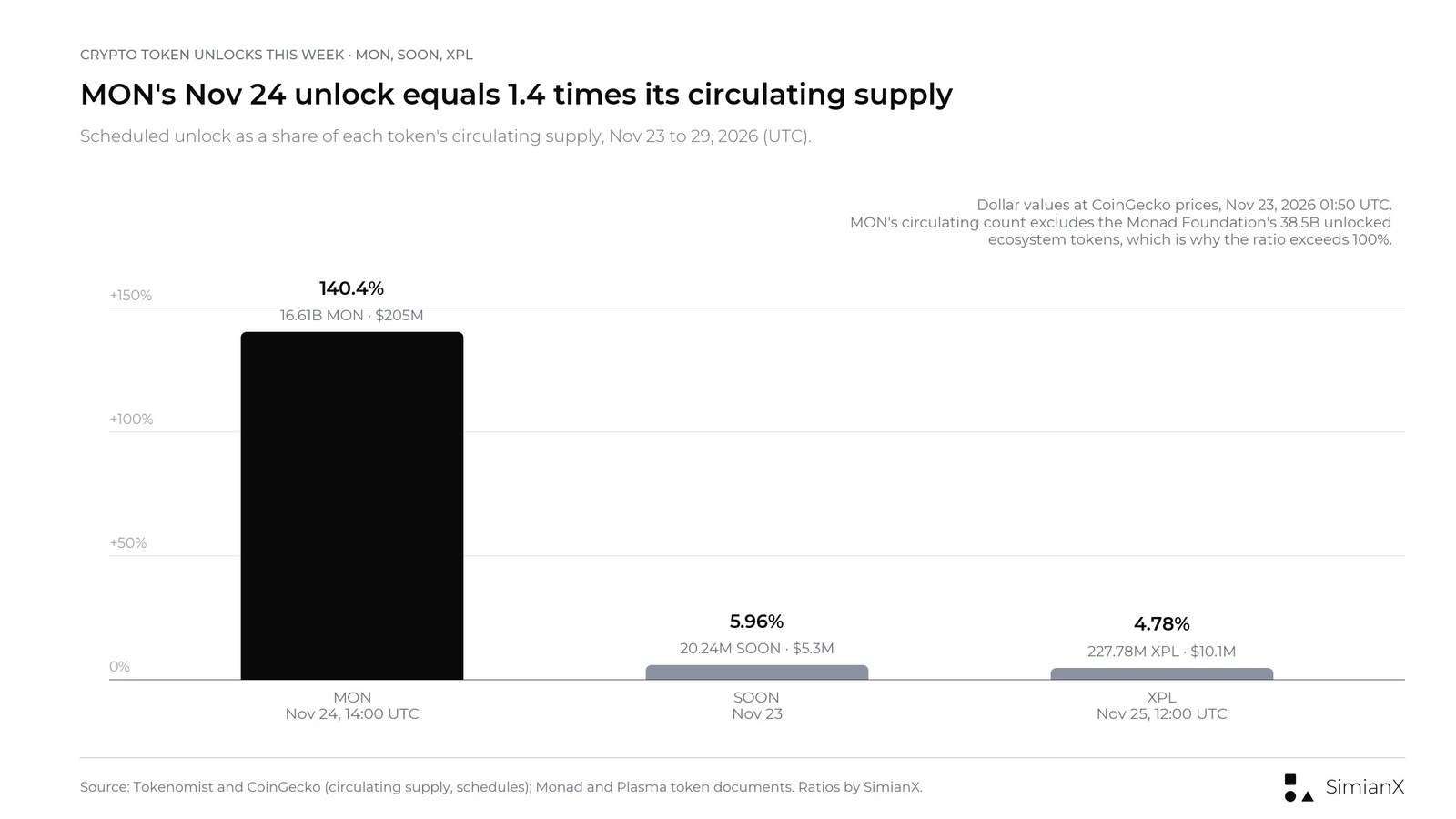
MON's unlock is larger than the whole float that trackers count today. SOON's and XPL's are about 5%.
Together the three events come to about $220.4 million at the snapshot, and MON accounts for 93.0% of it. That is a subtotal for these three tokens only, not every unlock in the market this week.
How to Read a Token Unlock: Four Questions
The same method works for any week's calendar.
1. How big is it, and against which supply? A token can have four different "supplies". Initial or total supply is everything created. Released supply is everything a vesting model treats as unlocked, including tokens a foundation holds and has not spent. Circulating supply is a data provider's estimate of tokens actually available to the market, and it usually leaves out foundation and treasury holdings. Tradable liquidity is what sits in order books near the current price. The same unlock can be 140% of one and 17% of another, so always ask which denominator a headline percentage uses.
2. Who receives the tokens? Team and early-investor tokens were acquired at a fraction of the market price and have been locked for a year or more. Ecosystem and foundation tokens are usually spent slowly on grants and incentives. Airdrop and community pools go to many small holders. The recipient mix says more about potential selling than the token count does.
3. Is it a cliff or a linear release? A cliff releases a large block at once after a lock-up; a linear schedule releases a small slice every month. A first cliff is a new event for the market. A monthly tranche is a known, recurring flow that traders can see coming.
4. What does history show? The largest public study, by the market maker Keyrock, examined more than 16,000 unlock events across 40 tokens, tracking prices from 30 days before to 30 days after each event and normalising them against ether. It reported that about 90% of unlocks came with negative price pressure, that team unlocks were followed by the largest drawdowns (about −25% in its summary), that investor unlocks produced slow, small declines (106 events), that ecosystem-development unlocks averaged +1.18%, and that declines typically started about 30 days before the event, with prices stabilising within about 14 days after it. Two caveats: these are correlations, not proof that the unlock caused the move, and Keyrock sells the hedging and execution services it describes. The study does not publish its token list or date range. Later on this page we add our own count for XPL's 13 monthly unlocks.
A fifth check sits under all four: liquidity. A modest sale can move a thin market sharply, while a large release may barely register if only a small part reaches exchanges.
MON Token Unlock: Monad's First-Year Cliff on November 24
MON is the native token of Monad, a layer-1 blockchain whose mainnet and token went live on November 24, 2025. According to Monad's token-sale disclosure, published for the Coinbase public sale at $0.025 per token, the initial supply of 100 billion MON was split as follows:
| MON allocation | Tokens | Share | Status at mainnet | Vesting terms in the disclosure | Unlocking Nov 24, 2026 (our calculation) |
|---|---|---|---|---|---|
| Ecosystem Development | 38,544,142,854 | 38.5% | Unlocked | Stewarded by the Monad Foundation | — |
| Team | 26,989,187,887 | 27.0% | Locked | Locked for the first year; released at the one-year anniversary and over the three years that follow | ~10.70B |
| Investors | 19,683,237,451 | 19.7% | Locked | Four-year schedule, one-year cliff, then equal 1/48 monthly unlocks | ~4.92B |
| Public Sale | 7,500,000,000 | 7.5% | Unlocked | — | — |
| Category Labs Treasury | 3,952,848,412 | 4.0% | Locked | Four-year schedule, one-year cliff, then equal 1/48 monthly unlocks | ~0.99B |
| Airdrop | 3,330,583,396 | 3.3% | Unlocked | — | — |
| Total | 100,000,000,000 | 100% | ~16.61B |
The disclosure states that at the one-year anniversary "released team tokens will represent ~10.7% of initial token supply", which is about 10.70 billion MON. For investors and the Category Labs treasury, a one-year cliff followed by 1/48 a month means 12/48, or a quarter, unlocks at the cliff: 4.92 billion and 0.99 billion MON. The three add up to about 16.61 billion MON, which matches the figure Tokenomist lists for 14:00 UTC on November 24 (three allocations, 16.61 billion MON).
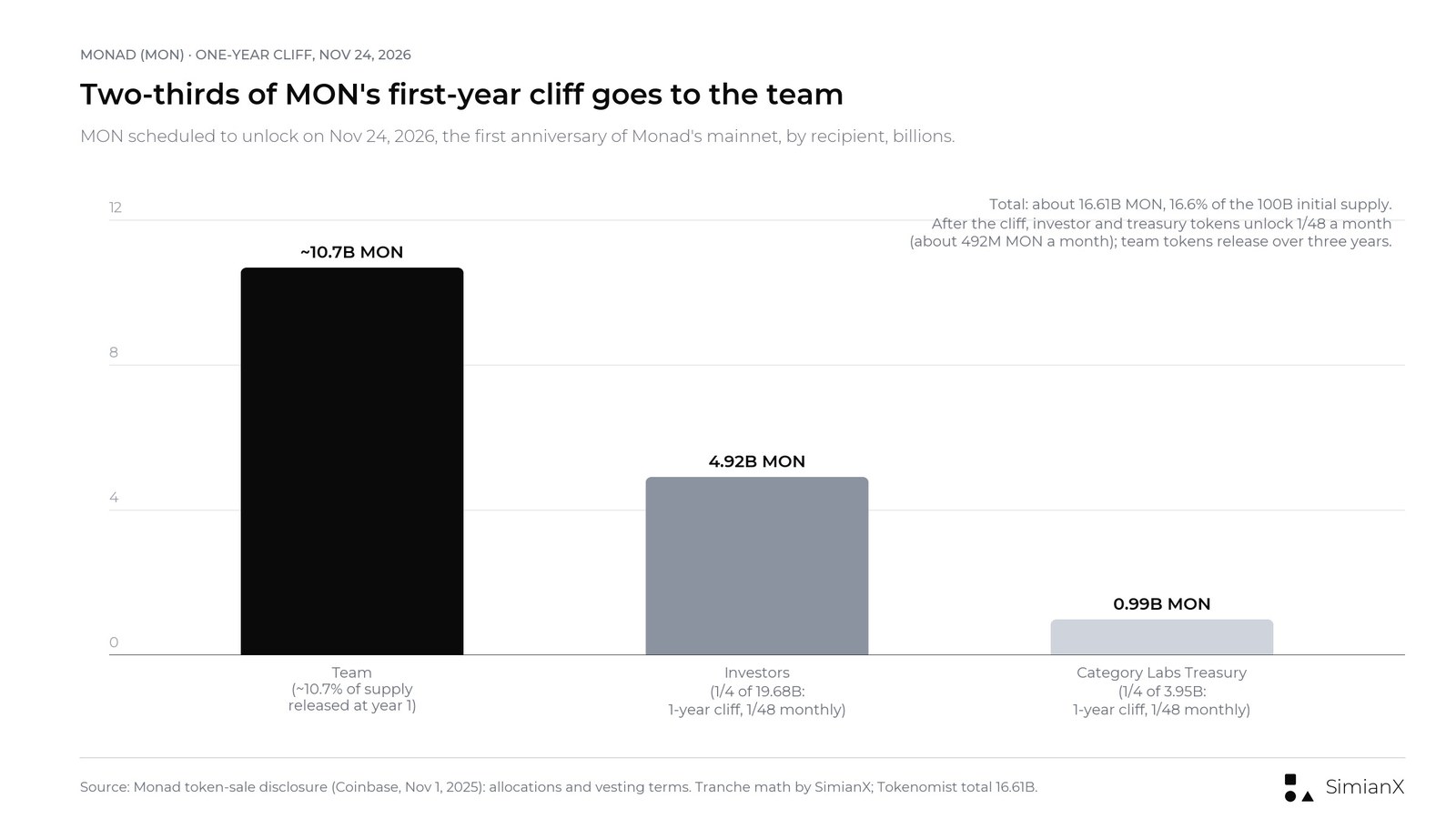
About two-thirds of the cliff goes to team members. Under Keyrock's breakdown, team unlocks are the category followed by the deepest drawdowns.
After the cliff the flow does not stop. Investor and treasury tokens then unlock at 1/48 a month, about 492 million MON a month between them (our calculation), and team tokens are released over the next three years. Locked MON cannot be staked under the disclosure, so the recipients only gain staking as an option once their tokens unlock.
Why the MON percentage can read 140%, 32% or 17%
Trackers quote very different percentages for the same 16.61 billion MON, because they divide by different supplies:
| Denominator | Supply | Unlock as a share (our calculation) |
|---|---|---|
| Circulating supply (CoinGecko, Tokenomist) | 11.83B | 140.4% |
| Released supply (Tokenomist) | ~51.3B | 32.36% |
| Initial supply (Monad disclosure) | 100B | 16.61% |
| Total supply incl. issuance (CoinGecko) | 100.68B | 16.5% |
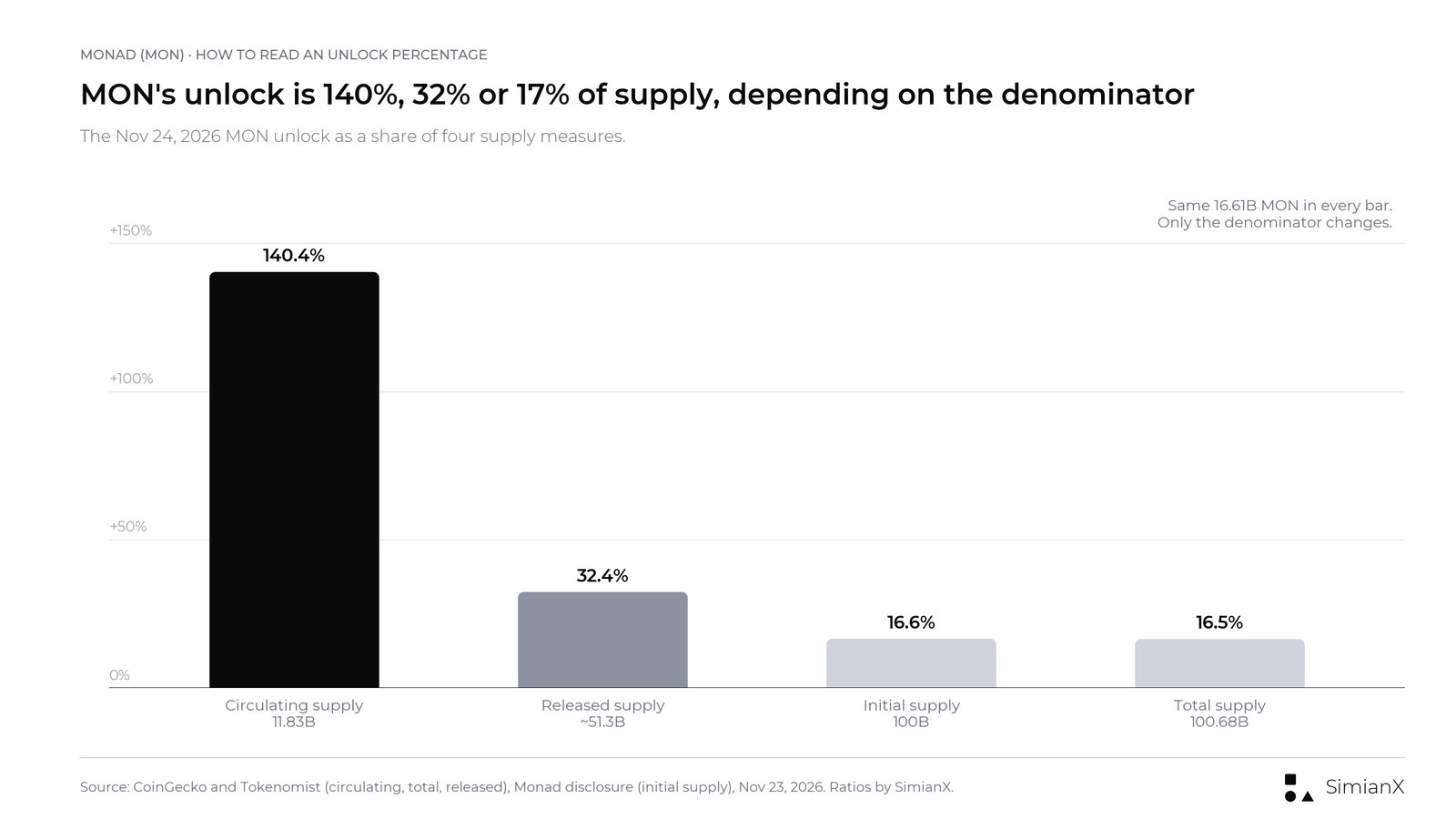
The token amount is the same in every bar; only the denominator changes.
The gap comes from the Monad Foundation's 38.5 billion unlocked ecosystem tokens. They count as released, because nothing stops them from moving, but data providers leave them out of circulating supply. That is why the 32.36% figure often quoted for MON should not be described as a share of circulating supply. Neither does 140% mean circulating supply will more than double on November 24: newly unlocked team and investor tokens may stay in custody, be staked or be distributed slowly, and providers will decide how to classify them.
MON's price going into the cliff
MON closed at $0.0125 on November 22 on both Kraken and Coinbase, half the $0.025 public-sale price. It was down 19.6% over seven days and 41.6% over 30 days, against a 24.6% fall in bitcoin over the same 30 days. At the snapshot, the tokens unlocking on November 24 were worth about $205 million, 1.4 times MON's $146 million market capitalisation. That pre-event weakness matches the pattern Keyrock describes, in which declines start before the unlock, but it does not show why MON fell or what happens next. Much of the weakness was market-wide, as the bitcoin figure shows.
SOON Token Unlock: The Date Is Confirmed, the Amount Is Not
SOON is the token of SOON Network. Its official documentation gives an initial total supply of 1 billion SOON and five allocation groups: community 51%, ecosystem 25%, team and co-builders 10%, airdrop and liquidity 8%, and foundation or treasury 6%. It does not publish a vesting calendar. The November 23 event therefore rests on trackers, and they disagree on its size.
CoinGecko's unlock panel, which uses Tokenomist data, lists 20.24 million SOON across seven pools:
| SOON pool | Tokens unlocking Nov 23 |
|---|---|
| SOON Squad | 6.67M |
| Ecosystem | 4.17M |
| Team and Co-builders | 2.78M |
| SOON Pill | 2.22M |
| Community Incentives for Future Products | 2.22M |
| Foundation/Treasury | 1.67M |
| Airdrop/Liquidity | 0.52M |
| Total | ~20.24M |
Tokenomics.com lists 13,575,556 SOON for the same date. The difference, about 6.66 million SOON, is almost exactly the 6.67 million SOON Squad tranche, so the two trackers most likely disagree on whether that pool still unlocks this month. Tokenomics.com describes the SOON Squad pool as a 6-month cliff followed by 12 months of linear vesting, which would make November 2026 its last month or put it just past the end, depending on how the schedule is counted. Neither tracker cites a project document for this event, so we report both figures and do not average them. A third tracker, RootData, shows a different figure again.
The 3.38% often quoted for SOON is the 20.24 million SOON divided by Tokenomist's 599.13 million "unlocked to date", a released-supply ratio. Against CoinGecko's circulating supply of 339.79 million it is 5.96%. At the snapshot SOON traded at $0.261, up 19.5% in seven days, so the event was worth about $5.29 million.
XPL Token Unlock: Plasma's Monthly Tranche on November 25
Plasma's official tokenomics set an initial supply of 10 billion XPL at the mainnet beta launch on September 25, 2025:
| XPL allocation | Tokens | Share | Vesting terms |
|---|---|---|---|
| Ecosystem and Growth | 4.0B | 40% | 800M at launch; remaining 3.2B monthly, pro rata, over three years to Sep 25, 2028 |
| Team | 2.5B | 25% | One-third after a one-year cliff (Sep 25, 2026); remaining two-thirds monthly over two years to Sep 25, 2028 |
| Investors | 2.5B | 25% | Same schedule as the team |
| Public Sale | 1.0B | 10% | Non-US buyers unlocked at launch; US buyers locked until Jul 28, 2026 |
The November 25 figure rebuilds exactly from those terms:
| Component | Calculation | Tokens a month |
|---|---|---|
| Ecosystem and Growth | 3.2B ÷ 36 months | 88.89M |
| Team | 2.5B × 2/3 ÷ 24 months | 69.44M |
| Investors | 2.5B × 2/3 ÷ 24 months | 69.44M |
| Total | 227.78M |
Tokenomist lists the same 227.78 million XPL for 12:00 UTC on November 25, 4.78% of released supply. October 25 had the same amount, and September 25, 2026 carried the team and investor cliff: about 1.76 billion XPL, or 833 million each for the team and investors plus the ecosystem tranche. So this week's XPL event is the second full monthly tranche, not a new cliff. Validator rewards, which Plasma says start at 5% a year, fall by 0.5 points a year to 3%, and only begin once external validators and delegation go live, are a separate supply source from vesting.
What history shows: XPL after its last 13 unlocks
XPL is one of the few tokens with a long, documented run of unlocks of known size, so we measured how its price moved around each one. For each unlock on the 25th of the month from October 2025 to October 2026, we took the daily close before the unlock and the close seven days later.
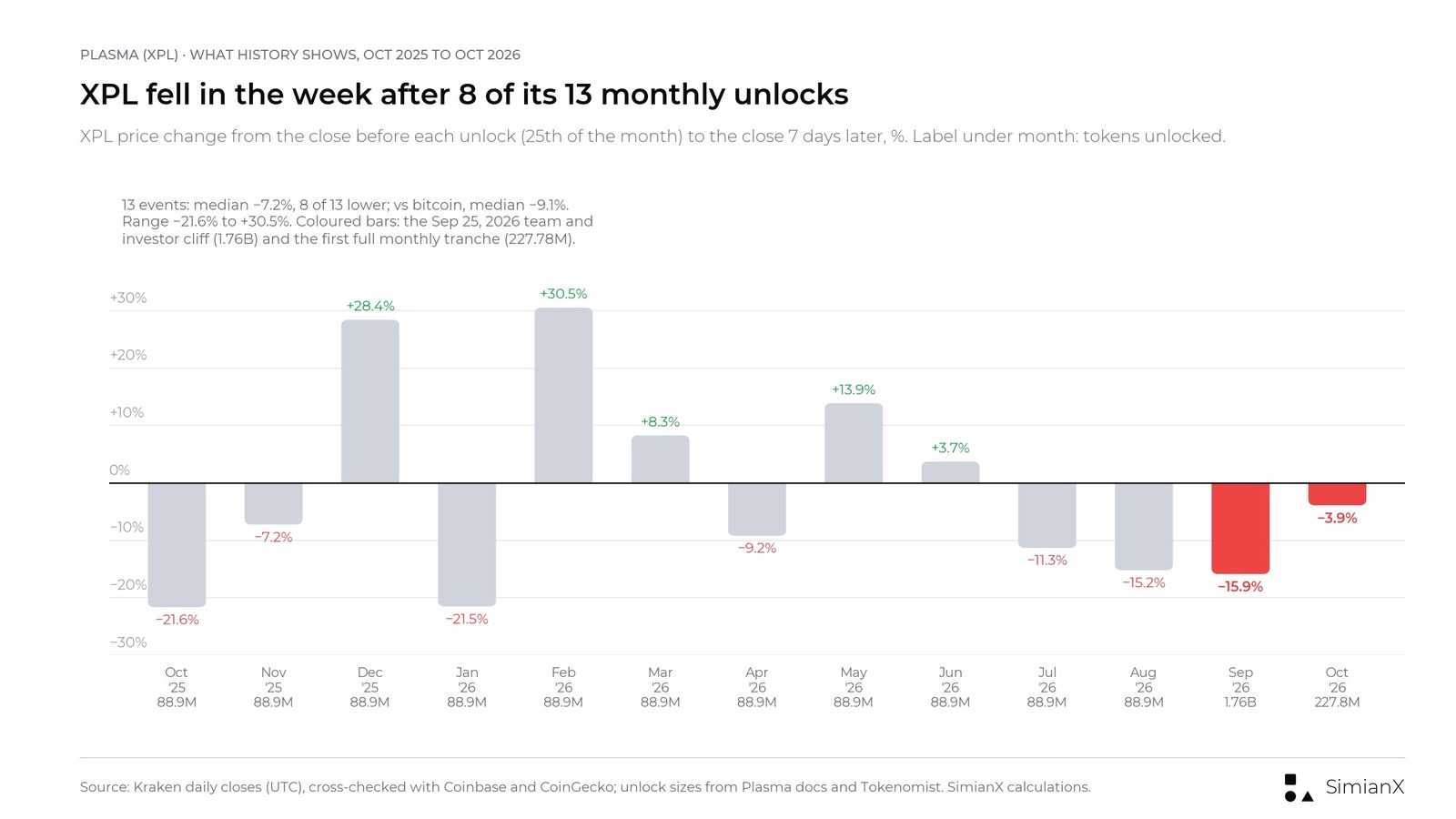
XPL fell in the week after 8 of its 13 monthly unlocks. The two coloured bars are the September 2026 team and investor cliff and the first full monthly tranche in October.
| Unlock date | XPL unlocked | XPL, 30 days before | XPL, 7 days after | XPL vs bitcoin, 7 days after |
|---|---|---|---|---|
| Oct 25, 2025 | 88.89M | — | −21.6% | −20.9% |
| Nov 25, 2025 | 88.89M | −49.0% | −7.2% | −10.3% |
| Dec 25, 2025 | 88.89M | −33.6% | +28.4% | +26.8% |
| Jan 25, 2026 | 88.89M | −2.9% | −21.5% | −9.1% |
| Feb 25, 2026 | 88.89M | −26.3% | +30.5% | +15.0% |
| Mar 25, 2026 | 88.89M | +9.2% | +8.3% | +12.1% |
| Apr 25, 2026 | 88.89M | −0.6% | −9.2% | −10.6% |
| May 25, 2026 | 88.89M | −18.5% | +13.9% | +22.9% |
| Jun 25, 2026 | 88.89M | +6.9% | +3.7% | +2.9% |
| Jul 25, 2026 | 88.89M | −7.7% | −11.3% | −9.4% |
| Aug 25, 2026 | 88.89M | +16.9% | −15.2% | −13.5% |
| Sep 25, 2026 (cliff) | 1.76B | +22.7% | −15.9% | −16.0% |
| Oct 25, 2026 | 227.78M | −33.0% | −3.9% | −0.8% |
Sources: Kraken daily closes (UTC). Coinbase (listed from December 2025) and CoinGecko (from November 2025) agree with Kraken to within one point on every 7-day window they cover; the October 2025 row and the November 2025 30-day figure rest on Kraken alone. Unlock sizes from Plasma's documentation and Tokenomist. Our calculations; "before" is the close on the day before the unlock.
Across the 13 events, XPL fell in the week after 8 of them, with a median change of −7.2%. Against bitcoin it lagged after 8 of 13, median −9.1%. The spread is wide, from −21.6% to +30.5%, and 13 events of one token is a small sample. The September 2026 cliff, the largest, was followed by −15.9% in a week, after XPL had risen 22.7% in the month before it. Treat this as a description of one token's record, not a rule for MON or SOON.
Why MON, SOON and XPL Are Different Kinds of Events
| Token | What kind of event | What to verify |
|---|---|---|
| MON | First one-year cliff, mostly team and investors, larger than today's float | Transfers from recipient wallets, exchange deposits, staking of newly unlocked MON |
| SOON | Monthly tranche, amount disputed between trackers | Which pools actually unlocked, ideally on-chain |
| XPL | Known monthly tranche, second after the September cliff | Monthly flows to exchanges and ecosystem spending |
| All three | Eligibility, not a sale | Order-book depth and whether demand absorbs any selling |
This is a framework for reading the events, not a forecast.
How Token Unlocks Can Affect Prices
There are five main channels, and none of them is automatic.
- Direct selling. Recipients may sell to diversify, fund operations or take profits. What matters is the part actually offered to buyers, not the full unlock.
- Positioning before the event. Traders may cut exposure or hedge with perpetual futures beforehand, so part of any price adjustment can happen before the unlock date. Funding rates and open interest show some of that positioning; our crypto liquidations, funding and open interest guide explains how to read them.
- Redistribution without a sale. Tokens can move to custodians, market makers or many wallets without being sold on the open market.
- New demand. Buyers may absorb the extra supply if they see value or expect more network use.
- Liquidity. The same sale moves a thin market far more than a deep one.
A post-unlock rally would not prove that supply did not matter, and a decline would not prove that every unlocked token was sold. Attribution needs price, flows and market conditions together.
What to Monitor Before and After the Events
| Measure | What it answers | Main limitation |
|---|---|---|
| Unlocked token amount | How much becomes transferable | Says nothing about intent |
| Value at market price | How large it is at today's price | Ignores price impact of selling |
| Share of circulating supply | How large it is against the float | Depends on the provider's definition |
| Exchange inflows from recipient wallets | Whether tokens are heading to trading venues | A deposit is not a sale |
| Order-book depth near the price | How much can trade without a large move | Liquidity can vanish quickly |
| Recipient balances over the following weeks | Whether holders are reducing exposure | Wallet labels may be incomplete |
- Confirm the event. Check the token identity (several assets share the SOON ticker), the allocation and the timestamp. A tracker countdown is not a project announcement.
- Watch recipient wallets. Did the expected allocation become transferable, and did it move?
- Watch exchange deposits. Transfers from recipient wallets to exchange addresses are the clearest early signal.
- Compare with the market. If bitcoin and ether fall by as much, the move is probably not about the unlock. Our bitcoin monthly returns heatmap gives the market backdrop, and the Ethereum price history by year covers the benchmark Keyrock used.
- Check liquidity and follow-through. Watch whether spreads widen and whether pressure continues after the first few days; Keyrock found that volatility usually settled within about two weeks.
To follow MON, XPL or SOON through the week, you can run a SimianX live analysis on the pair, and the SimianX crypto leaderboard shows how AI models are trading crypto right now. For events that land at the same time as US macro data, our US economic calendar in your time zone lists the release times.
Frequently Asked Questions
Which crypto token unlock is largest this week?
MON. About 16.61 billion MON unlocks on November 24, 2026, worth about $205 million at our November 23 snapshot and equal to 140% of its circulating supply. That is 93% of the value of this week's three events (MON, SOON and XPL).
When is the MON token unlock?
November 24, 2026 at 14:00 UTC (9:00 am US Eastern, 10:00 pm UTC+8), according to Tokenomist. It is the first anniversary of Monad's mainnet launch on November 24, 2025, when the one-year lock on team, investor and Category Labs treasury tokens ends.
Who receives the unlocked MON?
Based on Monad's token-sale disclosure, about 10.7 billion goes to team members, about 4.92 billion to investors and about 0.99 billion to the Category Labs treasury. Investor and treasury tokens then unlock 1/48 a month, about 492 million MON a month combined.
Is MON unlocking 32% of its circulating supply?
No. The 32.36% figure divides the unlock by released supply (about 51.3 billion MON, including the Monad Foundation's 38.5 billion unlocked ecosystem tokens). Against circulating supply of 11.83 billion it is 140%; against the 100 billion initial supply it is 16.6%.
How much SOON unlocks on November 23?
Trackers disagree. CoinGecko and Tokenomist list about 20.24 million SOON across seven pools; Tokenomics.com lists 13.58 million. The gap matches the 6.67 million SOON Squad tranche. SOON Network's own documentation does not publish a vesting calendar.
How much XPL unlocks this week?
227.78 million XPL at 12:00 UTC on November 25: 88.89 million from the ecosystem and growth pool and 69.44 million each for the team and investors, exactly as Plasma's published schedule implies. It is about 4.78% of circulating supply.
Are token unlocks always bearish?
No, but the record leans negative. Keyrock's study of more than 16,000 events found about 90% came with negative price pressure, worst for team unlocks and slightly positive for ecosystem unlocks. XPL fell in the week after 8 of its 13 monthly unlocks, yet rose more than 28% after two of them. The outcome depends on recipients, prior positioning, liquidity and demand.
Verdict: MON Leads the Calendar, Definitions Lead the Analysis
MON's November 24 cliff is the week's dominant event: 16.61 billion tokens, mostly for the team and investors, larger than the float trackers count today, arriving after a 42% fall in a month. SOON's event is small, but its size is disputed. XPL's is a known monthly tranche with a year of history behind it.
The useful questions are the same every week. Against which supply is the percentage measured? Who receives the tokens? Is it a first cliff or a routine tranche? What did the token do around its previous unlocks? Only then look at flows: the calendar shows potential pressure, and recipient behaviour and liquidity decide how much of it becomes real.
This article is research, not investment advice. It is not a forecast or a price target, and it does not recommend buying, selling or shorting MON, SOON or XPL.
Related Reading
- Crypto Liquidations, Funding & OI: Biggest Wipeouts Ranked
- Bitcoin Monthly Returns: Every Month 2013–2026 Heatmap
- Ethereum Price History by Year 2015–2026: Table + 2026 YTD
- US Economic Calendar This Week & November 2026, Local Times
References
- Monad: token-sale disclosure for the Coinbase public sale, allocations and vesting (Nov 1, 2025)
- The Block: Monad mainnet launches with 50.6% of MON supply locked (Nov 24, 2025)
- Tokenomist: Monad (MON) unlock schedule
- CoinGecko: Monad (MON) price and supply
- Plasma: XPL tokenomics and vesting
- Tokenomist: Plasma (XPL) unlock schedule
- CoinGecko: Plasma (XPL) price and supply
- SOON Network: tokenomics documentation
- CoinGecko: SOON price, supply and unlock panel
- Tokenomist: SOON unlock events
- Tokenomics.com: SOON unlock schedule
- Keyrock: From Locked to Liquidity, what 16,000+ token unlocks teach us