
 By Marcus Reeve
Lighter Withdrawal Halt: Every Perp DEX Exploit and How the Token Traded
Lighter, a perpetual futures exchange built on Ethereum, suspended all withdrawals and new liquidity-pool creation early on Monday, November 16, 2026, after a security incident, and said about seven hours later that withdrawals had resumed. On-chain researchers report that about $15.48 million in USDC was drained from two market-maker accounts. Lighter says the cause was a trader's API key exposed by that account's own signing code, not a flaw in its protocol.
Perp DEX exploits are no longer rare. This page puts the Lighter halt next to every perpetual-DEX exploit and withdrawal or trading halt we could source since 2022, from Mango Markets to Drift, and records what each platform's token did one day and seven days later. It will be updated as Lighter publishes more.
Quick answer (updated 4:25 p.m. PT / 7:25 p.m. ET, Monday, Nov 16, 2026; 00:25 UTC, Tuesday, Nov 17)
>
- Can I withdraw from Lighter right now? Yes, according to Lighter. In an update on X at about 1:20 p.m. ET (10:20 a.m. PT, 18:20 UTC) on November 16, 2026, Lighter said it had switched off Guardian mode, that withdrawals had resumed and that pending withdrawals were being processed, as reported by PANews and TokenPost. That came about seven hours after its first post, at about 6:02 a.m. ET (3:02 a.m. PT, 11:02 UTC), which suspended all withdrawals and new pool creation. The update did not say whether new pool creation had reopened; it said transfers into public pools now require a wallet signature. Lighter's status page read "All services are online" with no incident listed throughout, including at 00:25 UTC on Nov 17, so it is not a reliable signal for this event; watch Lighter's X account.
- What happened? Lighter's 18:20 UTC update says the affected accounts used their own signing code, outside Lighter's official SDKs, that reused signing nonces, which let the attacker derive their API private keys from public signatures. Lighter says its protocol, smart contracts, infrastructure and official SDKs were unaffected, and that its Security Council returned about 5 million USDC to the affected trader (PANews and TokenPost say "traders"). Lighter has still not given a total loss figure, and the reported figures disagree: blockchain data firm Bitquery traced 10,393,057 USDC (about $10.4 million) leaving Lighter's Ethereum contract at 10:11 UTC, per CoinDesk and Cointelegraph, while on-chain researchers report about $15.48 million taken from two market-maker accounts. We had seen no figure from a named security firm or investigator such as PeckShield, Cyvers or ZachXBT, and no report of a bounty.
- What did LIT do? On CoinGecko data, LIT fell from about $2.74 to $2.49 in the ten minutes after 10:25 UTC, roughly half an hour before Lighter's first post, and was still 7.9% below the previous daily close at 11:55 UTC. It then recovered and closed the UTC day (00:00 UTC Nov 17, 7 p.m. ET Nov 16) at $2.975, up 5.0% from the Nov 15 close of $2.833. On OKX, the LIT-USDT pair closed the day at $2.963, up 4.5% from $2.836. Upbit suspended LIT deposits and withdrawals at 6:09 a.m. ET, and Bithumb's public API showed LIT deposits and withdrawals switched off at 11:58 UTC; both were still suspended at 00:25 UTC Nov 17 (7:25 p.m. ET Nov 16).
- Has this happened before? Yes. The table below lists every perp DEX exploit and withdrawal halt we could source, with the loss, the stated cause, how long the halt lasted, whether funds came back, and how the platform's token traded one day and seven days later.
What happened at Lighter on November 16, 2026
Times are Eastern (ET) and Pacific (PT), with UTC. We list only facts that appear in at least one linked source, and we mark which ones come from Lighter, which from an exchange, and which only from on-chain researchers or news outlets.
| Time (ET / PT / UTC) | Event | Source | Status |
|---|---|---|---|
| 5:11 a.m. ET / 2:11 a.m. PT / 10:11 UTC | 10,393,057 USDC (about $10.4M) leaves Lighter's Ethereum contract and is swapped into ETH through CoW Swap within minutes, per blockchain data firm Bitquery; Bubblemaps also puts the withdrawal at about $10.4M | CoinDesk, Cointelegraph | Reported |
| ~5:25–5:35 a.m. ET / 2:25–2:35 a.m. PT / 10:25–10:35 UTC | LIT drops from about $2.74 to about $2.49 in ten minutes, before any statement from Lighter | CoinGecko 5-minute prices | Market data |
| About 5:56 a.m. ET / 2:56 a.m. PT / 10:56 UTC | ChainCatcher relays research shared by on-chain analyst 0xTria: two market-maker accounts, No. 714710 (about $10.39M) and No. 714723 (about $5.09M), possibly hit through leaked API keys | ChainCatcher | Reported, not confirmed |
| 6:02 a.m. ET / 3:02 a.m. PT / 11:02 UTC | Lighter posts on X that it is investigating a security incident that "appears to involve a single compromised external party," and that withdrawals and pool creation are temporarily suspended | Lighter on X (time from the post ID; wording as quoted by CryptoBriefing) | Official |
| 6:05 a.m. ET / 3:05 a.m. PT / 11:05 UTC | Lookonchain reports that an address linked to the incident deposited about 288,300 USDC into Hyperliquid and bought XMR (Monero) | Lookonchain on X, via TechFlow | Reported |
| 6:09 a.m. ET / 3:09 a.m. PT / 11:09 UTC | Upbit suspends LIT deposits and withdrawals on the Ethereum network "until stability is confirmed," citing signs of a security incident | Upbit notice | Official (exchange) |
| 6:30 a.m. ET / 3:30 a.m. PT / 11:30 UTC | Upbit issues a trading caution for LIT, warning that volatility may increase, and links Lighter's X post | Upbit notice | Official (exchange) |
| By 6:36 a.m. ET / 3:36 a.m. PT / 11:36 UTC | Onchain Lens puts the total at about $15.5M and says the suspected attacker's main wallet still holds about 4,805 ETH (about $8.7M) | ChainCatcher | Reported |
| 6:52 a.m. ET / 3:52 a.m. PT / 11:52 UTC | Lighter's status page shows "All services are online" and lists no incident | status.lighter.xyz | Checked by us |
| 6:58 a.m. ET / 3:58 a.m. PT / 11:58 UTC | Bithumb's public asset-status API shows LIT deposits and withdrawals disabled (ETH remains enabled) | Bithumb API | Checked by us |
| 7:49 a.m. ET / 4:49 a.m. PT / 12:49 UTC | Lighter's update on X: the incident "was caused by a leaked API key for a specific trader's account" and "the Lighter protocol and smart contracts are unaffected"; Guardian mode is on; the priority is recovering funds tied to "an additional withdrawal attempt by the attacker"; its Security Council will upgrade the contracts, aiming to resume withdrawals by the end of the day; it has identified a wallet it believes is the attacker's | Lighter on X (time from the post ID), Unchained | Official |
| 12:55 p.m. ET / 9:55 a.m. PT / 17:55 UTC | No notice seen that withdrawals or pool creation have reopened. Lighter's status page still shows "All services are online" with no incident; Upbit notice 6782 is unchanged (LIT deposits and withdrawals still suspended); Bithumb's API still shows LIT deposits and withdrawals disabled | status.lighter.xyz, Upbit notice 6782, Bithumb API | Checked by us |
| 1:20 p.m. ET / 10:20 a.m. PT / 18:20 UTC | Lighter's update on X: Guardian mode switched off, withdrawals resumed and pending withdrawals being processed; its Security Council returned about 5 million USDC to the affected trader; the cause was nonce reuse in the affected accounts' own signing code, outside Lighter's official SDKs, which let the attacker derive API private keys from public signatures; transfers into public pools now require a wallet signature. No total loss figure and no word on pool creation | Lighter on X (time from the post ID), via PANews and TokenPost | Official |
| 7:00 p.m. ET / 4:00 p.m. PT / 00:00 UTC Nov 17 | LIT closes the UTC day at $2.975, up 5.0% from the Nov 15 close of $2.833; OKX's LIT-USDT pair closes at $2.963, up 4.5% | CoinGecko, OKX daily candles | Market data |
| 7:25 p.m. ET / 4:25 p.m. PT / 00:25 UTC Nov 17 | Upbit notice 6782 is unchanged (LIT deposits and withdrawals still suspended); Bithumb's API still shows LIT deposits and withdrawals disabled; Lighter's status page still shows "All services are online" with no incident | Upbit notice 6782, Bithumb API, status.lighter.xyz | Checked by us |
What we have not seen: a total loss figure from Lighter or a report from a named security firm such as PeckShield or Cyvers. Lighter's only figure is the roughly 5 million USDC its Security Council returned. The $15.48 million figure and the account numbers come from on-chain researchers and news outlets; the roughly $10.4 million withdrawal comes from Bitquery and Bubblemaps, as reported by CoinDesk and Cointelegraph. Lighter has identified a wallet it believes belongs to the attacker, but it has not named the affected trader or said how much remains with the attacker, and no bounty has been reported. ChainCatcher relayed an unconfirmed suggestion from one analyst about which market maker was hit; we do not repeat it here.
How the reported Lighter drain worked, step by step
This section describes what on-chain researchers and news outlets report. Lighter has confirmed the suspension; in its 12:49 UTC update, that a leaked API key for a specific trader's account caused the incident; and in its 18:20 UTC update, as relayed by Wu Blockchain and TokenPost, that the key was exposed by nonce reuse in that account's own signing code and that the attacker created a public pool through a compromised account and redeemed the pool shares through an account it controlled. It has not confirmed the amount or the two account numbers described below.
- Access. Two market-maker accounts, numbered 714710 and 714723 in the reports, were controlled by someone other than their owners. TokenPost and CryptoBriefing say leaked API keys are the suspected entry point. CryptoBriefing reported that the leaked keys "permitted same-L1 transfers without requiring any additional signatures," meaning funds could be moved between accounts tied to the same Ethereum address without a fresh wallet signature.
- Free up the collateral. The accounts' open positions were closed, turning margin into withdrawable USDC.
- Route it through a pool. A new public liquidity pool was created with a 0% fee. ChainCatcher, citing Onchain Lens, reports the attacker took 99.99% of its shares for about $10,000; the market-maker funds were moved in and then redeemed by the attacker.
- Cash out. USDC left in batches of about $1 million and was swapped into ETH through CoW Protocol, according to TokenPost and CryptoBriefing. Lookonchain later tracked about 288,300 USDC into Hyperliquid, where it was used to buy XMR.
That sequence also explains the shape of Lighter's response. Suspending pool creation closes step 3 for anyone else. Suspending withdrawals closes step 4 for everyone, including users who were not affected. Trading did not stop: The Defiant reported that ETH perpetual futures kept trading after the notice.
Two wording differences are worth flagging. Lighter's post, as relayed by PANews and The Defiant, says withdrawals and pool creation are paused; BlockBeats and Bloomingbit say withdrawals and wallet/address creation. And some headlines call this a "Lighter hack," while Lighter says the protocol itself was not breached. Both can be true at once: user funds sat inside Lighter, but the reported weak point was a third party's credentials.
Every perp DEX exploit and halt since 2022
The table below covers decentralized perpetual-futures exchanges that lost user or pool funds to an exploit, manipulation or compromised key, or that halted withdrawals or trading during an incident. Each row was checked against at least one major outlet, security firm or the protocol's own post-mortem. Losses are the protocol's figure where it gave one, otherwise the figure from a named security firm or outlet. For thefts from centralized exchanges, which are much larger, see our ranked table of crypto exchange hacks.
| Date (UTC) | Venue | Loss | Cause, as stated | Halt and duration | Funds returned? | Token: 1 day / 7 days |
|---|---|---|---|---|---|---|
| Oct 11, 2022 | Mango Markets (Solana) | About $114M (Hacken, via The Block; outlets range $110M–$117M) | Manipulation of the MNGO price used as collateral | Deposits turned off in the front end; end date not verified | About $67M returned on Oct 15, 2022; the rest kept under a deal put to a DAO vote | MNGO: n/a |
| Nov 17–18, 2023 | dYdX v3 | About $9M from the insurance fund (dYdX) | "Targeted attack" manipulating the YFI market | No trading or withdrawal halt; margin requirements raised | No | DYDX: −5.4% / +5.1% |
| Mar 26, 2025 | Hyperliquid (JELLY market) | No realized loss per Hyperliquid (HLP up about $700K over 24 hours); about $12M unrealized at the peak (Lookonchain) | "Suspicious market activity"; validators voted to delist JELLY perps | JELLY trading only; withdrawals not halted | Users made whole by the Hyper Foundation, except flagged addresses | HYPE: −13.0% / −16.9% |
| Apr 14, 2025 | KiloEx (Base, opBNB, BNB Chain) | About $7.5M (Halborn); about $7M (Cyvers, via CoinDesk) | Price-oracle access-control flaw (Halborn) | Operations suspended; restart date not verified | Yes, per KiloEx, on Apr 18; 10% ($750K) bounty | KILO: n/a |
| Jul 9, 2025 | GMX v1 (Arbitrum) | About $42M from the GLP pool | Re-entrancy bug | V1 trading and GLP minting and redemption paused on Arbitrum and Avalanche | About $40.5M returned on Jul 11; about $5M kept as a bounty | GMX: −16.1% / −7.7% |
| Nov 12, 2025 | Hyperliquid (POPCAT market) | About $4.9M HLP loss (analysts; not confirmed by Hyperliquid) | No official cause; reports describe a fake POPCAT buy wall | Bridge deposits and withdrawals paused "for maintenance," for under an hour by most accounts | n/a | HYPE: −1.1% / +0.2% |
| Apr 1, 2026 | Drift (Solana) | About $285M (TRM Labs; confirmed by Drift on Apr 2) | Drift: "an active attack." TRM Labs: social engineering of multisig signers and a fake collateral token, likely North Korea | Deposits and withdrawals suspended; restart date not verified | Not returned, per TRM Labs | DRIFT: −25.9% / −61.2% |
| Jul 15, 2026 | Ostium (Arbitrum) | About $18M (Blockaid) to $22M (CertiK); Ostium has given no figure | Ostium: "an issue with the OLP vault." Blockaid: a compromised oracle signer key | All trading paused; restart date not verified | Not reported | No token |
| Nov 16, 2026 | Lighter (Ethereum L2) | About $10.4M withdrawn on-chain (Bitquery, Bubblemaps) to about $15.48M reported (on-chain researchers); Lighter has given no total | Lighter: API keys exposed by nonce reuse in the affected accounts' own signing code; protocol, smart contracts and official SDKs unaffected. Researchers: two market-maker accounts | All withdrawals and new pool creation suspended at 11:02 UTC; withdrawals resumed by 18:20 UTC the same day, about 7 hours later, per Lighter. No restart time given for pool creation | About 5M USDC returned to the affected trader by Lighter's Security Council; no bounty reported | LIT: +5.0% / pending |
How to read the token columns: the baseline is the daily close (00:00 UTC) of the day before the incident; "1 day" is the close of the incident day; "7 days" is the close six days after that. Prices are Coin Metrics daily reference rates, and CoinGecko for LIT. "n/a" means no daily close was available to us for that token on those dates.
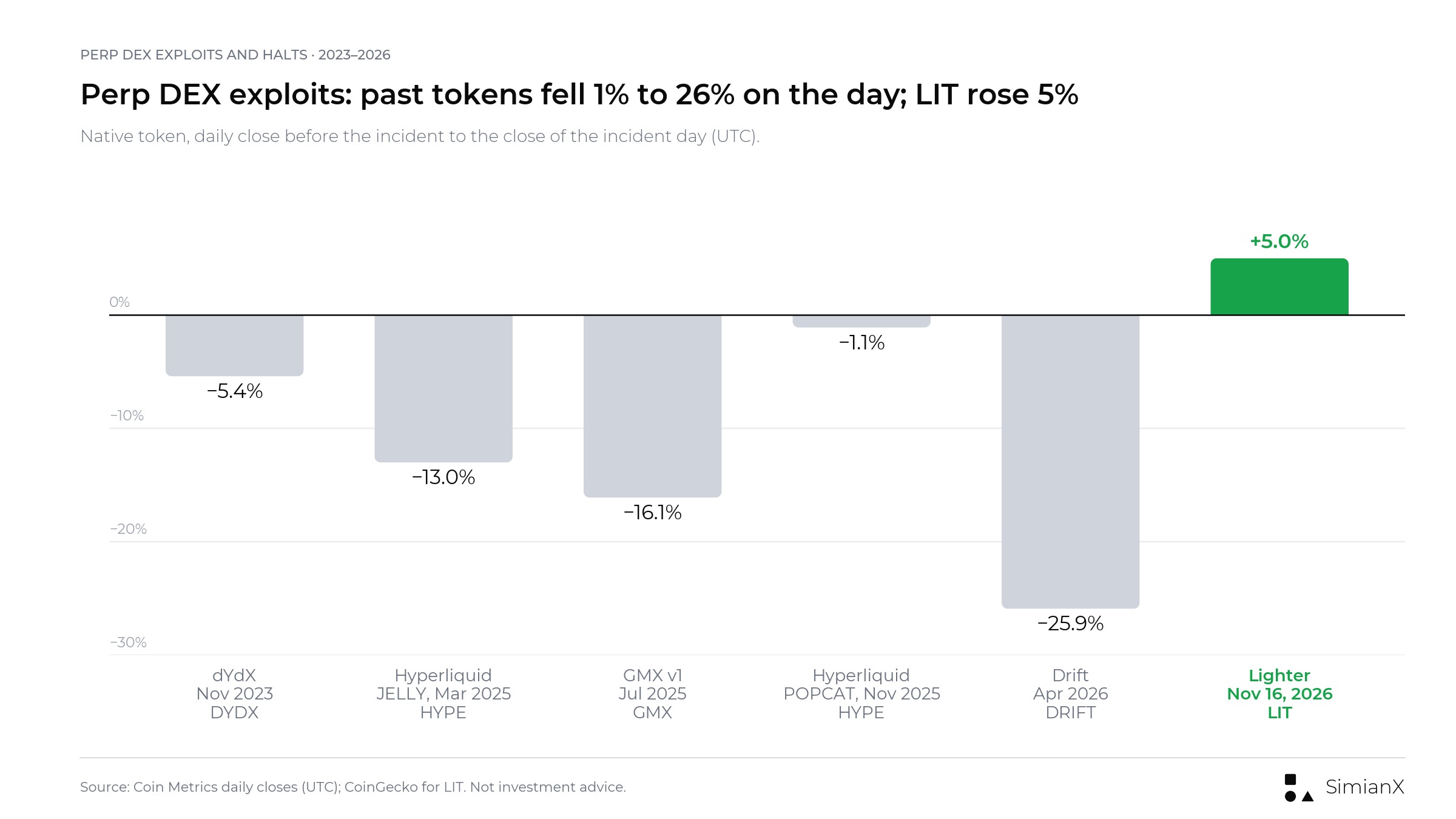
How each past incident unfolded
Mango Markets, October 2022
A trader pushed up the price of the MNGO token on the thin markets that fed Mango's oracle, then borrowed against the inflated collateral and emptied the lending pools. The Block reported a loss of more than $100 million, and CoinDesk reported four days later that the trader had identified himself and returned most of the money. It remains the clearest case of oracle manipulation on a perp venue. No reliable daily price series for MNGO from that period was available to us, so the token cells are empty.
dYdX and YFI, November 2023
dYdX v3 lost about $9 million from its insurance fund when the YFI market was pushed up and then collapsed. dYdX called it a "targeted attack" and published a post-mortem that dates the crash to about 05:00 UTC on November 18. Nothing was halted. DYDX fell 5.4% on the day and was 5.1% above its pre-incident close a week later.
Hyperliquid and JELLY, March 2025
A large JELLYJELLY short, a thinly traded memecoin, ended up inside Hyperliquid's HLP vault as the token's price was driven up. Lookonchain put HLP's unrealized loss at about $12 million at the peak. Citing "suspicious market activity," validators voted to delist the market; Hyperliquid said HLP ended the 24 hours about $700,000 in profit and that users would be made whole, as The Block reported. Withdrawals stayed open. HYPE still fell 13.0% that day and was 16.9% lower after a week.
KiloEx, April 2025
An attacker abused an access-control flaw in KiloEx's price oracle to open positions at fake prices and close them at real ones, across several chains. Halborn put the loss at about $7.5 million; CoinDesk, citing Cyvers, said about $7 million. KiloEx suspended operations and, within four days, said all funds had been returned in exchange for a 10% bounty. Cointelegraph noted that PeckShield saw about $5.5 million in the return transfers, so the totals do not fully agree.
GMX v1, July 2025
A re-entrancy bug let an attacker drain about $42 million from GMX v1's GLP pool on Arbitrum, per The Block. GMX paused v1 trading and GLP minting and redemption. Two days later the attacker returned about $40.5 million and kept about $5 million as a bounty, as DL News reported. GMX fell 16.1% on the day of the attack and was still 7.7% lower a week later, even after most funds came back.
Hyperliquid and POPCAT, November 2025
Reports describe a large POPCAT position propped up by a buy wall that was then pulled, leaving HLP with a loss that analysts put at about $4.9 million. Hyperliquid has not published a cause. Hyperliquid paused bridge deposits and withdrawals briefly "for maintenance," per The Block and Cointelegraph; reports of the pause length range from about 20 minutes to an hour. HYPE moved little: −1.1% on the day and +0.2% after a week.
Drift, April 2026
Drift, a perp DEX on Solana, said on April 1, 2026 that it was under "an active attack." TRM Labs put the loss at about $285 million and linked it to North Korea, describing social engineering of the protocol's multisig signers and a fake collateral token. Drift suspended deposits and withdrawals. It is the largest perp DEX loss in this table by a wide margin, and the token reaction matched: DRIFT fell 25.9% that day and 61.2% within a week.
Ostium, July 2026
Ostium, a perp DEX on Arbitrum, paused all trading after what it called "an issue with the OLP vault." Blockaid attributed the loss to a compromised oracle signer key and put it at about $18 million; CertiK said about $22 million, per Cointelegraph. Ostium has no listed token, so there is no price reaction to record.
What the table shows
- Withdrawal halts are the exception, not the rule. Of the nine incidents, four involved a pause of deposits or withdrawals (Mango, Hyperliquid POPCAT, Drift and now Lighter), and several of the others paused trading or a single market instead. dYdX and JELLY kept withdrawals open throughout. Lighter's is one of the broadest: all withdrawals, with trading left running.
- The weak point keeps moving off-chain. Mango, dYdX, JELLY and POPCAT were market manipulation; KiloEx and GMX were smart-contract bugs. The 2026 cases are about keys and people: Drift's multisig signers, Ostium's oracle signer key and, if the reports hold, Lighter's market-maker API keys.
- Past tokens fell on the day; LIT did not. The five past cases with a token and daily data fell between 1.1% and 25.9%. LIT dropped more than 9% within minutes on November 16 but closed the day up 5.0%. Among the past cases, the size of the loss and whether it was covered seem to matter more than the headline: HYPE barely moved after POPCAT, but DRIFT kept falling after an unreturned $285 million loss.
- Returned funds did not mean a quick recovery. GMX got most of its $42 million back within two days and was still 7.7% lower after a week.
- Five data points are not a forecast. These cases differ in size, cause and market backdrop. The table records what happened; it does not predict what LIT will do.
Lighter: reaction so far
| Measure | Before | Latest | Change | Source |
|---|---|---|---|---|
| LIT price | $2.833 (Nov 15 daily close, 00:00 UTC) | $2.975 (Nov 16 daily close, 00:00 UTC Nov 17) | +5.0% | CoinGecko |
| LIT intraday low | $2.744 (10:15 UTC) | $2.492 (10:35 UTC) | −9.2% in 20 minutes | CoinGecko 5-minute prices |
| LIT-USDT on OKX | $2.836 (Nov 15 daily close, UTC) | $2.963 (Nov 16 daily close, UTC) | +4.5% | OKX daily candles |
| ETH price | $1,834.5 (Nov 15 daily close) | $1,819.5 (Nov 16 daily close) | −0.8% | CoinGecko |
| Lighter TVL | $759.1M (00:00 UTC Nov 16) | $688.8M (23:50 UTC Nov 16) | −9.3% | DefiLlama |
| Upbit LIT deposits and withdrawals | Open | Suspended at 11:09 UTC; trading caution at 11:30 UTC; still suspended at 00:25 UTC Nov 17 | n/a | Upbit notices 6782 and 6783 |
| Bithumb LIT deposits and withdrawals | Open | Disabled at 11:58 UTC; still disabled at 00:25 UTC Nov 17 | n/a | Bithumb public API; reported by PANews and TechFlow |
LIT's day had two halves. It fell 9.2% in 20 minutes before Lighter's first post and was still 7.9% below the previous close at 11:55 UTC, then recovered to close the UTC day up 5.0% on CoinGecko and 4.5% on OKX. Reported intraday moves differ by source and window: CryptoBriefing reported a fall of 7% to 13% within a day, which fits the CoinGecko data above depending on the starting point. ETH ended the day down 0.8%.
How we built this page
- Lighter facts come from Lighter's X post (time taken from the post ID; wording as quoted by CryptoBriefing), Upbit's two notices read directly through Upbit's announcement API, Bithumb's public asset-status API, Lighter's status page, DefiLlama, and news coverage from CryptoBriefing, TokenPost, PANews, ChainCatcher, TechFlow, Bloomingbit and The Defiant. ChainCatcher's time stamp is read as Beijing time (UTC+8).
- The $15.48 million loss is reported, not confirmed. It traces to on-chain researchers (0xTria, Onchain Lens) and news outlets, not to Lighter or a named security firm.
- Historical rows use the protocol's post-mortem where we could open it (dYdX), security-firm reports (Halborn, TRM Labs) and major outlets (The Block, CoinDesk, Cointelegraph, DL News). Where figures differ, we show the range.
- Rows we dropped: Level Finance (May 2023, about $1M referral-contract bug), because we could not open a primary or major-outlet report; Lighter's December 2025 withdrawal delays after the LIT launch, because the reports were thin and there was no token baseline; Hyperliquid's March 2025 ETH whale loss, which Hyperliquid said was not an exploit and which involved no halt; and two small 2026 incidents we could not confirm as perp-DEX exploits from more than one source.
- What we have not done: we have not guessed at the identity of the compromised party, the final loss, or when pool creation will reopen.
FAQ
Can I withdraw from Lighter right now?
Yes, according to Lighter. In an update on X at about 1:20 p.m. ET (10:20 a.m. PT, 18:20 UTC) on Monday, November 16, 2026, Lighter said it had switched off Guardian mode, that withdrawals had resumed and that pending withdrawal requests were being processed. That came about seven hours after its first post, at about 6:02 a.m. ET (11:02 UTC), which suspended all withdrawals and new pool creation. The update did not say whether new pool creation had reopened; it said transfers into public pools now require a wallet signature. Lighter's status page showed "All services are online" throughout, so check Lighter's X account rather than the status page. Separately, Upbit and Bithumb still had LIT deposits and withdrawals suspended at 7:25 p.m. ET (4:25 p.m. PT) on November 16 (00:25 UTC on November 17).
Was Lighter hacked?
Lighter says its protocol was not hacked. Its first post said the incident "appears to involve a single compromised external party"; its 12:49 UTC update said the incident "was caused by a leaked API key for a specific trader's account"; and its 18:20 UTC update said the affected accounts' own signing code, outside Lighter's official SDKs, reused nonces, which let the attacker derive their API private keys from public signatures. Lighter says its protocol, smart contracts, infrastructure and official SDKs were unaffected. On-chain researchers report that two market-maker accounts lost about $15.48 million, while Bitquery traced about $10.4 million leaving Lighter's Ethereum contract. Lighter has not confirmed either amount, and as of 00:25 UTC on November 17 we had seen no figure from a named security firm.
How much was stolen from Lighter?
The figure in circulation is about $15.48 million in USDC: about $10.39 million from account 714710 and about $5.09 million from account 714723, as reported by CryptoBriefing and TokenPost and traced to research shared by on-chain analyst 0xTria. Onchain Lens puts it at about $15.5 million. Lighter has not published a loss figure; the only amount it has given is about 5 million USDC that its Security Council returned to the affected trader.
Why did Upbit and Bithumb suspend LIT?
Upbit's notice says it suspended LIT deposits and withdrawals on the Ethereum network as a user-protection step after signs of a security incident, until it can confirm the network is stable. It later added a trading caution warning that LIT's volatility may rise. Bithumb's suspension is reported by PANews and TechFlow. We could not open Bithumb's notice page, but its public asset-status API showed LIT deposits and withdrawals disabled at 11:58 UTC.
What is the biggest perp DEX exploit?
By loss, the Drift exploit of April 1, 2026, at about $285 million per TRM Labs, is the largest in our table, followed by Mango Markets in October 2022 at about $114 million. Both lost far more than the roughly $15.5 million reported at Lighter. For centralized exchange thefts, which run into the billions, see our ranked table of crypto exchange hacks.
Do perp DEX tokens recover after an exploit?
Not reliably. In the five past cases with a token and daily data, the token fell between 1.1% and 25.9% on the day of the incident. A week later, two were back above their pre-incident close (DYDX after the YFI attack and HYPE after POPCAT) and three were lower, led by DRIFT at −61.2%. LIT broke the day-one pattern: it closed November 16 up 5.0%, and its 7-day figure is due after the November 22 close. Six cases are too few for a rule, and the table shows what happened, not what will happen.
Is Lighter's TVL falling?
DefiLlama showed Lighter's total value locked at about $759 million at the start of November 16 (UTC), about $743 million at 10:35 UTC, before Lighter's announcement, and about $689 million at 23:50 UTC, after withdrawals had reopened. DefiLlama's figure does not show how much of the drop came from withdrawals and how much from other changes.
Related Reading
- Biggest Crypto Exchange Hacks: Every Major Theft, Ranked
- Every Major Stablecoin Depeg: A Complete Reference Table
- Crypto Liquidations, Funding & OI: Biggest Wipeouts Ranked
- Ethereum Price by Year: Every Year 2015–2026 Returns Table
- Bitcoin Returns by Year: Every Year 2011–2026 Table
Want to follow how LIT trades after the withdrawal halt? Start a live AI analysis on SimianX, compare models on the SimianX crypto leaderboard, or browse more market reference stories.
This page is for information only and is not investment advice. Lighter facts are as of 4:25 p.m. PT (7:25 p.m. ET) on Monday, November 16, 2026 (00:25 UTC, November 17); LIT prices are daily closes through November 16 (UTC). We will add the 7-day LIT figure after the November 22 close and update the page as Lighter and investigators publish more.
References
- Lighter: Lighter on X, Lighter status page, DefiLlama: Lighter, CryptoBriefing: Lighter suspends withdrawals, CryptoBriefing: Lighter halts withdrawals, CryptoBriefing: suspected $15.48M drain, TokenPost, PANews, The Defiant, ChainCatcher (accounts), ChainCatcher (Onchain Lens), TechFlow (Lookonchain), Bloomingbit, Lighter on X: 12:49 UTC update, CoinDesk, Cointelegraph, Unchained, Lighter on X: 18:20 UTC update, PANews: withdrawals resumed, TokenPost: withdrawals restored
- Exchanges: Upbit notice 6782, Upbit notice 6783, PANews: Upbit and Bithumb, Bithumb asset status
- Mango Markets: The Block, CoinDesk
- dYdX: dYdX post-mortem, The Block
- Hyperliquid: The Block: JELLY, The Block: POPCAT, Cointelegraph: POPCAT
- KiloEx: Halborn, CoinDesk, Cointelegraph
- GMX: The Block, DL News
- Drift: TRM Labs, Decrypt
- Ostium: Cointelegraph
- Prices: Coin Metrics community data, CoinGecko: Lighter, CoW Protocol