
 By Marcus Reeve
November 2026 US market calendar: Fed, CPI, jobs report and earnings dates with local times
Updated Friday, October 23, 2026. Next full refresh: Monday, November 30, 2026 (for December 2026), with a weekly check of every date in between.
Key U.S. market events in November 2026
>
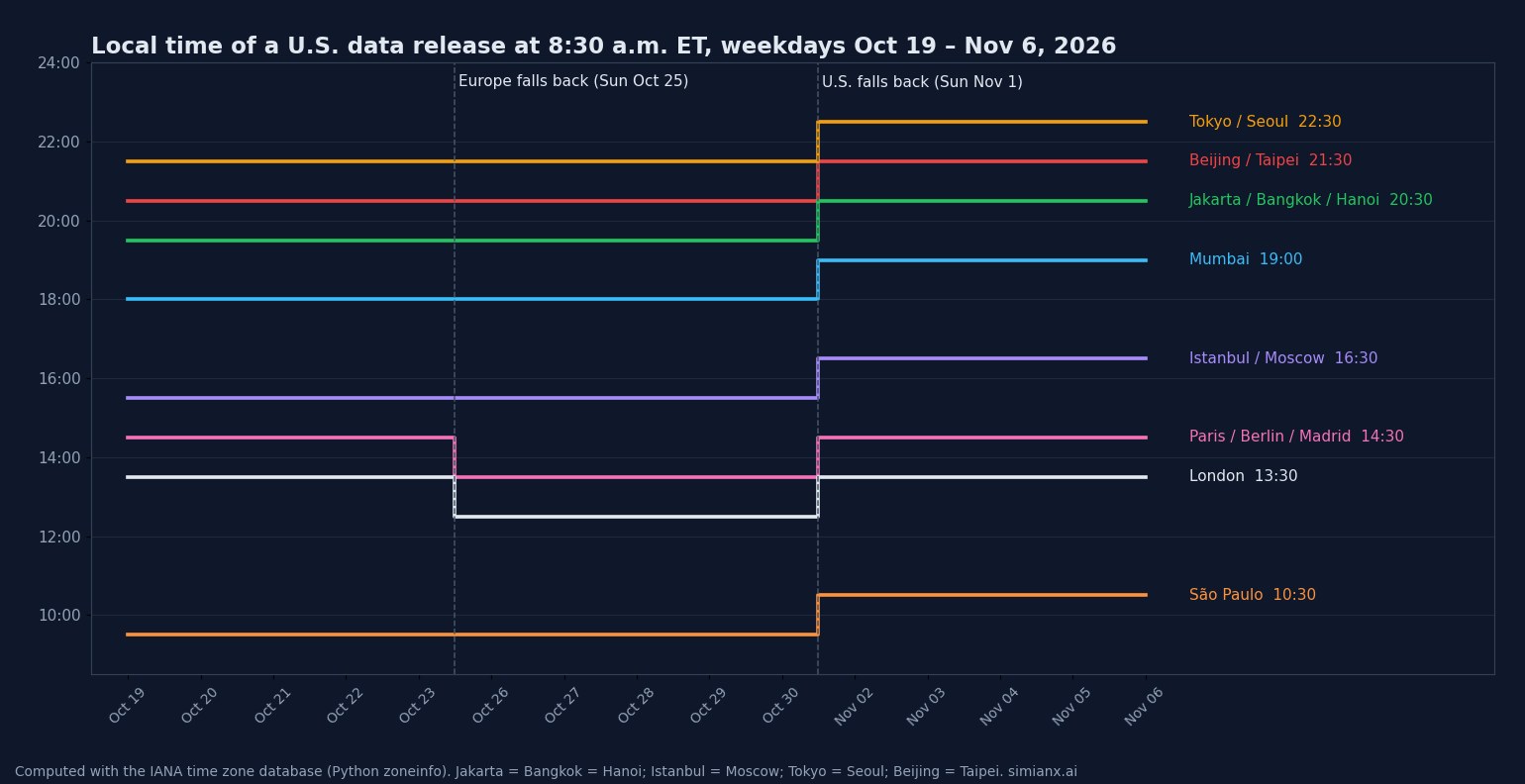
- Sun, Nov 1: U.S. daylight saving time ends (2:00 a.m. clocks go back one hour). From Monday, November 2, data released at 8:30 a.m. ET arrive at 13:30 UTC (12:30 UTC before the change)
- Tue, Nov 3: U.S. midterm elections (stock and bond markets open as usual)
- Fri, Nov 6: Jobs report: nonfarm payrolls and unemployment rate (October), 8:30 a.m. ET (13:30 UTC)
- Tue, Nov 10: CPI inflation report (October data), 8:30 a.m. ET (13:30 UTC)
- Wed, Nov 18: FOMC minutes (October meeting), 2:00 p.m. ET (19:00 UTC)
- Wed, Nov 18: Nvidia earnings, after the close (date expected, not yet confirmed by Nvidia), 4:00 p.m. ET (21:00 UTC)
- Wed, Nov 25: PCE inflation and consumer spending (October data), 8:30 a.m. ET (13:30 UTC)
- Thu, Nov 26: Thanksgiving Day: NYSE and Nasdaq closed
- Fri, Nov 27: Day after Thanksgiving: stocks close early, 1:00 p.m. ET (18:00 UTC)
- Crypto: Deribit's monthly BTC and ETH options expire on Fri, Nov 27 at 08:00 UTC; Binance, OKX and Bybit settle BTC and ETH funding every 8 hours at 00:00, 08:00 and 16:00 UTC.
- Lunar and astro: Mercury is retrograde from Sat, Oct 24 to Fri, Nov 13; full moon Tue, Nov 24; new moon Mon, Nov 9.
>
Still to come in October: Wed, Oct 28 Fed (FOMC) interest rate decision, 18:00 UTC; Wed, Oct 28 Alphabet and Microsoft earnings, after the close (calls 4:30 and 5:30 p.m. ET), 20:30 UTC; Thu, Oct 29 GDP, advance estimate (Q3 2026), 12:30 UTC; Thu, Oct 29 PCE inflation and consumer spending (September data), 12:30 UTC.
This is a monthly U.S. market calendar on one permanent page. Every scheduled event that tends to move U.S. stocks, bonds and the dollar in November 2026 is listed with its official release time in U.S. Eastern time (ET) and the same moment in your own time zone, so you never have to convert "8:30 a.m. ET" in your head. The English page shows UTC next to ET; each translated version shows its own zone (Beijing, Tokyo, Seoul, Jakarta, Mumbai, Istanbul, São Paulo and so on). Each date was checked against the agency that publishes the data: the Bureau of Labor Statistics, the Bureau of Economic Analysis, the Federal Reserve, the Census Bureau, ISM, the University of Michigan, the Treasury and the NYSE.
What this page does not do: it does not print forecasts or live "actual vs consensus" numbers. Live economic calendars are better for minute-by-minute results on the day. Use this page to plan the month, then open our always-updated pages for each report — the Fed decision page, the CPI page, the jobs report page and the PCE page — for the latest numbers and how markets reacted to every past release.
Rest of October: what is left before the month turns
| Date | Time (ET) | Event | UTC |
|---|---|---|---|
| Sun, Oct 25 | — | Europe ends summer time (clocks go back one hour) | London, Paris and Berlin move one hour back a week before the U.S.: from October 26 to 30, 8:30 a.m. ET is 12:30 in London |
| Wed, Oct 28 | 2:00 p.m. | Fed (FOMC) interest rate decision | 18:00 UTC |
| Wed, Oct 28 | 2:30 p.m. | Fed chair press conference | 18:30 UTC |
| Wed, Oct 28 | 4:30 p.m. | Alphabet and Microsoft earnings, after the close (calls 4:30 and 5:30 p.m. ET) | 20:30 UTC |
| Thu, Oct 29 | 8:30 a.m. | GDP, advance estimate (Q3 2026) | 12:30 UTC |
| Thu, Oct 29 | 8:30 a.m. | PCE inflation and consumer spending (September data) | 12:30 UTC |
| Thu, Oct 29 | 8:30 a.m. | Initial jobless claims (weekly) | 12:30 UTC |
| Thu, Oct 29 | 5:00 p.m. | Amazon earnings, after the close (call 5:00 p.m. ET) | 21:00 UTC |
| Fri, Oct 30 | 8:30 a.m. | Employment Cost Index (Q3 2026) | 12:30 UTC |
The Fed decision on October 28 comes in the middle of the busiest week of the earnings season: Microsoft and Alphabet report the same evening, Amazon the next evening, hours after the first estimate of third-quarter GDP and the September PCE inflation data come out that morning. Our Magnificent 7 earnings tracker has every confirmed date and each company's last five quarters.
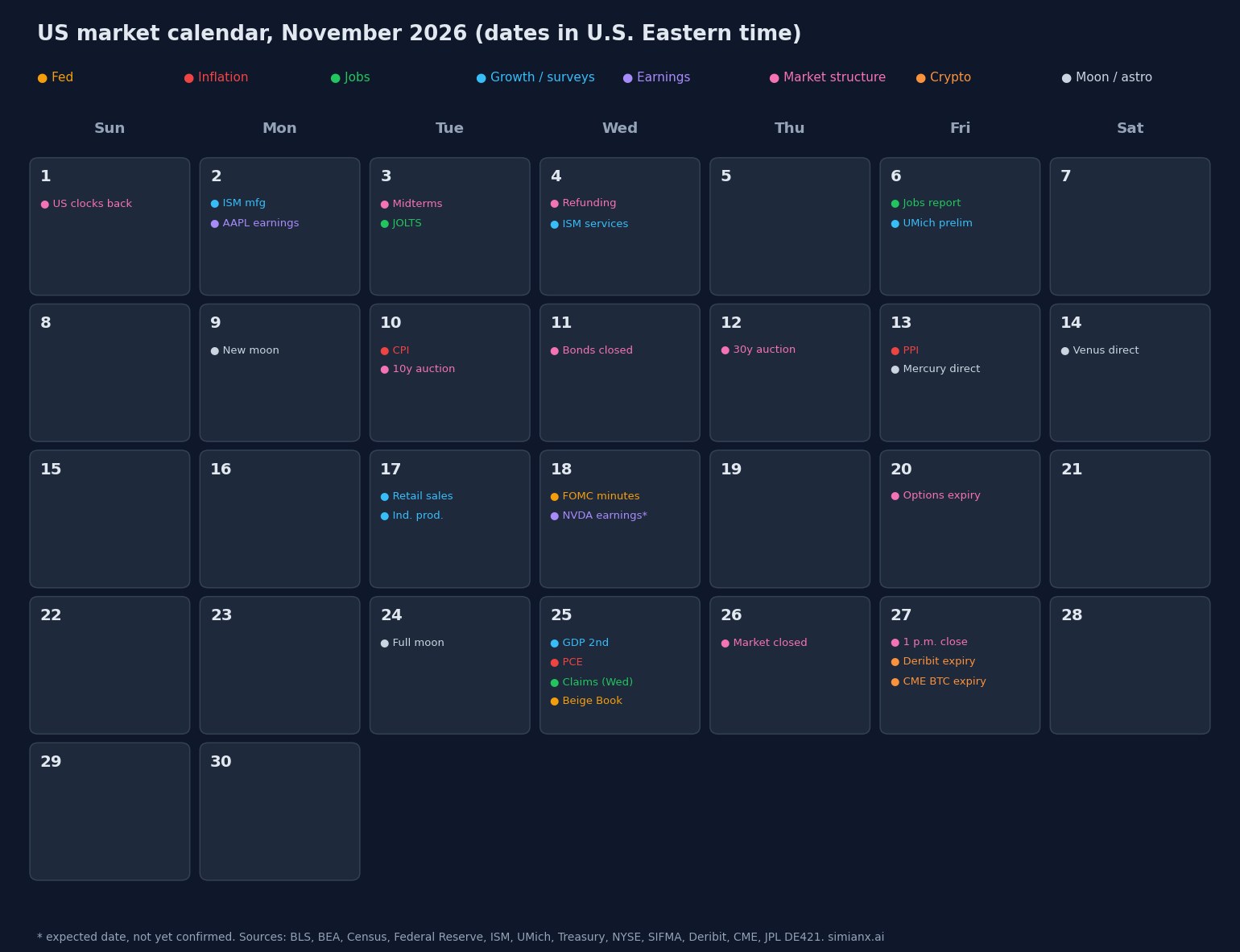
US economic calendar November 2026: full table with local times
All times are the official release times. "After the close" earnings come out shortly after the 4:00 p.m. ET stock market close; the time shown is the start of the conference call. Click an event for our page with its history and latest data.
| Date | Time (ET) | Event | UTC |
|---|---|---|---|
| Sun, Nov 1 | 2:00 a.m. | U.S. daylight saving time ends (2:00 a.m. clocks go back one hour) | From Monday, November 2, data released at 8:30 a.m. ET arrive at 13:30 UTC (12:30 UTC before the change) |
| Mon, Nov 2 | 10:00 a.m. | ISM manufacturing PMI (October) | 15:00 UTC |
| Mon, Nov 2 | 5:00 p.m. | Apple earnings, after the close (call 5:00 p.m. ET) | 22:00 UTC |
| Tue, Nov 3 | All day | U.S. midterm elections (stock and bond markets open as usual) | — |
| Tue, Nov 3 | 10:00 a.m. | JOLTS job openings (September) | 15:00 UTC |
| Wed, Nov 4 | 8:30 a.m. | Treasury quarterly refunding announcement | 13:30 UTC |
| Wed, Nov 4 | 10:00 a.m. | ISM services PMI (October) | 15:00 UTC |
| Fri, Nov 6 | 8:30 a.m. | Jobs report: nonfarm payrolls and unemployment rate (October) | 13:30 UTC |
| Fri, Nov 6 | 10:00 a.m. | University of Michigan consumer sentiment, preliminary (November) | 15:00 UTC |
| Mon, Nov 9 | 1:00 p.m. | 3-year Treasury note auction | 18:00 UTC |
| Tue, Nov 10 | 8:30 a.m. | CPI inflation report (October data) | 13:30 UTC |
| Tue, Nov 10 | 1:00 p.m. | 10-year Treasury note auction | 18:00 UTC |
| Wed, Nov 11 | All day | Veterans Day: stock market open, bond market closed | — |
| Thu, Nov 12 | 1:00 p.m. | 30-year Treasury bond auction | 18:00 UTC |
| Fri, Nov 13 | 8:30 a.m. | PPI producer prices (October) | 13:30 UTC |
| Tue, Nov 17 | 8:30 a.m. | Retail sales (October) | 13:30 UTC |
| Tue, Nov 17 | 9:15 a.m. | Industrial production (October) | 14:15 UTC |
| Wed, Nov 18 | 2:00 p.m. | FOMC minutes (October meeting) | 19:00 UTC |
| Wed, Nov 18 | 4:00 p.m. (expected) | Nvidia earnings, after the close (date expected, not yet confirmed by Nvidia) | 21:00 UTC |
| Fri, Nov 20 | 9:30 a.m. | Monthly options expiration (third Friday; SPX AM settlement at the open) | 14:30 UTC |
| Wed, Nov 25 | 8:30 a.m. | GDP, second estimate (Q3 2026) | 13:30 UTC |
| Wed, Nov 25 | 8:30 a.m. | PCE inflation and consumer spending (October data) | 13:30 UTC |
| Wed, Nov 25 | 8:30 a.m. | Initial jobless claims (moved to Wednesday for Thanksgiving) | 13:30 UTC |
| Wed, Nov 25 | 2:00 p.m. | Fed Beige Book | 19:00 UTC |
| Thu, Nov 26 | All day | Thanksgiving Day: NYSE and Nasdaq closed | — |
| Fri, Nov 27 | 1:00 p.m. | Day after Thanksgiving: stocks close early | 18:00 UTC |
| Fri, Nov 27 | 2:00 p.m. | Bond market early close (SIFMA recommendation) | 19:00 UTC |
Weekly: Initial jobless claims, every Thursday at 8:30 a.m. ET in November (Wednesday in Thanksgiving week): Thu, Nov 5 · Thu, Nov 12 · Thu, Nov 19 · Wed, Nov 25 → 13:30 UTC
Three things make this month unusual. First, U.S. clocks go back one hour on Sunday, November 1, so every U.S. release lands one hour later in Asia, India, Turkey, Russia and Brazil from November 2 (Europe already moved on October 25) — our US market hours in your time zone page has the full trading-session table. Second, the U.S. midterm elections on Tuesday, November 3 fall in the same week as the jobs report and the Treasury's quarterly refunding; see how the S&P 500 behaved after every midterm election since 1950. Third, Thanksgiving compresses the end of the month: GDP, PCE, jobless claims and the Beige Book all arrive on Wednesday, November 25, the market is closed on Thursday and closes early on Friday. Our Thanksgiving week stock market table shows how that week has gone every year since 1950.
Coming up next month
| Date | Time (ET) | Event | UTC |
|---|---|---|---|
| Fri, Dec 4 | 8:30 a.m. | Jobs report: nonfarm payrolls and unemployment rate (November) | 13:30 UTC |
| Wed, Dec 9 | 2:00 p.m. | Fed (FOMC) rate decision with new dot plot | 19:00 UTC |
| Thu, Dec 10 | 8:30 a.m. | CPI inflation report (November data) | 13:30 UTC |
| Fri, Dec 18 | 9:30 a.m. | Quarterly options expiration (“quad witching”) | 14:30 UTC |
| Thu, Dec 24 | 1:00 p.m. | Christmas Eve: stocks close early | 18:00 UTC |
December's meeting is the last of 2026 and comes with a new set of Fed projections; our dot plot history shows how past projections compared with what the Fed actually did, and the FOMC 2027 meeting dates page lists next year's schedule. For the trading holidays of 2027, see stock market holidays 2027.
Which releases move markets the most
Not every row in the table matters equally. Three events usually cause the biggest moves in U.S. stocks and two-year Treasury yields (our page for each one tracks the market reaction to every release of the last two years):
- The jobs report (Employment Situation). Released by the BLS at 8:30 a.m. ET, usually on the first Friday of the month. Nonfarm payrolls, the unemployment rate and average hourly earnings arrive together, and revisions to the two previous months often matter as much as the headline. History and the last 24 reports: jobs report page.
- CPI inflation. Also 8:30 a.m. ET from the BLS, around the middle of the month. Core CPI (excluding food and energy) is the number rate markets watch first. See the CPI page.
- The Fed decision. The FOMC statement is published at 2:00 p.m. ET on the second day of the meeting and the chair's press conference starts at 2:30 p.m. The minutes follow three weeks later, also at 2:00 p.m. ET. See the Fed decision page.
The second tier: PCE inflation, the Fed's preferred inflation gauge, published by the BEA together with personal income and spending at 8:30 a.m. ET (PCE page); GDP (advance, second and third estimates, 8:30 a.m. ET); retail sales from the Census Bureau (8:30 a.m. ET); the ISM manufacturing and services surveys (10:00 a.m. ET on the first and third business days); PPI producer prices; and weekly jobless claims every Thursday at 8:30 a.m. ET. University of Michigan consumer sentiment comes twice a month at 10:00 a.m. ET, a preliminary reading and a final one.
Bond-market events matter more than their low profile suggests. The Treasury's quarterly refunding announcement sets the size of the next three months of note and bond sales, and weak demand at a 10-year or 30-year auction (results at about 1:00 p.m. ET) can move yields for the rest of the day.
Market structure dates round out the calendar: monthly options expiration on the third Friday (the S&P 500 index options settle on opening prices that morning), quarterly "quad witching" in March, June, September and December, and the NYSE holiday schedule. Big index moves cluster around these dates as much as around data; our VIX spike history lists every volatility shock since 1990.
Why the local times shift twice a year
U.S. release times are fixed in Eastern time, which itself moves: daylight saving time starts on the second Sunday of March and ends on the first Sunday of November. Most of Asia, India, the Gulf, Turkey, Russia and Brazil do not change their clocks, so a U.S. release at 8:30 a.m. ET arrives one hour later there from November to March. Europe changes its clocks too, but on different Sundays (the last Sunday of March and of October), which creates "gap weeks" in late March and late October/early November when the usual difference between New York and London, Paris or Berlin is one hour shorter.
That is why every local time on this page is calculated for its own date with the official time zone database instead of a fixed "ET plus N hours" rule. In November 2026 the only shift is the U.S. change on November 1; Europe moved one week earlier. The next changes are on March 14, 2027 (United States) and March 28, 2027 (Europe).
Crypto calendar: funding times, options and futures expiries
Crypto trades around the clock, but it also has a fixed schedule. Perpetual futures pay funding between longs and shorts at set times: on Binance, OKX and Bybit the BTC and ETH perpetuals settle every 8 hours at 00:00, 08:00 and 16:00 UTC (checked against each exchange's public API on October 23, 2026). Many smaller contracts settle every 4 hours, and a few every hour — 465 of the 810 contracts in Binance's funding-interval list were on a 4-hour cycle — and exchanges can change a contract's interval when funding hits its cap, so check the contract page before relying on a time. Monthly and quarterly options expiries on Deribit, the largest crypto options venue, fall on the last Friday of the month at 08:00 UTC, and CME Bitcoin futures stop trading at 4:00 p.m. London time on the last Friday of the contract month.
| When (UTC) | U.S. Eastern time | Event |
|---|---|---|
| Every day 00:00 · 08:00 · 16:00 | 7:00 p.m. ET · 3:00 a.m. ET · 11:00 a.m. ET | Perpetual futures funding: Binance, OKX and Bybit BTC and ETH contracts settle every 8 hours |
| Fri, Oct 30 08:00 | Fri, Oct 30, 4:00 a.m. ET | Deribit monthly BTC and ETH options expiry (October contracts) |
| Fri, Oct 30 16:00 | Fri, Oct 30, 12:00 p.m. ET | CME Bitcoin futures last trading day (October contract, 4:00 p.m. London time) |
| Fri, Nov 6 08:00 | Fri, Nov 6, 3:00 a.m. ET | Deribit weekly options expiry (every Friday at 08:00 UTC) |
| Fri, Nov 27 08:00 | Fri, Nov 27, 3:00 a.m. ET | Deribit monthly BTC and ETH options expiry (November contracts) |
| Fri, Nov 27 16:00 | Fri, Nov 27, 11:00 a.m. ET | CME Bitcoin futures last trading day (November contract, 4:00 p.m. London time) |
| Fri, Dec 25 08:00 | Fri, Dec 25, 3:00 a.m. ET | Deribit quarterly BTC and ETH options and futures expiry (December) |
We list token unlocks only when the project publishes a schedule we can check at the source; none is listed this month. For how funding rates, open interest and liquidations feed into risk signals, see our crypto leverage radar, and for how AI models trade these markets live, the SimianX crypto leaderboard.
Lunar and astro calendar (for traders who follow it)
Some traders track the moon's phases, planetary "retrograde" periods and the Chinese solar terms alongside the economic calendar. We list these events because readers ask for them, not because they predict prices: the positions below are astronomical facts, and we make no claim about their effect on markets. Moon phases are computed with JPL's DE421 ephemeris and match the U.S. Naval Observatory to the minute; planet stations and aspects use geocentric ecliptic longitudes (Mercury's dates match JPL Horizons); solar terms and lunar dates follow the Hong Kong Observatory calendar.
| When (UTC) | U.S. Eastern time | Event | Position |
|---|---|---|---|
| Sat, Oct 24 03:44 | Fri, Oct 23, 11:44 p.m. ET | Venus inferior conjunction (passes between Earth and the Sun) | Scorpio 0°45′ |
| Sat, Oct 24 07:13 | Sat, Oct 24, 3:13 a.m. ET | Mercury stations retrograde | Scorpio 20°59′ |
| Mon, Oct 26 04:12 | Mon, Oct 26, 12:12 a.m. ET | Full moon | Moon in Taurus |
| Fri, Oct 30 17:20 | Fri, Oct 30, 1:20 p.m. ET | Mercury square Mars | Scorpio 17°59′ / Leo 17°59′ |
| Sun, Nov 1 20:28 | Sun, Nov 1, 3:28 p.m. ET | Last quarter moon | Moon in Leo |
| Wed, Nov 4 14:24 | Wed, Nov 4, 9:24 a.m. ET | Mercury inferior conjunction (passes between Earth and the Sun) | Scorpio 12°11′ |
| Sat, Nov 7 09:52 | Sat, Nov 7, 4:52 a.m. ET | Chinese solar term: Start of Winter (Lidong) | Sun at 225° |
| Mon, Nov 9 07:02 | Mon, Nov 9, 2:02 a.m. ET | New moon | Moon in Scorpio; Start of the 10th lunar month (Chinese calendar) |
| Fri, Nov 13 15:54 | Fri, Nov 13, 10:54 a.m. ET | Mercury stations direct | Scorpio 5°02′ |
| Sat, Nov 14 00:27 | Fri, Nov 13, 7:27 p.m. ET | Venus stations direct | Libra 22°52′ |
| Mon, Nov 16 06:24 | Mon, Nov 16, 1:24 a.m. ET | Mars conjunct Jupiter | Leo 25°53′ / Leo 25°53′ |
| Tue, Nov 17 11:48 | Tue, Nov 17, 6:48 a.m. ET | First quarter moon | Moon in Aquarius |
| Sun, Nov 22 07:23 | Sun, Nov 22, 2:23 a.m. ET | Chinese solar term: Minor Snow (Xiaoxue) | Sun at 240° |
| Tue, Nov 24 14:53 | Tue, Nov 24, 9:53 a.m. ET | Full moon | Moon in Gemini |
| Wed, Nov 25 22:41 | Wed, Nov 25, 5:41 p.m. ET | Sun opposite Uranus (Uranus at opposition) | Sagittarius 3°40′ / Gemini 3°40′ |
Retrograde at the start of November: Mercury (until Fri, Nov 13), Venus (until Sat, Nov 14), Saturn (all month), Uranus (all month), Neptune (all month). There are no solar or lunar eclipses in November 2026. Whether Mercury retrograde actually lines up with weaker stocks is tested against S&P 500 history in our Mercury retrograde study.
"Retrograde" means a planet appears to move backwards against the stars as seen from Earth; a "station" is the day it appears to stand still before changing direction. A conjunction, square or opposition means two bodies are 0°, 90° or 180° apart in ecliptic longitude. The 24 solar terms divide the sun's yearly path into 15° steps and are still used in Chinese, Korean, Japanese and Vietnamese calendars; the Chinese lunar month starts on the day of the new moon (Beijing time).
How this page is updated
This page keeps the same address every month. It is fully refreshed on the last business day of each month for the following month, and every date is re-checked once a week, so a rescheduled release or a newly announced earnings date appears within days. Each refresh re-downloads the official schedules (BLS, BEA, Census, Federal Reserve, Treasury, NYSE, SIFMA, University of Michigan, the U.S. Department of Labor and the exchanges' public data), recomputes every local time with the time zone database and recalculates the astronomical events. Dates a company or agency has not yet confirmed are marked "expected".
Nothing on this page is investment advice. Release dates can change at short notice, for example during a U.S. government shutdown, when agencies postpone their reports.
FAQ
What are the key US economic events in November 2026?
The biggest scheduled U.S. events in November 2026 are: Fri, Nov 6: Jobs report: nonfarm payrolls and unemployment rate (October); Tue, Nov 10: CPI inflation report (October data); Wed, Nov 18: FOMC minutes (October meeting); Wed, Nov 18: Nvidia earnings, after the close (date expected, not yet confirmed by Nvidia); Wed, Nov 25: PCE inflation and consumer spending (October data); Fri, Nov 27: Day after Thanksgiving: stocks close early.
What time are US economic data released?
Most U.S. economic data come out at 8:30 a.m. Eastern time. That is 13:30 UTC while the U.S. is on standard time (early November to mid-March) and 12:30 UTC during U.S. daylight saving time. ISM surveys and JOLTS come at 10:00 a.m. ET and Fed decisions at 2:00 p.m. ET (19:00 UTC in winter, 18:00 UTC in summer).
When is the next Fed meeting?
The next Fed rate decision is on Wed, Dec 9 at 2:00 p.m. ET (19:00 UTC), with a new dot plot. The minutes of the October meeting come out on Wed, Nov 18 at 2:00 p.m. ET.
Is the US stock market open on Thanksgiving and Veterans Day?
Not on Thanksgiving: U.S. stock exchanges are closed on Thu, Nov 26 for Thanksgiving and close early at 1:00 p.m. ET (18:00 UTC) on Fri, Nov 27. On Veterans Day (Wed, Nov 11) stocks trade normally but the bond market is closed.
When is Mercury retrograde?
Mercury stations retrograde on Sat, Oct 24 and stations direct on Fri, Nov 13 (in U.S. Eastern time: Sat, Oct 24, 3:13 a.m. ET and Fri, Nov 13, 10:54 a.m. ET).
When do Bitcoin options expire this month?
Deribit's monthly BTC and ETH options expire on the last Friday of the month at 08:00 UTC: Fri, Nov 27 this month (Fri, Nov 27, 3:00 a.m. ET). The quarterly expiry is on Fri, Dec 25.
Where can I follow the market live while these events happen?
SimianX runs AI analysis of U.S. stocks and crypto in real time: start a live session on any ticker, compare how different AI models trade on the leaderboard, or browse all our reference stories.
Related Reading
- Fed Interest Rate Decision: Latest FOMC Result and History
- US CPI Report: Latest Inflation Data and Release Schedule
- US Jobs Report: Latest Nonfarm Payrolls and Release Schedule
- PCE Inflation Report: Latest Data and Release Schedule
- US Stock Market Hours in Your Time Zone: 2026–2027 Table
- Magnificent 7 Earnings Dates and Results: Q3 2026 Tracker
- Stock Market Holidays 2027: NYSE & Nasdaq Closed Dates
- FOMC Meeting Dates 2027: How the S&P 500 Moves on Fed Days
- Thanksgiving Week Stock Market: S&P 500 Each Year Since 1950
- Stock Market After Midterm Elections: Every Cycle 1950–2026
More calendars and schedules in the Market calendar topic hub, and every story in the SimianX stories library.
References
- BLS — Consumer Price Index release schedule
- BLS — Employment Situation release schedule
- BLS — Producer Price Index release schedule
- BEA — News release schedule 2026
- Federal Reserve — FOMC meeting calendars
- Federal Reserve — November 2026 release calendar (minutes, Beige Book, industrial production)
- Census Bureau — Economic indicator release schedule 2026
- ISM — Report On Business release calendar
- University of Michigan — Surveys of Consumers
- U.S. Department of Labor — Weekly claims release dates
- U.S. Treasury — Quarterly refunding statement, August 5, 2026
- U.S. Treasury — Tentative auction schedule
- NYSE — Holidays and trading hours
- SIFMA — U.S. bond market holiday schedule
- CME Group — Bitcoin futures rulebook, chapter 350
- Deribit — Public API: instruments and expiries
- Binance — Funding rate history and intervals
- OKX — Public funding-rate API
- Bybit — Instruments info API (funding interval)
- U.S. Naval Observatory — Phases of the Moon
- NASA JPL — Horizons ephemeris system
- Hong Kong Observatory — Gregorian-lunar calendar conversion table