
 By Marcus Reeve
What Time Does the US Stock Market Open in Your Country? NYSE and Nasdaq Hours for 2026–2027
Updated October 16, 2026. Every local time on this page is computed for its exact date from the IANA time-zone database, so daylight-saving changes on both sides of the Atlantic are already built in. The page is reviewed before each clock change; the next review is due before March 14, 2027.
US stock market hours: the New York Stock Exchange (NYSE) and Nasdaq hold their regular session from 9:30 a.m. to 4:00 p.m. Eastern Time (ET), Monday to Friday. Pre-market trading runs from 4:00 to 9:30 a.m. ET and after-hours trading from 4:00 to 8:00 p.m. ET, although many brokers offer shorter windows. Next clock change: Sunday, November 1, 2026. U.S. clocks fall back one hour to Eastern Standard Time (UTC−5), so from Monday, November 2 the 9:30 a.m. open lands at 14:30 UTC instead of 13:30 UTC — one hour later on the local clock everywhere that does not change its own clocks that week.
>
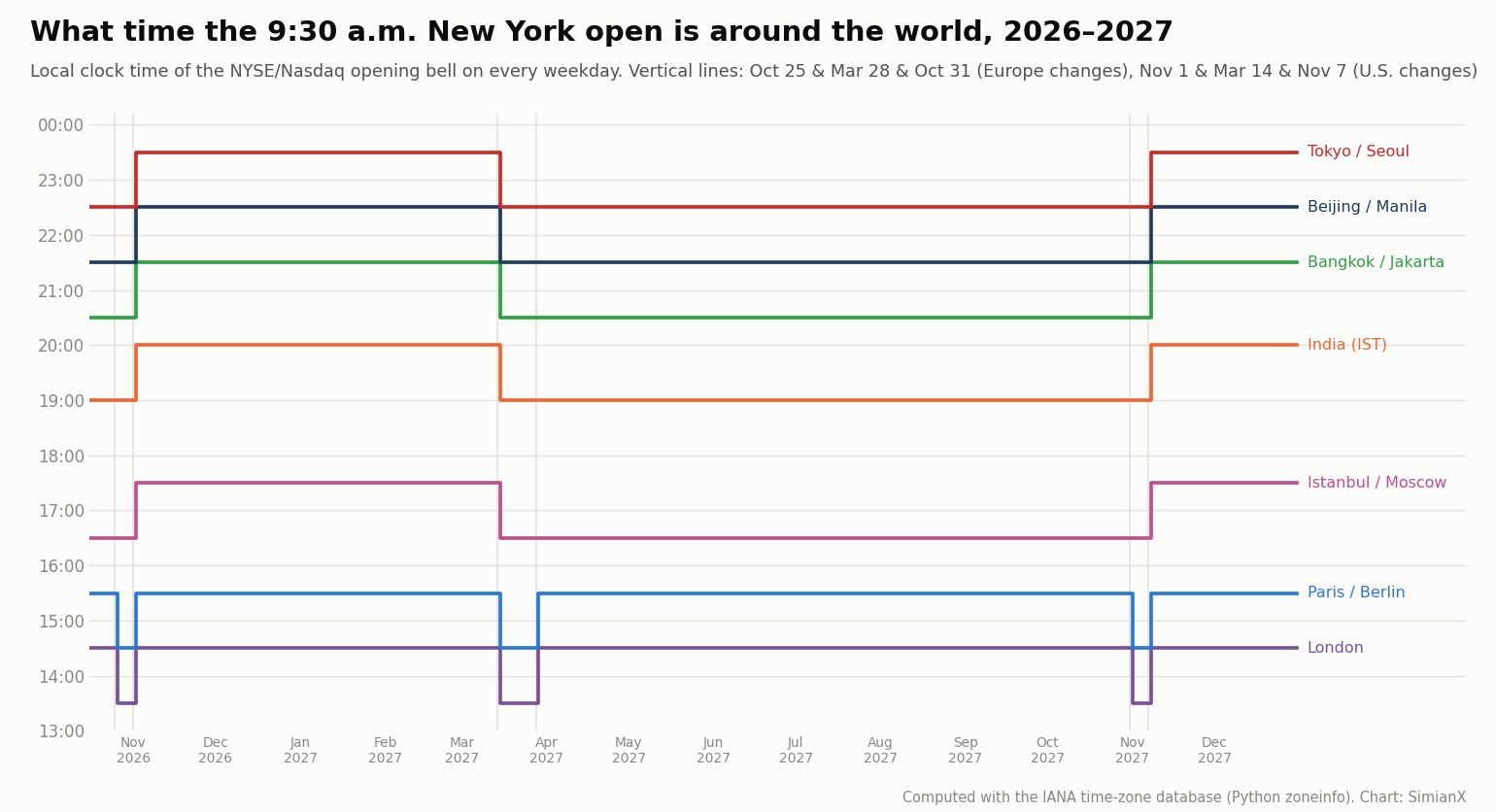
Around the world: in London the regular session runs 2:30 p.m. – 9:00 p.m. until Friday, October 23, 1:30 p.m. – 8:00 p.m. during the October 26–30 gap week and 2:30 p.m. – 9:00 p.m. again from November 2. Until Friday, October 30, 2026 it runs 7:00 p.m. – 1:30 a.m. (+1) in India (IST), 8:30 p.m. – 3:00 a.m. (+1) in Bangkok and Jakarta, and 9:30 p.m. – 4:00 a.m. (+1) in Manila, Singapore and Hong Kong; from Monday, November 2, 2026 it moves one hour later there: 8:00 p.m. – 2:30 a.m. (+1), 9:30 p.m. – 4:00 a.m. (+1) and 10:30 p.m. – 5:00 a.m. (+1).
The question sounds simple, but the answer moves. New York shifts its clocks twice a year, Europe shifts on different Sundays, and most of Asia, India, Turkey, Russia, Brazil and Mexico do not shift at all. That is why the US open can jump from 9:30 p.m. to 10:30 p.m. in Manila overnight, or arrive an hour early in London for one week in late October. This page is the reference we keep for our own trading desk: the official session times, the open and close in every major time zone for each period through the end of 2027, the clock-change calendar and the "gap weeks", the pre-market and after-hours windows, the early-close days, and our own measurements of how much of the day's trading happens in the first and last 30 minutes.
US stock market hours at a glance, 2026–2027
The table below shows the regular session (9:30 a.m. to 4:00 p.m. New York time) for each period between now and the end of 2027. A new row starts whenever New York or the other city changes its clocks.
| Period | New York (ET) | London | India (IST) | Philippines / Singapore |
|---|---|---|---|---|
| Until Oct 24, 2026 (EDT) | 9:30 a.m. – 4:00 p.m. | 2:30 p.m. – 9:00 p.m. | 7:00 p.m. – 1:30 a.m. (+1) | 9:30 p.m. – 4:00 a.m. (+1) |
| Oct 25, 2026 – Oct 31, 2026 (EDT) | 9:30 a.m. – 4:00 p.m. | 1:30 p.m. – 8:00 p.m. | 7:00 p.m. – 1:30 a.m. (+1) | 9:30 p.m. – 4:00 a.m. (+1) |
| Nov 1, 2026 – Mar 13, 2027 (EST) | 9:30 a.m. – 4:00 p.m. | 2:30 p.m. – 9:00 p.m. | 8:00 p.m. – 2:30 a.m. (+1) | 10:30 p.m. – 5:00 a.m. (+1) |
| Mar 14, 2027 – Mar 27, 2027 (EDT) | 9:30 a.m. – 4:00 p.m. | 1:30 p.m. – 8:00 p.m. | 7:00 p.m. – 1:30 a.m. (+1) | 9:30 p.m. – 4:00 a.m. (+1) |
| Mar 28, 2027 – Oct 30, 2027 (EDT) | 9:30 a.m. – 4:00 p.m. | 2:30 p.m. – 9:00 p.m. | 7:00 p.m. – 1:30 a.m. (+1) | 9:30 p.m. – 4:00 a.m. (+1) |
| Oct 31, 2027 – Nov 6, 2027 (EDT) | 9:30 a.m. – 4:00 p.m. | 1:30 p.m. – 8:00 p.m. | 7:00 p.m. – 1:30 a.m. (+1) | 9:30 p.m. – 4:00 a.m. (+1) |
| From Nov 7, 2027 (EST) | 9:30 a.m. – 4:00 p.m. | 2:30 p.m. – 9:00 p.m. | 8:00 p.m. – 2:30 a.m. (+1) | 10:30 p.m. – 5:00 a.m. (+1) |
(+1) = the next calendar day in that city. Weekends are always closed, and so are the U.S. market holidays listed further down.
The trading sessions in New York time
U.S. stock exchanges run several sessions around the core trading day. The regular session is when the official opening and closing auctions set the prices you see quoted as the day's open and close, and it is when almost all volume trades.
| Session | Hours (ET) | Where it runs |
|---|---|---|
| Pre-market (early trading) | 4:00 a.m. – 9:30 a.m. | Nasdaq and NYSE Arca from 4:00 a.m.; NYSE American, NYSE National, NYSE Texas and NYSE (Tapes B and C) from 7:00 a.m.; NYSE-listed (Tape A) orders queue from 6:30 a.m. for the opening auction |
| Regular session | 9:30 a.m. – 4:00 p.m. | All NYSE markets and the Nasdaq Stock Market, with an opening auction at 9:30 a.m. and a closing auction at 4:00 p.m. |
| After-hours (late trading) | 4:00 p.m. – 8:00 p.m. | Nasdaq, NYSE Arca, NYSE American, NYSE National and NYSE Texas; the NYSE itself has no late session |
| Early-close days | 9:30 a.m. – 1:00 p.m. | Regular session ends at 1:00 p.m.; the late sessions on NYSE Arca, NYSE American, NYSE National and NYSE Texas end at 5:00 p.m. instead of 8:00 p.m. |
| Planned overnight session | 9:00 p.m. – 4:00 a.m. | Nasdaq and NYSE Arca, targeted to start on Sunday, December 6, 2026, subject to regulatory approval |
"ET" means New York local time. It is Eastern Daylight Time (EDT, UTC−4) from the second Sunday in March to the first Sunday in November, and Eastern Standard Time (EST, UTC−5) for the rest of the year, as set by U.S. law and published by NIST. The exchange hours themselves never change: the opening bell is always 9:30 a.m. in New York. What changes is how that moment maps onto your own clock.
Extended-hours trading works differently from the regular session. Most brokers accept only limit orders, quotes are wider, volume is thin, and prices can move sharply on news. The U.S. regulator FINRA lists these risks in its investor guide to extended-hours trading. Your broker may also open its pre-market window later than 4:00 a.m. or close after-hours trading earlier than 8:00 p.m.; the exchange hours above are the outer limits.
A 23-hour trading day is coming, but not yet. The SEC approved Nasdaq's plan for nearly round-the-clock trading on April 10, 2026. Nasdaq and NYSE Arca have both targeted Sunday, December 6, 2026 for the first overnight session, which would run from 9:00 p.m. to 4:00 a.m. ET each weeknight after a one-hour pause from 8:00 to 9:00 p.m., according to a September 2026 analysis by the law firm Jones Day. The launch is still subject to regulatory approval and industry testing, trades between 9:00 p.m. and midnight ET would carry the next day's trade date, and retail investors would reach the session only through a broker that supports it. We will update this page when the session actually opens.
US market hours in your time zone: open and close in major cities
This is the full multi-city table. Each cell shows the regular session's open and close in that city's local time for the period in the column header.
| City / time zone | Until Oct 31, 2026 (EDT) | Nov 1, 2026 – Mar 13, 2027 (EST) | Mar 14, 2027 – Nov 6, 2027 (EDT) | From Nov 7, 2027 (EST) |
|---|---|---|---|---|
| New York (ET) | 9:30 a.m. – 4:00 p.m. | 9:30 a.m. – 4:00 p.m. | 9:30 a.m. – 4:00 p.m. | 9:30 a.m. – 4:00 p.m. |
| São Paulo / Brasília | 10:30 a.m. – 5:00 p.m. | 11:30 a.m. – 6:00 p.m. | 10:30 a.m. – 5:00 p.m. | 11:30 a.m. – 6:00 p.m. |
| Mexico City | 7:30 a.m. – 2:00 p.m. | 8:30 a.m. – 3:00 p.m. | 7:30 a.m. – 2:00 p.m. | 8:30 a.m. – 3:00 p.m. |
| Bogotá / Lima | 8:30 a.m. – 3:00 p.m. | 9:30 a.m. – 4:00 p.m. | 8:30 a.m. – 3:00 p.m. | 9:30 a.m. – 4:00 p.m. |
| Buenos Aires | 10:30 a.m. – 5:00 p.m. | 11:30 a.m. – 6:00 p.m. | 10:30 a.m. – 5:00 p.m. | 11:30 a.m. – 6:00 p.m. |
| London / Lisbon | 2:30 p.m. – 9:00 p.m. † | 2:30 p.m. – 9:00 p.m. | 2:30 p.m. – 9:00 p.m. † | 2:30 p.m. – 9:00 p.m. |
| Paris / Berlin / Madrid / Rome | 3:30 p.m. – 10:00 p.m. † | 3:30 p.m. – 10:00 p.m. | 3:30 p.m. – 10:00 p.m. † | 3:30 p.m. – 10:00 p.m. |
| Istanbul | 4:30 p.m. – 11:00 p.m. | 5:30 p.m. – 12:00 a.m. (+1) | 4:30 p.m. – 11:00 p.m. | 5:30 p.m. – 12:00 a.m. (+1) |
| Moscow | 4:30 p.m. – 11:00 p.m. | 5:30 p.m. – 12:00 a.m. (+1) | 4:30 p.m. – 11:00 p.m. | 5:30 p.m. – 12:00 a.m. (+1) |
| Dubai | 5:30 p.m. – 12:00 a.m. (+1) | 6:30 p.m. – 1:00 a.m. (+1) | 5:30 p.m. – 12:00 a.m. (+1) | 6:30 p.m. – 1:00 a.m. (+1) |
| India (IST) | 7:00 p.m. – 1:30 a.m. (+1) | 8:00 p.m. – 2:30 a.m. (+1) | 7:00 p.m. – 1:30 a.m. (+1) | 8:00 p.m. – 2:30 a.m. (+1) |
| Bangkok / Jakarta (WIB) / Ho Chi Minh City | 8:30 p.m. – 3:00 a.m. (+1) | 9:30 p.m. – 4:00 a.m. (+1) | 8:30 p.m. – 3:00 a.m. (+1) | 9:30 p.m. – 4:00 a.m. (+1) |
| Manila / Singapore / Hong Kong / Beijing / Taipei | 9:30 p.m. – 4:00 a.m. (+1) | 10:30 p.m. – 5:00 a.m. (+1) | 9:30 p.m. – 4:00 a.m. (+1) | 10:30 p.m. – 5:00 a.m. (+1) |
| Tokyo / Seoul | 10:30 p.m. – 5:00 a.m. (+1) | 11:30 p.m. – 6:00 a.m. (+1) | 10:30 p.m. – 5:00 a.m. (+1) | 11:30 p.m. – 6:00 a.m. (+1) |
(+1) = the next calendar day in that city. † Europe changes its clocks on different Sundays from the U.S., so for a few weeks each year the session starts and ends one hour earlier in these cities; the dates are in the gap-week table below.
Three patterns are worth knowing. First, for Asia and India the US session runs overnight, and the close always falls on the next calendar day: Friday's close arrives on Saturday morning. Second, every city without daylight saving time sees the US open move one hour later on November 1, 2026 and one hour earlier on March 14, 2027, then later again on November 7, 2027. Third, in London, Paris, Berlin and Madrid the open is at the same local time almost all year, because both sides change their clocks — just not on the same weekend.
Daylight saving time 2026–2027: when the US open moves
| Date | Clock change | What happens to the US open |
|---|---|---|
| Sunday, October 25, 2026 | U.K. and EU end summer time | Gap week: the open is one hour earlier in Europe for the five sessions from October 26 to 30 |
| Sunday, November 1, 2026 | U.S. ends daylight saving time (EDT to EST) | Europe returns to its usual times; the open is one hour later in every zone without daylight saving time |
| Sunday, March 14, 2027 | U.S. starts daylight saving time (EST to EDT) | The open is one hour earlier in zones without daylight saving time, and two gap weeks begin in Europe |
| Sunday, March 28, 2027 | U.K. and EU start summer time | Europe returns to its usual times |
| Sunday, October 31, 2027 | U.K. and EU end summer time | Gap week from November 1 to 5, 2027 |
| Sunday, November 7, 2027 | U.S. ends daylight saving time | The open is one hour later in zones without daylight saving time |
The U.S. rule (second Sunday in March, first Sunday in November) and the European rule (last Sunday in March, last Sunday in October, under EU Directive 2000/84/EC) do not line up, which creates the gap weeks. During those weeks the regular session in Europe looks like this:
| Period | London / Lisbon | Paris / Berlin / Madrid / Rome |
|---|---|---|
| Until Oct 24, 2026 (EDT) | 2:30 p.m. – 9:00 p.m. | 3:30 p.m. – 10:00 p.m. |
| Oct 25, 2026 – Oct 31, 2026 (EDT) — gap week | 1:30 p.m. – 8:00 p.m. | 2:30 p.m. – 9:00 p.m. |
| Nov 1, 2026 – Mar 13, 2027 (EST) | 2:30 p.m. – 9:00 p.m. | 3:30 p.m. – 10:00 p.m. |
| Mar 14, 2027 – Mar 27, 2027 (EDT) — gap weeks | 1:30 p.m. – 8:00 p.m. | 2:30 p.m. – 9:00 p.m. |
| Mar 28, 2027 – Oct 30, 2027 (EDT) | 2:30 p.m. – 9:00 p.m. | 3:30 p.m. – 10:00 p.m. |
| Oct 31, 2027 – Nov 6, 2027 (EDT) — gap week | 1:30 p.m. – 8:00 p.m. | 2:30 p.m. – 9:00 p.m. |
| From Nov 7, 2027 (EST) | 2:30 p.m. – 9:00 p.m. | 3:30 p.m. – 10:00 p.m. |
Which countries do not change their clocks? India, Indonesia (WIB, WITA and WIT), Vietnam, Thailand, the Philippines, mainland China, Hong Kong, Singapore, Taiwan, Japan, South Korea and the United Arab Emirates do not use daylight saving time. Turkey has stayed on UTC+3 all year since 2016, and Russia has kept Moscow time at UTC+3 since October 2014 (Time in Turkey, Time in Russia). Brazil abolished daylight saving time in 2019, and Mexico abolished it in 2022 for most of the country, including Mexico City; only some municipalities on the U.S. border still follow U.S. clock changes (Time in Brazil, Time in Mexico). For readers in all of these places, the US session moves on your clock only because New York moves its clocks.
Pre-market and after-hours trading in local time
The extended sessions stretch the US trading day to 16 hours (4:00 a.m. to 8:00 p.m. ET). In Asia that means the pre-market opens in the late afternoon and after-hours trading continues past breakfast the next morning.
| City / time zone | Pre-market opens: U.S. daylight time (EDT) | Pre-market opens: U.S. standard time (EST) | After-hours ends: U.S. daylight time (EDT) | After-hours ends: U.S. standard time (EST) |
|---|---|---|---|---|
| New York (ET) | 4:00 a.m. | 4:00 a.m. | 8:00 p.m. | 8:00 p.m. |
| São Paulo / Brasília | 5:00 a.m. | 6:00 a.m. | 9:00 p.m. | 10:00 p.m. |
| Mexico City | 2:00 a.m. | 3:00 a.m. | 6:00 p.m. | 7:00 p.m. |
| Bogotá / Lima | 3:00 a.m. | 4:00 a.m. | 7:00 p.m. | 8:00 p.m. |
| Buenos Aires | 5:00 a.m. | 6:00 a.m. | 9:00 p.m. | 10:00 p.m. |
| London / Lisbon | 9:00 a.m. † | 9:00 a.m. | 1:00 a.m. (+1) † | 1:00 a.m. (+1) |
| Paris / Berlin / Madrid / Rome | 10:00 a.m. † | 10:00 a.m. | 2:00 a.m. (+1) † | 2:00 a.m. (+1) |
| Istanbul | 11:00 a.m. | 12:00 p.m. | 3:00 a.m. (+1) | 4:00 a.m. (+1) |
| Moscow | 11:00 a.m. | 12:00 p.m. | 3:00 a.m. (+1) | 4:00 a.m. (+1) |
| Dubai | 12:00 p.m. | 1:00 p.m. | 4:00 a.m. (+1) | 5:00 a.m. (+1) |
| India (IST) | 1:30 p.m. | 2:30 p.m. | 5:30 a.m. (+1) | 6:30 a.m. (+1) |
| Bangkok / Jakarta (WIB) / Ho Chi Minh City | 3:00 p.m. | 4:00 p.m. | 7:00 a.m. (+1) | 8:00 a.m. (+1) |
| Manila / Singapore / Hong Kong / Beijing / Taipei | 4:00 p.m. | 5:00 p.m. | 8:00 a.m. (+1) | 9:00 a.m. (+1) |
| Tokyo / Seoul | 5:00 p.m. | 6:00 p.m. | 9:00 a.m. (+1) | 10:00 a.m. (+1) |
(+1) = the next calendar day in that city. † Gap weeks: one hour earlier, as in the table above.
The extended sessions matter mostly for news. Company earnings usually come out before 9:30 a.m. or after 4:00 p.m. ET, and the main U.S. economic data — the CPI report, the jobs report and the PCE inflation report — is released at 8:30 a.m. ET, an hour before the open, so the first reaction happens in the pre-market. Federal Reserve decisions arrive at 2:00 p.m. ET, in the middle of the regular session. Each of those pages lists the release time in your local time too.
Early closes and holidays through 2027, in local time
U.S. exchanges close for these remaining dates of 2026 and for ten weekdays in 2027, according to the NYSE holiday calendar. On a closed day there is no pre-market, regular or after-hours session.
| Date | Weekday | Status |
|---|---|---|
| November 26, 2026 | Thursday | Closed (Thanksgiving Day) |
| November 27, 2026 | Friday | Early close at 1:00 p.m. ET |
| December 24, 2026 | Thursday | Early close at 1:00 p.m. ET |
| December 25, 2026 | Friday | Closed (Christmas Day) |
| January 1, 2027 | Friday | Closed (New Year's Day) |
| January 18, 2027 | Monday | Closed (Martin Luther King Jr. Day) |
| February 15, 2027 | Monday | Closed (Washington's Birthday) |
| March 26, 2027 | Friday | Closed (Good Friday) |
| May 31, 2027 | Monday | Closed (Memorial Day) |
| June 18, 2027 | Friday | Closed (Juneteenth, observed) |
| July 5, 2027 | Monday | Closed (Independence Day, observed) |
| September 6, 2027 | Monday | Closed (Labor Day) |
| November 25, 2027 | Thursday | Closed (Thanksgiving Day) |
| November 26, 2027 | Friday | Early close at 1:00 p.m. ET |
| December 24, 2027 | Friday | Closed (Christmas Day, observed) |
All three early closes in this window fall while the U.S. is on standard time, so one set of local times covers all of them:
| City / time zone | Early close (1:00 p.m. ET) | Normal close (4:00 p.m. ET) |
|---|---|---|
| New York (ET) | 1:00 p.m. | 4:00 p.m. |
| São Paulo / Brasília | 3:00 p.m. | 6:00 p.m. |
| Mexico City | 12:00 p.m. | 3:00 p.m. |
| Bogotá / Lima | 1:00 p.m. | 4:00 p.m. |
| Buenos Aires | 3:00 p.m. | 6:00 p.m. |
| London / Lisbon | 6:00 p.m. | 9:00 p.m. |
| Paris / Berlin / Madrid / Rome | 7:00 p.m. | 10:00 p.m. |
| Istanbul | 9:00 p.m. | 12:00 a.m. (+1) |
| Moscow | 9:00 p.m. | 12:00 a.m. (+1) |
| Dubai | 10:00 p.m. | 1:00 a.m. (+1) |
| India (IST) | 11:30 p.m. | 2:30 a.m. (+1) |
| Bangkok / Jakarta (WIB) / Ho Chi Minh City | 1:00 a.m. (+1) | 4:00 a.m. (+1) |
| Manila / Singapore / Hong Kong / Beijing / Taipei | 2:00 a.m. (+1) | 5:00 a.m. (+1) |
| Tokyo / Seoul | 3:00 a.m. (+1) | 6:00 a.m. (+1) |
(+1) = the next calendar day in that city.
Remember the time difference when a holiday falls on a Monday or a Friday. A Monday U.S. holiday means no US session on Monday night in Asia; a Friday holiday means no session on Friday night, so Asian markets open on Monday without a fresh U.S. close. Good Friday is the main holiday on which U.S. exchanges close but several Asian exchanges trade. Our 2027 stock market holiday calendar has the full rules, the 2028 dates, the separate bond-market schedule and how the S&P 500 behaves before holidays; for the Thanksgiving half day, see how the S&P 500 has done in Thanksgiving week since 1950.
When the opening and closing bells matter most: SPY in the first and last 30 minutes
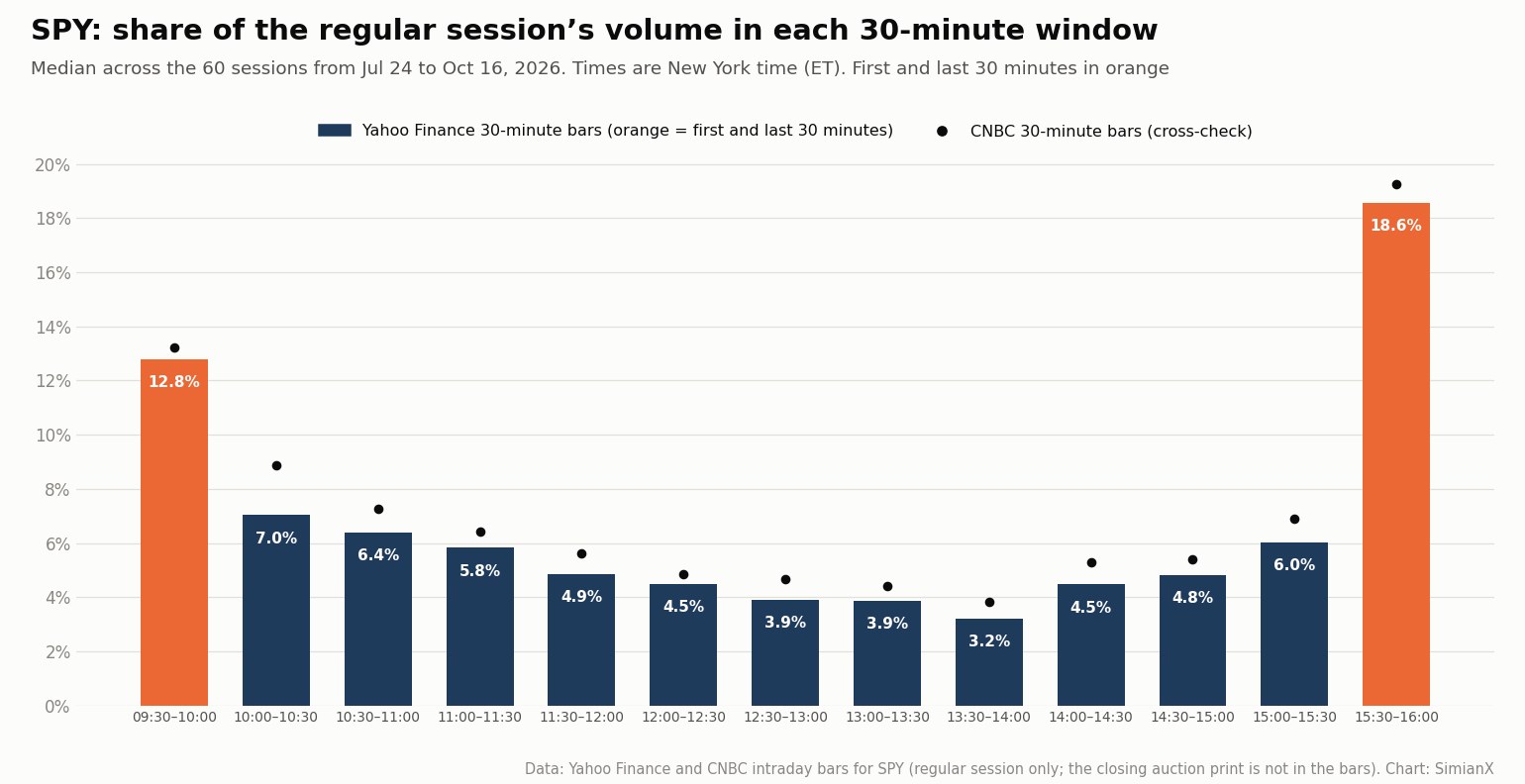
If you live far from New York, you probably cannot watch the whole session. So which part matters most? We measured it on the SPDR S&P 500 ETF Trust (SPY), an exchange-traded fund that tracks the S&P 500 and trades on NYSE Arca, using every regular session in the 60 trading days from July 24 to October 16, 2026. We split each day into its thirteen 30-minute windows, using 30-minute bars from Yahoo Finance and, as a cross-check, from CNBC.
| Measure (60 sessions, July 24 – October 16, 2026) | Yahoo Finance bars | CNBC bars |
|---|---|---|
| Median share of the session's volume in the first 30 minutes (9:30–10:00 a.m. ET) | 12.8% | 13.2% |
| Median share in the last 30 minutes (3:30–4:00 p.m. ET) | 18.6% | 19.3% |
| Median share in the quietest window (1:30–2:00 p.m. ET) | 3.2% | 3.8% |
| Average share of the day's high-to-low range covered in the first 30 minutes | 43.3% | 43.3% |
| Average share of the day's range covered in the first hour | 58.3% | 58.1% |
| Average share of the day's range covered in the last 30 minutes | 27.5% | 26.7% |
| Sessions whose high or low was set in the first 30 minutes | 32 of 60 | 33 of 60 |
| Sessions whose high or low was set in the last 30 minutes | 15 of 60 | 14 of 60 |
Four things stand out:
- The two ends of the day carry about a third of the volume. The first and last 30 minutes are 2 of the 13 windows, or 15% of the clock, but together they held a median 32.2% of SPY's regular-session volume in the Yahoo data.
- The last half hour is busier than the first. Index funds, ETFs and other investors that trade at the closing price send orders toward the close, and the 3:30–4:00 p.m. window was the busiest of the day on both data sets.
- The open sets the day's range. The first 30 minutes alone covered 43% of the average day's high-to-low range, and on more than half of all sessions either the day's high or its low was printed before 10:00 a.m. ET. The median full-day range was 0.68% of the opening price.
- Pre-market volume is small. In CNBC's bars, trading from 4:00 to 9:30 a.m. ET accounted for a median 2.8% of SPY's volume from 4:00 a.m. to 4:00 p.m.; Yahoo's intraday data does not report pre-market volume, so this figure has a single source.
For overseas readers this turns into a practical rule. The first 30 minutes run from 9:30 to 10:00 a.m. in New York, which is 7:00 p.m. to 7:30 p.m. in India and 9:30 p.m. to 10:00 p.m. in Manila and Singapore until October 30, and 8:00 p.m. to 8:30 p.m. and 10:30 p.m. to 11:00 p.m. from November 2. The last 30 minutes fall at 2:00 a.m. (+1) to 2:30 a.m. (+1) in India and 4:30 a.m. (+1) to 5:00 a.m. (+1) in Manila during U.S. winter. If you can follow only one part of the session, the opening half hour shows where the day's range is being set; the closing half hour is when the most shares change hands.
Two caveats. The bars cover the continuous regular session only; the closing auction print at 4:00 p.m. is not in them, and Yahoo's daily volume figure ran a median 15% above the sum of its 30-minute bars, so the true share of volume traded "at the close" is larger than the table suggests. And 60 sessions is a recent snapshot, not a law: a news-heavy afternoon or an options-expiration day can shift the pattern. Individual stocks also differ from an index ETF.
Is the US stock market open right now? A quick checklist
- Is it a weekday in New York? U.S. exchanges trade Monday to Friday only. In Asia that means the trading week runs from Monday evening to Saturday morning, local time.
- Is it a U.S. market holiday or an early-close day? Check the table above or the full 2027 holiday calendar.
- Which period are you in? Before November 1, 2026, the U.S. is on daylight time; from November 1, 2026 to March 13, 2027 it is on standard time. In Europe, check the gap weeks.
- Which session do you need? Regular session for full liquidity, pre-market for reactions to 8:30 a.m. ET data and overnight earnings, after-hours for earnings released after the close.
When the session is open, SimianX's Live Command Room puts a team of AI agents on any U.S. ticker in real time, and Market Pulse ranks market-moving headlines as they land, which helps in the hours before a New York open that falls late in your evening. Plans start free.
Frequently asked questions
Is the US stock market open on Saturday?
No. The NYSE and Nasdaq trade Monday to Friday only, with no regular, pre-market or after-hours session on Saturday or Sunday. Readers in Asia sometimes see trading on Saturday morning because Friday's session ends after midnight local time: the 4:00 p.m. ET close is 5:00 a.m. (+1) Saturday in Manila and 6:00 a.m. (+1) Saturday in Tokyo during U.S. winter. After that, nothing trades on U.S. exchanges until the pre-market opens on Monday.
When does the time change in 2026 and 2027?
The U.S. ends daylight saving time on Sunday, November 1, 2026, starts it on Sunday, March 14, 2027, and ends it again on Sunday, November 7, 2027. The U.K. and the EU change on October 25, 2026, March 28, 2027 and October 31, 2027. Those differences create gap weeks for European readers: October 26–30, 2026, March 15–26, 2027 and November 1–5, 2027.
Why did the US market open move by an hour?
Because New York changed its clocks and your country did not, or did so on a different date. The exchange always opens at 9:30 a.m. New York time. When the U.S. switches from EDT (UTC−4) to EST (UTC−5), that moment arrives one hour later in UTC, so in India it moves from 7:00 p.m. to 8:00 p.m. IST, and in Manila from 9:30 p.m. to 10:30 p.m..
Can I trade US stocks in the pre-market from outside the U.S.?
Usually yes, if your broker offers extended-hours trading in U.S. stocks. International brokers and local brokers with U.S. market access differ in which hours they support, whether they accept only limit orders, and which stocks are eligible, so check your broker's own extended-hours rules before placing an order. Regulations, taxes and currency conversion depend on your country. Liquidity is much thinner than in the regular session, so prices can be far from the last close.
What time does the US stock market open in India and the Philippines?
In India the regular session runs 7:00 p.m. – 1:30 a.m. (+1) IST while the U.S. is on daylight time (until October 31, 2026 and again from March 14 to November 6, 2027) and 8:00 p.m. – 2:30 a.m. (+1) IST while it is on standard time (November 1, 2026 to March 13, 2027 and from November 7, 2027). In the Philippines it runs 9:30 p.m. – 4:00 a.m. (+1) and 10:30 p.m. – 5:00 a.m. (+1) respectively. Pre-market trading starts at 1:30 p.m. / 2:30 p.m. in India and 4:00 p.m. / 5:00 p.m. in Manila.
Is the stock market open the day after Thanksgiving and on Christmas Eve 2026?
Yes, but only until 1:00 p.m. ET on Friday, November 27, 2026 and on Thursday, December 24, 2026. That is 6:00 p.m. in London, 11:30 p.m. in India and 2:00 a.m. (+1) in Manila. The market is closed on Thanksgiving Day (November 26) and Christmas Day (December 25).
Will US stocks trade 23 hours a day?
Nasdaq and NYSE Arca have targeted December 6, 2026 for an overnight session from 9:00 p.m. to 4:00 a.m. ET, subject to regulatory approval. If it launches on that schedule, the overnight session would be 7:30 a.m. – 2:30 p.m. in India and 10:00 a.m. – 5:00 p.m. in Manila during U.S. winter — in daytime across Asia. Until then, the exchange trading day ends at 8:00 p.m. ET.
Methodology and sources
- Session times: NYSE holidays and trading hours and Nasdaq trading hours, checked October 16, 2026. Holidays and early closes for 2026–2027 are from the NYSE calendar and match our 2027 holiday page.
- Local times: computed in Python with the IANA time-zone database (
zoneinfo) for every trading day from October 16, 2026 to December 31, 2027: each 9:30 a.m. / 4:00 p.m. New York time on that date was converted to the local zone, and every table cell was checked to be identical across all trading days of its period. Daylight-saving dates were taken from the same database (U.S.: November 1, 2026, March 14, 2027, November 7, 2027; Europe: October 25, 2026, March 28, 2027, October 31, 2027) and match NIST and the EU directive. The database also confirms that none of the zones listed as not observing daylight saving time changes its offset in this window. - Overnight session: Jones Day (September 2026) and Troutman Pepper Locke (April 2026) on the SEC approval and the targeted launch; the start date may change.
- SPY intraday study: 30-minute bars for SPY from Yahoo Finance and CNBC, regular session (9:30 a.m. – 4:00 p.m. ET), July 24 – October 16, 2026 (60 sessions; no early-close days in the window). Volume shares are medians across days of each window's share of that day's regular-session volume; range shares use each 30-minute bar's high and low against the day's high and low. Pre-market volume uses CNBC's 4:00–9:30 a.m. bars. Both vendors occasionally show single-bar volume spikes, which is why we report medians for volume.
- Compiled October 16, 2026. Exchange hours can change in an emergency; confirm with your broker before trading. This article is for information only and is not investment advice.
Related Reading
- Stock Market Holidays 2027: NYSE & Nasdaq Closed Dates
- US Jobs Report: Latest Nonfarm Payrolls and Release Schedule
- US CPI Report: Latest Inflation Data and Release Schedule
- Fed Interest Rate Decision: Latest FOMC Result and History
- PCE Inflation Report: Latest Data and Release Schedule
- FOMC Meeting Dates 2027: How the S&P 500 Moves on Fed Days
- Thanksgiving Week Stock Market: S&P 500 Each Year Since 1950
- Santa Claus Rally: Every Year Since 1950 and What Came Next
References
- NYSE — Holidays & Trading Hours
- Nasdaq — Stock market trading hours
- Nasdaq — Stock market holiday schedule
- NIST — Daylight Saving Time
- EUR-Lex — Directive 2000/84/EC on summer-time arrangements
- IANA — Time Zone Database
- FINRA — Extended-hours trading: know the risks
- Investor.gov — Extended-hours trading
- Jones Day — NYSE and Nasdaq move to a 23-hour trading day (September 2026)
- Troutman Pepper Locke — Nasdaq 23-hour equity trading proposal approved by SEC
- State Street — SPDR S&P 500 ETF Trust (SPY)
- Yahoo Finance — SPY quote and chart data
- CNBC — SPY quote and chart data
- Wikipedia — Time in Turkey
- Wikipedia — Time in Russia
- Wikipedia — Time in Brazil
- Wikipedia — Time in Mexico