
Is the Stock Market Open Today? The Complete 2027 NYSE and Nasdaq Holiday Calendar
The stock market holidays for 2027 are already official. The New York Stock Exchange published its calendar through 2028 on December 23, 2025, and it holds a few surprises: three holidays land on weekends and shift to a Friday or a Monday, Christmas Eve is a full closure rather than a half day, New Year's Eve is a normal full session, and the June quarterly expiration gets pushed to a Thursday. In total, U.S. stock exchanges will be closed on 10 weekdays in 2027, close early on one day, and run 251 regular trading sessions.
This page is the reference we keep for our own trading desk: every 2027 closure and early close with its weekday, the remaining 2026 dates, the official 2028 calendar, the separate bond-market schedule, the exact local time of the 1:00 p.m. early close in Beijing, Tokyo, Seoul, London and a dozen other cities, and 36 years of data on how the S&P 500 actually behaves right before a market holiday.
Stock market holidays 2027 at a glance
All NYSE markets and the Nasdaq Stock Market observe the following U.S. holidays in 2027. On these days there is no regular session, no pre-market and no after-hours trading on U.S. exchanges.
| Holiday | Date | Weekday | Market status |
|---|---|---|---|
| New Year's Day | January 1, 2027 | Friday | Closed |
| Martin Luther King Jr. Day | January 18, 2027 | Monday | Closed |
| Washington's Birthday (Presidents Day) | February 15, 2027 | Monday | Closed |
| Good Friday | March 26, 2027 | Friday | Closed |
| Memorial Day | May 31, 2027 | Monday | Closed |
| Juneteenth National Independence Day (observed) | June 18, 2027 | Friday | Closed |
| Independence Day (observed) | July 5, 2027 | Monday | Closed |
| Labor Day | September 6, 2027 | Monday | Closed |
| Thanksgiving Day | November 25, 2027 | Thursday | Closed |
| Day after Thanksgiving | November 26, 2027 | Friday | Early close, 1:00 p.m. ET |
| Christmas Day (observed) | December 24, 2027 | Friday | Closed |
Three rules explain everything unusual in that table. When a holiday falls on a Saturday, the exchange closes on the preceding Friday — that is why Juneteenth (Saturday, June 19) is observed on Friday, June 18, and Christmas (Saturday, December 25) is observed on Friday, December 24. When a holiday falls on a Sunday, the exchange closes on the following Monday — Independence Day (Sunday, July 4) is observed on Monday, July 5. And there is one exception to the Saturday rule: the NYSE does not move a holiday into the previous year's final trading day. Because January 1, 2028 is a Saturday, no New Year's Day holiday is observed at all, and Friday, December 31, 2027 is a regular full session.
The weekday pattern also matters for anyone planning around long weekends. Nine of the ten 2027 closures sit on a Monday or a Friday, which creates nine three-day weekends; Thanksgiving is the only mid-week closure. Easter Sunday falls on March 28, 2027, two days after Good Friday.
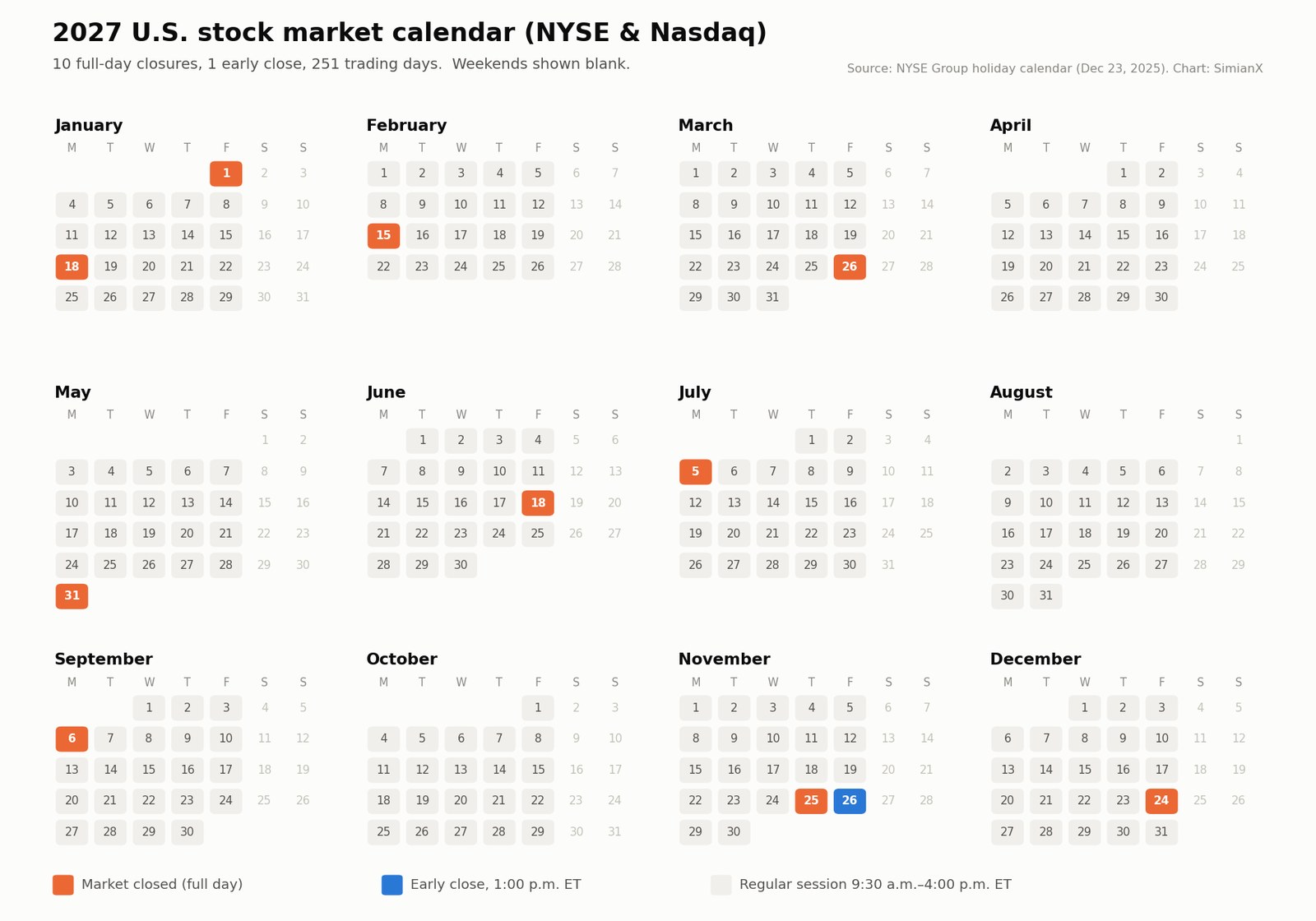
The only early close of 2027: Friday, November 26
The 2027 calendar has just one shortened session: the Friday after Thanksgiving. On November 26, 2027 the NYSE, NYSE American, NYSE Arca, NYSE National, NYSE Texas and Nasdaq equity markets close at 1:00 p.m. Eastern Time; eligible options close at 1:15 p.m., and the late (after-hours) sessions on NYSE American, NYSE Arca, NYSE National and NYSE Texas end at 5:00 p.m. instead of 8:00 p.m.
Two familiar half days are missing, and both disappearances are calendar quirks rather than rule changes:
- No Christmas Eve half day. In most years December 24 is a 1:00 p.m. early close. In 2027 it is the observed Christmas holiday, so the market is shut all day, and Thursday, December 23 is a normal full session.
- No July early close. When July 4 falls on a weekday, the session before it is often shortened. In 2027 the holiday moves to Monday, July 5, and Friday, July 2 is a regular full day for stocks — only the bond market closes early that afternoon.
If 2027 looks familiar, it should: it uses exactly the same weekday layout as 2021, which also had a Friday Christmas closure on December 24, no Christmas Eve half day, and a full New Year's Eve session.
Remaining 2026 stock market holidays and early closes
For the rest of 2026, four dates are left on the U.S. equity calendar, and New Year's Day 2027 follows immediately.
| Date | Weekday | Status |
|---|---|---|
| November 26, 2026 | Thursday | Closed (Thanksgiving Day) |
| November 27, 2026 | Friday | Early close, 1:00 p.m. ET |
| December 24, 2026 | Thursday | Early close, 1:00 p.m. ET |
| December 25, 2026 | Friday | Closed (Christmas Day) |
| December 31, 2026 | Thursday | Regular full session |
| January 1, 2027 | Friday | Closed (New Year's Day) |
The 2026 holiday stretch therefore has two half days instead of 2027's one. Like 2027, 2026 contains 251 trading sessions.
Stock market holidays 2028: the official NYSE calendar
The NYSE has also published 2028, so planners can look three years out. 2028 is a leap year, and its calendar is the mirror image of 2027's year-end quirk: with January 1, 2028 on a Saturday, the year opens with no New Year's closure.
| Holiday | Date | Weekday | Status |
|---|---|---|---|
| New Year's Day | — | — | Not observed (Jan 1 is a Saturday) |
| Martin Luther King Jr. Day | January 17, 2028 | Monday | Closed |
| Washington's Birthday | February 21, 2028 | Monday | Closed |
| Good Friday | April 14, 2028 | Friday | Closed |
| Memorial Day | May 29, 2028 | Monday | Closed |
| Juneteenth | June 19, 2028 | Monday | Closed |
| Day before Independence Day | July 3, 2028 | Monday | Early close, 1:00 p.m. ET |
| Independence Day | July 4, 2028 | Tuesday | Closed |
| Labor Day | September 4, 2028 | Monday | Closed |
| Thanksgiving Day | November 23, 2028 | Thursday | Closed |
| Day after Thanksgiving | November 24, 2028 | Friday | Early close, 1:00 p.m. ET |
| Christmas Day | December 25, 2028 | Monday | Closed |
That makes nine full closures and two early closes in 2028 — and, because the leap year adds a weekday, the total is once again 251 trading sessions. Three consecutive years with 251 sessions is a coincidence of the calendar, not a rule: every year since 2000 has had between 250 and 253 sessions, except 2001, when the September 11 closures cut the count to 248.
How many trading days are in 2027?
There are 251 trading days in 2027: 261 weekdays minus 10 holidays. The early close on November 26 still counts as a trading day. Here is the month-by-month breakdown, which is useful for anything that annualizes daily data or counts sessions to an expiration date:
| Month | Trading days | Month | Trading days |
|---|---|---|---|
| January | 19 | July | 21 |
| February | 19 | August | 22 |
| March | 22 | September | 21 |
| April | 22 | October | 21 |
| May | 20 | November | 21 |
| June | 21 | December | 22 |
The first quarter has 60 sessions, the second 63, the third 64 and the fourth 64.
Bond market holidays 2027: a separate schedule
The bond market does not follow the NYSE. U.S. Treasury, agency and corporate bond trading follows recommendations from SIFMA, the securities-industry trade group, and that schedule differs in two important ways: bond trading is closed on Columbus Day and Veterans Day while stocks trade normally, and SIFMA recommends 2:00 p.m. ET early closes before most long weekends.
SIFMA's 2027 U.S. recommendations (issued December 17, 2025):
| Date | Weekday | Bond market (SIFMA recommendation) | Stock market |
|---|---|---|---|
| December 31, 2026 | Thursday | Early close, 2:00 p.m. ET | Open, full day |
| January 1, 2027 | Friday | Closed | Closed |
| January 18 | Monday | Closed | Closed |
| February 15 | Monday | Closed | Closed |
| March 25 | Thursday | Early close, 2:00 p.m. ET | Open, full day |
| March 26 | Friday | Closed (Good Friday) | Closed |
| May 28 | Friday | Early close, 2:00 p.m. ET | Open, full day |
| May 31 | Monday | Closed | Closed |
| June 18 | Friday | Closed | Closed |
| July 2 | Friday | Early close, 2:00 p.m. ET | Open, full day |
| July 5 | Monday | Closed | Closed |
| September 6 | Monday | Closed | Closed |
| October 11 | Monday | Closed (Columbus Day) | Open |
| November 11 | Thursday | Closed (Veterans Day) | Open |
| November 25 | Thursday | Closed | Closed |
| November 26 | Friday | Early close, 2:00 p.m. ET | Early close, 1:00 p.m. ET |
| December 23 | Thursday | Early close, 2:00 p.m. ET | Open, full day |
| December 24 | Friday | Closed | Closed |
| December 31 | Friday | Early close, 2:00 p.m. ET | Open, full day |
For the rest of 2026, the bond market is closed on Veterans Day (Wednesday, November 11) and on Thanksgiving and Christmas, with 2:00 p.m. early closes on November 27, December 24 and December 31. These are recommendations rather than exchange rules, but dealers follow them in practice — so expect thin Treasury liquidity, and occasionally jumpy yields, on those afternoons even when stocks are trading. Our breakdown of the 2026 global bond selloff shows how quickly long-dated yields can move once liquidity thins.
What time is the early close in Asia and Europe?
All three U.S. early closes in 2026 and 2027 — November 27, 2026, December 24, 2026 and November 26, 2027 — fall while the U.S. is on standard time (EST, UTC−5). That means the local times below apply to all three. The 1:00 p.m. ET close lands after midnight across Asia, so readers in Beijing or Tokyo see the final bell on Saturday morning (or, on December 24, 2026, on Christmas morning).
| City | Early close (1:00 p.m. ET) | Normal close (4:00 p.m. ET) |
|---|---|---|
| New York | 1:00 p.m., same day | 4:00 p.m. |
| São Paulo | 3:00 p.m., same day | 6:00 p.m. |
| London | 6:00 p.m., same day | 9:00 p.m. |
| Berlin / Paris / Madrid | 7:00 p.m., same day | 10:00 p.m. |
| Istanbul / Moscow | 9:00 p.m., same day | midnight |
| Mumbai | 11:30 p.m., same day | 2:30 a.m. next day |
| Bangkok / Jakarta / Ho Chi Minh City | 1:00 a.m., next day | 4:00 a.m. next day |
| Beijing / Hong Kong / Taipei / Singapore / Manila | 2:00 a.m., next day | 5:00 a.m. next day |
| Tokyo / Seoul | 3:00 a.m., next day | 6:00 a.m. next day |
The 2028 calendar adds a summer early close: on Monday, July 3, 2028, the U.S. is on daylight time (EDT, UTC−4), so 1:00 p.m. ET equals 6:00 p.m. in London, 1:00 a.m. Tuesday in Beijing and 2:00 a.m. Tuesday in Tokyo and Seoul.
Daylight-saving switches shift the regular session for overseas investors, too. In 2027 the U.S. springs forward on March 14 and falls back on November 7, while the U.K. and the EU switch on March 28 and October 31. During the two "gap" windows (March 14–27 and October 31–November 6), the New York open is one hour earlier than usual in Europe: 1:30 p.m. in London instead of 2:30 p.m. In Asia, which does not observe daylight saving, the regular session runs 9:30 p.m.–4:00 a.m. Beijing time during U.S. daylight time and 10:30 p.m.–5:00 a.m. during U.S. standard time.
What a U.S. market holiday means outside the U.S.
Because of the time difference, a U.S. holiday on a Monday means no U.S. session on Monday night in Asia, so Asian markets trade Tuesday without a fresh U.S. close and the next U.S. open arrives Tuesday night local time. A Friday U.S. holiday means no U.S. session on Friday night Asian time, so Tokyo, Seoul, Shanghai and Hong Kong open on Monday with three days of news and no U.S. close to anchor it — Asia prices the weekend first.
Good Friday is the holiday that splits global markets most sharply. London, Frankfurt, Hong Kong and Sydney typically close for it (and for Easter Monday in Europe and Hong Kong), while Tokyo, Shanghai, Seoul and Taipei usually trade. On March 26, 2027 that leaves Asian traders pricing whatever U.S. news lands that day — and the Easter weekend — without a U.S. session to react to. Meanwhile U.S. stock futures and many other products run their own holiday hours, so check your futures exchange's calendar separately from the stock exchange's.
There is one more 2027 detail worth circling for derivatives traders. Juneteenth (observed Friday, June 18) is the third Friday of June 2027 — the standard monthly options expiration and the quarterly expiration for index futures and options. Under the long-standing rule that moves an expiration to the prior business day when the exchange is closed, June 2027 expirations are expected to shift to Thursday, June 17, exactly as the June 2026 expiration moved to Thursday, June 18, 2026 when Juneteenth fell on the third Friday. Confirm the final dates with the options clearing house calendar or your broker.
Settlement follows bank holidays, not just exchange holidays. Since May 28, 2024 most U.S. stock trades settle on T+1, one business day after the trade. Columbus Day (October 11) and Veterans Day (November 11) are open for trading but are bank holidays, so a trade executed the day before either one settles a day later than usual.
How stocks have behaved around market holidays (1990–2025)
Market lore says stocks drift higher into a long weekend — the so-called pre-holiday effect, documented in academic work as early as Lakonishok and Smidt (1988) and Ariel (1990). We tested it on our own data: every S&P 500 session from January 1990 to December 2025, comparing the last trading day before each scheduled NYSE holiday with every other day.
| Session type | Sessions | Average S&P 500 change | Share of up days |
|---|---|---|---|
| Last session before a holiday | 314 | +0.10% | 57.3% |
| First session after a holiday | 314 | +0.03% | 51.0% |
| All other sessions | 8,439 | +0.04% | 53.7% |
The pre-holiday session has averaged about 2.6 times the return of an ordinary day and has closed higher 57% of the time, versus 54% for everything else. That is real, but it is small: the average extra gain is about six hundredths of a percentage point, the day-to-day noise is roughly fifteen times larger than that edge, and the difference does not clear conventional statistical significance (a t-statistic of about 1.2). In other words, it is a tailwind, not a trading strategy.
The holiday you are approaching matters far more than the average:
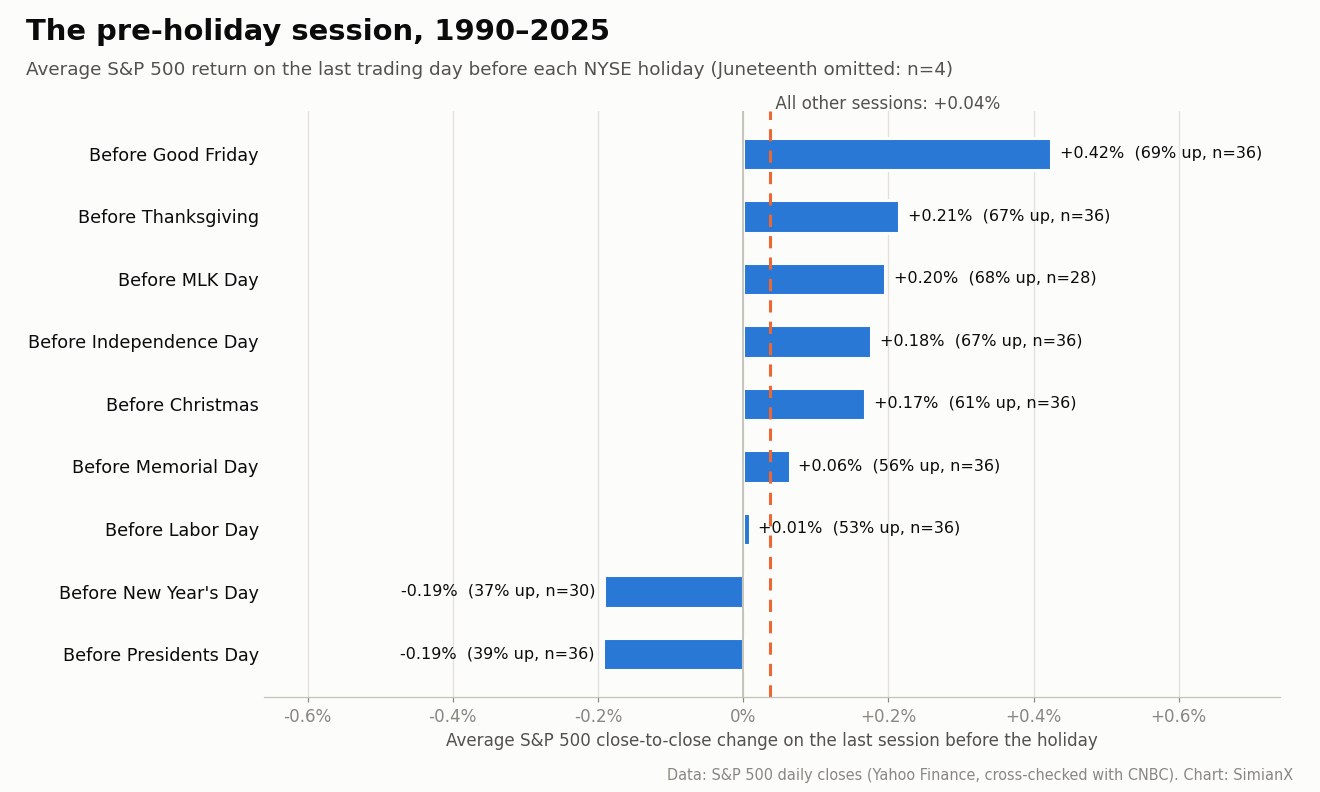
Which holidays have the strongest pre-holiday rally?
- Good Friday is the standout. The Thursday before Good Friday has averaged +0.42% and risen in 25 of 36 years (69%). The biggest pre-holiday gain in the whole sample came on April 9, 2009, when the S&P 500 jumped 3.8% ahead of the Easter weekend, a month after the financial-crisis low.
- Thanksgiving, MLK Day, Independence Day and Christmas form a second tier, each averaging between +0.17% and +0.21% with roughly two-thirds of sessions positive. The Wednesday before Thanksgiving rose in 24 of 36 years.
- Memorial Day and Labor Day show essentially no effect (+0.06% and +0.01%).
- Two holidays run the other way. The last session before New Year's Day has averaged −0.19% and risen only 37% of the time, and the Friday before Presidents Day has also averaged −0.19%, up just 39% of the time. December 31 is often a day of last-minute rebalancing and tax positioning, which may explain the first; we have no tidy explanation for the second.
The post-holiday sessions are mostly unremarkable, with two exceptions. The session after Christmas has averaged +0.36% and risen 67% of the time, which overlaps with the start of the Santa Claus rally window we track in our S&P 500 seasonality reference. The session after Good Friday — Easter Monday for much of the world — has averaged −0.19%, up only 44% of the time, partly giving back the pre-holiday gain.
What about the half days? The Friday after Thanksgiving has averaged +0.10%, up 58% of the time, but low volume can cut both ways: on November 26, 2021, news of the Omicron variant sent the S&P 500 down 2.3% in a shortened session. Christmas Eve sessions have been a coin flip (21 sessions, average 0.00%), including a 2.7% drop on December 24, 2018, in the middle of the S&P 500's worst December since at least 1950. December 31 sessions have averaged −0.11%.
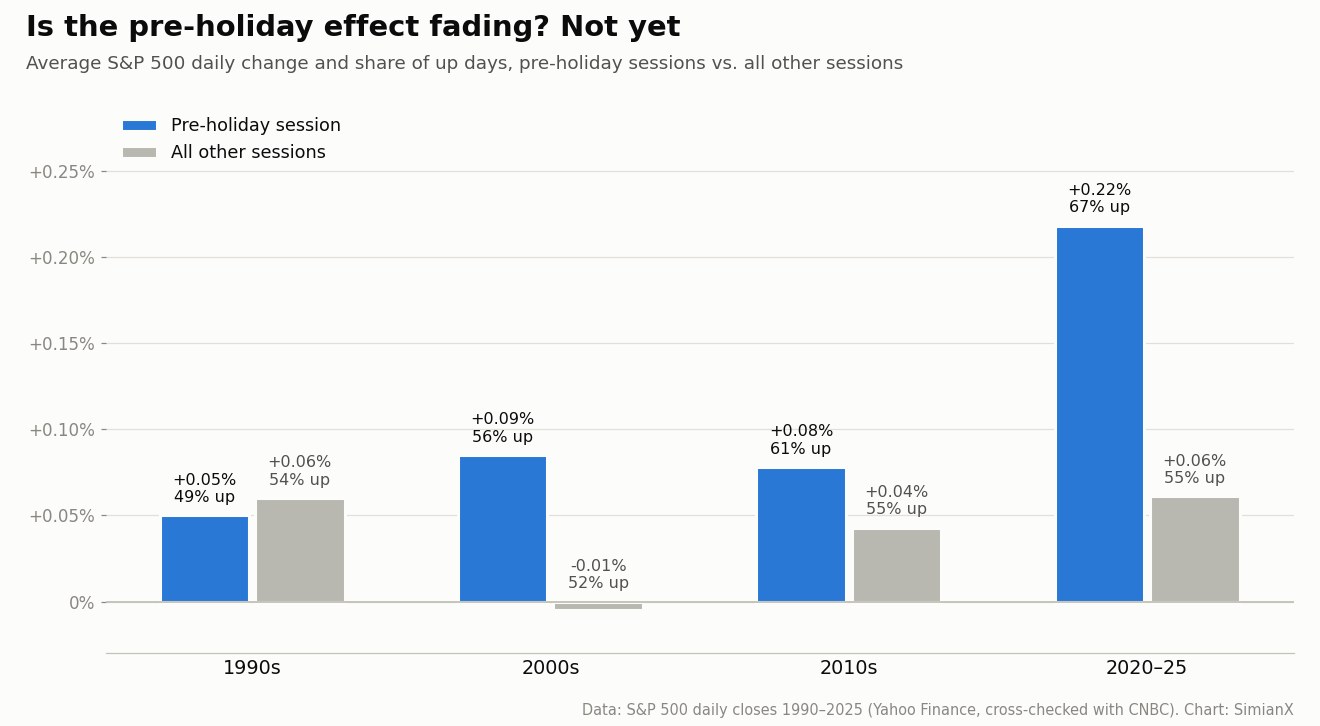
Is the pre-holiday effect fading?
Many calendar anomalies weaken once they are published. This one has not — at least not yet. In the 1990s the pre-holiday session actually lagged ordinary days (+0.05% versus +0.06%, up only 49% of the time). In the 2000s and 2010s it beat them, and in 2020–2025 it has been at its strongest: +0.22% on average, positive two-thirds of the time, versus +0.06% for other sessions. Treat that recent strength with caution, though — it rests on only 57 sessions, and a handful of big moves in 2020–2022 can tilt a small sample. If you want a broader view of how calendar effects behave across entire market cycles, our tables of every S&P 500 bear market since 1929 and the 20 worst days in S&P 500 history show how quickly a single news shock can overwhelm any seasonal tilt.
Planning your 2027 trading calendar
A practical checklist for using these dates:
- Roll options and futures early around June 18. The Juneteenth Friday closure collides with the June quarterly expiration, so expirations are expected to move to Thursday, June 17.
- Mind the bond-only closures. On October 11 and November 11, stocks trade but the bond market is shut, Treasury yields barely update, and trades executed the day before settle a day late.
- Expect a thin Thanksgiving week. The Wednesday before Thanksgiving has historically leaned positive, but the Friday half day sees some of the lowest volume of the year — which can magnify a surprise headline.
- Note the year-end difference. December 24, 2027 is a full closure, while December 31, 2027 is a full session; in 2026, December 24 is a half day and December 31 is a full session.
- Pencil in the other fixed dates. The Federal Reserve's 2027 FOMC meeting schedule puts rate decisions on January 27, March 17, April 28, June 9, July 28, September 15, October 27 and December 8. None collides with a market holiday, and four of them (March, June, September, December) come with fresh economic projections. The Fed enters 2027 in tightening mode after raising rates in September 2026 for the first time since 2023, so for context keep our tables of every Fed rate-hike cycle since 1983 and every rate-cut cycle since 1980 at hand.
Calendar effects are worth knowing, but they are background noise next to policy and news. The macro events that actually moved markets around past holidays are collected in our references on government shutdowns and the stock market, midterm election years and the presidential cycle.
Watching the market around holidays with SimianX
Long weekends are when news piles up while the exchange is shut, and the first session back has to price all of it at once. SimianX's Market Pulse ranks market-moving headlines by score as they land, so you can see what has accumulated before the open. When the bell rings, the Live Command Room runs a team of AI agents on any ticker in real time (and our 8-agent deep analysis answers follow-up questions on a single stock) — start with SPY for the broad market or QQQ for the Nasdaq 100 — and our autopilots let you run strategies without watching every session yourself. Plans start free.
Frequently asked questions
Is the stock market open on Good Friday 2027?
No. The NYSE and Nasdaq are closed on Good Friday, March 26, 2027, even though it is not a federal holiday. The bond market is also closed, with a 2:00 p.m. ET early close on Thursday, March 25. Stocks trade a full session on Thursday.
Is the stock market open on Juneteenth 2027?
No. Juneteenth falls on Saturday, June 19, 2027, so U.S. stock exchanges close on Friday, June 18. The June options and futures expirations normally scheduled for that Friday are expected to move to Thursday, June 17.
Is the stock market open the day after Thanksgiving 2027?
Yes, but only until 1:00 p.m. ET on Friday, November 26, 2027 (1:15 p.m. for eligible options). It is the only early close on the 2027 calendar. The market is fully closed on Thanksgiving Day, Thursday, November 25.
Is the stock market open on Christmas Eve 2027?
No. Christmas Day falls on a Saturday in 2027, so the NYSE and Nasdaq observe the holiday on Friday, December 24 and are closed all day. There is no Christmas Eve half day in 2027; Thursday, December 23 is a regular full session.
Is the stock market open on New Year's Eve 2027?
Yes. Friday, December 31, 2027 is a normal full trading session from 9:30 a.m. to 4:00 p.m. ET. Because New Year's Day 2028 falls on a Saturday, no New Year's holiday is observed for the stock market at all. The bond market closes early, at 2:00 p.m. ET.
Is the stock market open on Columbus Day and Veterans Day 2027?
Yes. Stocks trade normally on Monday, October 11 and Thursday, November 11, 2027, but the bond market is closed and banks are shut, so stock trades executed the day before settle one day later.
How many trading days are there in 2027?
There are 251 trading days in 2027 — 261 weekdays minus 10 market holidays. The shortened session on November 26 counts as a full trading day. 2026 and 2028 also have 251 sessions each.
Do stocks really go up before holidays?
On average, slightly. From 1990 to 2025 the S&P 500 gained an average of 0.10% on the last session before a market holiday, versus 0.04% on other days, and rose 57% of the time. The effect is strongest before Good Friday and negative before New Year's Day and Presidents Day — and it is too small and too noisy to trade on its own.
Methodology and sources
- Holiday calendar: the official NYSE Group holiday and early-closing calendar for 2026–2028 (press release dated December 23, 2025, and the NYSE holidays and trading hours page). Nasdaq's own holiday schedule currently lists 2026, which matches the NYSE date for date; Nasdaq has historically observed the same holidays as the NYSE.
- Bond market: SIFMA's U.S. holiday recommendations for 2026 and 2027, issued December 17, 2025. SIFMA has not yet issued 2028 recommendations.
- Time zones: computed from the IANA time-zone database; U.S. daylight-saving dates follow NIST. Federal (bank) holidays follow the U.S. Office of Personnel Management.
- Holiday-effect study: S&P 500 price index daily closes, January 2, 1990 to December 31, 2025, from Yahoo Finance, cross-checked against CNBC's index history (every pre-holiday session matched to within 0.05 percentage points) and against FRED from October 2016. Returns are close-to-close price changes, excluding dividends. A "pre-holiday session" is the last trading day before a scheduled NYSE holiday; unscheduled closures (1994, September 2001, 2004, 2007, Hurricane Sandy in 2012, 2018 and 2025) are excluded, and the January 2007 closure that combined New Year's Day with a national day of mourning is excluded as well. MLK Day starts in 1998, when the NYSE first observed it; Juneteenth starts in 2022.
- Compiled October 2026. Exchange calendars can change in an emergency; confirm with the exchange before trading. This article is for information only and is not investment advice.
Related Reading
- S&P 500 Seasonality: The Best & Worst Months 1950–2026
- The Presidential Cycle: S&P 500 Returns by Year, 1928-2025
- Stock Market After Midterm Elections: Every Cycle 1950–2026
- Government Shutdowns and the Stock Market: 1976–2026
- The 20 Worst Days in S&P 500 History and What Came Next
- Every S&P 500 Bear Market Since 1929: When Was the Last?
- Every Fed Rate-Cut Cycle Since 1980: Stocks, Bonds & Gold
- Every Fed Rate-Hike Cycle Since 1983: S&P 500 & Chip Stocks
- FOMC Meeting Dates 2027: How the S&P 500 Moves on Fed Days
References
- NYSE — Holidays & Trading Hours
- NYSE Group — 2026, 2027 and 2028 Holiday and Early Closings Calendar (press release, December 23, 2025)
- Nasdaq — Stock Market Holiday Schedule
- SIFMA — U.S. Holiday Recommendations
- U.S. SEC — T+1 settlement rule (press release 2023-29)
- Federal Reserve — FOMC meeting calendars
- NIST — Daylight Saving Time
- OPM — Federal Holidays
- Lakonishok & Smidt (1988) — Are Seasonal Anomalies Real? A Ninety-Year Perspective
- Ariel (1990) — High Stock Returns before Holidays: Existence and Evidence on Possible Causes
- FRED — S&P 500 daily index (SP500)