
The Midterm Cycle: 19 Elections of S&P 500 Data
The 2026 midterm elections land on November 3, 2026 — and if history is any guide, the months around that date matter more for the stock market than almost any other recurring event on the calendar. Midterm election years are, on average, the weakest year of the four-year presidential cycle for the S&P 500. They also produce deeper intra-year drawdowns, a famous September–October bottom zone, and one of the most reliable bullish signals in market history: since 1950, the S&P 500 has been higher 12 months after every single midterm election — 19 out of 19.
This is the complete reference: every midterm election year since 1950, the calendar-year return, the approximate intra-year drawdown, what happened the year after, why the pattern exists, and what the setup looks like heading into November 2026.
Why Midterm Years Are the Weakest Year of the Presidential Cycle
The presidential election cycle theory divides the four-year term into post-election (Year 1), midterm (Year 2), pre-election (Year 3), and election (Year 4) years. The historical numbers are not subtle:
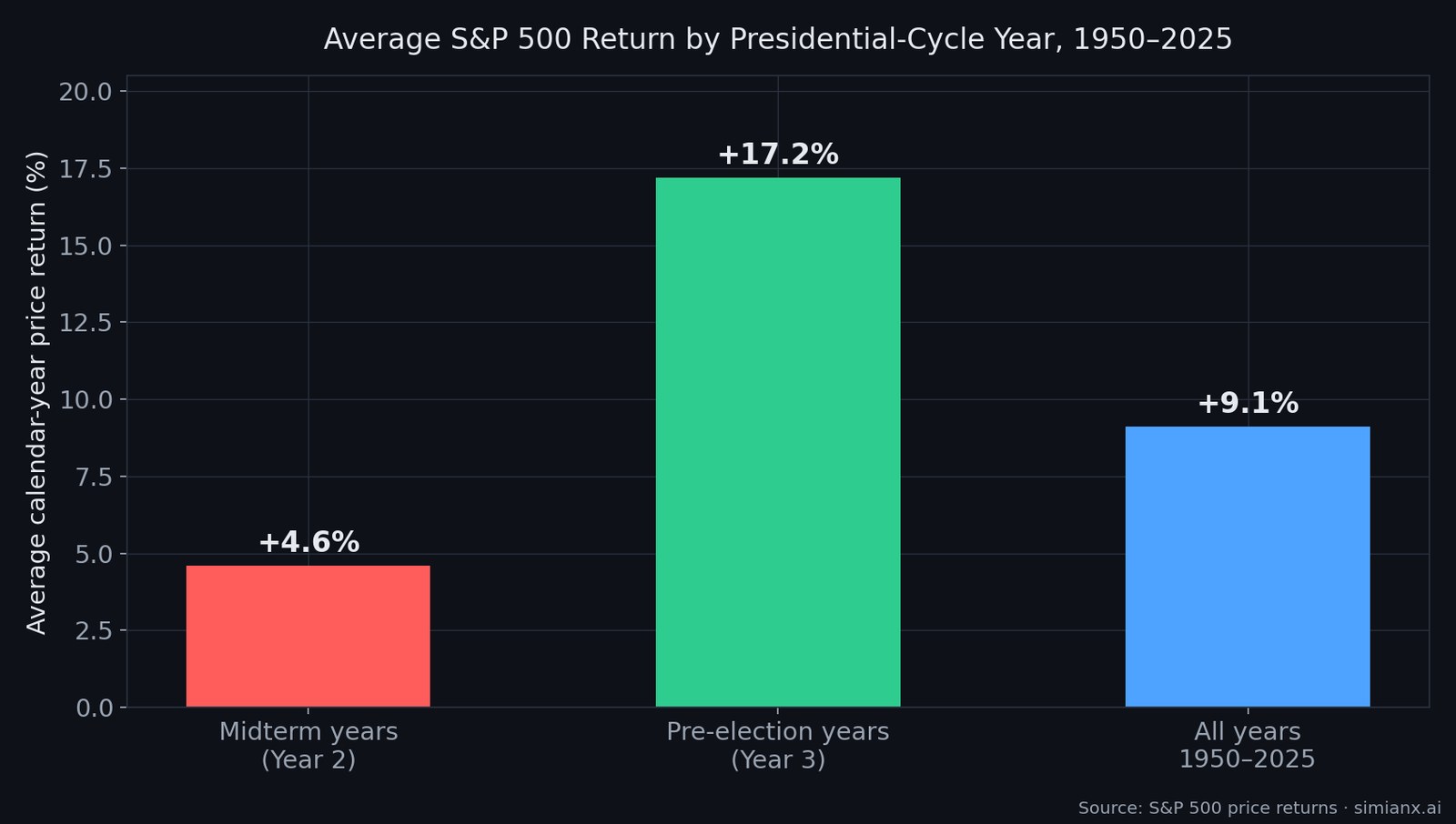
- Midterm years (Year 2): +4.6% average S&P 500 price return since 1950 — the weakest of the four.
- Pre-election years (Year 3): +17.2% average — the strongest, and by a wide margin.
- All years 1950–2025: roughly +9.1% average for context.
The gap between Year 2 and Year 3 — more than twelve percentage points — is the core of the midterm pattern. It is not that midterm years are reliably bad; eleven of the nineteen since 1950 finished positive. It is that the path through a midterm year is choppier, the drawdowns are deeper, and the big gains tend to arrive only after the election resolves.
If you want the month-by-month view of this seasonality, our companion reference on S&P 500 seasonality and the best and worst months since 1950 pairs naturally with this table.
Every Midterm Election Year Since 1950: The Reference Table
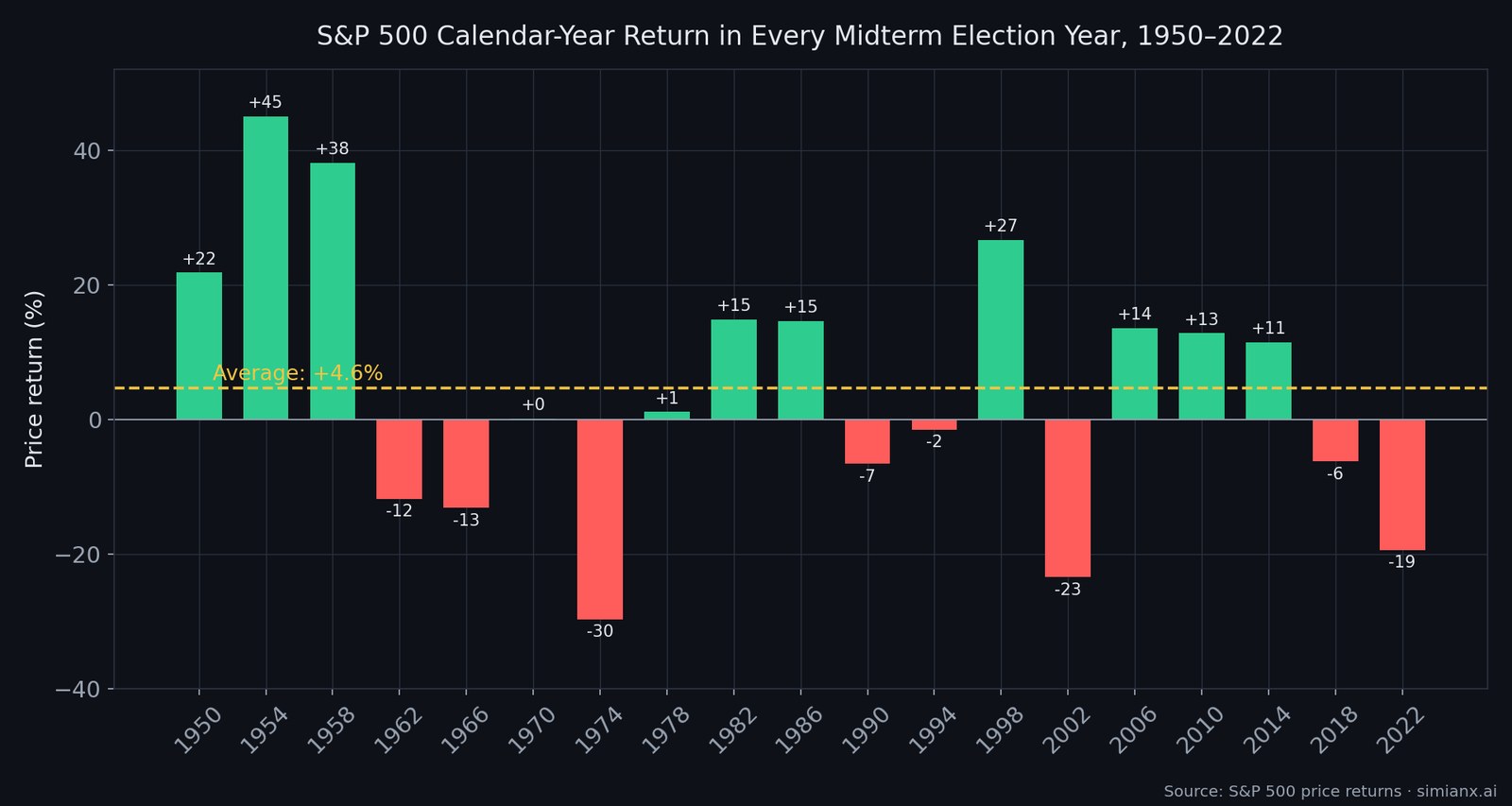
| Midterm year | President | S&P 500 return | Approx. max drawdown | Next year (Year 3) |
|---|---|---|---|---|
| 1950 | Truman (D) | +21.8% | −14% | +16.5% |
| 1954 | Eisenhower (R) | +45.0% | −4% | +26.4% |
| 1958 | Eisenhower (R) | +38.1% | −4% | +8.5% |
| 1962 | Kennedy (D) | −11.8% | −26% | +18.9% |
| 1966 | Johnson (D) | −13.1% | −22% | +20.1% |
| 1970 | Nixon (R) | +0.1% | −26% | +10.8% |
| 1974 | Nixon/Ford (R) | −29.7% | −38% | +31.5% |
| 1978 | Carter (D) | +1.1% | −14% | +12.3% |
| 1982 | Reagan (R) | +14.8% | −16% | +17.3% |
| 1986 | Reagan (R) | +14.6% | −9% | +2.0% |
| 1990 | G.H.W. Bush (R) | −6.6% | −20% | +26.3% |
| 1994 | Clinton (D) | −1.5% | −9% | +34.1% |
| 1998 | Clinton (D) | +26.7% | −19% | +19.5% |
| 2002 | G.W. Bush (R) | −23.4% | −34% | +26.4% |
| 2006 | G.W. Bush (R) | +13.6% | −8% | +3.5% |
| 2010 | Obama (D) | +12.8% | −17% | +0.0% |
| 2014 | Obama (D) | +11.4% | −7% | −0.7% |
| 2018 | Trump (R) | −6.2% | −20% | +28.9% |
| 2022 | Biden (D) | −19.4% | −25% | +24.2% |
S&P 500 price returns, dividends excluded. Drawdowns are peak-to-trough within or into the year, rounded.
Three things jump out of the table:
- The averages hide a barbell. Midterm years cluster at the extremes — monster years like 1954 (+45.0%) and 1958 (+38.1%) sit next to disasters like 1974 (−29.7%) and 2002 (−23.4%). The +4.6% average is the residue of a tug-of-war, not a typical outcome.
- Year 3 almost never disappoints. Of the nineteen pre-election years that followed, only 2015 (−0.7%) finished meaningfully below zero, and 2011 was flat. Seventeen of nineteen were positive, with seven gaining more than 20%.
- Bad midterm years front-load the pain. The worst calendar outcomes — 1974, 2002, 2022 — all bottomed in October of the midterm year and were followed by Year 3 gains of +31.5%, +26.4% and +24.2% respectively.
The Midterm-Year Drawdown: Deeper Than Average
The calendar-year return understates how rough midterm years feel while you are living through them. The intra-year peak-to-trough decline in midterm years has averaged roughly −17%, against roughly −14% for all years — and the distribution is fat-tailed:
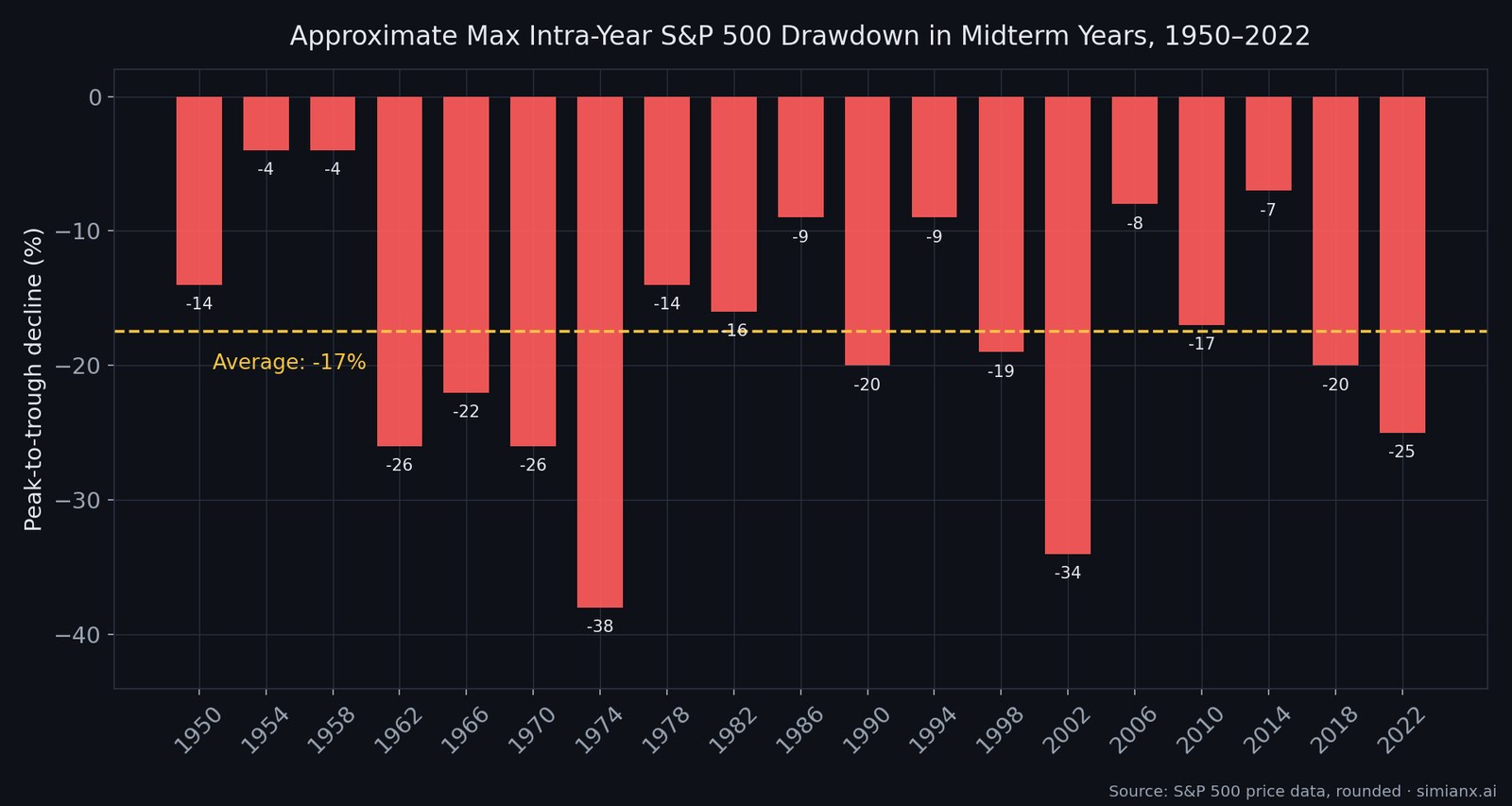
The deepest midterm-year declines each came with a macro shock attached: 1974 (−38% within the year, the second leg of the 1973–74 oil-shock bear), 2002 (−34%, the dot-com unwind plus accounting scandals), 1962 (−26%, the "Kennedy Slide"), 1970 (−26%, recession and tight money) and 2022 (−25%, the fastest Fed hiking cycle in four decades). For full context on the deepest declines, see our reference on every S&P 500 bear market since 1929.
The practical takeaway: a double-digit drawdown in a midterm year is the historical norm, not a signal that something unusual has broken. Fourteen of the nineteen midterm years since 1950 saw a peak-to-trough decline of 9% or more.
The Pre-Midterm Low: September–October Is the Bottom Zone
The single most actionable feature of the midterm cycle is when the lows tend to arrive. Across the nineteen midterm years since 1950, the market's low for the cycle clustered heavily in the weeks just before the election:
- October lows: 1966, 1974, 1990, 1998, 2002, 2014 and 2022 all printed their midterm-year bottom in October.
- Summer lows: 1962 (June), 1970 (May), 1982 (August), 2010 (July).
- The exception: 2018, where the December crash pushed the bottom past the election to December 24 — a reminder that no seasonal map is a guarantee.
The 2022 sequence is the textbook case: the S&P 500 bottomed at 3,577 on October 12, 2022 — twenty-seven days before the November 8 midterms — then rallied roughly 14% over the following twelve months and went on to new all-time highs in early 2024.
Stacked on top of ordinary September weakness (September is the worst month of the year on average), the midterm version of autumn has historically been the most reliable buy-the-fear window of the entire four-year cycle. The fourth quarter of the midterm year through the second quarter of the pre-election year has historically been the strongest three-quarter stretch in the cycle.
19 for 19: The 12 Months After Midterms
Here is the statistic that makes this table worth bookmarking: measured from election day, the S&P 500 has been higher one year after every midterm election since 1950. Nineteen midterms, nineteen positive 12-month windows, with an average gain in the neighborhood of +15%.
The streak survived some hostile conditions: it held through the 1973–74 oil embargo aftermath, the 1987 run-up, the 1990 Gulf crisis, the 2002 post-bubble wreckage, the 2010 European debt scare and the 2022 inflation shock. The mechanism is straightforward — by election day, the market has usually already absorbed a midterm-year drawdown, sentiment is washed out, and a major source of political uncertainty gets resolved overnight.
No streak is a law of nature, and nineteen observations is a modest sample. But as base rates go, it is one of the cleanest in market history — comparable in reliability to the recession signal in our yield curve inversion reference table, and far cleaner than most seasonal lore.
Why Does the Midterm Pattern Exist?
Four explanations carry most of the weight:
- Uncertainty resolution. Markets price political risk all year; the election removes it in a single night, whatever the outcome. Implied volatility around midterms reliably deflates after the vote.
- Gridlock is a feature. The president's party has lost House seats in the vast majority of midterms since World War II. Markets historically treat divided government as policy stability — fewer big legislative swings to reprice.
- The fiscal cycle. Administrations tend to take economic pain early in the term (Year 1–2) and push stimulus, spending and market-friendly policy toward re-election (Year 3–4). Year 3's +17.2% average is partly that incentive showing up in prices.
- Monetary coincidence. Several midterm-year drawdowns (1974, 1982, 2018, 2022) coincided with Fed tightening cycles that peaked or pivoted near the election window — turning the post-midterm rally into a double tailwind. Our live tracker of market expectations for Fed rate cuts covers where that variable stands now.
Gridlock vs. Sweep: Does the Result Matter?
Less than the headlines suggest. Historical average returns under divided government are similar to — and in several studies modestly better than — returns under unified control. The market's revealed preference is for resolution itself, not for either party: the 12-months-after streak includes elections the incumbent party lost badly (1994, 2010, 2018) and ones it weathered (1962, 1998, 2022).
What does move sectors is the composition of the result — which committees change hands, what happens to tax, energy, defense and antitrust expectations. That is a stock-picking question rather than an index question, which is why watching how the Magnificent 7's index concentration interacts with any post-election rotation matters more in 2026 than in past cycles: seven stocks now carry roughly a third of the S&P 500's weight.
The 2026 Setup: What to Watch Into November 3
The 2026 midterms arrive with the S&P 500 near record highs after a turbulent first half — a February–March risk flush, an Iran-driven oil spike that faded on de-escalation, and an AI-capex rally that has broadened beyond Nvidia into power, networking and memory names. Against the historical template, three things are worth tracking from June through November:
- The drawdown budget. History says assume a double-digit peak-to-trough decline at some point in 2026. If it arrives in the August–October window, the midterm map says that is the highest-probability accumulation zone of the cycle — not the moment to de-risk. Our AI drawdown early-warning dashboard tracks breadth, credit spreads and revision signals daily for exactly this scenario.
- The Fed variable. As in 2022 and 2018, the interaction between the tightening/easing path and the election window will decide whether the post-midterm rally gets one tailwind or two.
- Crypto as the risk-appetite proxy. Bitcoin has historically amplified the same post-uncertainty relief moves that equities show — its own reference table of reactions to every Fed rate cut since 2019 rhymes closely with the post-midterm pattern.
How to Trade a Midterm Year with AI
A seasonal base rate is a starting point, not a strategy. The way to use this table is to combine the when (midterm autumn weakness, post-election strength) with live confirmation from breadth, positioning and macro data — which is exactly the job multi-agent AI is built for.
On SimianX, the AI model leaderboard runs 30 AI models from 6 providers on real trading P&L, so you can see which models are actually navigating the 2026 tape rather than backtesting it — we wrote up which AI model is the best trader from that data. If you want the pattern executed without screen time, AI autopilots can run a rules-plus-AI process around events like the November 3 election continuously — the mechanics are covered in our guide to running a 24/7 AI trading bot on autopilot, and plans start free.
FAQ
Is a midterm election year good for stocks?
On average it is the weakest year of the four-year cycle: +4.6% for the S&P 500 since 1950 versus +9.1% for all years. But eleven of nineteen midterm years still finished positive, and the weakness is concentrated in the first nine to ten months of the year.
What happens to the stock market after midterm elections?
Since 1950 the S&P 500 has been higher 12 months after all nineteen midterm elections, with an average gain of roughly 15%. The fourth quarter of the midterm year through the second quarter of the following year has been the strongest three-quarter stretch of the entire cycle.
What was the worst midterm election year for the S&P 500?
1974, at −29.7% for the calendar year and roughly −38% peak-to-trough, during the oil-shock bear market. 2002 (−23.4%) and 2022 (−19.4%) are the modern runners-up. All three bottomed in October and were followed by Year 3 gains of more than 24%.
When does the market usually bottom in a midterm year?
October is the dominant bottom month — 1966, 1974, 1990, 1998, 2002, 2014 and 2022 all troughed there. Summer lows (May–August) cover most other cases. 2018 is the notable exception, bottoming on December 24, after the election.
Does it matter which party wins the midterms?
Historically, less than the resolution of uncertainty itself. Average returns under divided government match or beat unified control, and the 12-month post-midterm streak spans both parties losing and holding Congress. Sector winners and losers depend on the result; the index-level pattern mostly does not.
Sources & Further Reading
- United States midterm elections — Wikipedia
- Presidential Election Cycle Theory — Investopedia
- S&P 500 historical data — S&P Dow Jones Indices
- Companion references on SimianX: S&P 500 seasonality by month, every S&P 500 bear market since 1929, and the yield curve inversion table.
Past performance does not guarantee future results. This reference is for information and education, not investment advice.