
 By Muke
How AI and Chip Innovation Will Drive the Future of Market Forecasting and Investment Strategies
Artificial intelligence and chip innovation are reshaping the foundations of global finance. From ultra-low-latency trading to long-horizon macro forecasting, AI and chip innovation will drive the future of market forecasting and investment strategies by enabling faster computation, richer data integration, and adaptive decision-making systems. Platforms like SimianX AI are already demonstrating how multi-agent intelligence and high-performance compute can transform how investors interpret markets, manage risk, and allocate capital.
The Structural Limits of Traditional Market Forecasting
For decades, market forecasting relied on linear statistical models, simplified assumptions, and delayed data. While useful in stable regimes, these methods struggle under modern conditions:
- Fragmented global markets
- High-frequency volatility
- Massive alternative datasets (on-chain data, sentiment, geopolitics)
- Non-linear feedback loops
Traditional CPU-bound systems were never designed to process millions of signals in real time. This created a structural ceiling on predictive accuracy.
Key insight: Forecasting accuracy is no longer limited by theory alone, but by computational architecture.
AI as a New Forecasting Paradigm
AI shifts forecasting from static estimation to adaptive intelligence. Modern systems learn continuously, detect regime changes, and update beliefs dynamically.
Core AI Capabilities in Market Forecasting
- Pattern discovery across noisy, high-dimensional data
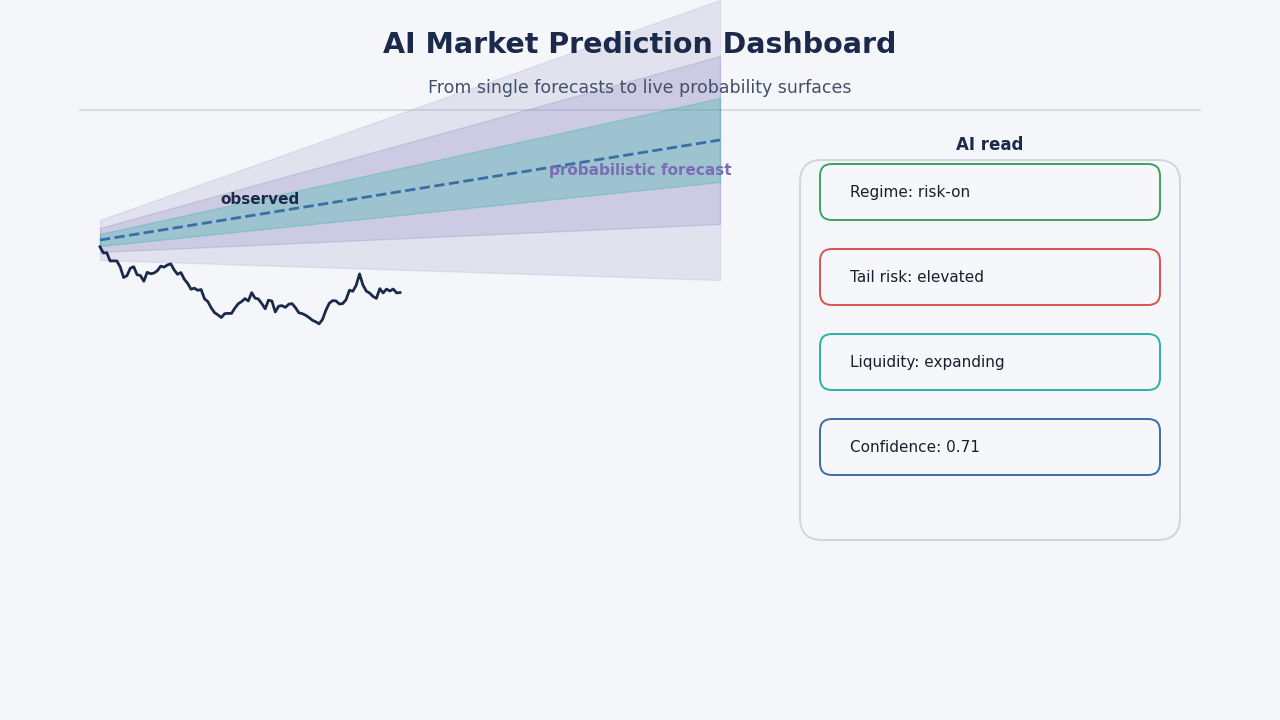
- Regime detection (risk-on vs risk-off, liquidity expansion vs contraction)
- Probabilistic forecasting instead of single-point predictions
- Scenario simulation across thousands of futures
These capabilities fundamentally change how investment strategies are designed.
Why Chip Innovation Is the Hidden Catalyst
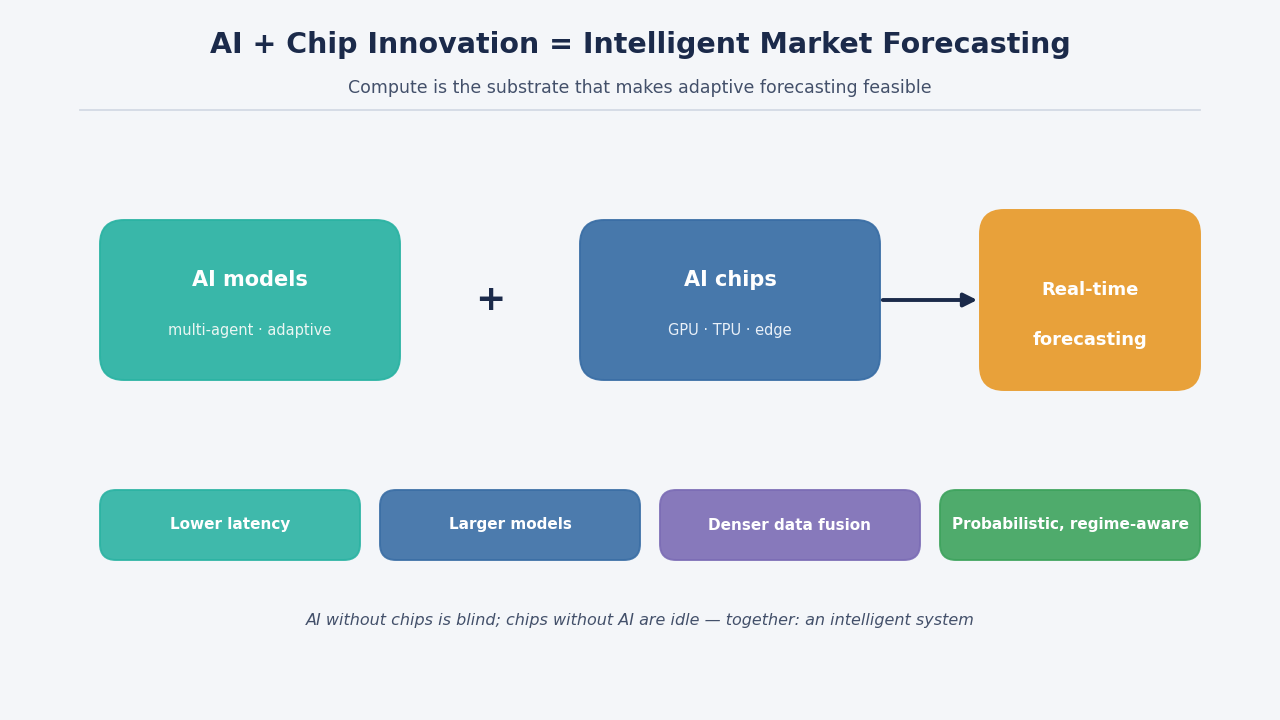
AI progress in finance would stall without parallel advances in hardware. Chip innovation provides the physical substrate that makes intelligent forecasting feasible.
Key Chip Breakthroughs
- GPUs – Massive parallelism for neural networks
- TPUs & AI accelerators – Optimized tensor computation
- Edge AI chips – Low-latency inference near data sources
- Energy-efficient architectures – Sustainable large-scale models
Companies like NVIDIA and Google pioneered this shift, enabling real-time learning at unprecedented scale.
Without specialized chips, AI forecasting remains theoretical. With them, it becomes operational.
AI + Chips = Real-Time Market Intelligence
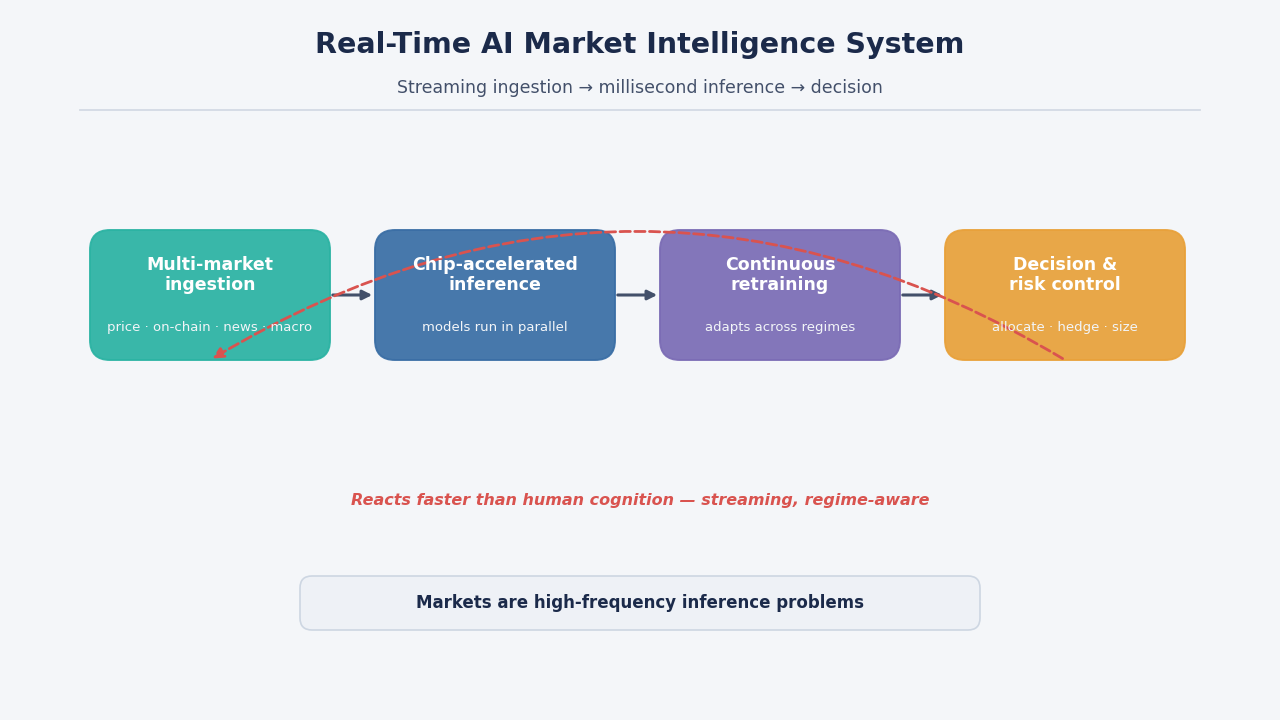
The convergence of AI models and advanced chips creates real-time market intelligence systems capable of:
- Streaming multi-market data ingestion
- Millisecond-level inference
- Continuous retraining across regimes
This is critical for modern investment strategies that must react faster than human cognition.
Multi-Agent AI Systems and Investment Strategy Design
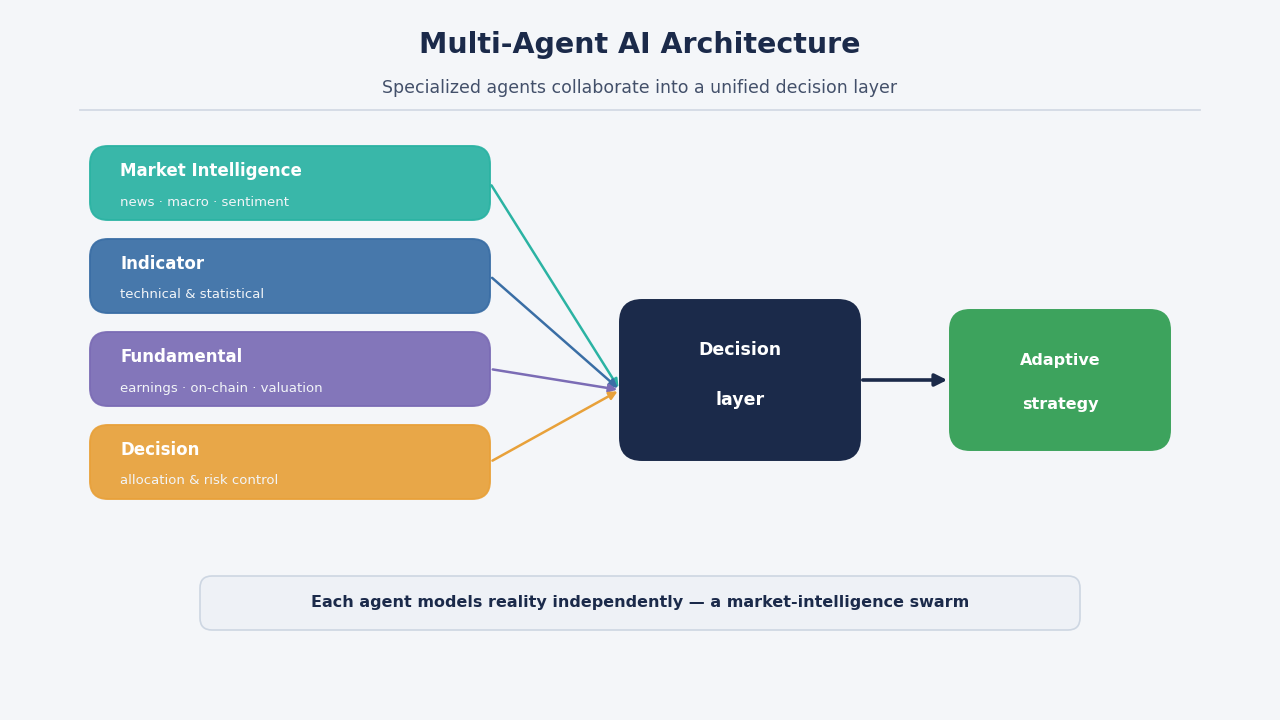
A major innovation is the rise of multi-agent AI architectures, where specialized agents collaborate rather than relying on a single monolithic model.
Typical Agent Roles
- Market Intelligence Agent – News, macro, sentiment
- Indicator Agent – Technical and statistical signals
- Fundamental Agent – Earnings, on-chain flows, valuation
- Decision Agent – Capital allocation and risk control
Platforms such as SimianX AI integrate these agents into a unified decision layer, allowing strategies to adapt across timeframes and asset classes.
How AI Chips Enable Multi-Timeframe Forecasting
Multi-timeframe forecasting (1m → 1d → multi-year) is computationally expensive. Each timeframe represents a different dynamical system.
Advanced chips allow:
- Parallel inference across time horizons
- Hierarchical models sharing latent representations
- Cross-timeframe consistency checks
This enables strategies that align short-term execution with long-term macro trends.
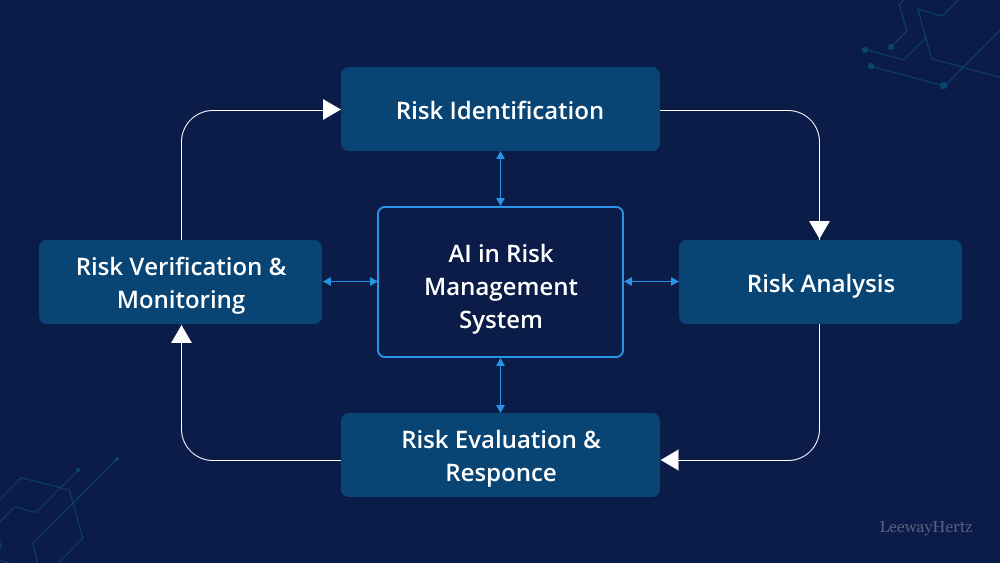
Risk Management in the AI-Chip Era
Risk is no longer measured only by volatility. AI systems quantify tail risk, liquidity risk, and regime risk in real time.
AI-Driven Risk Capabilities
- Early-warning signals before drawdowns
- Stress testing across simulated futures
- Adaptive position sizing
The future of investing is not predicting returns, but predicting risk distributions.
From Prediction to Decision Intelligence
Forecasting alone is insufficient. The real breakthrough is decision intelligence—systems that connect predictions directly to action.
This includes:
- Signal confidence estimation
- Strategy selection by regime
- Dynamic stop-loss and exposure control
AI chips ensure these decisions happen fast enough to matter.
Macro Forecasting at Scale
Macro forecasting involves slow-moving but highly complex systems: rates, liquidity, demographics, geopolitics.
AI models running on large-scale compute can:
- Fuse macro data with market microstructure
- Simulate policy outcomes (rate cuts, QE, fiscal shocks)
- Continuously update macro narratives
This allows investors to position before consensus shifts.
How SimianX AI Applies AI and Chip Innovation
SimianX AI exemplifies how these technologies converge in practice:
- Multi-agent forecasting architecture
- Multi-timeframe market intelligence
- AI-driven risk and scenario analysis
- User-selectable models powered by advanced compute
By abstracting hardware complexity, SimianX allows investors to focus on strategy, not infrastructure.
Investment Strategy Evolution in the AI-Chip Era
| Era | Strategy Style | Limitation |
|---|---|---|
| Pre-AI | Human discretion | Cognitive bias |
| Early quant | Static models | Regime blindness |
| AI + chips | Adaptive intelligence | Requires robust design |
What Investment Strategies Benefit Most?
- Macro trend following
- Volatility-aware strategies
- Cross-asset allocation
- Crypto & digital asset trading
These domains demand speed, adaptability, and probabilistic reasoning.
The Next Decade: Autonomous Investment Systems
Looking ahead, we will see:
- Self-optimizing portfolios
- Continuous learning strategies
- Human-AI collaborative decision loops
Humans define objectives and constraints; AI systems explore the solution space.
Investing becomes a dialogue between human intent and machine intelligence.
FAQ About AI and Chip Innovation in Market Forecasting
How does AI improve market forecasting accuracy?
AI captures non-linear patterns, adapts to regime changes, and integrates diverse datasets that traditional models cannot handle effectively.
Why are AI chips important for investment strategies?
AI chips enable fast training and inference, making real-time forecasting and decision-making possible at market speeds.
Can AI predict market crashes?
AI cannot predict exact events, but it can identify rising risk probabilities and early warning signals.
Is AI replacing human investors?
No. AI augments human decision-making by processing complexity, while humans set goals and constraints.
Conclusion
AI and chip innovation will drive the future of market forecasting and investment strategies by transforming prediction into adaptive, real-time intelligence. As compute power and model sophistication accelerate, investors gain tools to navigate uncertainty with clarity and precision. Platforms like SimianX AI demonstrate how this future is already unfolding—where data, intelligence, and strategy converge.
Explore the next generation of AI-driven investing with SimianX AI.
Computational Scaling Laws in Financial Intelligence
Financial markets are not just noisy — they are computationally deep systems.
They exhibit:
- Multi-scale temporal structure
- Agent reflexivity
- Endogenous feedback loops
- Non-stationary regimes
- Adversarial information flows
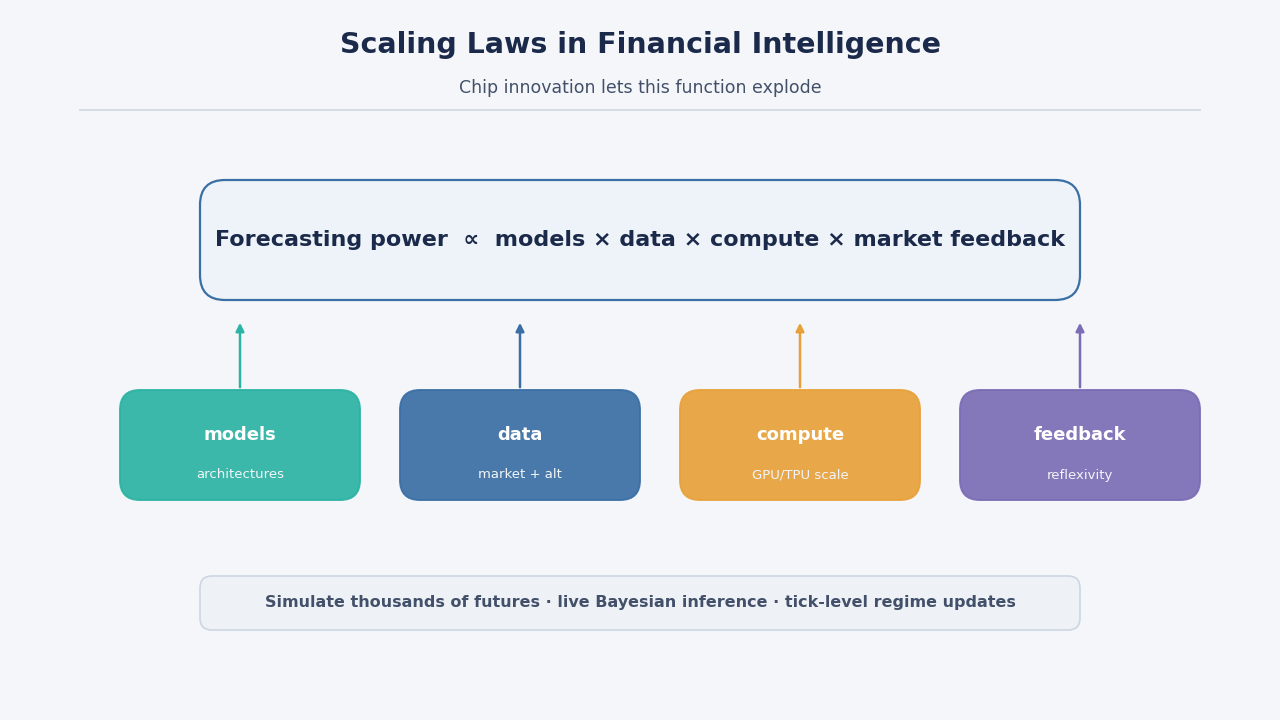
This means market forecasting obeys a variant of AI scaling laws.
In natural language models, scaling laws describe how:
Model accuracy ∝ f(parameters × data × compute)
In financial intelligence, the law becomes:
Forecasting power ∝ models × data × compute × market feedback
Chip innovation is what allows this function to explode.
Without advanced chips, even the best AI architectures cannot:
- Simulate thousands of alternative futures
- Run real-time Bayesian inference
- Update regime classifiers at tick-level resolution
- Maintain live probability surfaces for multiple markets
Markets are high-frequency inference problems.
Why CPUs Failed and Why GPUs Changed Everything
Classical financial systems were built on CPUs.
CPUs are optimized for:
- Sequential logic
- Branching
- Control flow
Markets require:
- Parallel probability computation
- Matrix multiplication
- Nonlinear optimization
- Continuous learning
This mismatch created a hard ceiling on forecasting intelligence.
When GPUs arrived, finance crossed a new threshold:
| CPU Finance | GPU + AI Finance |
|---|---|
| Linear regressions | Deep neural networks |
| Static factor models | Adaptive regime models |
| Backtests | Live simulations |
| Overnight risk | Real-time tail risk |
| Human reaction | Machine-speed reflexes |
Once GPUs could run:
- LSTMs
- Transformers
- Diffusion models
- Graph neural networks
…financial intelligence became dynamical instead of static.
AI Chips as Financial Time Machines
Modern AI chips allow something unprecedented:
The ability to simulate the future continuously.
Instead of one forecast, AI-chip systems generate:
- Thousands of potential futures
- Each with probability distributions
- Updated every second
This turns markets into probabilistic fields, not fixed trajectories.
SimianX’s multi-agent engines operate like this:
- Agents generate independent future scenarios
- Chip-accelerated models simulate paths
- A probability surface emerges
- Capital is allocated to the best-weighted futures
This is Monte-Carlo forecasting at industrial scale.
Why Prediction Becomes a Geometry Problem
Once AI + chips reach scale, forecasting stops being about single numbers and becomes geometric.
Markets form manifolds:
- One axis = price
- One axis = time
- One axis = volatility
- One axis = liquidity
- One axis = macro conditions
AI systems trained on GPUs learn these latent geometries.
Instead of:
BTC will go up
They produce:
BTC exists inside a probabilistic surface that tilts upward under current liquidity + sentiment + volatility constraints
This geometric view allows:
- Smooth regime transitions
- Early detection of instability
- Multi-asset correlation modeling
Humans cannot visualize this.
AI chips can.
Multi-Agent Systems as Financial Societies
Markets are not physical systems — they are social systems.
Every price is the result of:
- Beliefs
- Fear
- Incentives
- Strategy
- Reaction to others
This makes them ideal for multi-agent AI modeling.
SimianX mirrors this by using:
- Signal agents
- News agents
- On-chain agents
- Macro agents
- Execution agents
Each agent forms its own model of reality.
The chips allow:
- All agents to run simultaneously
- Competing hypotheses to be evaluated
- Weak signals to be amplified
- False narratives to be discarded
This creates a market intelligence swarm.
Why LLMs Alone Are Not Enough
LLMs are powerful — but markets are not language.
They are:
- Time series
- Game theory
- Physics
- Economics
- Psychology
The future belongs to hybrid architectures:
| Model Type | Role |
|---|---|
| LLMs | Narrative, macro interpretation |
| Time-series models | Price dynamics |
| Graph models | On-chain flows |
| Reinforcement learning | Strategy optimization |
| Bayesian nets | Risk & uncertainty |
AI chips make these models coexist in real time.
SimianX integrates all of them into a decision-layer stack.
From Indicators to Information Fields
Traditional trading used indicators:
- RSI
- MACD
- Moving averages
AI + chips transform indicators into information fields.
Instead of:
RSI = 68
AI systems see:
Momentum probability field is saturating under liquidity-weighted volatility constraints
This allows:
- Earlier entries
- Better exits
- Fewer false signals
- Higher risk-adjusted returns
Liquidity Is Now Computable
Liquidity used to be invisible.
Now AI chips process:
- Order books
- On-chain flows
- Funding rates
- ETF inflows
- Stablecoin issuance
Liquidity becomes a computable force.
SimianX agents monitor:
- Liquidity expansion
- Liquidity exhaustion
- Hidden capital movements
This is why AI predicts crashes before price moves.
Why Risk Is the True Forecast
Returns are easy.
Risk is hard.
AI + chips focus on:
- Drawdown probability
- Regime shifts
- Correlation breakdowns
- Black-swan exposure
Instead of:
What will happen?
The question becomes:
What could happen, and how bad would it be?
This transforms portfolio design.
The End of Static Portfolios
In the AI-chip era:
Portfolios become:
- Self-adjusting
- Regime-aware
- Volatility-sensitive
- Liquidity-weighted
SimianX implements:
- Dynamic rebalancing
- Real-time risk targeting
- Multi-asset hedging
This is not trading.
This is continuous capital optimization.
Macro Forecasting Becomes a Live Simulation
Central bank policy, inflation, GDP, geopolitics — all become variables in AI-driven simulations.
AI chips allow:
- Millions of macro scenarios
- Updated as news arrives
- Converted into asset probabilities
This is how funds will front-run:
- Rate cuts
- Recessions
- Liquidity waves
The Financial Singularity
When AI + chips reach sufficient scale, a phase shift occurs:
Markets become:
- Self-measuring
- Self-forecasting
- Self-correcting
Human traders become:
- Strategy designers
- Risk supervisors
- Goal setters
SimianX represents the bridge to this future.
What This Means for Crypto, Stocks, and Global Capital
Crypto markets are:
- High volatility
- High reflexivity
- High information density
They are the perfect laboratory for AI-chip finance.
Stocks and macro markets follow next.
The winners will be:
- AI-native funds
- Multi-agent systems
- Chip-accelerated intelligence platforms
Why SimianX Is Built for This Future
SimianX is not a trading app.
It is a market intelligence engine.
It combines:
- AI agents
- Multi-timeframe models
- Real-time chip-accelerated inference
- Risk-aware decision logic
This is exactly what the AI-chip revolution demands.
Final Synthesis
AI without chips is blind.
Chips without AI are useless.
Together they create:
The first truly intelligent financial system in human history.
Markets are becoming:
- Predictable in probability
- Measurable in risk
- Controllable through strategy
SimianX exists at the center of this transformation.
Related Reading
- S&P 500 to 7000: Momentum, Liquidity & Valuation Signals
- 2026 Fed Rate Cut Expectations: Live Market Pricing Map
- Multi-Agent AI for Traders: Strategy & Sentiment Stack
- Agentic AI Investing: Beginner's Guide to Next-Gen Markets
- AI Stock Research for Earnings & News with SimianX
- AI Market Insights: Data-Driven Guide to US Stocks 2026
- SimianX Crypto Leaderboard