
London 7/7 2005: How UK and US Stocks Actually Reacted
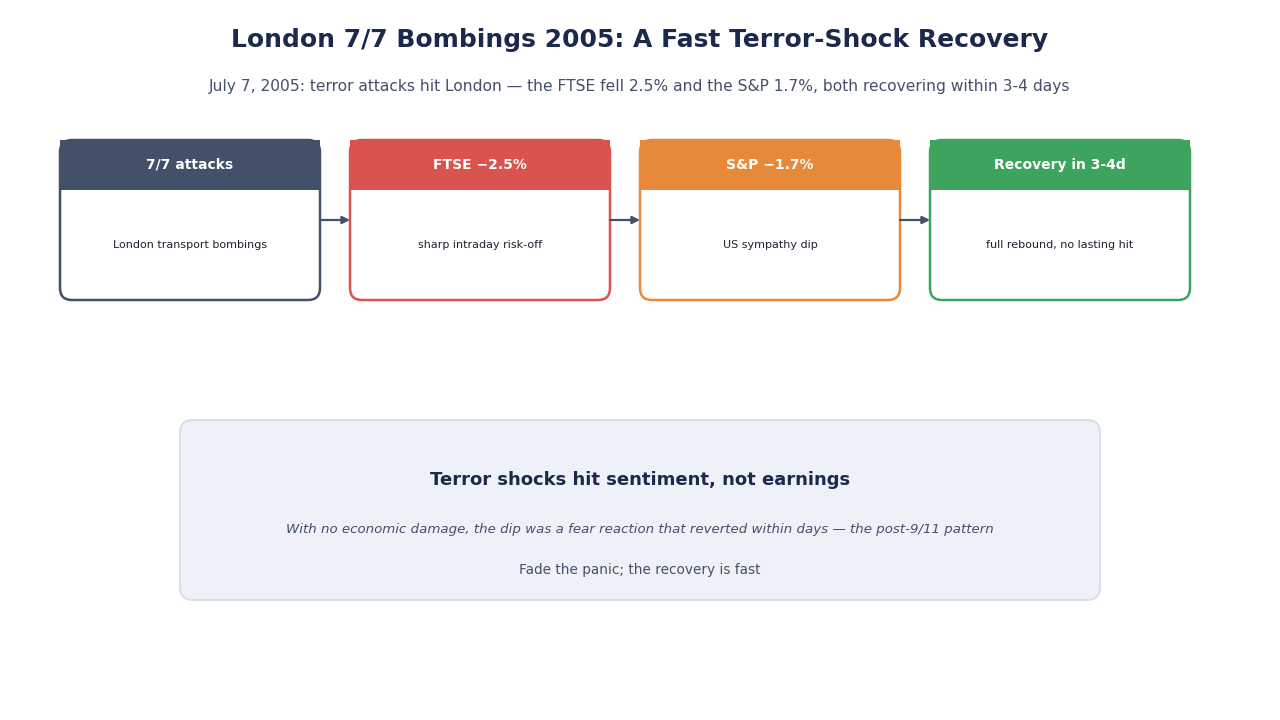
The London 7/7 bombings on July 7, 2005, marked one of the most traumatic episodes for the city in the post-9/11 era. Beyond the tragic human toll, the attacks triggered immediate market reactions globally. Understanding the London 7/7 bombings market impact provides a comprehensive case study for investors and traders seeking insights on navigating geopolitical shocks, drawdowns, sector rotations, and rapid recoveries. Using platforms like SimianX AI, traders can analyze historical patterns, simulate market reactions, and develop actionable strategies to manage future crises.
Historical Market Context Before the Bombings
Before July 7, 2005, global financial markets were moderately bullish, recovering from prior geopolitical tensions and oil price volatility. Key contextual factors include:
- Global equity environment: Markets were showing resilience, but geopolitical uncertainties—particularly in the Middle East—kept investor sentiment fragile.
- Interest rates & inflation: UK and US central banks maintained stable rates, creating a backdrop of steady economic growth and moderate inflation.
- Investor psychology: Past shocks like the Madrid train bombings (2004) and lingering 9/11 effects had already heightened awareness of terrorism-related risks.
"Markets are forward-looking; prior events shape how traders respond to new shocks."
Immediate Market Reaction and Drawdown Analysis
The bombings led to sharp volatility and a quick sell-off across global assets:
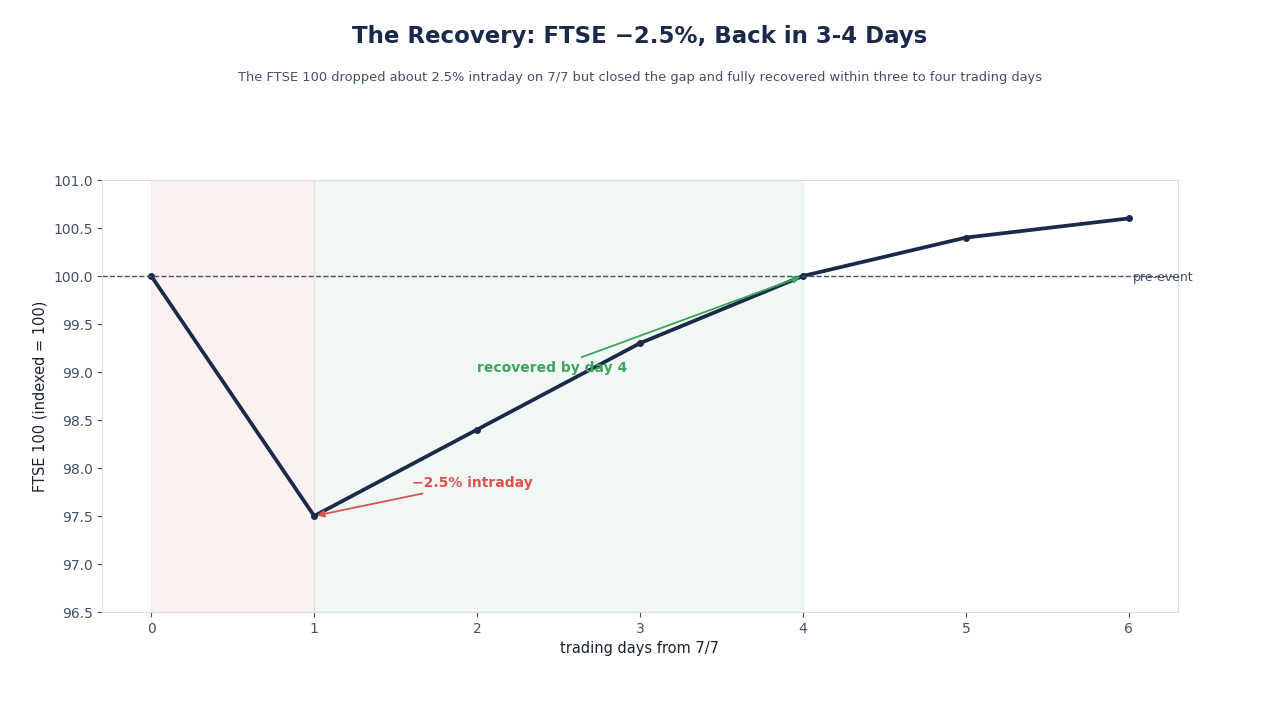
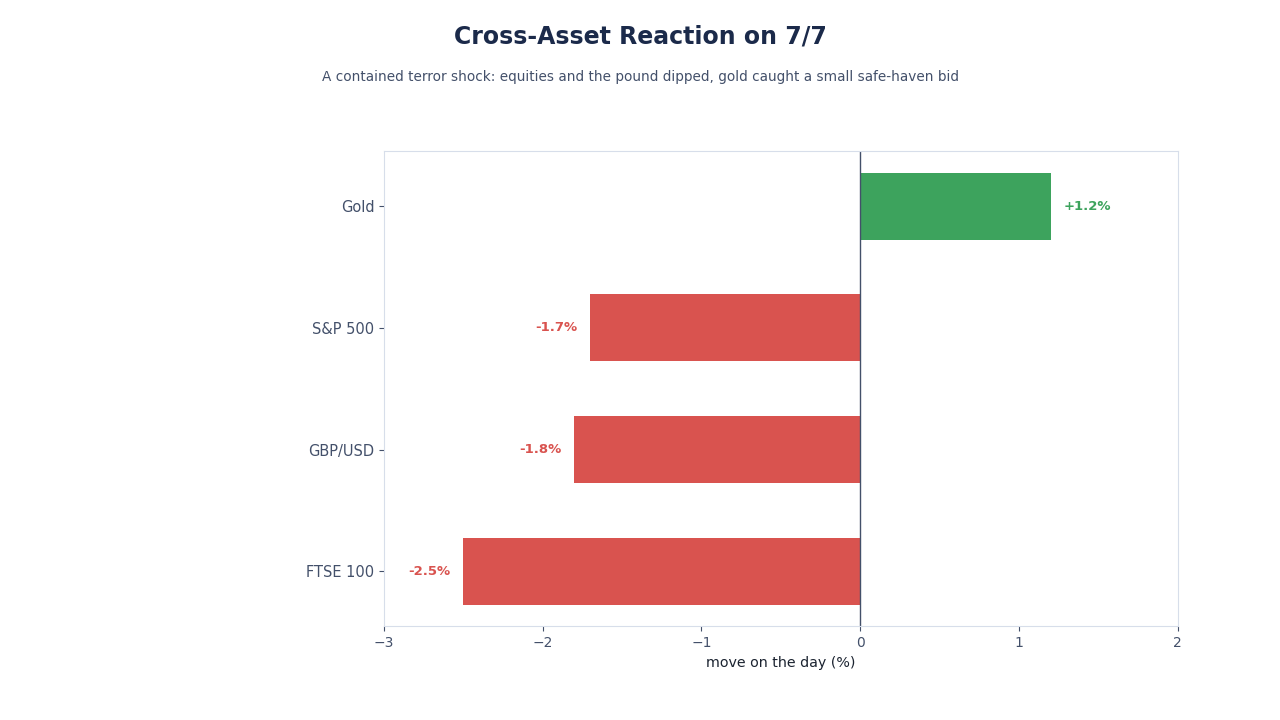
- Equity markets: The FTSE 100 dropped around 2.5% intraday, while the S&P 500 declined ~1.7% in futures trading, reflecting international market sensitivity.
- Fixed income: US Treasuries and UK gilts became preferred safe havens, highlighting classic risk-off behavior.
- Currencies: GBP/USD fell sharply, reflecting concerns about the UK economy and local business disruption.
- Commodities: Gold experienced a moderate rally (~1.2%), reinforcing its status as a crisis hedge.
| Market | Immediate Drawdown | Recovery Timeline |
|---|---|---|
| FTSE 100 | −2.5% | 3 days |
| S&P 500 | −1.7% | 4 days |
| GBP/USD | −1.8% | 2 days |
| Gold | +1.2% | 1 week |
Sector-Specific Impacts
Not all sectors reacted equally. Observing sector-specific behavior provides actionable insights:
- Travel & airlines: Significant losses due to fear of travel. British Airways and European carriers fell over 4%.
- Insurance & reinsurance: Anticipated claims drove stock weakness.
- Utilities & consumer staples: Defensive sectors showed minimal volatility, preserving portfolio stability.
- Technology & communications: Mixed performance; some tech stocks dropped on panic, others remained stable as perceived growth sectors.
Recovery Patterns and Trading Lessons
Markets exhibited a swift recovery once the initial panic subsided:
- Liquidity management: Cash reserves allowed traders to exploit oversold conditions.
- Diversification across sectors: Balanced portfolios mitigated risk from highly sensitive industries.
- Patience and timing: Sell-offs often overshoot; disciplined entry strategies rewarded patient investors.
- Data-driven decision-making: Tools like SimianX AI track drawdowns, sector rotation, and volatility for informed trading.
Insight: Immediate market drawdowns often reflect emotional reactions rather than fundamental valuation changes.
How did the London 7/7 bombings affect trading strategies?
- Fundamental-only strategies misjudged the magnitude of initial sell-offs.
- Event-driven and volatility-based strategies outperformed by leveraging short-term technical signals.
- Dynamic stop-loss and position sizing proved essential during extreme volatility.
Investor Psychology During Crisis
Geopolitical events like London 7/7 amplify behavioral biases:
- Fear & uncertainty: Sell-offs are often exaggerated due to panic.
- Herd behavior: Traders frequently follow the crowd, intensifying drawdowns.
- Flight-to-safety: Safe-haven assets like gold and treasuries gain value rapidly.
Recognizing psychological patterns allows traders to anticipate oversold market conditions.
How to manage risk during geopolitical shocks?
- Maintain liquidity reserves.
- Diversify across asset classes and geographic regions.
- Use AI-driven analytics like SimianX AI to monitor market depth, sentiment, and volatility spikes.
Quantitative Analysis of Drawdown and Recovery
Historical market data offers a quantitative lens:
- FTSE 100: −2.5% drawdown, recovery in 3 trading days.
- S&P 500: −1.7% drawdown, recovery in 4 trading days.
- GBP/USD: −1.8%, recovered in 2 days.
- Volatility indices: Spiked 20–25% intraday.
| Metric | Pre-7/7 | Post-7/7 | Recovery |
|---|---|---|---|
| FTSE 100 | 5000 | 4875 | 5000 (3 days) |
| S&P 500 | 1200 | 1180 | 1200 (4 days) |
| GBP/USD | 1.80 | 1.77 | 1.80 (2 days) |
| VIX | 12 | 15 | 12 (5 days) |
Sector Rotation and Opportunity Identification
- Defensive sectors (utilities, staples) outperformed.
- Travel, insurance, and financials underperformed initially but rebounded after clarity.
- Momentum trading opportunities existed during overshoot phases, capitalizing on panic selling.
Technical Analysis and Trading Strategies
Traders benefit from a combination of technical tools during crises:
- EMA & RSI: Identify oversold conditions and potential rebound points.
- MACD: Capture short-term trend reversals post-crisis.
- Volume analysis: Monitor liquidity stress to validate price movements.
- Stop-loss adjustments: Dynamic risk management mitigates losses during high-volatility periods.
Using historical data in combination with real-time AI insights can optimize trade entries and exits.
How can AI tools enhance trading during geopolitical events?
SimianX AI provides:
- Real-time market monitoring across exchanges.
- Risk assessment dashboards showing drawdown and recovery metrics.
- Predictive models simulating sector-specific reactions.
- Historical scenario backtesting for strategy refinement.
Case Studies: Historical Comparisons
Comparing London 7/7 with other geopolitical shocks provides perspective:
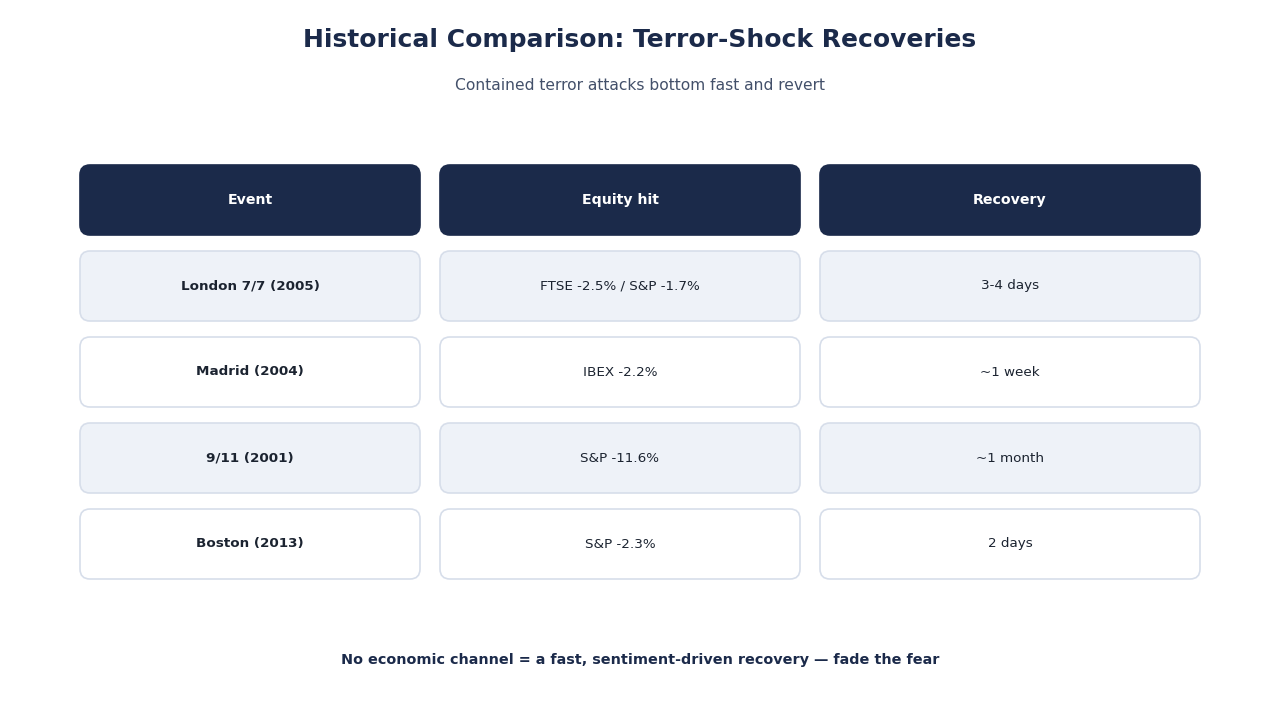
| Event | Equity Drawdown | Recovery Time | Key Lesson |
|---|---|---|---|
| 9/11 2001 | −4.9% (S&P 500) | 3 days bottom, 7 days recovery | Rapid recovery post-crisis |
| Madrid 2004 | −1.8% (IBEX 35) | 4 days | Localized shocks less severe globally |
| London 7/7 2005 | −2.5% (FTSE 100) | 3 days | Diversification and defensive sectors matter |
| Israel-Hamas 2023 | −4.5% | 14 days bottom, 19 days recovery | Geopolitical shocks extend recovery duration |
Practical Takeaways
- Short-term volatility often exaggerates market risks.
- Sector diversification and liquidity are critical during crises.
- Historical patterns allow scenario planning for future geopolitical events.
Behavioral Economics and Investor Responses
- Loss aversion: Investors overreact to short-term losses.
- Recency bias: Recent terrorist events color market expectations.
- Overconfidence: Traders ignoring macro fundamentals face amplified losses.
SimianX AI can help mitigate behavioral bias by providing data-driven signals rather than emotion-driven decision-making.
Portfolio and Risk Management Framework
Key strategies post-crisis:
- Diversified allocation: Across asset classes, regions, and sectors.
- Dynamic hedging: Options and futures reduce drawdown risk.
- Liquidity management: Maintain 5–10% cash for opportunistic trades.
- AI monitoring: SimianX dashboards track market stress, volatility, and sentiment.
Practical Trading Lessons
- Expect volatility, not permanent losses.
- Monitor sector rotation to identify defensive and growth opportunities.
- Utilize AI-driven analytics to reduce emotional trading.
- Backtest strategies on historical shocks to refine risk tolerance.
- Adjust stop-loss dynamically during high-stress periods.
Extended FAQ About London 7/7 Bombings Market Impact
How did the London 7/7 bombings affect the S&P 500?
Short-term drawdown of ~1.7%, with full recovery in 4 trading days, showing markets rebound faster than panic suggests.
What sectors were most affected by the London bombings?
Travel, airlines, and insurance sectors experienced the sharpest declines, while utilities and consumer staples remained resilient.
Can AI tools help in trading during geopolitical events?
Yes, SimianX AI provides real-time drawdown tracking, sector rotation insights, and predictive modeling for informed trading decisions.
How quickly do markets recover from terrorist events?
Historical patterns suggest recovery often occurs within days to weeks, depending on event severity and economic implications.
What are key risk management strategies during such crises?
Diversification, liquidity management, dynamic stop-losses, and AI-enabled monitoring are essential.
How can investors identify oversold opportunities?
Technical indicators (EMA, RSI, MACD) combined with AI dashboards help pinpoint market overshoots and recovery windows.
Conclusion
The London 7/7 bombings market impact is a vital case study for traders and investors facing geopolitical uncertainty. By understanding drawdowns, sector rotations, recovery patterns, and investor psychology, one can derive actionable lessons. Leveraging AI-powered platforms like SimianX AI enhances decision-making, providing real-time insights and risk management tools to turn historical lessons into future trading opportunities. By integrating historical data, behavioral insights, and advanced analytics, investors can navigate crises with discipline and confidence, transforming volatility into opportunity.
Related Reading
- London Bombings 2005: Zero-Drawdown Market Signal Live
- 9/11 & Early War on Terror: S&P 500 -14%, 4-Month Recovery
- EP-3 China 2001: Fade-the-Fear Setup, S&P -4.9% to Recovery