
2019 Saudi Aramco Drone Strike: Oil +20%, Stocks Sell Off, Trading the Shock
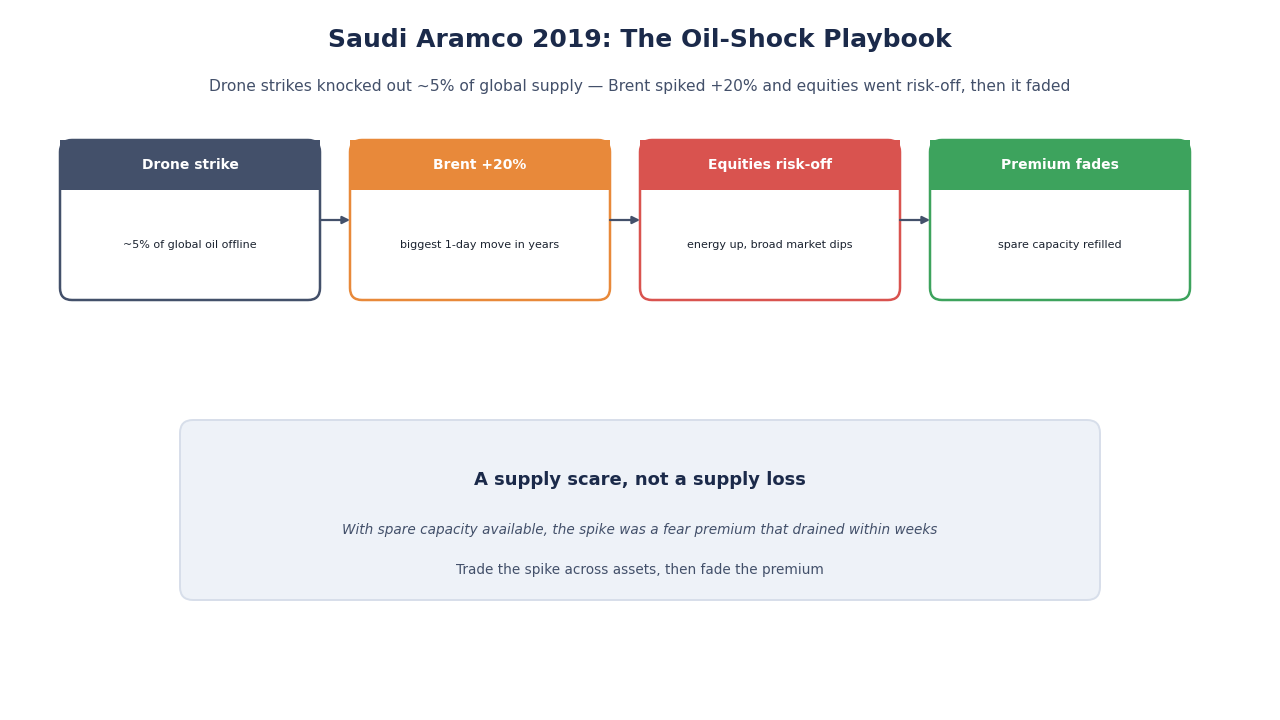
On September 14, 2019, the Saudi Aramco drone strike triggered one of the most dramatic commodity shocks in modern market history. Within hours, traders around the globe scrambled to price in a sudden supply disruption that temporarily knocked out roughly 5.7 million barrels per day of Saudi oil production—about 5% of global supply.
Brent crude exploded higher. Equity futures sold off. Safe havens surged. Volatility repriced instantly.
For traders, this was not just a geopolitical headline—it was a live stress test in cross-asset contagion.
In environments like this, platforms such as SimianX AI become especially relevant, because modern geopolitical trading requires monitoring not just headlines, but real-time liquidity shifts, sentiment flows, volatility expansion, and multi-asset correlations.
What Happened in the Saudi Aramco Drone Strike?
In the early hours of September 14, 2019, drones and cruise missiles struck two critical Saudi Aramco facilities:
- Abqaiq processing facility
- Khurais oil field
The immediate consequence was severe.
| Metric | Impact |
|---|---|
| Saudi production outage | 5.7 million barrels/day |
| Global oil supply affected | ~5% |
| Brent crude opening move | +19.5% intraday |
| WTI opening move | +15%+ |
| S&P 500 futures | Sharp selloff |
| Gold | Rally |
| Treasury yields | Drop |
This became the largest sudden oil supply disruption since the Gulf War era.
Why Was This Such a Big Deal?
Oil markets do not react merely to current supply shortages.
They react to:
- expected duration of disruption
- uncertainty around retaliation
- risk of wider Middle East escalation
- shipping route concerns
- strategic petroleum reserve expectations
The key issue was uncertainty.
Nobody initially knew:
- Was this a one-off?
- Would Iran be blamed?
- Could this escalate into military retaliation?
- Was the Strait of Hormuz next?
That uncertainty drove panic pricing.
Markets hate uncertainty more than bad news.
Brent Crude’s Historic Move
The Saudi Aramco attack triggered one of the most violent oil gap moves in decades.
Price Action Snapshot
| Asset | Pre-Attack | Post-Shock Peak | Move |
|---|---|---|---|
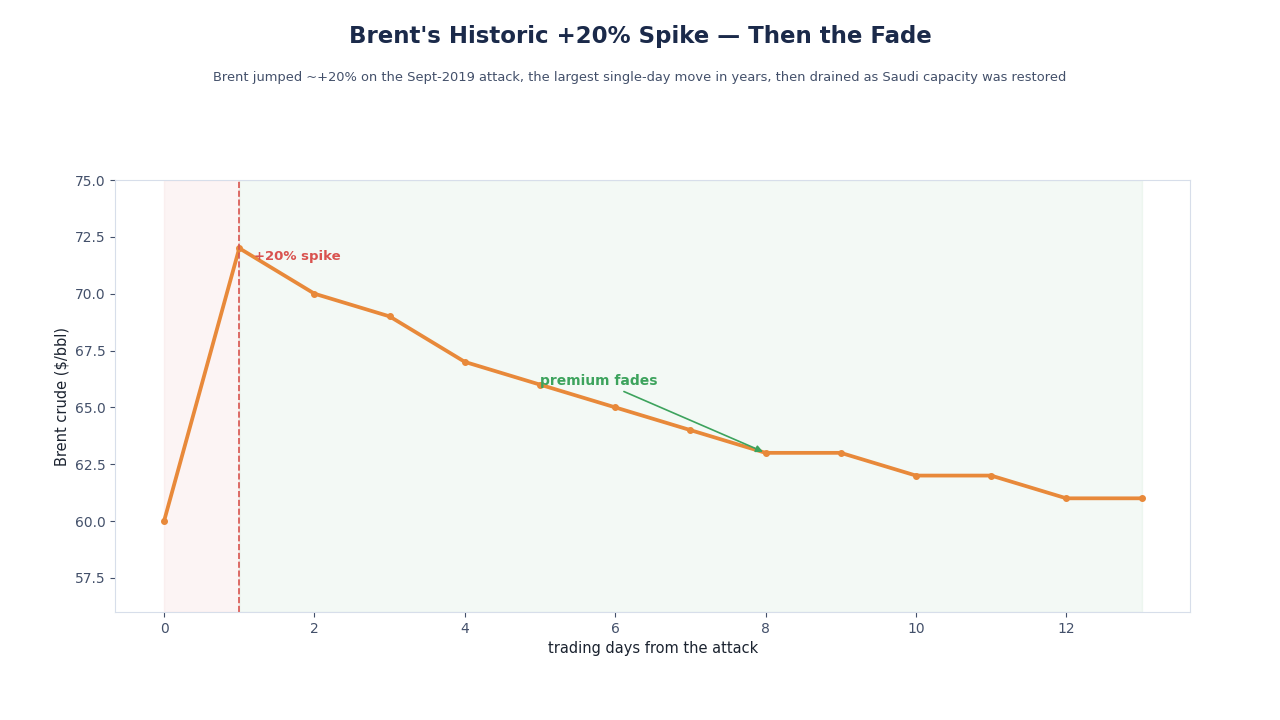
| Brent Crude | ~$60 | ~$72 | +20% |
| WTI Crude | ~$55 | ~$63 | +15% |
| Gold | ~$1490 | ~$1510+ | modest surge |
| USD/JPY | lower | safe haven move | risk-off |
The oil market was reacting to a classic supply shock.
Unlike demand shocks—which tend to evolve gradually—supply shocks arrive violently.
Examples include:
- wars
- sanctions
- embargoes
- infrastructure sabotage
- natural disasters
The Aramco event was infrastructure sabotage at scale.
How Did Stocks React?
S&P 500
Equities immediately moved into risk-off mode.
Why?
Because higher oil can:
- raise inflation expectations
- squeeze corporate margins
- hurt transportation firms
- pressure consumer spending
- reduce global growth expectations
Sectors reacted differently.
Winners
Energy stocks surged
Beneficiaries included:
- Exxon Mobil
- Chevron
- Schlumberger
- Halliburton
Logic:
Higher crude = stronger upstream earnings expectations.
Losers
Worst-hit sectors:
- airlines
- industrials
- consumer discretionary
- transport
Airlines were particularly vulnerable.
Jet fuel cost sensitivity makes airline equities extremely exposed to sudden oil spikes.
Defensive Stability
Relative resilience:
- utilities
- healthcare
- staples
Classic defensive rotation behavior.
Sector Rotation Framework
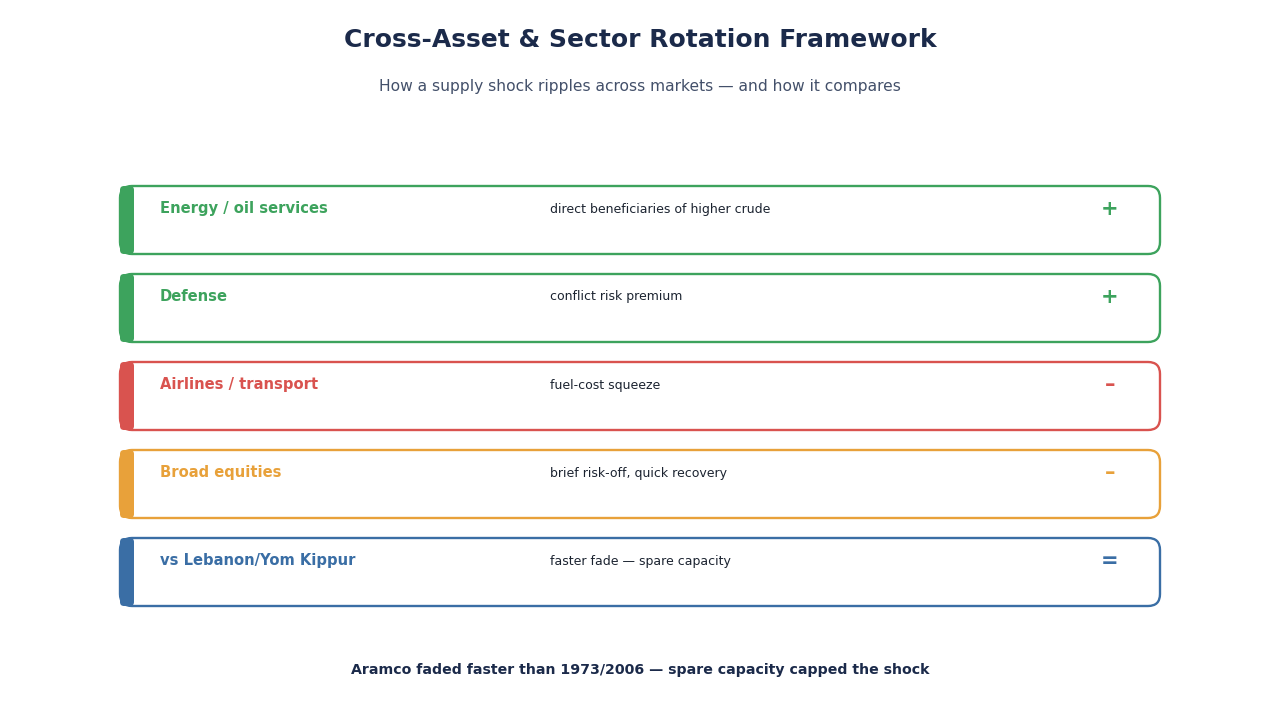
This event created textbook sector rotation.
| Sector | Expected Reaction |
|---|---|
| Energy | Bullish |
| Airlines | Bearish |
| Industrials | Bearish |
| Consumer discretionary | Bearish |
| Defense contractors | Potential bullish |
| Utilities | Defensive bid |
Understanding these second-order effects matters more than simply reacting to the headline.
Because the first trade is often obvious.
The better trade is often in sector dispersion.
Why Geopolitical Traders Focus on Cross-Asset Signals
A geopolitical shock is never just about one asset.
The professional framework includes:
Commodity Reaction
Questions:
- Is oil moving?
- Is natural gas reacting?
- Are metals responding?
Equity Index Reaction
Questions:
- S&P futures selling?
- Nasdaq underperforming?
- Russell weakness?
Safe Haven Flow
Watch:
- Gold
- USD
- CHF
- Treasuries
Volatility
Critical signals:
- VIX spike
- options skew expansion
- put demand
FX Impact
Oil-importing countries may weaken.
Oil exporters may strengthen.
This is why isolated chart watching is insufficient.
SimianX AI’s multi-agent monitoring architecture is useful here because geopolitical event trading requires simultaneous interpretation of:
- macro headlines
- sentiment shifts
- technical levels
- cross-market liquidity
- options stress
How to Trade Geopolitical Oil Shocks
Step 1: Identify Shock Type
Not all geopolitical headlines are equal.
| Shock Type | Market Impact |
|---|---|
| Rhetoric only | temporary noise |
| Sanctions | moderate |
| Infrastructure attack | severe |
| Military escalation | extreme |
| Shipping disruption | severe |
Saudi Aramco = infrastructure attack.
High severity.
Step 2: Measure Narrative Persistence
Ask:
Will this be fixed in:
- hours?
- days?
- weeks?
- months?
Saudi officials quickly moved to reassure markets.
That mattered.
Because if the outage had persisted longer, crude could have moved far higher.
Step 3: Watch Correlation Confirmation
A real shock should show confirmation across:
- oil
- futures
- bonds
- volatility
- safe havens
If only one market reacts, fade cautiously.
Step 4: Look for Overreaction
Fast traders ask:
Has panic overshot fundamentals?
Oil spikes often retrace when:
- repairs are faster than feared
- escalation does not materialize
- SPR intervention appears
That happened here.
Did Oil Stay Elevated?
No.
This is one of the most important lessons.
The initial shock was dramatic.
But Saudi restoration efforts moved faster than feared.
As supply confidence returned:
- Brent retraced sharply
- panic premium faded
- equity sentiment stabilized
This illustrates a critical truth:
Headline shocks are often faster than underlying fundamental repricing.
Historical Comparisons
Saudi Aramco vs Other Geopolitical Market Shocks
| Event | Immediate Shock | Market Pattern |
|---|---|---|
| Pearl Harbor | severe panic | prolonged uncertainty |
| Gulf War | oil surge | high volatility |
| Iraq War 2003 | pre-priced risk | relief rally |
| Saudi Aramco 2019 | supply panic | fast retracement |
| Israel-Hamas 2023 | moderate risk-off | contained |
Each shock trades differently.
Context matters.
Why Did the Saudi Shock Fade Faster?
Three reasons:
1. Fast Repair Expectations
Supply restoration confidence reduced panic.
2. No Immediate Full-Scale War
Escalation risk stayed contained.
3. Strategic Supply Confidence
Markets believed reserves could stabilize supply.
This reduced tail-risk pricing.
How Would Modern AI Traders Handle This?
Today’s traders operate differently.
AI systems can monitor:
- live news flow
- sentiment velocity
- abnormal order flow
- options positioning
- sector divergence
- support/resistance stress zones
SimianX AI provides a particularly useful framework because its multi-agent structure separates:
- technical analysis agents
- sentiment intelligence agents
- macro/fundamental agents
- decision fusion agents
That matters because geopolitical events generate conflicting signals.
Example:
- oil bullish
- equities bearish
- oversold technicals bullish
- sentiment panic extreme
Human traders struggle with conflicting narratives.
AI-assisted decision systems can process faster.
What Is the Best Way to Trade Saudi Aramco-Style Oil Shocks?
The most effective framework:
- classify the event
- confirm cross-asset contagion
- identify likely beneficiaries
- identify vulnerable sectors
- monitor escalation probability
- watch narrative decay
- fade panic if fundamentals normalize
Avoid:
- emotional chasing
- ignoring volatility regime shifts
- assuming every oil spike persists
Practical Trading Checklist
Before entering a trade:
- Is the supply disruption real?
- Is military escalation probable?
- Is crude confirming?
- Are safe havens confirming?
- Is VIX expanding?
- Is headline flow accelerating?
- Is this first-order panic or second-order opportunity?
FAQ About Saudi Aramco Drone Strike Market Impact
What happened after the Saudi Aramco drone strike?
The attack temporarily disrupted about 5% of global oil supply, causing crude prices to surge dramatically while equities entered risk-off mode. Markets later stabilized as repair timelines improved.
How to trade geopolitical oil shocks?
Focus on event classification, cross-asset confirmation, sector rotation, volatility monitoring, and narrative persistence rather than reacting emotionally to headlines.
Why did oil spike 20% after the Saudi Aramco attack?
Because markets feared a severe supply shortage combined with possible broader Middle East escalation. The uncertainty premium drove aggressive repricing.
Did stocks crash after the Saudi Aramco attack?
Not a full crash, but equity futures sold off and risk-sensitive sectors underperformed while energy stocks rallied.
What tools help monitor geopolitical trading risk?
Professional traders use systems combining technical signals, macro intelligence, sentiment analysis, and real-time market monitoring—platforms like SimianX AI fit this workflow.
Conclusion
The 2019 Saudi Aramco drone strike market impact remains one of the clearest modern examples of how quickly geopolitical risk can reprice global markets.
Oil surged nearly 20%.
Stocks sold off.
Safe havens caught bids.
Sector rotation accelerated instantly.
But the deeper lesson is not merely that geopolitical shocks create volatility.
It is that trading success depends on distinguishing temporary panic from structural disruption.
For traders navigating future geopolitical risk, AI-enhanced decision workflows offer a significant advantage. To monitor real-time sentiment, technical signals, macro catalysts, and cross-market stress in one place, explore SimianX AI.
Related Reading
- 2019 Saudi Aramco Drone Strike: Oil +20%, Stocks -5%
- How Oil Volatility Shakes US Stocks: $10 Move Sector Map
- Yom Kippur War 1973: Oil 4x, 2-Year Global Stock Crash
- 1991 Gulf War Countdown: Oil Doubles, Pre-Storm Stock Setup
- Second Lebanon War 2006: Oil $78 Spike, Stocks Resilient
- Oil -5% on Iran-Hormuz Talks: Brent, WTI & Sector Map 2026