
Madrid Bombings 2004 Market Impact: Drawdown, Recovery, and Trading Lessons
Geopolitical shocks often create some of the fastest and most emotionally driven market reactions in modern finance. The Madrid Bombings 2004 Market Impact remains one of the clearest examples of how sudden terrorist attacks can trigger immediate risk-off behavior, sector rotation, and rapid repricing of uncertainty.
For traders and investors, understanding these events is not about predicting tragedy—it is about understanding how markets process shock, fear, uncertainty, and recovery. Today, AI-driven platforms like SimianX AI help traders interpret these moments faster by combining macro headlines, technical signals, sentiment flows, and market structure into actionable intelligence.
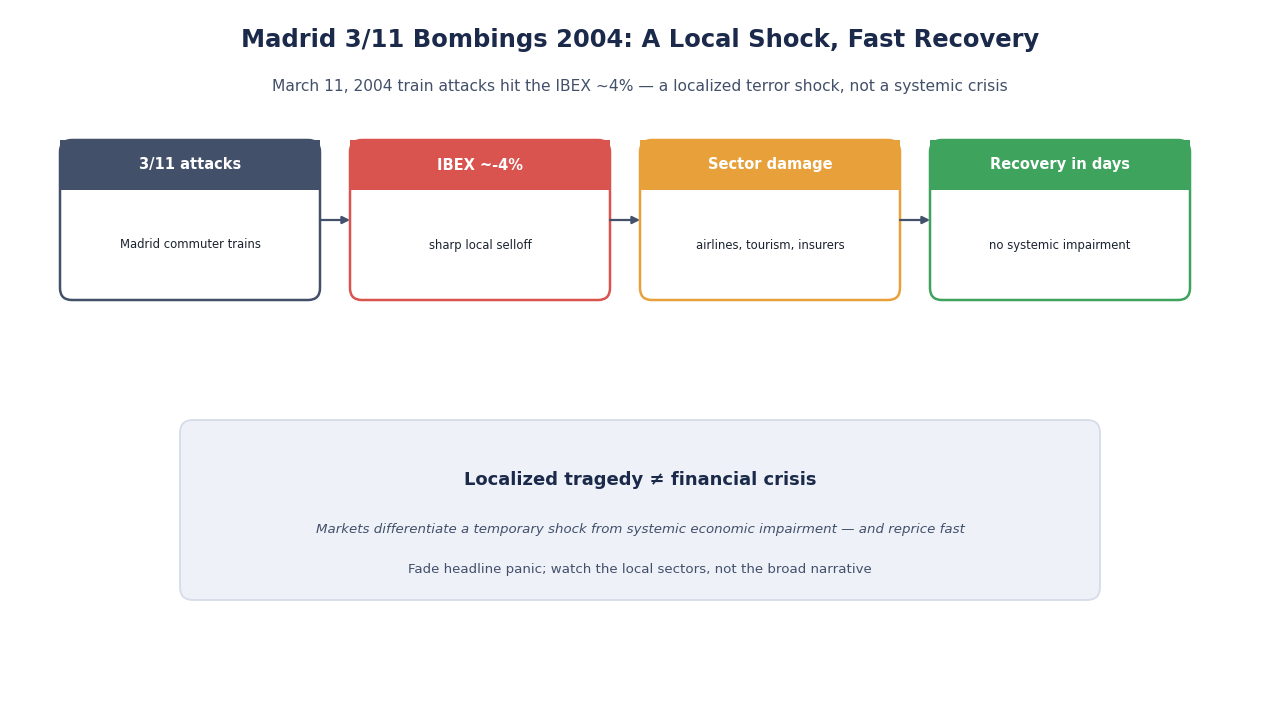
Event Overview: What Happened in Madrid on March 11, 2004?
On March 11, 2004, a coordinated terrorist attack targeted Madrid’s commuter rail system during morning rush hour.
Key facts:
- 10 explosions hit four commuter trains
- 193 people were killed
- More than 2,000 injured
- One of Europe’s deadliest terrorist attacks
- Immediate political uncertainty ahead of Spanish national elections
The event was not only a humanitarian tragedy—it also became a major financial shock.
Markets immediately faced questions:
- Was this an isolated attack?
- Would broader European security risks rise?
- Could consumer confidence collapse?
- Would political instability change fiscal policy?
- Would this trigger wider global risk aversion?
The answers mattered enormously for capital markets.
Immediate Market Reaction: Madrid Bombings 2004 Market Impact
The first and most direct reaction was classic risk-off positioning.
European Equity Selloff
Spain’s equity market reacted sharply.
| Asset | Immediate Reaction |
|---|---|
| IBEX 35 | Approx. -2% to -3% intraday |
| European Airlines | Sharp declines |
| Travel & Tourism | Heavy selling |
| Insurance | Weakness on claims uncertainty |
| Defense/Security | Relative strength |
This followed a predictable institutional response:
- Sell uncertainty
- Reduce cyclical exposure
- Rotate toward defensive sectors
- Price political risk
- Hedge for contagion
The IBEX 35 suffered disproportionately because the event occurred domestically.
Why Local Markets Usually Get Hit Harder
Geopolitical attacks typically create concentrated local damage because investors rapidly price:
Economic disruption
Consumer confidence deterioration
Tourism weakness
Operational interruptions
Political instability
For Spain, all five concerns appeared simultaneously.
Markets price uncertainty faster than they price economic reality.
Political Risk Amplified the Shock
The Madrid attacks happened just days before Spain’s general election.
This dramatically increased uncertainty.
Investors were not simply pricing terrorism.
They were pricing:
- potential policy changes
- military strategy shifts
- alliance uncertainty
- fiscal implications
- confidence shock to domestic spending
Political risk often matters more than the immediate event itself.
Historical examples show this repeatedly:
| Event | Political Risk Importance |
|---|---|
| 9/11 | Extremely High |
| Brexit Vote | Extremely High |
| Madrid 2004 | Very High |
| London 7/7 | Moderate |
| Paris 2015 | Moderate |
Madrid became a hybrid crisis:
terror event + election uncertainty + macro confidence shock
That combination magnified volatility.
Drawdown Analysis: How Deep Was the Market Decline?
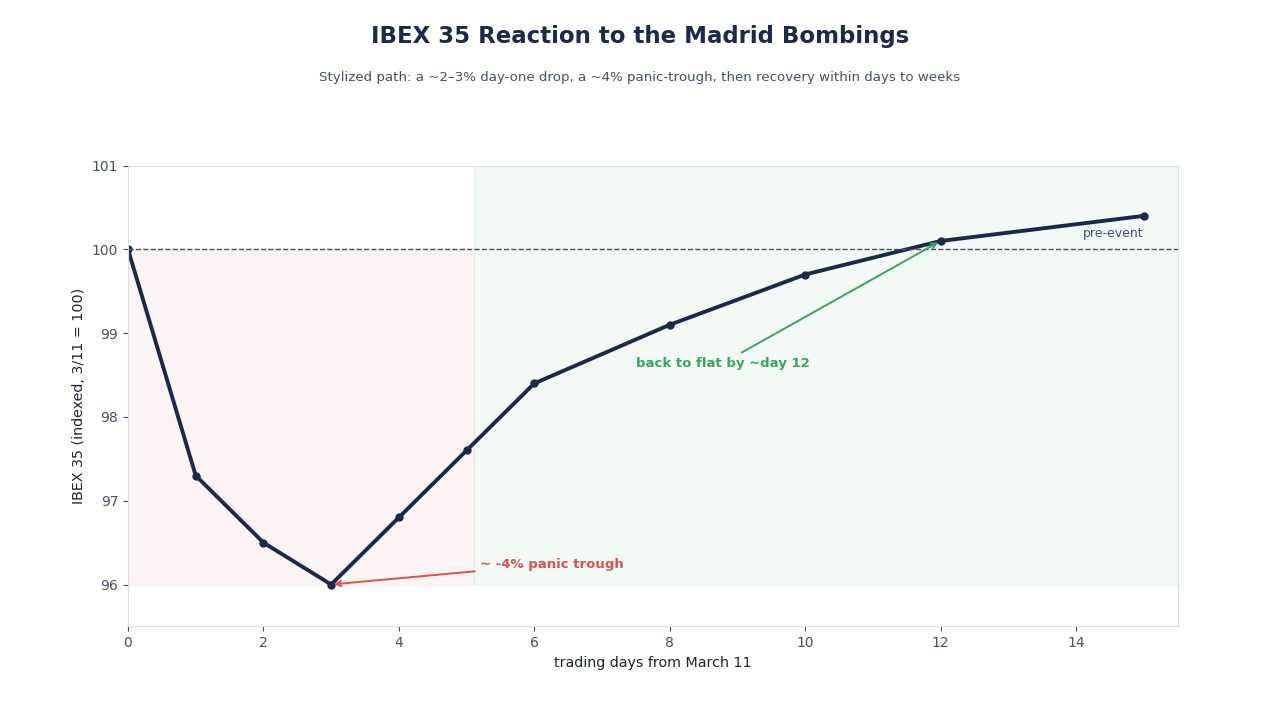
IBEX 35 Drawdown
Estimated short-term market behavior:
- Day 1: approximately -2% to -3%
- Peak panic drawdown: around -4%
- Recovery window: within days to weeks depending on political clarity
The decline was sharp but not structurally catastrophic.
Why?
Because markets quickly differentiated between:
temporary shock
vs
systemic economic impairment
This distinction is crucial.
A localized tragedy does not automatically create a financial crisis.
Cross-Asset Behavior
During shock periods, institutional behavior often looks like this:
| Asset Class | Typical Response |
|---|---|
| Equities | Selloff |
| Bonds | Safe-haven buying |
| Gold | Strength |
| Airlines | Sharp weakness |
| Tourism | Weakness |
| Energy | Mixed |
| Defense | Relative outperformance |
Madrid broadly fit this pattern.
How Fast Did Markets Recover?
Recovery speed is one of the most useful lessons.
Not every terrifying event produces prolonged bear markets.
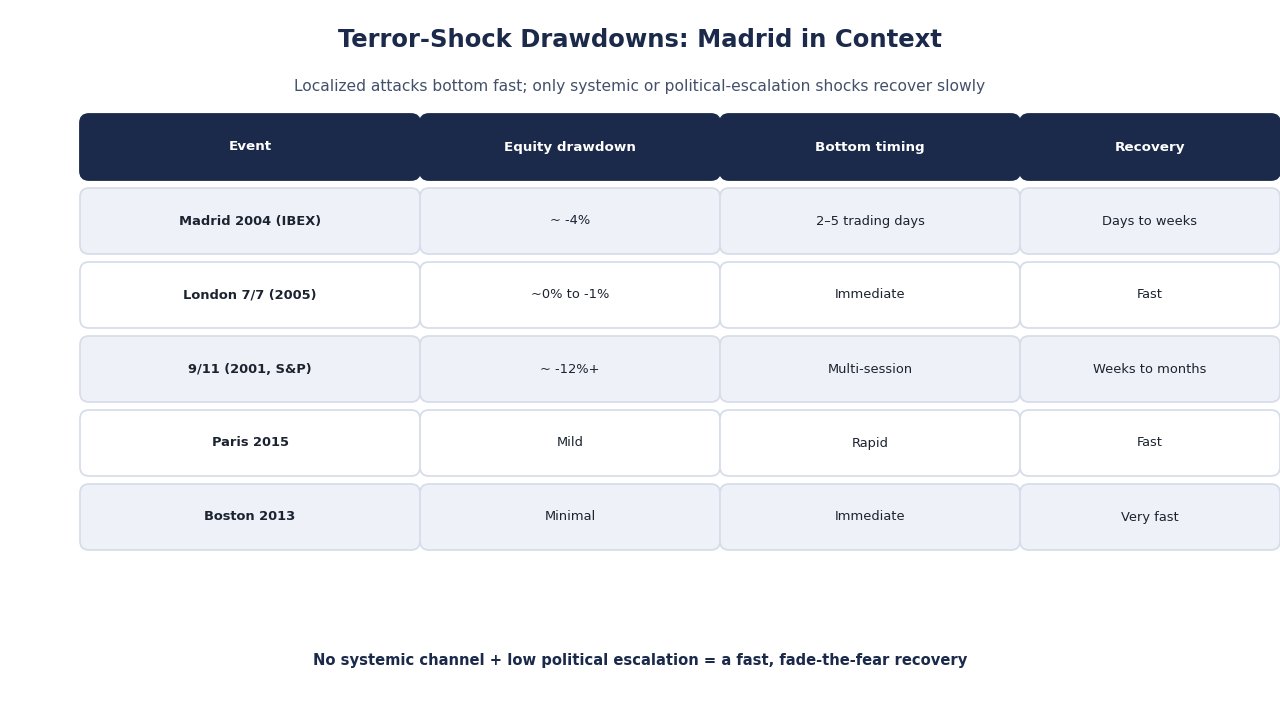
Historical comparison:
| Event | Approx Drawdown | Bottom Timing | Recovery Speed |
|---|---|---|---|
| Madrid 2004 | ~4% | 2–5 trading days | Days to weeks |
| London 7/7 | ~0% to -1% | Immediate | Fast |
| 9/11 | ~12%+ | Multi-session | Weeks/months |
| Paris 2015 | Mild | Rapid | Fast |
| Boston Marathon | Minimal | Immediate | Very fast |
Madrid recovered relatively quickly because:
- infrastructure damage was localized
- global economic system unaffected
- liquidity remained intact
- no banking contagion
- institutional confidence returned
What Determines Recovery Speed?
Three major variables:
1. Systemic Financial Risk
If banks, credit, or payment systems are threatened:
recovery slows.
Madrid did not create systemic financial plumbing risk.
2. Political Escalation Risk
If uncertainty spreads:
markets stay weak longer.
Election uncertainty initially delayed normalization.
3. Repeat Attack Fear
Markets hate uncertainty loops.
Single event:
easier recovery.
Ongoing threat:
slower recovery.
Trading Lessons from Madrid Bombings 2004 Market Impact
Modern traders can extract practical lessons.
Lesson 1: Headline Panic Often Peaks Early
The most emotional selling often happens quickly.
Institutions react immediately because:
- uncertainty is maximal
- information is incomplete
- risk managers force exposure cuts
This creates overshooting.
For disciplined traders, panic is information.
Not certainty.
Lesson 2: Local Sector Damage Matters More Than Broad Narratives
The broad market story may be less important than sector sensitivity.
Most exposed:
- airlines
- hotels
- tourism
- insurers
- transportation
Less exposed:
- utilities
- staples
- telecom
- healthcare
This helps frame pair trades.
Example:
Short travel / long defensive sectors.
Lesson 3: Political Timing Changes Everything
A terror event near elections creates higher uncertainty.
Markets price:
- leadership changes
- geopolitical alignment shifts
- defense spending expectations
- fiscal uncertainty
Political context matters as much as the event itself.
How SimianX AI Helps During Geopolitical Shock Trading
Modern traders face an information overload problem.
During breaking events, checking:
- news terminals
- technical charts
- sentiment feeds
- order flow
- macro dashboards
separately is too slow.
This is where SimianX AI becomes practical.
With SimianX AI, traders can combine:
- real-time technical indicators
- sentiment monitoring
- macro intelligence
- multi-timeframe analysis
- AI-generated risk interpretation
Instead of reacting emotionally, traders can build structured responses.
Example workflow:
- Detect sudden volatility spike
- Check cross-asset correlation shifts
- Monitor AI interpretation of headline flow
- Review technical breakdown levels
- Decide whether panic is expanding or exhausting
This process matters far more than guessing headlines.
Comparing Madrid with Other Terror Market Events
Terror Attack Market Behavior Framework
| Characteristic | Fast Recovery | Slow Recovery |
|---|---|---|
| Localized event | Yes | Sometimes |
| Systemic financial risk | No | Yes |
| Political instability | Low | High |
| Repeat threat | Low | High |
| Infrastructure disruption | Temporary | Severe |
Madrid sat in the middle.
Scary enough for immediate repricing.
Contained enough for eventual normalization.
What Traders Often Get Wrong
Common mistakes:
Mistake #1: Assuming every shock becomes a crash
Most do not.
Mistake #2: Buying too early
Panic can extend further than expected.
Mistake #3: Ignoring political variables
Politics often drives second-wave volatility.
Mistake #4: Watching only equities
Cross-asset signals matter.
Could Madrid-Style Events Move Markets Differently Today?
Yes.
Modern markets differ because:
- algorithmic trading reacts faster
- ETF flows amplify momentum
- social media accelerates sentiment contagion
- options positioning creates gamma effects
- global macro linkages are tighter
Today’s selloff could be sharper intraday.
But recovery might also be faster.
AI-assisted trading tools like SimianX AI help process these higher-speed environments more effectively.
How do markets react to terrorist attacks today?
Modern reactions typically follow:
- Immediate futures volatility
- Risk-off sector rotation
- Treasury/bond demand
- options hedging spike
- narrative stabilization
- recovery if systemic risk remains low
Speed changed.
Human psychology did not.
FAQ About Madrid Bombings 2004 Market Impact
What happened to the Spanish stock market after the Madrid bombings?
The Spanish equity market sold off sharply, with the IBEX 35 experiencing an immediate decline as investors priced uncertainty, political risk, and economic disruption concerns.
How long did markets take to recover after the Madrid train bombings?
Recovery was relatively fast compared with systemic crises. Once investors saw the broader financial system remained stable, confidence returned.
Do terrorist attacks always cause stock market crashes?
No. Most localized attacks create short-term volatility but not prolonged bear markets unless they trigger systemic financial or geopolitical escalation.
What sectors are most vulnerable during geopolitical shock events?
Travel, tourism, airlines, insurers, transportation, and consumer discretionary sectors typically face the heaviest immediate pressure.
Can AI help traders manage geopolitical risk?
Yes. AI platforms like SimianX AI help consolidate technical, sentiment, and macro signals so traders can make more structured decisions under stress.
Conclusion
The Madrid Bombings 2004 Market Impact shows a timeless market truth:
fear creates immediate repricing, but recovery depends on whether systemic risk emerges.
For traders, the practical lessons are clear:
- separate emotional headlines from structural damage
- monitor political uncertainty
- watch sector sensitivity
- track cross-asset confirmation
- avoid impulsive panic decisions
In modern fast-moving markets, structured decision-making matters more than ever.
If you want a disciplined AI-assisted framework for interpreting geopolitical volatility, monitoring market signals, and improving reaction speed, explore SimianX AI.
Related Reading
- London 7/7 Bombings 2005: FTSE -2.5%, S&P -1.7% in 3 Days
- London Bombings 2005: The Zero-Drawdown Market Signal
- 9/11 & Early War on Terror: S&P 500 -14%, 4-Month Recovery
- EP-3 China 2001: Fade-the-Fear Setup, S&P -4.9% to Recovery