
What Trump's 2026 Disclosure Reveals: Nvidia In, Microsoft Out
Trump Financial Disclosure 2026: Nvidia Buy, Microsoft Sale has become a high-signal case study for investors, journalists, and policy watchers trying to understand how presidential financial disclosures should be read. The headline is simple: a reported $1 million to $5 million Nvidia purchase and a $5 million to $25 million Microsoft sale. The research question is more complex: what does the official OGE source actually prove, and what should readers avoid over-interpreting?
For readers using SimianX AI, this is exactly the kind of event-driven market story that benefits from a disciplined, source-first workflow: separate the filing facts from market narrative, then evaluate the implications across policy, sector exposure, and portfolio risk.
Key Takeaways From the Trump Financial Disclosure 2026 Report
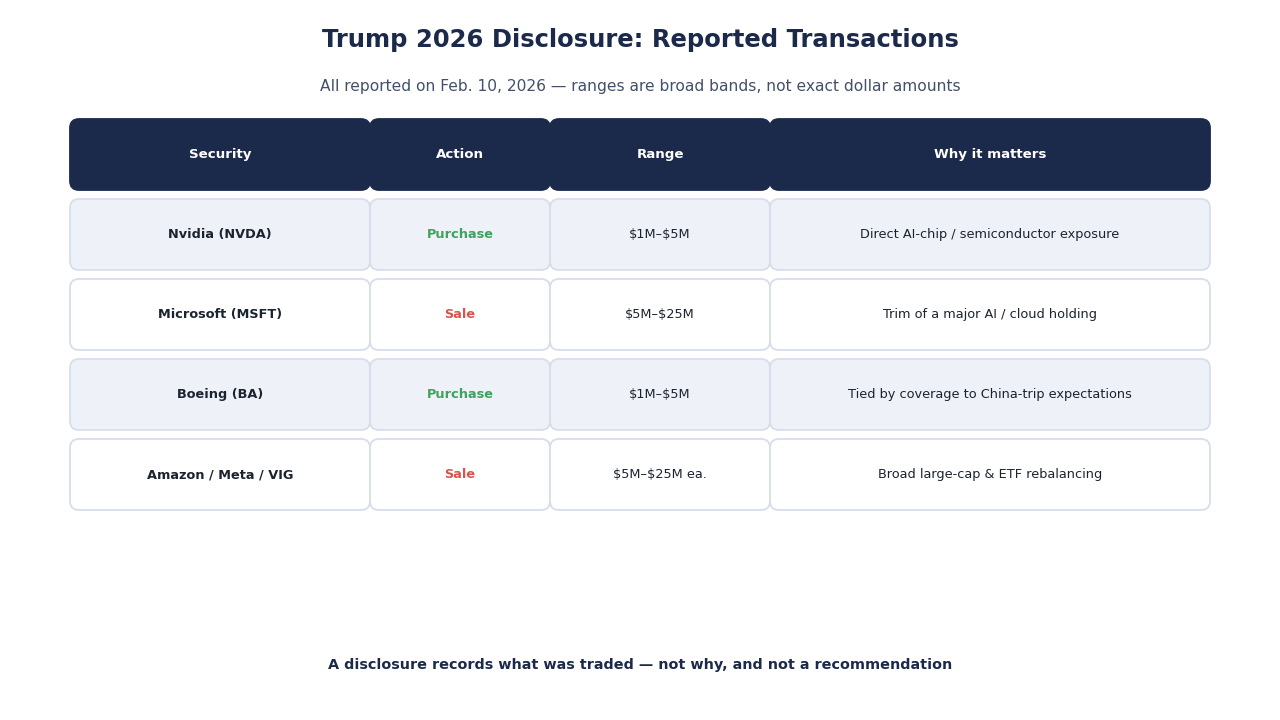
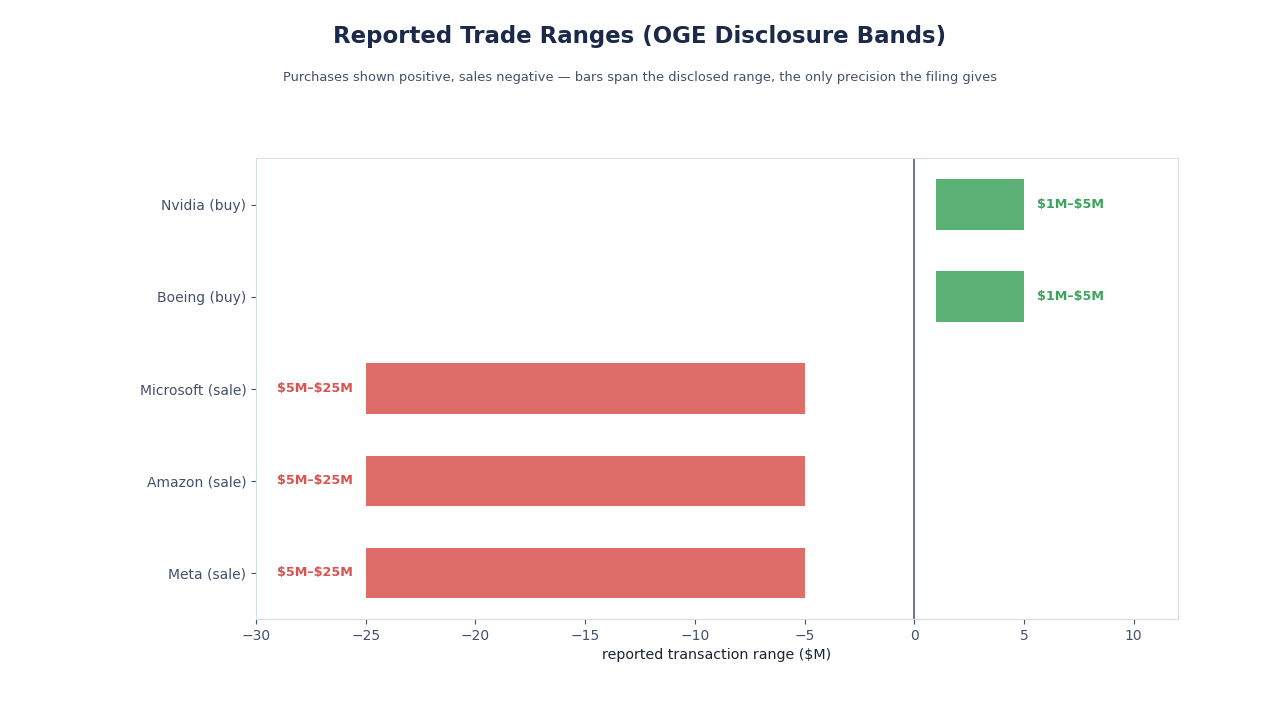
According to MarketWatch, a 113-page disclosure made available through a U.S. Office of Government Ethics website showed that President Donald Trump bought Boeing and Nvidia shares on February 10, with each purchase reported in the $1 million to $5 million range. The same report said the disclosure showed large sales on February 10 in the $5 million to $25 million range for Amazon, Meta, Microsoft, and Vanguard Dividend Appreciation ETF shares.
| Security | Reported Action | Date Reported | Reported Range | Why It Matters |
|---|---|---|---|---|
Nvidia (NVDA) | Purchase | Feb. 10, 2026 | $1M–$5M | Direct exposure to AI chips and semiconductor policy |
Microsoft (MSFT) | Sale | Feb. 10, 2026 | $5M–$25M | Reduction in a major AI/cloud software holding |
Boeing (BA) | Purchase | Feb. 10, 2026 | $1M–$5M | Linked by market coverage to China-trip expectations |
| Amazon / Meta / VIG | Sale | Feb. 10, 2026 | $5M–$25M each | Suggests broad large-cap and ETF rebalancing |
Key insight: The disclosure is more useful as a map of reported transactions than as proof of motive, timing skill, or policy intent.
The filing does not disclose the exact dollar amount, share count, execution price, broker, or investment rationale. Government financial disclosure forms commonly report transactions in broad ranges rather than exact amounts, which is why the Nvidia buy and Microsoft sale should be described as reported value bands, not precise trade sizes.
What Is OGE Form 278e, and Why Is It the Source Readers Need to Understand?
The source needs to be written clearly because OGE Form 278e and OGE Form 278-T are related but not identical. The U.S. Office of Government Ethics describes the Public Financial Disclosure Guide as guidance for completing and reviewing the Executive Branch Personnel Public Financial Disclosure Report, OGE Form 278e, and the supplemental Periodic Transaction Report, OGE Form 278-T.
In plain English:
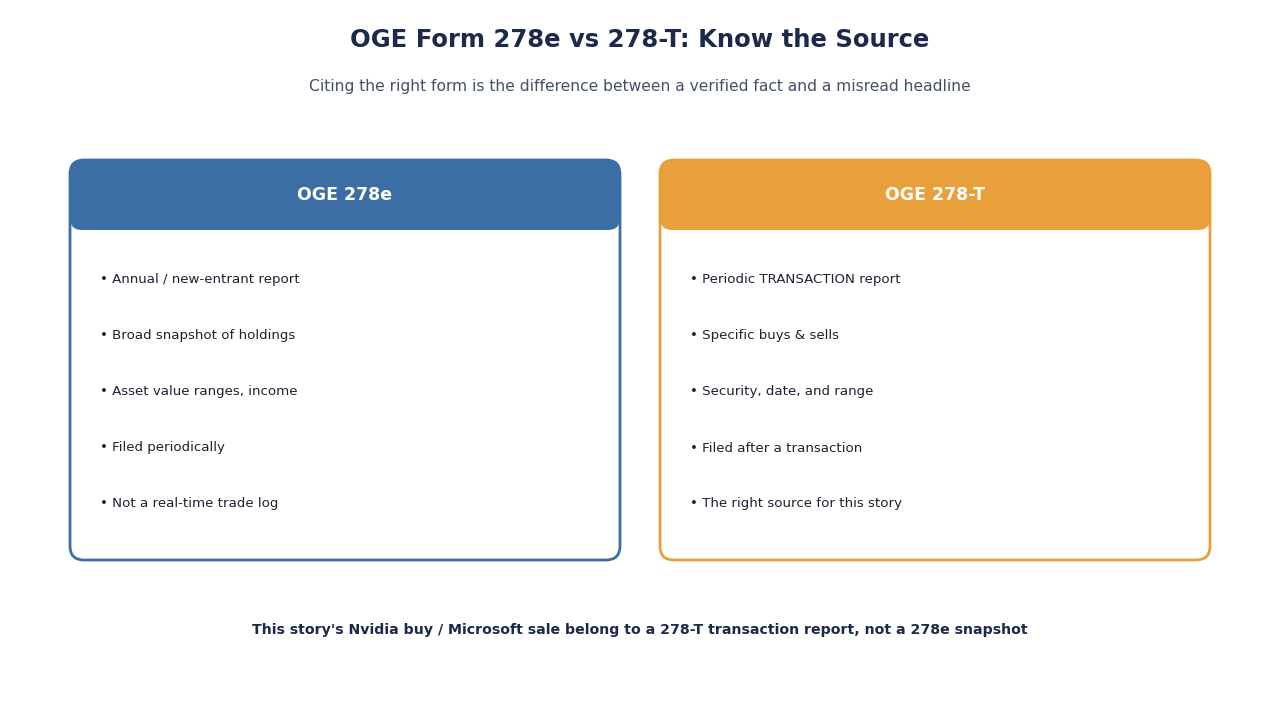
- OGE Form 278e is the broader public financial disclosure report used for assets, income, liabilities, positions, and other covered interests.
- OGE Form 278-T is the supplemental transaction report used for purchases, sales, or exchanges of reportable securities.
- The term “OGE 278-E” is often used informally, but the official form name is OGE Form 278e.
- For the Nvidia buy and Microsoft sale, the transaction-level source is best understood as a 278-T periodic transaction disclosure, connected to the broader 278e public disclosure system.
OGE’s official 278-T guidance states that a filer must submit a periodic transaction report if they are in a covered public financial disclosure position, served or are expected to serve more than 60 days, and had a reportable transaction. It also says the report must be filed within 30 days of receiving notification of the transaction, but no later than 45 days after the transaction.
Why does the OGE 278e source matter for Trump Financial Disclosure 2026?
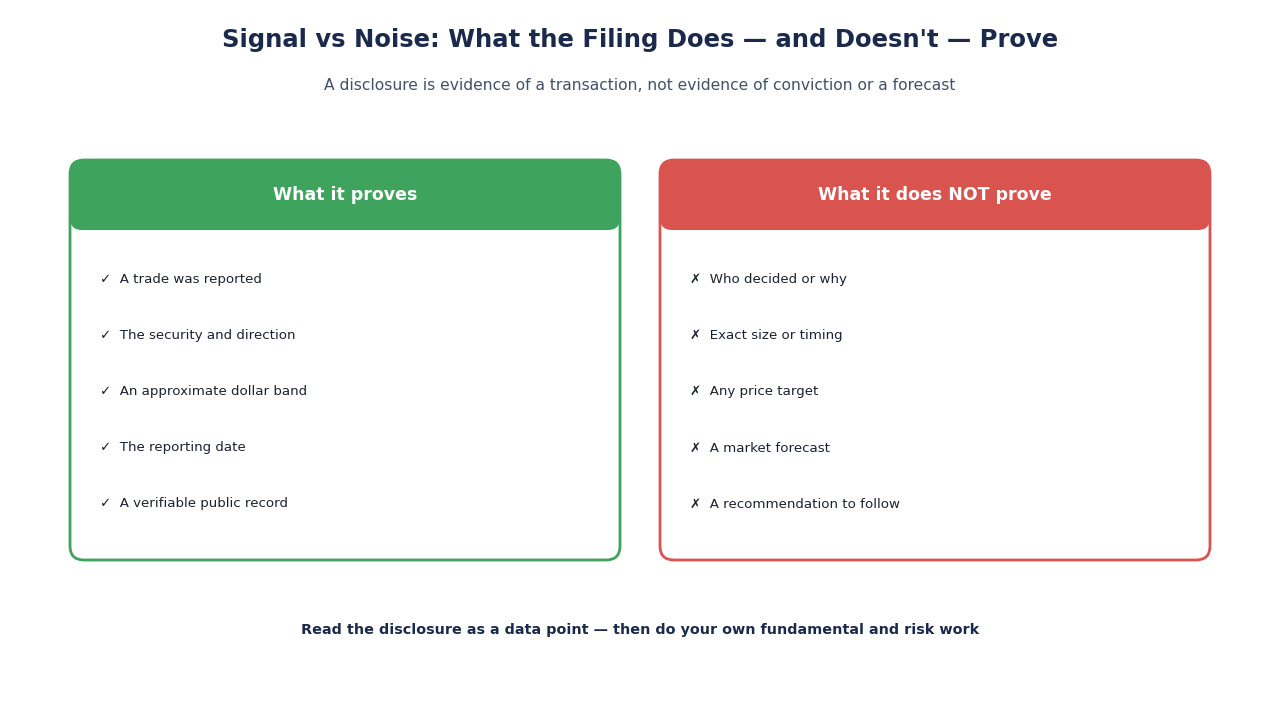
The OGE source matters because it defines what the public can and cannot know. OGE Form 278e and 278-T filings are disclosure tools, not investment research reports. They provide structured transparency, but they do not explain why a trade occurred.
The OGE-hosted disclosure system states that copies of public financial disclosure reports for executive branch leaders in Level 1 and Level 2 Executive Schedule positions are available online. Trump’s certified 2025 annual OGE Form 278e was also made available by OGE, and the annual report identifies Trump as President of the United States of America.
That annual 278e context is important because the 2025 annual report’s Part 7 transaction section shows “N/A,” meaning the annual form itself is not the main source for the Nvidia/Microsoft transaction story. The transaction story belongs in the periodic transaction report framework, not the annual 278e asset baseline alone.
How to Read the Nvidia Buy Without Overstating the Signal
The reported Nvidia purchase is important because Nvidia is one of the market’s most visible AI infrastructure companies. A large disclosed purchase in NVDA naturally attracts attention, especially when it appears near policy-sensitive headlines involving semiconductors, China access, and AI chip demand.
Still, the cleanest interpretation is limited:
- The disclosure reportedly shows a purchase of Nvidia shares.
- The reported value range was $1 million to $5 million.
- The date reported was February 10, 2026.
- The filing does not prove personal trading intent.
- The filing does not prove a policy connection.
MarketWatch also reported that Trump had previously disclosed a March 3 Nvidia purchase in the $100,001 to $250,000 range and that an annual disclosure filed the prior June showed a Nvidia stake worth at least $600,000.
For investors, the practical research angle is not “copy the trade.” It is: does the reported transaction align with a broader AI infrastructure thesis, and what risks come with that exposure?
| Research Lens | Nvidia Question |
|---|---|
| Fundamental | Is AI data-center demand still expanding fast enough to support expectations? |
| Policy | Could export rules, tariffs, or China access change revenue assumptions? |
| Valuation | Does the stock price already discount optimistic AI growth? |
| Portfolio | Does adding Nvidia increase concentration in mega-cap AI risk? |
| Disclosure | Is the OGE range too broad to infer exact conviction? |
SimianX AI’s multi-agent stock analysis approach is useful here because the platform emphasizes parallel AI analysis, debate, transparent reasoning, and buy/sell/hold consensus across market data and news signals.
How to Read the Microsoft Sale in Context
The reported Microsoft sale is just as important as the Nvidia buy because it suggests a possible rotation within AI-linked mega-cap technology. Microsoft is not a pure-play chip company; it is an AI platform, cloud infrastructure, enterprise software, and productivity ecosystem company. Selling MSFT while buying NVDA could be interpreted as a shift from software/cloud AI exposure toward semiconductor AI exposure—but that remains an interpretation, not a fact proven by the filing.
MarketWatch reported that the Microsoft sale was in the $5 million to $25 million range, grouped with large sales of Amazon, Meta, and Vanguard Dividend Appreciation ETF shares on the same date. That grouping matters because it may point to broader portfolio rebalancing rather than a company-specific negative view on Microsoft.
Practical reading: A Microsoft sale does not automatically mean “bearish on Microsoft.” It may reflect tax planning, liquidity needs, risk limits, model-portfolio rebalancing, or independent manager decisions.
The same MarketWatch report noted that a Trump Organization spokesperson had previously told The Washington Post that investment decisions were made by independent managers and based on computer-based model portfolios, with no input from Trump or his family. That statement should be included in any balanced research article because it directly affects how readers evaluate intent.
Why OGE 278-T Is More Relevant Than OGE 278e for This Specific Story
For this article, the clearest source language is:
The Nvidia purchase and Microsoft sale should be attributed to a public OGE periodic transaction disclosure, specifically the OGE Form 278-T framework, while OGE Form 278e provides the broader annual public financial disclosure context.
OGE’s own 278-T materials describe the form as a transaction report that consists of a general information section and a transaction reporting section. A January 2026 Trump 278-T filing hosted by OGE, though covering a different set of transactions, shows the same official form structure: “Executive Branch Personnel Public Financial Disclosure Report: Periodic Transaction Report (OGE Form 278-T)” for Donald Trump as President.
The official 278-T summary language also says the form discloses purchases, sales, or exchanges of securities in excess of $1,000 made on behalf of the filer, spouse, or dependent child, subject to certain exceptions. The Department of Energy’s STOCK Act guidance similarly explains that OGE-278 filers must file an OGE Form 278-T for certain financial transactions, including purchases, sales, or exchanges of stocks, bonds, commodity futures, and other securities greater than $1,000.
That is why a rigorous article should not simply say “OGE 278-E shows Trump bought Nvidia and sold Microsoft” without qualification. A better sentence is:
“The trade details are reported through the OGE periodic transaction disclosure system, OGE Form 278-T, which supplements the broader OGE Form 278e public financial disclosure framework.”
Research Framework: What Investors Should Check Next
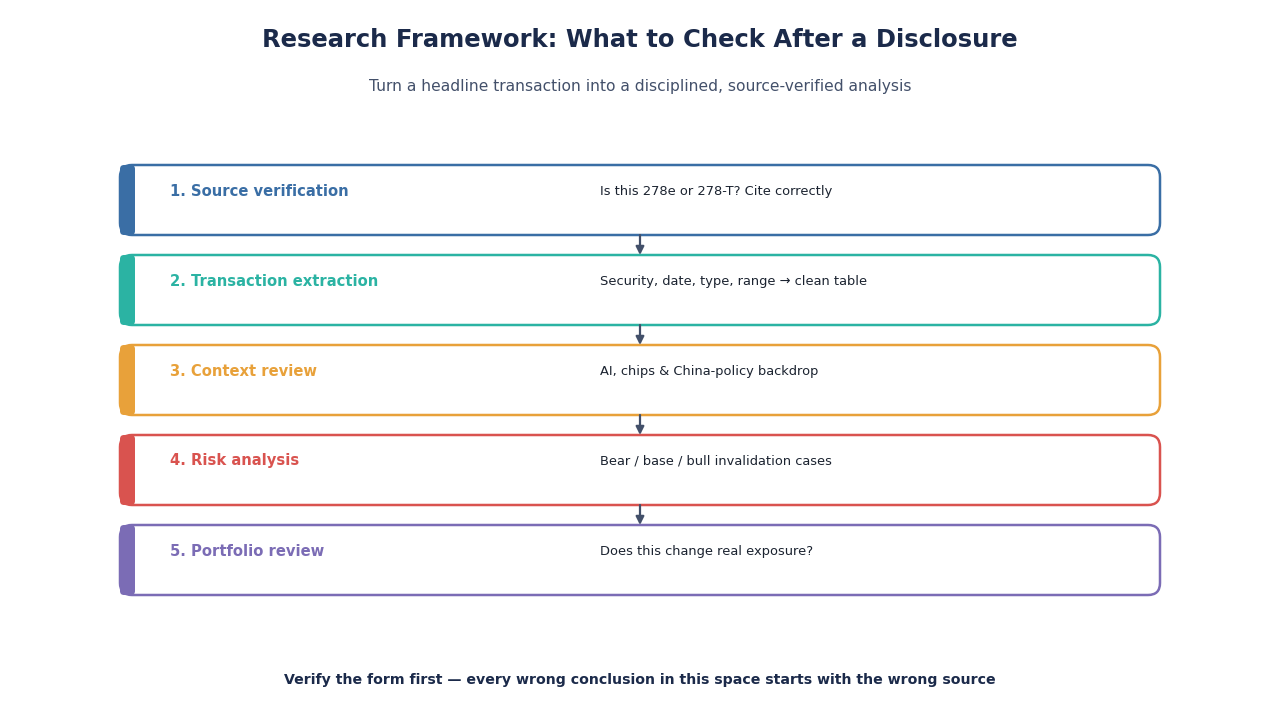
A strong research process should move from source verification to market interpretation. Here is a practical workflow:
- Verify the filing source. Confirm whether the document is an annual OGE Form 278e or a periodic OGE Form 278-T.
- Record only what the filing states. Use transaction type, date, asset name, and reported value range.
- Separate fact from inference. A buy is a fact; the motive behind the buy is usually inference.
- Cross-check with market context. Review semiconductor policy, AI demand, earnings expectations, and valuation.
- Stress-test the portfolio implication. Ask whether the trade increases concentration, reduces diversification, or changes sector exposure.
- Avoid copy-trading. Public disclosures are delayed, range-based, and incomplete.
| Step | Question | Output |
|---|---|---|
| Source verification | Is this 278e or 278-T? | Correct citation and form type |
| Transaction extraction | What security, date, type, and range? | Clean event table |
| Context review | What was happening in AI, chips, and China policy? | Market backdrop |
| Risk analysis | What could invalidate the thesis? | Bear/base/bull cases |
| Portfolio review | Does this change exposure? | Allocation impact |
SimianX AI can support this workflow by combining financial news, stock research, multi-agent debate, and shareable reports. Its stock analysis page describes coverage across U.S. equities, SEC filings, financials, insider activity, intrinsic value assessment, technical analysis, and real-time news sentiment.
What the Nvidia Buy and Microsoft Sale May Signal
The most reasonable research interpretation is that the disclosure points to active large-cap portfolio movement rather than a single isolated bet. MarketWatch reported that the disclosure showed more than 2,000 purchase transactions and more than 1,000 sell transactions, including many smaller purchases and multiple large transactions.
That scale matters. A single Nvidia purchase might look like a concentrated AI-chip bet. But when placed inside thousands of transactions, it may be part of a broader managed-portfolio program. The Microsoft sale likewise should not be read in isolation because it appeared alongside sales of other large-cap technology and dividend-oriented holdings.
A balanced interpretation might be:
- Bullish AI hardware exposure: Nvidia benefits directly from GPU demand, AI data centers, and accelerated computing.
- Reduced software-platform exposure: Microsoft remains a key AI beneficiary, but the reported sale lowers exposure to that name.
- Portfolio rebalancing: The combination of many buys and sells suggests broader allocation changes.
- Policy sensitivity: Nvidia and Boeing have policy-sensitive revenue narratives, especially around international trade and China.
- Disclosure uncertainty: The exact trade size and intent remain unknowable from public OGE ranges.
Risk and Ethics Considerations
This disclosure raises both market and ethics questions. MarketWatch noted ethical concerns around presidential holdings, while also reporting that U.S. presidents are exempt from conflict-of-interest rules that prohibit federal officials from participating in government matters in which they have a financial stake.
That legal backdrop does not eliminate reputational, political, or governance risk. For investors, the key is not to make a political judgment but to recognize that policy-sensitive holdings can create headline risk. Nvidia may be affected by export controls, tariff policy, AI infrastructure demand, and China access. Microsoft may be affected by cloud regulation, AI monetization, antitrust scrutiny, and federal technology procurement.
SimianX AI’s pricing and legal page states that the platform provides multi-agent market research and educational analysis, not investment, legal, or tax advice, and notes that stocks, options, and crypto trading involve significant risk. That same disclaimer belongs in any investor-facing article about political financial disclosures: this is research context, not a trade recommendation.
Sources for OGE 278e and 278-T Verification
Use these official and reporting sources when publishing or fact-checking this article:
- OGE Public Financial Disclosure Guide for OGE Form 278e and OGE Form 278-T: https://www.oge.gov/Web/278eGuide.nsf
- OGE 278-T guidance page: https://www2.oge.gov/web/278eGuide.nsf/Form_278-T
- OGE executive branch public financial disclosure database: https://extapps2.oge.gov/201/presiden.nsf/
- Example Trump OGE Form 278-T filing structure: https://extapps2.oge.gov/201/Presiden.nsf/PAS%2BIndex/268353939B7DACB585258D81003471B1/%24FILE/Donald-J-Trump%201.14.2026-278T.pdf
- Trump 2025 annual OGE Form 278e filing: https://extapps2.oge.gov/201/Presiden.nsf/PAS%2BIndex/4EC9A8E6DD078F2985258CA9002C9377/%24FILE/Trump%2C%20Donald%20J.%202025%20Annual%20278.pdf
- Department of Energy STOCK Act / OGE 278-T explanation: https://www.energy.gov/gc/stop-trading-congressional-knowledge-stock-act-periodic-transaction-reporting-requirements-oge
- MarketWatch report on Trump Nvidia purchase and Microsoft sale: https://www.marketwatch.com/story/trump-discloses-big-buys-of-shares-in-boeing-and-nvidia-as-the-companies-look-set-to-gain-from-his-china-trip-1081bd1d
- SimianX AI: https://www.simianx.ai
FAQ About Trump Financial Disclosure 2026
What is OGE Form 278e in Trump financial disclosure research?
OGE Form 278e is the Executive Branch Personnel Public Financial Disclosure Report. It provides the broader annual disclosure framework for assets, income, liabilities, positions, and related interests. For transaction-specific events like the Nvidia buy and Microsoft sale, the more relevant supplemental form is typically OGE Form 278-T.
Did Trump buy Nvidia stock in 2026?
According to MarketWatch, a 113-page disclosure made available through an OGE website showed a February 10, 2026 Nvidia purchase in the $1 million to $5 million range. The form reports a range, not an exact dollar amount or number of shares.
Did Trump sell Microsoft stock in 2026?
According to the same MarketWatch report, the disclosure showed a February 10, 2026 Microsoft sale in the $5 million to $25 million range. The sale appeared alongside large sales of Amazon, Meta, and Vanguard Dividend Appreciation ETF shares.
What is the difference between OGE 278e and OGE 278-T?
OGE Form 278e is the broader public financial disclosure report. OGE Form 278-T is the periodic transaction report used to disclose reportable purchases, sales, or exchanges of securities. OGE states that 278-T reports are due within 30 days of transaction notification, but no later than 45 days after the transaction.
Is the Trump Nvidia buy a stock recommendation?
No. The public disclosure is delayed, range-based, and incomplete. It does not provide the exact price, share count, investment thesis, or portfolio constraints, so investors should treat it as a research input—not a buy signal.
Conclusion
The Trump Financial Disclosure 2026: Nvidia Buy, Microsoft Sale story is best read as a source-verification exercise first and a market interpretation exercise second. The reported facts are notable: a large Nvidia purchase and a large Microsoft sale, both dated February 10, 2026, within broad OGE disclosure ranges. But the form does not reveal motive, precise sizing, execution price, or whether the trades reflected personal direction or independent portfolio management.
The most important source clarification is this: OGE Form 278e is the broader public financial disclosure framework, while OGE Form 278-T is the transaction-level reporting mechanism for purchases and sales like Nvidia and Microsoft. Getting that distinction right makes the article more accurate, more trustworthy, and more useful for readers.
For investors and researchers who want to analyze disclosure-driven market events with more structure, explore SimianX AI. SimianX AI helps turn scattered filings, headlines, market signals, and stock data into a more transparent research workflow—while keeping the line clear between factual disclosure analysis and investment advice.
Related Reading
- Alphabet Nears Nvidia in Market Value as AI Trade Broadens
- AI Chip Stocks Stay Strong: AMD, Intel Drive Data Centers
- Multi-Agent AI vs ChatGPT for NVDA Signals: 2026 Comparison