2026 Midterm Elections and Defense Stocks: Will LMT, RTX and NOC Benefit?
The question “2026 Midterm Elections and Defense Stocks: Will LMT, RTX and NOC Benefit?” is more complicated than a simple election trade. The November 3, 2026 midterms will determine all 435 House seats and roughly one-third of the Senate, but the contracts that drive defense revenue are usually negotiated years earlier. For investors, the election is best viewed as a policy and execution catalyst, not a guaranteed one-day rally.
This research separates enacted funding from campaign promises, compares Lockheed Martin (LMT), RTX (RTX) and Northrop Grumman (NOC), and provides a scenario framework you can update with SimianX AI, which combines filings, live news, technical indicators and multi-agent debate. It is educational research, not personalized investment advice.

What the 2026 midterm elections can—and cannot—change
The Federal Election Commission election calendar lists November 3, 2026 as the general election date, while USAGov confirms that every House seat and one-third of Senate seats are contested. A change in chamber control can alter committee chairs, subpoena priorities, procurement oversight and the negotiating leverage behind future budgets. It does not automatically cancel a signed contract or create an appropriation.
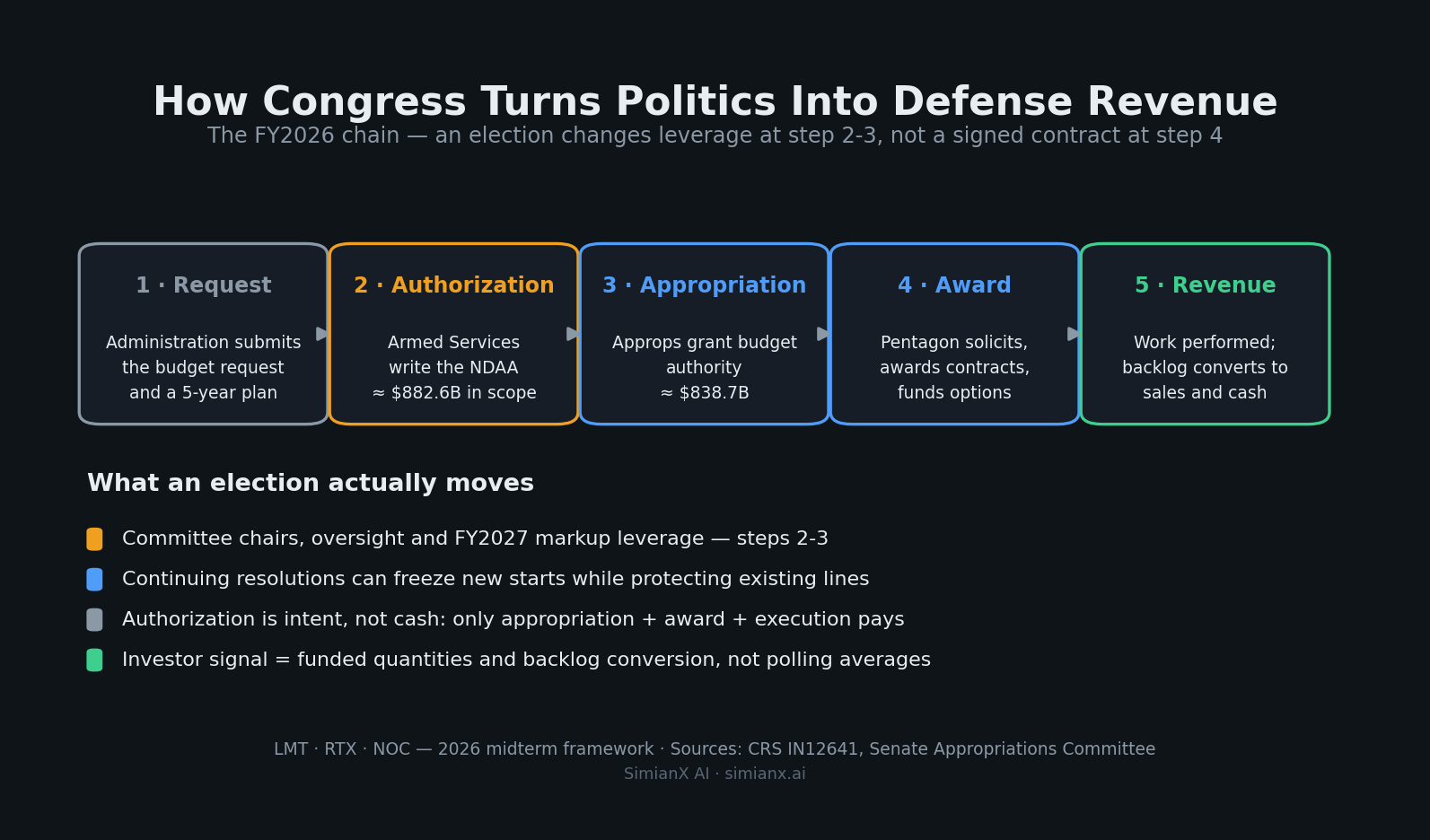
Congressional defense funding follows a multi-step chain:
- The administration submits a budget request and a five-year plan.
- The House and Senate Armed Services Committees write the National Defense Authorization Act (NDAA), which authorizes programs and sets policy.
- Appropriations committees provide budget authority; an NDAA alone is not cash.
- The Pentagon issues solicitations, awards contracts and funds options.
- Companies recognize revenue as work is performed, subject to negotiations, audits and production capacity.
The Congressional Research Service notes that the FY2026 NDAA covered approximately $882.6 billion in national-defense activities within its scope and that authorization is an indicator of congressional intent, not itself an appropriation. Separately, the Senate Appropriations Committee reported FY2026 defense appropriations of about $838.7 billion in discretionary funding. Those figures create a substantial base for 2026–2027 deliveries before the midterm results are known.
Key insight: Election headlines can move multiples quickly; only authorization, appropriation, a contract award and factory execution convert politics into earnings.
Why defense spending often remains bipartisan
Defense programs are distributed across congressional districts, shipyards, engineering centers and union workforces. That geographic footprint encourages bipartisan support, even when lawmakers disagree about strategy or the Pentagon’s management. The FY2026 package included funding for procurement, research and development, missile defense, space and the industrial base—areas that map directly to the three companies in this study.
However, bipartisan does not mean unlimited. Deficit pressure, continuing resolutions, cost overruns and program cancellations can delay cash. A divided Congress may increase oversight and slow new starts while protecting existing production lines. A unified majority may pass a larger topline but still redirect money toward drones, munitions, shipbuilding or classified programs that do not benefit every prime contractor equally.
How do 2026 midterm elections affect defense stocks such as LMT, RTX and NOC?
The transmission mechanism has four stages: expectations, legislation, awards and estimates. Before the election, candidates and defense committees shape expectations about China, Russia, missile defense and replenishing U.S. inventories. After the election, committee leadership influences the FY2027 NDAA and appropriations process. The market then watches whether programs receive funded quantities, and analysts revise backlog conversion, margins and free-cash-flow estimates.
Because the process is slow, investors should watch budget line items and contract obligations, not polling averages alone. A pre-election rally can reverse if a continuing resolution freezes new production, if a program is restructured, or if management warns about labor and supply-chain constraints.
Lockheed Martin (LMT): the broadest direct beneficiary, with execution risk
Lockheed Martin enters the midterm cycle with exposure to fighter aircraft, missile defense, precision strike, space and classified systems. Its 2025 annual report says backlog increased primarily on JASSM, LRASM, PAC-3 and Apache orders, while the company delivered 191 F-35 aircraft in 2025. A 2026 SEC filing also describes long-term agreements to triple Patriot PAC-3 MSE production and quadruple THAAD production—powerful evidence of demand, but not a guarantee that every unit converts to revenue on schedule.
Bull case: A Congress focused on replenishing interceptors and strengthening Indo-Pacific deterrence could add quantities to PAC-3, THAAD, long-range fires, F-35 sustainment and space programs. LMT’s scale and installed production base make it a natural recipient of funded options. Higher volume can improve absorption and support cash returns.
Risks: F-35 affordability and readiness remain political pressure points. The Government Accountability Office has documented low fully mission-capable rates, creating a risk that lawmakers attach performance conditions or shift dollars toward sustainment and alternative systems. Fixed-price development contracts, supplier shortages and concurrency can also pressure margins.
Investor dashboard for LMT
- F-35 Lot 18/19 contract definitization and annual production quantities.
- PAC-3 MSE and THAAD funded orders versus framework announcements.
- Space development awards and classified-contract growth.
- Segment operating margin, free cash flow and backlog conversion.
- Any congressional language requiring readiness milestones or cost sharing.
RTX (RTX): missile-defense leverage plus a large commercial-aerospace offset
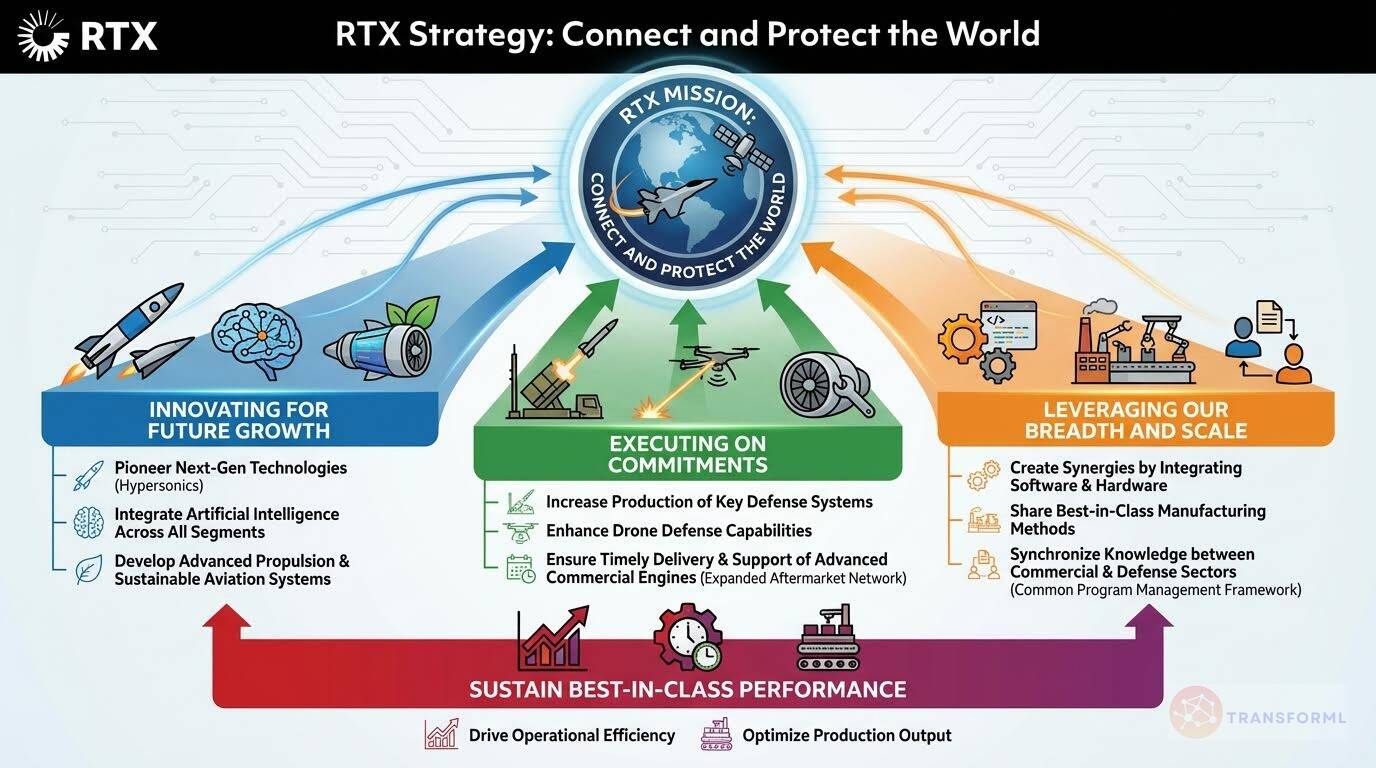
RTX is not a pure defense stock. Its Raytheon business sells missiles, radars and integrated air-defense systems, while Collins Aerospace and Pratt & Whitney are heavily exposed to commercial aviation. RTX’s 2025 annual report describes backlog as a key forward-looking measure, and its January 2026 outlook called for continued investment in capacity and new capabilities. That mix changes how the election affects the stock: defense appropriations can support Raytheon, while airline traffic, engine reliability and aftermarket demand may matter more to consolidated earnings.
Bull case: A procurement push for Patriot effectors, AMRAAM, advanced air-to-air weapons, counter-drone systems and hypersonic defense would benefit Raytheon. RTX can also gain from allied orders funded through foreign military sales. Because its commercial backlog is substantial, defense upside could diversify the cycle rather than determine the entire valuation.
Risks: Missile programs are production-constrained; a budget increase without skilled labor, energetics or test capacity may shift revenue into later years. Pratt & Whitney’s geared turbofan inspection and supply-chain work can absorb management attention and cash. Tariffs, work stoppages or commercial-aircraft delays could offset a strong Raytheon quarter.
What to monitor for RTX
- Raytheon book-to-bill and funded backlog, separated from unfunded options.
- Patriot, AMRAAM and counter-UAS awards and production-rate milestones.
- Pratt & Whitney fleet inspections, spare-engine availability and margin recovery.
- 2026 sales, adjusted EPS and free-cash-flow guidance revisions.
- The defense/commercial mix when modeling election sensitivity.
Northrop Grumman (NOC): strategic programs, longer duration and higher program concentration
Northrop Grumman’s investment case centers on B-21 Raider, Sentinel, space systems, missile defense, command-and-control and classified work. Its 2026 first-quarter earnings call highlighted sustained support for B-21, Sentinel, IBCS, E-2D and restricted programs. These franchises align with a long-term modernization agenda, but they also carry substantial development and cost risk.
Bull case: A midterm electorate and Congress that prioritize strategic deterrence, survivable command networks and space resilience could protect B-21 and missile-defense funding. NOC can benefit from multi-year production ramps, where learning curves and supplier investments eventually expand margins.
Risks: Program concentration means a single restructure can matter. Sentinel’s schedule and cost performance are closely watched, while B-21 development can generate charges before production economics improve. Space procurement may be redirected toward proliferated architectures or smaller, faster buys, creating winners and losers inside the portfolio.
For NOC, the most useful indicators are contract award timing, estimate-at-completion changes, segment margin and cash flow, rather than the headline defense topline. A large backlog is valuable only when it is profitable and executable.
Scenario analysis: who benefits under each election outcome?
| Scenario | Budget and policy path | Likely relative effect |
|---|---|---|
| Unified government, higher topline | Faster NDAA/appropriations; more munitions, missile defense and Indo-Pacific buys | Positive for LMT and RTX; positive for NOC if strategic programs are protected |
| Divided Congress, bipartisan baseline | Existing programs funded; new starts delayed; oversight increases | Supports all three through backlog, but limits multiple expansion |
| Deficit-driven restraint | Flat real spending, continuing resolutions, program cancellations | Negative for high-expectation names; execution and cash flow become decisive |
| Crisis-driven supplemental | Emergency interceptor, precision-strike and readiness orders | RTX and LMT may see faster munitions benefit; NOC gains if space/strategic scope expands |
| Procurement reform | Faster software and drone buys, fewer legacy platforms | Could favor specialized suppliers over traditional primes; stock-specific dispersion rises |
This table is a framework, not a forecast. The same election result can help one segment and hurt another. For example, a shift from exquisite aircraft to attritable drones may be positive for defense spending overall but neutral or negative for a fighter-heavy backlog.
For the ticker-level version of these scenarios across the wider market, see 2026 Midterm Election Stocks: 12 Tickers, 3 Scenarios.
Valuation and portfolio framework for investors
Do not value these companies on defense headlines alone. Build a three-layer model:
- Backlog quality: funded versus unfunded, duration, customer concentration and cancellation clauses.
- Conversion economics: sales growth, segment margin, working capital and free-cash-flow conversion.
- Multiple risk: interest rates, commercial aerospace exposure, program charges and political scrutiny.
An actionable workflow is:
- Download the latest 10-K, 10-Q and earnings presentation for
LMT,RTXandNOC. - Tag every program as funded, authorized-only, proposed or contingent on foreign sales.
- Map each program to the FY2026/FY2027 budget line and committee language.
- Stress-test a 5% real cut, a flat budget and a 5% increase; change quantities before changing margins.
- Compare implied free-cash-flow yield with aerospace and industrial peers.
- Set a review trigger for guidance cuts, major charge announcements or contract protests.
SimianX AI can accelerate this process by routing the same ticker through fundamental, technical, news-intelligence and decision agents. Use it to compare SEC filings with breaking congressional news, then challenge the output with your own assumptions; an AI signal is a research aid, not a substitute for risk limits.
FAQ About 2026 Midterm Elections and Defense Stocks
Will LMT, RTX and NOC definitely rise after the 2026 midterms?
No. Defense demand can remain strong while a stock falls because expectations, valuation or execution disappoint. The election is one variable among budget timing, rates, margins and program risk.
What is the best way to analyze defense contractor stocks in 2026?
Start with funded backlog and contract obligations, then test conversion to revenue and free cash flow under multiple budget scenarios. Read the company’s risk factors and the CRS budget tables before relying on campaign statements.
Are defense stocks bipartisan winners in a divided Congress?
Existing, geographically distributed programs often receive bipartisan protection, but new starts can be delayed and oversight can intensify. “Bipartisan” lowers cancellation risk; it does not eliminate cost, schedule or valuation risk.
How can investors track FY2027 defense spending after the election?
Follow Armed Services and Appropriations Committee markups, continuing-resolution deadlines, unfunded-priority lists and Pentagon contract announcements. Cross-check each headline against the relevant 10-Q and backlog disclosure.
Conclusion
The answer to “2026 Midterm Elections and Defense Stocks: Will LMT, RTX and NOC Benefit?” is conditional. The FY2026 funding base is already large, and the three companies have durable exposure to fighters, missiles, air defense, space and strategic systems. A higher or faster FY2027 procurement cycle could lift orders, but a divided Congress, deficit pressure, continuing resolutions or program-specific execution problems can mute the benefit.
Among the group, LMT offers the broadest direct exposure to major U.S. platforms and missile defense; RTX combines Raytheon’s munitions leverage with commercial-aerospace diversification; NOC offers strategic-program upside with greater concentration and development risk. Investors should therefore monitor funded quantities, backlog conversion, margins and cash flow—not election slogans. For a continuously updated, multi-agent view of these tickers and the news moving them, explore SimianX AI and use its research tools alongside your own due diligence.
Related Reading
- 2026 Midterm Election Stocks: 12 Tickers, 3 Scenarios
- The Presidential Cycle: S&P 500 Returns by Year, 1928-2025
- Iran-US War Impact on Stocks: AI Risk Signals Live
References
- FEC — 2026 election calendar
- USAGov — how midterm elections work
- Congressional Research Service — FY2026 NDAA topline
- Senate Appropriations Committee — FY2026 defense appropriations
- GAO — F-35 mission-capable rates
- SEC EDGAR — Lockheed Martin 2026 filing
- SEC EDGAR — RTX 2025 annual report
- Lockheed Martin — annual reports
- Northrop Grumman — Q1 2026 earnings call
- RTX — 2025 results and 2026 outlook