
Oura's Postponed IPO: The S-1 Numbers, the Share Math and What Comes Next
On September 29, 2026, Oura, the maker of the Oura Ring, postponed its planned Nasdaq listing under the ticker OURA. The company said it was waiting out market "uncertainty" "despite strong demand." The deal had been launched eight days earlier: 50 million shares at $40–$44, about $2.1 billion at the midpoint and a market value of roughly $13.5 billion.
Oura's amended Form S-1 explains why the price mattered so much, and it shows three things most coverage skipped:
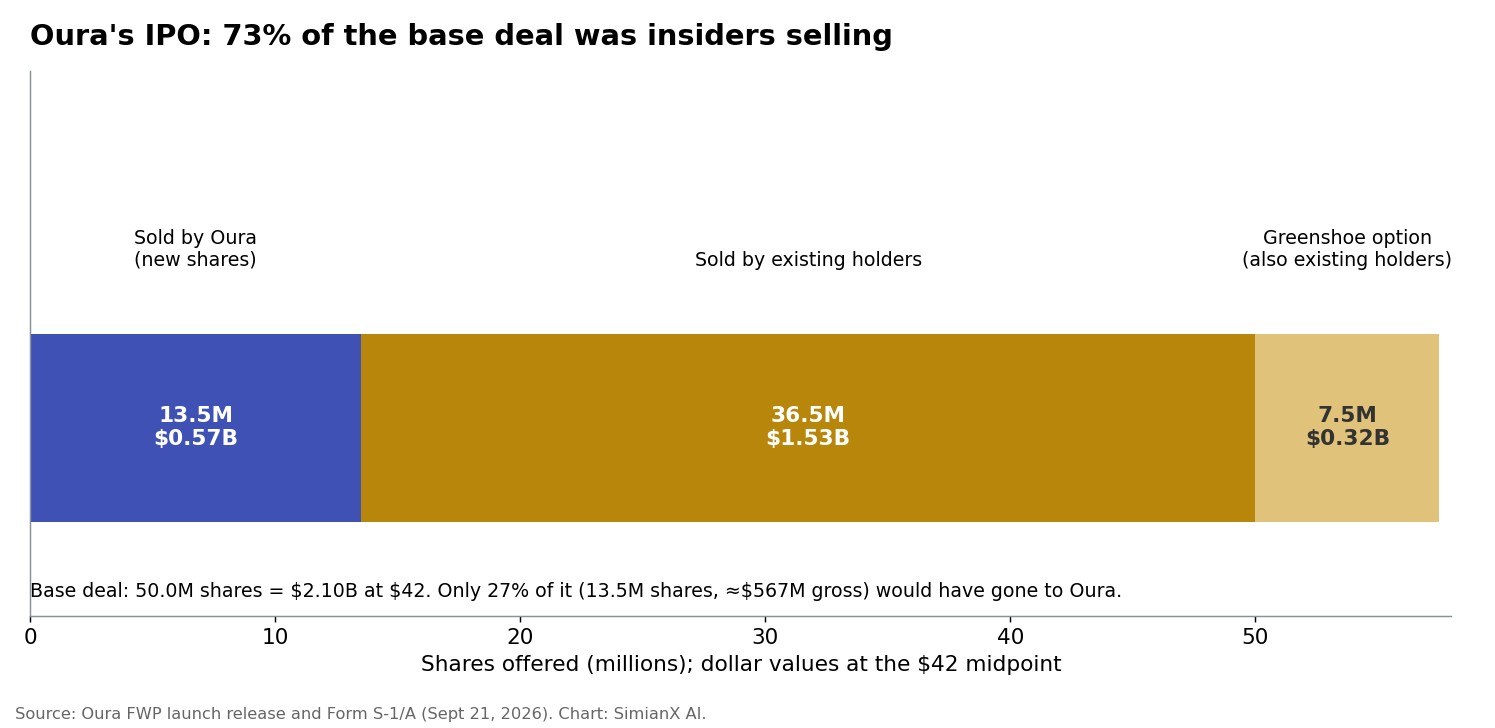
- This was mainly an insider sale. Existing holders were selling 36.5 million of the 50 million shares (73%), plus another 7.5 million through the underwriters' option. Oura itself would have received only about $567 million gross from 13.5 million new shares, and planned to spend $526 million of its net proceeds on tax withholding for employee stock awards vesting at the listing.
- Oura had just spent $1.17 billion buying out its own holders. In the nine months to June 30, 2026, it repurchased $1.17 billion of common and preferred stock. That is 3.6 times its $328 million of operating cash flow for the period. It drew $375 million on its credit line mostly to fund those buybacks. Cash fell from $764 million to $372 million.
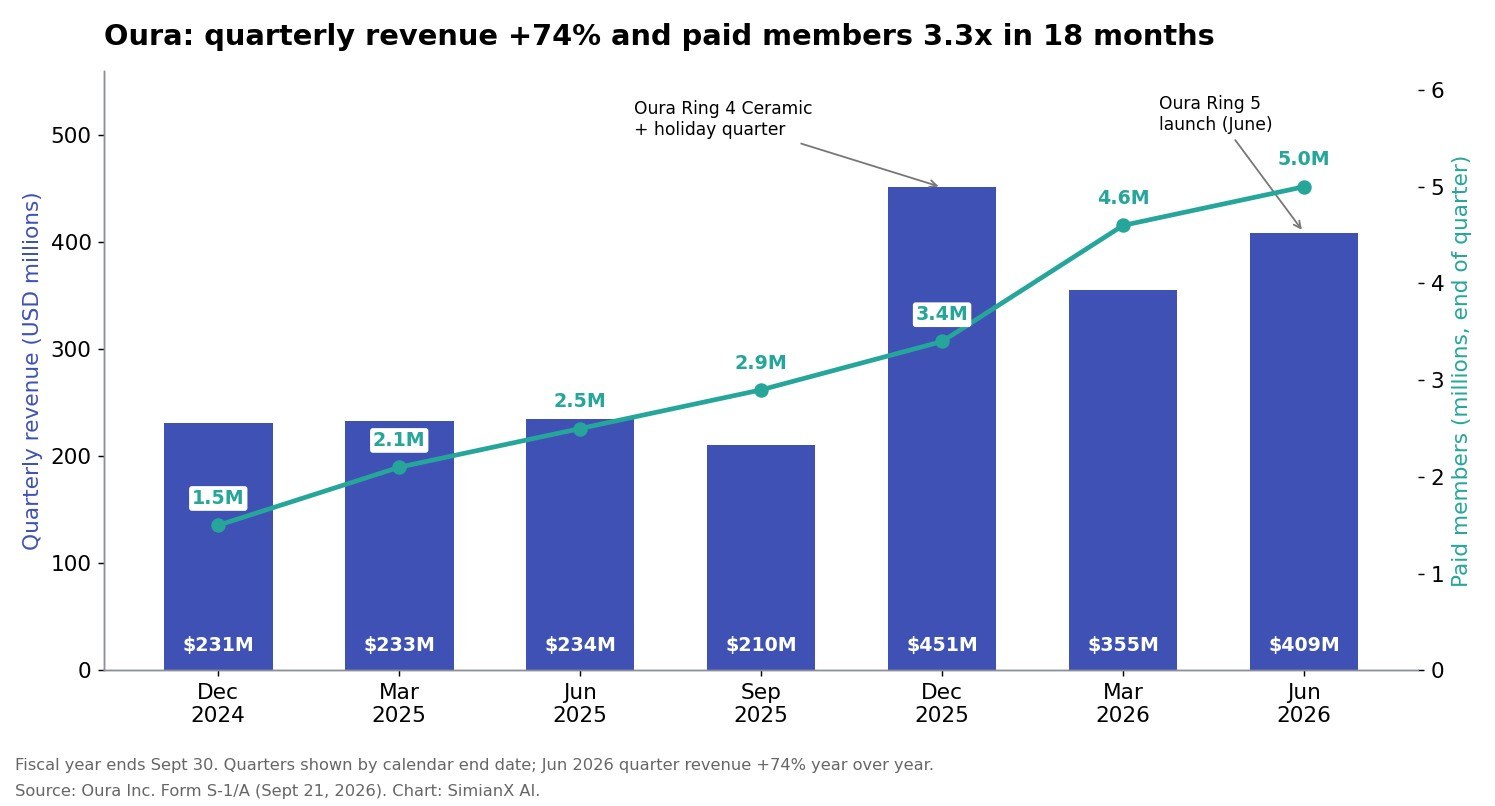
- The business itself is growing fast. Revenue rose 74% to $1.21 billion in the nine months. Paid members reached 5.0 million, up from 1.5 million at the end of 2024, and the business was profitable on an operating basis.
So the postponement was a disagreement about price, not about whether people buy the ring. Below we rebuild the offering from the filings: the share split, where the cash went, the quarter-by-quarter growth, the valuation at each price in the range, how Oura compares with a smart-ring market it already dominates, and what a second attempt would need to show.
Company figures come from Oura's Form S-1/A and free writing prospectuses filed with the SEC. Oura's fiscal year ends September 30, so "nine months" means October 2025 to June 2026. Valuation figures are illustrative, not forecasts.
What Happened to Oura's IPO
| Date | Event |
|---|---|
| May 19, 2026 | Oura files a confidential draft registration statement |
| Sep 3, 2026 | Public Form S-1 filed |
| Sep 21, 2026 | Amended S-1 and launch announcement: 50 million shares at $40–$44 |
| Sep 24, 2026 | Oura files a Robinhood interview with CEO Tom Hale as offering material |
| Sep 29, 2026 | Offering postponed, citing market conditions |
According to Axios, the book was about five times oversubscribed. However, Oura could not get the price it wanted amid swings in bond yields and oil. Most shares were being sold by insiders, "which put a premium on pricing." Axios also reported that this was the third official IPO postponement this month. CEO Tom Hale said the company has "the luxury of choosing our moment."
The Associated Press, citing Renaissance Capital, said the U.S. IPO market started 2026 well but faded in the third quarter. The reasons were worries about slower AI spending, the Federal Reserve resuming rate increases and a jump in bond yields. We covered those two macro shocks in the Fed's first rate hike since 2023 and the global bond selloff.
Demand was not the problem. The S-1 says Eli Lilly indicated interest in buying up to $100 million of stock, and funds affiliated with Dragoneer up to $300 million. Together that is about 19% of the $2.1 billion base deal before the roadshow even started. An oversubscribed book does not mean buyers will pay the top of the range.
The Share Math: Who Was Selling
| Component | Shares | At $40 | At $42 | At $44 |
|---|---|---|---|---|
| New shares sold by Oura | 13.5 million | $540M | $567M | $594M |
| Shares sold by existing holders | 36.5 million | $1.46B | $1.53B | $1.61B |
| Base offering | 50.0 million | $2.00B | $2.10B | $2.20B |
| Greenshoe option (existing holders) | 7.5 million | $300M | $315M | $330M |
| Market value (320.9 million shares after the offering) | — | $12.84B | $13.48B | $14.12B |
With the option exercised, insiders would have sold 44 million of 57.5 million shares, or 77%. Oura would not have received anything from those sales. Its own net proceeds, estimated at $532.6 million at $42, were earmarked almost entirely ($526.4 million) for tax withholding on restricted stock units that settle at the IPO, with the small remainder for general corporate purposes.
That structure explains the sensitivity to price. For a company raising money it needs, a lower price means some dilution. For holders selling their own shares, every dollar off the price is a dollar they don't get. According to Axios, Fidelity held 10.9% before the IPO, Forerunner Ventures 9.3%, Bedford Ridge Capital 9.2% and Lifeline Ventures 7.3%.
Where Oura's Cash Went: $1.17 Billion of Buybacks
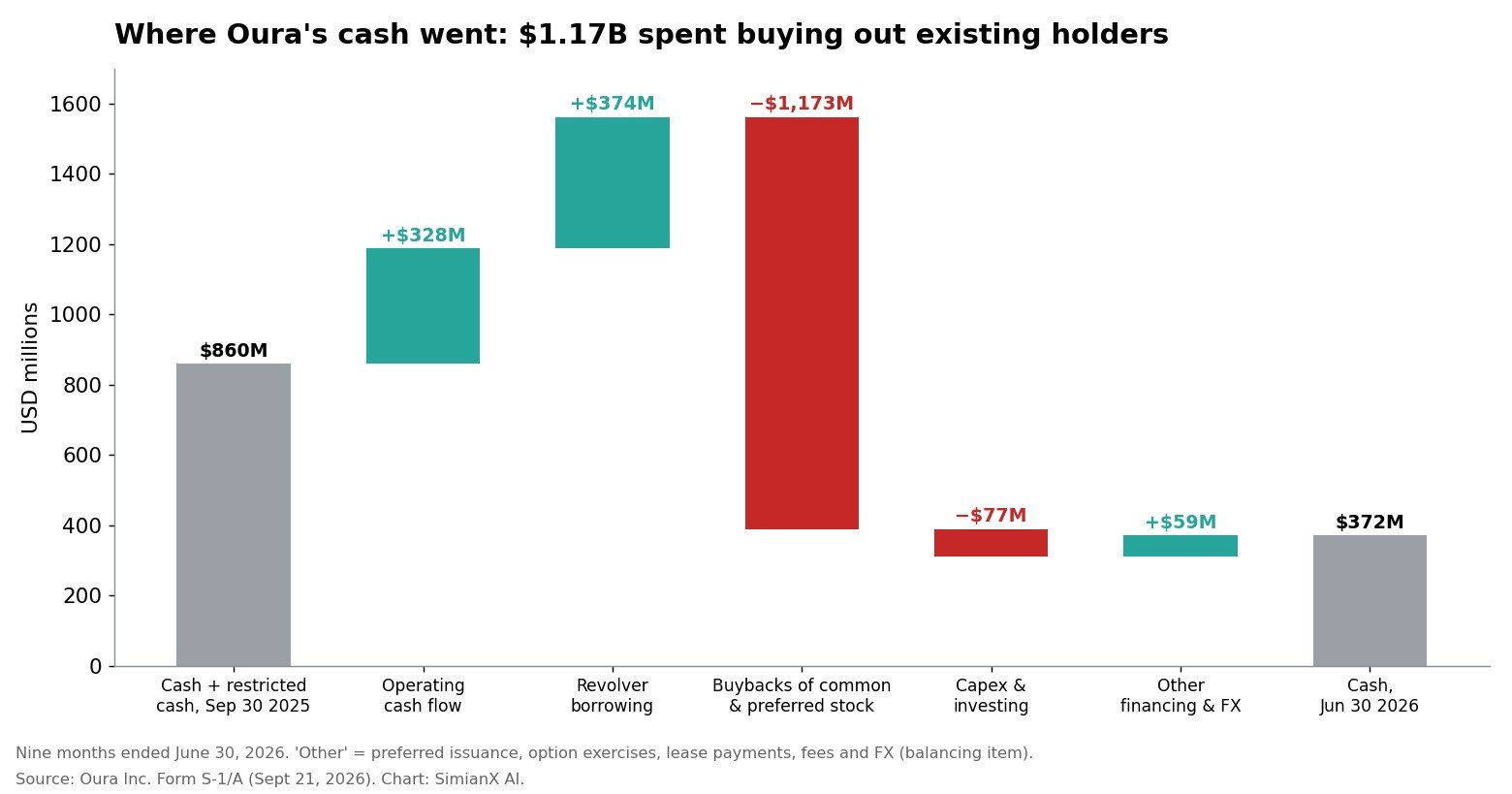
The cash-flow statement is the most revealing part of the filing. During the nine months ended June 30, 2026:
| Cash flow item | Amount |
|---|---|
| Cash, cash equivalents and restricted cash, Sep 30, 2025 | $860.5 million |
| Operating cash flow | +$328.0 million |
| Borrowings under the revolving credit facility (net of fees) | +$373.9 million |
| Repurchases of common and preferred stock | −$1,172.9 million |
| Capital spending and other investing | −$77.0 million |
| Other financing items and FX | +$59.3 million |
| Cash, Jun 30, 2026 | $371.8 million |
The S-1 says the credit-line draw was used "primarily to fund repurchases of our common and redeemable convertible preferred stock." Axios linked part of this to a $534 million tender offer completed in February. Oura repaid $25 million of the line on August 13, leaving $350 million outstanding.
This is why "Oura doesn't need the money" is true for the operating business but not for the whole picture. The company borrowed on its revolving credit facility to buy out earlier investors, and the IPO would not have repaid that loan: nearly all of Oura's own proceeds were set aside for employee stock-award taxes. The $350 million balance stays on the books either way, and the delay also postpones the RSU tax bill. At $328 million of operating cash flow in nine months, the debt is manageable, but it is not nothing.
How Strong Is the Business?
The operating numbers hold up. From the S-1:
| Metric | 9 months to Jun 30, 2026 | 9 months to Jun 30, 2025 | Change |
|---|---|---|---|
| Revenue | $1,214.5M | $697.6M | +74% |
| Hardware revenue | $974.0M | $588.7M | +65% |
| Membership revenue | $240.5M (20% of total) | $108.8M (16%) | +121% |
| Gross margin | 55% | 51% | +4 pts |
| Operating income | $71.2M | $60.3M | +18% |
| Net income | $60.8M | $1.6M | — |
| Adjusted EBITDA | $106.7M (9% margin) | $83.5M (12%) | +28% |
| Operating cash flow | $328.0M | $135.3M | +142% |
| Rings sold | 3.1 million | 1.8 million | +75% |
| Paid members (end of period) | 5.0 million | 2.5 million | +100% |
Other disclosures:
- Retention: 12-month paid-member retention was about 85%, and daily-to-monthly active use about 65%. Paid members opened the app more than 3.5 times a day on average.
- Members: about 72% are women, and paid-member growth has exceeded 100% year over year for seven straight quarters.
- Outlook: Oura expects to end fiscal 2026 with about 5.7 million paid members, helped by the Oura Ring 5, which launched in June. AP also reported that Oura expects full-year revenue to grow about 90%. That implies a fourth quarter of roughly $510 million, against $210 million a year earlier.
Two caveats. First, adjusted EBITDA margin fell from 12% to 9% because operating expenses nearly doubled to $591 million. Oura is spending heavily on marketing, R&D and preparing for life as a public company. Second, the headline "net loss to common stockholders" of $924 million is an accounting effect. It comes from a $985 million deemed dividend: the amount Oura paid above book value when it bought back preferred stock. It is not an operating loss.
Hardware Is Still 80% of Revenue
Oura presents itself as a "health intelligence platform." The numbers still describe mainly a hardware company: about 80% of nine-month revenue came from rings. That matters because hardware brings hardware risk.
- Warranty: in fiscal 2025, gross margin fell to 52% from 65%, partly because of an $84.4 million increase in warranty expense linked to battery problems in some Oura Ring 4 batches.
- Seasonality: revenue in the December 2025 quarter was $451 million, versus $210 million in the September 2025 quarter. The holiday season and new ring launches drive large swings.
- Customer acquisition: subscriptions start with a ring purchase. If ring sales slow, paid-member growth eventually slows too.
Membership is the part investors want to pay software-like multiples for. It grew 121% and rose from 16% to 20% of revenue in a year. Getting that share toward 30% would change how the stock is valued more than any single quarter of ring sales.
What Was the $13.5 Billion Price Tag Worth?
| Valuation measure | At $40 ($12.84B) | At $42 ($13.48B) | At $44 ($14.12B) |
|---|---|---|---|
| Price / 9-month revenue annualized ($1.62B) | 7.9× | 8.3× | 8.7× |
| Price / fiscal 2026 revenue if growth is ~90% (~$1.73B) | 7.4× | 7.8× | 8.2× |
| Price / annualized adjusted EBITDA ($142M) | 90× | 95× | 99× |
| Price / annualized net income ($81M) | 158× | 166× | 174× |
| Price / annualized operating cash flow ($437M) | 29× | 31× | 32× |
Annualized figures are the nine-month totals multiplied by 4/3. They ignore seasonality, so they understate the holiday quarter; they are a yardstick, not a forecast.
On revenue, the range asked investors to pay about 8 times sales for a company that is 80% hardware. That is the gap Axios described: Wall Street had to decide whether Oura is a health-technology company or a consumer-electronics company. Hardware makers usually trade at far lower multiples of sales; subscription health platforms trade higher. At the bottom of the range, $40, the multiple drops to about 7.4 times this year's expected sales. A reset somewhere near there is the obvious compromise for a second attempt.
Smart Rings: Growing, and Oura Already Owns Most of It
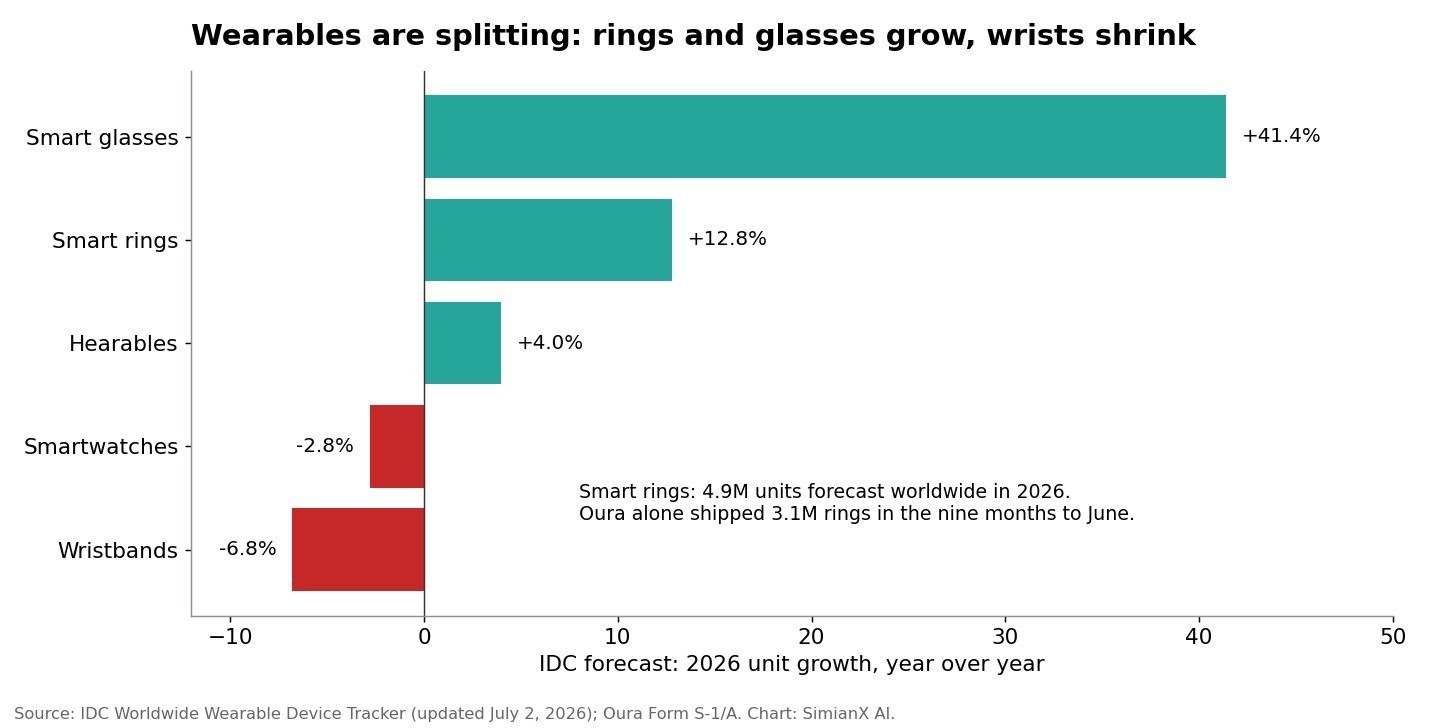
IDC counted 145.7 million wearable shipments worldwide in the first quarter of 2026, up 4.3%. The categories are moving in different directions:
| Category (IDC 2026 forecast) | Units | Growth |
|---|---|---|
| Hearables | 407.6 million | +4.0% |
| Smartwatches | 159.7 million | −2.8% |
| Wristbands | 40.2 million | −6.8% |
| Smart glasses | 13.6 million | +41.4% |
| Smart rings | 4.9 million | +12.8% |
The striking comparison: IDC expects 4.9 million smart rings to ship worldwide in all of 2026, and about 6.3 million by 2030. Oura alone recorded 3.1 million ring sales in the nine months to June. IDC says Oura "continues to anchor the category." Company and tracker counts are not measured identically, but the gap makes the point. Oura is not winning share in a big market. It is most of a small one, and IDC's forecast of 12.8% category growth is far slower than Oura's 75%.
That cuts both ways. Oura's growth has come from winning buyers who would otherwise not own a ring, and from upgrades. Staying on a 70%+ growth path means the category itself has to get much bigger. The competition in the S-1's risk factors, including Apple, Google's Fitbit, Samsung's Galaxy Ring, Garmin and Whoop, makes that harder. For a listed comparison, Garmin is the closest wearables pure play, and Apple sets the pace in smartwatches.
Is the Delay a Market Problem or an Oura Problem?
Mostly the market, with price as the trigger.
| Points to the market | Points to Oura |
|---|---|
| Book was ~5× oversubscribed (Axios) | 73–77% of shares were insiders selling |
| Third official IPO postponement this month | ~8× sales for a business that is 80% hardware |
| Fed rate hikes and a bond-yield surge (Renaissance/AP) | Adjusted EBITDA margin fell from 12% to 9% |
| Revenue +74%, members +100%, positive operating cash flow | $350M of debt taken on largely to fund buybacks |
| Lilly and Dragoneer indicated $400M of interest | A $84.4M warranty hit only one product cycle ago |
Recent IPOs show the stakes. Newcleo closed its first day below its $10 SPAC reference price. Unitree jumped 460%. A first-day drop would have hurt Oura's employees and its long-term holders more than a delay.
What Would Make the Next Attempt Work?
- A lower range. About $36–$40 would put the stock near 7 times this year's revenue, a level buyers appear willing to accept.
- The fourth quarter. The Oura Ring 5 holiday quarter should be Oura's biggest ever (roughly $510 million if the ~90% growth expectation holds). A strong print, with gross margin at or above 55%, would support the case.
- Less insider selling. A smaller secondary portion, or longer lock-ups for the biggest funds, would ease concerns about stock overhang.
- Membership disclosure. Quarterly subscription revenue, churn and average revenue per member would show investors whether subscriptions can be valued like software.
- Debt paydown. Using operating cash to shrink the $350 million revolver would show that the buyback borrowing is temporary.
FAQ
Why did Oura delay its IPO?
Oura postponed the offering on September 29, 2026, citing market uncertainty. Reporting by Axios and AP pointed to price: demand was strong (about 5× oversubscribed), but not at the top of the $40–$44 range, amid Fed rate hikes and rising bond yields.
Is the Oura IPO canceled?
No. It is postponed. The registration statement remains on file and Oura can relaunch when it chooses.
What would Oura's stock ticker be?
Oura applied to list on the Nasdaq Global Select Market as OURA.
How much was Oura worth in the IPO?
About $13.5 billion at the $42 midpoint, based on 320.9 million shares outstanding after the offering. The range implied $12.8–$14.1 billion.
Is Oura profitable?
Yes, on an operating basis. For the nine months to June 30, 2026, Oura reported $71.2 million of operating income, $60.8 million of net income and $328 million of operating cash flow. A $985 million deemed dividend on preferred stock produced a large accounting loss attributable to common stockholders.
Can you buy Oura stock now?
Not on a public exchange. Until it lists, the closest public ways to follow the wearables market are companies like Garmin and Apple. The Robinhood Ventures Fund I, disclosed in Oura's offering materials, is one of its pre-IPO holders.
For live fundamentals on listed wearables stocks, see the Garmin stock page. For how famous IPOs have performed after listing, see When Did Tesla IPO?.
This article is for research and education only and is not financial advice.
Related Reading
- Newcleo NWCL Debut: $8.145 Close vs $10 SPAC Price, Decoded
- Unitree Robotics IPO Soars 460%: AI Breakthrough or Bubble?
- Warsh Ignores Trump: The Fed's First Rate Hike Since 2023
- Global Bond Selloff 2026: 30-Year Yields at 19-Year Highs
- Robinhood Stock 2026: Crypto Is Only 8% of HOOD Revenue
- When Did Tesla IPO? The Date, Price, and 290x Return
References
- Oura — amended Form S-1 (Sept 21, 2026)
- Oura — IPO launch announcement (free writing prospectus)
- Oura — CEO interview filed as offering material (Sept 24, 2026)
- SEC EDGAR — Oura Inc. filings
- Axios — Smart-ring maker Oura delays $2 billion IPO
- Associated Press — Oura postpones IPO, citing market uncertainty
- IDC — Wearable Devices Market Insights
- Renaissance Capital — IPO market research
- Nasdaq — IPO calendar
- Oura — newsroom
- Wikipedia — Oura Health
- Investopedia — initial public offering
- Investopedia — secondary offering
- Investopedia — greenshoe option
- Investopedia — oversubscribed
- Investopedia — tender offer
- Investopedia — lock-up period
- Investopedia — revolving credit
- Investopedia — EBITDA
- SimianX — GRMN stock fundamentals