
Reading Robinhood as a Financial Platform, Not a Bitcoin Proxy
Is HOOD the best crypto market play of 2026? The short answer is nuanced: Robinhood Markets (NASDAQ: HOOD) may be one of the strongest diversified ways to participate in digital-asset growth, but it is neither the purest cryptocurrency investment nor an obviously cheap stock.
Robinhood now combines retail brokerage, crypto trading, institutional exchange infrastructure, prediction markets, interest income, subscriptions, credit cards, and international expansion. That diversification helped the company report record revenue even while its cryptocurrency revenue declined sharply.
For investors monitoring this fast-changing story, SimianX AI can supplement manual research by comparing market data, fundamentals, technical indicators, news sentiment, and risk factors. Its multi-agent approach is especially relevant to HOOD, where a bullish crypto narrative must be tested against valuation and regulatory risk.
Core conclusion: Robinhood looks increasingly like a financial-market platform with crypto infrastructure—not simply a leveraged bet on Bitcoin. That makes the business more resilient, but the stock’s premium valuation leaves limited room for execution mistakes.
All financial figures and market prices in this research are based on information available through August 7, 2026. This article is educational and does not constitute personalized investment advice.
Robinhood’s 2026 Investment Thesis in One Table
Robinhood’s attraction is no longer confined to commission-free equity trading. The company is attempting to own multiple layers of the next-generation financial system: customer acquisition, trading, custody, subscriptions, market infrastructure, tokenization, and wealth management.
| Investment factor | Bullish interpretation | Bearish interpretation |
|---|---|---|
| Crypto exposure | Robinhood can monetize higher crypto volumes, staking, custody, lending, and tokenization | Crypto revenue remains cyclical and fell sharply in early 2026 |
| Revenue diversification | Options, prediction markets, interest income, and Gold reduce dependence on crypto | Several growth engines are themselves tied to speculative retail activity |
| Customer assets | Higher platform assets can support interest, lending, subscriptions, and trading revenue | Asset growth partly reflects rising market prices rather than organic deposits |
| International expansion | Bitstamp and WonderFi add licenses, institutional customers, and new markets | Acquisitions add integration, compliance, and execution risk |
| Profitability | Robinhood has reached substantial GAAP profitability and operating leverage | Reported profit can include tax benefits, investment gains, and market-sensitive revenue |
| Valuation | A premium may be justified if Robinhood becomes a global financial super-app | The current multiple already discounts years of strong execution |
Robinhood therefore offers an unusual combination: crypto-market upside with more diversified cash flows than a crypto-only exchange. Whether that combination makes HOOD the best crypto market play depends heavily on the price an investor pays.
What Do Robinhood’s Latest Financial Results Show?
Robinhood’s second-quarter 2026 results were strong at the consolidated level:
- Total net revenue increased 32% year over year to $1.31 billion.
- Transaction-based revenue increased 44% to $776 million.
- Net interest revenue increased 9% to $389 million.
- Other revenue increased 54% to $143 million.
- Net income increased 48% to $573 million.
- Diluted EPS increased 48% to $0.62.
However, $129 million of quarterly net income came primarily from gains associated with deconsolidating Robinhood Ventures Fund I. Investors should therefore avoid annualizing the entire $573 million as if it were recurring operating profit.
The revenue mix tells the more important story:
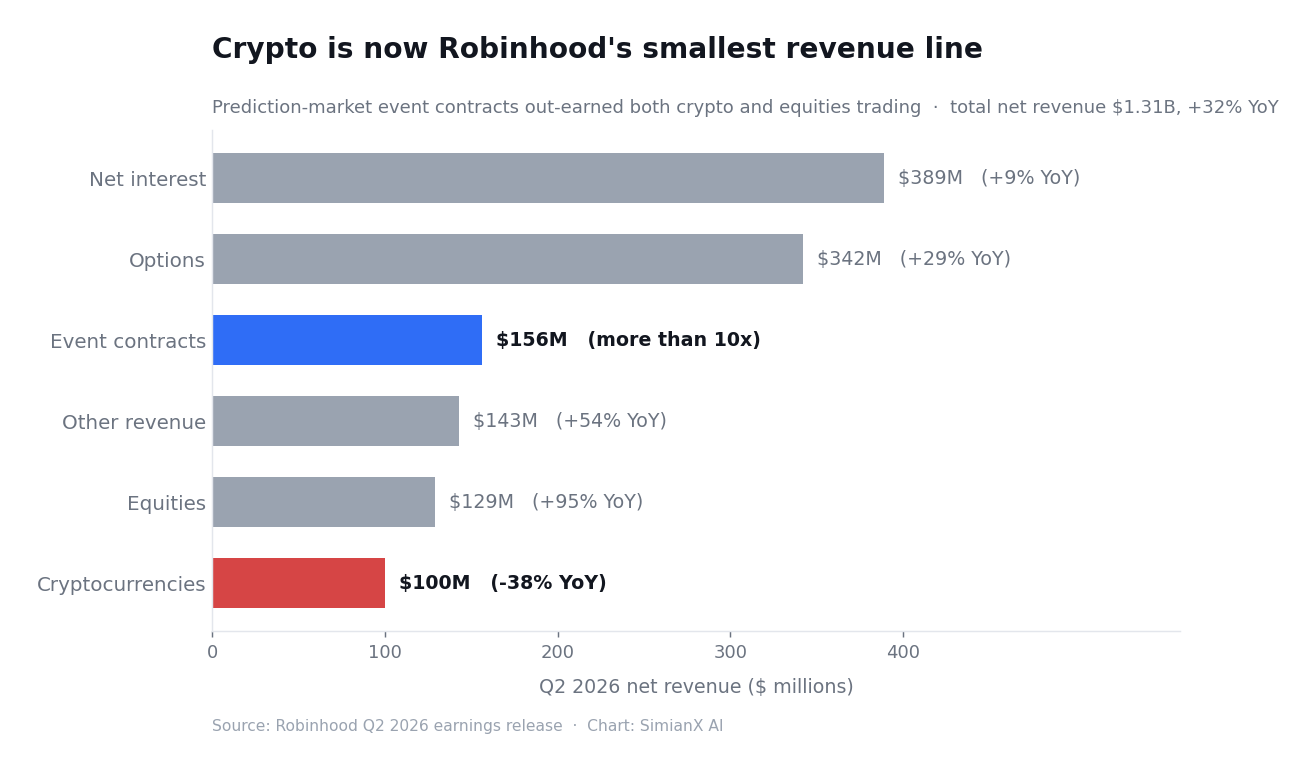
| Q2 2026 revenue source | Revenue | Year-over-year change |
|---|---|---|
| Options | $342 million | +29% |
| Event contracts | $156 million | More than 10x |
| Equities | $129 million | +95% |
| Cryptocurrencies | $100 million | -38% |
| Net interest | $389 million | +9% |
| Other revenue | $143 million | +54% |
These figures come from Robinhood’s official Q2 2026 earnings materials and the company’s earnings release reproduced by GlobeNewswire/StreetInsider.
The critical finding is that prediction-market revenue exceeded cryptocurrency and equity trading revenue during the quarter. Crypto was only about 8% of total net revenue, compared with substantially greater dependence on digital-asset trading during earlier periods.
That diversification protected consolidated growth, but it complicates the idea that Robinhood is the “best crypto stock.” In Q2, the company succeeded largely because other products compensated for crypto weakness.
Are Robinhood’s customer and asset trends still strong?
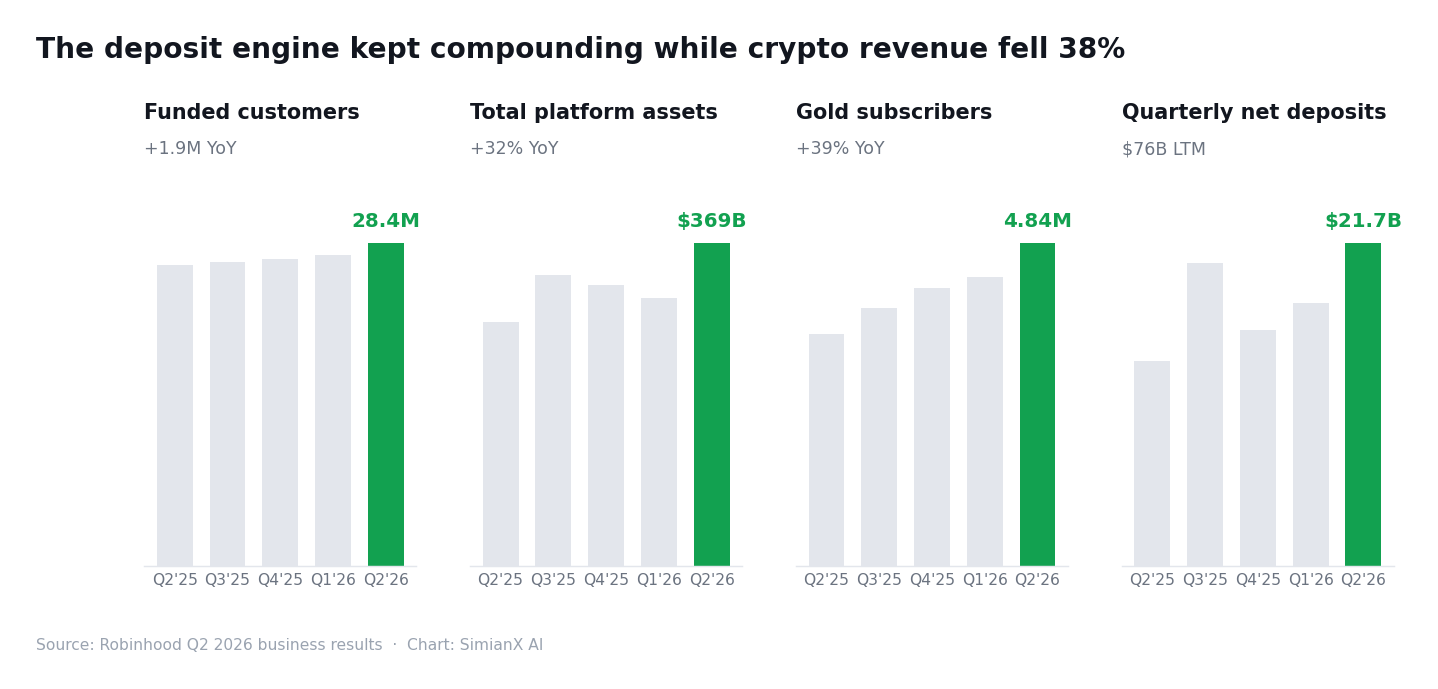
Yes. Robinhood reported several record operating metrics for Q2 2026:
- 28.4 million funded customers, up approximately 1.9 million year over year.
- $369 billion in Total Platform Assets, up 32%.
- $21.7 billion in quarterly net deposits.
- 4.8 million Robinhood Gold subscribers, up 39%.
- Nearly $2 billion managed by Robinhood Strategies across more than 300,000 funded customers.
The growth in Gold subscribers is particularly valuable because subscriptions can deepen customer relationships and encourage adoption of margin, retirement accounts, banking, credit cards, research, and advisory services.
Total Platform Assets should nevertheless be interpreted carefully. It rises through both net deposits and appreciation in customers’ securities and crypto holdings. A strong equity market can make the figure grow rapidly even if underlying deposit momentum slows.
How Much Crypto Exposure Does Robinhood Actually Have?
Robinhood’s direct crypto transaction revenue is currently meaningful but no longer dominant. In Q2 2026, crypto revenue was $100 million, versus total net revenue of $1.31 billion. In Q1, crypto revenue was $134 million, down 47% year over year, according to Robinhood’s first-quarter results.
This does not capture Robinhood’s complete digital-asset exposure. The broader crypto strategy includes:
- Retail cryptocurrency trading in the United States and international markets.
- Institutional and retail exchange services through Bitstamp.
- Canadian platforms acquired through WonderFi.
- Staking and on-chain lending products.
- Self-custody through Robinhood Wallet.
- Cryptocurrency perpetual futures in Europe.
- Tokenized equities and other real-world assets.
- Robinhood Chain, an Ethereum Layer 2 designed for tokenized financial assets.
- Potential future custody, settlement, and infrastructure revenue.
Robinhood completed its acquisition of Bitstamp in June 2025, adding Bitstamp, an exchange with retail and institutional customers across the United States, United Kingdom, and European Union. It then completed the approximately C$250 million WonderFi transaction in June 2026, gaining Canadian platforms including Bitbuy and Coinsquare. Robinhood said the WonderFi deal brought its international funded-customer count above one million. See the company’s WonderFi completion announcement.
These assets give Robinhood more ways to participate in crypto adoption than a simple trading rebate. The long-term opportunity is to turn digital assets into financial infrastructure revenue through custody, staking, lending, tokenization, and settlement.
The challenge is that many of these products remain early. Robinhood Chain adoption, tokenized-asset liquidity, regulatory acceptance, and eventual monetization are not guaranteed.
Robinhood is becoming less dependent on crypto transaction revenue while making a larger strategic commitment to crypto infrastructure.
This distinction matters. Investors buying HOOD for the next Bitcoin rally may receive less direct upside than expected. Investors buying it for the convergence of brokerage, crypto, and tokenized finance may find the strategy more compelling.
Why HOOD Could Be One of the Best Crypto Market Stocks in 2026
1. It offers diversified crypto upside
Coinbase is generally a purer crypto-market investment. Robinhood instead combines digital-asset exposure with options, equities, interest income, subscriptions, advisory services, prediction markets, and banking products.
That diversification can cushion earnings when crypto trading weakens. Robinhood demonstrated exactly that in Q2 2026: crypto revenue fell 38%, yet total revenue rose 32%.
2. Customer deposits create a compounding platform
Robinhood generated $68.1 billion in net deposits during 2025 and ended that year with approximately $324 billion in platform assets. Full-year revenue rose 52% to $4.47 billion, while net income reached $1.88 billion, according to Robinhood’s 2025 Form 10-K.
Deposits can contribute to multiple revenue streams:
- Trading activity
- Margin lending
- Cash-sweep interest
- Securities lending
- Gold subscriptions
- Advisory fees
- Retirement products
- Crypto custody and trading
This creates more potential lifetime value per customer than a platform dependent on one transaction category.
3. Robinhood has demonstrated operating leverage
The company moved from heavy losses earlier in its public history to strong GAAP profitability. Adjusted EBITDA reached approximately $2.5 billion in 2025, up 76%.
Robinhood also lowered and tightened its 2026 outlook for adjusted operating expenses plus stock-based compensation to approximately $2.675 billion–$2.775 billion, despite incorporating new operations such as WonderFi and Rothera.
4. Tokenization could expand Robinhood’s addressable market
Robinhood has introduced stock tokens in Europe and is developing Robinhood Chain. The same regulated-tokenization race is covered from the issuer side in Securitize Stock 2026: SECZ Tokenized Shares Guide and Securitize NYSE Debut 2026: Tokenized Stocks Hit Wall Street. If securities, private-market interests, funds, and other real-world assets increasingly move on-chain, Robinhood could participate as a distributor, broker, custodian, and infrastructure provider.
This is an attractive strategic option, but investors should treat tokenization revenue as potential, not established earnings. Regulatory approval and genuine customer demand remain necessary.
5. The brand resonates with younger investors
Robinhood’s mobile-first design, low-friction onboarding, fractional shares, retirement matches, and premium subscription ecosystem have helped it reach customers who may accumulate more assets as they age.
The investment case depends on Robinhood retaining these users while expanding from speculative trading into long-term wealth, retirement, banking, and advisory relationships.
Is Robinhood Stock Overvalued in 2026?
Valuation is the strongest argument against treating HOOD as an automatic buy.
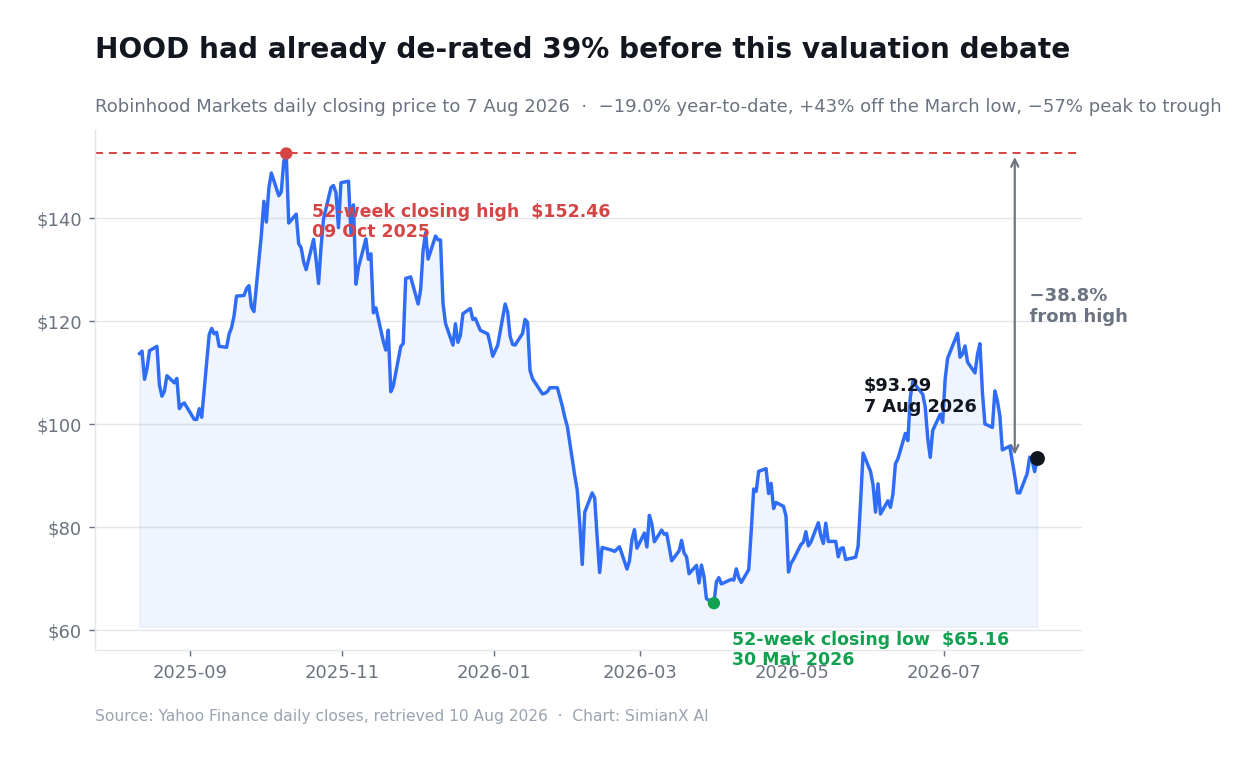
Robinhood closed at $93.29 on August 7, 2026, giving it a market capitalization of approximately $83.9 billion and an enterprise value near $82.9 billion, according to Stock Analysis data sourced from S&P Global Market Intelligence.
The Stock Has Already De-Rated 39% From Its High
Any argument about Robinhood’s "premium" has to start with what the market has already taken back. HOOD closed at $152.46 on October 9, 2025 — its highest close of the trailing twelve months — and then fell to $65.16 on March 30, 2026, a peak-to-trough decline of 57.3%. The August 7 close of $93.29 leaves the shares 38.8% below that high and 19.0% lower year to date, even after a 43% recovery off the March low. Those figures come from Yahoo Finance daily closing prices for HOOD.
This changes how the multiples above should be read. A 37.8x forward earnings multiple on a stock sitting at its 52-week high is a very different proposition from the same multiple on a stock that has already surrendered nearly two-fifths of its value. A meaningful part of the "premium valuation" concern was settled by the market itself between October and March. What is still open is whether the consensus 2026 and 2027 estimates are the right denominators.
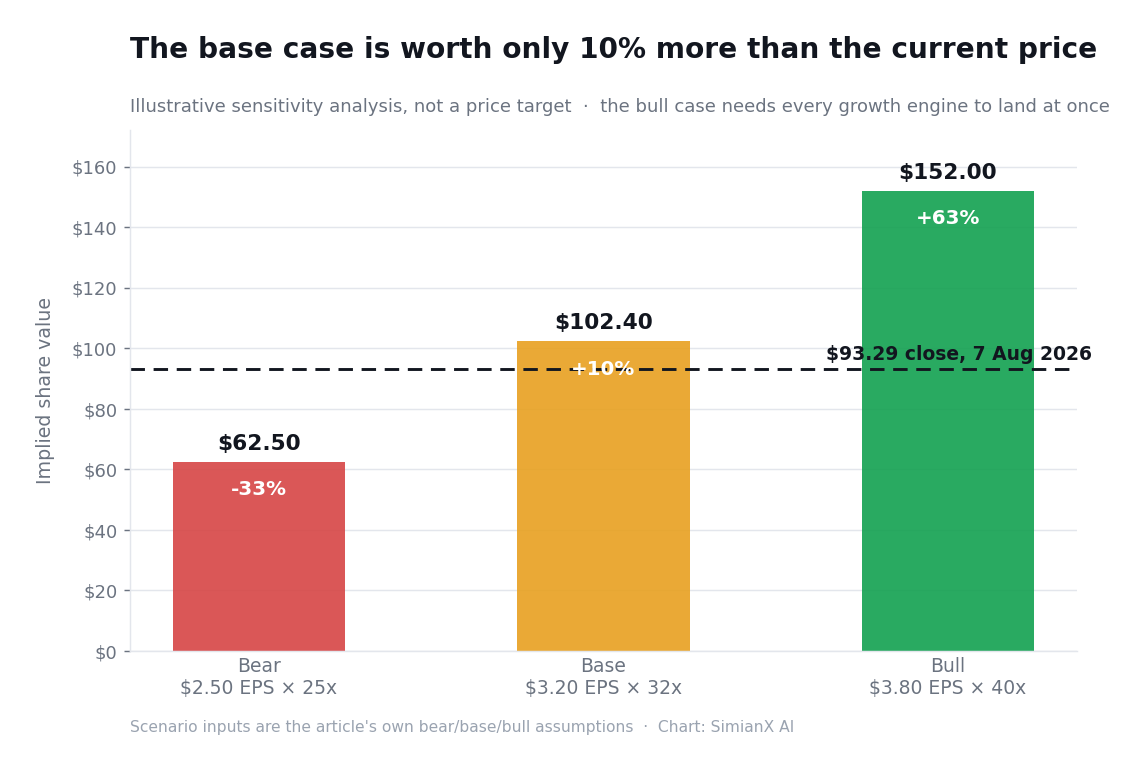
It also puts the downside scenario in context. The bear case below implies $62.50 — only about 4% below the $65.16 that Robinhood actually closed at in March 2026. That is not a hypothetical drawn from a spreadsheet; it is within a few percent of a price the market assigned to this business inside the last six months. Investors sizing the risk here should treat the bear column as a recently visited level rather than a remote tail. For how long comparable drawdowns have historically taken to repair, see How Long Every Bear Market Took to Recover: 1929-2022.
Consensus estimates at that time called for approximately:
- $5.15 billion of 2026 revenue
- $2.47 of adjusted 2026 EPS
- $6.47 billion of 2027 revenue
- $3.18 of adjusted 2027 EPS
At $93.29, those estimates imply roughly:
- 16.3 times 2026 revenue
- 37.8 times 2026 adjusted EPS
- 29.3 times 2027 adjusted EPS
That is a substantial premium for a company whose revenue is still sensitive to trading activity, interest rates, asset prices, and regulatory policy.
The market is pricing Robinhood more like a high-growth financial technology platform than a conventional broker. To justify that premium, the company must probably maintain strong net deposits, expand margins, retain Gold subscribers, monetize international operations, and convert new products into durable revenue.
An illustrative HOOD valuation framework
The following is a sensitivity analysis—not a prediction or price target.
| Scenario | Illustrative forward EPS | Applied P/E | Implied value |
|---|---|---|---|
| Bear case | $2.50 | 25x | $62.50 |
| Base case | $3.20 | 32x | $102.40 |
| Bull case | $3.80 | 40x | $152.00 |
The bear case could occur if crypto and retail trading remain weak, prediction-market growth slows, interest rates fall faster than asset balances grow, or regulation constrains key products.
The base case assumes Robinhood delivers around consensus 2027 earnings, maintains customer inflows, and keeps a premium growth multiple.
The bull case requires exceptional execution: international expansion, higher crypto activity, successful tokenization, continued prediction-market growth, and strong subscription and interest-bearing asset expansion.
The asymmetry is not obviously favorable at every price. HOOD can be a strong company and still produce disappointing returns if investors enter at an excessive multiple.
Robinhood vs. Coinbase: Which Is the Better Crypto Stock?
| Factor | Robinhood | Coinbase |
|---|---|---|
| Crypto purity | Moderate | High |
| Revenue diversification | High | Improving, but still crypto-centric |
| Sensitivity to Bitcoin volumes | Lower | Higher |
| Retail brokerage exposure | Extensive | Expanding |
| Institutional crypto infrastructure | Bitstamp and related services | Deep custody and institutional franchise |
| Blockchain strategy | Robinhood Chain | Base |
| Likely performance in crypto mania | Strong | Potentially stronger |
| Down-cycle resilience | Potentially better | More exposed to crypto conditions |
| Valuation risk | High | High and earnings-sensitive |
A July 2026 comparison showed Robinhood’s trailing revenue growing about 41.5% while Coinbase’s declined 5.4%. Robinhood also had lower measured share-price beta, although both stocks remained volatile. See the Robinhood-versus-Coinbase fundamentals comparison.
The choice depends on the investor’s objective:
- Choose Coinbase for more concentrated exposure to crypto prices, trading volumes, custody, staking, and on-chain activity.
- Choose Robinhood for crypto exposure combined with brokerage, options, prediction markets, subscriptions, and interest income.
- Choose Bitcoin or a spot Bitcoin ETF when the goal is primarily exposure to Bitcoin itself without corporate operating risk — BTC vs ETH vs SOL: Best Buy Zones in the 2026 Crypto Dip frames that choice directly.
- Choose neither if the valuation does not provide an adequate margin of safety.
For many portfolios, Robinhood is the better business diversification play, while Coinbase remains the clearer crypto beta play.
The Biggest Risks to the HOOD Stock Thesis
Crypto and retail trading cyclicality
Transaction activity can decline rapidly when volatility and investor enthusiasm fade. Robinhood’s Q1 and Q2 crypto revenue declines demonstrate that favorable long-term adoption does not guarantee smooth quarterly growth. The underlying cycle is documented in Bitcoin Quarterly Returns: Full History Table 2013–2026 and Every Bitcoin Crash Over 50%: Recovery Times Since 2011.
Prediction-market regulation
Event contracts generated $156 million in Q2 2026 and became a major revenue contributor. But federal and state disputes over sports and event contracts — fought largely around the CFTC’s jurisdiction over event contracts — could limit product availability or raise compliance costs. A business that diversifies away from crypto into another disputed regulatory category may not reduce risk as much as headline revenue diversity suggests.
Interest-rate sensitivity
Net interest revenue is supported by margin balances, customer cash, corporate investments, securities lending, and credit-card balances. Lower rates can compress yields, while rapid credit expansion can increase loss provisions. For how the rate path has historically transmitted into both equities and digital assets, see June 2026 FOMC Decision: Dot Plot, AI Stocks & Bitcoin and Bitcoin After Every Fed Rate Cut: 2019-2026 Reference.
Compliance and operational history
The SEC closed its Robinhood Crypto investigation without recommending enforcement in February 2025, reducing an important overhang. Nevertheless, compliance risk remains material.
In March 2025, FINRA fined Robinhood Financial and Robinhood Securities $26 million and ordered $3.75 million of customer restitution concerning anti-money-laundering, supervisory, reporting, and disclosure failures. FINRA said the firms agreed to certify remediation. Investors should review the FINRA enforcement announcement.
The SEC separately announced $45 million in combined penalties against two Robinhood broker-dealers in January 2025 for violations involving reporting, recordkeeping, customer-information safeguards, suspicious-activity reporting, and short-sale rules. See the SEC enforcement release.
Acquisition and integration risk
Bitstamp and WonderFi expand Robinhood’s geographic and product reach, but integrating technology, customer assets, licenses, employees, and compliance systems across jurisdictions can be expensive.
Dilution and capital allocation
Robinhood raised $2.2 billion through 0% convertible senior notes due in 2029. The company used part of the proceeds for share repurchases and capped-call transactions intended to reduce potential dilution. Nevertheless, convertible financing can complicate per-share valuation.
High expectations
Perhaps the greatest risk is simply that the market already recognizes Robinhood’s strengths. At a premium earnings and revenue multiple, a modest growth slowdown can cause substantial multiple compression. The 2026 semiconductor complex offers a live example of how quickly a crowded growth multiple can unwind — see AI Momentum Unwind 2026: Why Semiconductor Stocks Fall.
A Practical Framework for Evaluating Robinhood Stock
Rather than making a decision based only on Bitcoin’s price, investors can track five groups of indicators:
- Customer growth: funded customers, Gold subscribers, and international adoption.
- Asset growth: net deposits, Total Platform Assets, retirement assets, and advisory AUM.
- Revenue quality: recurring subscriptions and asset-based revenue versus volatile transaction revenue.
- Crypto execution: Bitstamp volume, staking assets, international expansion, Robinhood Chain usage, and tokenized-asset adoption.
- Valuation: forward EPS, enterprise value-to-revenue, dilution, and free-cash-flow conversion.
A useful quarterly checklist is:
- Did net deposits exceed market-driven asset appreciation?
- Did Gold adoption rise as a percentage of funded customers?
- Did crypto market share improve even if industry volume weakened?
- Did new products add revenue without accelerating expenses?
- Were earnings driven by recurring operations or one-time gains?
- Has the stock’s valuation moved faster than underlying estimates?
This is where a multi-perspective tool can be helpful. SimianX AI combines fundamental, technical, sentiment, and risk analysis and allows specialized agents to challenge one another’s conclusions. Investors can use SimianX’s stock-analysis platform to monitor HOOD, then verify important outputs against Robinhood filings and independent market data. Because the bull case rests on digital-asset volumes, the SimianX Crypto Leaderboard is a useful companion for tracking whether crypto-market activity is actually recovering.
AI research should remain an input—not an unquestioned answer. SimianX itself states that its analysis is educational, may contain errors, and does not guarantee investment outcomes.
FAQ About Robinhood Stock 2026
Is HOOD a good crypto stock to buy in 2026?
HOOD offers meaningful crypto exposure alongside more diversified financial-services revenue. It may suit investors seeking a broader platform investment, but its premium valuation and regulatory exposure require a substantial margin of safety.
How much of Robinhood’s revenue comes from cryptocurrency?
Robinhood generated $100 million of crypto transaction revenue in Q2 2026, approximately 8% of its $1.31 billion in total net revenue. Its wider digital-asset exposure also includes Bitstamp, WonderFi, staking, wallets, tokenized assets, and Robinhood Chain.
Is Robinhood better than Coinbase for crypto exposure?
Robinhood is more diversified and may be more resilient when crypto trading slows. Coinbase generally provides purer exposure to crypto-market activity and may respond more strongly during a major digital-asset bull market.
What could make HOOD stock rise?
Potential catalysts include stronger net deposits, higher crypto and options activity, continued Gold growth, successful international integration, Robinhood Chain adoption, tokenization revenue, and sustained prediction-market expansion.
What is the biggest risk to Robinhood stock?
The biggest combined risk is a high valuation meeting cyclical or regulatory weakness. Even solid operational results may not support the share price if earnings estimates fall or investors assign the company a lower multiple.
Conclusion
So, is HOOD the best crypto market play of 2026? Robinhood is arguably one of the best diversified financial-platform plays on crypto adoption, but it is not the purest digital-asset investment and cannot be called the best at any valuation.
The bull case is credible: Robinhood has strong customer inflows, record platform assets, rising Gold adoption, multiple profitable revenue streams, and a growing international crypto footprint. Bitstamp, WonderFi, tokenization, and Robinhood Chain give it strategic options beyond retail trading.
The caution is equally important. Crypto revenue declined 38% in Q2 2026, one-time gains supported quarterly profit, prediction markets introduce a new regulatory dependency, and the shares traded at approximately 38 times consensus 2026 adjusted EPS as of August 7.
The most defensible verdict is “high-quality watchlist candidate, valuation-sensitive purchase.” Robinhood may offer a better risk-balanced business than a crypto-only exchange, but investors primarily seeking Bitcoin exposure may prefer Bitcoin itself or a spot ETF. Investors seeking maximum crypto-cycle beta may still favor Coinbase.
Use SimianX AI to examine Robinhood through multiple analytical lenses, track changes after each earnings release, and challenge both bullish and bearish assumptions before committing capital.
Related Reading
- Securitize Stock 2026: SECZ Tokenized Shares Guide
- Securitize NYSE Debut 2026: Tokenized Stocks Hit Wall Street
- Bitcoin Quarterly Returns: Full History Table 2013–2026
- Every Bitcoin Crash Over 50%: Recovery Times Since 2011
- How Long Every Bear Market Took to Recover: 1929-2022
- June 2026 FOMC Decision: Dot Plot, AI Stocks & Bitcoin
- Bitcoin After Every Fed Rate Cut: 2019-2026 Reference
- BTC vs ETH vs SOL: Best Buy Zones in the 2026 Crypto Dip
- AI Momentum Unwind 2026: Why Semiconductor Stocks Fall
References
- Robinhood Investor Relations — quarterly results and earnings materials
- SEC EDGAR — Robinhood Markets filings (CIK 0001783879)
- SEC — January 2025 enforcement action against two Robinhood broker-dealers
- FINRA — March 2025 fine and customer restitution order
- CFTC — federal regulator for event contracts and prediction markets
- Yahoo Finance — HOOD daily price history
- Nasdaq — HOOD market activity
- Stock Analysis — HOOD market capitalisation and enterprise value
- Bitstamp — the exchange Robinhood acquired in 2025
- Coinbase — the closest listed crypto-native comparable
- SimianX Crypto Leaderboard — live AI model performance on crypto markets