
The IEEPA Tariff Refund Tracker: Who Got Paid, How Much, and What It Does to Earnings
The Supreme Court struck down President Trump's emergency tariffs on February 20, 2026. Since then, more than $122 billion of refunds has been certified for payment. That money is now showing up in corporate earnings, and it is large enough to change how a quarter looks.
Target booked $994 million of tariff refunds in one quarter, worth $1.65 per share, and kept it in both its GAAP and adjusted earnings. Nike said refunds added about 900 basis points to its fourth-quarter gross margin. Ford recorded a $1.3 billion one-time benefit. At the other end, TJX, Victoria's Secret and Five Below removed the refunds from their adjusted results, so their headline "beats" mean something different.
This tracker is built from every SEC filing that mentions IEEPA refunds between the ruling and September 24, 2026: 1,396 filings from 644 companies. We read the disclosures of the largest ones and quantified the refunds of 78 public companies, which together have booked or received about $11.4 billion. The tables below show who got paid, how big the windfall is relative to each company, how it flatters margins and earnings per share, and which companies still have money coming as third-quarter earnings season begins.
Figures are as disclosed in each company's latest 8-K, 10-Q or 10-K through September 24, 2026. "Refund" means the amount recognized in the income statement where disclosed, otherwise cash received.
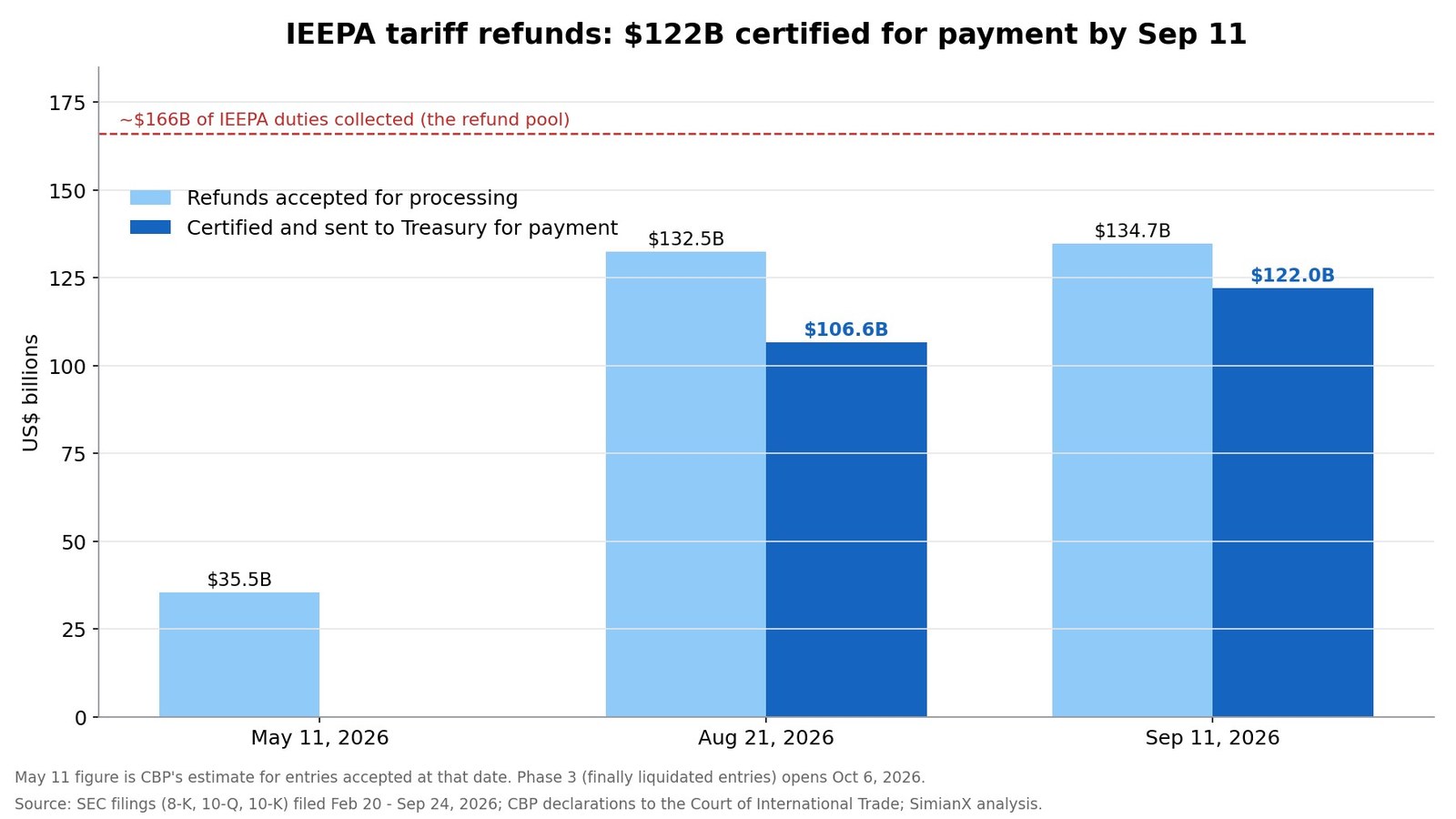
Tariff Refunds at a Glance
| Metric | Figure |
|---|---|
| Supreme Court ruling | Feb 20, 2026 (Learning Resources v. Trump, 6–3) |
| IEEPA duties collected (the refund pool) | ~$166 billion from 330,000+ importers |
| Refunds accepted for processing (Sep 11) | ~$134.7 billion |
| Refunds certified and sent to Treasury (Sep 11) | ~$122.0 billion |
| CAPE refund declarations filed (Sep 11) | 286,044, covering 27.2 million entries |
| Next refund phase | Phase 3 opens Oct 6, 2026 |
| Public companies quantified in this tracker | 78 |
| Refunds those 78 have booked or received | ~$11.4 billion |
| Share taken by the top 10 | ~$6.5 billion (57%) |
The gap between the $122 billion certified and the $11.4 billion we can trace to named public companies is itself informative. Most IEEPA duties were paid by private importers, foreign-owned subsidiaries and smaller companies that do not disclose the amounts, and by customs brokers acting for thousands of clients. The listed companies below are the visible part of a much larger transfer.
How the IEEPA Tariff Refunds Happened: The Timeline
The International Emergency Economic Powers Act (IEEPA) is a 1977 sanctions law. In 2025 it was used for the first time to impose broad import tariffs: the "trafficking" tariffs on China, Canada and Mexico in February 2025, then the "reciprocal" tariffs announced on April 2, 2025. Importers challenged them, and the case reached the Supreme Court.
| Date | Event |
|---|---|
| Feb 2025 | IEEPA tariffs imposed on China, Canada and Mexico |
| Apr 2, 2025 | "Reciprocal" IEEPA tariffs announced on most trading partners |
| Feb 20, 2026 | Supreme Court rules 6–3 that IEEPA does not authorize tariffs |
| Feb 24, 2026 | Replacement 10% global surcharge takes effect under Section 122 of the Trade Act of 1974 |
| Mar 4, 2026 | Court of International Trade orders refunds of IEEPA duties, with interest |
| Apr 20, 2026 | CBP opens Phase 1 of its refund system (CAPE) |
| Jun 2, 2026 | Justice Department appeals the refund order for entries that were already finally liquidated |
| Jun 29, 2026 | Phase 2 adds reconciliation-flagged entries |
| Jul 24, 2026 | Section 122 surcharge expires; new Section 301 duties of 10%–12.5% on 60 economies replace it |
| Sep 11, 2026 | $134.7B accepted and $122.0B certified for payment |
| Oct 6, 2026 | Phase 3 opens for finally liquidated entries covered by court orders |
The Court's majority opinion, written by Chief Justice Roberts, held that the President needs clear authorization from Congress to impose tariffs and that IEEPA does not give it. Justices Thomas, Alito and Kavanaugh dissented. The full opinion is on the Supreme Court's website.
Two points matter for investors. First, the refunds are one-time. Tariffs did not disappear: the Section 122 surcharge and then new Section 301 duties took their place, so companies are paying new tariffs while collecting refunds on the old ones. Second, the refunds are not finished. Phase 3 opens on October 6, and the government's appeal over finally liquidated entries is still pending, so some of the largest claims remain unresolved.
The Tariff Refund Tracker: The 25 Largest Disclosed Refunds
| Rank | Company | Refund booked or received | When recognized | Where it lands | Adjusted EPS treatment |
|---|---|---|---|---|---|
| 1 | Ford (F) | $1,300M | Q1 2026 | Cost of sales | Kept in adjusted EBIT |
| 2 | Target (TGT) | $994M | Q2 FY2026 | Gross margin | Kept in ($1.65/share) |
| 3 | Nike (NKE) | $986M | Q4 FY2026 | Gross margin | Kept in reported EPS ($0.52/share) |
| 4 | Home Depot (HD) | $685M | Q2 FY2026 | Cost of sales | Not stated |
| 5 | Amazon (AMZN) | $640M | Q2 2026 | Cost of sales | Not stated |
| 6 | General Motors (GM) | $500M | Q1 2026 | Net favorable adjustment | Not stated |
| 7 | Caterpillar (CAT) | $392M | Q2 2026 | Cost of goods sold (receivable) | Not stated |
| 8 | Dollar Tree (DLTR) | $369M | Q2 FY2026 | Cost of sales | Not stated |
| 9 | TJX (TJX) | $331M | Q2 FY2027 | Cost of sales | Excluded |
| 10 | Deere (DE) | $272M | Q2 FY2026 | Production costs | Not stated |
| 11 | Ross Stores (ROST) | $253M | Q2 FY2026 | Cost of goods sold | Kept in reported EPS ($0.60/share) |
| 12 | Medline (MDLN) | $243M | Q2 2026 | Cost of goods sold, net of customer repayments | Kept in adjusted EBITDA |
| 13 | American Eagle (AEO) | $196M | Q2 FY2026 | Cost of sales and SG&A | Not stated |
| 14 | Five Below (FIVE) | $170M | Q2 FY2026 | Cost of goods sold and interest | Excluded |
| 15 | Williams-Sonoma (WSM) | $168M | Q2 FY2026 | Cost of goods sold | Excluded ($1.06/share) |
| 16 | Victoria's Secret (VSCO) | $140M+ | Q2 FY2026 | Operating income | Excluded |
| 17 | Newell Brands (NWL) | $138M | H1 2026 | Cost of products sold | Kept in |
| 18 | Lululemon (LULU) | $135M | Q2 2026 | Cost of goods sold | Kept in reported EPS ($0.86/share) |
| 19 | VF Corp (VFC) | $131M | FY26–Q1 FY27 | Cost of goods sold | Not stated |
| 20 | GE HealthCare (GEHC) | $129M | Q2 2026 | Cost of products and services | Partly excluded |
| 21 | HP Inc (HPQ) | $127M | FQ3 FY2026 | Cost of revenue | Not stated |
| 22 | G-III Apparel (GIII) | $126M | H1 FY2027 | Cost of goods sold | Excluded |
| 23 | Stanley Black & Decker (SWK) | $118M | Q2 2026 | Cost of sales (partly offset by $83M of costs) | Kept in ($0.17/share net) |
| 24 | PVH (PVH) | $107M | Q2 2026 | Cost of goods sold | Not stated |
| 25 | Abercrombie & Fitch (ANF) | $100M | Q2 FY2026 | Cost of sales | Shown separately ($1.75/share) |
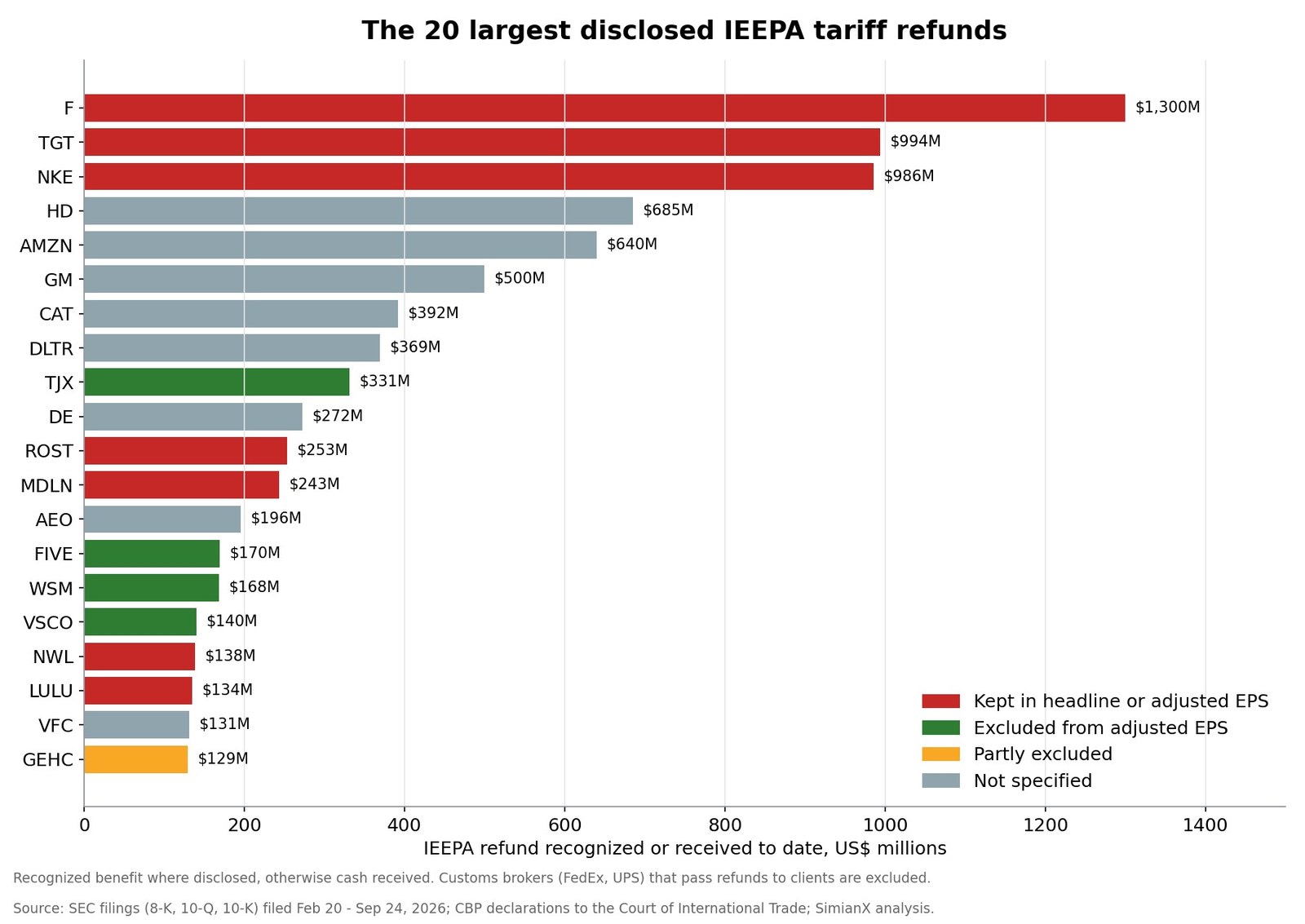
Four patterns stand out:
- Retail and apparel dominate. Fifteen of the top 25 are retailers or apparel brands. These companies import finished goods and pay the duty themselves as importer of record, so the refund comes straight back to them. For the consumer backdrop behind these names, see our analysis of what Walmart and Target signalled about stretched shoppers.
- Autos and machinery are next. Ford, GM, Caterpillar and Deere import parts and components at scale. Caterpillar says it paid about $1.0 billion of IEEPA tariffs in total but has recorded only $392 million so far, because it does not yet consider its remaining claims probable.
- Timing differs. Ford and GM booked their refunds in the first quarter, when they judged them probable. Most retailers waited until the cash arrived in the second quarter. Tesla, Hubbell and SharkNinja have recognized nothing yet, so their refunds will show up in later quarters.
- Some big importers show nothing. Walmart did not disclose a dollar amount. It said its gross-profit rate rose 96 basis points in its second quarter "primarily driven by tariff refunds," and that it is reinvesting the rest in lower prices. Costco disclosed only a net benefit of $0.15 per share in its fiscal fourth quarter, after reinvesting part of it in member value.
Biggest Windfalls Relative to Company Size
A $1.3 billion refund is 2.6% of Ford's market value. For smaller apparel and consumer-goods companies the refund is a much larger share of what the company is worth.
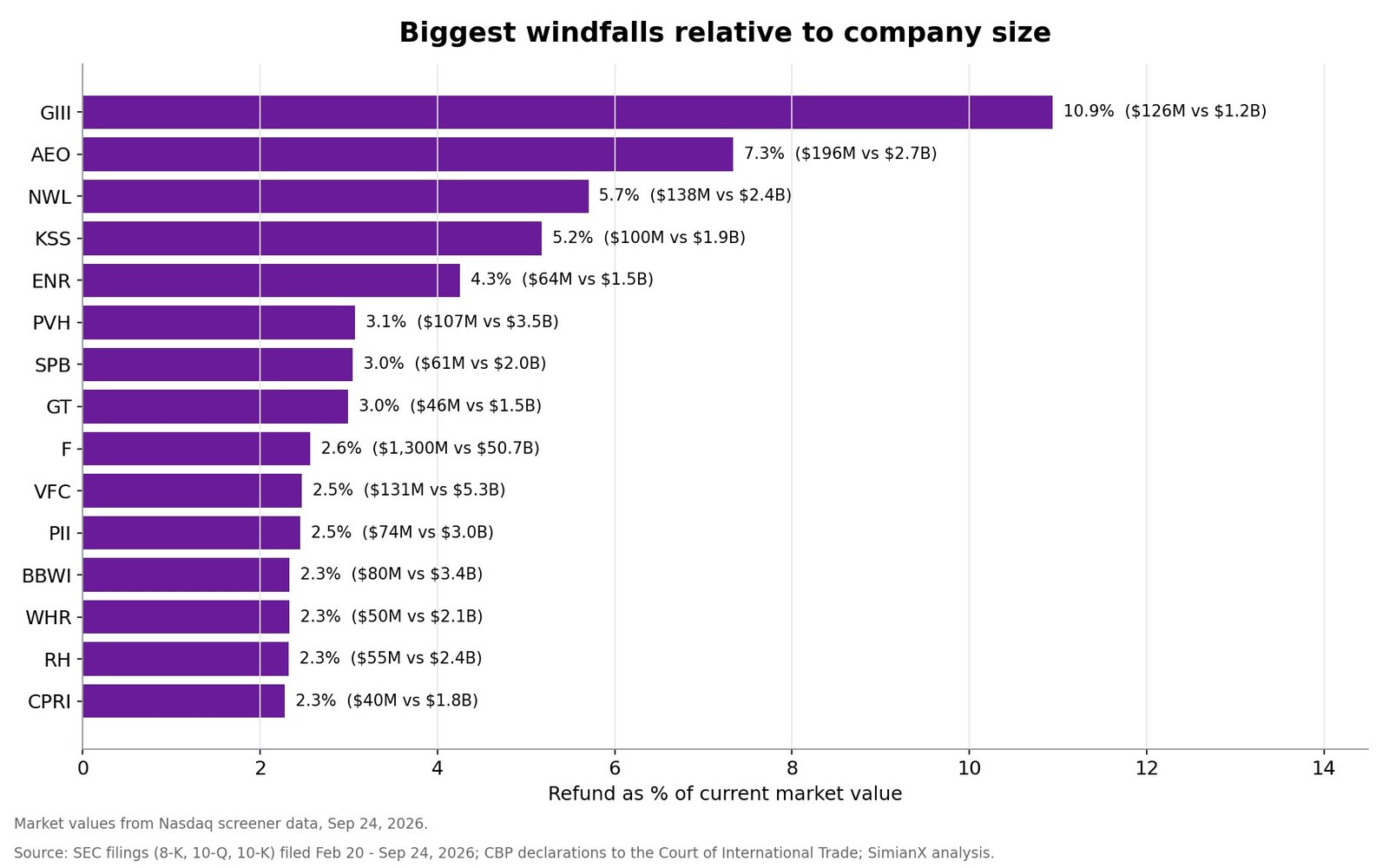
| Company | Refund | Market value (Sep 24) | Refund as % of market value |
|---|---|---|---|
| G-III Apparel (GIII) | $126M | $1.2B | 10.9% |
| American Eagle (AEO) | $196M | $2.7B | 7.3% |
| Newell Brands (NWL) | $138M | $2.4B | 5.7% |
| Kohl's (KSS) | $100M | $1.9B | 5.2% |
| Energizer (ENR) | $64M | $1.5B | 4.3% |
| PVH (PVH) | $107M | $3.5B | 3.1% |
| Spectrum Brands (SPB) | $61M | $2.0B | 3.0% |
| Goodyear (GT) | $46M | $1.5B | 3.0% |
| Ford (F) | $1,300M | $50.7B | 2.6% |
| VF Corp (VFC) | $131M | $5.3B | 2.5% |
These are the companies where the refund changes the balance sheet, not just one quarter. For G-III, the refund is equal to roughly a tenth of its market value. For heavily indebted names like Newell and VF, it is cash that can go toward debt reduction. The market has already had a quarter to price these amounts, so a high ratio is not in itself a reason to buy. It does mean the second-quarter results of these companies are hard to compare with any other quarter.
How Tariff Refunds Inflate Margins and EPS
Most companies booked the refund as a reduction in cost of goods sold. The refund goes straight into gross margin, so a quarter that includes one shows a margin jump unrelated to the underlying business.
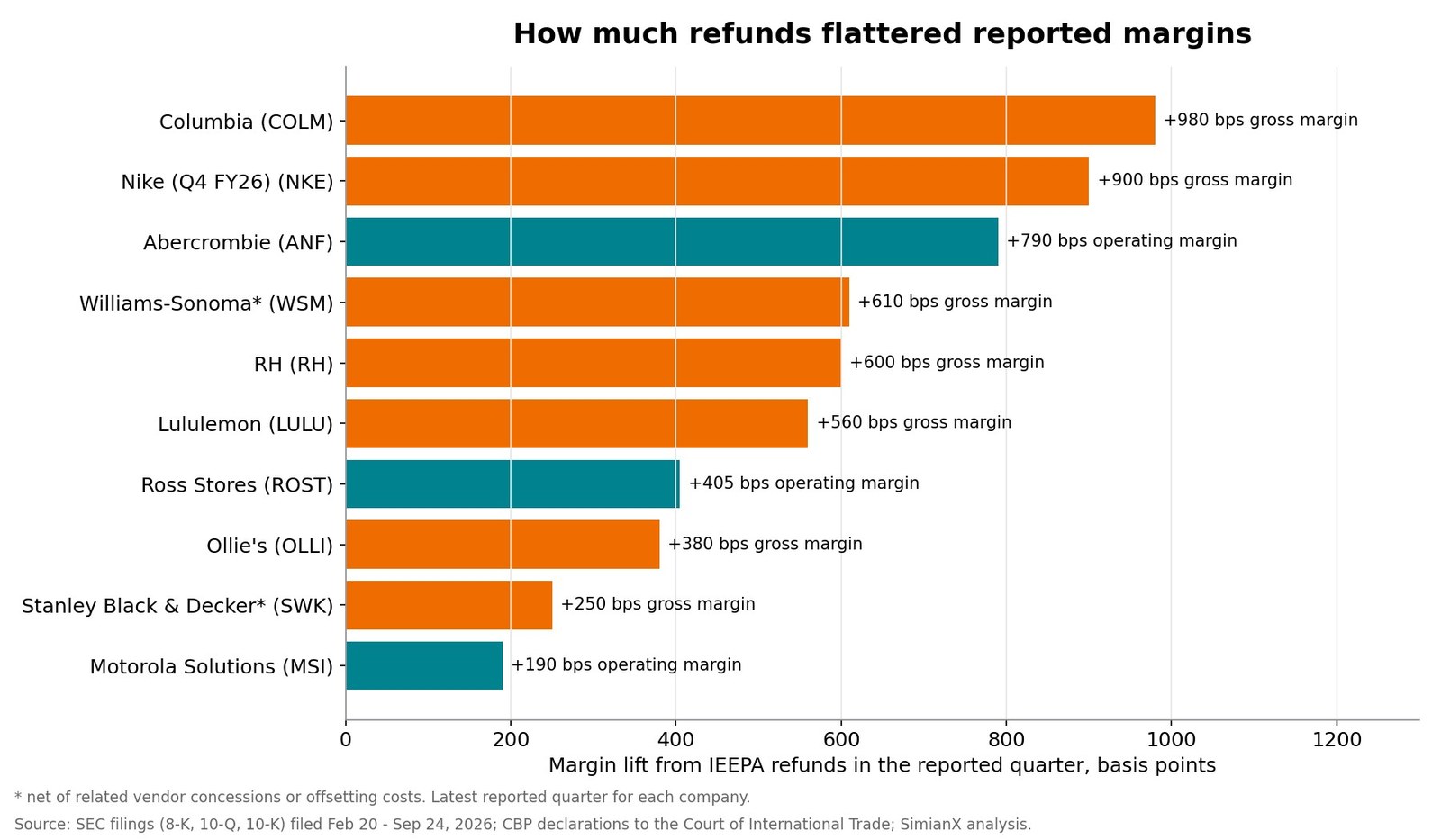
| Company | Margin effect disclosed | EPS effect disclosed | In adjusted EPS? |
|---|---|---|---|
| Abercrombie & Fitch (ANF) | +790 bps operating margin | $1.75 of $4.17 | Shown separately |
| Target (TGT) | Gross margin and operating income | $1.65 | Yes, in GAAP and adjusted |
| Williams-Sonoma (WSM) | +610 bps gross margin, net of vendor concessions | $1.06 gross, less $0.30 of concessions | No |
| Columbia Sportswear (COLM) | +980 bps gross margin | ~$0.93 added to full-year EPS outlook | Reported EPS |
| Lululemon (LULU) | +560 bps gross margin | $0.86 of $2.92 | Reported EPS (no adjusted EPS) |
| Parker-Hannifin (PH) | Cost of sales reduction of $84M | $0.65 | No |
| Ross Stores (ROST) | +405 bps operating margin | ~$0.60 of $2.66 | Reported EPS |
| Nike (NKE) | ~+900 bps Q4 gross margin | $0.52 of $0.72 | Reported EPS |
| Cardinal Health (CAH) | Net of expected customer payback | $0.31 | Yes |
| Motorola Solutions (MSI) | +190 bps operating margin | $0.25 | Yes, GAAP and non-GAAP |
| Stanley Black & Decker (SWK) | ~+250 bps gross margin (net) | ~$0.17 | Yes |
| Costco (COST) | Net of reinvestment in member value | $0.15 | Non-recurring, disclosed |
| Emerson (EMR) | Cost of sales | $0.11 | No |
| Intuitive Surgical (ISRG) | Cost of revenue | $0.08 | Yes, disclosed separately |
The adjusted-EPS split is the most important detail for anyone comparing results with analyst estimates. Of the 78 companies we quantified:
- 20 kept the refund in headline or adjusted earnings. Some, like Target, Stanley Black & Decker and Motorola Solutions, put it in both GAAP and adjusted EPS. Others, like Nike, Ross and Lululemon, report no adjusted EPS at all.
- 14 excluded it from adjusted earnings, including TJX, Victoria's Secret, Five Below, Williams-Sonoma, Parker-Hannifin, Emerson and Boston Scientific.
- 4 excluded only the part that related to tariffs expensed in 2025. These are GE HealthCare, Kontoor Brands, YETI and Dick's Sporting Goods.
- 40 did not say clearly.
The practical consequence: when a company that keeps the refund in adjusted EPS "beats" consensus, check whether the estimate included the refund. Consensus may not, because companies such as Walmart and Target set their guidance without refunds. Target's second-quarter adjusted EPS carried $1.65 of refund benefit. Our guide to reading post-earnings moves explains why the first reaction to a headline beat often reverses once the details are read.
Who Passes the Refund On, and Who Gets Nothing
Not every dollar the government returns stays with the company that receives it:
- Customs brokers pass refunds through. FedEx had submitted claims of $3.3 billion and received about $800 million by May 31, 2026, largely on behalf of customers, and recorded a $749 million liability to return it. UPS recorded about $500 million of approved refunds as payable to customers. These are not earnings.
- Some companies owe customers a share. Medline recognized $332 million of refunds but accrued $89 million of customer repayments against them. Mettler-Toledo booked a $52.4 million gross benefit but refunded $27.8 million of tariff surcharges to customers. Keysight set up a $40 million liability to refund surcharges. Magna said on its call that it expects customers to get 80%–90% of its refunds.
- Some had already recovered the tariff from customers. Lear says nearly all of its $85 million of IEEPA tariffs had been recovered from customers, so the refund replaces money it would otherwise have collected from them rather than adding profit.
- Some sold their claims early. Before the ruling, American Eagle sold $68.9 million of refund claims to a third party for $18.6 million in cash, then had to pay the buyer $70.8 million once the claims paid out. GoPro transferred about $19.4 million of claims to a lender in February 2026 and will receive none of the proceeds.
- Consumers do not get refunds directly. Only the importer of record, or the broker that filed the entry, can claim through CBP's CAPE system. That gap has already produced litigation: Mattel disclosed putative class actions filed in July 2026 alleging it was unjustly enriched by passing tariffs on to customers.
Still to Come: Q3 2026 Refunds and the Earnings Calendar
Several companies have told investors that refunds received after their last quarter closed will appear in third-quarter results:
| Company | Refund still to be recognized | Expected report date |
|---|---|---|
| Nike (NKE) | $684M receivable at May 31, mostly collected after year-end | Oct 1, 2026 (Nasdaq calendar) |
| General Motors (GM) | Booked in Q1; watch cash collection | Oct 20, 2026 |
| Ford (F) | ~$500M of cash expected in H2 2026 | ~Oct 22, 2026 (estimated) |
| Procter & Gamble (PG) | Second half of ~$200M paid | Oct 22, 2026 |
| Hubbell (HUBB) | ~$30M received after Jun 30 | ~Oct 27, 2026 (estimated) |
| Tesla (TSLA) | Nothing recognized yet; amount undisclosed | ~Oct 28, 2026 (estimated) |
| Crocs (CROX) | ~$20M received; ~$70M eligible in total | ~Oct 29, 2026 (estimated) |
| Amazon (AMZN) | Said Q2's $640M was the "significant majority" of refunds it expects | ~Oct 29, 2026 (estimated) |
| SharkNinja (SN) | $247.1M of claims accepted in July | ~Nov 5, 2026 (estimated) |
| On Holding (ONON) | Up to $65M in Q3 gross profit | ~Nov 11, 2026 (estimated) |
| Best Buy (BBY) | $41M received Sep 2 | Late November |
| Target (TGT) | Outstanding claims not yet recognized | ~Nov 18, 2026 (estimated) |
SharkNinja is the clearest example. It raised its full-year adjusted EPS outlook by $0.45, of which about $0.15 comes from the expected net refund benefit. On Holding kept its refund out of guidance entirely, as we covered in our analysis of its $1 billion buyback. Generac is another company whose recent results were affected by a tariff refund, as covered in our Generac-Amazon analysis.
The companies with the most still at stake are the ones whose claims fall outside Phase 1 and Phase 2. Caterpillar (about $1.0 billion paid, $392 million recorded) and RTX (about $0.5 billion paid, an immaterial amount received) are the largest examples. Their remaining money depends on Phase 3, which opens on October 6, and on the outcome of the government's appeal at the Federal Circuit.
How to Read a Tariff-Refund Quarter
A quick checklist for any earnings report this season:
- Find the refund line. Search the release for "IEEPA" or "tariff refund." Most companies now quantify it.
- Check where it landed. A cost-of-sales credit inflates gross margin. An interest-income credit does not.
- Check adjusted EPS. Did the company exclude it, and did the analyst consensus include it?
- Separate prior-year from current-year tariffs. Several companies, including GE HealthCare, YETI and Dick's, adjusted out only the refund of 2025 tariffs.
- Look for give-backs. Customer repayments, vendor concessions and price reinvestment can absorb much of the benefit.
- Remember the replacement tariffs. Section 122 and Section 301 duties are still being paid, so gross margin will not stay at refund-quarter levels.
- Compare cash with recognition. Receivables such as Caterpillar's $392 million, or Nike's $684 million at year-end, are not cash yet.
SimianX AI runs this kind of filing review with multiple AI agents that read 8-K releases, 10-Q footnotes and price data together, so a one-time refund is separated from underlying growth before a trade decision. You can start a live multi-agent analysis of any company in this tracker, or see how AI models trade live on the SimianX AI leaderboard.
FAQ
What are IEEPA tariff refunds?
They are refunds of tariffs collected under the International Emergency Economic Powers Act, which the Supreme Court ruled on February 20, 2026 does not authorize tariffs. The Court of International Trade ordered the duties refunded with interest, and U.S. Customs and Border Protection pays them through its CAPE system.
How much money is being refunded?
About $166 billion of IEEPA duties was collected from more than 330,000 importers. As of September 11, 2026, CBP had accepted about $134.7 billion of refunds for processing and certified about $122.0 billion to the Treasury for payment.
Which companies got the biggest tariff refunds?
Among public companies that disclosed amounts, the largest are Ford ($1.3 billion), Target ($994 million), Nike ($986 million), Home Depot ($685 million), Amazon ($640 million), General Motors ($500 million), Caterpillar ($392 million), Dollar Tree ($369 million), TJX ($331 million) and Deere ($272 million).
Do tariff refunds count in earnings?
Yes. Most companies book them as a reduction in cost of goods sold, which raises gross margin and GAAP earnings. Companies differ on adjusted earnings: Target and Stanley Black & Decker keep refunds in adjusted EPS, while TJX, Victoria's Secret, Five Below and Williams-Sonoma exclude them.
Can consumers get a tariff refund?
Not directly. Only the importer of record or the licensed customs broker that filed the entries can claim refunds through CAPE. Consumers who paid higher prices have no direct claim, which has already led to class actions against some companies over tariff pass-throughs.
When will the remaining refunds be paid?
CBP says valid refunds are generally issued 60–90 days after a CAPE declaration is accepted. Phase 3, covering finally liquidated entries subject to court orders, opens on October 6, 2026. Some claims depend on the government's pending appeal at the Federal Circuit.
Conclusion
The IEEPA refunds are one of the largest one-time items in U.S. corporate earnings this year. They total about $122 billion certified so far, and the 78 public companies we could quantify have booked about $11.4 billion. For a quarter or two, they will make retailers, apparel brands, automakers and machinery makers look more profitable than they are. They lift gross margin by several hundred basis points in some cases and add more than a dollar a share to earnings at Target and Abercrombie & Fitch.
The refunds do not change what these businesses earn once they are paid. Replacement tariffs are still in force, and several companies are already passing refunds back to customers or into lower prices. The useful question for each third-quarter report is how much of the result is refund and how much is the business. Nike, which reports on October 1, will be among the first to show it.
This article is for research and education only and is not financial advice.
Related Reading
- On Holding (ONON) $1B Buyback: 10% of Shares vs Nike's $123M
- Generac-Amazon Deal: $2.4B Order Behind an $8B Headline
- Walmart & Target 2026: Decoding US Consumer Stress Signals
- Lululemon Stock Below $100: Broken Brand or Rare Buy?
- NVDA After Earnings: Every Reaction Since 2016 in One Table
References
- Supreme Court of the United States — Learning Resources, Inc. v. Trump opinion (Feb 20, 2026)
- U.S. Customs and Border Protection — IEEPA duty refunds
- U.S. Customs and Border Protection — IEEPA refunds fact sheet
- Wikipedia — Learning Resources, Inc. v. Trump
- Wikipedia — International Emergency Economic Powers Act
- SEC EDGAR — full-text search for IEEPA refund filings
- Target — Q2 2026 earnings release
- Ford — Q1 2026 earnings release
- Nike — fiscal 2026 fourth-quarter results
- Home Depot — Q2 fiscal 2026 Form 10-Q
- Amazon — Q2 2026 Form 10-Q
- Caterpillar — Q2 2026 Form 10-Q
- Walmart — Q2 fiscal 2027 earnings release
- Costco — fiscal 2026 fourth-quarter release
- FedEx — fiscal 2026 Form 10-K
- SharkNinja — Q2 2026 earnings release
- American Eagle Outfitters — Q2 fiscal 2026 Form 10-Q
- Investopedia — tariffs
- Investopedia — cost of goods sold