
Newcleo Goes Public at $8.145: What the First NWCL Close Says About the Deal
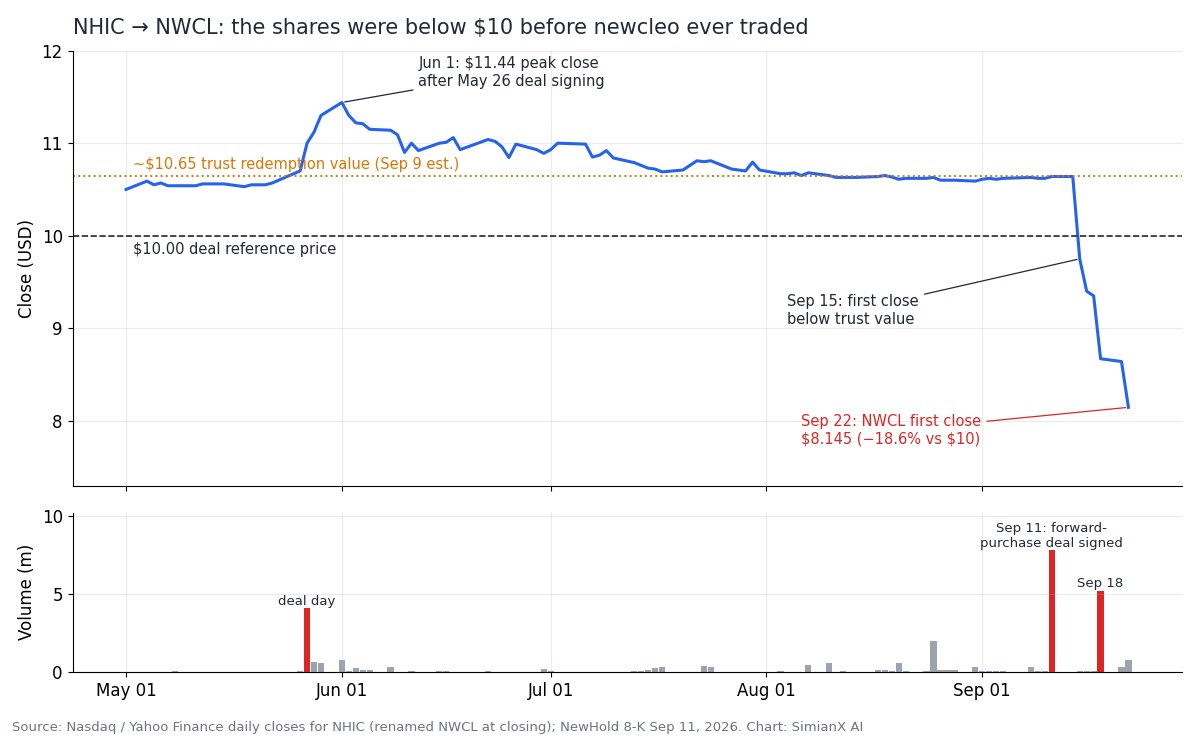
Newcleo (Nasdaq: NWCL), the London- and Turin-based developer of lead-cooled fast reactors and recycled MOX nuclear fuel, finished its first day as a public company at $8.145 on September 22, 2026. That is 18.6% below the $10.00 reference price at which the whole deal was struck, and 28.8% below the $11.44 peak the SPAC shares reached a week after the merger was announced.
Most coverage framed the listing as a "$2.4 billion nuclear IPO for the AI power boom." Three details in the filings change that picture:
- It is not an IPO. Newcleo merged with the SPAC NewHold Investment Corp III (
NHIC), and the $2.4 billion is a pre-money equity value fixed at signing on May 26, 2026 — not cash raised, and not what the market now says the company is worth. - The stock was below $10 before newcleo ever traded. NHIC slid from about $10.64 to $8.64 in the five sessions after the redemption window closed, so the first NWCL print simply continued a repricing that was already under way.
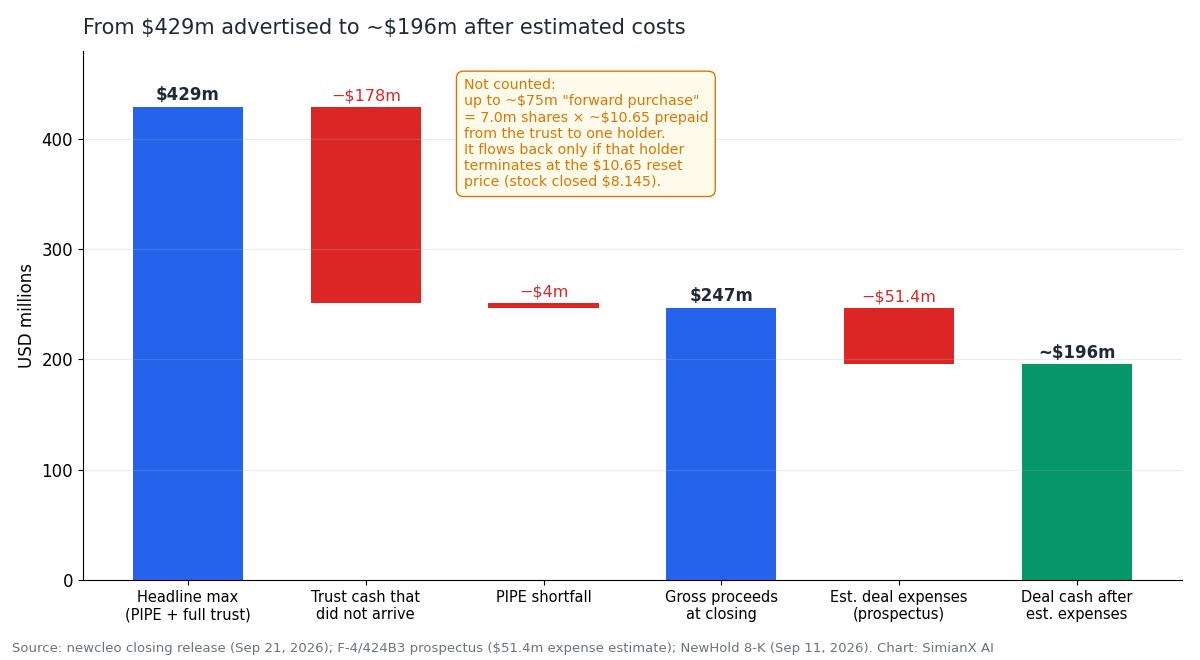
- The cash is smaller than the headline. Gross proceeds were $247 million, not the $429 million advertised; after the prospectus's $51.4 million expense estimate that is roughly $196 million. At newcleo's Q1 2026 all-in burn rate, that covers about 11 months.
This analysis rebuilds the deal from the SEC prospectus, the closing announcement, NewHold's 8-K filings and the first-day tape. The two things it adds are a price ladder — seven share prices written into the deal documents — and a cash-runway estimate that includes capex.
Prices are Nasdaq closing prices as of September 22, 2026. Figures in euros come from newcleo's IFRS financial statements; dollar conversions use the prospectus rate of about $1.15 per euro.
NWCL Debut by the Numbers
| Metric | Value | Source |
|---|---|---|
| First close (Sep 22, 2026) | $8.145 | Nasdaq |
| Day range | $7.15 – $8.63 | Nasdaq |
| First-day volume | ~752,000 shares | Nasdaq |
| Change vs $10.00 deal price | −18.6% | Calculated |
| Change vs NHIC peak close ($11.44, Jun 1) | −28.8% | Calculated |
Warrants (NWCLW) first close | $1.00 | Nasdaq |
| Pre-money equity value at signing | ~$2.4 billion | Closing release |
| Gross proceeds delivered | $247 million | Closing release |
| Estimated transaction expenses | $51.4 million | 424B3 prospectus |
| Fully diluted shares at closing (derived) | ~329.9 million | S-8 plan sizing |
| Fully diluted value at first close | ~$2.69 billion | Calculated |
| Shares under lock-up | ~90% | 424B3 prospectus |
The fully diluted share count is not published directly. It can be derived from the Form S-8 filed on listing day: the employee stock purchase plan reserves 6,598,752 shares, which the deal agreement fixes at 2% of shares outstanding immediately after closing on a fully diluted basis. That implies about 329.9 million shares. The 2026 equity plan's 32,993,758-share reserve, fixed at 10% on the same basis, gives the same number.
At $10.00 those shares would be worth about $3.30 billion. At the first close they are worth about $2.69 billion. The fully diluted figure includes options and warrants that are currently out of the money, so the basic market capitalization is lower. It is still the right number for judging what the market now pays for newcleo: about $0.6 billion less than the $10 deal price implied.
Was This an IPO? How the NewHold SPAC Deal Worked
Newcleo reached Nasdaq through a special purpose acquisition company (SPAC) merger, not an underwritten initial public offering. The sequence:
- May 26, 2026 — business combination agreement signed at a ~$2.4 billion pre-money equity value, with a $220 million PIPE and up to ~$209 million from NewHold's trust, for up to $429 million of gross proceeds at $10.00 per share.
- September 11 — NewHold and newcleo signed a prepaid forward purchase agreement with an unaffiliated holder (explained below). NHIC traded 7.78 million shares that day, roughly 80 times its normal volume.
- September 15 — redemption requests were due ahead of the vote. NHIC closed at $9.75, its first close below the trust value of about $10.65.
- September 17 — shareholders approved the merger with 93.4% of votes cast, representing 72.4% of NewHold's outstanding shares (8-K).
- September 21 — the deal closed. Existing newcleo shareholders rolled over 100% of their equity, and former TVA chief executive Jeffrey Lyash became board chair.
- September 22 —
NWCLandNWCLWbegan trading on the Nasdaq Global Select Market.
For comparison, X-energy took the traditional route in April 2026: an underwritten IPO priced at $23.00 that raised about $1.02 billion. Newcleo's route produced a quarter of that cash at a lower valuation, and it came with the SPAC-specific mechanics — redemptions, a forward purchase and sponsor earn-outs — that shape the stock's first months.
Where the $429 Million Went
| Funding line | Announced (May) | Delivered (Sep 21) |
|---|---|---|
| PIPE | $220 million | $216 million |
| NewHold trust cash | up to ~$209 million | $31 million |
| Gross proceeds | up to $429 million | $247 million |
| Estimated deal expenses | — | −$51.4 million |
| Cash after estimated expenses | ~$374 million (company estimate, no redemptions) | ~$196 million |
| Forward purchase (contingent) | — | up to ~$75 million |
The $51.4 million expense estimate includes $26.3 million of financial-advisory fees and $5.0 million of deferred underwriting fees that were payable only if the deal closed. Some of the total may already have been paid or may differ at settlement, so ~$196 million is an estimate rather than a reported balance. In May, NewHold's own presentation script expected about $374 million to reach newcleo's balance sheet in a no-redemption case. The delivered figure is roughly half of that.
The PIPE held up: $216 million of $220 million, and the release calls it oversubscribed. The trust did not: only $31 million of it reached newcleo. The deal still cleared its $200 million minimum-cash condition (PIPE plus retained trust cash). Because the total fell short of $400 million, part of the sponsor's earn-out shares is forfeited under the sponsor support agreement — one term that works in public shareholders' favor.
The pattern is familiar from other 2026 "AI power" headlines. In Generac's Amazon deal, an $8 billion headline turned out to cover a $2.4 billion initial order.
The forward-purchase catch: the "up to $75 million" is not new money
The closing release says up to $75 million more "may become available" under the forward purchase agreement. The September 11 8-K describes a prepaid share forward, which works differently from a fresh investment:
- The holder agreed to buy up to 7,000,000 NewHold shares in the market and waive redemption on them.
- At closing, newcleo prepays the holder the number of shares times the trust redemption price (estimated at $10.65), paid directly out of the trust account. On 7 million shares that is about $74.6 million.
- Newcleo gets that money back only when the holder terminates early, paying the reset price (initially $10.65, adjustable only downward) for each terminated share.
- At maturity, up to 24 months after closing, the holder either returns the shares or the forward is settled in cash over a valuation period.
The first reading is an inference, but the arithmetic fits closely. If the prepayment came out of the trust as the 8-K says it would, then the $31 million is what was left after about $75 million went to the forward holder. That would also explain why the release describes the forward as "up to an additional $75 million." Either way, while NWCL trades below the $10.65 reset price, the holder has no economic reason to terminate early. The $75 million should be valued as contingent, not as cash. It also means that trust-cash figures do not reliably show how many shares were redeemed. The exact redemption count had not been filed by listing day.
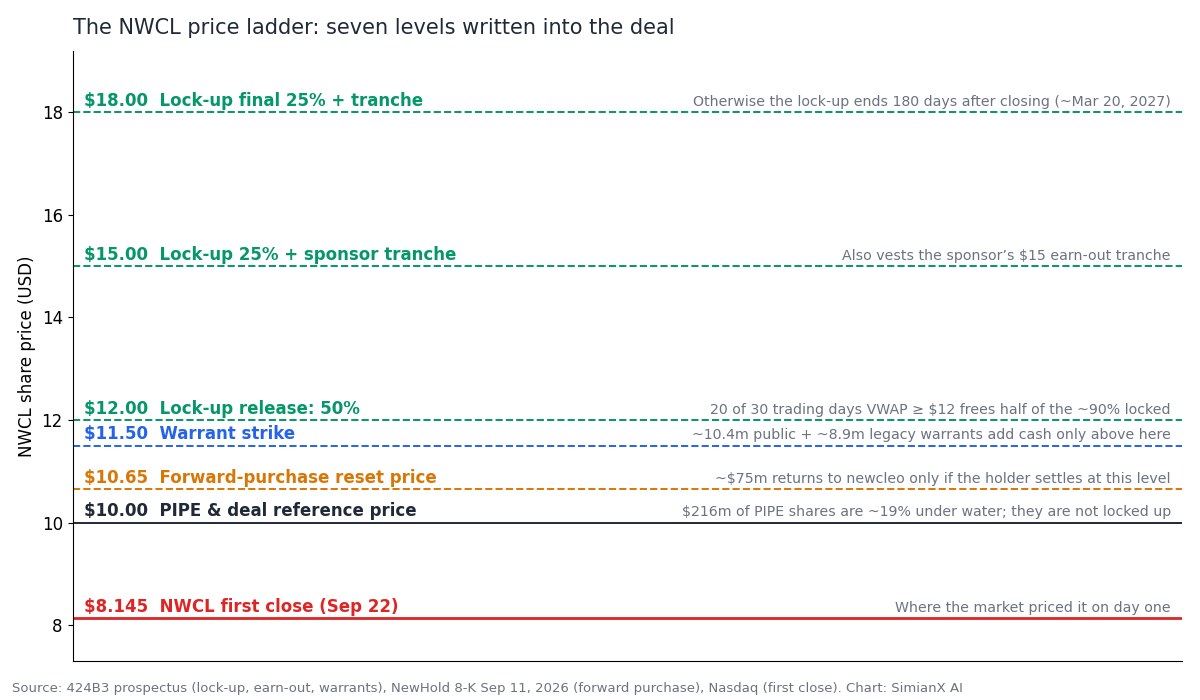
The NWCL Price Ladder: Seven Levels Written Into the Deal
The deal documents fix a series of share prices that change who can sell and how much cash newcleo receives. On day one, NWCL sat below all of them.
| Price | What it controls | Why it matters |
|---|---|---|
| $8.145 | First close | Where the market priced newcleo on day one |
| $10.00 | PIPE and deal reference price | $216 million of PIPE shares are ~19% under water, and PIPE shares are excluded from the lock-up |
| $10.65 | Forward-purchase reset price | The ~$75 million comes back only through terminations at this level |
| $11.50 | Warrant strike | About 10.4 million public warrants and 8.9 million legacy warrants add cash only above it |
| $12.00 | 50% lock-up release | VWAP ≥ $12 on 20 of 30 trading days frees half the locked shares |
| $15.00 | 25% lock-up release + sponsor tranche | Also vests the sponsor's $15 earn-out tranche |
| $18.00 | Final 25% release + sponsor tranche | Otherwise the lock-up ends 180 days after closing (around March 20, 2027) |
Two practical points follow.
The float is small, and the unlocked holders are under water. The prospectus estimated that about 90% of shares would be locked up in a high-redemption scenario. The tradable float is therefore mostly former NHIC holders, the forward holder and PIPE investors. The PIPE investors paid $10.00, are not locked up, and can sell once their resale registration is effective. A small float with an under-water unlocked holder base usually means high volatility in both directions.
Warrants add nothing at current prices. At $1.00, NWCLW values the option to buy stock at $11.50 at roughly 12% of the share price. Warrant cash, one of the classic "extra" SPAC funding sources, needs a 41% rally from the first close before it becomes available.
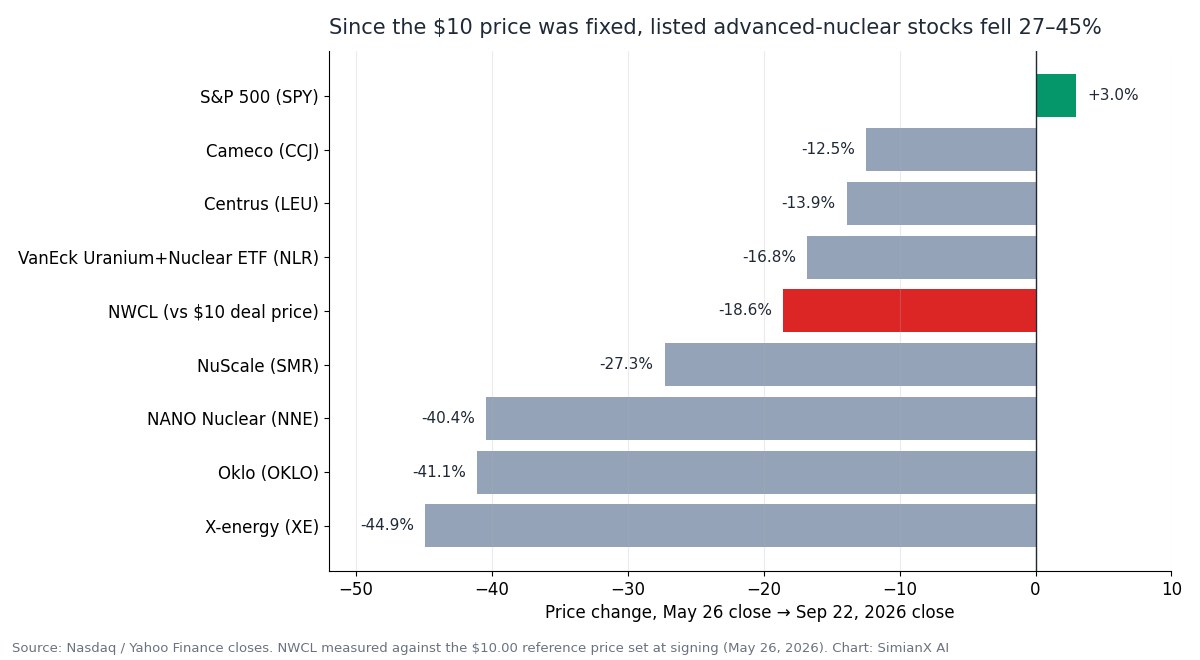
Why NWCL Priced Below $10: The Sector Repriced First
The $10 price was set on May 26. What happened next matters as much as newcleo itself.
| Stock | May 26 → Sep 22, 2026 | Drop from 52-week closing high | Market cap (Sep 22) |
|---|---|---|---|
| NWCL (vs $10 deal price) | −18.6% | n/a | ~$2.7bn fully diluted |
| X-energy (XE) | −44.9% | −54.5% (IPO price $23) | ~$6.6bn |
| Oklo (OKLO) | −41.1% | −76.8% | ~$7.5bn |
| NANO Nuclear (NNE) | −40.4% | −69.4% | ~$0.9bn |
| NuScale (SMR) | −27.3% | −83.4% | ~$3.8bn |
| VanEck Uranium & Nuclear ETF (NLR) | −16.8% | −31.9% | — |
| Centrus (LEU) | −13.9% | −63.8% | ~$3.1bn |
| Cameco (CCJ) | −12.5% | −29.5% | — |
| S&P 500 (SPY) | +3.0% | −0.6% | — |
Measured this way, NWCL's first print was not an outlier. The pre-revenue advanced-reactor developers — X-energy, Oklo and NANO Nuclear — fell about 40–45% over the same window, while the S&P 500 rose 3%. A fixed $10 SPAC price cannot follow that move; the only point where it can reset is the first trade. Against that backdrop, an 18.6% discount is mild.
The table also puts the valuation in context. At ~$2.7 billion fully diluted, newcleo is priced at about 40% of Oklo and X-energy. That reflects its earlier regulatory status, its smaller cash pile, and its SPAC overhang. For the broader sector view, see our analysis of nuclear and uranium stocks and the AI power crunch.
What Is Newcleo Building?
Newcleo was founded in 2021 by physicist Stefano Buono, whose previous company, Advanced Accelerator Applications, was sold to Novartis for $3.9 billion. It reports more than 900 employees and contractors across Europe and the United States. Its plan has three parts:
1. A lead-cooled fast reactor. The flagship LFR-AS-200 is a modular 200 MWe (480 MWt) lead-cooled fast reactor, one of the six Generation IV designs. Liquid lead lets the reactor run at near-atmospheric pressure, has a very high boiling point and provides radiation shielding. The engineering challenge is corrosion and erosion of structural materials in flowing lead, which the prospectus lists among the central technical risks. A smaller LFR-AS-30 (30 MWe) is planned as the French first unit.
2. Recycled MOX fuel. Newcleo plans to make mixed-oxide (MOX) fuel — plutonium and uranium oxides recovered from spent fuel — for fast reactors. Its first MOX plant is planned for 2031, with a target capacity of about 40 tonnes of heavy metal per year, on land it has acquired in France. Handling plutonium brings IAEA safeguards, physical-protection and export-control requirements that most reactor developers do not face.
3. Industrial subsidiaries. Pump maker Rütschi, Fucina and engineering units already earn revenue from the existing nuclear industry. This is newcleo's only revenue today.
Hardware and licensing milestones
| Milestone | Status per filings | Target |
|---|---|---|
| OTHELLO — 2 MWt liquid-lead loop at ENEA Brasimone, Italy | Completed; ~€69m invested at Brasimone since 2022 | Done (Q4 2025) |
| PRECURSOR — 10 MWt non-nuclear, full-system demonstrator | Construction in progress | End of 2026 |
| France: LFR-AS-30 (Indre-et-Loire) + MOX plant (Aube) | CNDP public debate Apr 2 – Jul 30, 2026; positive feedback from regulator ASNR on safety options | Construction-licence applications by end of 2027 |
| First MOX fabrication facility | Detailed design; French site acquired | 2031 |
| First commercial US LFR (200 MWe) | Basic design; NRC pre-application engagement since March 2026 | 2032 (investor deck) |
| UK | LFR-AS-200 accepted into Generic Design Assessment | — |
| Slovakia | JV with JAVYS for up to four LFR-AS-200 units at Jaslovské Bohunice | Feasibility study |
The 2032 date refers to a 200 MWe US unit, which newcleo's May investor presentation links to co-location with AI infrastructure through a partnership with IP3 and a Department of Energy site solicitation at Savannah River. No final investment decision has been taken on any project, and the prospectus warns that none of the milestones is guaranteed.
How Much Cash Does Newcleo Burn?
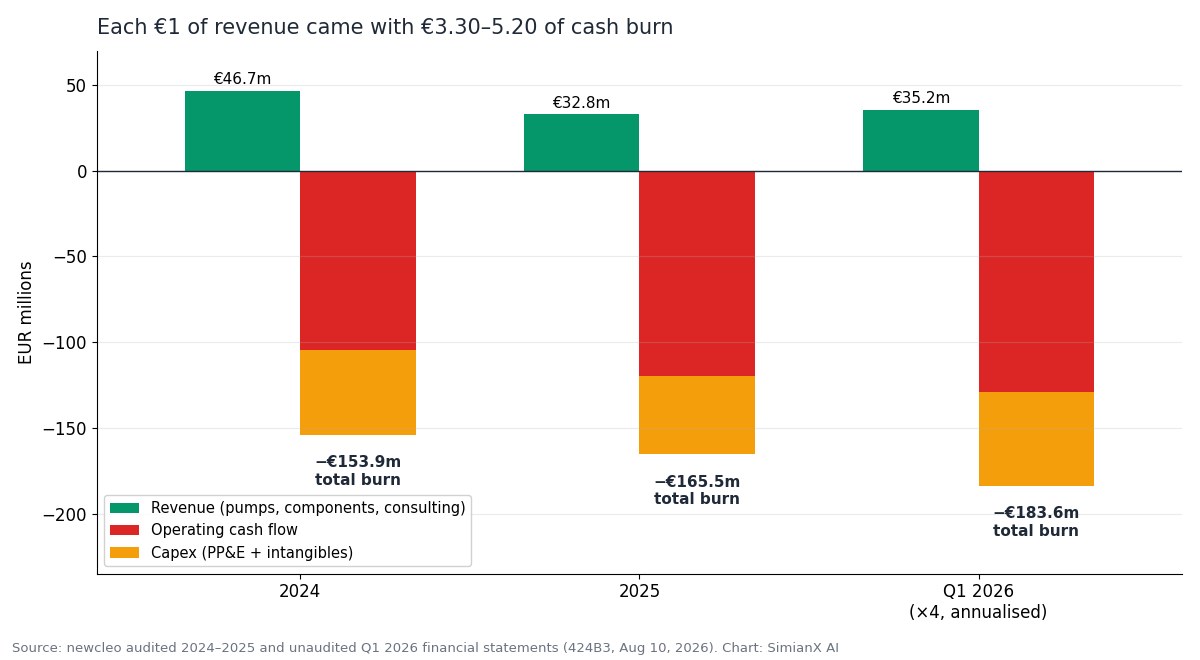
| € millions | 2024 | 2025 | Q1 2026 |
|---|---|---|---|
| Revenue | 46.7 | 32.8 | 8.8 |
| Gross profit | 11.7 | 7.8 | 3.3 |
| Other income (grants, R&D tax credits) | 17.7 | 19.3 | 3.2 |
| R&D expense | (58.5) | (68.5) | (16.1) |
| SG&A expense | (86.8) | (98.5) | (26.8) |
| Net loss | (110.2) | (140.0) | (36.2) |
| Operating cash flow | (104.5) | (119.7) | (32.3) |
| Capex (PP&E + intangibles) | (49.4) | (45.8) | (13.6) |
| Total cash burn | (153.9) | (165.5) | (45.9) |
| Cash at period end | 192.7 | 105.3 | 100.6 |
Revenue fell 30% in 2025 to €32.8 million, then rose 51% year on year in Q1 2026 to €8.8 million on new long-term pump and component contracts. It is lumpy, contract-driven industrial revenue and is not yet linked to reactors or fuel.
Most runway estimates use operating cash flow alone (€32.3 million in Q1, or ~€129 million a year). That leaves out capex, which in 2026 is largely the PRECURSOR build at Brasimone. Including it, Q1 burn was €45.9 million — about €184 million (~$211 million) a year.
The runway math
- Deal cash after estimated expenses: ~$196 million ≈ €170 million.
- Q1 2026 all-in burn: €45.9 million per quarter.
- Result: about 3.7 quarters (~11 months) of burn from the deal proceeds alone.
Newcleo also had its own cash (€100.6 million at March 31, before two more quarters of spending), about €45 million raised from shareholders between January and July, and "close to $20 million" raised since the deal was announced. These extend the runway but do not change its order of magnitude. The company's own statements say the same: its Q1 accounts disclose a material uncertainty about its ability to continue as a going concern, say that "additional capital will be required during the next twelve months", and mention negotiations for bridge financing before closing. Newcleo has now raised over $1 billion in total since 2021; the stock market's role from here is to fund the next round.
Does AI Power Demand Support the NWCL Bull Case?
Demand is the strongest part of the story. The U.S. Department of Energy estimates that data centers used about 4.4% of U.S. electricity in 2023 (176 TWh) and could use 6.7%–12% by 2028 (325–580 TWh). The IEA expects electricity demand from data centers to roughly double by 2030. Hyperscalers have already signed nuclear deals: Google with Kairos Power, Amazon with X-energy, and Microsoft for the Crane Clean Energy Center restart at Three Mile Island.
The same pressure shows up across the power chain — from NextEra and Dominion's 110 GW grid problem to KKR's Helix power platform and NVIDIA's 5 GW deal with IREN.
What newcleo can claim today is narrower:
- A 9.2 GW commercial pipeline that the prospectus says is non-binding and "does not represent contracted backlog, committed revenue or binding customer obligations."
- No binding customer contract for an LFR or a MOX plant.
- The IP3 AI co-location partnership and several other agreements are memoranda of understanding or letters of intent, according to the deck's own footnote.
- A first commercial reactor targeted for 2032. Gas turbines, grid upgrades, restarts of existing reactors and on-site generation will meet much of the AI demand before then.
AI demand supports the size of the market newcleo is chasing. It does not yet show up in newcleo's revenue, and the stock should be valued with that in mind.
What Makes Newcleo Different
- Reactor plus fuel. Few developers try to control both the reactor and its fuel. If it works, newcleo turns a government liability — separated plutonium and spent fuel — into fuel supply, independent of enrichment capacity.
- The Oklo link. In October 2025, newcleo agreed with Oklo to develop US advanced-fuel manufacturing and pledged $2 billion of US investment. On May 26, 2026 — the day the NewHold deal was signed — Oklo was one of five companies the DOE selected for advanced negotiations under its surplus-plutonium program. Terms were still being negotiated when the prospectus was written.
- Several regulators at once. France, the UK, Slovakia, Italy and the US spread the political risk but also multiply the licensing work.
- Industrial revenue from day one. Small, but real, and it pays for supply-chain know-how.
- A founder with an exit. Buono took Advanced Accelerator Applications from a $16 IPO to a $3.9 billion sale.
The Biggest Risks for NWCL Shareholders
- Funding and dilution. About 11 months of deal cash at the current burn rate, plus an automatic yearly increase of up to 5% in the equity-plan reserve for nine years, ~19 million warrants, and future equity raises that are likely to be priced below $10.
- Lock-up and PIPE supply. ~90% of shares unlock by about March 2027 (or earlier at $12/$15/$18), and the PIPE shares are unlocked but under water.
- Technology. Lead corrosion and materials qualification have not yet been shown at full-system scale; PRECURSOR is the first test.
- Fuel. The MOX strategy depends on plutonium access, safeguards and public acceptance in each country.
- Licensing and timing. None of newcleo's projects has a construction licence, and the US unit is at the pre-application stage.
- Customers. A non-binding pipeline, not backlog.
- Disclosure. As a foreign private issuer, newcleo does not file quarterly 10-Qs; investors get semi-annual updates and 6-Ks.
- Sector beta. As the peer table shows, advanced-nuclear stocks move together, and they have fallen 40–85% from their highs.
Bull, Base and Bear Cases
Bull case — the ladder gets climbed. PRECURSOR runs well by end-2026, France accepts construction-licence applications in 2027, the Oklo fuel deal and a US site become binding, and project-level money pays for most of the first plant. The stock goes above $12, and each rung unlocks something in turn: the forward holder terminates and returns cash, warrants are exercised, and the lock-up releases happen in an up-market.
Base case — progress with dilution. The technology advances, but schedules slip toward the mid-2030s. Newcleo raises equity every 12–18 months below the $10 deal price. The company creates value, but early NWCL holders capture less of it because of dilution. The stock trades with the advanced-nuclear group, with high volatility.
Bear case — the SPAC pattern. A weak nuclear tape, a small float and a lock-up expiry in March 2027 meet a financing need. A heavily discounted raise resets the share price, and the forward and warrants never provide cash. Many de-SPAC development companies have followed this path; our history of tech bubbles since 1929 shows how often capital-hungry themes go through the same cycle.
How to Track NWCL After the Debut
- Next funding event. Watch for the pricing, size and structure of the next raise, and whether it is equity, debt, grant or project-level money.
- The ladder. Track whether NWCL gets back above $10 (PIPE breakeven), $10.65 (forward) and $11.50 (warrants).
- Shell-company report and 6-Ks. The post-closing filing should give the actual redemption count and basic share count.
- PRECURSOR start-up by end-2026 — the first full-system technical evidence.
- French licensing — applications for the LFR-AS-30 and the MOX plant by end-2027.
- Binding contracts — anything that turns the 9.2 GW pipeline, the IP3 partnership or the Oklo framework into signed, funded agreements.
- Peers. OKLO, XE, NNE and SMR set the mood for the sector.
SimianX AI brings filings, price action and news on advanced-nuclear stocks into one multi-agent research workflow. NWCL is too new for our stock coverage, but its closest listed peer and fuel partner, Oklo (OKLO), is covered.
FAQ
What was NWCL's first-day closing price?
$8.145 on September 22, 2026, in a range of $7.15–$8.63 on about 752,000 shares. That is 18.6% below the $10.00 reference price of the SPAC deal.
Is newcleo's Nasdaq listing an IPO?
No. Newcleo listed through a merger with the SPAC NewHold Investment Corp III. NHIC shares became NWCL shares, and PIPE investors provided most of the new money.
How much money did newcleo actually raise?
$247 million gross: a $216 million PIPE and $31 million from the NewHold trust. The prospectus estimates $51.4 million of transaction expenses, leaving about $196 million. The "up to $75 million" forward purchase is contingent and depends on the stock trading near $10.65.
What is newcleo's valuation now?
About $2.69 billion fully diluted at the first close (roughly 329.9 million shares, derived from the S-8), compared with about $3.30 billion at $10.00. The $2.4 billion figure is the pre-money value agreed in May.
When do newcleo's lock-ups expire?
About 180 days after the September 21, 2026 closing, around March 20, 2027. Earlier releases apply if NWCL's VWAP is at or above $12 (50%), $15 (25%) and $18 (25%) on 20 of any 30 trading days. PIPE shares are not locked up.
When will newcleo's reactors produce power?
Not before the 2030s. The non-nuclear PRECURSOR demonstrator is due by end-2026, the first MOX plant by 2031, and the first commercial 200 MWe US reactor is targeted for 2032. None of these projects has a construction licence or a final investment decision yet.
Does newcleo have AI data-center customers?
Not binding ones. The IP3 AI co-location partnership and the 9.2 GW pipeline are non-binding, and the prospectus states that newcleo has not entered into binding customer contracts for its LFR or MOX plants.
Conclusion
Newcleo's debut repriced a deal that had been agreed four months earlier. Between signing and listing, the advanced-nuclear stocks newcleo is compared with fell 27–45%. The trust mostly paid out rather than stayed in, the "up to $75 million" became money that returns only near $10.65, and the $429 million headline became about $196 million after estimated costs. The first close of $8.145 — about $2.69 billion fully diluted — is the market's first independent price for all of this.
What newcleo is building is serious: a lead-cooled reactor backed by €69 million of test infrastructure, a recycled-fuel strategy that few rivals attempt, working industrial subsidiaries and a founder who has sold a nuclear company before. The stock's next year, however, will depend on the price ladder and the runway: roughly 11 months of deal cash at the Q1 burn rate, a PIPE base under water, and a lock-up that ends by March 2027. The key facts to watch are the size and price of the next raise, whether PRECURSOR runs by year-end, and whether any part of the 9.2 GW pipeline becomes binding.
Related Reading
- Nuclear & Uranium Stocks 2026: The AI Power Crunch Bet
- Generac-Amazon Deal: $2.4B Order Behind an $8B Headline
- NextEra-Dominion 2026 Deal: 110 GW AI Power Bottleneck
- KKR Helix AI Infrastructure: NVDA, VST Power Trade
- NVIDIA-IREN 2026: The $2.1B 5GW AI Factory Power Trade
- Caterpillar Stock 2026: AI Data Center Power Trade
- Unitree Robotics IPO Soars 460%: AI Breakthrough or Bubble?
- Every Tech Bubble Since 1929: How AI in 2026 Compares
- Oura IPO Delayed: What the S-1 Shows Behind the $13.5B Ask
References
- newcleo — proxy statement/prospectus (Form 424B3, Aug 10, 2026)
- newcleo — Form S-8 (Sep 22, 2026)
- newcleo — closing announcement (GlobeNewswire, Sep 21, 2026)
- NewHold Investment Corp III — 8-K on the forward purchase agreement (Sep 11, 2026)
- NewHold Investment Corp III — 8-K with shareholder vote results (Sep 17, 2026)
- SEC EDGAR — newcleo plc filings
- Nasdaq — NWCL quote
- U.S. NRC — Newcleo Americas pre-application activities
- Generation IV International Forum — lead-cooled fast reactor
- World Nuclear Association — mixed oxide (MOX) fuel
- IAEA — nuclear safeguards explained
- U.S. Department of Energy — data-center electricity demand report
- IEA — Energy and AI
- X-energy — pricing of its initial public offering
- Investopedia — SPACs
- Investopedia — PIPE financing
- Investopedia — lock-up periods
- newcleo — company website
- SimianX — OKLO stock fundamentals