
 By Muke
Uber’s Robotaxi Future Depends on Who Keeps the Customer—and the Profit
Robotaxis could expand Uber’s business, but they could also weaken its bargaining power. The decisive question for UBER shareholders is whether Uber can turn its customer demand into durable profits after paying autonomous vehicle partners and supporting the fleets.
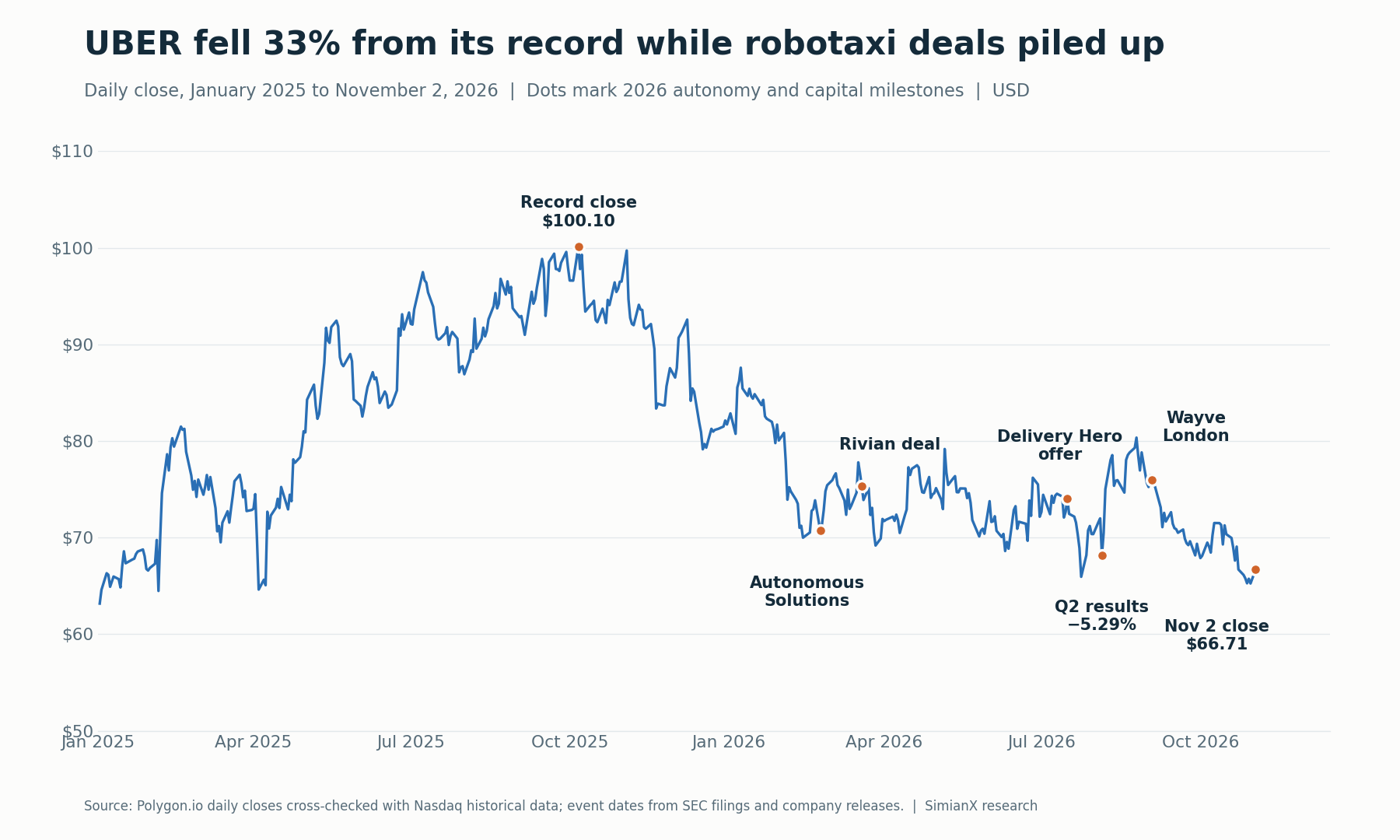
The market has been asking that question loudly. UBER closed at $66.71 on November 2, 2026, 33.4% below its record close of $100.10 on October 6, 2025, and 18.4% lower year to date, while the S&P 500 ETF (SPY) gained 10.3% over the same period. The sell-off came during a year in which Uber's core business kept growing at about 20% and its list of robotaxi partners kept getting longer.
The evidence supports a mixed conclusion. Uber already distributes autonomous rides, has expanded its partnerships, and is building services around fleet commercialization. However, its partners can also develop direct customer relationships, and some announced vehicle commitments require years of technical progress and substantial capital.
Updated November 4, 2026. Sources include Uber’s SEC-filed earnings releases (most recently Q3 2026, filed November 4) and 10-Q, management’s prepared remarks, Rivian’s SEC filings, official partnership announcements, and Waymo’s disclosures. Prices are daily closes from Polygon.io cross-checked with Nasdaq. Reported results, management targets, and illustrative calculations are distinguished below.
UBER Stock at a Glance: Price, Drawdown and Peers
| Measure | Value | Date or period |
|---|---|---|
| Latest close | $66.71 | November 2, 2026 |
| Record close | $100.10 | October 6, 2025 |
| Decline from record close | −33.4% | October 6, 2025 to November 2, 2026 |
| Lowest close of the past 52 weeks | $65.25 | October 30, 2026 |
| 2025 year-end close | $81.71 | December 31, 2025 |
| UBER change in 2026 | −18.4% | December 31, 2025 to November 2, 2026 |
| SPY change in 2026 | +10.3% | Same period |
| Lyft (LYFT) change in 2026 | −14.2% | Same period |
| Tesla (TSLA) change in 2026 | −10.2% | Same period |
| Rivian (RIVN) change in 2026 | −33.1% | Same period |
| Trailing four-quarter free cash flow | $10.1 billion | Q3 2025 to Q2 2026 |
| Approximate market value | $136 billion | 2,042,560,121 shares at $66.71 |
| Approximate free cash flow yield | 7.4% | $10.1 billion ÷ $136 billion |
Market value uses the share count on the cover of Uber's Q2 2026 10-Q (as of July 31, 2026); it is an approximation, not a quote.
The gap between a growing business and a falling share price is the robotaxi debate in numbers. Investors are discounting the possibility that autonomous operators such as Waymo, Tesla and Amazon's Zoox capture riders directly, and they are weighing a heavier capital program, including the Delivery Hero acquisition, against Uber's former asset-light profile.
Uber Stock Robotaxi Outlook: The Opportunity and the Threat
Uber’s robotaxi strategy rests on a straightforward proposition: autonomous vehicle developers need customers, and Uber can help deliver them.
For an autonomous fleet, an idle vehicle generates no passenger revenue while financing, depreciation, insurance, and other costs continue. A marketplace that supplies additional trips can therefore provide real economic value.
However, the relationship works in both directions. Uber needs competitive transportation supply. If a small number of autonomous developers control the most capable vehicles, those companies could demand attractive commercial terms or steer riders toward their own apps.
| Question | Growth opportunity for Uber | Threat to Uber |
|---|---|---|
| Who attracts the rider? | Uber retains the booking relationship | Riders increasingly book directly with AV operators |
| Who supplies vehicles? | Multiple competing partners strengthen Uber’s choice | A few strong providers gain negotiating power |
| Who improves utilization? | Uber fills otherwise idle fleet capacity | Operators build sufficient demand independently |
| Who funds expansion? | External investors finance fleets on sustainable terms | Uber must commit more capital or absorb downside risk |
| Who captures cost savings? | Uber gains volume and retains attractive economics | Lower fares and partner payments absorb the savings |
| What happens to existing trips? | AVs attract incremental demand | AV trips replace more profitable human-driven rides |
Our assessment is that robotaxis are a credible growth opportunity with an unresolved distribution of profits. More autonomous trips would demonstrate adoption. They would not, by themselves, prove that Uber shareholders capture attractive returns.
Uber Robotaxi Partners: Status of Every Major Deal (November 2026)
The term “robotaxi partnership” covers projects at very different stages.
A commercial service with no driver onboard is economically different from a supervised ride with a safety driver. A planned deployment several years away is different again.
These distinctions matter because the most attractive robotaxi argument depends partly on removing the cost of an onboard driver. A supervised launch may demonstrate customer interest and operational progress without establishing that eventual cost structure.
| Partnership or program | Announced | Verified disclosure | Status on November 2, 2026 |
|---|---|---|---|
| Waymo through Uber | Earlier agreement | Waymo identifies Austin and Atlanta as cities where riders can access its service through Uber | Operating, fully driverless; Waymo serves riders in 14 cities in total, mostly through its own app |
| Zoox (Amazon) | March 11, 2026 | Zoox robotaxis to be offered on Uber in Las Vegas (planned for summer 2026) and Los Angeles (targeted for mid-2027), while Zoox keeps its own app | Dual-channel plan; announcement alone does not establish completed rollout |
| Wayve and Nissan in Tokyo | March 11, 2026 | Memorandum of understanding for a pilot targeted for late 2026, with a trained safety operator and a licensed taxi partner | Development and pilot plan, subject to discussions with authorities |
| Rivian | March 19, 2026 | 10,000 R2 robotaxis planned, first deployments in San Francisco and Miami in 2028; $300 million investment funded on May 4, 2026 | Long-term, milestone-dependent plan |
| Wayve in London | September 3, 2026 | Supervised public rides with a trained, TfL-licensed private hire driver onboard | Operating, supervised; no date given for driver-out rides |
| Lucid and Nuro | July 2025 and January 2026 | Lucid Gravity robotaxi with the Nuro Driver, unveiled in January 2026, for a planned San Francisco Bay Area launch in 2026 | Planned; owned by Uber or fleet partners and offered only on Uber |
Sources: Waymo’s network partnerships, Zoox and Uber release, Wayve, Uber and Nissan release, Rivian agreement, Rivian’s Form 8-K on the $300 million investment, Uber’s London launch, London launch coverage, and Lucid, Uber and Nuro robotaxi unveiling. For the stock reaction to the Lucid deal, see our Lucid and Uber robotaxi deal analysis.
Uber's Q2 2026 prepared remarks also named European deployments with Autobrains and WeRide and progress with Nuro, Wayve and Zoox.
The table shows why adding every announced city or vehicle into one “operating robotaxi fleet” would overstate commercial progress.
A useful investment framework tracks each project through successive stages: agreement, testing, supervised service, driverless authorization, driverless commercial operations, and demonstrated profitability.
How UBER Stock Reacted to Each 2026 Robotaxi Milestone
| Date | Event | UBER close | UBER that day | SPY that day | UBER from that close to November 2 |
|---|---|---|---|---|---|
| February 23, 2026 | Uber Autonomous Solutions launched | $70.72 | −4.25% | −1.02% | −5.7% |
| March 11, 2026 | Zoox deal and Wayve-Nissan Tokyo plan | $74.97 | +3.61% | −0.13% | −11.0% |
| March 19, 2026 | Rivian robotaxi agreement announced | $75.34 | −1.72% | −0.25% | −11.5% |
| July 16, 2026 | Delivery Hero takeover offer | $74.04 | +1.89% | −0.54% | −9.9% |
| August 5, 2026 | Q2 2026 results and Q3 outlook | $68.18 | −5.29% | −0.20% | −2.2% |
| September 1, 2026 | Waymo opens Denver, San Diego and Tampa, reaching 14 cities | $75.24 | −0.54% | −0.69% | −11.3% |
| September 3, 2026 | Wayve supervised rides start in London on Uber | $75.96 | −0.64% | +1.05% | −12.2% |
| November 4, 2026 | Q3 2026 results and Q4 outlook, released before the open | Prior close $66.60 (November 3) | To be added after the close | To be added after the close | — |
Close-to-close changes from Polygon.io daily data, cross-checked with Nasdaq. Same-day moves include all other news that day and are not proof of cause. The November 3 close is from Cboe delayed-quote data, cross-checked with StockAnalysis; the November 4 reaction will be added after the close.
The pattern is clear in hindsight: partnership headlines produced small or negative moves, and the stock is lower today than it was after each of them. The market treated each announcement as evidence of adoption, not as evidence of profit.
Uber’s Financial Starting Point Gives It Options
Uber is pursuing autonomous transportation from an established operating business.
For the quarter ended June 30, 2026, its SEC-filed earnings release reported the following:
| Q2 2026 metric | Reported result | Interpretation |
|---|---|---|
| Platform trips | 3.9 billion | Includes platform activity beyond robotaxis |
| Gross Bookings | $58.0 billion | Transaction value, not Uber revenue |
| Revenue | $14.2 billion | Accounting revenue |
| GAAP operating income | $1.9 billion | Operating profitability |
| Operating cash flow | $2.9 billion | Cash generated from operating activities |
| Free cash flow | $2.8 billion | Operating cash flow less capital expenditures |
The trend across six quarters is steady growth:
| Quarter | Trips | Gross Bookings | Revenue | GAAP operating income | Free cash flow |
|---|---|---|---|---|---|
| Q2 2025 | 3.3 billion | $46.8B | $12.7B | $1.45B | $2.5B |
| Q3 2025 | 3.5 billion | $49.7B | $13.5B | $1.1B | $2.2B |
| Q4 2025 | 3.8 billion | $54.1B | $14.4B | $1.8B | $2.8B |
| Q1 2026 | 3.6 billion | $53.7B | $13.2B | $1.9B | $2.3B |
| Q2 2026 | 3.9 billion | $58.0B | $14.2B | $1.9B | $2.8B |
| Q3 2026 | 4.1 billion | $59.8B | $14.8B | $1.4B | $2.5B |
Source: Uber's Q3 2025, Q4 2025, Q1 2026, Q2 2026 and Q3 2026 earnings releases. Q2 2025 figures are the comparison column of the Q2 2026 release.
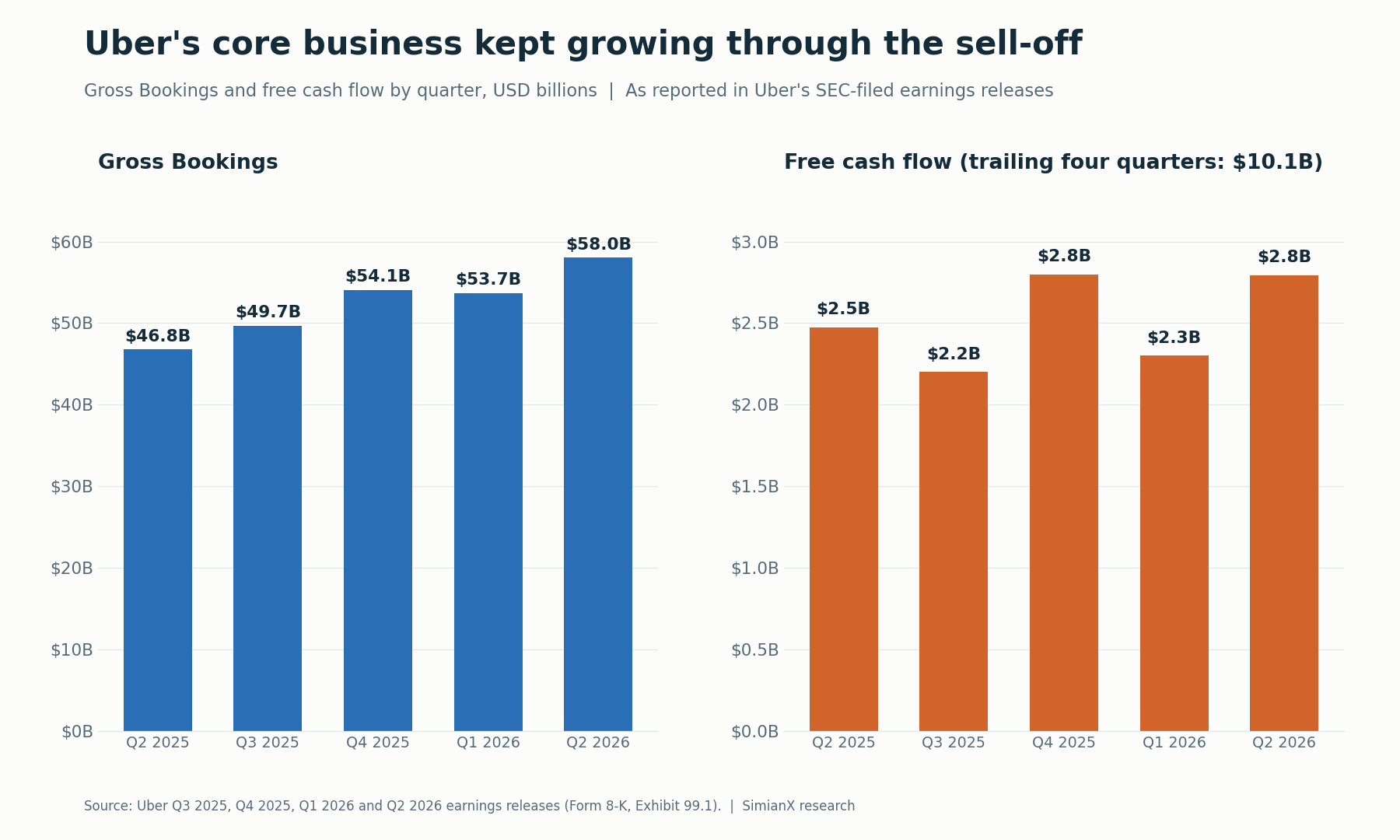
These group figures do not isolate robotaxi performance. The Mobility segment, where robotaxis sit, produced $29.0 billion of Gross Bookings (up 22%) and $2.2 billion of segment operating income (up 28%) in Q2 2026; Mobility revenue rose only 1% because of business model changes.
Reported net income of $2.4 billion also included a $1.6 billion pretax benefit from equity investment revaluations. That benefit should not be interpreted as recurring ride-hailing profit; in Q1 2026 the same line was a $1.5 billion headwind.
The Q3 2026 release, filed on November 4, showed the same pattern. Gross Bookings rose 20% to $59.8 billion, revenue rose 10% to $14.8 billion (business model changes cut revenue growth by 8 percentage points), and Adjusted EBITDA rose 31% to $3.0 billion. Mobility Gross Bookings reached $29.5 billion (up 18%) and Mobility segment operating income $2.4 billion (up 27%). GAAP net income of $512 million included a $476 million pretax loss from equity investment revaluations.
The strategic implication is that Uber has resources to pursue autonomy. The investment question is how productively those resources are deployed.
A profitable core business can finance experimentation, but it can also conceal weak returns in a developing activity if disclosures remain aggregated. Investors need evidence that autonomous expansion adds value beyond what the existing business would have produced.
Robotaxis Now Compete With Delivery Hero for Uber's Capital
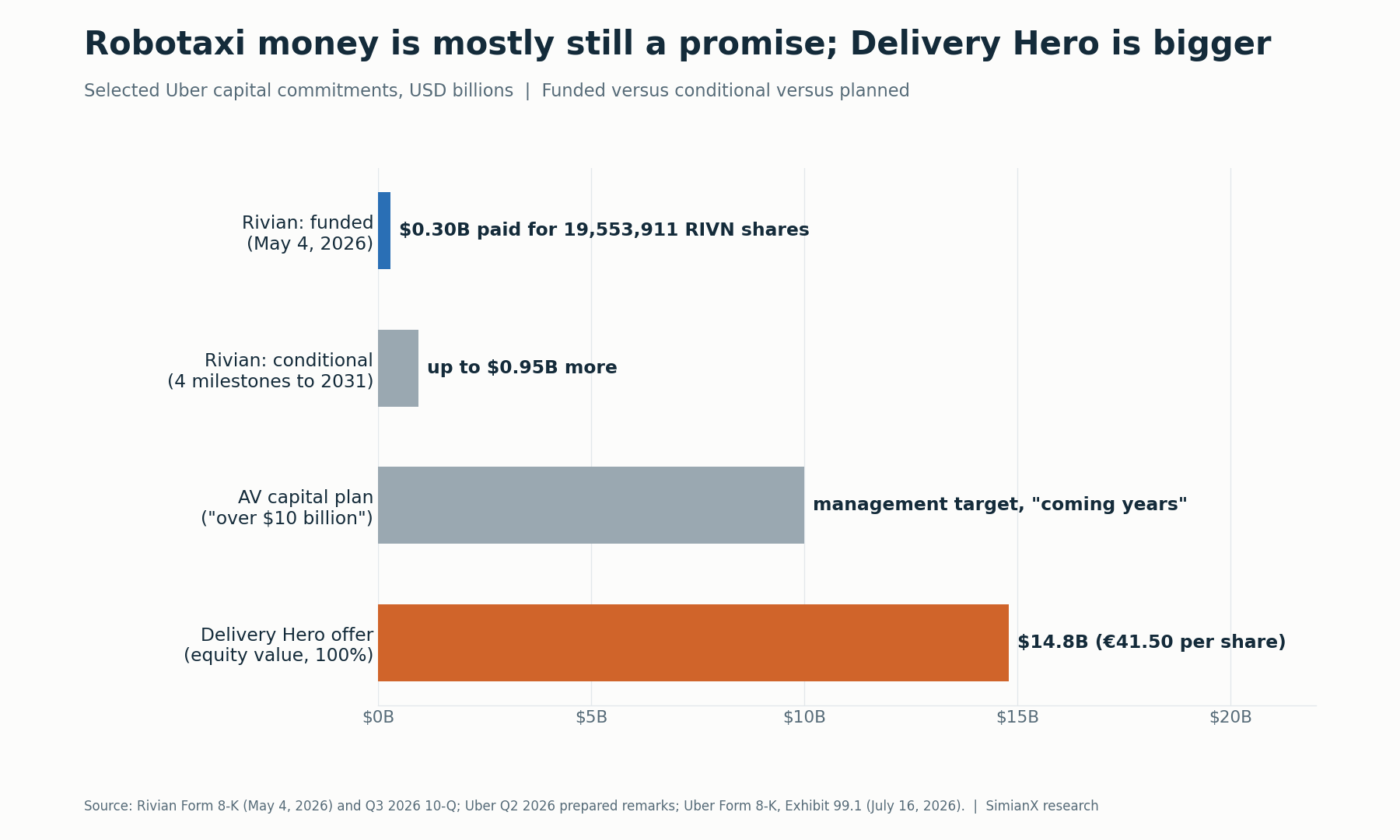
On July 16, 2026, Uber offered €41.50 per share for Delivery Hero, an equity value of $14.8 billion for 100% of the company, or $13.7 billion adjusted for the stake it already held. Uber expects the deal to close in the second half of 2027, to be accretive to non-GAAP EPS on closing, and to keep gross leverage below 2x.
The financing is already visible in SEC filings. Uber signed a bridge facility of €14.2 billion, replaced €4 billion of it with a term loan on August 6, 2026, and on September 15, 2026 sold €4.5 billion of senior notes due between 2029 and 2046. Total debt was $12.6 billion at June 30, 2026, before those steps.
At the same time, management said it expects to commit over $10 billion of capital over the coming years across AV equity investments, infrastructure, and vehicle offtake commitments, and is evaluating outside investors to share the load. Uber's Q2 2026 10-Q warns that it "may need to incur additional debt to finance the purchase of autonomous vehicles or infrastructure."
That is the core of the shareholder debate: a business that generates about $10 billion a year of free cash flow is now funding a large acquisition, a multi-year AV program and continued buybacks (about $16 billion remained authorized after Q2).
Why Autonomous Fleets Might Need Uber
The strongest argument for Uber is that manufacturing a capable autonomous vehicle does not automatically create a transportation marketplace.
A commercial operator must also solve passenger acquisition, trip matching, payment, support, pickup coordination, vehicle positioning, and service recovery.
Those tasks remain necessary when the driver disappears.
Consider a fleet with strong demand during commuting hours but weaker demand at other times. Additional bookings could spread fixed ownership costs across more passenger miles. Uber could be valuable if its marketplace supplies those bookings efficiently.
A mixed network could also help when autonomous vehicles cannot serve a particular road, weather condition, pickup location, or trip type. Human-driven supply can preserve service availability while autonomous coverage develops.
Management offered one early data point: in more mature AV markets, including Los Angeles, San Francisco, and Phoenix, Uber said its category share, both citywide and inside AV operating zones, is higher than a year earlier. That is a company claim without disclosed figures, but it is the kind of evidence the bull case needs.
These are economic arguments, not proof of Uber’s future margins. Their strength depends on whether Uber supplies incremental demand and operational capabilities that partners cannot obtain more cheaply elsewhere.
The important comparison is therefore the partner’s profit with Uber versus its profit without Uber.
Why Waymo Can Be Both a Partner and a Competitive Threat
Waymo’s own materials confirm Uber distribution in Austin and Atlanta. The same company also operates a consumer service with its own app.
On September 1, 2026, Waymo began welcoming public riders in Denver, San Diego, and Tampa, bringing its fully autonomous rider footprint to 14 cities. The announcement directed interested customers to the Waymo app and described access expanding gradually.
The implication is that distribution arrangements can differ by city.
For Uber, a relationship with a leading AV provider validates the marketplace’s usefulness. It does not guarantee that the provider will use Uber everywhere or preserve the same commercial terms indefinitely.
The risk grows if customers develop a strong preference for a particular autonomous service. Brand preference could give the operator leverage over pricing, placement, customer access, and distribution.
Conversely, if riders primarily value short waits, broad coverage, and a familiar booking experience, Uber could retain an important role even when the underlying vehicle technology comes from another company.
Tesla is the other direct-to-consumer threat. It began Robotaxi rides with Cybercabs in Austin in September 2026, as tracked in our Tesla robotaxi and margin page, and it is funding that push from its own cash flow, as our Tesla free cash flow analysis shows. Uber's 10-Q names Alphabet (Waymo), Amazon (Zoox) and Tesla as autonomous competitors.
The relevant question is how much demand each party brings to the relationship.
Zoox Shows Why Partnership Does Not Eliminate Competition
The Zoox-Uber announcement described planned Uber availability in Las Vegas and Los Angeles while explicitly preserving service through the Zoox app. It was Zoox's first partnership with a third-party platform.
That structure illustrates a possible industry outcome: autonomous operators use marketplaces and direct channels at the same time. Uber's own prepared remarks now say it expects first-party and third-party distribution models to coexist.
For Uber, the opportunity is access to differentiated vehicles without developing the entire autonomous system itself.
The competitive issue is that a partner can observe demand, build brand familiarity, and retain a separate relationship with passengers. Over time, both sides may negotiate over who deserves more of the fare.
A dual-channel model can still be profitable for Uber. It simply places more weight on the company’s ability to demonstrate measurable incremental value.
Investors should examine whether distribution rights are exclusive, which cities they cover, how long they last, and whether partners can change their allocation of vehicles across booking channels.
Rivian Makes the Capital Question More Concrete
The Rivian agreement announced on March 19, 2026 (the subscription agreement is dated March 18) included several distinct commitments and plans:
| Disclosed item | Amount or timing | Qualification |
|---|---|---|
| Potential Uber investment | Up to $1.25 billion through 2031 | Subject to autonomous milestones |
| First investment | $300 million, funded on May 4, 2026 | Paid after Rivian met Milestone #1 in April; 19,553,911 Rivian shares at $15.3422 |
| Remaining investment | Up to $950 million | Four further milestones, some requiring proven autonomy quality |
| Expected initial vehicle purchases | 10,000 R2 robotaxis | Uber or fleet partners |
| Additional vehicle opportunity | Up to 40,000 vehicles | Option to negotiate purchases beginning in 2030 |
| Initial commercial deployments | San Francisco and Miami in 2028 | Planned timing |
| Geographic ambition | 25 cities through 2031 | Future deployment target in the US, Canada and Europe |
Source for the funded tranche: Rivian's Form 8-K of May 4, 2026 and its Q3 2026 10-Q.
These terms describe conditional future exposure, rather than a completed fleet of 50,000 vehicles.
The first tranche already shows the risk. At Rivian's November 2, 2026 close of $13.19, the 19,553,911 shares were worth about $258 million, roughly 14% below the $300 million Uber paid.
The arrangement also shows why “asset-light” requires closer examination. Equity investment, direct vehicle ownership, third-party fleet financing, and contractual guarantees create different risks.
A company can avoid holding vehicles directly while still accepting obligations that influence its economic return. Conversely, outside fleet capital can support growth without requiring Uber to finance every vehicle.
The analysis should follow cash commitments and contractual risk, rather than relying on a single label.
Robotaxi Unit Economics: Who Pays for the Vehicle?
Removing an onboard driver changes the cost structure. It does not remove the cost of providing transportation.
A commercially sustainable robotaxi service must cover the vehicle, autonomous hardware and software, financing, insurance, maintenance, energy, cleaning, support, and operating downtime.
| Economic layer | Costs or responsibilities | Question for Uber shareholders |
|---|---|---|
| Vehicle ownership | Purchase cost, financing, depreciation | Does Uber own the asset or support its financing? |
| Autonomous technology | Software, sensors, computing, updates | How much bargaining power does the technology provider retain? |
| Fleet operations | Charging, cleaning, maintenance, depots | Who pays when vehicles are unavailable? |
| Passenger service | Matching, payments, support, refunds | What incremental value does Uber provide? |
| Risk allocation | Insurance, incidents, guarantees | Which party absorbs adverse outcomes? |
| Demand generation | Discounts, marketing, booking access | Does growth remain attractive after incentives? |
There is no universal public cost figure that can be safely applied across all these partnerships.
Vehicle designs, service areas, accounting arrangements, and operating responsibilities vary. A precise claim about Uber’s robotaxi margin requires specific commercial terms and actual fleet performance.
The most useful measure is cash contribution after the costs and risks Uber actually bears.
A Lower Cost per Ride Does Not Guarantee Higher Uber Profit
An illustrative calculation shows why demand growth and platform profit can move in different directions.
Assume a hypothetical service initially completes 100 rides at a $20 fare and retains $4 per ride after its direct costs.
Now assume lower prices increase demand, but the platform retains less per ride.
| Illustrative scenario | Trips | Fare per trip | Retained contribution per trip | Total contribution, calculated |
|---|---|---|---|---|
| Starting position | 100 | $20 | $4 | $400 |
| More demand with moderate compression | 140 | $16 | $3 | $420 |
| More demand with stronger compression | 140 | $16 | $2 | $280 |
These are invented scenario inputs for explanation, not Uber’s disclosed fares, margins, or forecasts.
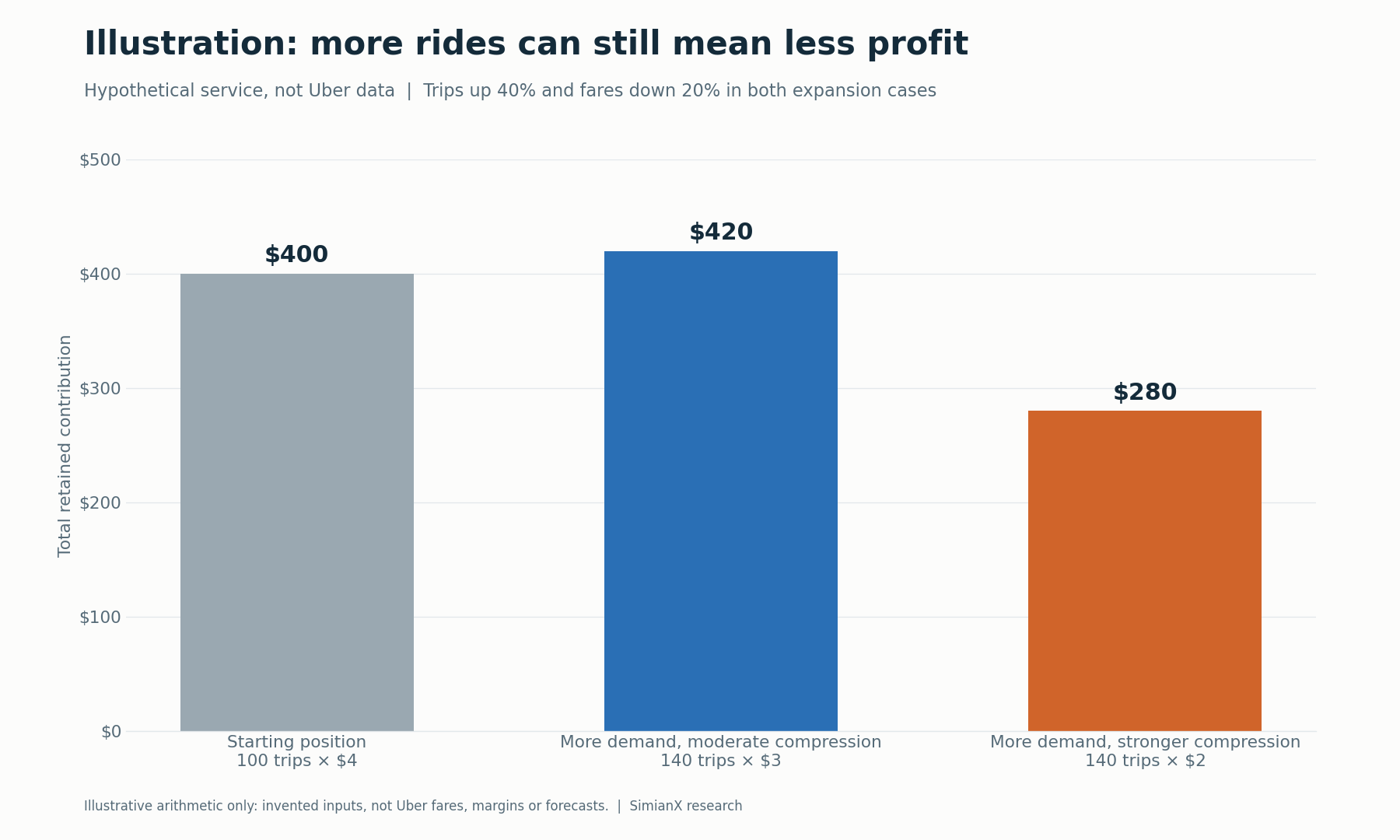
In both expansion scenarios, trips rise 40% and fares fall 20%. Yet contribution either increases modestly or declines materially.
The difference is the amount retained per trip.
This is why a compelling robotaxi adoption story can coexist with disappointing shareholder economics. Competition may pass cost savings to riders, autonomous providers may capture more of the fare, or fleet support costs may absorb the benefit.
The reverse is also possible. Strong utilization and efficient operations could improve contribution even at lower passenger prices.
The outcome needs measurement.
Incremental Demand Versus Cannibalization
Robotaxis can contribute to Uber in two different ways.
They can attract journeys that would not otherwise have occurred on Uber. They can also replace journeys that would have used human-driven vehicles.
The first creates incremental demand. The second changes the supply mix.
Both may be useful, but the profit implications differ.
For a replaced trip, the relevant comparison is the contribution Uber earns from the autonomous trip versus the contribution it would have earned from the human-driven alternative.
For a genuinely incremental trip, the question is whether its additional revenue exceeds the incremental costs of acquiring and serving it.
The strongest evidence would show city-level total demand expanding alongside healthy contribution, rather than a simple increase in the autonomous share of existing bookings.
Such analysis also needs to control for discounts, launch publicity, seasonality, service-area expansion, and changes in the broader transportation market.
Uber Is Trying to Sell More Than Bookings
On February 23, 2026, Uber introduced Uber Autonomous Solutions, covering infrastructure, user experience, and fleet operations.
Its disclosed capabilities include demand generation, mapping support, financing support, rider interfaces, and operational services. Earlier in 2026, Uber added an AV Labs team that deploys hundreds of sensor-equipped vehicles to collect driving data for its partners.
The strategic logic is clear: the more commercialization tasks Uber handles, the more reasons a developer has to remain connected to its platform.
However, operational breadth also introduces costs and execution responsibilities.
A service can strengthen a relationship while producing limited profit. Investors therefore need to distinguish strategic importance from demonstrated financial contribution.
The evidence to seek includes repeatable customer demand, partner retention, service revenue, and returns after associated operating expenses and investment.
Why Fleet Commitments Are Not the Same as Fleet Productivity
Uber’s Q2 2026 prepared remarks stated that AVs were live on its platform in seven cities, with a target of as many as 15 by year-end. Management also described approximately 120,000 vehicles committed by partners to the Uber network over coming years.
These were management disclosures at that reporting date. They should not be read as a November operating fleet count.
In the Q3 2026 release, CEO Dara Khosrowshahi said Uber expects approximately 700 fully driverless vehicles on its platform by year-end and over 2,000 in 2027. That near-term driverless figure is small relative to the long-range commitments.
A vehicle commitment needs several additional steps before producing economic value: delivery, technical validation, regulatory authorization, deployment, passenger demand, and sustainable operations.
A useful operating bridge is:
Announced vehicles → delivered vehicles → authorized vehicles → active vehicles → paid trips → cash contribution.
The number of cities can also be misleading without service-area detail. Limited coverage in one city is different from broad availability across another.
The quality of deployment matters at least as much as the size of the announcement.
What Would Confirm the Bull Case—or the Bear Case?
The strongest bull case is that Uber becomes an efficient distribution and commercialization layer for multiple autonomous suppliers.
The strongest bear case is that autonomous operators gain sufficient demand and technical differentiation to reduce Uber’s economic role, while Uber commits capital to preserve access.
| Evidence to monitor | Supports the bull case | Supports the bear case |
|---|---|---|
| Trip demand | Total city demand expands | AV rides mainly replace existing bookings |
| Contribution | Profit per trip remains attractive | Volume grows while retained contribution falls |
| Partner choice | Several capable suppliers compete | Supply concentrates among a few providers |
| Direct booking | Uber continues to deliver valuable incremental demand | Partners acquire riders independently at attractive cost |
| Capital exposure | External financing supports profitable growth | Guarantees and commitments expand faster than returns |
| Fleet operations | Reliability and utilization improve | Downtime and support costs remain high |
| Deployment status | Supervised projects become sustainable driverless services | Launches remain limited or repeatedly delayed |
This framework makes the thesis testable.
A growing partnership list is insufficient evidence for the bull case. The bear case also requires more than the existence of a competing app. The financial outcome depends on customer behavior, operational performance, and negotiated economics.
What Uber’s Q3 2026 Report Showed and What to Watch Next
Uber reported its Q3 2026 results before the market opened on Wednesday, November 4, 2026, ahead of its earnings call at 5:00 a.m. Pacific Time.
Both headline numbers landed in the upper half of Uber's August outlook: Gross Bookings of $59.8 billion against guidance of $58.25 billion to $60.25 billion, and non-GAAP EPS of $0.88, the top of its $0.84 to $0.88 range. Non-GAAP operating income rose 38% to $2.3 billion, or 3.9% of Gross Bookings, and free cash flow was $2.5 billion.
For Q4 2026, Uber guided to Gross Bookings of $63.25 billion to $65.25 billion (18% to 22% growth in constant currency), non-GAAP EPS of $0.95 to $0.99 and Adjusted EBITDA of $3.13 billion to $3.23 billion. On autonomy, the release's only quantified item was the CEO's expectation of approximately 700 fully driverless vehicles on Uber by year-end and over 2,000 in 2027; it did not break out autonomous trips, revenue or costs. Results from autonomy rivals' parent companies are tracked in our Magnificent 7 earnings tracker.
The autonomy disclosures that would be most useful in future reports would distinguish:
- Fully driverless trips from supervised autonomous trips.
- Active vehicles from future commitments.
- Incremental demand from substitution.
- Cash investment from contingent commitments.
- Gross booking growth from retained contribution.
- Group profitability from autonomous project economics.
These distinctions would help investors connect the technology narrative to the financial statements. To follow UBER's price action and the robotaxi headlines in real time, you can run a live AI analysis session on SimianX.
Frequently Asked Questions
Will robotaxis help or hurt Uber stock?
Robotaxis could help Uber if they expand profitable demand and strengthen the value of its marketplace. They could hurt its investment case if autonomous providers gain bargaining power or expansion requires unattractive capital commitments.
Why is Uber stock down in 2026?
UBER fell 18.4% from its 2025 year-end close to $66.71 on November 2, 2026, and is 33.4% below its October 2025 record close, even as Gross Bookings grew about 20% a year. The main concerns are robotaxi competitors that sell rides directly, rising capital commitments to AV partners, and the debt-funded Delivery Hero offer.
What did Uber report for Q3 2026?
On November 4, 2026, Uber reported Q3 Gross Bookings of $59.8 billion (up 20%), revenue of $14.8 billion, non-GAAP EPS of $0.88 and free cash flow of $2.5 billion, with Gross Bookings in the upper half of its guidance and EPS at the top of it. It guided Q4 Gross Bookings to $63.25 billion to $65.25 billion and non-GAAP EPS to $0.95 to $0.99.
Who are Uber's robotaxi partners?
The main named partners are Waymo (Austin and Atlanta), Zoox, Wayve (London and a planned Tokyo pilot with Nissan), Rivian, Lucid with Nuro, and in Europe Autobrains and WeRide. Their status ranges from fully driverless service to supervised rides and plans set for 2028.
Does Uber need to build its own self-driving system?
Uber’s disclosed approach relies heavily on partnerships and commercialization services. Its success depends on whether distribution and operating capabilities earn attractive returns alongside the companies supplying the autonomous technology.
Are all autonomous rides on Uber fully driverless?
No. Uber’s September 2026 London launch explicitly included a trained private hire driver onboard. Investors should check each deployment’s operating status rather than infer it from the word “autonomous.”
Can Waymo be both Uber’s partner and competitor?
Yes. Waymo identifies Uber distribution in Austin and Atlanta while also developing direct consumer access elsewhere. Cooperation can create value even when the companies compete for customer relationships.
Will eliminating drivers automatically increase Uber’s margins?
No. Savings can flow to passengers, technology providers, fleet owners, or operating expenses. Uber’s benefit depends on the contribution it retains after its actual costs and obligations.
Does the Rivian agreement mean 50,000 robotaxis are already operating?
No. The announcement described an initial purchase plan of 10,000 vehicles, an option for up to 40,000 more from 2030, and milestones extending into future years. Initial commercial deployments are planned for 2028. Only the first $300 million of Uber's investment has been paid.
Verdict: Uber Must Prove It Can Capture the Value It Helps Create
Robotaxis offer Uber a credible path to growth, but the financial benefit remains conditional on utilization, commercial terms, and capital discipline.
Uber can create value by connecting autonomous vehicles with passengers and helping fleets operate efficiently. The competing possibility is that strong autonomous providers capture more of the customer relationship and economics.
The share price already reflects a good deal of doubt: at $66.71 the market value is about 13.5 times trailing free cash flow. The evidence to watch is the progression from announcements to productive fleets, and from productive fleets to durable cash returns.
For UBER shareholders, the decisive result is profitable participation in autonomous transportation after accounting for the capital and risk required to secure it.
Related Reading
- Tesla Auto Gross Margin by Quarter: Q3 2026 Rose to 18.5%
- Tesla Free Cash Flow by Year: Q3 2026's $1.5B vs AI Capex
- Lucid Stock LCID Surges on Uber Robotaxi Deal Today
- Magnificent 7 Earnings Dates and Results: Q3 2026 Tracker
References
- Uber: SEC-filed Q3 2026 earnings release (Form 8-K, Exhibit 99.1)
- Uber: SEC-filed Q2 2026 earnings release
- Uber: Q2 2026 Form 10-Q
- Uber: Q1 2026 earnings release
- Uber: Q4 2025 earnings release
- Uber: Q3 2025 earnings release
- Uber: Q2 2026 prepared remarks
- Uber: Q3 2026 earnings call date announcement
- Uber: Delivery Hero takeover offer (Form 8-K, Exhibit 99.1)
- Uber: Term loan for the Delivery Hero offer (Form 8-K)
- Uber: €4.5 billion senior notes offering (Form 8-K)
- Uber: Autonomous Solutions announcement
- Uber and Rivian: Conditional investment and robotaxi deployment plans
- Rivian: Form 8-K on the $300 million Uber investment
- Rivian: Q3 2026 Form 10-Q (Uber subscription agreement)
- Uber and Zoox: Distribution partnership announcement
- Zoox and Uber: Business Wire release
- Uber: Wayve supervised rides launch in London
- Tech.eu: Londoners can now hail Wayve autonomous vehicles through Uber
- Wayve, Uber, and Nissan: Tokyo pilot collaboration
- electrive: Lucid, Uber and Nuro unveil the Lucid Gravity robotaxi
- Waymo: Network partnerships and Uber availability
- Waymo: September 2026 expansion and direct rider access