
 By Muke
U.S. Invasion of Grenada 1983 Market Impact: -2.8% Drawdown, 11-Day Bottom
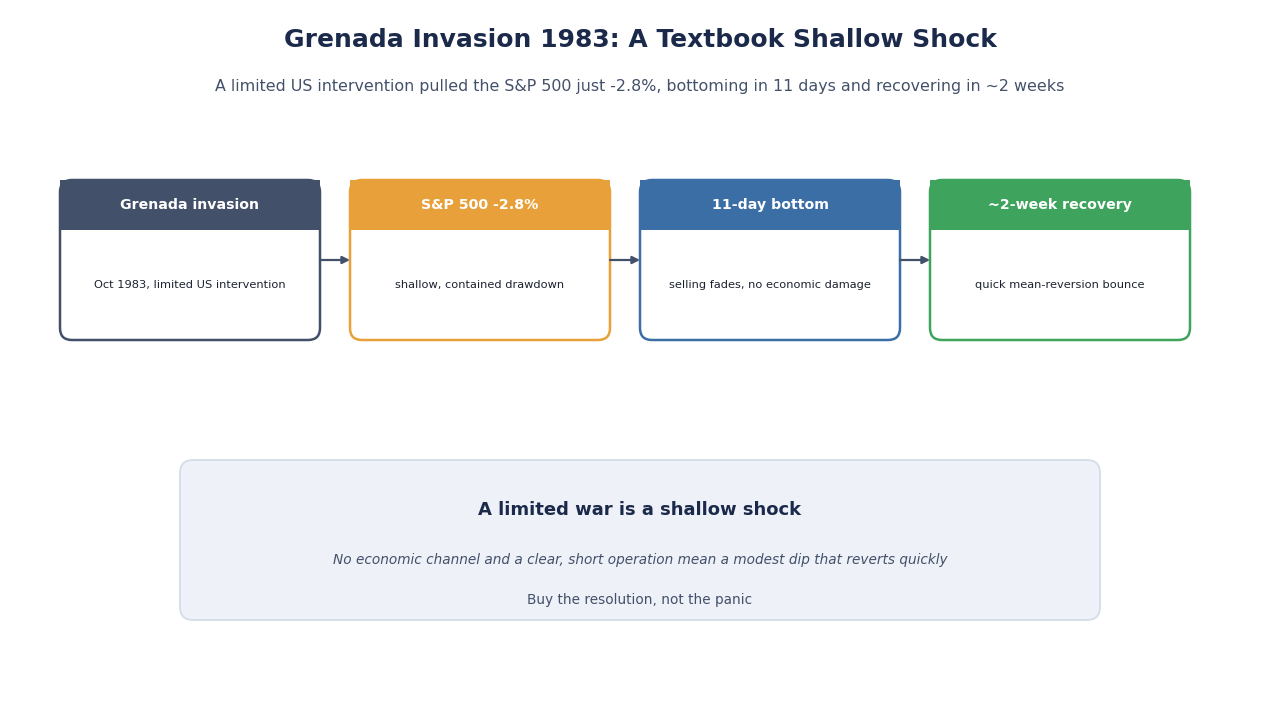
The U.S. Invasion of Grenada 1983 market impact is one of the most overlooked yet highly instructive case studies in understanding how financial markets react to short-duration geopolitical shocks. For traders and investors using modern tools like SimianX AI, this event provides a blueprint for identifying low-risk dip-buying opportunities during limited military conflicts.
In October 1983, the U.S. launched a rapid military intervention in Grenada. The stock market response? A modest -2.8% drawdown, an 11-day bottom, and a swift recovery. This pattern is not random—it reflects deeper structural dynamics between geopolitics, liquidity, and investor psychology.
Understanding the Event: Why the Market Reacted Mildly
The invasion—Operation Urgent Fury—was triggered by political instability in Grenada and concerns over Cold War influence. However, from a market perspective, several critical factors limited the downside.
Markets do not price headlines—they price systemic risk and duration uncertainty.
Key reasons for limited drawdown:
- Contained geography (Caribbean micro-conflict)
- No oil or commodity disruption
- Low probability of superpower escalation
- Short expected duration
This combination prevented the event from triggering a macro-level repricing of risk assets.
Market Timeline Breakdown: From Shock to Recovery
Phase 1: Initial Shock (Day 0–3)
The market reacted quickly to unexpected military news:
- S&P 500 declines begin (~-1% to -2%)
- Short-term volatility spike
- Risk-off sentiment dominates
Phase 2: Controlled Selloff (Day 3–11)
Selling pressure continued but remained limited:
- Maximum drawdown: ~-2.8%
- No panic selling
- Market breadth weakened but did not collapse
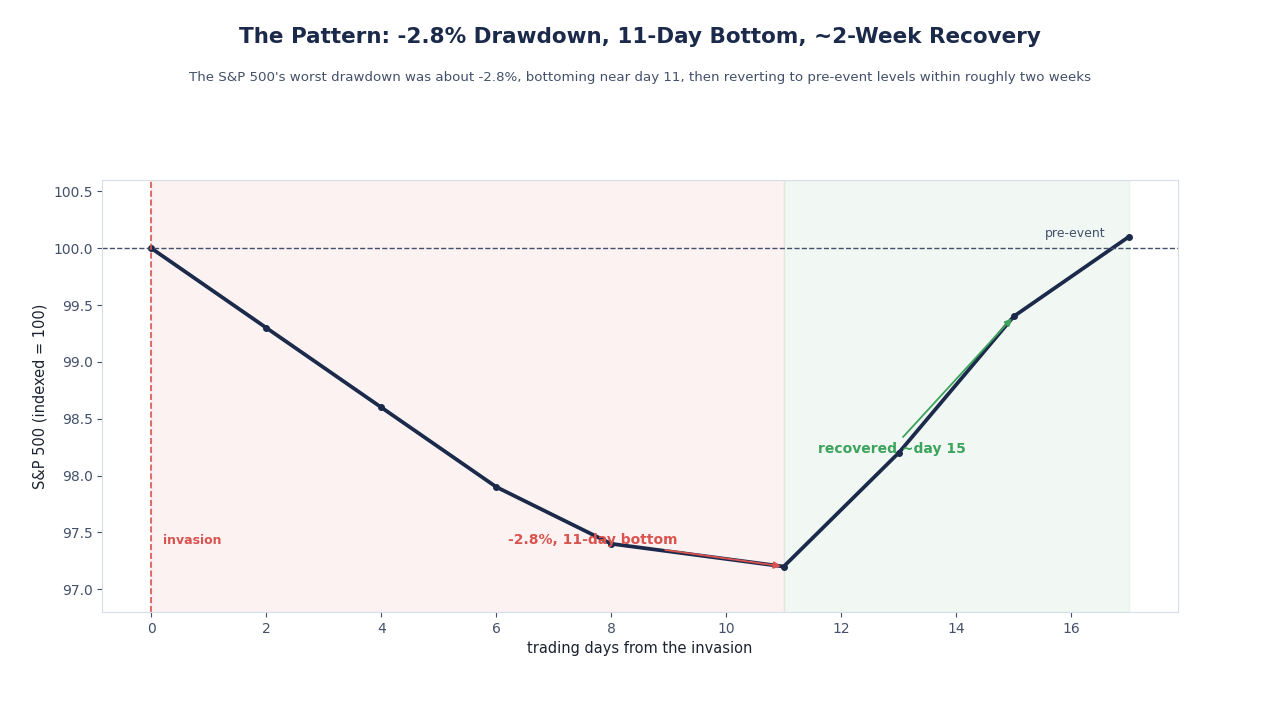
Phase 3: Bottom Formation (~Day 11)
Markets stabilized as:
- Military success became evident
- No escalation with Soviet forces
- Investor confidence returned
Phase 4: Rapid Recovery (~Day 11–15)
- Strong rebound begins
- Risk assets regain momentum
- Dip buyers dominate flows
What Made This a “Shallow Shock” Event?
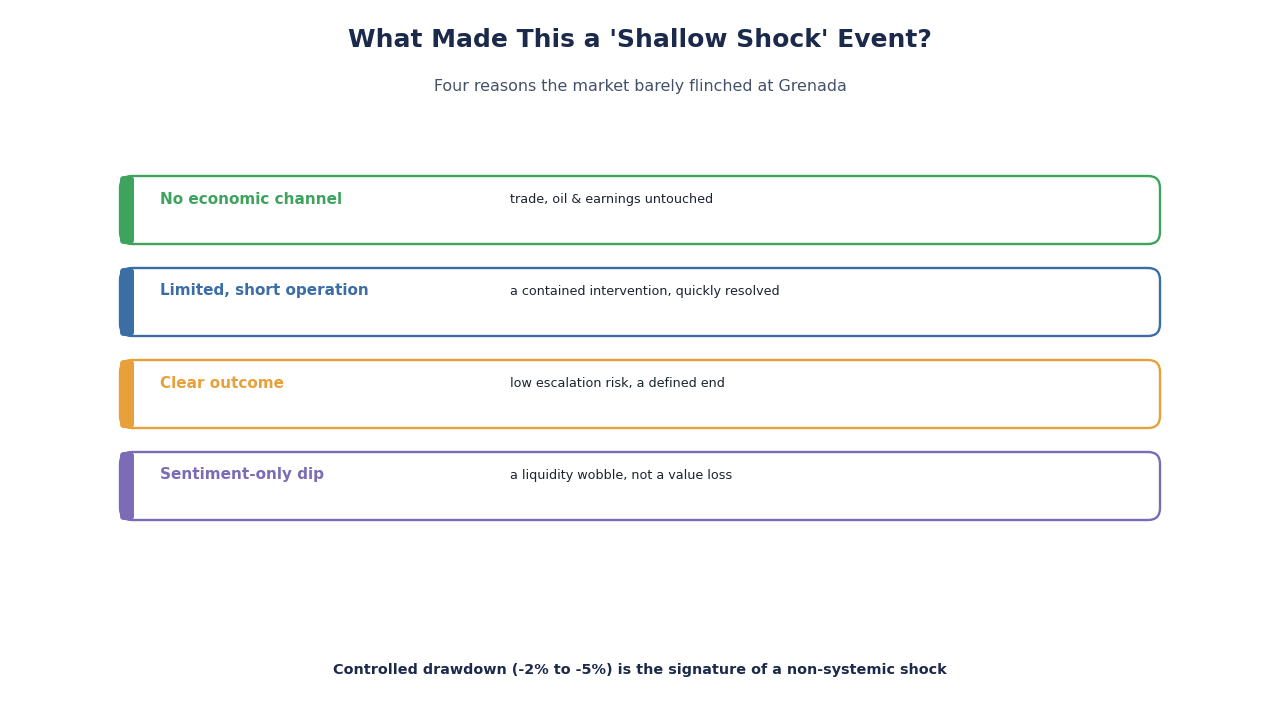
1. No Liquidity Disruption
The Federal Reserve did not intervene, and liquidity conditions remained stable. This is crucial because:
Liquidity—not geopolitics—is the primary driver of deep market drawdowns.
2. No Macro Spillover
Unlike major wars, Grenada had:
- No effect on global trade
- No energy price shock
- No earnings revisions
3. Predictable Duration
Markets quickly assessed that this was a short-term operation, reducing uncertainty.
Cross-Event Comparison: Where Grenada Fits
| Event | Drawdown | Bottom | Recovery | Type |
|---|---|---|---|---|
| Grenada 1983 | -2.8% | 11 days | ~15 days | Limited intervention |
| EP-3 Incident 2001 | -4.9% | 3 days | 7 days | Military tension |
| Afghanistan Withdrawal 2021 | -0.1% | 1 day | 3 days | De-escalation |
| Lebanon War 2006 | ~-3% | ~10 days | ~20 days | Regional conflict |
Insight:
Markets react more to uncertainty and systemic risk than to the event itself.
Trading Strategy: How to Exploit Similar Events
The U.S. Invasion of Grenada 1983 market impact provides a repeatable trading framework.
Entry Conditions
- Market drop between -2% and -5%
- No widening in credit spreads
- No spike in oil prices
Execution Strategy
- Buy broad index exposure (S&P 500, Nasdaq)
- Focus on large-cap, high-liquidity assets
- Avoid overreacting to headlines
Exit Strategy
- Target rebound of 5–10%
- Monitor volatility normalization
- Exit when sentiment shifts from fear → relief
!Trading strategy chart:maxbytes(150000):stripicc():format(webp)/dotdashv5The5MinuteTradingStrategyJun2020-01-7cb7eedc852d4d79b0fdf76d0b68dd3d.jpg)
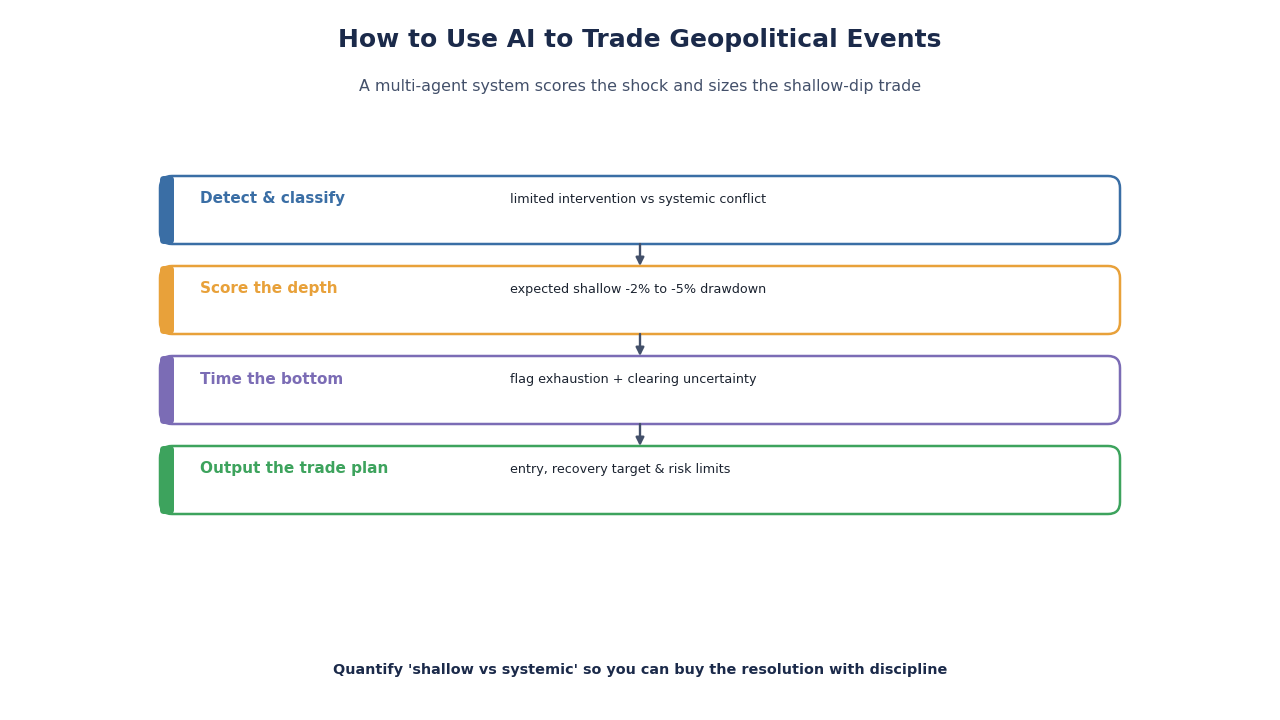
How to Use AI to Trade Geopolitical Events
Modern traders have a massive advantage: AI-powered multi-agent analysis.
With SimianX AI, you can structure decision-making like an institutional desk:
Step-by-Step Framework
- News Intelligence Agent
- Detects geopolitical shocks in real time
- Classifies risk level (limited vs escalation)
- Technical Indicator Agent
- Tracks RSI, EMA, MACD for entry signals
- Macro Agent
- Confirms liquidity and credit conditions
- Decision Agent
- Outputs:
- Direction (bullish/bearish)
- Key levels
- Risk scenarios
- Confidence score
| Agent Type | Role |
|---|---|
| News Agent | Detects geopolitical events |
| Indicator Agent | Identifies technical setups |
| Macro Agent | Validates systemic risk |
| Decision Agent | Produces actionable signals |
This multi-agent approach ensures disciplined, data-driven trading, not emotional reactions.
How to analyze Grenada-style events using AI trading tools?
To analyze events like the Grenada invasion:
- Track real-time news sentiment
- Confirm no macro deterioration
- Identify technical oversold levels
- Execute controlled dip-buy strategy
Using SimianX AI, this process becomes automated and significantly more accurate.
FAQ About U.S. Invasion of Grenada 1983 Market Impact
What was the stock market reaction to the Grenada invasion?
The S&P 500 experienced a -2.8% drawdown, bottoming in approximately 11 days, followed by a quick recovery within two weeks.
Why was the market impact so small?
Because the event lacked macro consequences—no oil shock, no global escalation, and no liquidity tightening.
How do markets typically react to small wars?
Small, contained conflicts usually cause short-term dips followed by fast recoveries, especially when systemic risk remains low.
What is the best trading strategy during geopolitical shocks?
A disciplined dip-buying strategy works best when:
- Drawdowns are shallow
- Liquidity is stable
- No macro disruptions occur
Can AI improve trading during such events?
Yes. Tools like SimianX AI help filter noise, validate signals, and provide high-confidence trading decisions in real time.
Conclusion
The U.S. Invasion of Grenada 1983 market impact demonstrates a critical truth: not all geopolitical events are equal. Markets respond primarily to systemic risk, liquidity conditions, and duration uncertainty—not headlines alone.
For modern traders, this creates opportunity. By recognizing shallow geopolitical shocks, you can position early and capture rapid recoveries.
With platforms like SimianX AI, you can turn complex, fast-moving events into structured, high-probability trades—leveraging AI agents to analyze news, technicals, and macro signals simultaneously.
U.S. Invasion of Grenada 1983 Market Impact: Strategy, Patterns, and AI Trading Framework
The U.S. Invasion of Grenada 1983 market impact is not just a historical footnote—it is a repeatable trading pattern that modern investors can still exploit today. Understanding how markets reacted to this short-duration conflict helps traders identify low-risk, high-probability opportunities during similar geopolitical shocks.
With tools like SimianX AI, traders can now systematically detect and act on these patterns using multi-agent intelligence, transforming what used to be intuition into a structured decision-making process.
The Hidden Pattern Behind Short Wars and Stock Markets
The Grenada invasion belongs to a specific class of events:
Short, contained military conflicts that create temporary uncertainty but no systemic disruption.
These events share a predictable structure:
- Initial headline-driven selloff
- Controlled drawdown (typically -2% to -5%)
- Fast bottom formation
- Sharp relief rally
Why This Pattern Repeats
Markets operate on risk repricing mechanisms, not emotions alone. The key drivers include:
- Liquidity stability
- Absence of macro shock
- Duration clarity
When all three remain intact, drawdowns are shallow and short-lived.
Deep Dive: Market Psychology During Grenada 1983
Phase 1: Information Shock
At the moment of invasion, uncertainty spikes:
- Investors lack clarity on escalation
- Algorithms (today) would classify as high headline risk
- Short-term selling pressure increases
Phase 2: Rapid Reassessment
Within days, markets begin recalibrating:
- No escalation signals detected
- Institutional money slows selling
- Volatility stabilizes
Phase 3: Opportunity Recognition
Smart money identifies:
- Overreaction relative to fundamentals
- Stable macro backdrop
- Temporary sentiment distortion
This is where alpha is generated—not at the headline, but at the mispricing.
Structural Drivers of the -2.8% Drawdown
The specific -2.8% drawdown is not random. It reflects a balance between:
| Force | Impact |
|---|---|
| Fear of escalation | Negative |
| Lack of macro spillover | Positive |
| Stable liquidity | Positive |
| Short duration expectation | Positive |
Key Insight:
Drawdowns under -5% often signal “non-systemic events”—prime conditions for tactical entries.
Advanced Framework: Classifying Geopolitical Events
To replicate the Grenada strategy, events must be categorized correctly.
Tier 1: Limited Intervention (Grenada Type)
- Drawdown: -2% to -5%
- Recovery: <20 days
- Strategy: Aggressive dip-buy
Tier 2: Regional Conflict
- Drawdown: -5% to -10%
- Recovery: 1–3 months
- Strategy: Staggered entry
Tier 3: Systemic War / Crisis
- Drawdown: -15%+
- Recovery: Long-term
- Strategy: Capital preservation
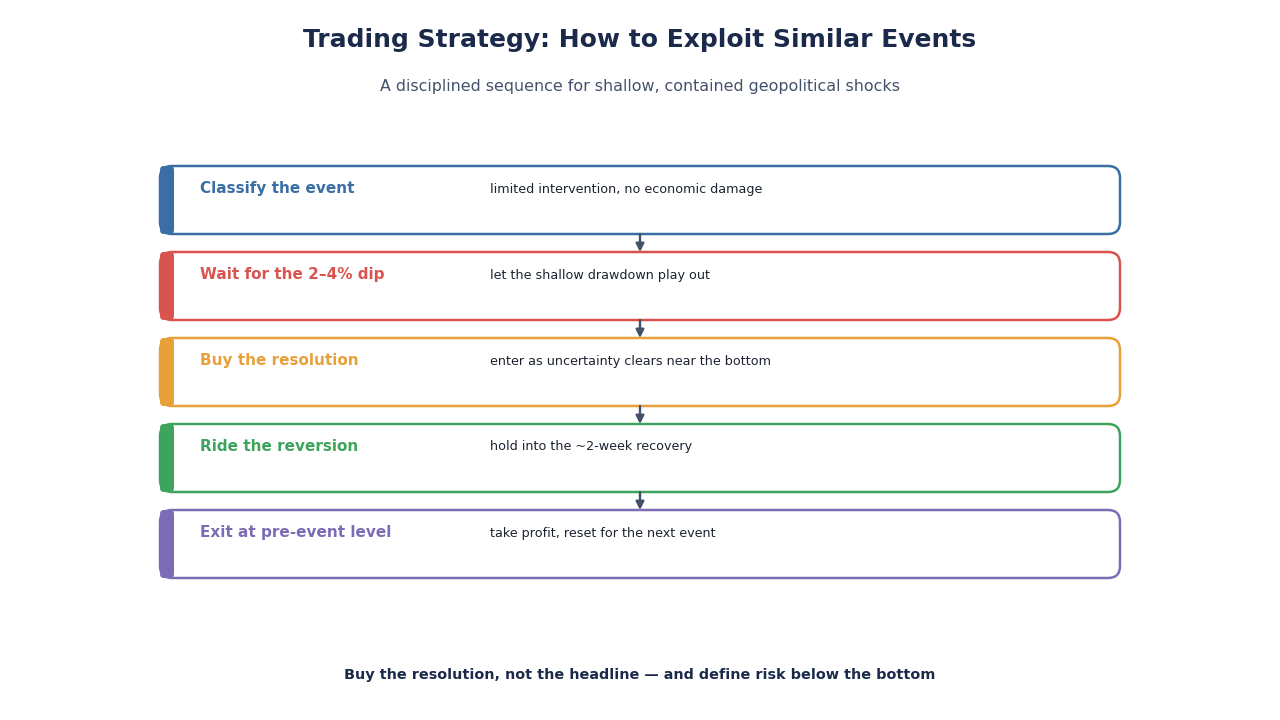
How to Trade Grenada-Type Events Step-by-Step
Step 1: Identify the Event Type
Ask:
- Is the conflict geographically contained?
- Is there a risk of global escalation?
- Does it affect energy supply?
If answers are mostly NO, you're likely in a Grenada-type setup.
Step 2: Confirm Market Conditions
Use these filters:
- Credit spreads stable
- No spike in oil prices
- Central bank policy unchanged
Step 3: Execute Entry
- Wait for 2–4% drawdown
- Look for technical support (EMA, RSI oversold)
- Enter gradually, not all at once
Step 4: Manage Risk
- Set invalidation: escalation news
- Avoid leverage spikes
- Track volatility normalization
Step 5: Exit Strategically
- Target 5–10% rebound
- Exit into strength, not weakness
How SimianX AI Enhances This Strategy
Modern markets move faster than ever. Manual analysis is no longer enough.
SimianX AI introduces a multi-agent framework that mirrors institutional workflows:
1. Intelligence Agent
- Real-time geopolitical monitoring
- Detects sentiment shifts instantly
2. Indicator Agent
- Tracks:
- RSI
- MACD
- EMA crossovers
3. Macro Agent
- Validates:
- Liquidity conditions
- Credit spreads
- Economic signals
4. Decision Agent
Outputs:
- Trade direction
- Entry/exit levels
- Risk scenarios
- Confidence score
| Component | Function |
|---|---|
| News AI | Detects geopolitical shocks |
| Technical AI | Identifies entry timing |
| Macro AI | Confirms systemic stability |
| Decision AI | Generates final trade |
This system ensures discipline over emotion, a key advantage in volatile situations.
How to trade geopolitical events stock market using AI?
To trade events like the Grenada invasion:
- Let AI detect event classification
- Confirm low systemic risk
- Execute data-driven entry
- Manage risk via real-time updates
Using SimianX AI, this entire workflow becomes automated and scalable.
Case Study Extension: Applying Grenada Logic to Modern Markets
Example: Hypothetical 2026 Scenario
- Small regional conflict breaks out
- Markets drop -3% in 2 days
- No oil disruption
Using Grenada framework:
- Identify as Tier 1 event
- Enter positions early
- Exit during rebound
Result:
- High probability short-term gains
- Limited downside risk
Common Mistakes Traders Make
Avoid these pitfalls:
- Overestimating geopolitical risk
- Ignoring liquidity conditions
- Entering too early (before confirmation)
- Holding too long after recovery
FAQ About U.S. Invasion of Grenada 1983 Market Impact
What makes Grenada 1983 a unique market case?
It represents a low-intensity conflict with minimal macro impact, making it ideal for studying shallow drawdowns.
How long did the market take to recover?
Approximately 15 days, highlighting the speed of recovery in non-systemic events.
What is the best strategy for similar events?
A disciplined dip-buying strategy, supported by technical and macro confirmation.
Can AI tools improve geopolitical trading?
Yes. AI platforms like SimianX AI provide real-time, multi-layered analysis, improving decision accuracy.
Are all military conflicts bullish for stocks?
No. Only contained, short-duration conflicts tend to produce bullish recovery setups.
Conclusion
The U.S. Invasion of Grenada 1983 market impact reveals a powerful truth: markets are highly efficient at distinguishing between temporary shocks and systemic risks.
For traders, this creates a repeatable edge.
By combining historical patterns with modern AI tools like SimianX AI, you can:
- Identify high-probability setups faster
- Execute with greater confidence
- Avoid emotional decision-making
Related Reading
- EP-3 Incident 2001: S&P -4.9%, 7-Day Recovery Pattern
- The Fade-the-Fear Setup: Trading the EP-3 2001 Panic
- Afghanistan Withdrawal 2021: S&P +0.1%, the Non-Event Trade
- 1989 Panama Invasion: S&P -2.2% in 2 Days, 8-Day Recovery
- Syria Airstrike 2017: S&P 500 -1.2%, Same-Week Recovery
- Israel-Hamas 2023: S&P -4.5% Drawdown, 14-Day Bottom