
 By Marcus Reeve
FAA Nationwide Ground Stops: Every One on Record and How Airline Stocks Reacted
On Friday, November 13, 2026, the Federal Aviation Administration halted departures at every airport in the United States. It is one of the rarest orders in American aviation. Before Friday, the FAA had stopped all departures nationwide only twice in the modern era: on the morning of September 11, 2001, and on January 11, 2023, when its NOTAM safety-alert system failed overnight.
This page is a reference for that short list. For each FAA nationwide ground stop it records what happened, when it started and ended, what the FAA said caused it, and how airline stocks moved: Delta (DAL), United (UAL), American (AAL, AMR in 2001), Southwest (LUV), the JETS airline ETF and the S&P 500. The 2026 stop was lifted at 8:15 p.m. ET the same evening; the first full-session airline reaction will be added after Monday, Nov 16.
Quick answer (updated Friday evening, Nov 13, 2026, ET)
>
- Is there a nationwide ground stop right now? No. The FAA lifted it at 8:15 p.m. ET (5:15 p.m. PT) on Friday, Nov 13, 2026, the time given by Transportation Secretary Sean Duffy and by Flightradar24 (01:15 UTC Nov 14). Measured from the 3:54 p.m. ET start, it lasted about 4 hours 21 minutes; some outlets say "about five hours," counting from when communication problems began around 3:30 p.m. ET. Recovery is slow: by 9:30 p.m. ET, FlightAware counted more than 6,600 cancellations and more than 25,100 delays for flights within, into or out of the US, per AP via Yahoo News. Check your airline before going to the airport.
- Why? The FAA cited a "temporary telecommunications outage" affecting Air Route Traffic Control Centers. Transportation Secretary Sean Duffy blamed an "incredibly old" air traffic control system whose switches and routers became overloaded and produced inconsistent data, per CBS News. Homeland Security Secretary Markwayne Mullin, speaking at the White House, said there was no indication "as of yet" of a nefarious act. No final cause has been published.
- How many nationwide ground stops has the FAA ordered? Three on record: Sep 11, 2001; Jan 11, 2023; Nov 13, 2026.
- What did airline stocks do? After 9/11, airline shares fell 24% to 52% on the first trading day. On the 2023 outage day they mostly rose. On Nov 13, 2026, the stop began six minutes before the closing bell; airline shares were down 2% to 3.5% from the 3:54 p.m. ET print by 6:00 p.m. ET in after-hours trading. The first full-session reaction is Monday, Nov 16.
What happened on November 13, 2026
Here is what is sourced so far, in Eastern Time (ET) with Pacific Time (PT) where useful. We only list facts that appear in at least one of the sources linked below, and we flag where they differ.
- Start: 3:54 p.m. ET (12:54 p.m. PT, 20:54 UTC). An FAA Air Traffic Control System Command Center advisory, reported by News On 6, put the start at 2:54 p.m. Central, which is 20:54 UTC. According to Flightradar24, as cited by CBS News, about 3,100 airborne aircraft were bound for US airports at that moment.
- Scope. The FAA ordered departing traffic at all US airports to remain on the ground "until further notice." It said the stop was "due to extraordinary circumstances and for reasons of safety." Flights already in the air continued. Inbound international flights were handled case by case, per CNBC and CBS News.
- Stated cause. Transportation Secretary Sean Duffy cited "a communication issue impacting all Air Route Traffic Control Centers." The FAA's own statement referred to "communication issues impacting multiple" centers and later to a "temporary telecommunications outage." The US has 22 such en route centers, per ABC News. Note the wording gap between "all" and "multiple"; the FAA has not published a final scope or root cause.
- Not an attack, so far. At the White House, Homeland Security Secretary Markwayne Mullin said there was no indication "as of yet" of anything nefarious, and that the stop was ordered out of an abundance of caution. He told reporters, "This isn't another 9/11," per ABC News.
- Lifted: 8:15 p.m. ET (5:15 p.m. PT, 01:15 UTC Nov 14). "At 8:15 tonight, Eastern time, we've opened up the airspace," Duffy said, per CBS News; NBC News and Flightradar24 give the same time. That is about 4 hours 21 minutes after the 3:54 p.m. ET start, and earlier than the 10 p.m. Central (11 p.m. ET) estimate in the Command Center advisory reported by News On 6. Duffy warned the restart would be "slow." Delta said it was "safely resuming operations," and United said it was resuming operations, including some Friday night flights, per NBC News.
- Scale of disruption. About 11,000 flights were scheduled to depart US airports after 4 p.m. ET, per Cirium data cited by CNBC. FlightAware listed at least 8,000 delays and 400 cancellations within a short time, per CBS News. Chicago O'Hare and Midway had their own equipment-related ground stop shortly before the nationwide order. By 9:30 p.m. ET, FlightAware counted more than 6,600 cancellations and more than 25,100 delays, per AP; the totals were still rising.
- Canada. Toronto Pearson, Montreal-Trudeau and Calgary held US-bound flights, while NAV Canada said its own systems were operating normally, per Global News.
Former NTSB chair Robert Sumwalt called the event unprecedented, per CBS News. Several outlets, including ABC News and Global News, describe it as only the second nationwide stop of all departures since 9/11.
Every FAA nationwide ground stop on record
A ground stop is a traffic-management tool. The FAA uses it daily at single airports for weather, volume or equipment. A nationwide ground stop, one that halts departures at every US airport at once, is something else entirely. We found three that are documented in primary or major-press sources.
| # | Date | Trigger | Start (ET) | End | Scope |
|---|---|---|---|---|---|
| 1 | Tue, Sep 11, 2001 | Terrorist attacks | 9:25 a.m. | Limited commercial service resumed Sep 13 | All departures stopped; at about 9:42 a.m. every aircraft ordered to land |
| 2 | Wed, Jan 11, 2023 | NOTAM system outage | Ordered before 7:15 a.m. statement | FAA: "lifted" at 8:50 a.m. statement | All domestic departures |
| 3 | Fri, Nov 13, 2026 | ATC telecommunications outage | 3:54 p.m. | Lifted 8:15 p.m. ET (about 4 h 21 min); 6,600+ cancellations, 25,100+ delays by 9:30 p.m. ET (FlightAware) | All US airports, departures |
1. September 11, 2001: the first full shutdown
The 9/11 Commission Report gives the sequence. American Airlines stopped its own flights nationwide between 9:05 and 9:10 a.m., and United followed. At 9:25 a.m., the FAA's Herndon Command Center ordered a nationwide ground stop, "which prohibited takeoffs of all civilian aircraft regardless of destination." At 9:42 a.m., after learning a plane had hit the Pentagon, the Command Center's national operations manager, Ben Sliney, ordered all aircraft to land at the nearest airport. About 4,500 commercial and general aviation aircraft landed without incident. Transportation Secretary Norman Mineta testified that he gave the final order for all civil aircraft to land at about 9:45 a.m.
US airspace reopened for limited commercial service on Thursday, September 13. Reagan Washington National stayed closed until October 4, 2001.
The stock market was closed too. The NYSE and Nasdaq did not open on September 11 and stayed shut through Friday, September 14. They reopened on Monday, September 17. That first session is the airline reaction in our table. For the full market story, see our reference on 9/11 and the early War on Terror market shock.
2. January 11, 2023: the NOTAM outage
The Notice to Air Missions (NOTAM) system is how the FAA pushes safety information, such as closed runways and equipment outages, to pilots. It failed on the night of January 10, 2023. The FAA's statement log shows the timeline:
- 7:15 a.m. ET: "The FAA has ordered airlines to pause all domestic departures until 9 a.m. Eastern Time to allow the agency to validate the integrity of flight and safety information."
- 8:15 a.m. ET: Departures resumed at Newark and Atlanta because of congestion there; others were expected to restart at 9 a.m.
- 8:50 a.m. ET: "Normal air traffic operations are resuming gradually across the United States... The ground stop has been lifted."
Press reports differ by a few minutes on the exact lift time; some put it just after 9 a.m. Either way, the departure pause lasted under two hours. The ripple effect was larger: airlines cancelled more than 1,300 flights and delayed nearly 10,000, per NPR.
The cause came a week later. In its January 19 statement, the FAA said a preliminary review found "contract personnel unintentionally deleted files while working to correct synchronization between the live primary database and a backup database," and that it had "found no evidence of a cyber-attack or malicious intent."
3. November 13, 2026: the ATC telecommunications outage
See the timeline above. It is the first of the three to begin while US stock markets were open, if only by six minutes, and the first that was triggered by a problem with air traffic control communications rather than a pilot-alert database.
Not nationwide: airline-specific stops
Several widely reported "nationwide ground stops" applied to a single airline, usually at the carrier's request after an IT failure. They did not halt the national system and are not counted above:
- Sep 5, 2023, United Airlines. United asked the FAA to stop its departures nationwide for a little over an hour after a software update slowed its systems, per CBS News.
- Jul 19, 2024, the CrowdStrike outage. Delta, United and American requested ground stops for their own flights during the global Windows outage tied to a CrowdStrike update (background).
- Dec 24, 2024, American Airlines. A brief nationwide ground stop for American flights over an IT issue, per Airways Magazine.
How airline stocks reacted to each nationwide ground stop
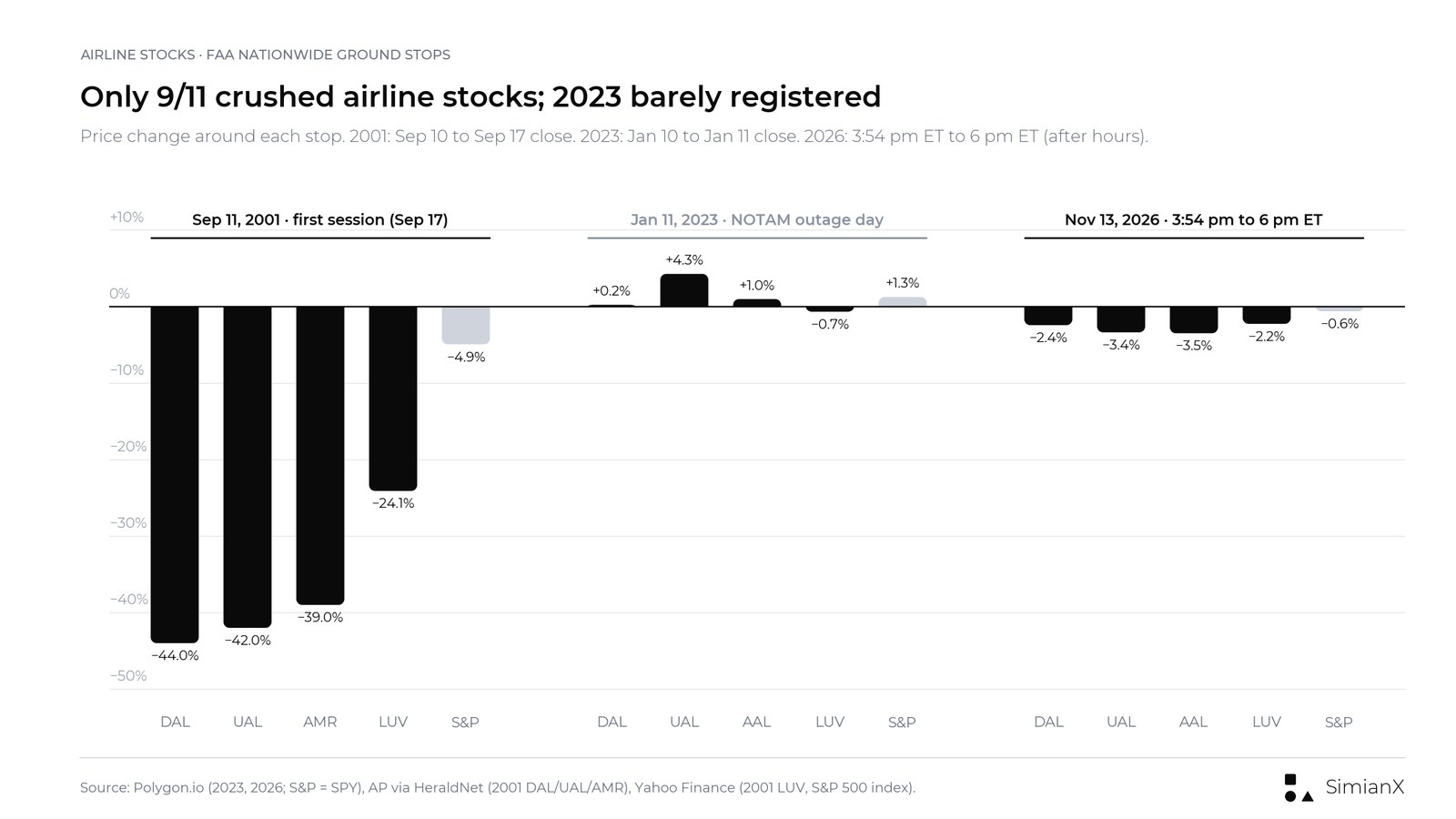
Reaction table
All figures are price changes. 2023 and 2026 use Polygon.io daily and minute closes; the S&P 500 is tracked through the SPY ETF in those years. 2001 airline figures are AP closing figures for Monday, September 17, 2001, as published by HeraldNet; Southwest and the S&P 500 index for 2001 come from Yahoo Finance daily closes.
| Ticker | 2001: Sep 10 → Sep 17 close | 2023: Jan 10 → Jan 11 close | 2023: Jan 10 → Jan 13 close | 2026: Nov 12 → Nov 13 close | 2026: 3:54 p.m. → 6:00 p.m. ET (after hours) |
|---|---|---|---|---|---|
| DAL | −44% | +0.24% | +0.29% | −0.35% | −2.42% |
| UAL | −42% | +4.28% | +12.90% | −1.74% | −3.36% |
| AAL (AMR in 2001) | −39% | +0.99% | +12.05% | −1.05% | −3.48% |
| LUV | −24.1% | −0.66% | +2.15% | −0.64% | −2.25% |
| JETS (ETF) | n/a (launched 2015) | +0.36% | +5.16% | −0.69% | −2.64% |
| S&P 500 | −4.92% (index) | +1.26% (SPY) | +2.03% (SPY) | −0.36% (SPY) | −0.60% (SPY) |
How to read the 2026 columns:
- Nov 12 → Nov 13 close is the full Friday session. Almost all of it happened before the ground stop, which began at 3:54 p.m. ET, six minutes before the 4:00 p.m. close. Treat it as background, not as the reaction.
- 3:54 p.m. → 6:00 p.m. ET combines the last six minutes of the regular session and two hours of after-hours trading. Delta went from $86.80 to $84.70, United from $110.99 to $107.26, American from $13.375 to $12.91, Southwest from $45.27 to $44.25 and JETS from $29.055 to $28.29. Most of the drop came after the close: from the 4:00 p.m. close to 6:00 p.m., DAL was −1.80%, UAL −1.88%, AAL −1.97%, LUV −1.54% and JETS −1.91%.
- After-hours prices are thin. Fewer shares trade outside the 9:30 a.m. to 4:00 p.m. ET session, so prints can move more than they would in regular hours. See our guide to US stock market hours, including pre-market and after-hours sessions.
- The first full-session reaction is Monday, November 16, 2026. We will add that column once the session closes.
Alaska Air (ALK), which is not in the main table, fell 1.21% from 3:54 p.m. to 6:00 p.m. ET on the same data.
What the three events have in common, and what they don't
The 2001 drop is the outlier, and it was not about the ground stop. Airline shares fell 24% to 52% on September 17, 2001 (US Airways Group lost 52%, per the same AP report) because the attacks changed the business itself: carriers announced deep schedule cuts, insurers repriced risk and air travel demand fell for months. The Dow Jones Transportation Average fell 15% that day and the S&P 500 lost 4.9%, per The Daily Record. The ground stop was a symptom of the shock, not the shock.
The 2023 stop is the opposite case. It was a technical failure, it was over before the 9:30 a.m. opening bell, and the FAA ruled out a cyberattack within days. Airline stocks rose on the day. Over the next two sessions UAL and AAL gained more than 12%, but other news was in play: December CPI data came out on January 12, 2023, and Delta reported quarterly results on January 13. The rally cannot be credited to the ground stop.
The 2026 stop sits in between on what is known. Like 2023, the stated cause is technical, and officials have said there is no sign of an attack so far. Unlike 2023, it started in the afternoon, at the edge of the trading day and on a Friday ahead of a busy travel period, and its duration and cause were still open when markets closed. That uncertainty is what after-hours prices were trading on.
Why the market cares about how long a ground stop lasts
For an airline, a ground stop costs money in a few direct ways. Aircraft and crews end up in the wrong cities. Crews can reach their legal duty-time limits, which forces more cancellations later, a risk CNBC flagged on Friday. Passengers need rebooking, and under US Department of Transportation rules, travellers are owed a refund when an airline cancels a flight and they choose not to travel. The DOT explains the rules on its refunds page.
A two-hour pause early in the morning, as in 2023, can mostly be absorbed within a day. A stop that runs into the evening touches more flights and lasts into the next day's schedule. That is why the two facts that matter most for the next update are the official lift time and the final cause.
None of this is a forecast. Three events are too few for statistics, and each one had a different cause, a different time of day and a different news backdrop. The table records what prices did; it does not say what they will do.
How we built this page
- Event facts come from FAA statements, the 9/11 Commission Report, congressional testimony, and major press (CNBC, CBS News, ABC News, NPR, Global News, AP). When sources disagree, as on the 2023 lift time or the 2026 "until 10 p.m." wording, we say so.
- 2023 and 2026 prices come from Polygon.io daily and one-minute bars. The 6:00 p.m. ET figure for 2026 is the last after-hours print at or before 6:00 p.m. (Southwest 5:56 p.m., JETS 5:57 p.m.).
- 2001 prices are AP closing figures for Delta, UAL Corp. and AMR Corp., and Yahoo Finance daily closes for Southwest and the S&P 500 index. The JETS ETF did not exist until 2015. Reported percentages for UAL differ slightly between AP versions (42% and nearly 43%).
- What we have not done: we have not guessed at the 2026 cause. Officials have described a telecommunications outage, the TSA was still investigating, per CBS News, and the FAA had not published a root cause.
FAQ
Is there a nationwide ground stop right now?
No. The FAA's nationwide ground stop of Friday, November 13, 2026 began at 3:54 p.m. ET and was lifted at 8:15 p.m. ET (5:15 p.m. PT), about 4 hours 21 minutes later. Recovery is slow: thousands of flights were still cancelled or delayed that night, and Duffy said the restart would take time. Check your airline for your flight and FAA NAS Status for airport delays.
How many times has the FAA grounded all flights?
Three nationwide ground stops are on record: September 11, 2001, after the terrorist attacks, when the FAA also ordered every airborne aircraft to land; January 11, 2023, after the NOTAM system outage; and November 13, 2026, after a telecommunications outage affected Air Route Traffic Control Centers. Airline-specific stops, such as those during the July 19, 2024 CrowdStrike outage, are not nationwide.
What happened to airline stocks after a nationwide ground stop?
It depended on the cause. After 9/11, airline shares fell between 24% and 52% on the first trading day, September 17, 2001. On January 11, 2023, DAL, UAL and AAL rose and LUV slipped 0.66%. On November 13, 2026, airline shares fell 2.2% to 3.5% between 3:54 p.m. ET and 6:00 p.m. ET, mostly in after-hours trading. The first full session after the 2026 stop is Monday, November 16.
Why did the FAA stop flights on November 13, 2026?
The FAA cited a "temporary telecommunications outage" and communication issues affecting Air Route Traffic Control Centers, and said the stop was for "reasons of safety." Homeland Security Secretary Markwayne Mullin said there was no indication "as of yet" of a nefarious act. The root cause had not been published at the time of writing.
How long did the 2023 ground stop last?
The FAA ordered the pause before 7:15 a.m. ET on January 11, 2023, and said the stop "has been lifted" in its 8:50 a.m. ET statement. Some outlets put the lift just after 9 a.m. Cancellations and delays ran through the day.
Were stock markets closed during these ground stops?
Only in 2001. US stock markets did not open on September 11, 2001 and reopened on September 17. In 2023, the stop ended before the opening bell. In 2026, it began six minutes before the close. For scheduled closures, see our list of 2027 stock market holidays.
Related reading
- 9/11 & Early War on Terror: S&P 500 −14%, 4-Month Recovery
- VIX spikes history: every major spike since 1990
- Iran de-escalation 2026: oil down, travel stocks rally
- Thanksgiving week and the S&P 500, every year since 1950
- US stock market hours in your time zone, 2026–27
Want to watch how an airline stock trades into Monday's open? Start a live AI analysis on SimianX or browse more market reference stories.
This page is for information only and is not investment advice. Prices are as of 6:00 p.m. ET on November 13, 2026. Event details were updated on the evening of November 13, 2026 (ET).
References
- FAA NAS Status
- FAA NOTAM statements, January 2023
- 9/11 Commission Report, Chapter 1
- CNBC: FAA ground stop, Nov 13, 2026
- CBS News: FAA issues nationwide ground stop
- ABC News: FAA issues rare nationwide ground stop
- CNN live updates, Nov 13, 2026
- Axios: FAA nationwide ground stop
- Flightradar24 live blog
- NPR: FAA contractors deleted files, Jan 19, 2023
- US DOT: airline refunds
- NBC News live blog: FAA lifts ground stop, Nov 13, 2026
- AP via Yahoo News: FAA ground stop and FlightAware counts