
 By Muke
NVIDIA's First Report Without Jensen Huang: Q3 FY2027 Results, Margins, Cash and Commitments From the Filings
NVIDIA reported results for the third quarter of fiscal 2027 on November 17, 2026, six days after its board accepted Jensen Huang's resignation as president, chief executive officer and director. The quarter itself was the strongest in the company's history: revenue of $115.8 billion, up 103% from a year earlier, against a $108.0 billion guide. The harder questions sit elsewhere in the filings: who runs the company now, why the fourth-quarter gross margin guide fell to 71% to 72%, why only two-thirds of profit turned into free cash flow, and what $518 billion of commitments actually covers. In the first regular session after the report, on November 18, NVDA closed at $150.96, down 2.89% from its November 17 close of $155.46.
This page answers each of those from primary sources: the Form 8-K filings NVIDIA made with the SEC on November 12 and November 17, its CFO commentary and supplemental financial information, and two statements from its board. Where we calculate something, we say so. Where the filings are silent, we say that too.
NVIDIA's fiscal year ends in late January, so fiscal 2027 is not calendar 2027. Q3 FY2027 is the 13 weeks ended October 25, 2026. All dollar figures are U.S. dollars. This is research, not investment advice.
Nvidia Q3 FY2027 Results at a Glance
| Measure | Q3 FY2027 | Q2 FY2027 | Q3 FY2026 | Year over year |
|---|---|---|---|---|
| Revenue | $115.844B | $96.221B | $57.006B | +103% |
| Data Center revenue | $107.6B | $89.0B | $51.2B | +110% |
| Edge Computing revenue | $8.2B | $7.2B | $5.8B | +42% |
| GAAP gross margin | 74.8% | 75.0% | 73.4% | +1.4 pts |
| Non-GAAP gross margin | 74.9% | 75.0% | 73.5% | +1.4 pts |
| Non-GAAP operating income | $77.883B | $63.956B | $36.097B | +116% |
| GAAP net income | $65.287B | $59.688B | $31.910B | +105% |
| GAAP diluted EPS | $2.70 | $2.46 | $1.30 | +108% |
| Non-GAAP diluted EPS | $2.68 | $2.22 | $1.27 | +111% |
| Operating cash flow | $48.253B | $24.077B | $23.750B | +103% |
| Free cash flow | $43.777B | $21.341B | $22.089B | +98% |
| Returned to shareholders | $28.1B | — | — | — |
Source: NVIDIA Q3 FY2027 results release and CFO commentary, Form 8-K, November 17, 2026. Non-GAAP figures include stock-based compensation from fiscal 2027 on; prior periods are shown on that restated basis, which is why Q3 FY2026 non-GAAP EPS reads $1.27 here against the $1.30 first reported.
Within Data Center, the Hyperscale platform brought in $60.1 billion (+71% year over year) and AI Clouds, Industrial and Enterprise $47.5 billion (+195%). NVIDIA said both were driven by the Rubin ramp, "our fastest architecture ramp ever", standalone Vera CPUs and Blackwell Ultra. Against the analyst consensus, non-GAAP EPS of $2.68 compared with $2.49 (Zacks consensus of 14 estimates, high $2.70, low $2.34, as shown on Nasdaq.com), a beat of $0.19 or 7.6%.
Results vs Guidance: How Nvidia Beat the $108 Billion Guide
On August 26, NVIDIA guided Q3 to $108.0 billion of revenue, plus or minus 2%, and said it was not assuming any Data Center compute revenue from China. Revenue and both gross margins landed above the top of their ranges.
| Item | Guidance (Aug 26, 2026) | Reported (Nov 17, 2026) | Result |
|---|---|---|---|
| Revenue | $108.0B ±2% ($105.84B to $110.16B) | $115.844B | $5.68B above the top of the range |
| GAAP gross margin | 74.0% ±50 bp | 74.8% | Above the range |
| Non-GAAP gross margin | 74.0% ±50 bp | 74.9% | Above the range |
| GAAP operating expenses | About $9.2B | $9.156B | In line |
| Non-GAAP operating expenses | About $9.0B | $8.841B | Below |
| China Data Center compute | None assumed | $2.4B of Hopper shipments to China | Not in the guide |
| Tax rate | 16% to 18% (full year) | 17.4% GAAP, 17.0% non-GAAP | Within |
Source: Q2 FY2027 results release (outlook) and the Q3 FY2027 release and CFO commentary.
The China line matters for reading the beat. Revenue exceeded the guidance midpoint by $7.844 billion (+7.3%). The CFO commentary says "shipments of Data Center Hopper products to China during the quarter were $2.4 billion", revenue the guide had explicitly left out. Take that out and the remaining excess is still $5.444 billion, or 5.0% above the midpoint ($115.844B − $108.0B − $2.4B, our calculation). The beat was not a China windfall. Most of it came from the products NVIDIA credits for the quarter's growth: the Rubin ramp, Vera CPUs and Blackwell Ultra.
Two caveats. First, this is a mechanical subtraction, not a counterfactual: product mix and shipment timing would have differed without China. Second, NVIDIA's geographic disclosure, which assigns revenue by the location of the direct customer's headquarters, showed $11.05 billion from China including Hong Kong in Q3 against $2.97 billion a year earlier. That line includes Edge Computing, and NVIDIA notes that the end customer and shipping location can differ from the headquarters location, so it is not the same thing as the $2.4 billion Hopper figure.
Guidance vs actual: seven straight revenue beats
| Quarter | Reported | Guidance midpoint | Revenue | Above midpoint | Data Center |
|---|---|---|---|---|---|
| Q1 FY2026 | May 28, 2025 | $43.0B | $44.062B | +2.5% | $39.1B |
| Q2 FY2026 | Aug 27, 2025 | $45.0B | $46.743B | +3.9% | $41.1B |
| Q3 FY2026 | Nov 19, 2025 | $54.0B | $57.006B | +5.6% | $51.2B |
| Q4 FY2026 | Feb 25, 2026 | $65.0B | $68.127B | +4.8% | $62.3B |
| Q1 FY2027 | May 20, 2026 | $78.0B | $81.615B | +4.6% | $75.2B |
| Q2 FY2027 | Aug 26, 2026 | $91.0B | $96.221B | +5.7% | $89.0B |
| Q3 FY2027 | Nov 17, 2026 | $108.0B | $115.844B | +7.3% | $107.6B |
| Q4 FY2027 | Late Feb 2027 (expected) | $130.0B (±3%) | Pending | — | — |
Source: NVIDIA quarterly results releases on SEC EDGAR (Q1 FY26, Q2 FY26, Q3 FY26, Q4 FY26, Q1 FY27, Q2 and Q3 FY27 above). Guidance midpoint = the revenue outlook in the prior quarter's release. Percentages are our calculation.
Q3 was the widest beat of the seven quarters, and NVIDIA has not missed its own midpoint in that run. The Q2 FY2026 guide had already absorbed an $8.0 billion loss of H20 revenue after U.S. export licensing rules changed. For every quarter back to fiscal 2024, with EPS, margins and the next-day stock move, see our Nvidia earnings by quarter reference.
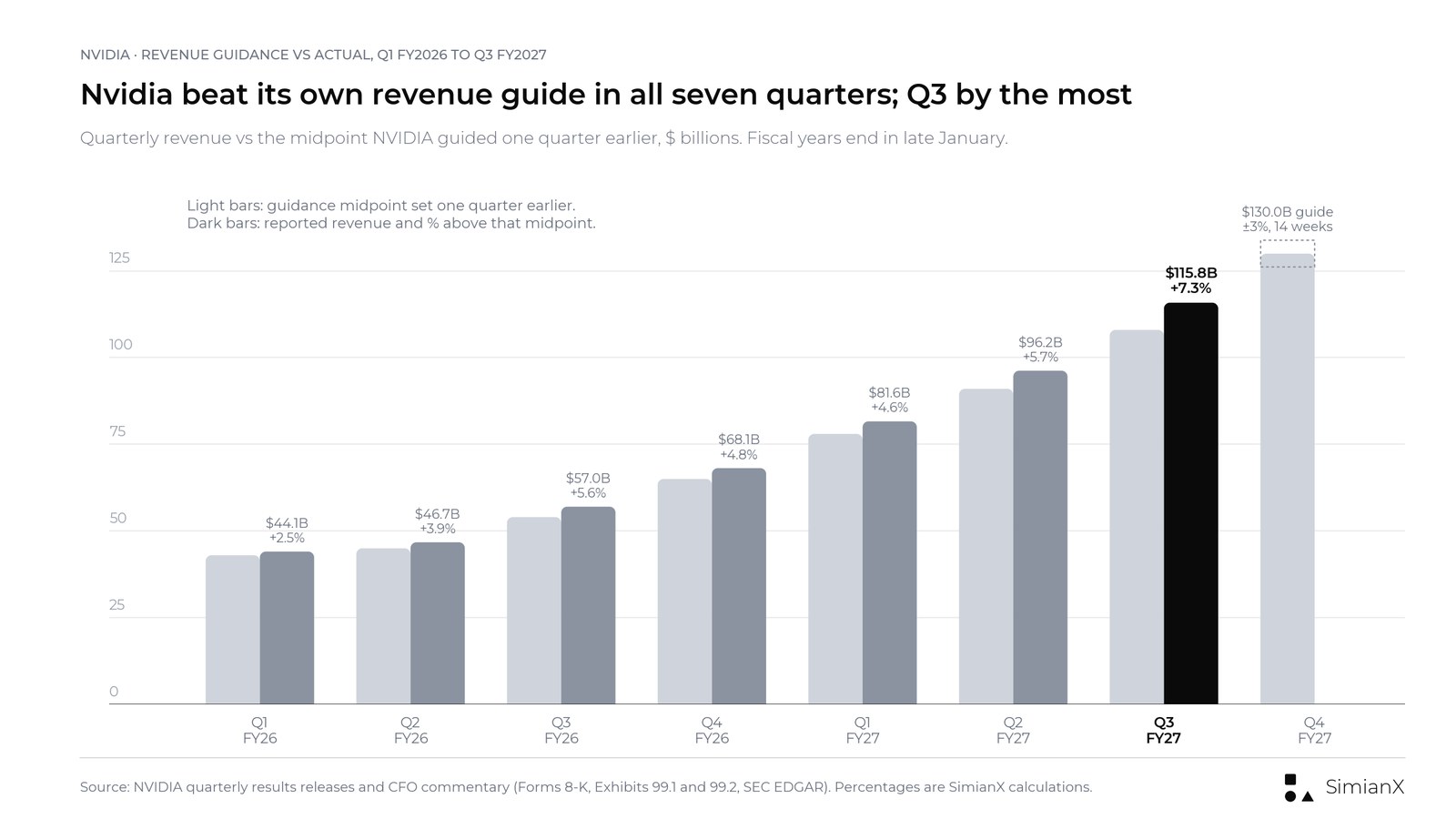
NVIDIA has beaten the midpoint of its own revenue guide in each of the last seven quarters; the 7.3% beat in Q3 FY2027 was the widest.
Who Runs Nvidia Now? The Leadership Change From Primary Filings
The leadership change is documented in five NVIDIA disclosures. The table lists each one and what it says, and nothing beyond that.
| Date (2026) | Source | What NVIDIA disclosed |
|---|---|---|
| Sun, Nov 8 | Statement from the NVIDIA Board of Directors | The board is "initiating an independent investigation in light of recent reporting that founder and CEO Jensen Huang has been the target of a foreign intelligence effort." A committee of independent directors, assisted by outside counsel, oversees it. The board said it had "no reason to believe that either national security or NVIDIA secrets were compromised", that Huang "fully supports the review", and that it "has confidence in Jensen". |
| Wed, Nov 11 | Form 8-K, Item 5.02 (filed Nov 12) | The board "accepted the resignation of Jen-Hsun Huang, as NVIDIA's President, Chief Executive Officer and member of the Board, effective immediately." It appointed CFO Colette M. Kress, 59, as interim CEO while it searches for a new one; she stays CFO. Harvey C. Jones, 73, a director since 1993, became Chair of the Board. |
| Thu, Nov 12, 8:48 a.m. ET | Press release (8-K Exhibit 99.1) | "Jensen Huang Resigns." Jones is the company's "first-ever Chair". The search "will consider internal and external candidates". The board expects "operations, customer commitments and product roadmap to continue without interruption." Q3 reporting date unchanged. |
| Tue, Nov 17, before the open | Board committee release | New standing National Security and Export Control Oversight Committee, chaired by Suzanne Nora Johnson with Stephen C. Neal and John O. Dabiri. NVIDIA's National Security Team and Global Trade Compliance Team report to it and to interim CEO Kress. |
| Tue, Nov 17, 4:20 p.m. ET | Form 8-K, Item 2.02 | Q3 results, signed by Kress as interim CEO and CFO. The forward-looking statements list "the ongoing investigation by an independent committee of NVIDIA's board of directors" and "the search for a new chief executive officer". |
So the answer to "who runs Nvidia now" is, per the filings: Colette Kress, as interim CEO and CFO at the same time, under a newly created independent Chair, Harvey Jones, while the board searches internally and externally for a permanent CEO. Kress has been CFO since September 2013; the Q3 release quotes her saying "our roadmap is on track".
Three days separate the board's November 8 statement of confidence in Huang from its acceptance of his resignation on November 11. Neither document connects the two events.
What the filings do not say
Read precisely, NVIDIA's disclosures leave several things open:
- No reason for the resignation. The 8-K and the press release do not say why Huang resigned. They do not link it to the investigation.
- No finding. The investigation is described as "ongoing" in the November 17 materials. No conclusion has been disclosed.
- No separation terms. The Item 5.02 filing does not describe any separation or compensation arrangement for Huang.
- No search timetable. The board has not said when it expects to name a permanent CEO.
Press coverage since November 12 has carried further reports about the circumstances of the resignation and about Huang's future role. None of that appears in NVIDIA's filings or releases as of November 17, and this article does not rely on it. If the company discloses more, it will most likely come through another Form 8-K or the Q3 Form 10-Q, which the CFO commentary says will be filed "in the coming weeks".
How unusual is this? Many large-cap CEO changes are announced months ahead, with a named successor and a set effective date; Apple's handover from Tim Cook to John Ternus, documented in Apple CEO History: Tim Cook to John Ternus, AAPL Reactions, followed that pattern. NVIDIA's came with immediate effect, an interim CEO who keeps her CFO job, and an open internal and external search, which leaves more open questions than a planned handover.
NVDA Stock Through the Leadership Change
The share price moved on the leadership news well before the results. From the last close before the board's November 8 statement to the close before the Q3 release, NVDA fell 16.7%. The Nasdaq-100 ETF (QQQ) was flat over the same seven sessions.
| Session (2026) | Event | NVDA close | NVDA | QQQ | SPY | NVDA volume |
|---|---|---|---|---|---|---|
| Fri, Nov 6 | Last close before the board statement | $186.64 | +2.78% | +1.40% | +0.31% | 180.2M |
| Mon, Nov 9 | First session after the Nov 8 statement | $178.67 | −4.27% | +3.54% | +2.37% | 462.7M |
| Tue, Nov 10 | — | $168.89 | −5.47% | −0.68% | −0.37% | 429.3M |
| Wed, Nov 11 | Resignation accepted (disclosed the next morning) | $173.73 | +2.87% | +2.31% | +1.32% | 339.2M |
| Thu, Nov 12 | CEO change announced 8:48 a.m. ET; opened $151.005 (−13.1%), low $148.80 (−14.3%) | $166.19 | −4.34% | −0.32% | −0.35% | 747.7M |
| Fri, Nov 13 | — | $162.85 | −2.01% | −1.20% | −0.36% | 365.8M |
| Mon, Nov 16 | — | $156.14 | −4.12% | −2.67% | −1.91% | 333.8M |
| Tue, Nov 17 | Committee announced before the open; results after the close | $155.46 | −0.44% | −0.73% | −1.01% | 407.0M |
| Wed, Nov 18 | First regular session after the Q3 release | $150.96 | −2.89% | +0.39% | −0.31% | 340.3M |
| Nov 6 to Nov 17 | Seven sessions | — | −16.71% | +0.13% | −0.39% | — |
Source: Nasdaq.com historical prices for NVDA, QQQ and SPY, cross-checked against Cboe official closes through November 16 and the Cboe quote for the November 17 close ($155.46 on both). The November 18 row is Cboe's official close and session data, cross-checked against the Yahoo Finance daily bar. The summary row covers the seven sessions before the release. Percentages are our calculation.
Three readings stand out. On November 9 NVDA fell 4.3% while QQQ rose 3.5%, a 7.8-point gap on a day the wider market rallied. On November 12 the stock opened 13.1% lower on the CEO news, touched $148.80, and recovered to close down 4.3% on 747.7 million shares, about seven times its average daily volume over the 20 sessions to November 4 (about 104 million). And the November 17 close of $155.46 was the lowest since July 1, 2025, 35.0% below the record close of $239.24 on October 6, 2026, and 16.6% below the 2025 year-end close of $186.50.
This came on top of the November 5 chip selloff, when NVDA fell 9.3% with the semiconductor group; that day is covered in our Nvidia earnings-by-quarter page, and the longer history in Semiconductor Bear Markets: Every SOX Crash, 1995–2026.
After the release (after-hours, not a close). NVDA's last after-hours trade on November 17 was $162.94 at 8:00 p.m. ET, 4.8% above the $155.46 regular-session close (our calculation; Nasdaq.com's own after-hours page computes its change from the November 16 close). After-hours trading ranged from $153.72 at 4:13 p.m. to $163.86 at 6:14 p.m. ET on 77.6 million shares, per Nasdaq.com. Every earlier first-day move is in NVDA After Earnings: Every Reaction Since 2016 in One Table.
The first regular session (November 18). NVDA opened at $159.21, +2.41% against the November 17 close, traded between $150.40 and $159.70, and closed at $150.96, a loss of 2.89%, on 340.3 million shares. On the same day QQQ moved +0.39% and SPY −0.31%. One session is the market's first reading of the report, not a verdict on it.
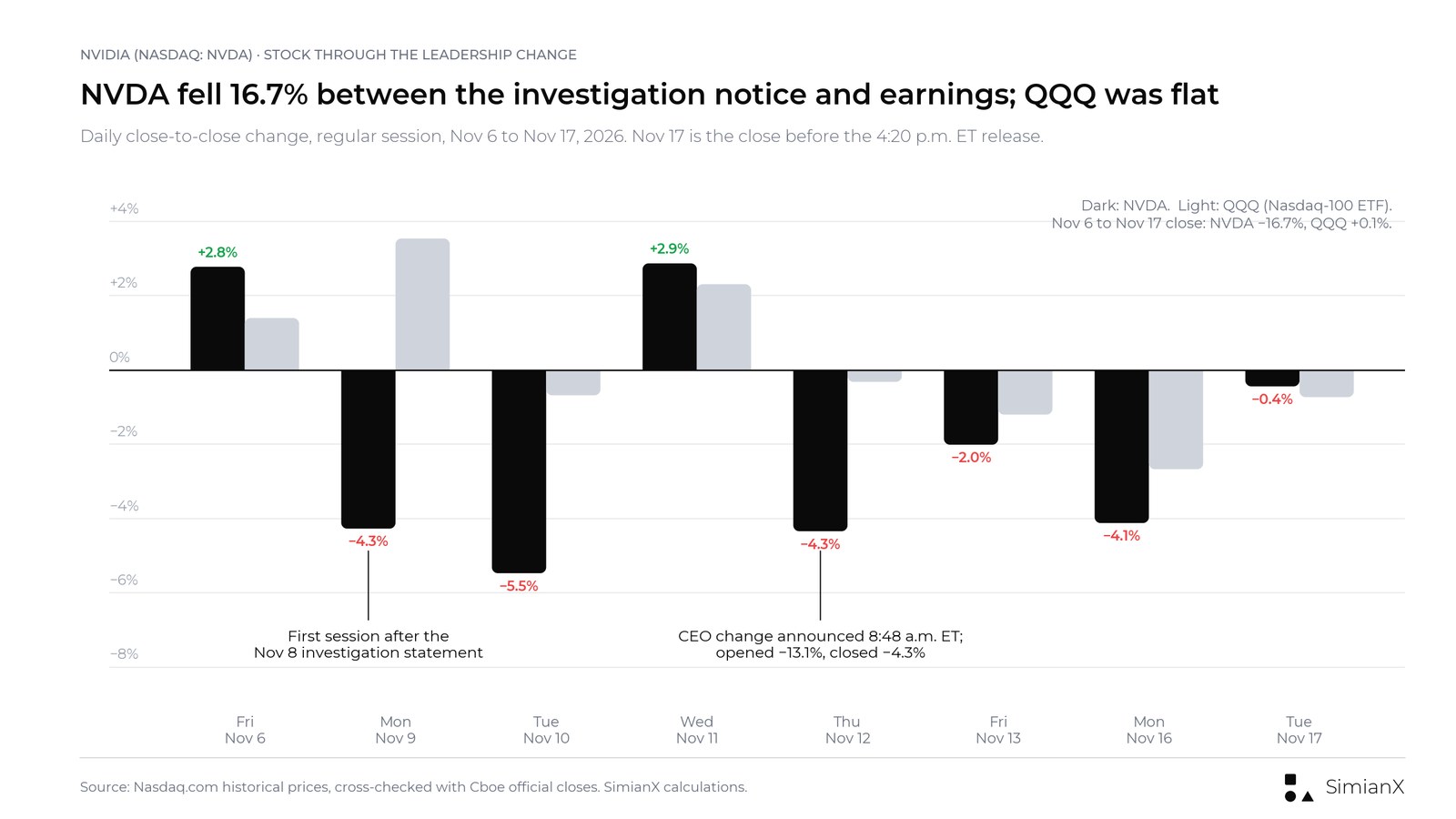
NVDA fell in six of the seven sessions between the board's investigation statement and the Q3 release, while QQQ ended the stretch flat.
Why Did Nvidia's Gross Margin Guidance Fall?
The fourth-quarter outlook is where the results turn more complicated.
| Q4 FY2027 outlook (Nov 17, 2026) | Guidance |
|---|---|
| Revenue | $130.0B, plus or minus 3% ($126.1B to $133.9B) |
| China | No Data Center compute revenue from China assumed |
| GAAP and non-GAAP gross margin | 71.0% to 72.0% |
| Operating expenses | About $11.0B GAAP, $10.7B non-GAAP |
| Tax rate (full year) | 16.0% to 18.0% |
| Calendar | Includes an additional week (14-week quarter) |
Source: Q3 FY2027 results release and CFO commentary.
The 71.5% midpoint would be 3.4 points below Q3's 74.9% non-GAAP gross margin and the lowest since the first quarter of fiscal 2026. The guidance range is also wider than usual, at ±3% instead of the ±2% NVIDIA gave in each of the previous seven quarters.
NVIDIA's written materials do not give a separate reason for the Q4 margin range. For Q3, the CFO commentary attributes the slight sequential dip (75.0% to 74.9% non-GAAP) to "the initial Rubin ramp". It also shows inventory provisions of $680 million in Q3 cost of revenue and supply commitments that rose "primarily related to the multi-year procurement of memory supply". Our reading, which is an inference and not a company statement, is that a fuller Rubin ramp in Q4 carries the same early-production costs at much higher volume. The earnings call may have added detail; we do not quote it here.
There is a precedent. During the Blackwell ramp, non-GAAP gross margin went from 75.0% in Q3 FY2025 to 73.5% in Q4 FY2025 and 71.3% in Q1 FY2026, excluding a $4.5 billion H20 inventory charge that took the reported figure to 61.0%. It was back to 75.2% by Q4 FY2026, three quarters after the low. The Q4 FY2027 guide lands almost exactly on that Blackwell-ramp low. Whether the Rubin cycle recovers on the same timetable is the main margin question for fiscal 2028.
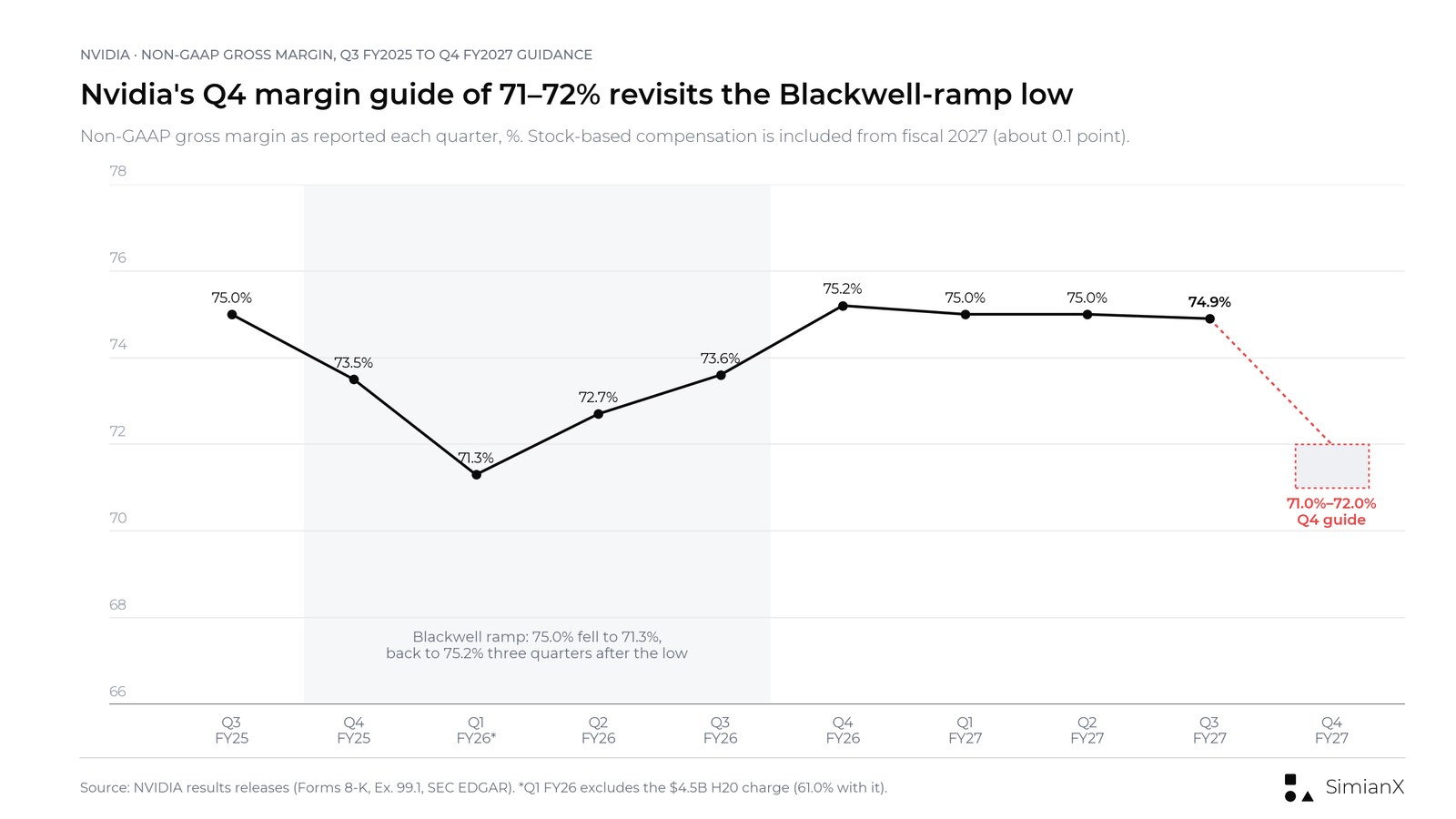
The Q4 FY2027 margin guide returns to the level of the Blackwell-ramp low in Q1 FY2026; margins then took three quarters to recover above 75%.
The extra week: what the $130 billion guide really implies
Fiscal 2027 is a 53-week year. NVIDIA's Q2 FY2027 Form 10-Q states that "the fourth quarter of fiscal year 2027 will be a 14-week quarter". Comparing a 14-week quarter with a 13-week one flatters growth.
| Measure | Q3 FY2027 (reported) | Q4 FY2027 (guide midpoint) | Change |
|---|---|---|---|
| Revenue | $115.844B | $130.0B | +12.2% |
| Weeks | 13 | 14 | +1 |
| Revenue per week | $8.911B | $9.286B | +4.2% |
| Non-GAAP gross margin | 74.9% | 71.5% | −3.4 pts |
| Non-GAAP gross profit | $86.724B | about $92.95B | +7.2% |
| Non-GAAP operating expenses | $8.841B | about $10.7B | +21.0% |
| Non-GAAP operating income | $77.883B | about $82.25B (implied) | +5.6% |
| Non-GAAP operating income per week | $5.991B | about $5.875B | −1.9% |
Q4 gross profit and operating income are our calculations from the guidance midpoints ($130.0B × 71.5% − $10.7B), not company forecasts. Per-week figures assume shipments spread evenly across weeks, which they do not.
On a per-week basis, the guide implies revenue growth of about 4% and slightly lower operating income per week than in Q3. At the bottom of the range ($126.1B), revenue per week would be just 1.1% above Q3's. That is still an enormous quarter, but it is a slower one than the 12% headline suggests.
Cash Conversion: $43.8 Billion of Free Cash Flow on $65.3 Billion of Net Income
Free cash flow, as NVIDIA defines it, is operating cash flow minus purchases of property, equipment and intangible assets and principal payments on them. In Q3 that was $48.253 billion − $4.422 billion − $0.054 billion = $43.777 billion, 67.1% of GAAP net income.
| Period | GAAP net income | Non-GAAP net income | Operating cash flow | Free cash flow | FCF ÷ non-GAAP net income |
|---|---|---|---|---|---|
| Q3 FY2026 | $31.910B | $30.979B | $23.750B | $22.089B | 71.3% |
| Q2 FY2027 | $59.688B | $53.954B | $24.077B | $21.341B | 39.6% |
| Q3 FY2027 | $65.287B | $64.870B | $48.253B | $43.777B | 67.5% |
| 9 months FY2026 | $77.107B | $74.836B | $66.530B | $61.675B | 82.4% |
| 9 months FY2027 | $183.297B | $164.374B | $122.675B | $113.672B | 69.2% |
Source: Q3 FY2027 results release, reconciliation of GAAP to non-GAAP measures, and Supplemental Financial Information (8-K Exhibit 99.3). Ratios are our calculation. We use non-GAAP net income as the denominator because GAAP net income includes large gains on equity securities ($25.5 billion in the first nine months of fiscal 2027).
Single quarters are noisy: the CFO commentary says the sequential jump in Q3 operating cash flow "was also impacted by the timing of federal cash tax payments". The nine-month view is cleaner, and it shows conversion falling from 82% to 69% year over year. The cause is working capital:
- Receivables. Accounts receivable rose $18.1 billion in Q3 and $42.6 billion in nine months, to $81.0 billion. Days sales outstanding rose to 64 from 60 a quarter earlier, which NVIDIA attributes to "shipment linearity from our Rubin launch and extended payment terms on large, multi-quarter agreements with certain investment-grade customers". Two direct customers accounted for 18% and 17% of receivables.
- Inventory. Inventory rose $8.1 billion in Q3 to $39.7 billion "to support our Rubin product ramp": $15.8 billion of raw materials, $17.8 billion of work in process and $6.2 billion of finished goods.
- Offsets. Payables and accrued liabilities rose, which added back about $6.6 billion in Q3 together with other items.
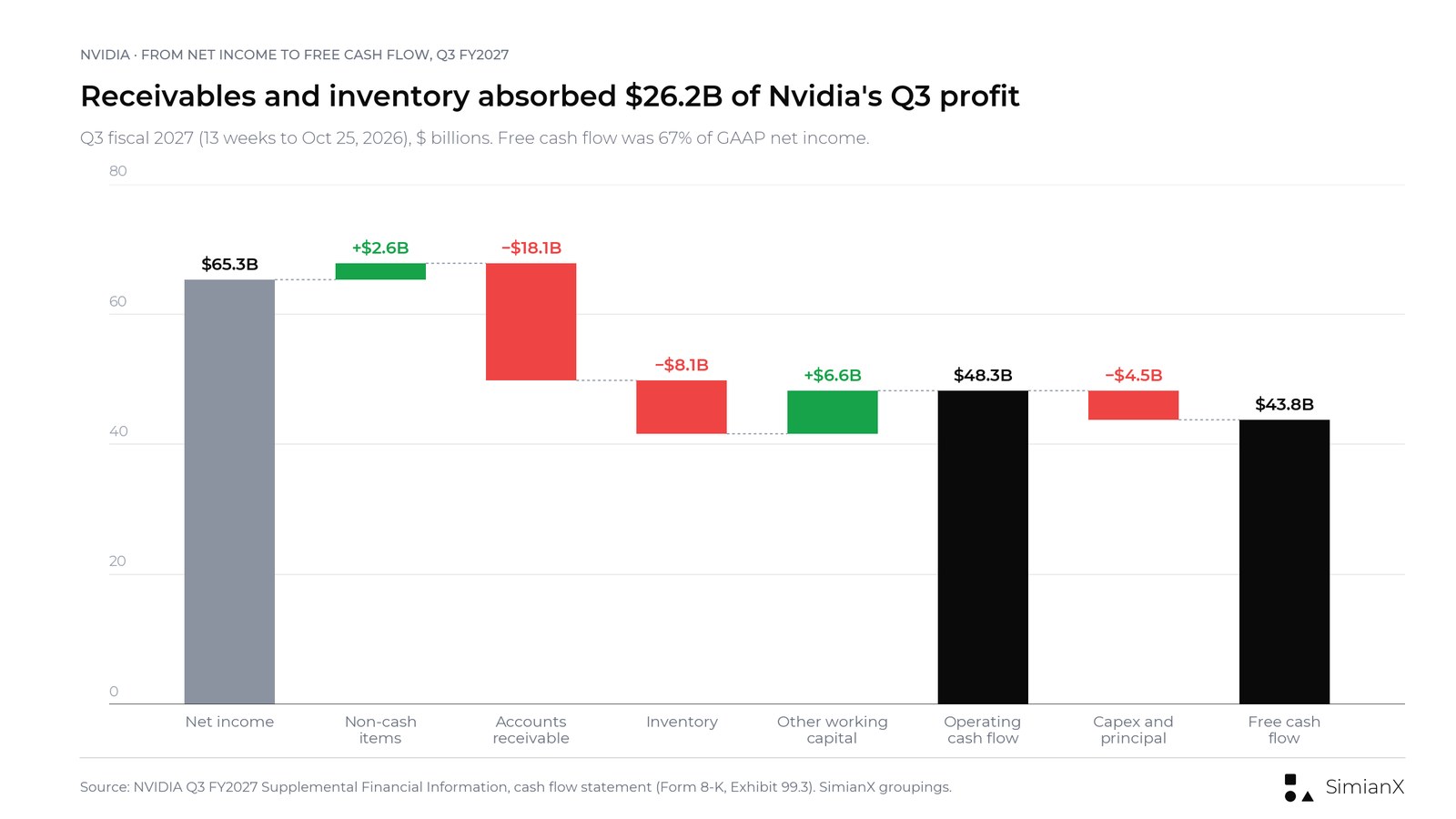
Receivables and inventory together absorbed $26.2 billion of Q3 profit before capital spending.
Extended payment terms for investment-grade customers are a commercial choice, not evidence of bad debt, and a launch quarter skews shipments late in the period. But they mean revenue is running ahead of cash. In Q3 NVIDIA also spent heavily outside the free-cash-flow definition: $22.1 billion on buybacks, $6.0 billion on dividends, $15.7 billion on equity securities and $2.7 billion on acquisitions, together $46.6 billion, more than the quarter's $43.8 billion of free cash flow. Cash, cash equivalents and marketable debt securities fell to $53.5 billion from $56.6 billion a quarter earlier. Long-term debt stood at $32.4 billion, up from $7.5 billion in January after $24.9 billion of issuance earlier in the year, and NVIDIA repaid $1.0 billion of notes in Q3. The board added $150 billion to the buyback authorization in September; $227.3 billion remains, which NVIDIA plans to use through fiscal 2028.
Nvidia's $518 Billion of Commitments, Line by Line
The CFO commentary lists three different kinds of obligation. They have different triggers and different timing, and adding them into one "debt" number would be wrong. Here is each one as disclosed, with the prior quarter for comparison.
| Category | Jul 26, 2026 | Oct 25, 2026 | What it is |
|---|---|---|---|
| Supply and capacity | $279B | $390B | Purchase commitments, mainly multi-year memory supply |
| Data center leases not commenced | $25B | $74B | Leases of up to 20 years starting between Q4 FY2027 and FY2033; some may be assigned to third parties |
| Cloud service agreements | $29B | $28B | Cloud capacity NVIDIA buys for its own R&D |
| Equity investments | $25B | $20B | Committed investments in frontier labs, infrastructure financiers and other private companies |
| Capital expenditures | $8B | $6B | NVIDIA's own capex commitments |
| Commitments subtotal (as reported) | $366B | $518B | Contractual commitments |
| Leases to be reassigned to third parties | $20B | Not listed separately | Shown in Q2 as an "additional commitment" |
| Neocloud agreements (formerly "AI cloud agreements") | $36B | $32B | Conditional: effective only if neoclouds secure financing and NVIDIA accepts deployed capacity |
| Guarantees, maximum gross exposure | $108.5B | $118.0B | Contingent: payable only if partners default |
Source: Q3 FY2027 CFO commentary and Q2 FY2027 CFO commentary, 8-K Exhibit 99.2. NVIDIA's own comparison counts the $20 billion of third-party leases in Q2: it says cloud service agreements and data center leases together rose from $74 billion to $102 billion.
The subtotal rose $152 billion in one quarter, $111 billion of it in supply and capacity; about $20 billion of the rise in leases appears to reflect the third-party leases that Q2 listed separately.
The schedule matters as much as the size. Of the $518 billion, $82 billion falls in the remainder of fiscal 2027 and $222 billion in fiscal 2028, of which $203 billion is supply and capacity. For scale, NVIDIA's cost of revenue over the last four reported quarters was $90.7 billion (our calculation from the releases), so the fiscal 2028 supply commitment alone is about 2.2 times a year of current cost of goods. A company signs commitments on that scale only if it plans for a much larger business, and purchase commitments are generally hard to unwind if demand falls short.
| Fiscal year | Supply and capacity | Cloud services | Leases not commenced | Equity investments | Capex | Total | Neocloud (conditional) |
|---|---|---|---|---|---|---|---|
| Rest of FY2027 | $69B | $2B | — | $5B | $6B | $82B | — |
| FY2028 | $203B | $7B | $1B | $11B | — | $222B | $6B |
| FY2029 | $92B | $7B | $2B | $2B | — | $103B | $7B |
| FY2030 | $10B | $6B | $4B | $2B | — | $22B | $6B |
| FY2031 | $8B | $4B | $4B | — | — | $16B | $5B |
| FY2032 and later | $8B | $2B | $63B | — | — | $73B | $8B |
| Total | $390B | $28B | $74B | $20B | $6B | $518B | $32B |
Source: Q3 FY2027 CFO commentary, future commitments by fiscal year as of October 25, 2026.
The $118 billion of guarantees breaks down into $105.0 billion of credit support for SB Energy's PORTS-Pike campus in Ohio (about 4.25 GW across nine buildings, to host NVIDIA infrastructure under 20-year leases to OpenAI), $9.5 billion of power and systems credit support, and $3.5 billion of land, power and shell guarantees for neoclouds. The SB Energy guarantees take effect building by building as each is ready for service, the first expected in fiscal 2029, and then decline as OpenAI pays rent. NVIDIA says it has made no payments under any guarantee to date. The investment loop behind these arrangements is examined in Is Jensen Huang Fueling an AI Bubble? Nvidia's Boom Examined, and one earlier neocloud deal in NVIDIA-IREN 2026: The $2.1B 5GW AI Factory Power Trade.
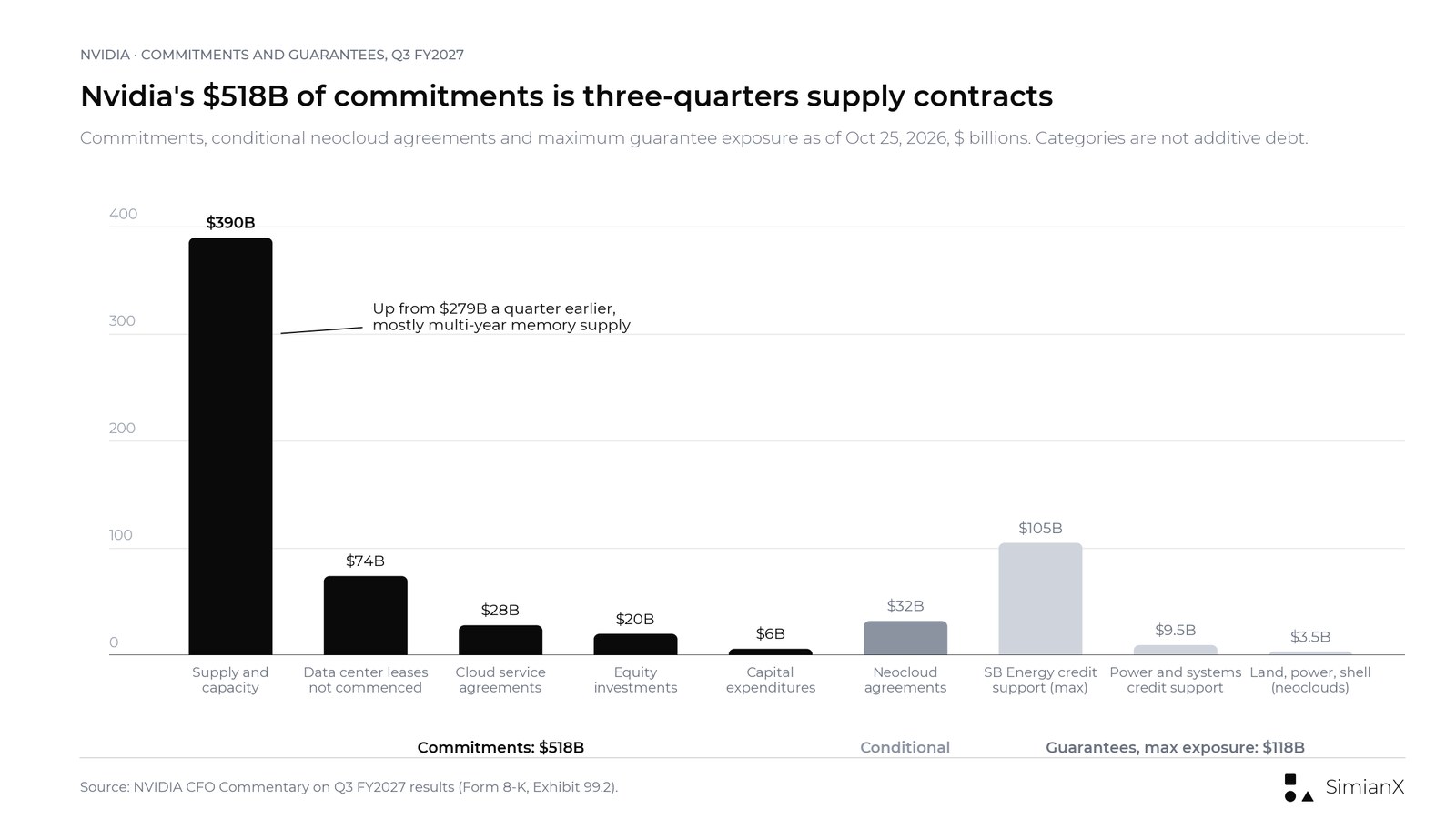
Supply and capacity contracts make up three-quarters of the $518 billion; conditional agreements and guarantees are separate and are not debt.
What the commitments are, and what they are not:
- A purchase commitment is an obligation to buy supply; it becomes inventory and cost of revenue as product ships. It is the largest item and the one most tied to the Rubin ramp. The suppliers named in NVIDIA's November 17 supply chain release include TSMC, Amkor, SPIL, Kinsus, Samsung Electro-Mechanics and Foxconn; why TSMC sits at the center is covered in TSMC Stock 2026: Record Q3 and Why Nvidia Can't Replace It.
- A lease not yet commenced is a future rent obligation, mostly after fiscal 2031.
- A neocloud agreement is conditional: NVIDIA says its commitments "take effect only if the neoclouds secure financing" and the capacity is "deployed, made operational, and accepted by us".
- A guarantee is a contingent liability. The $118 billion is a maximum, not an expected loss.
The fair question is not whether $518 billion is "too much", but how much of NVIDIA's own demand depends on customers it is helping to finance. The filings do not answer that. The Q3 Form 10-Q, when filed, is the next place to look for counterparties, conditions and maturities.
Hyperscaler Capex: What Nvidia's Biggest Customers Filed
Three direct customers each accounted for more than 10% of Q3 revenue (14%, 11% and 11%). NVIDIA does not name them. The largest cloud companies, several of which NVIDIA lists as Rubin partners, publish their own spending plans. Each company defines capital spending differently, so the figures below are not additive and not a proxy for NVIDIA revenue.
| Company | Latest quarter (to Sep 30, 2026) | 2026 outlook in the results release | Definition |
|---|---|---|---|
| Amazon | $77.3B purchases of property and equipment | About $220B of cash capital expenditures | 8-K Ex. 99.1, Oct 29, 2026 |
| Meta | $34.91B, including principal payments on finance leases | $135B to $145B, narrowed from $130B to $145B | 8-K Ex. 99.1, Oct 21, 2026 |
| Microsoft | $39.4B additions to property and equipment (fiscal Q1 2027) | Not stated in the release | 8-K Ex. 99.1, Oct 28, 2026 |
These plans support near-term demand for NVIDIA systems. They also raise the bar for those customers to show a return, which is the subject of AI Capex 2026: Big Tech Now Spends 96% of Its Cash Flow and, from the supplier side, AI Spending Surges: TSMC Outlook Confirms Nvidia Demand. NVIDIA also listed a pending agreement to acquire Hugging Face among its Q3 highlights; the deal history is in Nvidia's Biggest Deals: Hugging Face, Groq, Arm and Mellanox.
Governance: The Oversight Committee Is Not the Investigation
NVIDIA now has two separate board-level processes, and they answer different questions:
- The independent investigation (announced November 8) concerns the reporting about Huang. It is run by a committee of independent directors with outside counsel. It is described as ongoing and has reported no findings.
- The National Security and Export Control Oversight Committee (announced November 17) is a standing committee for national security policy, export control compliance and global trade risk. It meets at least quarterly and will retain outside experts. Chair Harvey Jones said the company has "both a responsibility and an opportunity to lead the industry" on these issues.
The second is a permanent governance structure; it does not resolve the first. Export controls already shape NVIDIA's numbers directly: the Q4 guide again assumes no Data Center compute revenue from China.
Bull, Base and Bear Cases for NVDA
These are qualitative frameworks, not forecasts or price targets.
| Scenario | What would support it | What it would mean |
|---|---|---|
| Bull | Q4 lands at or above $130B, margins recover toward 75% through fiscal 2028 as Blackwell's did, receivables convert to cash, and the board names a permanent CEO quickly | The leadership change proves to be a governance event, not an operating one |
| Base | Revenue stays strong, margins recover slowly, DSO stays elevated, and the CEO search runs for months | Growth continues, but the market demands more evidence each quarter |
| Bear | Rubin margins stay near 71%, collections lag, a financed customer struggles, or the investigation produces adverse findings | Operating, balance-sheet and governance risks reinforce each other |
The bull case does not need margins to stay at a permanent peak. The bear case does not follow automatically from a large commitment number. Both depend on evidence that has not been published yet.
What to Watch Next
- The first week after the report. NVDA fell 2.89% on November 18. In 36 of the 43 earlier reports with a complete window, the day-one direction still held four sessions later; the five-session window for this report closes on November 24.
- The Q3 Form 10-Q. Expected "in the coming weeks"; it should carry the full commitments and guarantees notes, legal proceedings and any subsequent events.
- The CEO search. Any appointment would be disclosed on a new Form 8-K, Item 5.02.
- The investigation. Any finding, or any statement that it has concluded.
- Q4 FY2027 results, around late February 2027. NVIDIA reported Q4 on February 25, 2026 and February 26, 2025. The test is $130.0 billion ±3% revenue and 71% to 72% gross margin in a 14-week quarter.
- Days sales outstanding. Whether 64 days falls back as the Rubin launch normalizes.
You can follow NVDA filings, price and news in one place on the NVDA stock page, or run a live multi-agent analysis when the next report lands. Our AI stock analysis tools apply the same guidance, margin and cash-flow checks to any company.
Frequently Asked Questions
Who is Nvidia's CEO now?
Colette Kress is interim CEO. She was appointed on November 11, 2026, after the board accepted Jensen Huang's resignation, and she remains executive vice president and CFO. Harvey C. Jones became the company's first Chair of the Board. The board is searching for a permanent CEO among internal and external candidates.
Why did Jensen Huang resign?
NVIDIA has not said. Its Form 8-K and press release state that the board accepted his resignation effective immediately, without giving a reason. Three days earlier, on November 8, the board had announced an independent investigation "in light of recent reporting that founder and CEO Jensen Huang has been the target of a foreign intelligence effort", and said it had no reason to believe national security or NVIDIA secrets were compromised. The November 17 materials describe that investigation as ongoing.
Did Nvidia beat earnings expectations in Q3 FY2027?
Yes. Revenue of $115.844 billion beat NVIDIA's own $108.0 billion guide by 7.3%, the widest beat in seven quarters, and non-GAAP EPS of $2.68 beat the $2.49 Zacks consensus shown on Nasdaq.com. Gross margin of 74.9% was above the 74.0% ±0.5-point guide.
What is Nvidia's Q4 FY2027 guidance?
Revenue of $130.0 billion, plus or minus 3%, with no Data Center compute revenue from China assumed; GAAP and non-GAAP gross margin of 71.0% to 72.0%; and operating expenses of about $11.0 billion GAAP and $10.7 billion non-GAAP. The quarter has 14 weeks instead of 13.
Why is Nvidia's gross margin guidance lower?
NVIDIA's written materials do not give a separate reason for the Q4 range. They attribute Q3's slight sequential dip to the initial Rubin ramp. During the Blackwell ramp, non-GAAP gross margin fell from 75.0% to 71.3% (excluding a $4.5 billion H20 charge) and recovered to 75.2% three quarters after the low.
How did NVDA stock react to the Q3 FY2027 report?
On November 18, the first regular session after the report, NVDA closed at $150.96, down 2.89% from the November 17 close of $155.46, which was set before the 4:20 p.m. ET release. QQQ moved +0.39% the same day. In after-hours trading on November 17, the last trade was $162.94 at 8:00 p.m. ET. Before the report, NVDA had fallen 16.7% from November 6 to November 17 while QQQ was flat.
Are Nvidia's $518 billion of commitments debt?
No. They are contractual commitments, mostly $390 billion of supply and capacity purchases, plus leases, cloud services, equity investments and capex. Separately, NVIDIA has $32 billion of conditional neocloud agreements and up to $118 billion of guarantee exposure, on which it says it has made no payments. NVIDIA's actual long-term debt was $32.4 billion at October 25, 2026.
When is Nvidia's next earnings date?
NVIDIA has not announced it. The company reported fourth-quarter results on February 25, 2026 and February 26, 2025, so late February 2027 is the likely window for Q4 FY2027.
Verdict: A Record Quarter, a Different Kind of Risk
The operating evidence in Q3 is strong. NVIDIA beat its own guide for a seventh straight quarter, by the widest margin yet, and most of the beat did not come from China. The risk has moved somewhere else. The company is run by an interim CEO who is also its CFO, under a newly created Chair, while an independent board committee looks into reporting that its founder was the target of a foreign intelligence effort. Its Q4 guide implies a margin dip similar to the Blackwell ramp, and, per week, only modest growth. Cash conversion has fallen to about 69% of non-GAAP profit as receivables and inventory build. And it has signed $518 billion of commitments, $222 billion of them due in fiscal 2028.
None of these settles the story on its own. The first session after the report, a −2.89% move on November 18, is the market's opening reading, not a conclusion. Together these points are the list to check against the next disclosures: the Q3 Form 10-Q, any 8-K on the CEO search or the investigation, and the Q4 report in February.
This article is financial research for information only. It is not personalized investment advice or a recommendation to buy or sell any security.
Related Reading
- Nvidia Earnings by Quarter: Q3 FY2027 Results vs Guidance
- NVDA After Earnings: Every Reaction Since 2016 in One Table
- Is Jensen Huang Fueling an AI Bubble? Nvidia’s Boom Examined
- Nvidia's Biggest Deals: Hugging Face, Groq, Arm and Mellanox
- AI Capex 2026: Big Tech Now Spends 96% of Its Cash Flow
- TSMC Stock 2026: Record Q3 and Why Nvidia Can't Replace It
- NVIDIA-IREN 2026: The $2.1B 5GW AI Factory Power Trade
- CoreWeave Stock 2026: $104B Backlog vs $35B Debt by Quarter
- Apple CEO History: Tim Cook to John Ternus, AAPL Reactions
- Semiconductor Bear Markets: Every SOX Crash, 1995–2026
- AI Spending Surges: TSMC Outlook Confirms Nvidia Demand
References
- NVIDIA: Form 8-K, Item 5.02, CEO transition (filed November 12, 2026), SEC EDGAR
- NVIDIA: "NVIDIA Announces CEO Transition", press release, November 12, 2026 (8-K Exhibit 99.1)
- NVIDIA Newsroom: Statement From NVIDIA Board of Directors, November 8, 2026
- NVIDIA Newsroom: Board establishes National Security and Export Control Oversight Committee, November 17, 2026
- NVIDIA: Form 8-K, Item 2.02, Q3 FY2027 results (November 17, 2026), SEC EDGAR
- NVIDIA: Q3 FY2027 results press release (8-K Exhibit 99.1)
- NVIDIA: CFO Commentary on Q3 FY2027 results (8-K Exhibit 99.2)
- NVIDIA: Supplemental Financial Information, Q3 FY2027 (8-K Exhibit 99.3)
- NVIDIA: Q2 FY2027 results press release and Q3 outlook, August 26, 2026
- NVIDIA: CFO Commentary on Q2 FY2027 results, August 26, 2026
- NVIDIA: Form 10-Q for the quarter ended July 26, 2026 (53-week fiscal year)
- NVIDIA Newsroom: NVIDIA Expands Commitments With Supply Chain Partners, November 17, 2026
- Amazon: Q3 2026 results release (8-K Exhibit 99.1), October 29, 2026
- Meta Platforms: Q3 2026 results release (8-K Exhibit 99.1), October 21, 2026
- Microsoft: fiscal Q1 2027 results release (8-K Exhibit 99.1), October 28, 2026
- Nasdaq.com: NVDA historical prices
- Nasdaq.com: NVDA after-hours trading
- Nasdaq.com: NVDA earnings and Zacks consensus estimates
- Investor.gov: Form 8-K
- Investopedia: Free cash flow
- Investopedia: Working capital