
 By Muke
Why Every AI Accelerator Passes Through Synopsys Software
Synopsys earnings 2026 arrive at a pivotal moment for one of the most important—and least visible—companies in the artificial-intelligence supply chain. Nvidia sells the accelerators powering the AI boom, but those increasingly complex chips cannot be designed, verified, packaged and simulated without sophisticated electronic design automation software. Synopsys, traded under the ticker SNPS, supplies much of that essential infrastructure.
The investment thesis became even more intriguing in December 2025, when Nvidia invested $2 billion in Synopsys common stock and expanded a multi-year strategic partnership covering accelerated computing, autonomous engineering agents and digital twins. That does not make Synopsys “the next Nvidia” — and as Is Jensen Huang Fueling an AI Bubble? Nvidia’s Boom Examined argues, the boom funding all of this deserves its own scrutiny. It does, however, strengthen the argument that Synopsys is a picks-and-shovels beneficiary of rising chip and system complexity.
This article is a pre-earnings research report based on information available through August 26, 2026. Synopsys is scheduled to release its fiscal third-quarter 2026 results after the U.S. market closes on August 26, followed by a conference call at 5:00 p.m. Eastern Time. The Q3 results had not yet been published at this research cutoff. Investors can use SimianX AI to monitor the release, SEC filings, price reaction, news sentiment and updated valuation data in one workflow.
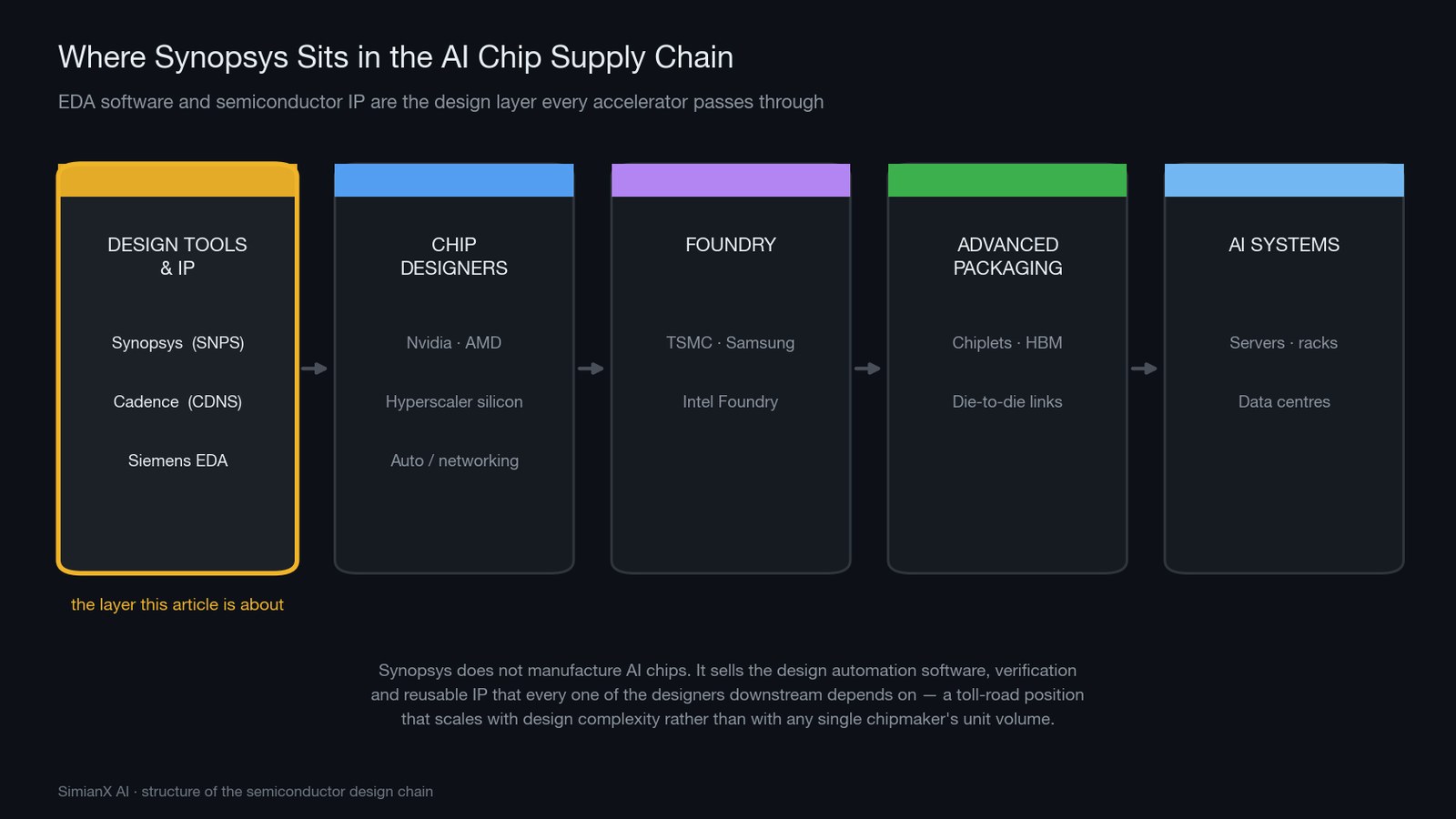
The hidden attraction of Synopsys is not that it manufactures AI chips. It sells essential software and intellectual property to companies attempting to design the next generation of them.
Synopsys Earnings 2026: What Has the Company Guided For?
Synopsys entered its fiscal third-quarter report with management guidance already on the table. Following stronger-than-expected fiscal Q2 results, the company projected:
| Fiscal Q3 2026 metric | Management guidance |
|---|---|
| Revenue | $2.410 billion–$2.460 billion |
| GAAP EPS | $0.84–$0.98 |
| Non-GAAP EPS | $3.63–$3.69 |
| Non-GAAP expenses | $1.440 billion–$1.470 billion |
| Assumed non-GAAP tax rate | 18% |
| Diluted share count | Approximately 193 million |
The company also raised its full-year fiscal 2026 targets:
| Fiscal 2026 metric | Management guidance |
|---|---|
| Revenue | $9.625 billion–$9.705 billion |
| Guidance midpoint | $9.665 billion |
| GAAP EPS | $2.49–$2.91 |
| Non-GAAP EPS | $14.72–$14.80 |
| Operating cash flow | Approximately $2.3 billion |
| Free cash flow | Approximately $2.0 billion |
| Capital expenditure | Approximately $300 million |
| Expected Ansys revenue contribution | $2.96 billion |
Management said the higher full-year revenue target reflected better business performance and a $60 million Ansys channel-accounting benefit, partially offset by a $40 million impact from the planned Processor IP Solutions divestiture. The complete ranges are available in the company’s fiscal Q2 2026 earnings release.
Fiscal Q3 2026 scorecard: guidance, consensus and the beat line
| Metric | Management guidance | External consensus | Reads as a beat if |
|---|---|---|---|
| Revenue | $2.410B–$2.460B | around the midpoint | above $2.460B |
| Non-GAAP EPS | $3.63–$3.69 | ~$3.67 | above $3.69 |
| GAAP EPS | $0.84–$0.98 | not separately tracked | above $0.98 |
| Non-GAAP expenses | $1.440B–$1.470B | not separately tracked | below $1.440B |
| Diluted share count | ~193 million | not separately tracked | below 193 million |
| Design IP revenue | not guided separately | not separately tracked | sequential growth on Q2’s $454M |
| Fiscal 2026 revenue | $9.625B–$9.705B | not separately tracked | raised again |
| Fiscal 2026 free cash flow | ~$2.0 billion | not separately tracked | raised above $2.0 billion |
Methodology: guidance figures are management’s own fiscal Q3 2026 and fiscal 2026 ranges as published in the fiscal Q2 2026 earnings release. The consensus figure is the external non-GAAP EPS estimate circulating immediately before the print. The “beat line” column is this article’s framing for reading the release, not a company or analyst target. Figures reflect information available through August 26, 2026.
External consensus estimates immediately before the report centered near $3.67 in non-GAAP EPS, essentially the high end of management’s range. That raises the earnings bar: merely meeting the published guidance may not be enough if investors have already priced in an upside surprise.
The five questions that matter more than the headline EPS number
Investors should examine the following in order:
- Did organic Design Automation growth remain healthy after removing Ansys?
- Is Design IP stabilizing after weak China demand and execution problems?
- Are Ansys cost synergies arriving faster than expected?
- Did management raise fiscal 2026 or longer-term guidance?
- Is AI demand translating into revenue now, or primarily supporting a long-term narrative?
A one-cent EPS beat provides less information than the answers to these five questions.
What Synopsys Actually Does
Synopsys is not a semiconductor manufacturer. It develops software, reusable semiconductor intellectual property and engineering simulation tools.
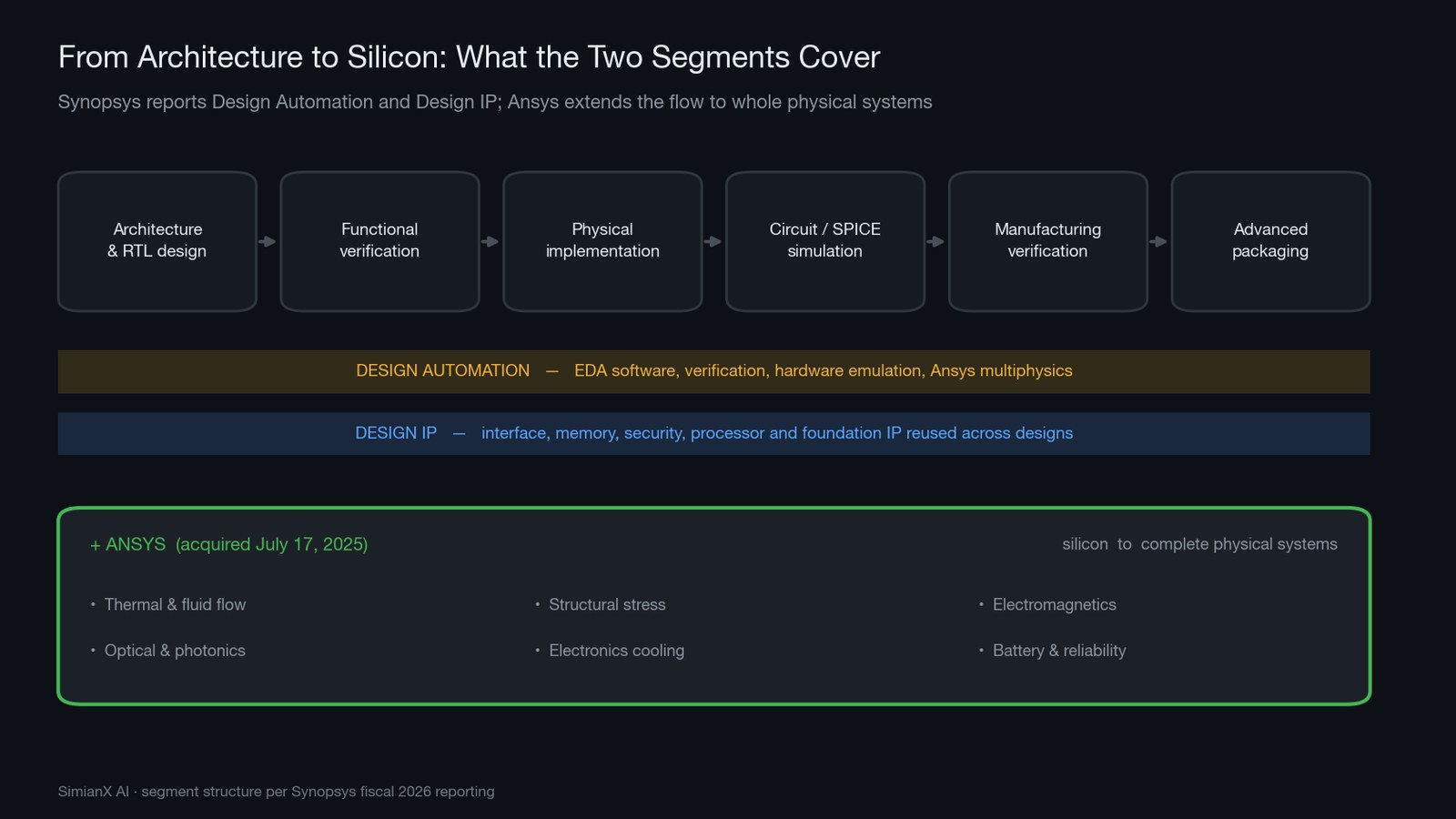
Its products help engineering teams move from an idea to a manufacturable, verifiable chip or physical system. The workflow can include:
- Chip architecture and logic design
- Functional verification
- Physical implementation
- Circuit and transistor simulation
- Manufacturing verification
- Advanced packaging analysis
- Interface and memory IP
- Emulation and prototyping
- Thermal, structural and electromagnetic simulation
- Software-defined system testing
Following the Ansys acquisition, Synopsys reports two operating segments.
| Segment | Principal products | Role in the AI economy |
|---|---|---|
| Design Automation | EDA software, verification, hardware emulation, Ansys simulation and system analysis | Helps design, verify and simulate complex chips and complete systems |
| Design IP | Interface, memory, security, processor and foundation IP | Provides reusable building blocks that reduce chip-development time |
This creates an attractive business model. Chip companies cannot avoid design software simply because semiconductor demand weakens for a quarter. Advanced chips take years to develop, and a design error can cost hundreds of millions of dollars in delayed production or failed silicon. The mission-critical nature of EDA software supports recurring contracts, customer retention and pricing power.
The industry is also highly concentrated. Synopsys primarily competes with Cadence Design Systems and Siemens EDA. Customers may develop some internal tools, but reproducing a complete commercial EDA workflow requires decades of software development, foundry relationships, verification data and engineering expertise.
How Does Synopsys Benefit From Nvidia’s AI Chip Boom?
Synopsys benefits from Nvidia and the broader AI investment cycle through complexity rather than chip volume alone.
A traditional processor is already difficult to design. A modern AI accelerator introduces additional challenges:
- Billions or tens of billions of transistors
- High-bandwidth memory integration
- Advanced process nodes
- Chiplet-based architectures
- Die-to-die interfaces
- Power-delivery constraints
- Extreme heat density
- High-speed networking
- Advanced packaging and interconnects
- Complex software-hardware co-optimization
Each new layer of complexity creates more design, verification and simulation work. That increases demand for EDA software, reusable IP, emulation systems and multiphysics analysis.
Synopsys is both an Nvidia supplier and an Nvidia technology partner
The relationship should not be simplified into “Nvidia buys Synopsys software.” It operates in several directions:
- Nvidia uses sophisticated EDA and verification tools to develop chips.
- Synopsys optimizes engineering applications to run on Nvidia GPUs.
- The companies are developing agentic-AI workflows for engineering.
- Synopsys uses Nvidia Omniverse technology in digital-twin applications.
- Nvidia’s GPUs accelerate compute-heavy circuit and physical simulations.
- Nvidia owns a direct equity stake in Synopsys.
In December 2025, Nvidia purchased $2 billion of Synopsys shares at $414.79 per share. The companies announced a multi-year collaboration involving CUDA-X, agentic AI and Omniverse. The official Nvidia–Synopsys strategic partnership announcement described plans to accelerate applications spanning chip design, physical verification, molecular simulation, electromagnetic analysis and optical simulation.
This investment is strategically meaningful, but investors should maintain analytical discipline. Nvidia’s purchase:
- Does not guarantee future Synopsys earnings growth.
- Does not create an exclusive relationship.
- Does not eliminate competition from Cadence or Siemens.
- Does not mean Nvidia will continually purchase additional shares.
- Does provide evidence that Nvidia views engineering software as strategically important to accelerated computing.
Nvidia’s equity investment validates the strategic relationship, but Synopsys must still convert technical collaboration into durable revenue, margin expansion and cash flow.
AI Could Transform Both Synopsys’ Products and Their Performance
Synopsys has two different AI opportunities.
The first is AI for chip design. Synopsys.ai and its AgentEngineer technology use machine learning, generative AI and autonomous agents to improve engineering workflows. Potential applications include design-space exploration, verification, debugging, test generation and physical optimization.
The second is GPU acceleration of engineering software. Circuit, electromagnetic, thermal and physical simulations can be computationally intensive. Moving suitable workloads from CPU-only infrastructure to Nvidia GPU platforms may reduce simulation time and allow customers to explore more design alternatives.
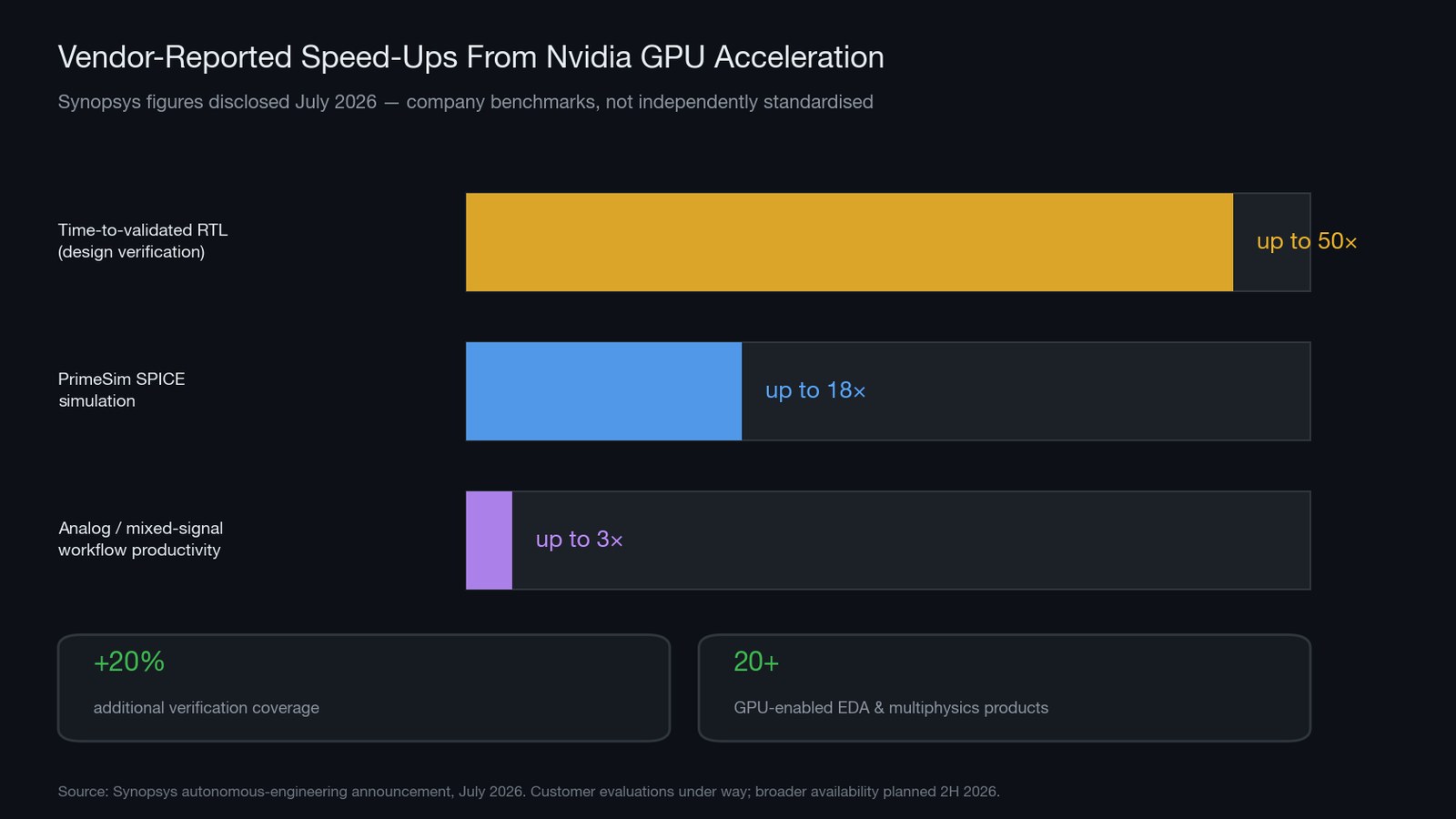
In July 2026, Synopsys demonstrated autonomous engineering workflows developed with Nvidia technology. According to the company:
- A design-verification workflow delivered up to 50 times faster time-to-validated RTL and 20% additional coverage improvement.
- An analog and mixed-signal workflow improved productivity by up to three times.
- PrimeSim SPICE simulation ran up to 18 times faster using Nvidia GPUs.
- Synopsys expanded its portfolio to more than 20 GPU-enabled EDA and multiphysics products.
These are vendor-reported performance comparisons rather than independently standardized benchmarks. They nevertheless indicate where Synopsys is directing research and product development. Customer evaluations were underway, with broader availability planned for the second half of 2026. Details are available in the company’s July 2026 autonomous-engineering announcement.
The Ansys Acquisition Changes the Synopsys Investment Thesis
Synopsys completed its acquisition of Ansys on July 17, 2025. The approximately $35 billion transaction transformed the company from a predominantly chip-design software provider into a broader engineering platform spanning silicon to complete physical systems.
Ansys software simulates how products behave under real-world conditions, including:
- Heat and fluid flow
- Structural stress
- Electromagnetic interference
- Optical performance
- Mechanical reliability
- Battery performance
- Aerodynamics
- Electronics cooling
This matters for AI infrastructure. Designing an advanced accelerator is only part of the problem. Engineers must also determine how it will be packaged, powered and cooled inside servers and data centers. With Ansys, Synopsys can potentially connect chip-level design decisions with system-level thermal, electrical and mechanical consequences.
Why advanced packaging makes the combination compelling
As transistor scaling becomes more expensive, semiconductor companies increasingly combine multiple dies in advanced packages. A multi-die system creates interdependent problems involving:
- Signal integrity
- Power integrity
- Thermal behavior
- Mechanical stress
- Electromagnetic effects
- Die-to-die communication
- Package reliability
Synopsys supplies the EDA and IP layer, while Ansys contributes multiphysics simulation. An integrated workflow could allow engineers to identify system-level problems earlier, when changes are cheaper to make.
Synopsys estimated that the acquisition expanded its total addressable market to approximately $31 billion. At the time the deal was announced, the companies targeted roughly $400 million of annual cost synergies by the third year and $400 million of annual revenue synergies by the fourth year, with longer-term revenue synergies potentially exceeding $1 billion annually. Synopsys expected initial integrated capabilities during the first half of 2026. See the company’s Ansys acquisition completion announcement.
The acquisition also makes the financial statements harder to read
The Ansys transaction creates several complications:
- Reported revenue growth includes acquired revenue.
- Acquisition accounting creates large intangible-asset amortization charges.
- Synopsys issued shares, increasing the diluted share count.
- The company took on debt to fund the cash portion.
- Integration and restructuring costs affect GAAP earnings.
- Product divestitures required for regulatory approval alter comparisons.
- Cost synergies may improve non-GAAP margins before revenue synergies become visible.
Investors should therefore avoid treating consolidated year-over-year revenue growth as purely organic growth.
What Fiscal Q2 2026 Revealed
Synopsys reported fiscal Q2 2026 revenue of $2.276 billion, up from $1.604 billion a year earlier. The 42% reported increase looks exceptional, but much of it reflected the inclusion of Ansys.
The underlying segment results were mixed:
| Fiscal Q2 metric | Q2 2026 | Q2 2025 | Change |
|---|---|---|---|
| Total revenue | $2.276B | $1.604B | +42% |
| Design Automation revenue | $1.822B | $1.122B | +62% |
| Design IP revenue | $454M | $482M | -6% |
| GAAP net income | $17M | $349M | -95% |
| GAAP diluted EPS | $0.09 | $2.24 | -96% |
| Non-GAAP net income | $644M | $573M | +12% |
| Non-GAAP diluted EPS | $3.35 | $3.67 | -9% |
The numbers show why a superficial earnings analysis can be misleading.
Design Automation benefited from Ansys and performed strongly. Design IP, however, declined. Meanwhile, non-GAAP net income increased, but non-GAAP EPS fell because the diluted share count rose from approximately 156 million to 192 million after the acquisition.
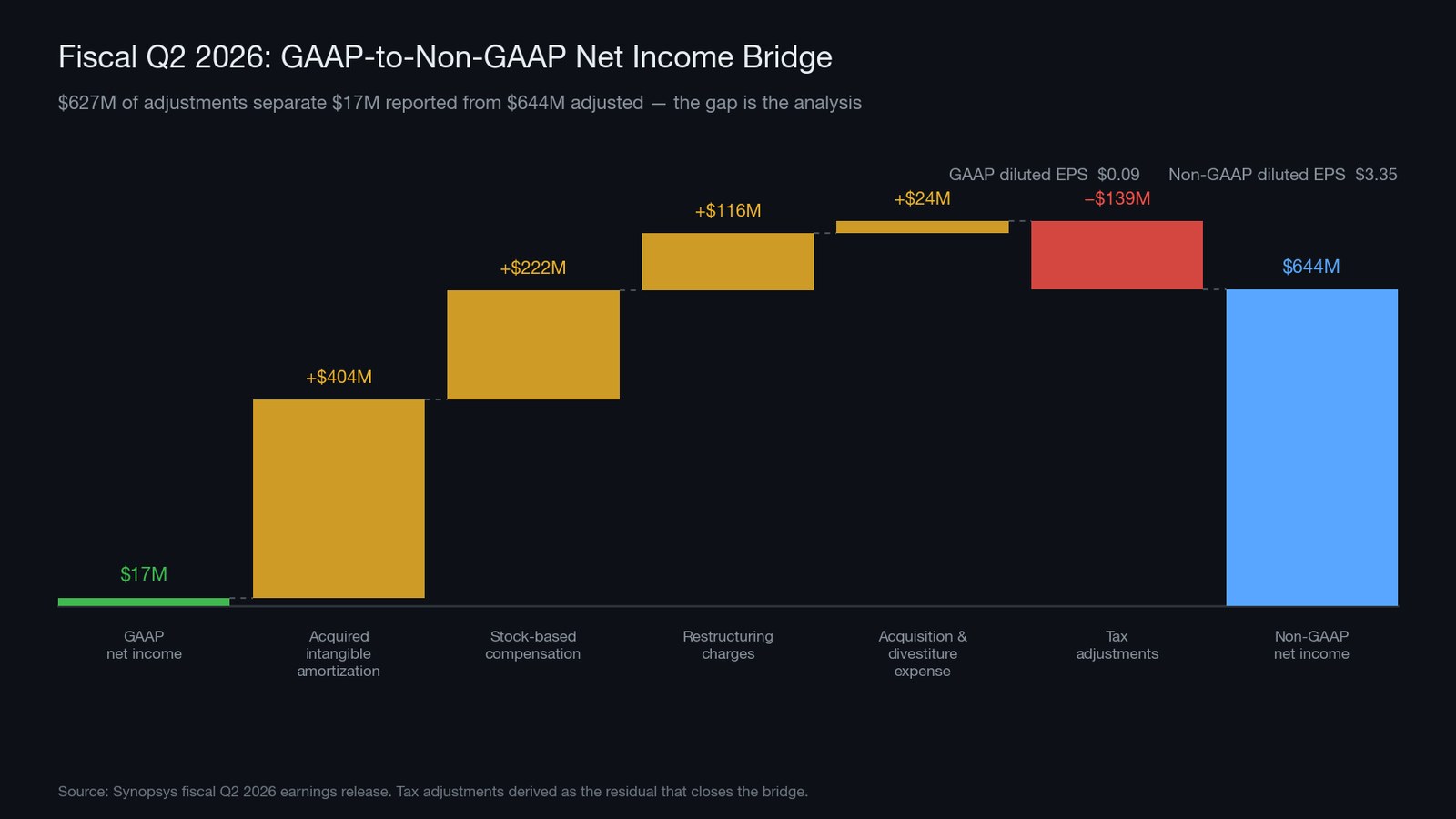
The gap between GAAP and non-GAAP earnings was also unusually wide. Fiscal Q2 adjustments included:
- $404 million of acquired-intangible amortization
- $222 million of stock-based compensation
- $116 million of restructuring charges
- $24 million of acquisition and divestiture expenses
- Related tax adjustments
Some exclusions are non-cash, but they are not economically meaningless. Stock-based compensation dilutes shareholders, while acquisition amortization reflects the large price paid for intangible assets. A balanced analysis should examine both measures.
GAAP earnings currently understate cash-generating capacity, but non-GAAP earnings can overstate the economics experienced by long-term shareholders if dilution and acquisition costs are ignored.
The Most Important Weak Spot: Design IP
The AI-chip thesis does not mean every Synopsys business is performing equally well. Design IP revenue fell approximately 6% year over year in fiscal Q2.
Design IP includes reusable components such as interface IP, embedded memory, security IP, processor technology and foundation libraries. These products help customers avoid designing every function from scratch.
The segment has faced several headwinds:
- China export-control disruption
- Weakness in Chinese semiconductor demand
- Lower demand from a major foundry customer
- Roadmap and resource decisions that did not deliver intended results
- Timing volatility in hardware and IP transactions
- Competitive pressure and customer-developed alternatives
Synopsys disclosed that its fiscal 2025 China revenue, excluding Ansys, declined 22% from fiscal 2024. Temporary U.S. restrictions imposed in May 2025 were rescinded in July 2025, but the event disrupted customer access and exposed the business to policy risk. Synopsys’ financial guidance assumes no additional changes to export controls or Entity List restrictions.
For the bull case to strengthen, investors should look for:
- Sequential Design IP stabilization
- Improved design-win activity
- Better performance in processor and interface IP
- Recovery in Chinese customer demand
- Evidence that management’s roadmap changes are working
Design Automation can carry the consolidated company for a time, but a durable premium valuation is easier to defend if both segments contribute.
Is Synopsys Really a “Hidden AI Chip Stock”?
The description is directionally useful but requires qualification.
Synopsys is an AI infrastructure enabler, not a direct AI accelerator company. It benefits when Nvidia, AMD, hyperscalers, networking companies, automotive chip designers and semiconductor startups invest in increasingly complex products.
That may offer attractive diversification. Investors do not need to predict which chip designer ultimately wins every AI workload if most competitors use commercial EDA tools and IP.
However, Synopsys is not completely neutral:
- Large customers negotiate aggressively.
- Customers may use different EDA vendors for different workflow stages.
- Foundry roadmaps affect demand.
- Design activity can slow during downturns.
- Export controls can remove addressable customers.
- Cadence and Siemens compete for the same engineering budgets.
- Cloud companies increasingly develop internal silicon and tools.
The best description is therefore:
Synopsys is a high-quality toll-road business on the road toward more complex chips and intelligent physical systems—but the toll road is regulated, competitive and expensive to value.
Synopsys Stock Valuation Before Earnings
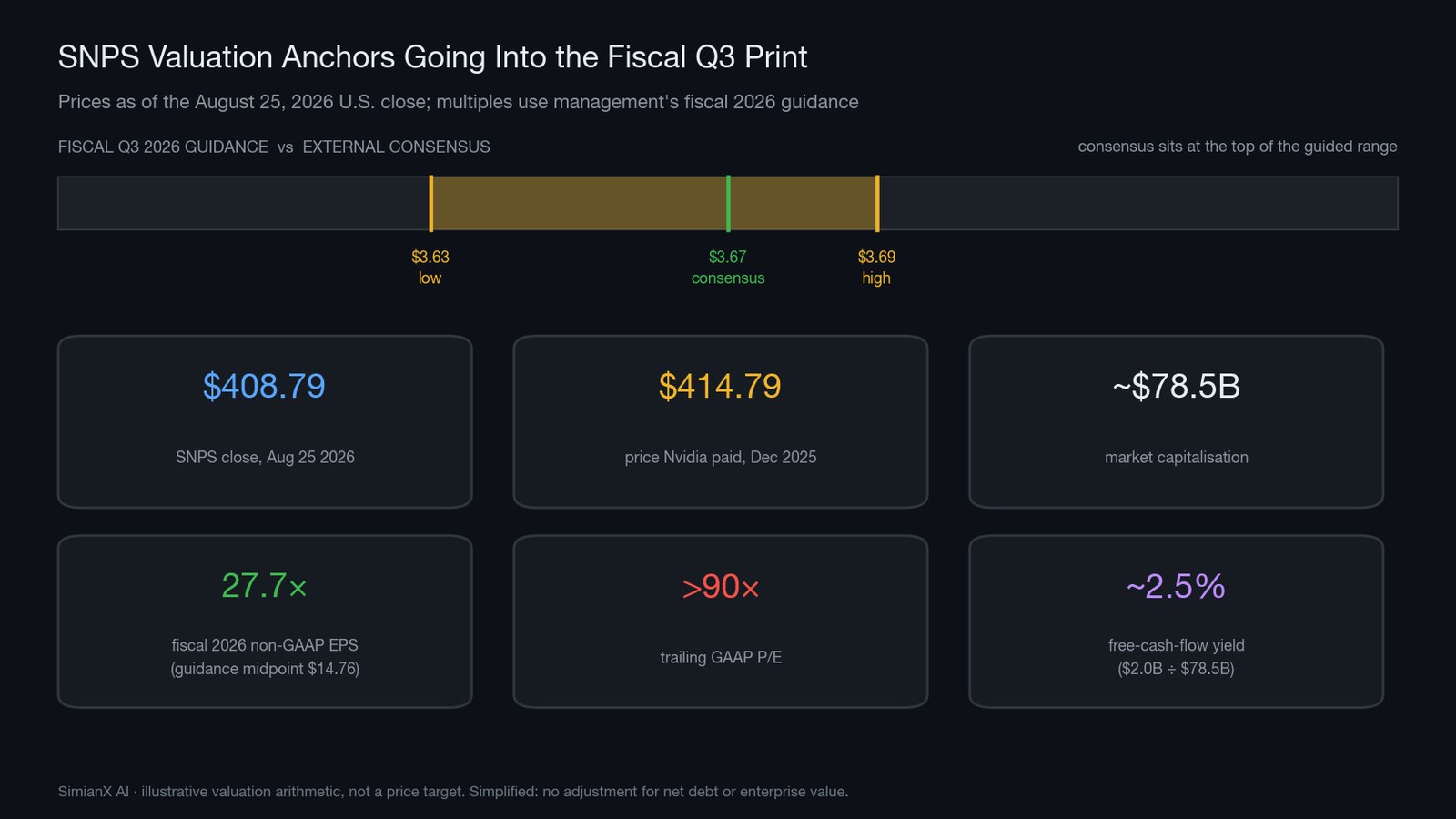
As of the August 25, 2026 U.S. close, SNPS traded near $408.79, giving the company a market capitalization of roughly $78.5 billion.
Using management’s full-year non-GAAP EPS midpoint of $14.76 produces a price-to-earnings multiple of approximately:
$408.79 ÷ $14.76 = 27.7x fiscal 2026 non-GAAP EPS
Using GAAP earnings produces a dramatically higher multiple because acquisition amortization and restructuring expenses reduce reported EPS. Market data placed the trailing GAAP P/E above 90 at the research cutoff.
Management expects approximately $2 billion in fiscal 2026 free cash flow. Dividing that figure by the market capitalization gives a rough equity free-cash-flow yield near:
$2.0B ÷ $78.5B = 2.5%
This is only a simplified calculation. It does not adjust for net debt, working-capital timing, acquisition financing or the difference between equity value and enterprise value.
Scenario framework for SNPS stock
| Scenario | Operating assumptions | Illustrative valuation logic |
|---|---|---|
| Bear case | Design IP remains weak, China declines, Ansys integration disappoints, AI tools monetize slowly | Lower earnings multiple as growth and execution risks dominate |
| Base case | Q3 meets guidance, Design Automation stays strong, IP gradually stabilizes, synergies support margins | Premium software multiple supported by durable growth |
| Bull case | Guidance rises, Ansys cross-selling accelerates, agentic EDA gains adoption, free cash flow beats targets | Higher earnings estimates and sustained premium valuation |
| Stress case | New export controls, acquisition problems or semiconductor-design slowdown | Earnings reductions plus multiple compression |
The notable reference point is Nvidia’s $414.79 purchase price. Synopsys traded slightly below that level at the research cutoff. That price is not a guaranteed floor: Nvidia made a strategic investment, not a promise to support the public market. Nevertheless, it provides a useful indication of what Nvidia was willing to pay when formalizing the partnership.
What Would Count as a Strong Synopsys Earnings Report?
A genuinely strong fiscal Q3 report would require more than beating EPS by excluding additional costs.
The best combination would include:
- Revenue above the $2.410 billion–$2.460 billion range
- Non-GAAP EPS above $3.69
- Healthy organic Design Automation growth
- Sequential improvement in Design IP
- Higher full-year free-cash-flow guidance
- Ansys cost synergies arriving ahead of schedule
- Evidence of integrated-product sales
- Constructive comments about China
- Clear commercialization timing for AgentEngineer
- No deterioration in customer concentration or contract duration
A mixed report might include an EPS beat driven by cost reductions while Design IP remains weak. That could support short-term margins without resolving long-term growth concerns.
A weak report would likely combine a revenue miss, lower guidance, delayed Ansys synergies or renewed China pressure.
How to Analyze the Earnings Release Step by Step
Investors can use the following workflow after the results appear:
- Compare reported revenue with guidance, not only with analyst consensus.
- Separate Ansys revenue from organic Synopsys growth wherever disclosure allows.
- Check Design Automation and Design IP independently.
- Build a GAAP-to-non-GAAP bridge for EPS and operating margin.
- Review diluted share count to measure acquisition-related dilution.
- Compare free cash flow with non-GAAP net income.
- Read the conference-call discussion of China and export controls.
- Look for Ansys cross-selling and synergy evidence.
- Track changes in full-year guidance, including divestiture assumptions.
- Recalculate valuation using updated EPS and cash-flow estimates.
A platform such as SimianX AI’s stock analysis command room can assist by bringing together live price data, SEC filings, fundamental analysis, technical indicators and news sentiment. For an event-driven stock such as Synopsys, that is useful because the first price move may reflect headline EPS, while the more durable move often depends on guidance and the earnings call — a pattern documented across 42 prints in NVDA After Earnings: Every Reaction Since 2016 in One Table.
SimianX AI should be used as a research aid rather than a substitute for verifying the company’s release, Form 10-Q and management commentary.
Risks That Could Break the Bull Case
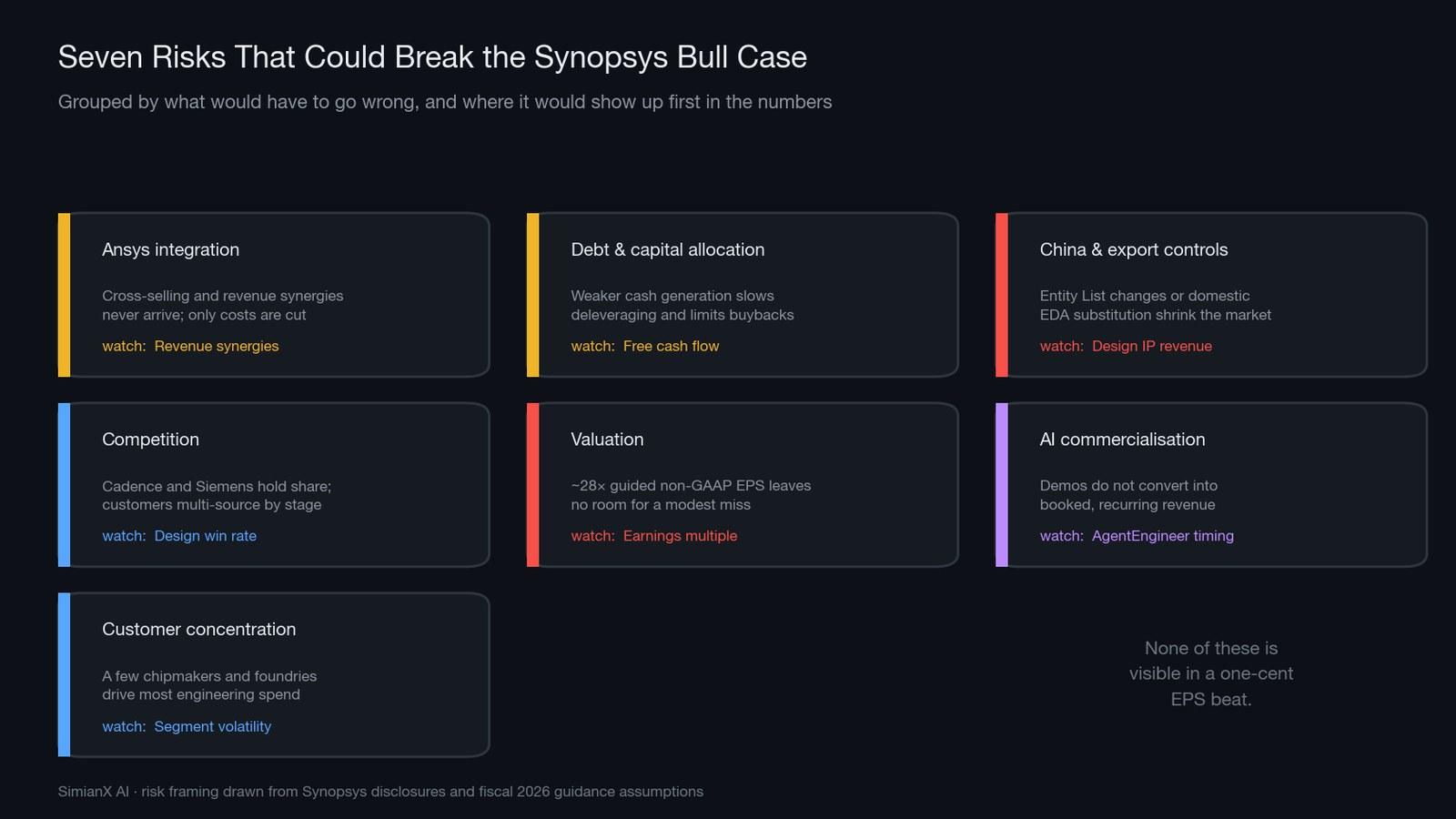
Ansys integration risk
Synopsys paid a large price for Ansys. The company must integrate products, sales teams, contracts and technical roadmaps while retaining engineers and customers. Cost savings alone will not prove the acquisition was successful; investors eventually need evidence of cross-selling and revenue synergies.
Debt and capital-allocation risk
The Ansys transaction required significant cash financing. Management expects free-cash-flow growth to support rapid deleveraging, but weaker operating performance could slow that process and restrict buybacks or other investments.
China and export-control risk
EDA software is strategically sensitive because it enables advanced semiconductor development. Synopsys remains vulnerable to U.S.–China policy changes, Entity List restrictions and Chinese efforts to develop domestic EDA alternatives.
Competitive risk
Cadence is a formidable rival, and Siemens EDA remains significant. Customers frequently use tools from multiple vendors, which limits the ability of one supplier to capture the entire workflow.
Valuation risk
At roughly 28 times management’s fiscal 2026 non-GAAP EPS midpoint before the report, Synopsys is not priced as a distressed company. A modest operational disappointment can cause both earnings estimates and the valuation multiple to decline — the momentum unwind that hit the group earlier in 2026 is the template.
AI commercialization risk
Impressive performance demonstrations do not automatically become material revenue. Customers must validate reliability, security, interoperability and return on investment before deploying autonomous engineering tools broadly.
Customer concentration and semiconductor cyclicality
A small number of major chipmakers, foundries and technology companies account for substantial engineering spending. Delays in a major customer program can create volatility, especially in Design IP and hardware revenue.
Bull Case Versus Bear Case
| Bull argument | Bear argument |
|---|---|
| AI chips require more design and verification work | AI enthusiasm may already be reflected in the valuation |
| EDA is mission-critical and difficult to replace | Cadence and Siemens prevent monopoly economics |
| Nvidia invested $2 billion in Synopsys | Strategic backing does not guarantee earnings |
| Ansys expands the platform from silicon to systems | The acquisition creates debt, dilution and execution risk |
| Agentic AI can improve customer productivity | Adoption and monetization may take years |
| Advanced packaging increases multiphysics demand | Semiconductor-design activity remains cyclical |
| Recurring software contracts improve visibility | IP and hardware revenue can be volatile |
| Strong free cash flow can fund deleveraging | GAAP earnings are burdened by acquisition accounting |
| A $31 billion addressable market creates runway | China restrictions could shrink the accessible market |
The investment case is strongest for shareholders who believe that engineering complexity will compound faster than competitive and regulatory pressure.
FAQ About Synopsys Earnings 2026
When will Synopsys report fiscal Q3 2026 earnings?
Synopsys is scheduled to report fiscal third-quarter 2026 results after the U.S. market closes on August 26, 2026. Its earnings conference call is scheduled for 5:00 p.m. Eastern Time on the same day.
Is Synopsys an AI chip company?
Synopsys does not manufacture AI chips. It supplies electronic design automation software, semiconductor IP and engineering simulation products used to design and verify advanced chips and systems, making it an indirect AI infrastructure investment.
How does Synopsys benefit from Nvidia?
Nvidia is a customer, technology partner and shareholder. The companies are combining Nvidia accelerated computing and agentic-AI technology with Synopsys engineering software, while Nvidia invested $2 billion in Synopsys shares in December 2025.
Is Synopsys stock a buy before earnings?
That depends on an investor’s risk tolerance, valuation assumptions and time horizon. The company has strong competitive assets and AI exposure, but the upcoming report carries gap risk, while Ansys integration, China weakness and a premium valuation create meaningful uncertainty.
What is the most important Synopsys earnings metric?
No single metric is sufficient. Investors should prioritize organic Design Automation growth, Design IP stabilization, Ansys synergies, free cash flow and changes to full-year guidance over a small headline EPS beat.
Conclusion
Synopsys earnings 2026 will test whether the company can turn an exceptionally strong strategic position into accelerating per-share value.
The bull case is persuasive. AI accelerators, custom silicon, chiplets and advanced packaging make semiconductor design more difficult. Synopsys sells tools that engineers cannot easily replace, while the Ansys acquisition extends its reach into thermal, mechanical, electromagnetic and system-level simulation. Nvidia’s $2 billion investment adds strategic validation, and the companies’ work on GPU acceleration and autonomous engineering could open a new chapter for EDA productivity.
But Synopsys is not a risk-free way to own the AI boom. Reported growth is heavily influenced by Ansys, Design IP has been weak, the acquisition increased debt and dilution, and GAAP earnings remain far below adjusted earnings. Export controls and domestic Chinese competition create additional uncertainty. At approximately 28 times fiscal 2026 non-GAAP EPS guidance before the report, investors are paying for quality and future execution rather than buying an obviously cheap stock.
The most defensible conclusion is that Synopsys is a hidden AI infrastructure leader, but not necessarily a hidden bargain. Its long-term value will depend on organic growth, Ansys integration, cash-flow conversion and the successful commercialization of AI-enabled engineering—not simply on Nvidia’s share price.
To follow the earnings release and compare fundamentals, technical momentum, filings and news sentiment in real time, explore SimianX AI. Use its multi-agent analysis to challenge both the bullish and bearish thesis, verify critical figures against primary sources and consult a qualified financial professional before making an investment decision.
Related Reading
- TSMC Stock 2026: Why Nvidia Still Can’t Replace Its Fab
- AMD Stock 2026: $6.7B Data Center Quarter vs Nvidia’s $75B
- Is Jensen Huang Fueling an AI Bubble? Nvidia’s Boom Examined
- NVDA After Earnings: Every Reaction Since 2016 in One Table
- Semiconductor Bear Markets: Every SOX Crash, 1995–2026
- AI Momentum Unwind 2026: Why Semiconductor Stocks Fall
- Cerebras Stock 2026: AI Chip Boom vs Gross Margin Risk
- Every Tech Bubble Since 1929: How AI in 2026 Compares
References
- Synopsys Investor Relations — fiscal Q2 2026 results and full-year guidance
- Synopsys — Nvidia strategic partnership announcement, December 2025
- Synopsys — completion of the Ansys acquisition
- Synopsys — autonomous engineering workflows built with Nvidia, July 2026
- SEC EDGAR — Synopsys Inc. filings, CIK 0000883241
- Synopsys.ai — AI-driven design products
- Ansys — engineering simulation software
- Cadence Design Systems — EDA competitor
- Siemens EDA — EDA competitor
- Nvidia — CUDA-X acceleration libraries
- Nvidia Omniverse — digital-twin platform
- U.S. Bureau of Industry and Security — Entity List
- Semiconductor Industry Association — industry data
- SimianX — SNPS stock fundamentals