 By Muke
Is Solidigm Public? Solidigm IPO Timeline, Ownership and What Happens Next
Quick answer: No. Solidigm has no stock, no ticker and no IPO date. It is a wholly owned U.S. subsidiary of SK hynix, and on October 23, 2026 SK hynix told the SEC in a Form 6-K that Solidigm had "decided to discontinue its review of pre-IPO capital raising and IPO plans." Reports had pointed to a Nasdaq listing as early as 2027, raising $10–15 billion at a valuation of up to $150 billion, but no prospectus was ever filed. The only listed ways to own Solidigm's economics are SK hynix itself: KRX: 000660 in Seoul, which closed at ₩1,277,000 (+4.42%) on the day of the announcement, or the SKHY American depositary shares on Nasdaq, which closed at $137.02 (+4.05%), still below their $149 July IPO price. Solidigm's business came from Intel: SK hynix says it paid $6.6 billion in December 2021 and $2.2 billion in March 2025 for it, against the $9 billion headline price. Update, October 29: on SK hynix's October 28 earnings call, CEO Kwak Noh-jung confirmed the halt, citing financial-market volatility and the correction in chip stocks, and on October 29 the company told the SEC that Solidigm is reviewing ways to expand capacity but that "no matters have been determined," after a press report of a U.S. NAND fab costing about ₩60 trillion. SK hynix closed at ₩1,526,000 on October 29, after a 10.9% jump on its results day.
Solidigm stock is one of the most searched questions about AI storage, and the answer changed this week. Solidigm makes the high-capacity enterprise SSDs that AI data centers buy in bulk, and SK hynix had been weighing an outside fundraising and a U.S. listing to pay for a new NAND factory. That plan is now off the table.
This page is a reference for the whole story rather than a one-day news item: the full Solidigm timeline since the Intel deal, the ownership chain, what was actually proposed, why it stopped, what the share prices did, and how the factory might be funded instead. It was updated on October 29, 2026 with SK hynix's third-quarter results, its ₩100 trillion shareholder-return plan and the latest Solidigm filing.
For readers of SimianX AI, the case is also a clean lesson in why strong product demand does not automatically make a subsidiary IPO good for the parent's shareholders.
Our assessment: the halt reads best as a decision about price, governance and dilution, made in the middle of a three-week rout in memory stocks, not as a sign that AI storage demand is fading. It also leaves SK hynix fully responsible for funding, and justifying, an expensive expansion.
Research date: October 26, 2026 (U.S. Pacific). Filings: SK hynix Form 6-K reports and its July 2026 Nasdaq prospectus on SEC EDGAR; Intel's newsroom and Form 8-K. Prices: regular-session closes from Yahoo Finance (KRX and Nasdaq). Valuation and payback tables are SimianX illustrations, not forecasts or investment advice. Updated October 29, 2026: Q3 results and shareholder-return plan (Form 6-K, October 28), the Solidigm capacity clarification (Form 6-K, October 29) and CNBC's report of the earnings call.
Solidigm Stock at a Glance
| Question | Answer as of October 29, 2026 |
|---|---|
| Is Solidigm a public company? | No. It is privately held inside SK hynix |
| Solidigm stock ticker or symbol | None. There is no "Solidigm stock price" |
| Solidigm IPO date | None. The pre-IPO and IPO review was discontinued on October 23, 2026, and the halt was restated on the October 28 earnings call |
| Who owns Solidigm? | SK hynix, 100% through its U.S. subsidiaries (Solidigm Inc. since March 2026) |
| Who owns SK hynix? | SK square is the largest shareholder, with 20.5% as of March 31, 2026 |
| How can investors get exposure? | SK hynix shares (KRX: 000660) or SKHY ADSs on Nasdaq; each ADS is one-tenth of a share |
| Reported IPO size and valuation | $10–15 billion raised, valuation up to $150 billion (media reports, never official terms) |
| Is the U.S. factory still planned? | Under review: on October 29 SK hynix said Solidigm is reviewing ways to expand capacity but "no matters have been determined"; no site, budget or date announced |
| Next catalyst | A further SK hynix disclosure on Solidigm's capacity plans, due when details are confirmed or within one month of October 29, 2026 |
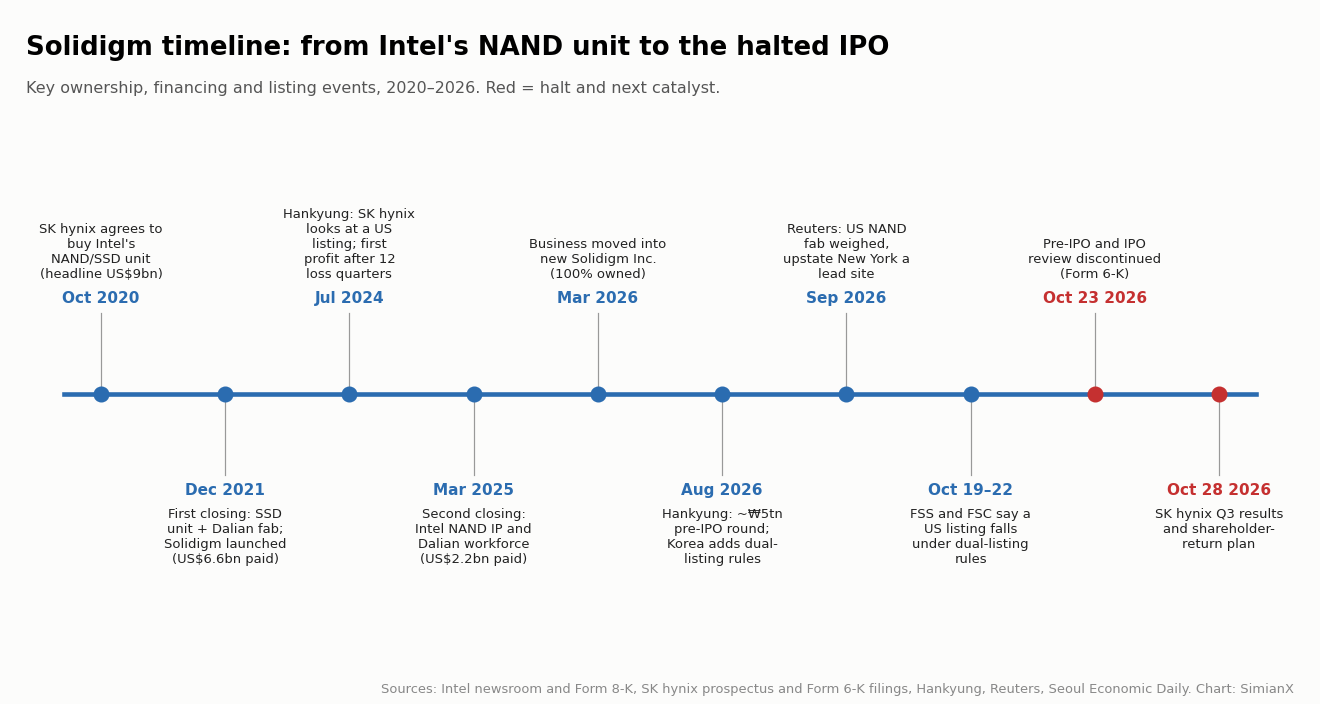
The Complete Solidigm Timeline, 2020–2026
Every dated event below comes from a company filing, a company statement or a named news report. Media reports are labelled as such.
| Date | Event | Source |
|---|---|---|
| Oct 19, 2020 | SK hynix agrees to buy Intel's NAND flash and SSD business, including the Dalian, China fab, for a headline $9 billion | Intel, SK hynix |
| Dec 29, 2021 | First closing: Intel's SSD business and the Dalian fab move to SK hynix. Intel announces $7 billion of consideration; SK hynix's prospectus says it paid $6.6 billion | Intel newsroom, SK hynix prospectus |
| Dec 30, 2021 | Solidigm launches as an SK hynix subsidiary, led by former Intel executive Rob Crooke | Intel newsroom |
| Dec 2021 | China's market regulator approves the deal with five-year conditions, including "reasonable" pricing and supply in China's enterprise SSD market | SK hynix prospectus |
| Jul 26, 2024 | Hankyung reports SK hynix is looking at a U.S. listing for Solidigm, which had just made its first profit after 12 loss-making quarters; SK hynix says no decision has been made | Hankyung via Blocks & Files |
| Mar 27, 2025 | Second closing: Intel's NAND technology and Dalian manufacturing workforce transfer. SK hynix says it paid $2.2 billion; Intel reports about $1.9 billion received, net of adjustments | SK hynix prospectus, Intel Form 8-K |
| Mar 1, 2026 | The NAND and SSD business is transferred into a newly formed Solidigm Inc., wholly owned within SK hynix | SK hynix prospectus |
| Jul 10, 2026 | SK hynix lists SKHY ADSs on Nasdaq at $149 each | SK hynix prospectus |
| Aug 5, 2026 | Hankyung reports Solidigm is pursuing a pre-IPO raise of about ₩5 trillion. SK hynix replies the next day that "no matters have been determined" | SK hynix Form 6-K (Aug 6) |
| Aug 2026 | Korea introduces dual-listing guidelines covering both domestic and overseas listings of subsidiaries | Seoul Economic Daily |
| Sep 4, 2026 | SK hynix repeats that nothing is decided and promises an update within three months | SK hynix Form 6-K |
| Sep 18, 2026 | Reuters reports Solidigm is weighing a U.S. NAND factory, with upstate New York a leading candidate | Reuters |
| Oct 1, 2026 | SK hynix says any outside financing will be judged against internal funding by its effect on existing shareholders | SK hynix newsroom |
| Oct 14, 2026 | Reuters reports SK hynix wants U.S. approval for more chipmaking tools at Dalian as a condition for the U.S. fab; SK hynix disputes that characterization | Reuters, Tom's Hardware |
| Oct 19, 2026 | The governor of the Financial Supervisory Service tells a National Assembly audit that the plan violates the dual-listing rules | Seoul Economic Daily |
| Oct 22, 2026 | The Financial Services Commission chairman says a U.S. listing falls under the guidelines | Seoul Economic Daily |
| Oct 23, 2026 | Solidigm discontinues its review of pre-IPO capital raising and an IPO | SK hynix Form 6-K |
| Oct 28, 2026 | Q3 results: revenue ₩104.6 trillion, operating profit ₩83.3 trillion, plus a ₩100 trillion 2026 shareholder-return plan. On the call, CEO Kwak Noh-jung cites market volatility and the chip-stock correction for halting the Solidigm IPO review | SK hynix Form 6-K; CNBC |
| Oct 29, 2026 | Responding to a Maeil Business Newspaper report of a ₩60 trillion U.S. NAND fab, SK hynix says Solidigm is reviewing capacity measures but nothing is decided; further disclosure within one month | SK hynix Form 6-K |
What Exactly Did SK Hynix Cancel?
The precise wording matters. In its October 23 Form 6-K, SK hynix said that Solidigm had been reviewing financing options to expand production capacity and, considering capital market conditions and other factors, "decided to discontinue its review of pre-IPO capital raising and IPO plans."
So nothing was withdrawn from the market. No registration statement, price range or allocation ever existed. What stopped was a review of two financing routes: a private pre-IPO round, reported at about ₩5 trillion, and a later public listing.
SK hynix's newsroom statement the same day added three points:
- the decision reflects capital-market conditions and share-price trends, not a change in Solidigm's growth prospects or investment needs;
- an IPO had been considered as a way to fund a new U.S. fab for AI-driven memory demand;
- SK hynix will keep reviewing the method, timing and scale of financing for Solidigm's expansion.
| Item | Status as of October 26, 2026 |
|---|---|
| Pre-IPO fundraising (reported ~₩5 trillion) | Review discontinued |
| U.S. IPO (reported for 2027) | Review discontinued |
| Registration statement or prospectus | Never filed |
| Official offering size, price or valuation | Never disclosed |
| Need for new production capacity | Unchanged, per SK hynix |
| Financing plan for that capacity | Under review |
The size figures came from the press. Seoul Economic Daily put the planned raise at $10–15 billion and the valuation at up to $150 billion (about ₩200 trillion); Bloomberg described a potential $10 billion listing. The spread itself is a warning not to treat any single number as a deal term.
Who Owns Solidigm? The Ownership Chain
Solidigm sits at the bottom of a vertical chain, which is exactly why the listing became a governance fight.
| Level | Company | Stake | Listed? |
|---|---|---|---|
| 1 | SK Inc. | SK Group's holding company and SK square's largest shareholder | Yes (KRX) |
| 2 | SK square | 20.5% of SK hynix (largest shareholder; must hold at least 20% under Korea's holding-company rules) | Yes (KRX: 402340) |
| 3 | SK hynix | 100% of Solidigm through U.S. subsidiaries | Yes (KRX: 000660; Nasdaq ADS: SKHY) |
| 4 | Solidigm Inc. | Operating company for NAND SSD sales and R&D since March 1, 2026 | No |
Ownership figures come from SK hynix's July 2026 Nasdaq prospectus. A Solidigm listing would have added a fourth listed company to the chain. That is the "duplicate listing" problem Korean regulators and minority investors objected to: shareholders of SK hynix already own all of Solidigm's upside, and selling a slice of it to new investors at the subsidiary level dilutes that claim.
Why the Solidigm IPO Was Halted
Three pressures arrived at once.
1. The Price Was Falling Fast
An IPO swaps part of a company's future profits for cash today. When valuations fall, the same amount of cash costs a bigger slice of the company.
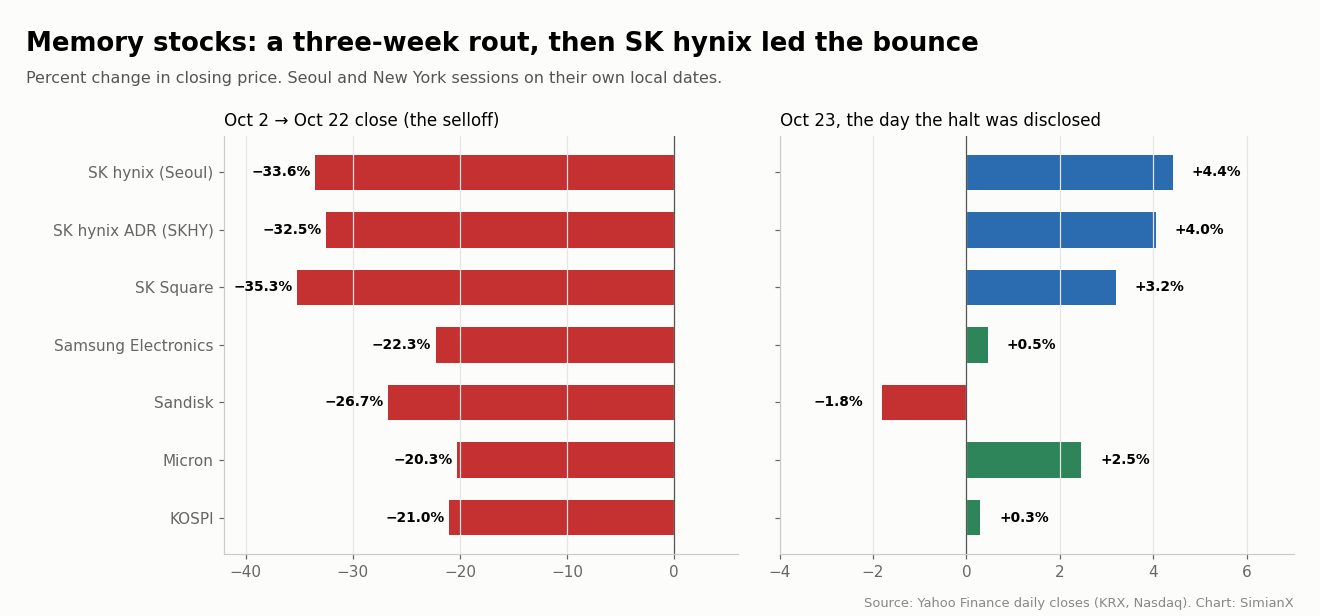
Between the October 2 close and the October 22 close, SK hynix fell 33.6%, SK square 35.3%, Samsung Electronics 22.3% and the KOSPI 21.0%. In New York, Sandisk fell 26.7% and Micron 20.3%. SK hynix's own Nasdaq ADSs closed at $131.69 on October 22, about 12% below the $149 they were sold at in July. That is the "share price trends" the company cited, and it made a new memory-sector IPO hard to price well.
2. Shareholders Objected to Dilution
SK hynix shareholders argued that a separate listing could create a valuation discount for the parent and dilute their indirect stake in Solidigm's future profits. SK hynix's own October 1 statement conceded the point in principle: it said any external financing would be compared with internal funding based on the effect on existing shareholders' economic value, and that the board would set out shareholder-protection measures for any concrete plan.
3. Regulators Said the Rules Applied
Korea's dual-listing guidelines, introduced in August 2026, require a parent's board to assess the impact on shareholders, prepare protection measures, communicate with shareholders, pass a board resolution and disclose it. On October 19, the governor of the Financial Supervisory Service told lawmakers the Solidigm plan violated those rules, and on October 22 the Financial Services Commission chairman said a U.S. listing fell under the guidelines, according to Seoul Economic Daily. Analysts quoted by the paper noted that Korean regulators would struggle to block an overseas listing directly, but the political pressure was obvious.
SK hynix's filing cites market conditions, not regulators. Both explanations can be true: the regulatory push raised the cost of proceeding at the same moment the market lowered the price.
How the Market Reacted
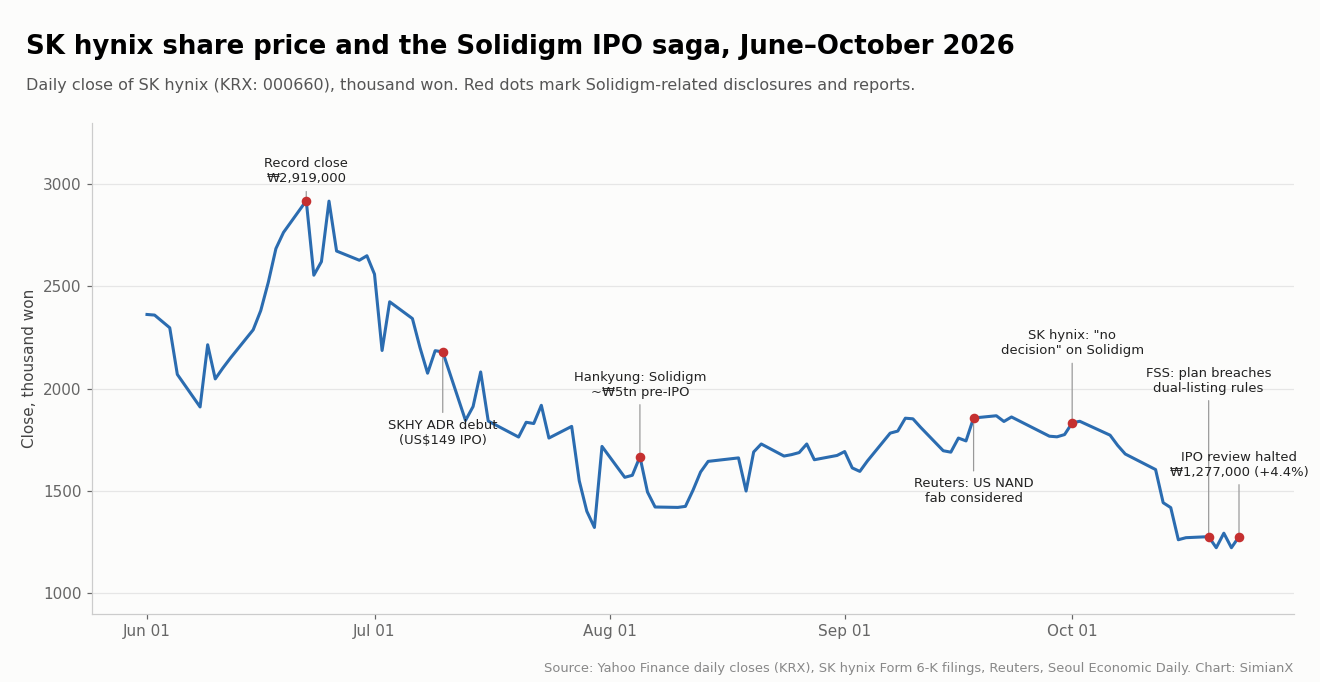
The halt was disclosed during the Seoul session on Friday, October 23. SK hynix opened lower, touched ₩1,171,000 (−4.3%), then reversed to close at ₩1,277,000, up 4.42%, while the KOSPI rose only 0.30% and Samsung Electronics 0.47%.
| Security | Oct 2 close | Oct 22 close | Oct 23 close | Oct 23 move | Oct 2 → Oct 22 |
|---|---|---|---|---|---|
| SK hynix (KRX: 000660) | ₩1,841,000 | ₩1,223,000 | ₩1,277,000 | +4.42% | −33.6% |
| SK hynix ADS (SKHY) | $195.13 | $131.69 | $137.02 | +4.05% | −32.5% |
| SK square (KRX: 402340) | ₩1,160,000 | ₩751,000 | ₩775,000 | +3.20% | −35.3% |
| Samsung Electronics (KRX: 005930) | ₩276,000 | ₩214,500 | ₩215,500 | +0.47% | −22.3% |
| Micron (MU) | $1,074.89 | $856.49 | $877.55 | +2.46% | −20.3% |
| Sandisk (SNDK) | $1,719.99 | $1,260.93 | $1,238.03 | −1.82% | −26.7% |
| KOSPI | 7,003.74 | 5,533.77 | 5,550.30 | +0.30% | −21.0% |
Two things stand out. First, SK hynix beat Samsung by about four percentage points on the day, which fits the reading that investors saw the cancellation as removing a dilution risk. Second, the bounce was small next to the damage: even after it, SK hynix was 56% below its record close of ₩2,919,000 on June 22, 2026. A one-day relief rally did not change the bigger picture of a sector-wide selloff. For how large memory and chip drawdowns have been historically, see every SOX crash since 1995, and for the Korean market's own history, the KOSPI crash comparison.
Does a Subsidiary IPO Destroy Shareholder Value?
Not automatically. The financing terms decide the outcome, and three different effects are often confused.
- Ownership dilution. When Solidigm issues new shares, SK hynix's percentage falls. But Solidigm also receives cash, and a smaller share of a better-funded business can be worth more.
- Economic dilution. This happens when the cash received is too little for the ownership given up, either because shares are sold cheaply or because the money earns poor returns.
- Parent-company discount. Investors may value the parent's stake below the subsidiary's market price because of overhead, taxes or uncertainty about how cash flows up the chain.
A simple example shows why the timing mattered. Suppose a subsidiary is worth $90 billion and raises $10 billion of new money. Its post-money value is $100 billion, new investors own 10%, and the parent's 90% is still worth $90 billion. No value is lost at that price. But if the business could reasonably be worth $140 billion and is sold at a $90 billion valuation because the market is weak, the 10% handed to new investors transfers far more future value than necessary.
The right question is whether the cash raised, and the returns it earns, compensate existing shareholders for what they give up. In a falling market that bar is harder to clear.
Why Solidigm Matters to SK Hynix
Solidigm is SK hynix's enterprise-SSD arm. SK hynix's prospectus says Solidigm uses its quad-level cell (QLC) NAND and SSD technology to offer "particularly high-end eSSDs," and that the Intel deal strengthened SK hynix in enterprise storage.
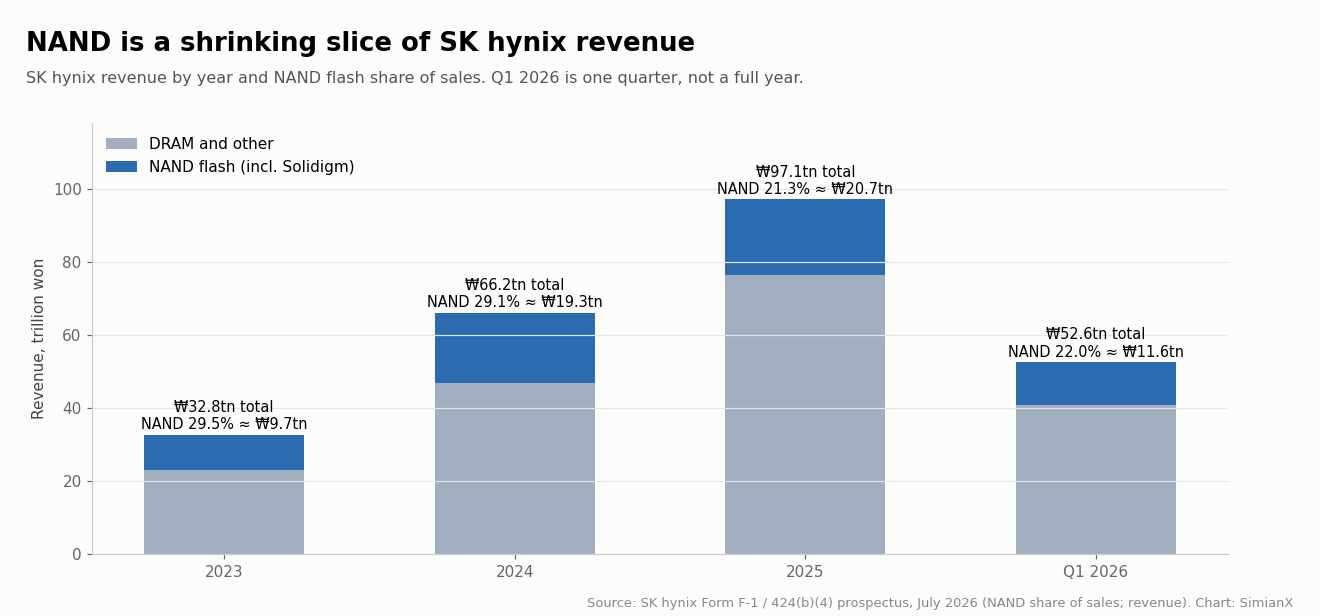
NAND, including Solidigm, has become a smaller share of SK hynix revenue as high-bandwidth memory took over, even though NAND sales roughly doubled in won terms between 2023 and 2025.
| Period | SK hynix revenue | NAND share of sales | Implied NAND sales |
|---|---|---|---|
| 2023 | ₩32.8 trillion | 29.5% | ≈ ₩9.7 trillion |
| 2024 | ₩66.2 trillion | 29.1% | ≈ ₩19.3 trillion |
| 2025 | ₩97.1 trillion | 21.3% | ≈ ₩20.7 trillion |
| Q1 2026 | ₩52.6 trillion | 22.0% | ≈ ₩11.6 trillion |
Source: SK hynix prospectus (July 2026). Implied NAND sales are SimianX arithmetic. SK hynix does not publish Solidigm's standalone revenue or profit in its earnings releases.
IDC ranked SK hynix, including Solidigm, as the second-largest NAND supplier with an 18.5% revenue share in the first quarter of 2026, according to the same prospectus. For the DRAM and HBM side of the business, and SK hynix's results quarter by quarter, see our SK Hynix earnings by quarter reference.
An enterprise SSD is more than NAND chips. It combines the controller, firmware, error correction, power-loss protection, thermal design and months of customer qualification. Hyperscale buyers pay for drives that behave predictably across huge fleets, which gives an established supplier some pricing power. It does not remove competition: customers qualify second sources, negotiate volume discounts and change architectures.
How AI Drives Enterprise SSD Demand
AI uses storage at several stages:
| AI activity | Storage need | What matters most |
|---|---|---|
| Training datasets | Large shared capacity | Sustained read bandwidth |
| Checkpointing | Periodic large writes | Write speed and recovery time |
| Retrieval-augmented generation (RAG) | Searchable document and vector stores | Retrieval latency |
| Inference context (KV cache offload) | Reusable model state | Access latency and endurance |
| Logs and generated data | Persistent history | Cost per terabyte and retention |
Solidigm argues in a technical brief that inference context is increasingly a flash-storage problem. An SSD is not GPU memory, and latency and bandwidth remain very different, but moving the right data to a cheaper tier can improve the economics of keeping expensive accelerators busy.
Industry forecasts point the same way. In its September 30 outlook, TrendForce projected enterprise SSD bit demand growth of more than 80% year over year in 2026 and NAND contract prices up 15–20% quarter over quarter in Q4 2026, with client SSD price increases limited by buyer inventory. These are forecasts, and bit growth measures volume, not revenue.
Why High-Capacity QLC Drives Matter
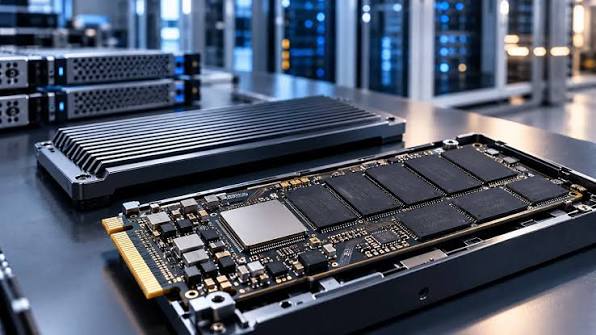
Solidigm's D5-P5336 offers capacities up to 122.88 TB for read-heavy workloads. QLC stores four bits per cell versus three for TLC, which raises density but brings trade-offs in write performance and endurance.
For a data center the comparison is total cost, not drive price:
Total storage cost = drives + servers + networking + power + cooling + software + operations
A pricier drive can still win if it reduces server count or keeps GPUs better fed. A write-heavy workload may still need a different drive. For investors, the moat depends on how reliably those system benefits turn into customer retention, pricing and cash flow.
The U.S. Factory and the Dalian Problem
Solidigm's only NAND production is in Dalian, China. That is the core of the expansion puzzle.
| Question | What is known (October 26, 2026) |
|---|---|
| Is a U.S. NAND fab planned? | Reuters reported on Sept 18 that Solidigm is weighing one, with upstate New York a leading candidate; no agreement reached; on Oct 29 SK hynix said Solidigm is reviewing ways to expand capacity and "no matters have been determined" (response to a Maeil Business report of about ₩60 trillion) |
| Cost | Not disclosed. Seoul Economic Daily cites tens of trillions of won for one fab and hundreds of trillions for a cluster |
| Timing | Not disclosed. New fabs typically take years |
| Dalian expansion | Reuters (Oct 14): Solidigm applied for a U.S. export license to add tools to unused "Mod B" space at Dalian |
| U.S. licensing | Reuters: the Commerce Department issued a 2026 license for Dalian that limited equipment quantities; no 2027 expansion license yet |
| SK hynix's position | Disputes reports that it made the U.S. fab conditional on Dalian approvals |
| China deal conditions | Five-year pricing and supply conditions from China's regulator, dating from December 2021, run through December 2026 |
The September Reuters report framed a U.S. plant as a way to reduce reliance on Dalian and limit exposure to tariffs and equipment export curbs. The October 14 report said SK hynix was seeking approval to send more U.S. tools to Dalian as part of the bargain; SK hynix disputed that characterization.
This creates two horizons. Near term, Solidigm needs economical capacity to meet orders. Longer term, it needs a footprint that survives changing trade policy. Raising outside equity before that path is clear would have meant investors funding a project whose cost and schedule could still change, which lowers the price they would pay.
Note that a NAND fab is not the same as SK hynix's advanced-packaging plant in Indiana, which is for high-bandwidth memory. An HBM packaging investment does not solve Solidigm's NAND supply needs.
How SK Hynix Could Fund Solidigm Without an IPO
SK hynix has not chosen a route. These are the realistic options:
| Funding route | Main advantage | Main cost or constraint |
|---|---|---|
| Parent cash and operating cash flow | Keeps 100% ownership | Competes with HBM, DRAM and shareholder returns |
| Corporate borrowing | No equity dilution | Interest and refinancing exposure |
| Project financing | Matches funding to the asset | Needs bankable contracts and protections |
| Customer prepayments | Ties capacity to demand | May require price or supply concessions |
| Strategic partner | Shares cost and risk | Shares control and future returns |
| Government incentives | Lowers project cost | Conditions, timing and eligibility |
| Phased build-out | Limits the first commitment | Delays available capacity |
The parent is not short of cash. SK hynix's Q2 2026 results showed ₩88 trillion of cash, ₩18.6 trillion of debt and ₩69.4 trillion of net cash at the end of June. Those are group figures, not Solidigm's own liquidity.
The real question is what else that cash is meant for. Since August, SK hynix has spent about ₩40.0 trillion buying back 23,693,272 of its own shares, which it plans to cancel on November 5, 2026, according to an October 26 Form 6-K. The same day it responded to a Dong-A Ilbo report of a special dividend of about ₩16 trillion funded by gains from selling its Kioxia stake: it said nothing is decided but that it plans to announce additional shareholder-return measures with its third-quarter results on October 28. Every won returned to shareholders is a won not available for a NAND fab, and vice versa. That trade-off, more than the cancelled listing, is what investors should watch.
What October 28 decided. SK hynix answered the shareholder-return question with its third-quarter results: about ₩100 trillion of returns for 2026 (at least ₩30 trillion of cash dividends and at least ₩60 trillion of buybacks and cancellations, including the ₩40 trillion already bought), a ₩20,000 third-quarter dividend, half of it a special dividend from Kioxia gains, and a new ₩20 trillion buyback running to January 28, 2027 (Form 6-K). It announced no budget for a Solidigm fab. The same quarter produced ₩83.3 trillion of operating profit on ₩104.6 trillion of revenue (Form 6-K), more than four-fifths of the whole 2026 payout in a single quarter, so cash is not the constraint; the order of priority between further buybacks and a NAND fab still has not been disclosed. Every quarter is tracked in our SK Hynix earnings by quarter reference.
What a New NAND Fab Has to Earn
A factory creates value only if its cash returns exceed its cost of capital over its life. The main variables are construction and equipment cost, ramp time, yield, utilization, cost per bit, qualification, selling prices, maintenance capex, taxes and incentives, and customer concentration.
A purely illustrative project costing $10 billion:
| Annual operating cash after ramp | Simple payback before maintenance capex |
|---|---|
| $1.0 billion | 10 years |
| $1.5 billion | 6.7 years |
| $2.0 billion | 5 years |
These are not Solidigm forecasts, and the exercise ignores construction delays and the time value of money. Its point is sensitivity: a fab that looks attractive at shortage-era prices can disappoint if competitors add supply by the time it ramps. TechInsights told Reuters that NAND pricing has risen about sevenfold since mid-2023, which is exactly the kind of starting point that flatters fab math.
Has AI Ended the NAND Cycle?
No. AI changes demand, but it does not abolish the supply response. When prices rise, every supplier invests, new process nodes add bits, and customers respond by compressing data, changing retention policies and moving cold data to cheaper tiers.
A useful model:
Revenue = bits shipped × realized price per bit
If bits grow while price per bit falls faster, revenue weakens. If manufacturing cost falls faster than price, margins improve anyway. The direction of AI adoption alone cannot settle those relationships, and investors who capitalize peak margins as permanent tend to overpay.
What Would $150 Billion Have Implied?
A reported valuation is a starting point for questions, not proof of value. Solidigm publishes no standalone financial statements, so the key inputs (revenue, normalized margins, cash conversion, debt allocation, intercompany pricing and capex needs) are all unknown to outside investors.
| Hypothetical sustainable net income | Implied P/E at $150 billion |
|---|---|
| $3 billion | 50× |
| $5 billion | 30× |
| $7.5 billion | 20× |
| $10 billion | 15× |
These are sensitivities, not earnings estimates. For comparison, the whole business cost SK hynix about $8.8 billion across the two closings. Historical cost does not set today's value, but the gap shows how much of a $150 billion figure would have rested on peak-cycle earnings and future factories.
What the Halt Means for SK Hynix Shareholders
The bull case. Cancellation helps if SK hynix avoids selling Solidigm cheaply, keeps all of its future earnings, funds capacity without excessive risk and discloses more about storage economics.
The bear case. It disappoints if it leads to slower capacity additions, lost orders, heavier borrowing, smaller shareholder returns or a fab that ramps after prices peak.
| Scenario | Operating path | Financing outcome | Shareholder implication |
|---|---|---|---|
| Bull | Enterprise demand stays strong; QLC economics improve | Expansion funded without selling equity cheaply | Full upside retained |
| Base | Demand grows but NAND prices normalize | Capacity added in phases | Growth with a heavy capex burden |
| Bear | Orders weaken or fab costs rise | Funding becomes more expensive | Lower cash returns despite AI exposure |
The announcement answers how capital will not be raised. Investors still need evidence about how capital will be spent.
Other Ways to Get NAND and Enterprise SSD Exposure
The halt changes sentiment, not competitors' orders. Listed alternatives, each with a different mix:
| Company | Listing | Storage exposure | Question to investigate |
|---|---|---|---|
| SK hynix | KRX: 000660; Nasdaq ADS: SKHY | Solidigm, NAND, DRAM, HBM | Can capital allocation protect returns? |
| Samsung Electronics | KRX: 005930 | NAND, DRAM, HBM, foundry, devices | Do enterprise products lift profitability? |
| Micron | Nasdaq: MU | DRAM, HBM, NAND, data-center SSDs | Is storage mix improving cash flow? |
| Sandisk | Nasdaq: SNDK | Flash and SSDs | How much growth is enterprise? |
| Kioxia | Tokyo Stock Exchange | NAND and SSDs | Are density and cost competitive? |
| Hard-drive makers | Nasdaq | High-capacity disk storage | Which workloads stay on disks? |
This is a research map, not a ranking. A diversified memory maker carries exposures unrelated to Solidigm. For deeper dives, see our Samsung Electronics stock and earnings history, Micron's HBM case and how Seagate earnings move storage stocks. Investors using SimianX AI can run a live analysis of any of these tickers and should still check every figure against company filings.
What to Watch Next
SK hynix reported Q3 2026 results on October 28, 2026: record revenue and operating profit, a ₩100 trillion shareholder-return plan and, on the call, a restated halt of the Solidigm IPO review. It gave no site, budget or schedule for Solidigm's expansion, and on October 29 it said in a Form 6-K that it will disclose more when details are confirmed or within one month. Five things still matter most:
- Shareholder returns. How the ₩100 trillion plan is carried out, and how much of the Kioxia gain goes into the annual dividend.
- Capex and NAND plans. Any site, budget, capacity target or schedule for Solidigm's expansion.
- Funding structure. Parent cash, borrowing, customers, partners or incentives.
- Demand quality. Enterprise SSD mix and evidence of real deployments rather than inventory building.
- Cash conversion. Operating profit versus operating cash flow, inventories and capex.
The call settled the payout question but not the three that matter most for Solidigm: what return a new fab must clear, how much spending is committed before customer demand is contracted, and what conditions would justify revisiting an IPO.
For other listings that stalled or changed course in 2026, see our Oura IPO status tracker and Anthropic and OpenAI IPO dates. More AI-market references are in the AI & markets topic hub.
FAQ About Solidigm Stock and the IPO
Is Solidigm a publicly traded company?
No. Solidigm is a wholly owned subsidiary of SK hynix and has no shares of its own on any exchange. On October 23, 2026, SK hynix disclosed that Solidigm had discontinued its review of a pre-IPO fundraising and an IPO.
What is Solidigm's stock symbol?
There is none. Searches for a "Solidigm stock price" or "Solidigm ticker" usually land on SK hynix, which trades as 000660 on the Korea Exchange and as SKHY American depositary shares on Nasdaq (one ADS equals one-tenth of a share).
Who owns Solidigm?
SK hynix owns 100% of Solidigm through its U.S. subsidiaries; the operating business has sat in Solidigm Inc. since March 1, 2026. SK hynix's largest shareholder is SK square, with 20.5% as of March 31, 2026.
Why did Solidigm halt its IPO?
SK hynix cited capital-market conditions and semiconductor share-price trends. The decision also followed shareholder objections to dilution and statements by Korea's Financial Supervisory Service and Financial Services Commission that a U.S. listing fell under the new dual-listing guidelines.
How much was the Solidigm IPO expected to raise?
No official terms existed. Media reports put the raise at $10–15 billion and the valuation at up to $150 billion, with a Nasdaq listing as early as 2027. An earlier pre-IPO round was reported at about ₩5 trillion.
How much did SK hynix pay Intel for Solidigm?
The headline price in 2020 was $9 billion. SK hynix's prospectus says it paid $6.6 billion in December 2021 and $2.2 billion in March 2025; Intel reported about $1.9 billion received at the second closing, net of adjustments.
Does the halt mean AI storage demand is weakening?
Not on its own. TrendForce still projects enterprise SSD bit demand growth above 80% in 2026, and SK hynix said Solidigm's investment needs are unchanged. The investment case still depends on pricing, costs and future supply.
Could Solidigm still go public later?
Possibly, but nothing is planned. CEO Kwak Noh-jung told analysts on October 28 that the review was halted because of financial-market volatility and the correction in chip stocks, and SK hynix said it will keep assessing the timing, scale and financing of Solidigm's growth. Any future listing would need to satisfy Korea's dual-listing guidelines, including board-approved shareholder protections.
Is Solidigm building a factory in the United States?
Not decided. Reuters reported in September that Solidigm was weighing a U.S. NAND fab, and on October 29 the Maeil Business Newspaper reported an investment of about ₩60 trillion. SK hynix replied in a Form 6-K that Solidigm is reviewing measures to strengthen its competitiveness and expand capacity, but that no matters have been determined, and promised a further disclosure when details are confirmed or within one month.
Conclusion: A Sensible Pause, If Discipline Follows
The Solidigm IPO halt is a choice about how to pay for growth. AI is creating real demand for high-capacity enterprise SSDs, and Solidigm is well placed in that market. But an IPO in October 2026 would have meant selling a slice of that future at a price set by a sector in freefall, against the objections of shareholders and regulators.
Keeping Solidigm protects that upside. It also leaves SK hynix accountable for the cost, timing and returns of whatever expansion comes next, now to be balanced against a shareholder-return plan of about ₩100 trillion for 2026.
The strongest signal will be a credible plan that links customer demand to profitable capacity and cash generation. The next checkpoint is the Solidigm capacity disclosure SK hynix promised within a month of October 29.
Related Reading
- SK Hynix Q3 2026 Earnings: 79.7% Margin, KRW100tn Payout
- Samsung Electronics Stock Price 2026: History and Earnings
- Semiconductor Bear Markets: Every SOX Crash, 1995–2026
- South Korea Stock Market Crash 2026 vs Every KOSPI Crash
- KOSPI Returns by Year: Every Year 1982–2026 (Table)
- Micron (MU): Why HBM3e Makes It the 2026 AI Memory Play
- Oura IPO Status: Delayed Since Sept 29, What the S-1 Shows
References
- SEC EDGAR — SK hynix Form 6-K: Solidigm discontinues pre-IPO and IPO review (October 23, 2026)
- SEC EDGAR — SK hynix Form 6-K: clarification of the ₩5 trillion pre-IPO report (August 6, 2026)
- SEC EDGAR — SK hynix Form 6-K: further clarification (September 4, 2026)
- SEC EDGAR — SK hynix Form 6-K: Q3 2026 conference call date (October 14, 2026)
- SEC EDGAR — SK hynix Form 6-K/A: treasury share cancellation, 23,693,272 shares (October 26, 2026)
- SEC EDGAR — SK hynix Form 6-K: response to special dividend report (October 26, 2026)
- SEC EDGAR — SK hynix ADS prospectus, Form 424(b)(4) (July 2026)
- SK hynix Newsroom — Solidigm to discontinue IPO review (October 23, 2026)
- SK hynix Newsroom — clarification on Solidigm media reports (October 1, 2026)
- SK hynix Newsroom — Q2 2026 business results
- SK hynix Newsroom — Q3 2026 earnings conference call invitation
- Intel Newsroom — first closing of the NAND and SSD sale to SK hynix (December 29, 2021)
- Intel — Form 8-K on the second closing (March 27, 2025)
- Seoul Economic Daily — SK hynix withdraws Solidigm's U.S. IPO plan after regulators push back
- Bloomberg — SK Hynix pulls Solidigm's $10 billion IPO on regulatory pushback
- Taipei Times — SK Hynix cancels IPO of Solidigm unit
- Reuters via Investing.com — Solidigm weighs a U.S. NAND factory (September 18, 2026)
- Reuters via Investing.com — Dalian equipment and the U.S. factory (October 14, 2026)
- Tom's Hardware — SK hynix response to the Dalian report
- Blocks & Files — SK hynix reportedly looking at a U.S. float for Solidigm (July 2024)
- TrendForce — Q4 2026 memory price outlook (September 30, 2026)
- Solidigm — D5-P5336 specifications
- Solidigm — AI inference is a flash storage problem (technical brief)
- Yahoo Finance — SK hynix (000660.KS) historical prices
- SEC EDGAR — SK hynix Form 6-K: preliminary Q3 2026 results (October 28, 2026)
- SEC EDGAR — SK hynix Form 6-K: FY2026 shareholder-return plan (October 28, 2026)
- SEC EDGAR — SK hynix Form 6-K: Solidigm capacity review, response to Maeil Business report (October 29, 2026)
- CNBC — SK Hynix Q3 2026 results and earnings call (October 28, 2026)