 By Muke
Elice IPO: a Day-One Drop, a Day-Two Limit-Up and How Korean AI IPOs Have Traded Since 2025
Quick answer: Elice (KOSDAQ: 0158S0) priced its IPO at ₩90,500, the top of its ₩70,400–₩90,500 range, after a 408-to-1 retail subscription and a 388.84-to-1 institutional book. On its debut on October 20, 2026 it opened at ₩75,700, fell as low as ₩56,500 and closed at ₩61,500, down 32.04% — the sixth-worst first day among 37 Korean IPOs in 2026. The next day it closed at the daily upper limit of ₩79,900 (+29.92%), still 11.7% below the offer price, and on the morning of October 22 it traded above the offer price for the first time, reaching ₩99,900. Of the ten AI-related Korean IPOs since January 2025 tracked below, seven traded below their offer price on October 20, 2026.
The Elice IPO delivered a sharp warning to investors in AI data center stocks: extraordinary subscription demand does not guarantee a successful listing, and rapid revenue growth does not automatically justify a premium valuation.
The South Korean AI infrastructure company priced its shares at ₩90,500, the top of its offering range, after attracting roughly 408 times retail demand. On October 20, 2026, the shares closed at ₩61,500, down 32.04% from the offering price, on a day when the KOSDAQ index fell 3.33%.
The next session moved the other way. On October 21, Elice hit the daily upper limit of ₩79,900 about ten minutes after the open, up 29.92% from its first closing price — the maximum one-day gain Korean rules allow. It closed at that limit, still approximately 11.7% below the IPO price. On the morning of October 22 it climbed above the offer price for the first time, reaching an intraday high of ₩99,900 (+10.4% vs the offer) by 10:00 KST.
Both moves matter. The first exposed a gap between private offering expectations and public market pricing. The second showed how quickly limited trading supply and changing sentiment can move a newly listed stock.
This SimianX AI research examines the financial question behind those price swings: Can Elice generate sufficient cash returns from its GPU infrastructure to justify its valuation and fund its next expansion? It also puts the debut in context with a reference table of every AI-related Korean IPO since 2025.
The evidence supports a selective conclusion. Elice has a growing business and reported operating profits. Its IPO also illustrates the risks of customer concentration, heavy equipment spending and valuations built around EBITDA.
Research date: October 22, 2026 (Korea time). October 20 and 21 prices are closing prices; October 22 prices are intraday (as of 10:00 KST), not a confirmed close. Financial calculations below are identified as historical comparisons or illustrative assumptions.
Source: MoneyToday’s October 21 trading report
Elice IPO at a Glance: The Price Tape
Elice trades on South Korea’s KOSDAQ under the code 0158S0. It raised approximately ₩201.1 billion, equivalent to about US$151 million at the exchange rate used in contemporary reporting, by selling 2,222,000 newly issued shares. At the offer price, its market capitalization was about ₩1.005 trillion.
| Event | Share price | Change from IPO price |
|---|---|---|
| IPO price (top of the ₩70,400–₩90,500 range) | ₩90,500 | — |
| October 20 opening trade | ₩75,700 | −16.35% |
| October 20 intraday high | ₩77,700 | −14.14% |
| October 20 intraday low | ₩56,500 | −37.57% |
| October 20 close | ₩61,500 | −32.04% |
| October 21 opening trade | ₩69,500 | −23.20% |
| October 21 close at the upper limit (reached about 10 minutes after the open) | ₩79,900 | −11.71% |
| October 22 intraday high (as of 10:00 KST) | ₩99,900 | +10.39% |
The stock therefore opened below the offer price before suffering additional selling. About 5.9 million shares changed hands on the first day, more than two and a half times the 2.22 million shares sold in the offering.
An investor allocated shares in the IPO experienced a different return from an investor buying at the opening trade. From ₩75,700 to ₩61,500, the opening-to-close decline was approximately 18.8%.
The distinction also matters when assessing the rebound. Recovering from ₩61,500 to the ₩90,500 offering price would require a gain of approximately 47.2%. A decline of 32% cannot be reversed by an equal percentage increase because the recovery begins from a smaller base. Even from the ₩79,900 limit close, a further 13.3% gain was needed to get back to the offer; the stock covered that on the morning of October 22.
The market backdrop was hostile. The KOSDAQ index closed at 781.97 on October 20, down 3.33% on the day and 15.0% below its October 6 close of 919.92, after a 7.65% single-day drop on October 15.
Sources: Elice’s offering announcement, Reuters’ initial trading report, ZDNet Korea’s closing report, MoneyToday’s subsequent trading update
How Korea’s First-Day Price Limits Shaped the Move
Korean IPOs trade under a special price band on the first day. Since June 26, 2023, a newly listed stock’s base price is simply its offer price, and on listing day it may trade anywhere from 60% to 400% of that price. From the second day on, the normal ±30% daily limit applies, measured from the previous close.
| Rule | What it meant for Elice |
|---|---|
| First-day floor: 60% of the offer price | ₩54,300. The ₩56,500 intraday low came within ₩2,200 of it. |
| First-day ceiling: 400% of the offer price | ₩362,000. Never in play. |
| Day-two limit: ±30% from the previous close | ₩61,500 × 1.3 = ₩79,950, rounded down to the ₩100 tick: ₩79,900. |
Two consequences follow. A first-day drop of 32% is a large fraction of the 40% maximum loss the band allows. And the October 21 rebound was mechanically capped: buyers who wanted more stock at higher prices could not trade above ₩79,900 that day. The same rule produced the opposite extreme for MakinaRocks in May 2026, which opened and closed its first day at exactly 400% of its offer price (the maximum, known in Korea as ttadabul).
Source: Financial News on the June 26, 2023 rule change
Korean AI IPOs 2025–2026: Day One vs Today
How unusual was Elice’s debut? The table below lists the ten Korean IPOs since January 2025 whose core business is AI software, AI chips or AI infrastructure, with first-day results and the latest close.
| Company | Listed | Offer price | Day-1 close | Day-1 vs offer | Close Oct 20, 2026 | vs offer | vs peak close |
|---|---|---|---|---|---|---|---|
| Wisenut | Jan 24, 2025 | ₩17,000 | ₩10,800 | −36.5% | ₩5,040 | −70.4% | −73.8% |
| LG CNS (KOSPI) | Feb 5, 2025 | ₩61,900 | ₩55,800 | −9.9% | ₩67,600 | +9.2% | −53.0% |
| Neurophet | Jul 25, 2025 | ₩14,000 | ₩20,300 | +45.0% | ₩6,100 | −56.4% | −83.4% |
| Nota | Nov 3, 2025 | ₩9,100 | ₩31,000 | +240.7% | ₩15,070 | +65.6% | −73.3% |
| Acryl | Dec 16, 2025 | ₩19,500 | ₩67,000 | +243.6% | ₩14,010 | −28.2% | −79.1% |
| SemiFive | Dec 29, 2025 | ₩24,000 | ₩27,650 | +15.2% | ₩15,020 | −37.4% | −69.2% |
| MakinaRocks | May 20, 2026 | ₩15,000 | ₩60,000 | +300.0% | ₩16,400 | +9.3% | −79.0% |
| StradVision | Jun 30, 2026 | ₩12,000 | ₩7,200 | −40.0% | ₩2,465 | −79.5% | −65.8% |
| Neosapience | Sep 21, 2026 | ₩10,000 | ₩36,900 | +269.0% | ₩7,920 | −20.8% | −78.5% |
| Elice | Oct 20, 2026 | ₩90,500 | ₩61,500 | −32.0% | ₩61,500 | −32.0% | — |
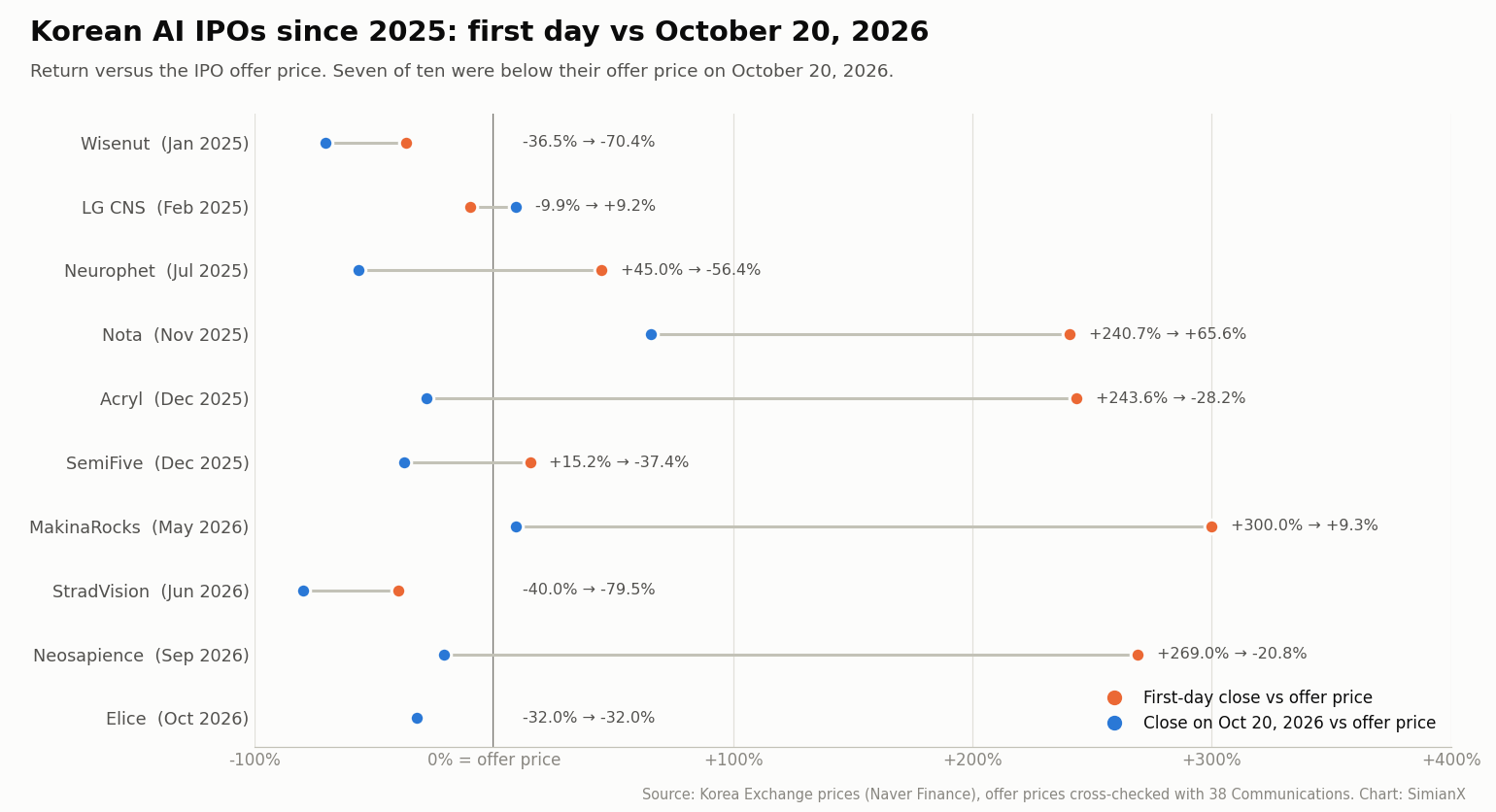
What the companies do: Wisenut (AI chatbot and search software), LG CNS (IT services, AI and cloud; listed on the KOSPI, all others on the KOSDAQ), Neurophet (brain-imaging AI software), Nota (AI model compression and optimization), Acryl (AI platform software), SemiFive (custom AI chip design), MakinaRocks (industrial AI software), StradVision (vision AI for vehicles), Neosapience (AI voice generation) and Elice (AI education plus GPU cloud and modular data centers).
Four patterns stand out:
- The median first day was a gain of about 30%; the median position on October 20, 2026 was a loss of about 30%. Seven of the ten traded below their offer price on that date.
- The four biggest first-day winners all gave most of it back. Nota, Acryl, MakinaRocks and Neosapience each closed their first day at least 240% above the offer price; each was more than 70% below its peak close by October 20. Neosapience fell from ₩36,900 to ₩7,920 in less than a month.
- A weak first day was not a buying signal either. Wisenut and StradVision, the two debuts that fell further than Elice on day one, were down another 53% and 66% from their first closes by October 20.
- Elice is the only one of the four first-day losers whose second session hit the upper limit. Wisenut rose 4.8% on its second day, LG CNS 3.4%, and StradVision fell another 18.9%. Elice’s later path is not yet part of the record.
These are price histories, not forecasts. The group is small, it lists only companies whose main business is AI, and its weakest stretch coincides with the October 2026 slide in the KOSDAQ.
Where Elice Ranks Among 2026 Korean IPOs
Across the 37 Korean IPOs in 2026 through October 20 (excluding SPACs and REITs), the median first-day close was about 45% above the offer price, and 10 of the 37 closed their first day below it. Elice’s −32.04% was the sixth-largest first-day decline of the year. The five larger ones were StradVision (−40.0%, June 30), Hatchtech (해치텍, −39.4%, August 25), Jincostech (진코스텍, −38.5%, October 15), PeacePeace Studio (피스피스스튜디오, −36.1%, June 8) and Kido Industry (기도산업, −34.6%, August 21).
Sources: News1 on the 2026 ranking, 38 Communications IPO listing results
How Could the Elice IPO Fall Despite 400× Demand?
The apparent contradiction becomes clearer once the subscription figures are defined.
Retail investors applied for 226,737,440 shares against an allocation of 555,500 shares, a quarter of the offering. That produces a subscription ratio of roughly 408 to one. In the earlier book-building, 2,367 institutions bid at a ratio of 388.84 to one, and the price was set at the top of the range.
Retail subscription deposits reached approximately ₩10.26 trillion.
Those deposits were application funds. They were not the amount raised by Elice, and they were not a commitment to buy the same shares after listing. The company raised approximately ₩201.1 billion before offering expenses.
Source: Newspim’s report of Elice’s subscription results
Several mechanisms explain why a heavily subscribed offering can still decline.
Allocation requests can exceed investors’ intended holdings
When investors expect small allocations, they may request substantially more shares than they ultimately want to own. The subscription ratio measures applications relative to a limited allocation.
It does not establish the price investors will accept once shares trade freely.
A listing gain may be the investment thesis
Some applicants participate because they expect an immediate price increase. If the shares open below the offer price, that thesis fails.
Investors who originally appeared to represent strong demand can become sellers at the same time.
The market can change between pricing and listing
Elice’s offering price was fixed before trading began. Changes in peer valuations, financing conditions and risk appetite can make an agreed offering price look expensive by the listing date. Between the end of book-building on October 1 and the listing on October 20, the KOSDAQ fell about 13%, and Korean press tied the debut-day selling to a fresh round of doubts about the profitability of US neocloud operators such as CoreWeave.
Demand must persist at the next available price
A successful IPO requires willing buyers after allocated investors begin selling. Subscription statistics provide limited information about that continuing demand.
An oversubscribed order book describes the allocation process. A durable share price requires continuing demand supported by business value.
What Business Does Elice Actually Operate?
Elice began in 2015 with coding education and expanded into AI training platforms, enterprise AI solutions and cloud infrastructure.
Today, its business spans two broad areas:
- AI transformation and education: learning platforms, assessments, enterprise AI applications and implementation services.
- AI cloud and infrastructure: GPU computing, infrastructure software and modular AI data centers.
The infrastructure offering includes Elice Cloud Infrastructure, or ECI, and the company’s Portable Modular Data Center, or PMDC.
Elice’s cloud platform supports reserved, on-demand and spot GPU access. Its public product materials list NVIDIA GPU generations including A100, H100, B200 and B300.
This combination gives Elice several possible revenue sources: renting compute, supplying infrastructure, operating customer environments and selling related software or services.
Investors need to distinguish those sources. Hardware delivery, project implementation and recurring cloud usage can have very different margins, cash requirements and customer retention.
A company described broadly as an “AI data center stock” may therefore contain businesses with substantially different economics.
Sources: Elice’s company overview, Elice’s GPU cloud product information
What Is a Neocloud?
A neocloud is a cloud provider focused heavily on AI computing, particularly GPU infrastructure.
These companies typically compete through computing performance, hardware availability, specialized software, support or pricing. Their business models differ from broad cloud platforms such as AWS, Microsoft Azure and Google Cloud, which offer extensive databases, enterprise software and application services.
Elice belongs in this discussion because its growth increasingly depends on AI infrastructure. Its education and enterprise application activities, however, make it an imperfect comparison with a company focused almost entirely on GPU rentals.
What Makes Elice’s Modular Data Center Strategy Interesting?
Elice’s PMDC approach packages computing, networking, power and cooling equipment into prefabricated modules.
The company markets deployment in approximately 12 weeks, subject to the relevant site and infrastructure conditions. It also advertises liquid cooling and power usage effectiveness around 1.1, and in its IPO announcement it claimed the approach cut initial infrastructure cost by up to 40%.
These are company claims and product specifications. They should not be treated as independently verified performance across every installation.
A modular design can nevertheless have practical advantages. Standardized equipment can reduce construction complexity, support incremental expansion and bring capacity online more quickly.
Source: Elice’s PMDC product specifications
What Does a PUE of 1.1 Mean?
Power usage effectiveness, or PUE, compares total facility electricity consumption with electricity used by computing equipment.
At a PUE of 1.1, a facility consuming 1 megawatt for IT equipment uses approximately 1.1 megawatts overall. The additional 0.1 megawatts supports cooling and other facility functions.
Lower overhead can improve operating economics. It does not measure customer utilization, revenue, financing costs or investment returns.
Can a Twelve-Week Build Solve the Power Bottleneck?
A module can be manufactured and installed quickly after essential conditions are met. Grid access, permits, land, transformers and contracted customers may take considerably longer.
For investors, the meaningful date is when infrastructure becomes available for billable customer workloads.
A rapid manufacturing cycle is valuable, but returns depend on the full development schedule.

Is Elice Profitable?
Yes, at the operating level in its reported first-half results — and that is a recent change.
Elice’s pre-IPO disclosures and Korean press reports give the following figures:
| Financial measure | First half of 2025 | Full year 2025 | First half of 2026 |
|---|---|---|---|
| Revenue | ₩11.4 billion | ₩39.5 billion | ₩34.4 billion |
| Operating profit (loss) | (₩3.6 billion) | ₩5.2 billion | ₩10.3 billion |
| EBITDA | — | — | ₩23.2 billion |
| Calculated operating margin | Loss | Approximately 13.2% | Approximately 29.9% |
| Calculated EBITDA margin | — | — | Approximately 67.4% |
First-half revenue roughly tripled (+202%), and six months of 2026 operating profit already exceeded the whole of 2025. The company rounded its EBITDA margin to approximately 68%.
These figures show that Elice’s valuation was supported by more than projected revenue. The business had already reported meaningful operating earnings.
The key issue is how repeatable those earnings will be as its infrastructure and customer base expand.
Sources: Elice’s September IPO presentation announcement, ChosunBiz on full-year 2025 results, EToday on first-half 2025 comparisons
Why Is the EBITDA Margin So Much Higher Than the Operating Margin?
The difference between ₩23.2 billion of EBITDA and ₩10.3 billion of operating profit is approximately ₩12.9 billion.
Korean financial reporting identified first-half depreciation of ₩12.9 billion, already more than the prior full-year level. This is substantial relative to Elice’s revenue and reflects the equipment intensity of the business.
Depreciation spreads the cost of infrastructure over its estimated useful life. It is noncash in the reporting period, but the company still had to acquire the equipment and may eventually need to replace it.
For an AI infrastructure operator, EBITDA offers useful information about operations before depreciation. It provides an incomplete picture of the cash available to shareholders.
How Much of First-Half Revenue Came From Prepaid Government Contracts?
This is the detail most debut-day coverage skipped. Elice collected cash in advance for government GPU leasing work and recognizes it as revenue as the service is delivered. The balance of those advances (contract liabilities) moved as follows:
| Date | Contract liabilities |
|---|---|
| End of 2024 | ₩1.5 billion |
| End of 2025 | ₩30.5 billion |
| End of June 2026 | ₩11.4 billion |
About ₩23.0 billion of advance payments was recognized as revenue in the first half of 2026 — roughly two-thirds (about 67%) of the ₩34.4 billion reported for the period. The cash for that revenue arrived mostly in 2025.
Two implications follow. First, the first-half profit surge drew heavily on prepaid government work, so it says less about recurring commercial demand than the headline growth rate suggests. Second, the advance balance has been drawn down; repeating the result requires new prepaid contracts or new customers.
Source: EToday’s analysis of Elice’s securities filing
What Does Capital Spending Reveal About Elice’s Earnings?
Reported first-half purchases of property and equipment were approximately ₩41.3 billion, compared with EBITDA of ₩23.2 billion.
That produces two useful comparisons:
- Equipment purchases were approximately 1.8 times EBITDA.
- Equipment purchases exceeded EBITDA by approximately ₩18.1 billion.
This difference is not a calculation of free cash flow. A proper cash-flow analysis must include operating cash flow, working capital, taxes, financing arrangements and the timing of equipment payments.
It does demonstrate why a high EBITDA margin cannot settle the investment case.
Pre-IPO reporting also placed Elice’s June 2026 current ratio at approximately 52.3%, down from about 267% at the end of 2023, and its borrowings at about 28.7% of total assets. The subsequent equity raise changes the liquidity picture, so those historical ratios should not be presented as the company’s post-IPO position.
Source: EToday’s analysis of Elice’s securities filing
How Should Investors Separate Growth Spending From Replacement Spending?
Some equipment purchases create additional capacity. Others preserve the competitiveness of existing capacity.
The distinction matters:
- Growth capex may create future revenue.
- Maintenance and replacement capex sustain existing earnings.
- Technology upgrades may perform both functions.
For GPU operators, an asset can remain technically functional while earning lower rental rates because newer hardware offers better performance.
Investors therefore need estimates of cash generation over the equipment’s economic life, including its residual value. Assuming that current EBITDA can continue indefinitely without further investment would overstate shareholder returns.
How Much Does Elice Depend on Government-Related Demand?
Customer concentration is one of the clearest risks.
ChosunBiz reported that approximately ₩22.5 billion, or 65.6%, of first-half 2026 revenue was related to South Korea’s National IT Industry Promotion Agency, or NIPA.
The comparable figure for 2025 was ₩13.4 billion, about 34% of revenue. Government-related demand therefore became more important as the business expanded.
The same report noted that Elice’s IPO valuation applied an average EV/EBITDA multiple of approximately 27.13 times, taken from US cloud and data center peers including CoreWeave and DigitalOcean. A small company with concentrated revenue that only recently shifted toward infrastructure deserves careful comparison with larger, more diversified operators.
Source: ChosunBiz’s pre-IPO valuation analysis
Government programs can provide valuable revenue, procurement credibility and access to research customers. Elice’s public announcements confirm participation in several such initiatives.
For example, Elice was selected as one of the suppliers of H100 and B200 GPU capacity for the 2026 National AI Data Center Advancement Project run by AICA, the Gwangju Artificial Intelligence Industry Cluster Agency. The company described the agreement as running from May through December 2026.
That is evidence of commercial activity. It also illustrates why investors must examine contract duration and renewal conditions.
Source: Elice’s AICA supplier announcement
Does Government Demand Make Revenue Safer?
It may reduce some payment risks, but it introduces other dependencies.
Revenue can be affected by budget appropriations, procurement schedules, supplier selection and the decision to renew a program. A broad group of end users may still depend economically on one government-funded purchasing arrangement.
The strongest evidence of diversification would be rising private-sector revenue alongside continued public-sector business.
A falling government revenue percentage caused by lost contracts would be much less encouraging.
Why Do Customer Prepayments Matter?
As the contract-liability table above shows, government GPU payments were received in advance and recognized as revenue as services were delivered.
Prepayments can support investment and reduce financing needs. They also mean cash collection and revenue recognition occur in different periods.
Investors should track contract liabilities, renewals and new advance payments alongside reported profit. Otherwise, an increase in accounting revenue may be mistaken for an equal increase in current-period cash receipts.
Is Elice Cheap After Falling 32%?
A large decline creates a lower price. Whether it creates good value depends on the earnings and cash flows available at that price.
The offer-price market capitalization of about ₩1.005 trillion implies roughly 11.11 million shares outstanding. On that basis, the first-day close implies an equity value around ₩683 billion, and the October 21 limit price of ₩79,900 implies about ₩888 billion.
The following calculations use rounded public financial figures. Annualized first-half results simply double six months of performance; they are not company guidance, and the prepaid-revenue share described above makes simple annualization especially optimistic.
| Equity valuation measure | At ₩90,500 IPO price | At ₩61,500 first close | At ₩79,900 day-two limit |
|---|---|---|---|
| Approximate market capitalization | ₩1.005 trillion | ₩683 billion | ₩888 billion |
| Market cap / 2025 revenue of ₩39.5B | 25.5× | 17.3× | 22.5× |
| Market cap / annualized H1 revenue of ₩68.8B | 14.6× | 9.9× | 12.9× |
| Market cap / annualized H1 operating profit of ₩20.6B | 48.8× | 33.2× | 43.1× |
The operating-profit comparison is neither a P/E ratio nor EV/EBIT. It excludes the adjustments needed for those measures and is presented only as a scale check.
Even at the first-day closing price, Elice still required substantial future growth to support its valuation.
Sources for offering size and capitalization: Newspim; historical revenue and operating profit: ChosunBiz. Multiples are author calculations.
Why Avoid a Precise Post-IPO EV/EBITDA Estimate?
Enterprise value requires a consistent, updated balance sheet, including cash, borrowings and relevant lease liabilities.
Elice’s gross IPO proceeds materially affect that calculation. Offering expenses, subsequent investment and financing also matter.
A headline enterprise multiple assembled from pre-IPO debt and post-IPO equity could create false precision. The next financial disclosure will provide a stronger basis.
What Does the IPO Cash Actually Change?
The offering consisted entirely of newly issued shares, so the capital goes to Elice before expenses rather than to selling shareholders.
That is a meaningful positive. The company gained funding for infrastructure expansion even though its market price subsequently declined.
The share-price loss did not remove the IPO proceeds from its bank account.
However, the money is intended largely for investment. Elice has described plans to expand regional edge AI data centers in Korea, mainly outside the Seoul metropolitan area, and to pursue overseas business through markets including the United States, Japan and Singapore.
Expansion can create value if equipment is deployed into profitable demand. It can also increase financial risk if capacity is built before customers commit.
Source: Elice’s stated expansion strategy
For SimianX AI readers comparing infrastructure investments, a useful discipline is to distinguish cash already available, capital contractually committed and funding still required. Each answers a different question about the next phase of growth.
How Sensitive Are GPU Cloud Returns to Utilization and Pricing?
GPU infrastructure has significant fixed costs. Small changes in occupancy or rental pricing can therefore produce much larger changes in profit.
Consider this hypothetical example, which does not represent Elice’s disclosed utilization or cost structure:
| Assumption | Starting case | Stress case |
|---|---|---|
| Billable utilization | 80% | 65% |
| Realized rental-price index | 100 | 80 |
| Revenue index | 100 | 65 |
| Fixed cash operating costs | 50 | 50 |
| Variable costs, proportional to usage | 20 | 16.25 |
| Cash operating contribution | 30 | −1.25 |
Revenue falls to 65% of the starting level because:
(65% ÷ 80%) × 80% = 65%
Despite continued customer usage, a combination of lower utilization and lower pricing eliminates the illustrative cash operating contribution.
This simplified example excludes depreciation, interest, taxes and replacement equipment. Including those costs would raise the required return further.
What Would Improve the Economics?
Stronger operators can protect returns through longer commitments, minimum payments, customer prepayments, efficient scheduling, better networking and valuable software.
Elice offers both reserved and spot capacity. Its spot service can help monetize otherwise idle equipment, while reserved contracts provide more visibility.
The relevant disclosure is the revenue mix and margin generated by each arrangement. Higher usage obtained through large discounts may produce less value than lower usage at attractive contracted rates.
Source: Elice’s descriptions of reserved, on-demand and spot services
What Does Elice Mean for CoreWeave and Nebius?
Elice’s debut is relevant to listed AI cloud providers, including CRWV and NBIS, because investors are examining similar questions about infrastructure investment and returns — and because CoreWeave was one of the peers used to price the Elice IPO.
The companies nevertheless have different customers, funding arrangements, geographic footprints and asset bases.
CoreWeave: Strong Growth Can Coexist With Heavy Financing Costs
CoreWeave’s second-quarter 2026 release reported:
- Revenue of $2.575 billion
- Adjusted EBITDA of $1.510 billion
- An operating loss of $49 million
- Net interest expense of $640 million
- A net loss of $626 million
Those figures illustrate the distance between EBITDA and earnings attributable to shareholders. Large-scale operations can generate substantial EBITDA while depreciation and financing costs absorb the benefit. The backlog-versus-debt trade-off is covered in more detail in CoreWeave Stock 2026: $100B AI Backlog vs Debt Risk.
The comparison does not imply that Elice has CoreWeave’s debt structure. It demonstrates why an EBITDA-based valuation requires a careful financing analysis.
Source: CoreWeave’s Q2 2026 results (SEC filing)
Nebius: Liquidity Must Be Compared With Investment Commitments
Nebius reported $8,042.1 million of cash and cash equivalents at June 30, 2026.
Its shareholder letter described approximately $5.7 billion of second-quarter capital expenditures and said it expects more than $9 billion of customer prepayments during 2026.
These figures show why a cash balance alone cannot establish financial safety. Investors must compare available liquidity with spending commitments, debt and the timing of customer payments.
Nebius also disclosed that it now uses a five-year useful life for server and network equipment, up from the four years used before 2026. Depreciation assumptions therefore deserve attention when comparing reported profits across cloud companies.
Sources: Nebius’s Q2 2026 financial review (SEC filing), Q2 shareholder letter
Is This a Warning for Every AI Data Center Stock?
The warning applies most directly to businesses that must finance expensive computing equipment and recover that investment through future rentals.
Different parts of the industry carry different risks:
| Business model | Examples | Main economic exposure |
|---|---|---|
| GPU cloud providers | Elice, CoreWeave, Nebius | Utilization, rental pricing, equipment replacement and financing |
| Colocation operators | Equinix, Digital Realty | Development costs, leasing, customer credit and debt |
| Power and cooling suppliers | Vertiv, Eaton | Orders, manufacturing execution and customer investment cycles |
| Semiconductor suppliers | NVIDIA, AMD | Product competitiveness, demand and supply-chain execution |
| Diversified cloud platforms | Amazon, Microsoft, Alphabet | Capital allocation, utilization and returns across large businesses |
The examples identify business models, not investment recommendations.
A GPU cloud provider may benefit from falling equipment prices when acquiring new capacity while suffering from lower rental rates on equipment it already owns.
A cooling supplier may earn revenue during construction before the operator proves its investment return. A colocation company may hold valuable long-lived facilities while leaving GPU ownership to its tenants.
Applying the same valuation multiple to all these companies would obscure those differences.
Are Other IPO Problems Supporting the Warning?
Yes. Australia’s Firmus, an Nvidia-backed AI data center operator, withdrew its proposed listing on October 9, 2026, citing market conditions, after investors questioned the terms. Reuters also reported that planned listings linked to AirTrunk and SB Energy had been pulled or paused.
Elice therefore arrived during a more selective funding environment. However, the difficulties of individual offerings cannot establish a sector-wide collapse in AI demand.
Source: iTnews (Reuters) on Firmus’s withdrawn offering
Does Rising AI Demand Still Support the Industry?
Yes, but demand growth and shareholder returns must be assessed separately.
The International Energy Agency’s updated outlook projects global data center electricity consumption rising from approximately 485 TWh in 2025 to roughly 950 TWh in 2030. Its central projection expects electricity use by AI-focused facilities to grow faster than the overall data center market.
The IEA also identifies bottlenecks in electricity infrastructure, equipment and grid connections.
Source: IEA, Key Questions on Energy and AI
Those projections support continued demand for computing and energy infrastructure. They do not determine which operator will earn an adequate return.
A growing market can still produce poor equity investments if:
- Too much capacity is financed at high valuations.
- Competitive pricing falls faster than costs.
- Customers move toward more efficient hardware.
- Debt matures before investments generate cash.
- Companies issue additional shares to complete construction.
Efficient models and cheaper inference can expand AI usage while reducing the revenue earned per unit of computation. The investment result depends on whether additional volume compensates for those price changes.
Does the October 21 Limit-Up Change the Thesis?
It changes the entry price substantially. It provides little new information about operating performance.
At ₩79,900, Elice had recovered much of its first-day loss, although it remained below the offering price. Investors buying at the limit were paying almost 30% more than those buying at the previous close. By the morning of October 22 it was trading above the offering price.
A rebound can reflect improved market sentiment, bargain buying, limited available shares and changing expectations. Korean press attributed the October 21 move to a broader rebound in risk appetite. Establishing the contribution of each factor requires trading and ownership data.
The record of the AI IPOs in the table above is a caution here: MakinaRocks also rose 30% on its second day, to its peak close of ₩78,000, and was 79% below that level five months later.
It should not be assumed that the rebound confirmed the IPO valuation or resolved the questions about customer concentration.
Equally, the first-day decline did not establish that Elice’s technology lacked value.
The operating evidence will arrive through revenue disclosures, contract renewals, utilization, equipment spending and cash generation.
What Would Make Elice an Attractive Investment?
The bullish case rests on converting a technically credible platform into repeatable commercial returns.
Several developments would strengthen it.
Private-Sector Revenue Grows Consistently
Elice needs customers whose spending extends beyond individual government programs. Enterprise contracts would provide stronger evidence that its services compete on commercial value.
Modular Deployment Improves Investment Payback
Faster construction creates value when it leads to earlier customer payments and lower total investment per unit of profitable capacity.
Software Supports Better Margins
Infrastructure software, deployment tools and secure environments could improve retention and differentiation. Investors should look for evidence in pricing, customer renewals and recurring revenue.
Expansion Has Funding Before Construction Begins
Customer commitments and appropriately structured financing can reduce the risk of building unused capacity.
Cash Flow Catches Up With Accounting Profit
A business can reasonably consume cash while expanding. Over time, investors need evidence that mature installations generate enough cash to support replacements and contribute to growth.
What Would Make Elice a Value Trap?
The bearish case is that current profits reflect a favorable phase of government-funded usage while future infrastructure requires more investment than investors expect.
Warning signs would include:
- Weak private-sector adoption
- Reduced government commitments
- More revenue without stronger cash collection
- Falling GPU rental rates
- Repeated equity issuance
- Rising financing costs
- Delayed power connections
- Shorter economic lives for equipment
- Expansion targets unsupported by customer contracts
A declining share price would not by itself make those risks acceptable. The investment case would need a lower valuation and stronger evidence of durable cash generation.
Bull, Base and Bear Scenarios
| Scenario | Business outcome | Financial implication | Evidence to monitor |
|---|---|---|---|
| Bull | Public contracts continue and enterprise demand expands | Higher utilization and better returns on new modules | Private revenue, renewals and cash conversion |
| Base | Government business remains important; commercial diversification is gradual | Growth continues with substantial reinvestment | Funding runway, contract duration and capex discipline |
| Bear | Renewals weaken or GPU pricing declines as capacity expands | Margins and liquidity deteriorate | Idle equipment, lower pricing and additional financing |
These are analytical scenarios, not price targets.
The IPO price should not be treated as fair value, and the first closing price should not be treated as a guaranteed floor.
For comparisons with US-listed AI infrastructure companies such as CoreWeave, NVIDIA and AMD, SimianX AI offers a starting point for organizing stock research, and a live analysis session can track them in real time. Elice’s Korean disclosures and original contract information remain essential to assessing Elice itself.
What Should Investors Check Before Buying?
A practical review should follow this sequence:
- Reconstruct revenue quality. Separate public procurement, private enterprise, cloud usage, hardware deliveries and implementation services.
- Review contract terms. Identify duration, minimum payments, cancellation rights, service obligations and renewal dates.
- Reconcile earnings to cash. Compare operating profit, EBITDA, operating cash flow, equipment purchases and financing payments.
- Map available funding. Update cash and debt after the IPO, then deduct committed investment.
- Check equipment assumptions. Review depreciation lives, residual values and replacement requirements.
- Measure commercial utilization. Track billable usage and realized pricing by hardware generation where disclosed.
- Review tradable supply. Examine institutional commitments, shareholder lockups and potential option dilution.
- Stress-test the valuation. Test slower growth, lower pricing, delayed deployment and reduced renewal rates.
If a key item is unavailable, it should remain an uncertainty in the model. Substituting the most optimistic assumption can make an apparently attractive valuation unreliable. Elice’s filings, including its securities registration statement, are available on DART, and exchange disclosures on KIND.
FAQ About the Elice IPO and AI Data Center Stocks
Why did the Elice IPO fall despite more than 400 times demand?
The subscription figure referred to the retail allocation. It did not guarantee continuing demand after trading began. Investors also reassessed valuation, infrastructure spending and the sector’s financing risks, and the KOSDAQ fell 3.33% on the listing day.
How far did Elice fall on its first day?
It opened at ₩75,700, traded as low as ₩56,500 (−37.57%) and closed at ₩61,500, down 32.04% from the ₩90,500 offer price — the sixth-largest first-day decline among 2026 Korean IPOs.
Is Elice profitable or still losing money?
Elice reported ₩10.3 billion of operating profit on ₩34.4 billion of revenue in the first half of 2026, after an operating loss a year earlier. Its ₩23.2 billion EBITDA was higher because depreciation was added back. About two-thirds of first-half revenue came from recognizing government GPU payments received in advance. Neither measure alone establishes free cash flow.
Did Elice recover after its first-day decline?
On October 21, the shares hit the daily upper limit of ₩79,900, up 29.92% from the first-day close. At that price, they remained approximately 11.7% below the ₩90,500 offering price. They closed at that limit. On the morning of October 22 the shares traded above the offering price for the first time, reaching ₩99,900 by 10:00 KST; that is an intraday price, not a close.
What is the price limit for a new listing in Korea?
On the first day, a Korean IPO can trade between 60% and 400% of its offer price. From the second day, the standard ±30% daily limit applies.
How have other Korean AI IPOs performed?
Of the ten AI-related Korean IPOs since January 2025 in the table above, the median first-day close was about 30% above the offer price, but seven of the ten traded below their offer price on October 20, 2026.
Does Elice prove that AI data centers are in a bubble?
One IPO cannot establish that conclusion. The debut does show that investors are questioning the prices and funding requirements of some infrastructure businesses. AI demand can continue growing while individual companies deliver disappointing returns.
What matters most when valuing GPU cloud stocks?
Contract quality, billable utilization, realized pricing, equipment economics and funding requirements matter most. EBITDA should be assessed alongside operating profit, cash flow, debt and replacement investment.
Conclusion: A Warning About Investment Returns
Elice’s 32% debut decline is a meaningful warning for AI infrastructure investors. The company entered public markets with strong subscription demand, rapid growth and operating profits, yet buyers quickly challenged the offering valuation.
The subsequent limit-up makes the lesson more useful. Sentiment can move a newly listed stock dramatically in both directions while leaving its contracts, equipment and cash requirements largely unchanged. The record of Korea’s other recent AI listings shows how far apart the first days and the following months can be.
Elice has credible strengths: modular infrastructure, cloud software, public-sector references and fresh equity funding. Its valuation still depends on commercial diversification, durable GPU demand and attractive returns on substantial reinvestment.
For the wider sector, the right response is to examine each business model carefully. A profitable cooling supplier, a colocation landlord and a debt-funded GPU operator have different exposures even when all benefit from AI spending.
Elice belongs on a research watchlist for investors willing to study those details. A convincing purchase case requires evidence that future cash generation can support the price paid.
Explore SimianX AI to develop comparisons across listed AI infrastructure companies, then test the thesis against original filings, contract terms and capital commitments. The strongest opportunities will be companies that translate growing AI usage into lasting value per share.
How this page is updated: the Korean AI IPO table uses closing prices as of October 20, 2026 and will be refreshed as new AI companies list in Korea. Prices come from Korea Exchange trading data as shown on Naver Finance; since March 2025 those daily closes can include after-hours Nextrade trades and may differ from the official KRX close by a few won (for Elice the official ₩61,500 close is used). IPO offer prices and first-day closes were cross-checked against 38 Communications. This page is analysis, not investment advice.
Related Reading
- Unitree Stock (688836): The 460% IPO Pop, Then Halved
- CoreWeave Stock 2026: $100B AI Backlog vs Debt Risk
- South Korea Stock Market Crash 2026 vs Every KOSPI Crash
- Samsung Electronics Stock Price 2026: History and Earnings
- SK Hynix Stock Surges 8%: Is the AI Supercycle Real?
- Anthropic IPO and OpenAI IPO: Date, Valuation, Latest Status
- AI Capex 2026: Big Tech Now Spends 96% of Its Cash Flow
- Nasdaq Up, Most Stocks Down: Narrow Rally Days 2019–2026
- SMCI Stock 2026: $7B Capital Raise vs $39B AI Backlog
- NVIDIA-IREN 2026: The $2.1B 5GW AI Factory Power Trade
- Every Tech Bubble Since 1929: How AI in 2026 Compares
- Newcleo NWCL Debut: $8.145 Close vs $10 SPAC Price, Decoded
- More analysis in the AI & markets topic hub
References
- Elice — KOSDAQ IPO announcement: offering terms, H1 2026 results (September 30, 2026)
- Elice — KOSDAQ listing application and expansion plans
- Elice — PMDC modular data center specifications
- Elice — ECI GPU cloud: reserved, on-demand and spot
- Elice — AICA 2026 National AI Data Center Advancement Project supplier (June 16, 2026)
- Newspim — Elice retail subscription results (October 2026)
- ZDNet Korea — Elice first-day close (October 20, 2026)
- News1 — Elice first-day decline and 2026 ranking (October 20, 2026)
- MoneyToday — Elice hits the upper limit on day two (October 21, 2026)
- Reuters via MarketScreener — Elice shares tumble in IPO debut (October 20, 2026)
- EToday — Elice securities filing: depreciation, capex, contract liabilities
- ChosunBiz — Elice valuation peers and NIPA revenue share (September 28, 2026)
- ChosunBiz — Elice debut and full-year 2025 results (October 20, 2026)
- Financial News — Korea’s 60–400% first-day price band (June 2023)
- 38 Communications — Korean IPO listing results (offer price, opening price, first-day close)
- Naver Finance — Elice (0158S0) quote and daily prices
- KIND (Korea Exchange) — company disclosures
- DART (Financial Supervisory Service) — securities filings
- SEC EDGAR — CoreWeave Q2 2026 earnings release
- SEC EDGAR — Nebius Q2 2026 operating and financial review
- Nebius — Q2 2026 shareholder letter
- iTnews — Nvidia-backed Firmus shelves IPO (October 2026)
- IEA — Key Questions on Energy and AI
- NIPA — National IT Industry Promotion Agency
- Investopedia — EBITDA